


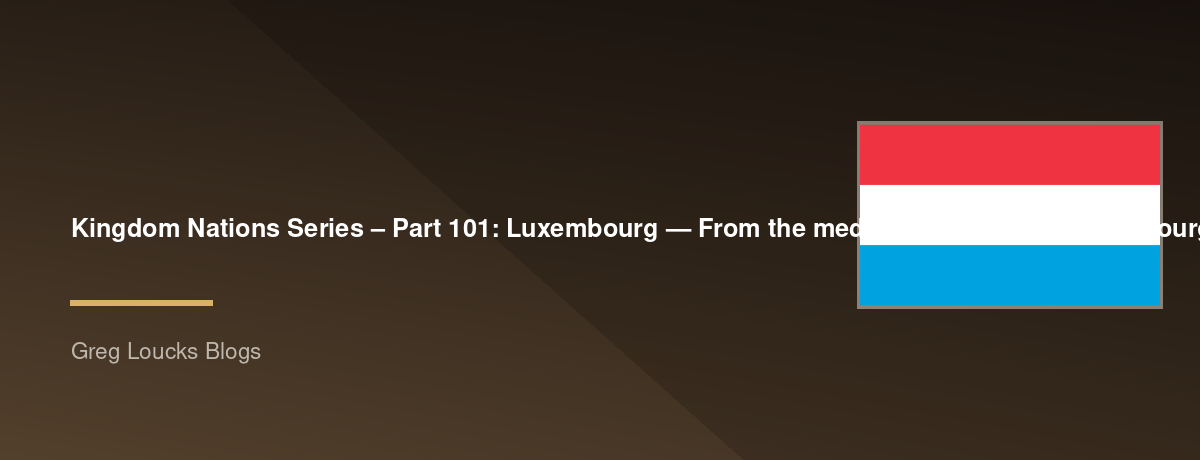
🌎 Kingdom Nations Series – Part 101: 🇱🇺 Luxembourg — From the medieval fortress of Luxembourg and the House of Luxembourg through the Holy Roman Empire, the Burgundian and Habsburg worlds, Spanish and French rule, independence, the Grand Duchy, industr
🌎 Kingdom Nations Series – Part 102 🇱🇺 Chapter 1 – Part 1 Luxembourg: The Grand Duchy at the Heart of Europe Ancient Celtic and Roman Lands, the Fortress of Luxembourg, the House of Luxembourg, the Holy Roman Empire, Burgundian and Habsburg Rule, French Occupation, Independence, Steel, European Integration, Finance, Catholic Heritage, and Luxembourg's Kingdom Role in Europe "The LORD is my rock, and my fortress, and my deliverer." — Psalm 18:2 Introduction Luxembourg is one of Europe's smallest nations. Yet its influence has been extraordinarily large. It is: A Grand Duchy. A constitutional monarchy. A founding member of European integration. A Germanic-speaking country. A multilingual society. A historic Catholic land. A former fortress state. A center of European institutions. A major financial center. A nation shaped by the House of Luxembourg. And one of the wealthiest countries in the world. Luxembourg's story is therefore a story of: fortresses. dynasties. war. industry. faith. diplomacy. integration. wealth. And: European unity. Where Is Luxembourg? Luxembourg is located in: Western Europe It borders: Belgium to the west and north. Germany to the east. France to the south. It is completely: landlocked. A Small Country Luxembourg covers approximately: 2,586 square kilometers It is one of Europe's smallest sovereign states. Luxembourg City The capital is: Luxembourg City The city sits dramatically above deep: Valleys. Gorges. River valleys. Fortifications. The Alzette and Pétrusse Two important waterways flow through the capital: Alzette and: Pétrusse Their deep valleys helped make Luxembourg City an exceptionally defensible location. The Fortress Luxembourg City became famous for its: fortifications Gibraltar of the North For centuries, Luxembourg was regarded as one of Europe's great fortress cities. Its strategic importance earned it the nickname: "Gibraltar of the North." Why Luxembourg? The location lies near the intersection of: France. Germany. Belgium. The Low Countries. This made the territory strategically valuable. Ancient Luxembourg Before the modern state existed, the region was inhabited by: Celtic peoples. The Treveri The: Treveri were an important Celtic people in the region. Their territory extended across parts of modern: Luxembourg. Belgium. Germany. France. Roman Luxembourg Rome conquered the region. It became part of the: Roman Empire Roman Roads Roman roads connected the region to major centers throughout: Gaul. Germania. The Rhine world. Roman Civilization Roman influence introduced: Urban organization. Roads. Trade. Law. Administration. Christianity eventually also entered the wider region. Christianity Arrives Christianity spread throughout Roman Gaul and the surrounding regions. Medieval Christianity After the collapse of Roman political authority, Christianity remained central to the emerging medieval societies of the region. Churches and monasteries became centers of: Worship. Education. Agriculture. Writing. Community life. The County of Luxembourg The medieval political identity of Luxembourg developed around a fortified settlement. Siegfried A major figure in Luxembourg's early history was: Siegfried 963 In: 963 Siegfried acquired the fortified site that became associated with: Luxembourg Castle Lucilinburhuc The name is traditionally associated with: Lucilinburhuc often interpreted as something like: "little fortress." The Birth of Luxembourg The fortress became the foundation around which the medieval territory developed. Luxembourg Castle The original fortress stood on a strategically powerful rocky promontory. Over the centuries it became: A castle. A fortress. A military complex. A symbol of the nation. The County Luxembourg became a county within the political world of the: Holy Roman Empire The Holy Roman Empire The Holy Roman Empire consisted of a complex collection of: Kingdoms. Duchies. Counties. Principalities. Free cities. Church territories. Luxembourg became part of this political world. The House of Luxembourg The dynasty that eventually became the: House of Luxembourg rose to extraordinary prominence. From County to European Power The dynasty produced: Counts. Dukes. Kings. And: Holy Roman Emperors. Henry VII One of the greatest Luxembourg rulers was: Henry VII Holy Roman Emperor Henry VII became: Holy Roman Emperor in: 1312 Luxembourg Dynasty The Luxembourg dynasty produced several major European rulers during the fourteenth century. John the Blind Another famous Luxembourg ruler was: John the Blind King of Bohemia John became: King of Bohemia Charles IV John's son: Charles IV became one of medieval Europe's most important rulers. Charles IV Charles became: King of Bohemia and: Holy Roman Emperor Prague Charles IV transformed: Prague into one of Europe's major cultural and political centers. Charles Bridge The famous: Charles Bridge in Prague is associated with the reign of Charles IV. Charles University Charles also founded: Charles University in Prague in: 1348 It became one of Europe's oldest universities. The Golden Bull Charles IV issued the: Golden Bull of 1356 which established important constitutional rules for electing the Holy Roman Emperor. Luxembourg's Dynasty The House of Luxembourg therefore influenced: Central Europe. Germany. Bohemia. Italy. The Holy Roman Empire. The Grand Duchy Modern Luxembourg's status as a: Grand Duchy developed later. Burgundian Rule Luxembourg eventually became associated with the: Burgundian Netherlands Philip the Good The Burgundian dynasty expanded its influence over the Low Countries. Luxembourg became part of this wider political world. Habsburg Rule Through dynastic inheritance, Luxembourg eventually entered the orbit of the: Habsburgs The Habsburg Netherlands Luxembourg became part of the: Habsburg Netherlands Charles V The Habsburg emperor: Charles V ruled an enormous collection of European and overseas territories. Spanish Netherlands After the division of Habsburg possessions, Luxembourg became associated with the: Spanish Netherlands France Luxembourg repeatedly became a battlefield between: France. Spain. The Habsburgs. The Netherlands. Louis XIV The French king: Louis XIV captured Luxembourg during the wars of the late seventeenth century. Vauban The famous French military engineer: Sébastien Le Prestre de Vauban strengthened Luxembourg's fortifications. French Fortress Under French control, Luxembourg became even more heavily fortified. The War of the Spanish Succession Luxembourg eventually returned to Habsburg control following the: War of the Spanish Succession Austrian Netherlands The territory became part of the: Austrian Netherlands The French Revolution The French Revolution transformed the political order of Europe. French Annexation In: 1795 French forces occupied and annexed Luxembourg. French Department Luxembourg became part of the French administrative system. Napoleon During the Napoleonic era, Luxembourg remained integrated into the French Empire. Napoleonic Wars The fortress remained strategically important. Napoleon's Defeat After Napoleon's defeat, Europe was reorganized. Congress of Vienna The: Congress of Vienna met in: 1814–1815 to reorganize Europe after Napoleon. Grand Duchy of Luxembourg Luxembourg was elevated to the status of: Grand Duchy William I The territory was placed under: William I of the Netherlands Personal Union Luxembourg became connected to the Kingdom of the Netherlands through a: personal union The German Confederation Luxembourg also became a member of the: German Confederation Federal Fortress The fortress at Luxembourg became part of the defensive system of the German Confederation. The Fortress Garrison Prussian troops were stationed at Luxembourg. This reinforced its importance as a military stronghold. The Luxembourg Crisis In: 1867 a major international crisis developed over Luxembourg. Napoleon III French Emperor: Napoleon III wanted to acquire Luxembourg. Prussia Prussia opposed the sale. International Crisis The dispute threatened war between: France. and: Prussia. Treaty of London The: Treaty of London of: 1867 resolved the crisis. Neutrality Luxembourg became: permanently neutral Demolition of the Fortress The fortress was largely dismantled. The military structures that had defined Luxembourg City for centuries were gradually removed. From Fortress to Nation This was a major transformation. Luxembourg began moving from: military stronghold toward: modern nation-state. Independence Luxembourg's relationship with the Netherlands changed dramatically during the nineteenth century. Belgian Revolution In: 1830 Belgium revolted against the Netherlands. Luxembourg was caught in the conflict. Partition The territory was eventually divided. The western portion became part of: Belgium and the remaining eastern territory became the modern: Grand Duchy of Luxembourg Treaty of London The final territorial settlement was established through international agreements. Luxembourg's Borders The modern country emerged as a compact state between: Belgium. Germany. France. Luxembourgish Language Modern Luxembourg has three official languages: Luxembourgish French German Luxembourgish Luxembourgish belongs to the: West Germanic language family. It developed from regional Moselle Franconian dialects. A National Language Luxembourgish became an important symbol of national identity. Multilingualism Luxembourg's multilingual culture reflects its position between: Germanic Europe. and: French-speaking Europe. French French is important in: Government. Law. Business. Administration. German German remains important in: Media. Education. Culture. Luxembourgish Identity The country's national identity developed partly through: Language. Neutrality. Dynastic continuity. European cooperation. Catholic Luxembourg Luxembourg has historically been overwhelmingly: Roman Catholic Catholic Heritage Catholicism shaped: Family life. Schools. Church architecture. Festivals. Political culture. Community institutions. Notre-Dame Cathedral The: Notre-Dame Cathedral in Luxembourg City is one of the country's most important religious buildings. The Cathedral The cathedral began as a: Jesuit church. It later became the cathedral of Luxembourg. Marian Devotion The cathedral is strongly associated with: Our Lady Consoler of the Afflicted Consoler of the Afflicted The: Notre-Dame de Luxembourg tradition became an important pilgrimage devotion. Pilgrimage The annual pilgrimage known as the: Octave is one of Luxembourg's major Catholic traditions. The Octave Pilgrims come to Luxembourg City to honor: Mary. Catholic Social Life The Church historically played important roles in: Education. Charity. Healthcare. Family support. Community life. Christianity and the Nation Luxembourg's Christian heritage is deeply embedded in the country's history. But modern Luxembourg has become increasingly: Secular. Secularization Church attendance and formal religious identification have declined. The Challenge of Heritage Luxembourg faces the same question as much of Europe: How does Christian heritage become living faith rather than merely cultural memory? Industrial Revolution Luxembourg's economic transformation accelerated during the: nineteenth century Iron Ore The discovery and exploitation of: iron ore transformed Luxembourg. Minette The iron-rich southern region became known as: Minette Steel Iron ore supported the development of: steel production The Steel Industry Luxembourg became one of Europe's major steel-producing regions. ARBED One of the country's most important industrial companies was: ARBED Industrialization Steel transformed: Cities. Employment. Infrastructure. Population. Wealth. Southern Luxembourg The southern region became strongly industrialized. Esch-sur-Alzette The city of: Esch-sur-Alzette became a major industrial center. Steel and National Wealth For generations, steel was the foundation of Luxembourg's economy. From Steel to Finance During the twentieth century, Luxembourg diversified. Banking Luxembourg developed into an important: international financial center Investment Funds The country became especially important for: Investment funds. Asset management. Private wealth. Cross-border finance. Financial Regulation Luxembourg developed specialized legal and financial structures that attracted international institutions. European Financial Center Luxembourg became one of Europe's major financial hubs. The Challenge of Wealth As with Liechtenstein, financial prosperity creates a Kingdom question: How should wealth be stewarded? Money Money can serve: Families. Businesses. Nations. Charities. Missions. But money can also become: An idol. Jesus and Wealth Jesus repeatedly warned against allowing wealth to become a substitute for God. Stewardship Christian stewardship means: Honest business. Fair treatment. Generosity. Transparency. Responsible investment. Care for the vulnerable. World War I Luxembourg was invaded by: Germany during: World War I Neutrality Violated Despite its neutrality, German forces occupied Luxembourg. World War II Luxembourg was invaded again by Germany in: 1940 German Occupation Nazi Germany annexed Luxembourg into the Reich. Resistance Luxembourg developed a resistance movement. General Strike In: 1942 a major general strike erupted against German attempts to impose Nazi policies. Nazi Repression The occupation brought: Arrests. Executions. Deportations. Forced labor. Germanization. Luxembourgish Jews Luxembourg's Jewish community suffered terribly under Nazi persecution. Many were deported and murdered. Holocaust Luxembourg participated in the wider European catastrophe of the: Holocaust Memory Modern Luxembourg remembers the victims of Nazi persecution. Liberation Luxembourg was liberated by Allied forces in: 1944 Grand Duchess Charlotte One of the most important figures in Luxembourg's twentieth-century history was: Grand Duchess Charlotte Charlotte She became grand duchess in: 1919 and remained a major symbol of national unity during the Second World War. Exile During Nazi occupation, the government and grand ducal family operated from exile. Voice of the Nation Grand Duchess Charlotte used radio broadcasts to encourage Luxembourg's people. National Symbol She became associated with: Freedom. Resistance. Continuity. National identity. Postwar Europe After World War II, Luxembourg took a dramatically different approach to European politics. European Integration Luxembourg became one of the founding participants in the project of: European integration Robert Schuman One of the central figures of European integration was: Robert Schuman Schuman and Luxembourg Schuman was born in: Luxembourg and later became a major French statesman. The Schuman Declaration In: 1950 Schuman proposed a new European framework for cooperation. Coal and Steel The first major European integration project centered on: coal and: steel European Coal and Steel Community The: European Coal and Steel Community was established in: 1951 Luxembourg's Role Luxembourg became one of the founding members. Why Coal and Steel? The idea was revolutionary: France and Germany would place strategic industrial resources under common institutions. The goal was to make another European war: materially more difficult. From War to Cooperation Luxembourg therefore became part of one of history's great political transformations: former enemies becoming partners. European Institutions Luxembourg City became the home of important: European Union institutions. European Court of Justice The: Court of Justice of the European Union is based in Luxembourg. European Investment Bank The: European Investment Bank is headquartered in Luxembourg. European Institutions Luxembourg hosts several major European institutions and offices. The European Union Luxembourg remains one of the central countries of the: European Union A Founding Nation Luxembourg's contribution to European integration is remarkable considering its tiny population. Schengen One of the most famous European agreements is associated with: Schengen a village in southeastern Luxembourg. Schengen Agreement The: Schengen Agreement was signed in: 1985 on a boat on the Moselle River near Schengen. Open Borders The Schengen system eventually became the foundation of passport-free travel across much of Europe. Luxembourg and European Unity Luxembourg therefore played a role in: Peace. Free movement. Economic integration. European institutions. A Bridge Nation Luxembourg sits between: Germanic. French. and broader European cultures. It can therefore function as a: bridge. The Moselle The: Moselle River forms part of Luxembourg's border with Germany. Vineyards The Moselle Valley is famous for: Vineyards. Wine. Villages. River landscapes. Luxembourg Wine The region produces: White wines. Sparkling wines. Traditional varieties. Rural Luxembourg Beyond the capital and industrial south, Luxembourg contains: Forests. Farms. Villages. Castles. River valleys. Ardennes Northern Luxembourg forms part of the: Ardennes Mullerthal The: Mullerthal region is famous for: Rock formations. Forests. Hiking trails. Little Switzerland Mullerthal is sometimes called: "Little Switzerland." Castles Luxembourg has numerous medieval castles. Vianden Castle One of the country's most famous is: Vianden Castle Vianden The castle rises dramatically above the town of: Vianden Medieval Heritage The castle reflects Luxembourg's medieval identity. Modern Luxembourg Today Luxembourg is: A parliamentary democracy. A constitutional monarchy. A Grand Duchy. A member of the European Union. A founding European state. The Grand Duke The head of state is: Grand Duke Guillaume who became grand duke in: 2025 Grand Duke Guillaume The monarchy continues the dynastic tradition of the House of Nassau-Weilburg. The Prime Minister Government is led by a: Prime Minister within Luxembourg's parliamentary system. Democracy Luxembourg has: Parliamentary elections. Political parties. Independent institutions. Rule of law. Economy Modern Luxembourg's economy includes: Finance. Technology. Logistics. Industry. European institutions. Services. Technology Luxembourg has invested heavily in: Digital infrastructure. Space technology. Fintech. Cybersecurity. Research. Space Resources Luxembourg has become an important European center for: space-resource research and: space technology Satellite Industry The country has developed significant capabilities in: Satellite communications. Space technology. Research. SES The Luxembourg-based company: SES became a major global satellite operator. Small Nation, Global Technology Again, Luxembourg demonstrates: small territory does not mean small influence. Population Luxembourg has a highly international population. A large proportion of residents are: Foreign nationals. Multicultural Society People from across Europe and the world live and work in Luxembourg. European Workplace The country is one of Europe's most internationally connected societies. Languages in Daily Life Residents may move between: Luxembourgish. French. German. English. Portuguese. and other languages. Portuguese Community Luxembourg has a particularly large: Portuguese community. Migration Migration has been central to Luxembourg's economic development. Christian Mission in a Multicultural Nation Luxembourg's international population creates a unique ministry opportunity. Churches can reach: French speakers. German speakers. Portuguese speakers. English speakers. Africans. Europeans. Asians. and many others. International Christianity Christian communities in Luxembourg include: Catholics. Protestants. Evangelicals. Orthodox Christians. Other traditions. Catholicism Catholicism remains the largest historic Christian tradition. Protestantism Protestant communities have also developed. Evangelical Christianity Evangelical churches serve increasingly international communities. Orthodox Christianity Eastern Orthodox communities reflect Luxembourg's international population. Christian Unity Luxembourg's diversity creates an opportunity for: Prayer. Cooperation. Evangelism. Discipleship. European Mission Because European institutions are concentrated in Luxembourg City, the country has an unusual international mission field. Diplomats International diplomats live and work there. European Officials European officials and professionals come from across: Europe. Business Leaders Global business leaders also operate in Luxembourg. The Gospel in the European Capital A small nation can become a place where: many nations meet. The Kingdom Opportunity Luxembourg's strategic Kingdom opportunity is therefore not primarily its: Size. Military. Population. It is its: connections. The Gospel and Europe Luxembourg can become a place where Christians from different nations pray together for: Europe. Peace. Justice. Revival. Reconciliation Luxembourg's history teaches reconciliation. The same continent that produced: Wars. Occupation. Persecution. can produce: Cooperation. Coal and Steel The European project began partly by placing: Coal. Steel. under shared institutions. The Gospel asks an even deeper question: Can human hearts be reconciled? France and Germany Luxembourg sits between two historic European powers: France. Germany. Former Enemies European integration transformed their relationship. The Gospel of Reconciliation Christianity teaches: Reconciliation with God. Reconciliation with one another. The Cross At the Cross: Hostility can be overcome. Forgiveness becomes possible. Enemies can become brothers and sisters. Luxembourg as a Symbol Luxembourg can symbolize: peace through cooperation. The Fortress and the European Union Luxembourg City was once one of Europe's great fortresses. Today it hosts European institutions. That transformation is extraordinary. From Fortress to Forum The city moved from: defending against Europe to: helping build Europe. From Walls to Bridges The old fortress represented: Walls. The European project represents: Bridges. Kingdom Perspective The Kingdom of God also breaks down walls. Jesus creates: One people. One family. One kingdom. Catholic Heritage and Renewal Luxembourg possesses a deep Christian heritage. The challenge is: renewal. Heritage Is Not Enough A cathedral can survive. A pilgrimage can survive. A Christian festival can survive. But the question remains: Does faith live in the heart? The Next Generation The Church must reach: Children. Teenagers. University students. Professionals. Immigrants. Families. Digital Evangelism Luxembourg's advanced digital infrastructure creates opportunities for: Online Bible study. Christian podcasts. Digital discipleship. Multilingual Scripture. Prayer networks. Business and Mission Christian businesspeople can influence: Finance. Technology. Law. European institutions. Investment. Entrepreneurship. Financial Stewardship Luxembourg's wealth can support: Missions. Education. Humanitarian work. Church planting. Bible translation. Poverty relief. The Poor Even wealthy nations contain: Loneliness. Homelessness. Addiction. Family breakdown. Isolation. Spiritual hunger. Wealth Does Not Eliminate Need Material prosperity cannot replace: Meaning. Community. Forgiveness. Hope. God. The Gospel The Gospel speaks to the wealthy and the poor. It offers: Grace. Truth. Purpose. Redemption. Prayer for Luxembourg Pray: For Grand Duke Guillaume. For the government. For the prime minister. For parliament. For the people of Luxembourg. For Catholic Christians. For Protestant Christians. For Evangelical Christians. For Orthodox Christians. For priests. For pastors. For missionaries. For Christian families. For children. For young people. For universities. For European institutions. For European leaders. For diplomats. For business leaders. For financial institutions. For integrity in finance. For responsible wealth. For entrepreneurs. For technology leaders. For space researchers. For immigrants. For Portuguese communities. For French speakers. For German speakers. For Luxembourgish speakers. For Christian unity. For evangelism. For discipleship. For revival. For European peace. For reconciliation between nations. For the protection of religious freedom. For the poor and vulnerable. For families. For mental and spiritual wellbeing. For Luxembourg's witness throughout Europe. Luxembourg Before the Throne Luxembourg has been: A Roman land. A medieval county. A fortress. A duchy. A Habsburg territory. A French territory. A member of the German Confederation. A neutral state. A Grand Duchy. A founding European nation. Yet It Remains The political structures changed. The borders changed. The armies changed. The economic system changed. But Luxembourg endured. From Fortress to Peace Few transformations are more remarkable. A city once designed to resist European armies became one of the homes of: European cooperation. From War to Unity Luxembourg's story reminds Europe: Peace must be built. From Steel to Service The nation moved from: Iron. Steel. Industry. to: Finance. Technology. Services. From Wealth to Stewardship The modern challenge is not merely: How to create wealth. It is: How to use wealth faithfully. From Cathedral to Living Faith Luxembourg's churches testify to centuries of Christianity. The next generation must discover Christ personally. From Castle to Cross The castle represents: Human power. The Cross represents: Divine love. From Fortress Walls to Open Borders Luxembourg became associated with: Schengen. The free movement of people. The European project. The Kingdom and the Nations The Kingdom of God transcends: Borders. Passports. Languages. Political systems. One Kingdom The Gospel creates a people from: Every nation. Every tribe. Every language. Luxembourg's Kingdom Assignment Luxembourg's Kingdom assignment can be summarized as: Bridge. Peace. Reconciliation. Europe. Stewardship. Innovation. Diplomacy. Multilingual witness. Final Commission May Luxembourg remain a nation of peace. May its monarchy serve with wisdom. May its democratic institutions remain strong. May its churches experience spiritual renewal. May Catholic Christians rediscover the living Christ. May Protestant and Evangelical churches flourish. May Orthodox Christians flourish. May Christian communities work together. May families be strengthened. May children grow in truth. May young people discover purpose. May Luxembourg's financial wealth be used responsibly. May businesses operate with integrity. May European institutions pursue justice. May diplomats pursue peace. May the nation's multilingual culture become an opportunity for Gospel witness. May Luxembourg serve as a bridge between: France. Germany. Belgium. Europe. And the nations. May the fortress city become increasingly a city of peace. May the memory of war strengthen the commitment to reconciliation. May the churches of Luxembourg become houses of prayer. May the Gospel reach European officials, business leaders, workers, immigrants, families, and the forgotten. May Luxembourg's influence be used not merely for wealth, but for blessing. And may the people of this Grand Duchy, together with every nation, tribe, people, and language, one day proclaim before the throne: "The kingdoms of this world are become the kingdoms of our Lord, and of his Christ; and he shall reign for ever and ever." (Revelation 11:15) Amen. 🇱🇺 Kingdom Nations Series – Part 102 Luxembourg From Celtic and Roman lands to the medieval county. From Lucilinburhuc to the fortress city. From the House of Luxembourg to Holy Roman Emperors. From Burgundian and Habsburg rule to French occupation. From Napoleon to the Grand Duchy. From fortress walls to neutrality. From iron ore to steel. From steel to finance and technology. From war and occupation to European integration. From the fortress of Luxembourg to Schengen. From Catholic heritage to the challenge of spiritual renewal. From Luxembourg to Europe. From Luxembourg to the nations. From Luxembourg to the throne. End of Kingdom Nations Series – Part 102: 🇱🇺 Luxembourg Coming Next: 🌎 🌎 Kingdom Nations Series – Part 103 Madagascar: The Great Island of the Indian Ocean

Comments and reactions 0
No comments yet. Yours would be the first.