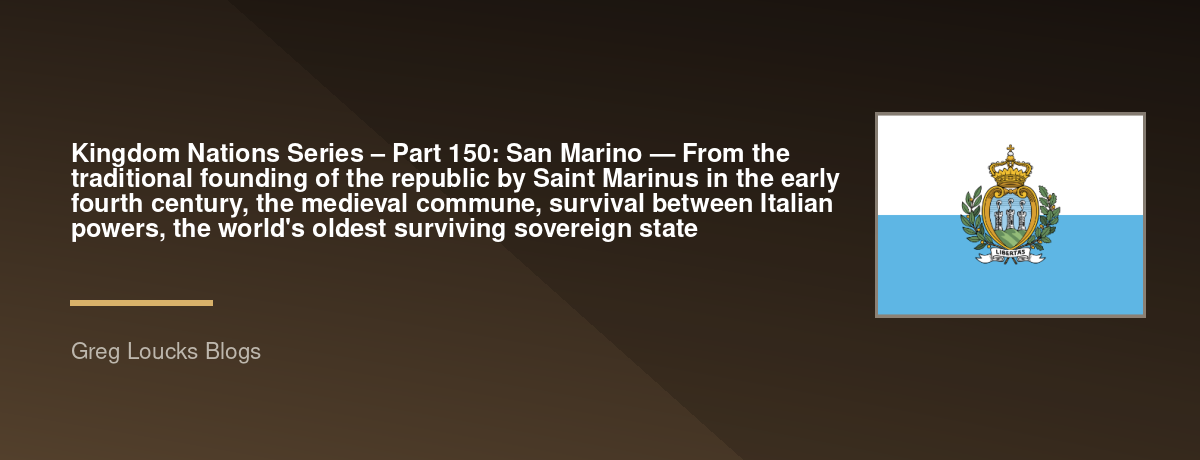
🌎 Kingdom Nations Series – Part 150: 🇸🇲 San Marino — From the traditional founding of the republic by Saint Marinus in the early fourth century, the medieval commune, survival between Italian powers, the world's oldest surviving sovereign state

🌎 Kingdom Nations Series – Part 150 🇸🇲 Chapter 1 – Part 1 San Marino: The Ancient Republic on the Mountain Saint Marinus, the Founding Tradition, the World's Oldest Surviving Republic, Monte Titano, the Three Towers, Borgo Maggiore, Serravalle, Catholic Christianity, Giuseppe Garibaldi, Italian Unification, World War II, Neutrality, Modern San Marino, Tourism, Culture, and San Marino's Kingdom Calling "The LORD shall preserve thy going out and thy coming in from this time forth, and even for evermore." — Psalm 121:8 Introduction San Marino is one of the world's most remarkable countries. It is: Tiny. Ancient. Independent. And: Surrounded completely by Italy. The Republic of San Marino occupies a small mountainous territory on the: Italian Peninsula. Its capital is: San Marino. Its most famous landmark is: Monte Titano. Three medieval towers stand upon the mountain: Guaita. Cesta. and: Montale. Together they have become the defining symbols of: San Marino. The country's traditional founding story reaches back to: Saint Marinus. According to tradition, Marinus was a Christian stonemason from the island of: Rab in the Adriatic. He came to the area around: Rimini and eventually established a Christian community on: Monte Titano. Tradition places the founding of San Marino in: 301 AD. Whether every detail of the traditional account can be historically verified is a separate question. But the tradition itself became foundational to: San Marino's identity. For more than a millennium, the community developed institutions of: Local government. Self-rule. Christian faith. Communal responsibility. And: Political independence. San Marino therefore became an extraordinary historical survivor. While kingdoms, empires, republics, and city-states rose and disappeared around it: San Marino endured. Where Is San Marino? San Marino is located in: Southern Europe. Italian Peninsula The republic lies on: The Italian Peninsula. Enclave San Marino is: Completely surrounded by Italy. Italy Its only neighboring country is: Italy. Adriatic Sea The Adriatic coast lies: East of San Marino. Rimini The Italian city of: Rimini is nearby. Monte Titano The country's dominant geographical feature is: Monte Titano. Monte Titano The mountain rises to approximately: 739 meters. Three Towers The summit contains: Guaita. Cesta. Montale. Guaita Guaita is the oldest and most famous of the: Three Towers. Cesta Cesta stands on another summit of: Monte Titano. Montale Montale is the smallest of the: Three Towers. UNESCO The historic center of San Marino and Mount Titano are recognized as: A: UNESCO World Heritage Site. Historic Center The capital's historic center preserves: Medieval streets. Stone buildings. Churches. Government buildings. Fortifications. Capital The capital is: City of San Marino. Borgo Maggiore Borgo Maggiore is one of the republic's major: Municipalities. Serravalle Serravalle is the largest municipality by population. Castello San Marino's municipalities are traditionally known as: Castelli. Nine Castelli The republic is divided into: Nine castelli. Small Country San Marino is one of the: Smallest sovereign states in Europe. Microstate It is classified as: A European microstate. Ancient Republic But its historical significance is: Far larger than its territory. Saint Marinus The nation's traditional founder is: Saint Marinus. Marinus Tradition says Marinus was: A Christian stonemason. Dalmatia He is traditionally associated with: Dalmatia. Rab Tradition places his birthplace on: Rab in the Adriatic. Rimini Marinus came to the region around: Rimini. Christian Community He established a: Christian community. Monte Titano He eventually established himself on: Monte Titano. 301 AD Traditional founding date: 301 AD. Foundation Tradition The traditional story is central to: San Marino's national identity. Saint Marinus His name became: San Marino. Republic San Marino developed into: A self-governing community. Christian Republic Its identity became closely associated with: Christianity. Catholic Christianity Roman Catholicism remains: The dominant religion. Basilica The: Basilica of San Marino stands in the capital. Basilica di San Marino The basilica is dedicated to: Saint Marinus. Saint Marinus The saint became: The republic's patron. Faith Christianity influenced: San Marino's culture. Community Religious and civic life historically developed: Together. Medieval San Marino During the Middle Ages, San Marino developed: Fortifications. Government institutions. Territorial independence. Fortifications Monte Titano provided: A natural defensive position. Towers The Three Towers protected: The mountain community. Guaita Guaita served as: A fortress. Cesta Cesta also served: A defensive purpose. Montale Montale formed part of: The defensive system. Medieval Europe San Marino survived among: Competing Italian powers. City-States Medieval Italy contained: Many independent cities and territories. Papal States San Marino existed near: The Papal States. Dukedoms It also existed near: Italian duchies. Republics Other Italian republics included: Venice. Genoa. Independence San Marino's survival depended upon: Diplomacy. Geography. Local institutions. And: Careful neutrality. Sovereignty The republic gradually developed: A durable tradition of sovereignty. Government San Marino is: A parliamentary republic. Captains Regent One of the country's most unusual institutions is: The: Captains Regent. Two Heads of State San Marino has: Two Captains Regent serving simultaneously. Term Their term lasts: Six months. Ancient Institution The system dates back: To the medieval period. Checks and Balance Having two heads of state reflects: A long tradition of shared authority. Parliament The legislature is: The: Grand and General Council. Council The council is: The national legislative body. Democracy Modern San Marino is: A democratic republic. Constitution Its constitutional system developed through: Centuries of statutes and institutions. Statutes San Marino's legal tradition is: Extremely old. Political Survival The republic survived by: Adapting. Italian Unification The nineteenth century brought: The unification of Italy. Giuseppe Garibaldi San Marino is associated with: Giuseppe Garibaldi. Garibaldi Garibaldi, one of the central figures of Italian unification, sought refuge in: San Marino during:   Garibaldi San Marino granted: Protection. Garibaldi's Army Garibaldi and his followers were: In a difficult position. Republic San Marino's neutrality and independence helped: Protect the community. Italian Unification When Italy unified, San Marino: Remained independent. Sovereignty This was one of the great achievements of: San Marino's diplomacy. Italy San Marino developed a close relationship with: Italy. Treaty The republic entered into: Treaties with: Italy. Cooperation The two states maintain: Close economic and political relations. World War I San Marino maintained: Its independent identity. World War II San Marino attempted to remain: Neutral. Refugees During World War II, San Marino became a refuge for: People fleeing the conflict. Thousands Large numbers of displaced people sought: Safety. Neutrality Neutrality became: A humanitarian responsibility. Bombing San Marino itself was mistakenly bombed by: British forces in:   World War II The event demonstrated: The dangers facing small neutral states. Postwar After the war, San Marino rebuilt: Its economy. Modern Republic San Marino became increasingly connected with: Italy. Europe The republic developed: Strong European relationships. Council of Europe San Marino is a member of: The: Council of Europe. United Nations San Marino joined: The: United Nations. International Diplomacy The country participates in: International organizations. Microstate Diplomacy Small states can have: Diplomatic influence. Tourism Tourism is a major: Economic activity. Medieval City Visitors come to experience: The medieval capital. Monte Titano Monte Titano provides: Panoramic views. Three Towers The Three Towers are: Major tourist attractions. Guaita Visitors can explore: Guaita. Cesta Visitors can also visit: Cesta. Montale Montale remains: A historic tower. Fortress The mountain's fortifications create: A dramatic skyline. Historic Streets The capital's narrow streets contain: Shops. Restaurants. Museums. Churches. Tourism San Marino attracts visitors from: Around the world. Italian Connection Many visitors arrive from: Italy. Cultural Tourism The republic's main attraction is: Its history. Museums San Marino contains: Museums. State Museum The: State Museum preserves: Historical artifacts. Philately San Marino is famous for: Stamps. Stamps Its postage stamps are: Highly collected. Coins San Marino also issues: Euro coins. Euro Although San Marino is not a member of the European Union, it uses: The euro. Economy San Marino's economy is based on: Tourism. Services. Manufacturing. Finance. Retail. Manufacturing The country has: Industrial activity. Ceramics Traditional and modern: Craft production is part of the economy. Banking Financial services have historically played: An important role. Economic Regulation Modern financial systems require: Transparency. Cross-Border Economy San Marino's economy is deeply connected with: Italy. Agriculture Agriculture is: Limited. Wine San Marino produces: Wine. Olive Oil Olive cultivation also occurs. Food San Marino shares many culinary traditions with: Northern and central Italy. Pasta Pasta is: Common. Bread Bread remains: Important. Cheese Cheese forms part of: Local cuisine. Torta Tre Monti One famous confection is: Torta Tre Monti. Three Mountains Its name references: The Three Towers. Culture San Marino's culture is closely connected to: Italian culture. Language The official language is: Italian. Sammarinese A local dialect known as: Sammarinese is also part of: Local heritage. Identity San Marino demonstrates that: Political independence does not require cultural isolation. Italian Culture San Marino remains: Culturally Italian. National Identity Yet it remains: Politically independent. Religion Catholic Christianity remains: Central to national heritage. Churches Historic churches preserve: Religious architecture. Basilica The Basilica of San Marino remains: A national symbol. Saint Marinus The founder's story remains: Central to national identity. Faith and Government San Marino's history demonstrates: The relationship between faith and civic institutions. Kingdom Perspective The Kingdom of God is: Not identical with any earthly republic. Republic San Marino is: A republic. Kingdom The biblical Kingdom is: The reign of God. Faith The Christian calling is: To serve God. Justice That includes: Justice. Mercy It includes: Mercy. Truth It includes: Truth. Stewardship It includes: Stewardship. Peace It includes: Peace. Small Nation San Marino's survival teaches: Smallness does not mean insignificance. Sovereignty Its history demonstrates: The importance of institutions. Diplomacy Its survival also demonstrates: The power of diplomacy. Neutrality Neutrality can provide: Protection. But it also requires: Responsibility. Humanitarianism During wartime, small nations can provide: Refuge. Refugees San Marino's wartime history reminds: Nations have moral responsibilities. Freedom Political independence is: A responsibility. Republic Government exists: To serve people. Leaders Leaders require: Wisdom. Captains Regent The Captains Regent represent: Shared leadership. Service Leadership should be: Service. San Marino's Kingdom Assignment San Marino's Kingdom assignment can be summarized as: European nation. Italian Peninsula nation. Microstate. Ancient republic. Christian heritage nation. Catholic nation. Diplomatic nation. Neutrality nation. Fortress nation. Mountain nation. Cultural heritage nation. Tourism nation. European bridge. Historic republic. Refuge nation. Peace nation. Stewardship nation. Sovereignty nation. Diplomatic witness. Prayer for San Marino Pray: For the Captains Regent. For the Grand and General Council. For the government. For judges. For public servants. For local leaders. For wisdom. For justice. For integrity. For national unity. For City of San Marino. For Borgo Maggiore. For Serravalle. For all nine castelli. For families. For children. For young people. For elderly citizens. For workers. For entrepreneurs. For business owners. For teachers. For students. For doctors. For nurses. For artists. For historians. For museum workers. For tourism workers. For churches. For priests. For Christian communities. For spiritual renewal. For biblical teaching. For Christian unity. For religious freedom. For the Basilica of San Marino. For the preservation of Saint Marinus's legacy. For Catholic communities. For Sammarinese cultural traditions. For the Italian language. For the Sammarinese dialect. For historic architecture. For Monte Titano. For Guaita. For Cesta. For Montale. For the protection of the historic center. For UNESCO heritage preservation. For museums. For libraries. For archives. For historians. For artists. For craftsmen. For traditional industries. For agriculture. For vineyards. For olive growers. For food producers. For tourism. For responsible tourism. For financial integrity. For transparent government. For ethical business. For international diplomacy. For the Council of Europe. For the United Nations. For relations with Italy. For European peace. For humanitarian efforts. For refugees. For people fleeing war. For San Marino to remain: A nation of peace. A nation of wisdom. A nation of justice. A nation of hospitality. A nation of historical preservation. For the nations. San Marino Before the Throne San Marino has experienced: Saint Marinus. Christian settlement. Medieval self-government. Fortification. Italian city-state politics. Papal influence. The rise and fall of neighboring powers. Italian unification. Garibaldi. World War I. World War II. Refugees. Neutrality. Modern European diplomacy. From Saint Marinus to the Republic The traditional founder established: A Christian community. From Community to Republic The community developed: Self-government. From Mountain to Fortress Monte Titano became: A defensive stronghold. From Fortress to Nation The mountain community became: A sovereign state. From Medieval Europe to Modern Europe San Marino adapted: Without surrendering its identity. From Garibaldi to Italian Unification The republic survived: The creation of modern Italy. From Neutrality to Humanitarianism During World War II, San Marino offered: Refuge. From Ancient Institutions to Modern Democracy The republic continues: Its ancient political traditions. From Towers to Tourism The Three Towers became: Symbols of national identity. From Saint Marinus to Modern San Marino The founding tradition remains: A national foundation. Kingdom Perspective San Marino's story teaches: Endurance matters. Endurance Empires can disappear. Republic Governments can change. Culture But communities can: Survive. Faith Faith can preserve: Identity. Institutions Institutions can preserve: Freedom. Diplomacy Diplomacy can protect: Sovereignty. Memory History can preserve: Wisdom. San Marino's Future San Marino can continue serving as: A center of European heritage. A center of historical preservation. A center of microstate diplomacy. A center of tourism. A center of Christian heritage. A center of peace. Heritage The country can preserve: Its medieval identity. Diplomacy San Marino can continue: Peaceful diplomacy. Humanitarianism It can remember: Its wartime refugee history. Stewardship It can protect: Monte Titano. Tourism It can develop: Sustainable tourism. Culture It can preserve: Sammarinese identity. Europe It can contribute: A small-state perspective. Kingdom Calling San Marino's calling can be summarized as: To demonstrate that endurance, peace, community, and principled self-government can preserve a people through centuries of political change. Final Commission May San Marino remain: A nation of peace. A nation of wisdom. A nation of justice. A nation of hospitality. A nation of historical memory. A nation of responsible government. May the Captains Regent lead: With wisdom. May Parliament govern: With integrity. May judges uphold: Justice. May public servants serve: The people. May families flourish. May children flourish. May young people find: Purpose. May elders receive: Honor. May businesses prosper: Ethically. May workers receive: Fair treatment. May teachers educate: With wisdom. May students learn: With diligence. May doctors heal: With compassion. May nurses serve: With mercy. May artists create: With excellence. May historians preserve: Truth. May museums preserve: Memory. May churches preserve: Faith. May priests serve: With humility. May Christians demonstrate: The love of Christ. May the legacy of Saint Marinus remain: A testimony of endurance. May the Basilica remain: A place of prayer. May Monte Titano remain: Protected. May Guaita remain: Preserved. May Cesta remain: Preserved. May Montale remain: Preserved. May the historic center remain: Protected. May UNESCO heritage remain: Safeguarded. May tourism remain: Sustainable. May visitors respect: The nation's heritage. May the economy remain: Strong. May financial institutions remain: Transparent. May businesses operate: With integrity. May relations with Italy remain: Peaceful. May European cooperation remain: Strong. May San Marino continue: To practice peaceful diplomacy. May its neutrality remain: Responsible. May its humanitarian tradition remain: Strong. May refugees fleeing war find: Compassion. May small nations around the world find: A voice. May San Marino demonstrate: That sovereignty can coexist with cooperation. May San Marino demonstrate: That ancient institutions can coexist with democracy. May San Marino demonstrate: That cultural identity can coexist with international friendship. May San Marino demonstrate: That a small territory can carry a great history. May its history produce: Wisdom. May its Christian heritage produce: Compassion. May its independence produce: Responsibility. May its diplomacy produce: Peace. May its mountains produce: Perspective. May its towers produce: Remembrance. May its people produce: Goodness. And may the people of San Marino, together with every nation, tribe, people, and language, one day stand before the throne and proclaim: "Blessed be the peacemakers: for they shall be called the children of God." (Matthew 5:9) Amen. 🇸🇲 Kingdom Nations Series – Part 150 San Marino From Saint Marinus to the republic. From Dalmatia to Monte Titano. From Christian settlement to self-government. From a mountain community to a sovereign state. From medieval fortifications to the Three Towers. From Guaita to Cesta. From Cesta to Montale. From fortress to heritage. From medieval Italy to the modern Italian Peninsula. From neighboring empires to independent sovereignty. From Catholic Christianity to civic tradition. From Saint Marinus to the Basilica. From the medieval republic to modern democracy. From Captains Regent to shared leadership. From the Grand and General Council to parliamentary government. From Giuseppe Garibaldi to Italian unification. From Italian unification to continued independence. From neutrality to humanitarian refuge. From World War II to national survival. From Monte Titano to UNESCO heritage. From medieval streets to modern tourism. From stamps and coins to national identity. From Italian culture to Sammarinese identity. From San Marino to Europe. From Europe to international diplomacy. From ancient institutions to modern government. From a tiny republic to a global historical witness. From San Marino to the nations. From San Marino to the Kingdom. From San Marino to the throne. End of Kingdom Nations Series – Part 150: 🇸🇲 San Marino Coming Next: 🌎 Kingdom Nations Series – Part 151: 🇸🇹 São Tomé and Príncipe — From the discovery and settlement of the volcanic islands, Portuguese colonization, African communities, plantation slavery, cocoa and coffee, the islands' role in the Atlantic world, Christianity, independence, São Tomé, Santo António, Príncipe, Pico de São Tomé, Pico de Príncipe, tropical rainforest, UNESCO heritage, biodiversity, sea turtles, fishing, tourism, Gulf of Guinea culture, and São Tomé and Príncipe's Kingdom calling.
Read more 🌎 Kingdom Nations Series – Part 150: 🇸🇲 San Marino — From the traditional founding of the republic by Saint Marinus in the early fourth century, the medieval commune, survival between Italian powers, the world's oldest surviving sovereign state

🌎 Kingdom Nations Series – Part 149: 🇼🇸 Samoa — From the ancient Polynesian settlement of the Samoan Islands, the origins of Fa'a Samoa, Samoan chiefly titles and villages, Christianity, European exploration, German and New Zealand administration, the

🌎 Kingdom Nations Series – Part 149 🇼🇸 Chapter 1 – Part 1 Samoa: The Heart of Polynesia Ancient Polynesian Settlement, Fa'a Samoa, Samoan Chiefly Titles, Village Life, Christianity, European Exploration, German and New Zealand Administration, the Mau Movement, Independence, Apia, Upolu, Savai'i, Volcanic Landscapes, Ocean Culture, Traditional Tattooing, Rugby, Samoan Christianity, Diaspora, Climate Resilience, and Samoa's Kingdom Calling "How good and how pleasant it is for brethren to dwell together in unity!" — Psalm 133:1 Introduction Samoa is one of the great cultural centers of: Polynesia. Located in the central South Pacific, Samoa consists of: Upolu. Savai'i. and several smaller islands. The country is known for: Volcanic mountains. Tropical forests. Coral reefs. Villages. The Pacific Ocean. Traditional chiefly systems. Christianity. Family. Hospitality. And: Fa'a Samoa. The phrase: Fa'a Samoa means: "The Samoan way." It describes a social and cultural system centered on: Family. Community. Respect. Service. Land. Chiefly authority. Genealogy. And: Collective responsibility. Samoa's history reaches deep into: Ancient Polynesian navigation. The settlement of the Pacific. Oral tradition. Inter-island relationships. And: Traditional village life. European contact brought: Missionaries. Traders. Colonial competition. Germany. New Zealand. And: New political institutions. But Samoa's people retained: Their language. Their villages. Their chiefly titles. Their ceremonies. Their land relationships. And: Their cultural identity. Samoa also became one of the earliest Pacific nations to achieve: Modern independence. Samoa became independent in: 1962. Its story is therefore one of: Ancient navigation. Cultural survival. Christian transformation. Colonial resistance. National independence. And: Pacific resilience. Where Is Samoa? Samoa is located in: Polynesia. Pacific Ocean The islands sit in: The South Pacific Ocean. Polynesia Samoa is part of: The: Polynesian cultural region. Neighboring Islands Samoa lies near: American Samoa. Tonga. Fiji. Tokelau. Wallis and Futuna. Upolu Upolu is Samoa's most populated island. Savai'i Savai'i is the largest island. Apia The capital is: Apia. Apia Apia is located on: Upolu. Apia It is the country's: Political. Commercial. Administrative. and: Cultural center. Savai'i Savai'i contains: Large areas of volcanic landscape. Volcanic Islands Samoa's islands were created primarily through: Volcanic activity. Mount Silisili The highest point in Samoa is: Mount Silisili. Mount Silisili It rises to approximately: 1,858 meters. Volcanoes Samoa contains: Ancient volcanic landscapes. Lava Fields Some areas preserve: Historic lava flows. Tropical Forests The islands contain: Tropical rainforest. Coral Reefs Coastal waters contain: Coral ecosystems. Ocean The ocean is central to: Samoan life. Fishing Fishing provides: Food. Income. Tradition. Navigation Samoans inherited: Ancient Polynesian navigation traditions. Polynesian Voyaging Ancient Polynesians navigated enormous distances across: The Pacific. Stars Navigators used: Stars. Ocean Swells They also read: Ocean swells. Winds Traditional navigators understood: Wind patterns. Birds Bird behavior could help reveal: The presence of land. Canoes Large ocean-going canoes connected: Pacific islands. Polynesian Settlement Samoa was settled by: Austronesian-speaking peoples. Lapita The broader Polynesian settlement story is connected to: The: Lapita cultural tradition. Polynesian Expansion Over centuries, Polynesian peoples spread across: The Pacific. Samoa Samoa became one of the important: Polynesian cultural centers. Tonga Samoa maintained historical connections with: Tonga. Fiji Samoa also maintained connections with: Fiji. Polynesian Triangle Samoa belongs to the broader: Polynesian world. Genealogy Genealogy is central to: Samoan identity. Oral Tradition Samoan history was preserved through: Oral traditions. Stories Stories preserved: Genealogy. Land rights. Chiefly histories. Wars. Migration. Matai The traditional title-holder system is centered around: Matai. Matai Matai are: Family chiefs. Titles Matai titles are inherited and/or bestowed through: Family processes. Aiga The extended family is known as: Aiga. Aiga The aiga forms: The foundation of Samoan society. Family Family includes: Parents. Children. Extended relatives. Ancestors. And: Community relationships. Land Land is closely connected with: Family identity. Communal Land Much Samoan land remains: Communally held. Village The village is a fundamental: Social unit. Village Council Village affairs are influenced by: Matai councils. Respect Respect is central to: Fa'a Samoa. Service Service to family and community is: Highly valued. Reciprocity Samoan social life emphasizes: Giving. Receiving. Returning. Hospitality Hospitality is: A major Samoan value. Fa'a Samoa The: Samoan way connects: Family. Faith. Land. Chiefly authority. Culture. And: Community. European Contact European explorers eventually reached: Samoa. Jacob Roggeveen Dutch explorer: Jacob Roggeveen encountered the Samoan islands in:   European Exploration European contact increased during: The eighteenth and nineteenth centuries. Traders Traders arrived seeking: Resources. Whalers Whalers also visited: The Pacific. Missionaries Christian missionaries eventually transformed: Samoan society. John Williams Missionary: John Williams played an important role in bringing: Christianity to Samoa. London Missionary Society The: London Missionary Society sent missionaries into: The Pacific. Christianity Christianity spread rapidly. Traditional Religion Samoan traditional religious beliefs were: Gradually transformed. Conversion Many Samoans embraced: Christianity. Village Christianity Christianity became integrated into: Village life. Churches Churches became: Central village institutions. Sabbath Sunday became: A major day of Christian worship and community life. Samoan Christianity Samoan Christianity developed alongside: Fa'a Samoa. Prayer Prayer became: Central to family and village life. Scripture The Bible became: A major cultural text. Translation Samoan became one of the Pacific languages with: A long Christian literary tradition. Christianity and Culture Samoan Christianity became: Distinctly Polynesian. Colonial Competition European powers competed for: Influence in Samoa. Germany Germany established: Colonial control over: Western Samoa. German Samoa Western Samoa became: A German colony. Apia Apia became: An important colonial port. United States The United States established control over: Eastern Samoa. American Samoa Eastern Samoa became: American Samoa. New Zealand New Zealand later administered: Western Samoa. World War I During: World War I, New Zealand occupied: German Samoa. Mandate Samoa subsequently came under: New Zealand administration. Mau Movement Samoans increasingly demanded: Self-government. Mau The: Mau movement became the major independence movement. "Samoa for Samoans" The movement emphasized: Samoan self-determination. Resistance The Mau used: Nonviolent resistance. Black Saturday In: 1929 New Zealand police opened fire on: Mau demonstrators. Tupua Tamasese Lealofi III One of the most important leaders was: Tupua Tamasese Lealofi III. Death He was killed during: The 1929 violence. Martyr He became a symbol of: Samoan independence. Independence Samoa eventually became: Independent. 1962 Independence occurred on: January 1, 1962. First Independent Polynesian State Samoa became: The first Pacific island country to achieve independence from a colonial power in the modern era. Independence The nation initially became known as: Western Samoa. Name Change In: 1997 the official name became: Samoa. Government Samoa is: A parliamentary democracy. O le Ao o le Malo The head of state is known as: O le Ao o le Malo. Constitutional System Samoa combines: Modern government with: Traditional chiefly institutions. Matai Matai remain important to: Political and social life. Parliament The national legislature is: The: Legislative Assembly. Village Government Traditional village governance remains: Powerful. Cultural Authority Matai councils influence: Community affairs. Traditional and Modern Samoa demonstrates that: Traditional governance and modern government can coexist. Samoan Language The official languages include: Samoan and: English. Samoan Samoan is one of the major: Polynesian languages. Language Language is central to: Cultural identity. Oral Culture Oral traditions remain: Important. Poetry Traditional poetry preserves: History. Oratory Formal speech is: Highly developed. Fa'a Samoa Public speaking reflects: Respect. Genealogy. Status. History. Ceremonies Ceremonial exchange is: Important. 'Ie toga The: 'Ie toga is a finely woven: Traditional textile. Fine Mats Fine mats are: Highly valued cultural treasures. Ceremonial Gifts They are exchanged during: Important ceremonies. Weddings Fine mats can be presented during: Weddings. Funerals They are also important during: Funerals. Titles They can be involved in: Matai title ceremonies. Tattooing Samoan tattooing is: Extremely important. Pe'a The traditional male tattoo is: Pe'a. Malu The traditional female tattoo is: Malu. Tattooing Traditional tattooing represents: Identity. Service. Courage. Cultural belonging. Tatau The Samoan tattoo tradition is often called: Tatau. Ceremony Traditional tattooing involves: Community. Endurance. Ritual. Cultural Survival Tattooing survived: Colonial influence. Dance Dance remains: A major cultural expression. Siva Siva is an important Samoan: Dance tradition. Music Music combines: Traditional. Christian. And: Modern influences. Choirs Church choirs are: Important. Hymns Christian hymns became: Part of Samoan culture. Rugby Rugby is one of Samoa's most popular: Sports. Rugby Union Samoa has produced: International rugby players. Manu Samoa The national rugby team is known as: Manu Samoa. Rugby Rugby has become: A major expression of national identity. Pacific Diaspora Samoans have migrated to: New Zealand. Australia. The United States. American Samoa. New Zealand New Zealand contains: A large Samoan community. Australia Australia also contains: A substantial Samoan diaspora. United States Samoans have significant communities in: The United States. Diaspora The diaspora maintains: Language. Family. Church. Culture. Remittances Money sent home supports: Families. Global Samoa Samoan identity now exists: Across continents. Rugby Diaspora Samoan athletes have achieved: Global recognition. Culture The diaspora helps spread: Samoan culture. Agriculture Agriculture remains: Central to Samoa's economy. Coconut Coconut is: Important. Copra Copra has historically been: An important export. Cocoa Cocoa is: Cultivated. Taro Taro remains: A major food crop. Breadfruit Breadfruit is: Important to Samoan cuisine. Bananas Bananas are also: Cultivated. Fishing Fishing supports: Food security. Ocean The ocean provides: Fish. Transportation. Tourism. Cultural identity. Tourism Tourism has become: Increasingly important. Beaches Samoa is famous for: Tropical beaches. Waterfalls The islands contain: Beautiful waterfalls. To Sua Ocean Trench The: To Sua Ocean Trench is one of Samoa's most famous: Natural attractions. Volcanic Landscape Samoa's volcanic geology created: Dramatic scenery. Alofaaga Blowholes The: Alofaaga Blowholes demonstrate the power of: Ocean and volcanic rock. Lava Fields Savai'i contains: Historic lava landscapes. Forests Samoan forests support: Biodiversity. Flying Foxes Fruit bats are: Important forest animals. Marine Life Samoan waters contain: Coral reefs. Fish. Sea turtles. Dolphins. Conservation Marine ecosystems require: Protection. Climate Change Samoa is highly vulnerable to: Climate change. Sea-Level Rise Rising seas threaten: Coastal communities. Cyclones Pacific cyclones can cause: Major destruction. Tsunami Samoa has experienced: Major tsunami events. Disaster Resilience Communities require: Preparedness. Coastal Protection Mangroves and reefs can help: Protect shorelines. Traditional Knowledge Traditional ecological knowledge can contribute: To resilience. Kingdom Stewardship Samoa's environment requires: Wise stewardship. Christianity Christianity remains: Central to Samoan society. Churches Churches are: Visible throughout Samoa. Congregations Families often participate together in: Church life. Prayer Prayer is deeply integrated into: Daily life. Scripture The Bible remains: Highly respected. Faith Christian faith has become: Part of Samoan identity. Kingdom Perspective But the Kingdom of God is larger than: Any national culture. Church The Church is called to: Serve. Service Samoan culture already emphasizes: Service. Family Fa'a Samoa emphasizes: Responsibility to family. Kingdom Christian discipleship calls believers toward: Love of neighbor. Hospitality Samoan hospitality reflects: A powerful cultural value. Humility Humility is: Highly valued. Respect Respect for elders is: Important. Elders Elders carry: Knowledge. Chiefs Matai carry: Responsibility. Servant Leadership Leadership should produce: Service. Land Samoan land is: Connected to identity. Stewardship Land should be: Protected. Ocean The ocean should be: Protected. Forests Forests should be: Protected. Climate Climate resilience should be: Strengthened. Samoa's Kingdom Assignment Samoa's Kingdom assignment can be summarized as: Polynesian nation. Pacific nation. Island nation. Ocean nation. Volcanic nation. Christian nation. Family nation. Village nation. Matai nation. Fa'a Samoa nation. Cultural preservation nation. Maritime nation. Agricultural nation. Rugby nation. Diaspora nation. Climate-resilience nation. Conservation nation. Hospitality nation. Pacific bridge. Polynesian cultural center. Peacemaking nation. Prayer for Samoa Pray: For the head of state. For the Prime Minister. For Parliament. For matai. For village councils. For public servants. For wisdom. For justice. For integrity. For national unity. For Apia. For Upolu. For Savai'i. For every village. For Samoan families. For children. For young people. For women. For men. For elders. For matai. For teachers. For students. For farmers. For fishermen. For sailors. For entrepreneurs. For artists. For musicians. For dancers. For tattoo artists. For traditional craftsmen. For pastors. For priests. For missionaries. For churches. For Christian schools. For Christian ministries. For biblical teaching. For spiritual renewal. For Christian unity. For religious freedom. For Samoan language. For cultural preservation. For Fa'a Samoa. For aiga. For village communities. For traditional chiefly institutions. For the preservation of genealogy. For traditional oratory. For fine-mat weaving. For tatau. For pe'a. For malu. For traditional dance. For music. For Samoan literature. For education. For universities. For healthcare. For doctors. For nurses. For community health. For agriculture. For taro farmers. For coconut growers. For cocoa growers. For banana growers. For food security. For sustainable agriculture. For fishermen. For sustainable fisheries. For the ocean. For coral reefs. For sea turtles. For dolphins. For marine ecosystems. For rainforests. For flying foxes. For native wildlife. For Mount Silisili. For volcanic landscapes. For Savai'i's lava fields. For To Sua Ocean Trench. For the Alofaaga Blowholes. For beaches. For waterfalls. For coastal communities. For climate resilience. For protection from cyclones. For tsunami preparedness. For sea-level rise. For disaster response. For environmental conservation. For sustainable tourism. For tourism workers. For local businesses. For the Samoan diaspora. For Samoans in New Zealand. For Samoans in Australia. For Samoans in the United States. For Samoans in American Samoa. For families separated by migration. For remittance-dependent families. For Samoan athletes. For Manu Samoa. For rugby. For Pacific cooperation. For Polynesian peoples. For Tonga. For Fiji. For American Samoa. For Tokelau. For New Zealand. For Australia. For Pacific Island nations. For climate justice. For regional peace. For cultural preservation. For Samoa to become: A center of Polynesian culture. A center of Christian service. A center of Pacific stewardship. A center of reconciliation. A center of hospitality. For the nations. Samoa Before the Throne Samoa has experienced: Ancient Polynesian settlement. Lapita cultural expansion. Ocean navigation. Village development. Matai institutions. Aiga. Fa'a Samoa. Traditional religion. Christian missionary arrival. Colonial competition. German administration. New Zealand administration. The Mau movement. Black Saturday. Independence. Modern democracy. Pacific development. From Ocean Voyagers to Villages Samoan ancestors crossed: Enormous stretches of ocean. From Navigation to Settlement They established: Permanent communities. From Genealogy to Land Families developed: Deep relationships with land. From Chiefs to Villages Matai institutions developed: Community leadership. From Traditional Religion to Christianity Christianity transformed: Spiritual life. From Colonialism to Independence Samoa became: An independent nation. From Mau to Freedom The Mau movement demonstrated: The power of peaceful resistance. From Western Samoa to Samoa The country adopted: Its modern name. From Village to Diaspora Samoan communities now exist: Across the world. From Island to Global Culture Samoan: Music. Dance. Language. Tattooing. Rugby. Christianity. And: Family traditions are now globally recognized. Kingdom Perspective Samoa's greatest treasure is not: Tourism. Culture It is: Its people. Family Its: Aiga. Land Its: Connection to land. Ocean Its: Relationship with the sea. Faith Its: Christian heritage. Service Its: Commitment to family and community. Fa'a Samoa Its: Cultural identity. Kingdom Calling Samoa's calling may be: To demonstrate how culture, family, faith, and community can remain strong in a rapidly changing world. Family Aiga teaches: Responsibility. Community Village life teaches: Interdependence. Service Matai leadership teaches: Responsibility. Hospitality Samoan culture teaches: Generosity. Christianity Faith teaches: Love. Stewardship The islands teach: Dependence upon creation. Diaspora Migration teaches: Connection across borders. Pacific The ocean teaches: Interdependence. Climate Climate change teaches: Responsibility. Samoa's Future Samoa can become a leader in: Pacific climate resilience. Marine conservation. Cultural preservation. Sustainable tourism. Traditional knowledge. Christian ministry. Pacific diplomacy. Climate Samoa can advocate for: Small island nations. Ocean Samoa can lead in: Marine stewardship. Culture Samoa can preserve: Polynesian heritage. Language Samoan can remain: Strong across generations. Diaspora The diaspora can become: A global cultural network. Christianity Samoan churches can become: Centers of service. Youth Young Samoans can carry: Culture into the future. Education Education can connect: Tradition. and: Modern knowledge. Technology Technology can preserve: Language. Genealogy. Culture. Tourism Tourism can support: Communities. Without destroying: Culture. Sustainable Tourism Visitors can be welcomed: Without turning Samoa into: A cultural museum. Authenticity Samoan culture should remain: Living. Land Traditional land relationships should be: Respected. Ocean Marine ecosystems should be: Protected. Forests Forests should remain: Healthy. Final Commission May Samoa become a nation of: Wisdom. Peace. Faith. Family. Service. Stewardship. May Apia flourish. May Upolu flourish. May Savai'i flourish. May every Samoan village flourish. May aiga flourish. May families flourish. May children grow up: With purpose. May young people remain: Connected to their heritage. May elders be: Honored. May matai lead: With wisdom. May chiefs serve: With humility. May villages remain: Strong. May Fa'a Samoa remain: Living. May Samoan language remain: Strong. May genealogy be: Preserved. May traditional oratory remain: Strong. May 'ie toga weaving remain: Strong. May tatau remain: Protected. May pe'a and malu remain: Honored. May traditional dance remain: Alive. May music flourish. May Samoan artists flourish. May Samoan writers flourish. May Samoan teachers flourish. May students flourish. May universities flourish. May healthcare improve. May doctors serve: With compassion. May nurses serve: With compassion. May churches flourish. May pastors lead: With wisdom. May priests serve: With humility. May missionaries serve: With love. May Christianity produce: Service. May faith produce: Justice. May faith produce: Mercy. May faith produce: Reconciliation. May agriculture flourish. May taro farmers prosper. May coconut growers prosper. May cocoa growers prosper. May banana growers prosper. May food security increase. May fishermen prosper. May fisheries remain: Sustainable. May the Pacific Ocean remain: Healthy. May coral reefs flourish. May sea turtles flourish. May dolphins flourish. May native wildlife flourish. May rainforests remain: Protected. May flying foxes survive. May Mount Silisili remain: Protected. May Savai'i's volcanic landscapes remain: Protected. May To Sua remain: Protected. May waterfalls remain: Clean. May beaches remain: Beautiful. May coastal communities remain: Safe. May Samoa become: More resilient to cyclones. May Samoa become: More resilient to tsunamis. May Samoa become: More resilient to sea-level rise. May climate adaptation strengthen. May disaster preparedness strengthen. May Pacific climate cooperation strengthen. May tourism remain: Sustainable. May tourism benefit: Local communities. May culture never become: A commodity without dignity. May visitors respect: Samoan traditions. May the Samoan diaspora remain: Connected. May Samoans in New Zealand remain: Connected. May Samoans in Australia remain: Connected. May Samoans in America remain: Connected. May American Samoa and Samoa maintain: Strong family ties. May migration strengthen: Families rather than divide them. May remittances support: Communities. May Manu Samoa flourish. May Samoan athletes flourish. May rugby remain: A source of pride. May Pacific nations cooperate: For peace. May Polynesian peoples preserve: Their heritage. May Samoa become: A voice for Pacific peoples. May Samoa become: A voice for climate justice. May Samoa become: A guardian of Polynesian culture. May Samoa become: A center of Christian service. May Samoa become: A model of community. May Samoa demonstrate: That tradition and modernity can coexist. May Samoa demonstrate: That family remains powerful. May Samoa demonstrate: That hospitality can be a national strength. May Samoa demonstrate: That cultural identity can survive globalization. May Samoa demonstrate: That small islands can speak to the world. May Samoa demonstrate: That the ocean is not a barrier: But a connection. May Samoa's history produce: Wisdom. May its culture produce: Beauty. May its faith produce: Love. May its families produce: Strength. May its land produce: Abundance. May its ocean produce: Life. May its people produce: Peace. And may the people of Samoa, together with every nation, tribe, people, and language, one day stand before the throne and proclaim: "Let the heavens be glad, and let the earth rejoice: and let men say among the nations, The LORD reigneth." (1 Chronicles 16:31) Amen. 🇼🇸 Kingdom Nations Series – Part 149 Samoa From ancient Polynesian voyagers to island settlement. From Lapita traditions to Samoa. From stars and ocean swells to Pacific navigation. From canoes to villages. From genealogy to land. From aiga to community. From matai to village leadership. From Fa'a Samoa to national identity. From Indigenous traditions to Christianity. From John Williams to the spread of the Gospel. From missionaries to Samoan churches. From German Samoa to New Zealand administration. From colonial rule to the Mau movement. From Black Saturday to national remembrance. From Tupua Tamasese Lealofi III to independence. From 1962 to sovereignty. From Western Samoa to Samoa. From Upolu to Savai'i. From Apia to the villages. From Mount Silisili to volcanic landscapes. From forests to waterfalls. From To Sua to the Pacific Ocean. From 'ie toga to tatau. From pe'a to malu. From siva to song. From church choirs to Christian worship. From taro to coconut. From agriculture to tourism. From Samoa to the Pacific diaspora. From New Zealand to Australia. From America to the islands. From Manu Samoa to global rugby. From Polynesian heritage to global culture. From climate vulnerability to resilience. From ocean culture to marine stewardship. From Samoa to the Pacific nations. From Samoa to the nations. From Samoa to the Kingdom. From Samoa to the throne. End of Kingdom Nations Series – Part 149: 🇼🇸 Samoa Coming Next: 🌎 Kingdom Nations Series – Part 150: 🇸🇲 San Marino — From the traditional founding of the republic by Saint Marinus in the early fourth century, the medieval commune, survival between Italian powers, the world's oldest surviving sovereign state and constitutional republic, Monte Titano, the Three Towers, Borgo Maggiore, Serravalle, Catholic Christianity, Giuseppe Garibaldi, World War II, neutrality, modern San Marino, tourism, finance, culture, and San Marino's Kingdom calling.

Read more 🌎 Kingdom Nations Series – Part 149: 🇼🇸 Samoa — From the ancient Polynesian settlement of the Samoan Islands, the origins of Fa'a Samoa, Samoan chiefly titles and villages, Christianity, European exploration, German and New Zealand administration, the

🌎 Kingdom Nations Series – Part 148: 🇻🇨 Saint Vincent and the Grenadines — From Indigenous Kalinago and Garifuna heritage, European colonization, the Black Caribs, British rule, slavery and emancipation, the Garifuna story, the Grenadine islands, Kings

🌎 Kingdom Nations Series – Part 148 🇻🇨 Chapter 1 – Part 1 Saint Vincent and the Grenadines: The Islands of the Garifuna Indigenous Kalinago and Garifuna Heritage, European Colonization, the Black Caribs, British Rule, Slavery and Emancipation, the Grenadine Islands, Kingstown, La Soufrière, Bequia, Mustique, Canouan, Union Island, Caribbean Christianity, Agriculture, Bananas, Sailing, Tourism, Volcanic Landscapes, Marine Conservation, Hurricane Resilience, and Saint Vincent and the Grenadines' Kingdom Calling "He that dwelleth in the secret place of the most High shall abide under the shadow of the Almighty." — Psalm 91:1 Introduction Saint Vincent and the Grenadines is an island nation scattered across the: Eastern Caribbean. It consists of: Saint Vincent and: A chain of smaller islands and cays known as: The Grenadines. The nation is famous for: Turquoise waters. Volcanic mountains. Rainforests. Coral reefs. Sailing. Fishing. Small island communities. And: A remarkable Indigenous and African-Caribbean heritage. But Saint Vincent's history is deeper than: Beaches. Sailing. And: Tourism. The island of Saint Vincent became one of the strongest centers of Indigenous resistance in the Caribbean. The: Kalinago people resisted European colonization for generations. African people who escaped slavery joined the Indigenous population, creating the community historically known as: Black Caribs. Their descendants became known as: Garifuna. The Garifuna story eventually spread far beyond Saint Vincent to: Dominica. Honduras. Guatemala. Nicaragua. Belize. And: The United States. Saint Vincent therefore became one of the great historical centers of: Indigenous resistance. African survival. Caribbean identity. And: Cultural resilience. The nation later passed through: British colonial rule. Plantation agriculture. Slavery. Emancipation. Self-government. And: Independence. Saint Vincent and the Grenadines became independent in: 1979. Today the country remains a: Constitutional monarchy. Its head of state is: King Charles III. Where Is Saint Vincent and the Grenadines? Saint Vincent and the Grenadines is located in: The Lesser Antilles. Eastern Caribbean The nation lies within: The eastern Caribbean. Windward Islands Saint Vincent is part of: The: Windward Islands. Saint Lucia Saint Lucia lies: North of Saint Vincent. Grenada Grenada lies: South of Saint Vincent. Barbados Barbados lies: East of the island chain. Caribbean Sea The islands are surrounded by: The Caribbean Sea. Kingstown The capital is: Kingstown. Kingstown Kingstown is located on: Saint Vincent. Saint Vincent Saint Vincent is the: Largest island in the country. Grenadines The Grenadines extend: Southward. Bequia Bequia is one of the most important: Grenadine islands. Mustique Mustique is internationally famous for: Tourism. Canouan Canouan is another major: Grenadine island. Union Island Union Island lies toward the: Southern end of the Grenadines. Mayreau Mayreau is one of the smaller: Inhabited islands. Tobago Cays The: Tobago Cays are famous for: Marine ecosystems. Marine Park The Tobago Cays are protected through: A marine conservation area. La Soufrière Saint Vincent is dominated by: La Soufrière. Volcano La Soufrière is an: Active volcano. 2021 Eruption La Soufrière erupted in: 2021. Volcanic Hazard The eruption demonstrated: The vulnerability of island communities. Volcanoes Volcanic activity has shaped: Saint Vincent's landscape. Mountains The island contains: Steep mountains. Rainforest The interior contains: Tropical rainforest. Vermont Nature Trail The: Vermont Nature Trail passes through: Rainforest habitat. Biodiversity Saint Vincent contains: Rich biodiversity. Saint Vincent Parrot The: Saint Vincent parrot is the national bird. Endemic Species The parrot is: Native to Saint Vincent. Conservation Protecting endemic species is: A national responsibility. Indigenous Peoples Long before European colonization, Saint Vincent was inhabited by: Indigenous Caribbean peoples. Arawak Earlier Indigenous populations included: Arawak-speaking peoples. Kalinago The: Kalinago became particularly important in: Saint Vincent. Indigenous Resistance Saint Vincent became one of the Caribbean's major centers of: Indigenous resistance. European Colonization European powers sought: Control of the island. French French settlers established: Communities. British British forces eventually established: Colonial control. Kalinago Resistance The Kalinago resisted: European settlement. African Arrivals Africans arrived through: The slave trade. Shipwrecks Some historical traditions describe escaped Africans reaching Saint Vincent through: Shipwrecks. African-Kalinago Community African and Indigenous populations became: Interconnected. Black Caribs The resulting population became known historically as: Black Caribs. Garifuna The descendants became widely known as: Garifuna. Garifuna Heritage Garifuna culture combines: Indigenous Caribbean. African. and: European influences. Language Garifuna language contains: A distinctive blend of: Arawakan. Cariban. African. and: European influences. Music Garifuna music became famous for: Drumming. Singing. Dance. Resistance The Garifuna tradition is deeply connected with: Resistance. Chief Joseph Chatoyer One of the greatest Indigenous resistance leaders was: Chief Joseph Chatoyer. Chatoyer Chatoyer led resistance against: British expansion. First Carib War The: First Carib War occurred in: 1772–1773. Second Carib War The: Second Carib War occurred from: 1795–1797. War The conflict became: Extremely destructive. Chatoyer's Death Chatoyer was killed in:   National Hero Chatoyer is honored as: A national hero. National Heroes Day Saint Vincent and the Grenadines observes: National Heroes Day in his honor. Resistance His story represents: Indigenous resistance. British Victory British forces eventually defeated: The Black Carib resistance. Deportation Many Garifuna were forcibly deported from: Saint Vincent. Roatán Large numbers were transported to: Roatán off the coast of: Honduras. Central America Garifuna communities subsequently spread throughout: Central America. Garifuna Diaspora Garifuna communities today exist in: Belize. Guatemala. Honduras. Nicaragua. United States. Cultural Survival The Garifuna survived: Displacement. Colonialism. And: Cultural pressure. UNESCO Garifuna language, music and dance have been recognized internationally as: Important intangible cultural heritage. African Heritage African heritage remains: Central to Vincentian culture. Plantation Economy European colonial rule introduced: Plantation agriculture. Sugar Sugar became an important: Plantation crop. Cotton Cotton was also: Important. Arrowroot Saint Vincent later became especially known for: Arrowroot. Arrowroot Arrowroot became an important: Agricultural product. Agriculture Agriculture remains important to: Rural communities. Bananas Bananas became one of the island's: Major export crops. Banana Industry The banana industry connected Saint Vincent with: European markets. Small Farmers Many farms were: Small-scale. Emancipation Slavery was abolished in: 1834 throughout the British Empire. Full Emancipation Full freedom followed: In:   Post-Emancipation Formerly enslaved people built: Independent communities. African-Caribbean Society The island developed a strong: Afro-Caribbean identity. British Rule Saint Vincent remained part of: The British colonial system. Christianity Christianity became: Deeply established. Anglicanism The: Anglican Church developed important: Institutions. Catholicism Catholic communities also developed: Across the islands. Methodism Methodist churches became: Important. Baptist Churches Baptist communities also became: Significant. Pentecostalism Pentecostal Christianity became: Increasingly influential. Evangelical Christianity Evangelical churches became: Part of modern Vincentian religious life. Churches Churches have historically provided: Education. Community. Welfare. Spiritual life. Caribbean Christianity Caribbean Christianity combines: Scripture. Prayer. Music. Community. And: African-Caribbean cultural traditions. Independence Saint Vincent and the Grenadines became independent on: October 27, 1979. Constitutional Monarchy The country remained: A constitutional monarchy. Commonwealth Saint Vincent and the Grenadines remains part of: The Commonwealth. King The head of state is: King Charles III. Governor-General The King is represented by: A governor-general. Democracy The country operates as: A parliamentary democracy. Caribbean Community Saint Vincent and the Grenadines is a member of: CARICOM. OECS It is also a member of: The: Organisation of Eastern Caribbean States. Eastern Caribbean Regional cooperation is essential to: Small island states. Tourism Tourism is an increasingly important: Economic sector. Sailing Saint Vincent and the Grenadines is internationally famous for: Sailing. Grenadines The Grenadines contain: Some of the Caribbean's most famous sailing waters. Bequia Bequia has a strong: Maritime tradition. Boatbuilding Traditional boatbuilding remains: Part of Bequia's heritage. Whaling Heritage Bequia has a historical: Whaling tradition. Conservation Modern conservation efforts seek to balance: Cultural heritage. and: Marine protection. Mustique Mustique became famous for: Luxury tourism. Canouan Canouan has developed: Resort tourism. Union Island Union Island serves as: A regional center. Tobago Cays The Tobago Cays are famous for: Clear waters. Coral reefs. Sea turtles. Sea Turtles Sea turtles are among the: Marine treasures of the Grenadines. Coral Reefs Coral reefs support: Fish. Tourism. Coastal protection. Marine Conservation Protecting marine ecosystems is: Essential. Fisheries Fishing remains important to: Island communities. Sustainable Fishing Fish stocks require: Responsible management. Blue Economy The ocean provides opportunities for: Tourism. Fishing. Transportation. Conservation. Climate Change Saint Vincent and the Grenadines is vulnerable to: Climate change. Hurricanes Caribbean storms can cause: Severe damage. Hurricane Beryl In: 2024 Hurricane Beryl caused severe damage in: The southern Grenadines. Union Island Union Island was among the areas: Seriously affected. Canouan Canouan also experienced: Major impacts. Mayreau Mayreau suffered: Storm damage. Recovery Recovery requires: Infrastructure. Housing. Economic support. Resilience Small island communities demonstrate: Remarkable resilience. Volcanoes La Soufrière also represents: A major natural hazard. 2021 The eruption forced: Large-scale evacuation. Disaster Preparedness Island nations require: Strong emergency systems. Climate Resilience Saint Vincent must invest in: Resilient infrastructure. Agriculture Agriculture faces: Climate challenges. Bananas Banana production can be damaged by: Storms. Food Security Local agriculture strengthens: National resilience. Rainforest The rainforest provides: Freshwater. Watersheds Mountain forests protect: Water supplies. Conservation Forests must be: Protected. Saint Vincent Parrot The national bird is: A conservation symbol. Wildlife Saint Vincent contains: Endemic species. Marine Life The surrounding seas contain: Rich biodiversity. National Parks Protected areas preserve: Natural heritage. Kingstown Kingstown is: The political center. Port Kingstown's harbor supports: Commerce. Market Traditional markets support: Local agriculture. Vincentian Culture Saint Vincent and the Grenadines has: A strong Caribbean identity. Music Music is central to: Vincentian culture. Calypso Calypso remains: Important. Soca Soca is: Widely popular. Reggae Reggae has influenced: Vincentian music. Drumming African-derived rhythms remain: Important. Garifuna Music Garifuna traditions preserve: Drumming. Dance. Song. Dance Dance remains: A major cultural expression. Carnival Saint Vincent celebrates: Vincy Mas. Vincy Mas Carnival brings together: Music. Dance. Costumes. Competition. Community. Heritage Carnival preserves: Cultural identity. Food Vincentian cuisine combines: African. Caribbean. European. and: Indigenous influences. Breadfruit Breadfruit is: An important Caribbean food. Roasted Breadfruit Roasted breadfruit is a: Popular traditional food. Saltfish Saltfish is commonly paired with: Breadfruit. Callaloo Callaloo reflects: Caribbean culinary traditions. Seafood Seafood remains: Important. Root Crops Cassava. Sweet potatoes. Yams. and: Other crops are cultivated. Agriculture Agriculture provides: Food. Income. Rural livelihoods. Education Education is important to: National development. Schools Primary and secondary education serves: Island communities. University The: University of the West Indies supports higher education throughout: The Caribbean. Medical Education Saint Vincent has also become connected to: International medical education. Healthcare Healthcare includes: Hospitals. Clinics. Community health. Community Small islands depend heavily on: Community networks. Family Family remains: Central to social life. Church Churches remain: Important community institutions. Faith Christianity continues to shape: Vincentian identity. Kingdom Justice The Christian faith must defend: Human dignity. Slavery The history of slavery requires: Honest remembrance. Indigenous Resistance The history of Chatoyer requires: Recognition. Garifuna Garifuna heritage must be: Protected. African Heritage African heritage must be: Honored. Colonial History Colonial history must be: Taught truthfully. Reconciliation Historical memory should produce: Wisdom. Saint Vincent's Kingdom Assignment Saint Vincent and the Grenadines' Kingdom assignment can be summarized as: Caribbean nation. Island nation. Volcanic nation. Maritime nation. Kalinago heritage nation. Garifuna heritage nation. African-Caribbean nation. Christian nation. Sailing nation. Fishing nation. Agricultural nation. Banana nation. Tourism nation. Conservation nation. Marine nation. Cultural nation. Diaspora nation. Resilience nation. Climate-vulnerable nation. Regional bridge. Caribbean peacemaker. Prayer for Saint Vincent and the Grenadines Pray: For the King. For the Governor-General. For the Prime Minister. For Parliament. For judges. For local leaders. For public servants. For wisdom. For justice. For integrity. For national unity. For Saint Vincent. For the Grenadines. For Kingstown. For Bequia. For Mustique. For Canouan. For Union Island. For Mayreau. For the Tobago Cays. For every village. For families. For children. For young people. For women. For men. For the elderly. For farmers. For fishermen. For sailors. For boatbuilders. For entrepreneurs. For tourism workers. For teachers. For students. For doctors. For nurses. For pastors. For priests. For missionaries. For churches. For Christian schools. For spiritual renewal. For biblical teaching. For Christian unity. For religious freedom. For the Anglican Church. For Catholic communities. For Methodists. For Baptists. For Pentecostals. For Evangelicals. For all Christian communities. For Kalinago heritage. For Garifuna heritage. For African-Caribbean communities. For descendants of enslaved Africans. For the memory of Chief Joseph Chatoyer. For National Heroes Day. For preservation of Indigenous history. For preservation of Garifuna culture. For Garifuna language. For traditional music. For traditional dance. For drumming traditions. For artists. For musicians. For storytellers. For cultural festivals. For Vincy Mas. For agriculture. For banana farmers. For arrowroot farmers. For small farmers. For food security. For rural communities. For fishermen. For sustainable fishing. For boatbuilders. For maritime communities. For sailing. For tourism. For responsible tourism. For local businesses. For Mount La Soufrière. For volcano monitoring. For volcanic safety. For rainforest protection. For the Saint Vincent parrot. For endemic wildlife. For coral reefs. For sea turtles. For marine ecosystems. For the Tobago Cays. For protected areas. For conservation workers. For park rangers. For clean water. For healthy forests. For climate resilience. For hurricane preparedness. For communities affected by Hurricane Beryl. For Union Island. For Canouan. For Mayreau. For the southern Grenadines. For recovery from storms. For resilient infrastructure. For housing. For healthcare. For education. For economic opportunity. For regional cooperation. For CARICOM. For the OECS. For Saint Lucia. For Grenada. For Barbados. For neighboring Caribbean nations. For Caribbean unity. For climate cooperation. For marine conservation. For regional peace. For the nations. Saint Vincent and the Grenadines Before the Throne The islands have experienced: Indigenous Caribbean civilization. Kalinago settlement. European colonization. French influence. British rule. African migration. Black Carib communities. Garifuna heritage. Resistance. The Carib Wars. Chief Joseph Chatoyer. Deportation. Sugar. Cotton. Arrowroot. Slavery. Emancipation. Christian missionary activity. British colonial government. Independence. Agriculture. Bananas. Tourism. Sailing. Marine conservation. From Indigenous Resistance to National Memory Saint Vincent became: A center of resistance. From Africa to Garifuna African and Indigenous communities created: A unique people. From Chatoyer to National Hero Resistance became: National memory. From Deportation to Diaspora The Garifuna story spread: Across Central America. From Slavery to Emancipation Freedom transformed: Society. From Plantation Agriculture to Small Farms Agriculture became: More diverse. From Colonial Rule to Independence Saint Vincent and the Grenadines became: A sovereign nation. From Agriculture to Tourism The economy diversified into: Services. From Sailing to Global Tourism The Grenadines became: An international sailing destination. From Volcanic Threat to Resilience La Soufrière demonstrated: The importance of preparedness. From Hurricane Beryl to Recovery The Grenadines demonstrated: Community resilience. From Garifuna Heritage to Global Culture Vincentian history became: Part of the wider African-Caribbean story. Kingdom Perspective Saint Vincent and the Grenadines teaches: Small nations can preserve enormous histories. Indigenous Resistance The Kalinago resistance demonstrates: The importance of defending dignity. Garifuna The Garifuna demonstrate: Cultural survival. Slavery The plantation era demonstrates: The consequences of dehumanization. Emancipation Freedom demonstrates: The power of human dignity. Christianity Faith can become: A source of service. But Faith Must Be Lived Christianity must not become: Empty identity. Gospel The Gospel calls: People to love. Justice It calls: People to justice. Mercy It calls: People to mercy. Reconciliation It calls: People to reconciliation. Stewardship It calls: People to protect creation. Saint Vincent's Future Saint Vincent and the Grenadines can become a leader in: Marine conservation. Sustainable tourism. Climate resilience. Caribbean culture. Garifuna heritage. Indigenous history. Sustainable agriculture. Regional cooperation. Christian ministry. Blue Economy The surrounding ocean can support: Fishing. Tourism. Transportation. Conservation. Green Economy Forests can provide: Water. Biodiversity. Climate protection. Cultural Economy Music. Dance. Art. Heritage. Tourism. can support: Local communities. Diaspora Vincentians abroad can contribute: Knowledge. Investment. Culture. Caribbean Cooperation Regional cooperation can strengthen: Small island resilience. Climate Justice Saint Vincent can speak strongly about: The vulnerability of small island nations. Disaster Resilience Volcanic eruptions and hurricanes demonstrate: The importance of preparation. Conservation The nation's natural heritage is: A treasure. Final Commission May Saint Vincent and the Grenadines become a nation of: Peace. Justice. Resilience. Wisdom. Stewardship. Unity. May Kingstown flourish. May Bequia flourish. May Mustique flourish. May Canouan flourish. May Union Island flourish. May Mayreau flourish. May the Tobago Cays flourish. May every village flourish. May families flourish. May children grow up: In peace. May young people find: Purpose. May women flourish. May men flourish. May elderly people receive: Honor. May farmers prosper. May fishermen prosper. May sailors prosper. May boatbuilders prosper. May entrepreneurs prosper. May tourism workers prosper. May local businesses prosper. May agriculture flourish. May banana farmers prosper. May arrowroot farmers prosper. May food security increase. May rural communities flourish. May churches flourish. May pastors lead: With wisdom. May priests serve: With humility. May missionaries serve: With courage. May Christians demonstrate: The love of Christ. May Kalinago history be: Remembered. May Garifuna heritage be: Protected. May Garifuna language remain: Strong. May African-Caribbean heritage be: Honored. May the memory of Chief Joseph Chatoyer remain: Strong. May Indigenous resistance be: Remembered. May the history of slavery be: Taught truthfully. May colonial history be: Remembered honestly. May descendants of enslaved Africans receive: Honor. May reconciliation grow. May justice remain: Strong. May democracy remain: Healthy. May leaders remain: Accountable. May corruption decrease. May La Soufrière be: Carefully monitored. May communities near the volcano remain: Prepared. May the rainforest remain: Protected. May the Saint Vincent parrot flourish. May endemic wildlife survive. May coral reefs flourish. May sea turtles flourish. May fish populations remain: Healthy. May the Tobago Cays remain: Protected. May marine conservation flourish. May beaches remain: Clean. May the Caribbean Sea remain: Healthy. May fishermen receive: Sustainable livelihoods. May tourism remain: Responsible. May local communities benefit: From tourism. May sailing remain: A source of culture and livelihood. May boatbuilding traditions survive. May the maritime heritage of Bequia remain: Strong. May Hurricane Beryl's survivors receive: Support. May Union Island recover. May Canouan recover. May Mayreau recover. May all affected communities rebuild: Stronger. May climate resilience increase. May hurricane preparedness improve. May infrastructure become: Resilient. May homes become: Safer. May Saint Vincent and the Grenadines become: A leader in Caribbean conservation. May Saint Vincent and the Grenadines become: A leader in climate resilience. May Saint Vincent and the Grenadines become: A leader in marine stewardship. May Saint Vincent and the Grenadines become: A leader in preserving Garifuna heritage. May Saint Vincent and the Grenadines become: A leader in Indigenous historical remembrance. May Saint Vincent and the Grenadines become: A leader in sustainable island tourism. May Saint Vincent and the Grenadines become: A leader in Caribbean cooperation. May its history produce: Wisdom. May its suffering produce: Compassion. May its resistance produce: Courage. May its culture produce: Creativity. May its faith produce: Love. May its natural beauty produce: Stewardship. May its independence produce: Responsibility. May its islands remain: A place of hospitality. May its people remain: Resilient. May its communities remain: United. May the Garifuna diaspora remain: Connected. May Vincentians abroad remain: Connected to their homeland. May the Caribbean remain: A region of peace. May CARICOM flourish. May the OECS flourish. May Caribbean nations cooperate: For climate resilience. May Caribbean nations cooperate: For economic opportunity. May Caribbean nations cooperate: For marine conservation. May Caribbean nations cooperate: For peace. And may the people of Saint Vincent and the Grenadines, together with every nation, tribe, people, and language, one day stand before the throne and proclaim: "For he shall have dominion also from sea to sea, and from the river unto the ends of the earth." (Psalm 72:8) Amen. 🇻🇨 Kingdom Nations Series – Part 148 Saint Vincent and the Grenadines From Arawak peoples to the Kalinago. From Indigenous settlement to European colonization. From French influence to British rule. From African arrival to the Black Caribs. From the Black Caribs to the Garifuna. From Garifuna heritage to a global diaspora. From Indigenous resistance to Chief Joseph Chatoyer. From the Carib Wars to national memory. From resistance to deportation. From Saint Vincent to Roatán. From Roatán to Central America. From slavery to emancipation. From plantations to agriculture. From arrowroot to bananas. From bananas to tourism. From Kingstown to the Grenadines. From Bequia to Mustique. From Canouan to Union Island. From Mayreau to the Tobago Cays. From sailing to marine conservation. From La Soufrière to volcanic resilience. From Hurricane Beryl to recovery. From forests to freshwater. From coral reefs to sea turtles. From African-Caribbean heritage to Vincentian culture. From Christianity to Caribbean faith. From Vincy Mas to national celebration. From colonial rule to independence. From independence to sovereignty. From two hundred years of colonial history to national identity. From Saint Vincent to CARICOM. From Saint Vincent to the Eastern Caribbean. From the Grenadines to the Caribbean Sea. From the Caribbean to the nations. From Saint Vincent and the Grenadines to the Kingdom. From the islands to the throne. End of Kingdom Nations Series – Part 148: 🇻🇨 Saint Vincent and the Grenadines Coming Next: 🌎 Kingdom Nations Series – Part 149: 🇼🇸 Samoa — From the ancient Polynesian settlement of the Samoan Islands, the origins of Fa'a Samoa, Samoan chiefly titles and villages, Christianity, European exploration, German and New Zealand administration, the Mau movement, independence, Apia, Upolu, Savai'i, volcanic landscapes, ocean culture, traditional tattooing, rugby, Samoan Christianity, diaspora, climate resilience, and Samoa's Kingdom calling.  

Read more 🌎 Kingdom Nations Series – Part 148: 🇻🇨 Saint Vincent and the Grenadines — From Indigenous Kalinago and Garifuna heritage, European colonization, the Black Caribs, British rule, slavery and emancipation, the Garifuna story, the Grenadine islands, Kings

🌎 Kingdom Nations Series – Part 147: 🇱🇨 Saint Lucia — From Indigenous Kalinago and Arawak peoples, French and British colonial rivalry, slavery and emancipation, the plantation economy, independence, Castries, Soufrière, the Pitons, Mount Gimie

🌎 Kingdom Nations Series – Part 147 🇱🇨 Chapter 1 – Part 1 Saint Lucia: The Helen of the West Indies Indigenous Peoples, Arawak and Kalinago Heritage, French and British Rivalry, Slavery and Emancipation, the Plantation Economy, Independence, Castries, Soufrière, the Pitons, Mount Gimie, Caribbean Christianity, Creole Culture, Derek Walcott, Arthur Lewis, Tourism, Agriculture, Volcanic Landscapes, Marine Ecosystems, Hurricane Resilience, and Saint Lucia's Kingdom Calling "The LORD is good to all: and his tender mercies are over all his works." — Psalm 145:9 Introduction Saint Lucia is a volcanic island in the: Eastern Caribbean. It is one of the most geographically dramatic islands of the Lesser Antilles. Its landscape includes: The Pitons. Rainforests. Volcanic peaks. Waterfalls. Hot springs. Coral reefs. Beaches. And: The Caribbean Sea. Saint Lucia is sometimes called: "The Helen of the West Indies." The name reflects the island's long history of competition between: France. and: Britain. Saint Lucia changed hands between the two powers repeatedly during the colonial period. The island's history therefore contains layers of: Indigenous Caribbean civilization. European colonization. African slavery. Plantation agriculture. Emancipation. British rule. French cultural influence. Creole identity. Christianity. Independence. And: Modern Caribbean nationhood. Saint Lucia has also produced two extraordinary Nobel laureates: Sir Arthur Lewis, an economist. and: Derek Walcott, a poet and playwright. Their achievements gave this small island an influence far beyond its geographic size. Where Is Saint Lucia? Saint Lucia is located in: The Lesser Antilles. Caribbean Sea The island lies within: The eastern Caribbean. Windward Islands Saint Lucia is generally considered part of: The: Windward Islands. Neighbors Saint Lucia lies: North of Saint Vincent and the Grenadines. and: South of Martinique. Martinique To the north lies: Martinique. Saint Vincent To the south lies: Saint Vincent and the Grenadines. Castries The capital is: Castries. Castries Castries is the island's: Political. Commercial. Administrative. and: Major port center. Soufrière Soufrière is one of Saint Lucia's most famous: Historic and tourist towns. The Pitons The: Pitons are Saint Lucia's most recognizable: Natural landmarks. Gros Piton Gros Piton rises dramatically from the: Southern coast. Petit Piton Petit Piton stands beside: Gros Piton. UNESCO The Pitons Management Area is recognized as a: UNESCO World Heritage Site. Mount Gimie The highest mountain on Saint Lucia is: Mount Gimie. Mount Gimie It rises to approximately: 950 meters. Volcanic Island Saint Lucia was formed through: Volcanic activity. Soufrière Volcano The Soufrière region contains: Geothermal activity. Sulphur Springs Saint Lucia's: Sulphur Springs are famous for: Hot springs. Mud baths. Volcanic landscapes. Volcano The island contains: An active volcanic system. Rainforest Saint Lucia's mountains support: Tropical rainforest. Biodiversity The island contains: Rich plant and animal life. Parrot The: Saint Lucia parrot is the country's national bird. Saint Lucia Parrot It is: Endemic to Saint Lucia. Conservation Protecting the island's endemic species is: A national responsibility. Marine Environment Saint Lucia's surrounding waters contain: Coral reefs. Fish. Sea turtles. Marine ecosystems. Beaches Tourism is strongly connected to: Saint Lucia's coastline. Indigenous Peoples Long before Europeans arrived, Saint Lucia was inhabited by: Indigenous Caribbean peoples. Arawak Earlier inhabitants included: Arawak-speaking peoples. Kalinago Later: Kalinago communities became prominent in the Lesser Antilles. Indigenous Caribbean The Caribbean was already: A populated world. Agriculture Indigenous communities cultivated: Cassava. Sweet potatoes. Maize. Other crops. Fishing Fishing was: Essential. Canoes Canoes allowed travel between: Caribbean islands. Inter-Island Culture The Lesser Antilles were connected through: Trade. Migration. Conflict. Marriage. and: Cultural exchange. European Arrival European exploration transformed: Saint Lucia. Christopher Columbus Columbus's voyages helped bring: The Caribbean into European imperial competition. Colonization European powers sought: Ports. Land. Resources. Strategic positions. French and British Rivalry Saint Lucia became one of the great contested islands between: France. and: Britain. Helen of the West Indies The island's repeated changes of control inspired the nickname: "Helen of the West Indies." French Influence French settlers established: Plantations. Communities. Catholic institutions. British Influence Britain eventually established: Long-term political control. Colonial Rivalry The island changed hands: Repeatedly. Seven Times Saint Lucia is traditionally described as having changed between French and British control: Seven times. Treaty The British eventually secured permanent control in: 1814. Plantation Economy European colonization transformed Saint Lucia's economy into: A plantation system. Sugar Sugar became: A major plantation crop. Sugar Cane Large plantations cultivated: Sugarcane. Enslaved Africans Plantations depended upon: Enslaved African labor. Transatlantic Slave Trade People were forcibly transported from: Africa to: The Caribbean. Human Suffering Slavery involved: Forced labor. Violence. Family separation. Sexual exploitation. Dehumanization. and: Loss of freedom. African Heritage Yet African communities preserved: Music. Food. Faith. Language. Family. Community. Traditions. Saint Lucian Culture Modern Saint Lucian culture is deeply shaped by: African heritage. Resistance Enslaved people resisted through: Escape. Rebellion. Community. Cultural survival. Maroons Escaped enslaved people formed: Maroons. Freedom Resistance became part of: Saint Lucian history. Emancipation Slavery was abolished throughout the British Empire in: 1834. Apprenticeship Full freedom followed: An apprenticeship period. 1838 Full emancipation took effect in: 1838. Post-Emancipation Formerly enslaved people sought: Land. Economic independence. Family stability. Freedom. Plantation Legacy The plantation economy continued to shape: Saint Lucia. Labor Plantation labor systems changed: After emancipation. Colonial Society Saint Lucian society developed through: African. European. Caribbean. and: Mixed cultural influences. Creole Saint Lucia developed a strong: Creole culture. Kwéyòl Saint Lucian French Creole is known as: Kwéyòl. French Creole Kwéyòl reflects: French vocabulary. African linguistic influence. Caribbean development. English English is the official: National language. Multilingual Heritage Saint Lucia therefore contains: English. Kwéyòl. and: Other linguistic influences. Christianity Christianity became deeply established: During the colonial period. Catholicism Roman Catholicism became: Highly influential. Anglicanism Anglican Christianity also developed: Strong roots. Protestantism Other Protestant denominations established: Churches and schools. Missionaries Missionaries contributed to: Education. Healthcare. Literacy. Church The Church became: A central community institution. Education Christian schools helped develop: Literacy. Christianity and Colonialism But Christian history must also acknowledge: The Church's complicated relationship with colonial society. Slavery Christian institutions did not always adequately challenge: Slavery. Gospel The Gospel demands: Human dignity. Repentance The Church must learn from: Its failures. Reconciliation Christianity can also become: A source of reconciliation. Independence Saint Lucia became independent on: February 22, 1979. Independence Saint Lucia became: A sovereign state. Commonwealth Saint Lucia remained part of: The Commonwealth. Constitutional Monarchy Saint Lucia is a: Constitutional monarchy. King The head of state is: King Charles III. Governor-General The monarch is represented by: A governor-general. Democracy The country operates under: Parliamentary democracy. Castries Castries remains: The national capital. Parliament The national legislature is: Parliament. Political Development Independence created: A new national political identity. Caribbean Community Saint Lucia is part of: CARICOM. OECS It is also a member of: The: Organisation of Eastern Caribbean States. Eastern Caribbean Saint Lucia participates in: Regional cooperation. Caribbean Unity Small Caribbean states gain strength through: Regional integration. Tourism Tourism is one of Saint Lucia's: Most important economic sectors. Pitons The Pitons are a major: Tourism attraction. Soufrière Soufrière is famous for: Volcanic landscapes. Sulphur Springs Visitors travel to: The geothermal region. Hot Springs Saint Lucia's volcanic activity creates: Hot springs. Rainforest Tourism Visitors explore: Mountain forests. Hiking Hiking trails connect: Communities. Forests. Mountains. Beaches Coastal tourism remains: Important. Diving Marine tourism includes: Scuba diving. Snorkeling Coral reefs support: Snorkeling. Sailing Saint Lucia is part of: The Caribbean sailing network. Yachting Yachting contributes to: Tourism. Cruise Ships Castries receives: Cruise ships. Tourism Economy Tourism creates employment in: Hotels. Restaurants. Transportation. Guiding. Entertainment. Retail. Sustainable Tourism Tourism must protect: The environment. Forests Mountain forests provide: Water. Habitat. Climate regulation. Watersheds Healthy forests protect: Freshwater resources. Marine Ecosystems Healthy reefs protect: Coastal communities. Coral Reefs Coral ecosystems face: Climate stress. Sea Turtles Sea turtles require: Protected nesting beaches. Fisheries Fish stocks require: Sustainable management. Agriculture Agriculture remains: Important. Bananas Bananas became an important: Export crop. Banana Industry The industry connected Saint Lucia with: European markets. Cocoa Cocoa is also cultivated. Coconut Coconut products contribute to: Agriculture. Tropical Fruit Farmers produce: Mangoes. Papayas. Avocados. and: Other tropical crops. Food Security Local agriculture contributes to: National resilience. Small Farmers Small farmers remain: Important. Climate Change Saint Lucia is vulnerable to: Climate change. Hurricanes Caribbean hurricanes can cause: Severe destruction. Storms Storms threaten: Homes. Roads. Agriculture. Tourism. Coastal Risk Sea-level rise increases: Coastal vulnerability. Coral Bleaching Warming oceans can cause: Coral bleaching. Resilience Saint Lucia must invest in: Climate resilience. Kingdom Stewardship Creation is: A responsibility. Rainforest Protecting forests protects: Water. Mountains Protecting mountains protects: Ecosystems. Ocean Protecting the ocean protects: Food and livelihoods. Volcanic Heritage Volcanic landscapes are: Part of Saint Lucia's identity. The Pitons The Pitons have become: A national symbol. Saint Lucia Parrot The national bird represents: Endemic biodiversity. Conservation Conservation can become: A source of national pride. Derek Walcott One of Saint Lucia's greatest cultural figures was: Derek Walcott. Poet Walcott was: A poet. Playwright. Artist. Nobel Prize Walcott received the: Nobel Prize in Literature in: 1992. Caribbean Literature His work brought: Caribbean experience to: Global literature. Colonial Legacy Walcott explored: Identity. Colonialism. Language. History. The Caribbean. Poetry His work demonstrates: The power of literature. Omeros One of Walcott's major works is: Omeros. Homer The work engages with: Classical literature. Caribbean Walcott transformed: Caribbean geography into: Literary mythology. Arthur Lewis Another Saint Lucian giant was: Sir Arthur Lewis. Economist Lewis became: A world-renowned economist. Nobel Prize He received the: Nobel Prize in Economic Sciences in: 1979. Development Economics Lewis made major contributions to: Development economics. Dual Sector Model His work examined: Economic development. Labor. Industrialization. Agriculture. Caribbean Achievement Lewis demonstrated that: A small Caribbean island could produce: World-class intellectual leadership. Nobel Legacy Saint Lucia is extraordinary because it produced: Two Nobel laureates. Walcott Literature. Lewis Economics. Culture and Development Together they represent: Imagination. and: Economic thought. Saint Lucia A small island can have: Global influence. Music Music is central to: Saint Lucian culture. Carnival Saint Lucia celebrates: Carnival. Jazz The: Saint Lucia Jazz & Arts Festival became internationally known. Music Music brings together: African. European. Caribbean. and: Modern influences. Folk Culture Traditional culture remains: Important. Dance Dance preserves: Community history. Storytelling Oral tradition remains: Important. Food Saint Lucian cuisine combines: African. French. British. and: Caribbean influences. Green Fig and Saltfish Green fig and saltfish is widely regarded as: Saint Lucia's national dish. Breadfruit Breadfruit is: An important Caribbean food. Fish Fish remains important because: Saint Lucia is an island nation. Creole Food Kwéyòl culture is reflected in: Cuisine. Music. Language. Festivals. Architecture Saint Lucia contains: Colonial buildings. Caribbean homes. Modern development. Castries Castries reflects: Colonial and modern history. Soufrière Soufrière preserves: Historic Caribbean character. Heritage Historic architecture should be: Protected. Indigenous Heritage Saint Lucia's Indigenous history also deserves: Recognition. African Heritage African heritage must remain: Central to national memory. European Heritage European influence is: Part of the historical record. Creole Heritage Creole culture demonstrates: Cultural creativity. Caribbean Identity Saint Lucia's identity is: Distinctly Caribbean. National Unity Different historical influences can become: One national story. Kingdom Perspective Saint Lucia demonstrates: The power of cultural synthesis. From Arawak and Kalinago The island inherited: Indigenous traditions. From Africa It inherited: Music. Food. Spiritual traditions. Community structures. From Europe It inherited: Languages. Institutions. Architecture. Christian traditions. From the Caribbean It developed: A unique identity. Kingdom Calling Saint Lucia's Kingdom calling can be summarized as: Caribbean nation. Island nation. Volcanic nation. Maritime nation. Creole nation. African-heritage nation. Christian nation. Literary nation. Economic-thought nation. Nobel nation. Tourism nation. Conservation nation. Cultural nation. Heritage nation. Climate-resilience nation. Caribbean bridge. Regional peacemaker. Creative nation. Stewardship nation. Prayer for Saint Lucia Pray: For the King. For the Governor-General. For the Prime Minister. For Parliament. For judges. For public servants. For local leaders. For wisdom. For justice. For integrity. For transparency. For national unity. For Castries. For Soufrière. For every village. For Saint Lucian families. For children. For young people. For women. For men. For the elderly. For workers. For farmers. For fishermen. For entrepreneurs. For artists. For musicians. For writers. For teachers. For students. For scientists. For economists. For doctors. For nurses. For pastors. For priests. For missionaries. For churches. For Christian schools. For spiritual renewal. For biblical teaching. For Christian unity. For religious freedom. For the Catholic Church. For Anglican churches. For Protestant churches. For Evangelical churches. For Pentecostal churches. For all Christian communities. For Indigenous heritage. For Kalinago history. For Arawak heritage. For African-descended Saint Lucians. For healing from the legacy of slavery. For descendants of plantation communities. For historical truth. For museums. For historians. For teachers. For cultural preservation. For Kwéyòl. For English speakers. For Saint Lucian literature. For poets. For playwrights. For artists. For Derek Walcott's literary legacy. For Arthur Lewis's intellectual legacy. For universities. For economists. For development researchers. For education. For healthcare. For tourism workers. For hotel workers. For restaurant workers. For tour guides. For taxi drivers. For small businesses. For entrepreneurs. For farmers. For banana growers. For cocoa growers. For fishermen. For food security. For agriculture. For sustainable farming. For Mount Gimie. For the Pitons. For Gros Piton. For Petit Piton. For Soufrière. For the rainforests. For the Saint Lucia parrot. For endemic wildlife. For coral reefs. For sea turtles. For marine ecosystems. For fisheries. For clean water. For clean beaches. For sustainable tourism. For responsible development. For hurricane preparedness. For climate resilience. For coastal communities. For the Caribbean Sea. For CARICOM. For the OECS. For Martinique. For Saint Vincent and the Grenadines. For neighboring Caribbean nations. For regional peace. For Caribbean unity. For economic cooperation. For climate cooperation. For environmental protection. For Saint Lucia to become: A center of creativity. A center of wisdom. A center of reconciliation. A center of conservation. A center of Caribbean scholarship. A center of hospitality. For the nations. Saint Lucia Before the Throne Saint Lucia has experienced: Arawak settlement. Kalinago settlement. European exploration. French colonization. British colonization. Repeated imperial rivalry. Sugar plantations. African slavery. Resistance. Emancipation. Christian missionary activity. Creole cultural development. British rule. Independence. Tourism. Modern Caribbean development. From Indigenous Island to Colonial Battleground Saint Lucia became: A strategic prize. From France to Britain The island repeatedly changed: Imperial hands. From Sugar to Freedom Plantations transformed: The economy. From Slavery to Emancipation Freedom transformed: Society. From Colonial Rule to Independence Saint Lucia became: A sovereign nation. From Plantations to Tourism The economy transitioned toward: Services. From Volcanic Mountains to Global Tourism The Pitons became: An international symbol. From Saint Lucia to Nobel Recognition Walcott and Lewis demonstrated: The intellectual power of the Caribbean. From Creole Culture to Global Culture Saint Lucia's culture became: Internationally recognized. Kingdom Perspective Saint Lucia demonstrates that: Smallness does not determine significance. Literature Walcott demonstrated: A small island can speak to the world. Economics Lewis demonstrated: A small island can shape global economic thought. Conservation The Pitons demonstrate: Natural beauty can become stewardship. Culture Kwéyòl demonstrates: Language can preserve memory. Christianity The Church can become: A force for service. Justice But Christianity must remember: Its failures during colonial history. Slavery The history of slavery demands: Truth. Repentance Truth should produce: Repentance. Reconciliation Repentance can produce: Reconciliation. Human Dignity Every human being is created: In God's image. Creation Every ecosystem also requires: Stewardship. Saint Lucia's Future Saint Lucia can become a leader in: Sustainable tourism. Climate resilience. Marine conservation. Caribbean education. Literature. Arts. Economic development. Regional cooperation. Christian ministry. Blue Economy The ocean can provide: Livelihoods. Food. Tourism. Green Economy Forests can provide: Water. Biodiversity. Climate protection. Creative Economy Literature and arts can provide: Global influence. Education Education can produce: The next generation of: Walcotts. Lewises. Scientists. Teachers. Artists. Entrepreneurs. Caribbean Leadership Saint Lucia can contribute: Wisdom to: The wider Caribbean. Regional Peace Saint Lucia can strengthen: Caribbean cooperation. Climate Justice Small island nations can speak with: Moral authority about: Climate change. Stewardship The islands depend upon: Healthy creation. Final Commission May Saint Lucia become a nation of: Wisdom. Justice. Creativity. Peace. Stewardship. May Castries flourish. May Soufrière flourish. May every village flourish. May families flourish. May children flourish. May young people flourish. May women flourish. May men flourish. May elderly people receive: Honor. May farmers prosper. May fishermen prosper. May entrepreneurs prosper. May artists prosper. May writers prosper. May musicians prosper. May teachers prosper. May students prosper. May doctors prosper. May nurses prosper. May churches flourish. May Christian ministries flourish. May pastors lead: With humility. May priests serve: With integrity. May missionaries serve: With courage. May Christians demonstrate: The love of Christ. May Kwéyòl remain: Strong. May Saint Lucian culture remain: Vibrant. May African heritage be: Honored. May Indigenous history be: Remembered. May the history of slavery be: Taught truthfully. May descendants of enslaved people receive: Honor. May colonial history be: Remembered honestly. May reconciliation grow. May justice remain: Strong. May democracy remain: Healthy. May leaders remain: Accountable. May corruption decrease. May government serve: The people. May Mount Gimie remain: Protected. May Gros Piton remain: Protected. May Petit Piton remain: Protected. May the rainforests remain: Healthy. May the Saint Lucia parrot flourish. May endemic species survive. May coral reefs recover. May sea turtles flourish. May fisheries remain: Healthy. May beaches remain: Clean. May the Caribbean Sea remain: Healthy. May Sulphur Springs remain: Protected. May volcanic landscapes remain: Protected. May tourism benefit: Local communities. May tourism remain: Sustainable. May agriculture remain: Productive. May farmers receive: Fair opportunity. May food security increase. May climate resilience strengthen. May hurricane preparedness improve. May coastal communities remain: Protected. May Saint Lucia become: A leader in Caribbean climate resilience. May Saint Lucia become: A leader in marine conservation. May Saint Lucia become: A leader in sustainable tourism. May Saint Lucia become: A leader in Caribbean education. May Saint Lucia continue: The intellectual legacy of Arthur Lewis. May Saint Lucia continue: The literary legacy of Derek Walcott. May poets rise. May economists rise. May scientists rise. May teachers rise. May entrepreneurs rise. May artists rise. May the Caribbean voice be: Heard. May the Caribbean story be: Remembered. May Saint Lucia become: A bridge between cultures. A bridge between languages. A bridge between generations. A bridge between Africa and the Caribbean. A bridge between Europe and the Caribbean. A bridge between the islands. A bridge between scholarship and service. A bridge between beauty and stewardship. May the island's history produce: Wisdom. May its suffering produce: Compassion. May its culture produce: Creativity. May its faith produce: Love. May its natural beauty produce: Stewardship. May its independence produce: Responsibility. And may the people of Saint Lucia, together with every nation, tribe, people, and language, one day stand before the throne and proclaim: "Let every thing that hath breath praise the LORD. Praise ye the LORD." (Psalm 150:6) Amen. 🇱🇨 Kingdom Nations Series – Part 147 Saint Lucia From Arawak peoples to the Kalinago. From Indigenous Caribbean civilization to European colonization. From French settlement to British rule. From the rivalry of empires to the Helen of the West Indies. From sugar plantations to emancipation. From slavery to freedom. From African heritage to Creole culture. From French influence to Kwéyòl. From Christianity to Caribbean faith. From colonial rule to independence. From Castries to Soufrière. From Mount Gimie to the Pitons. From volcanic mountains to tropical rainforest. From coral reefs to sea turtles. From bananas to tourism. From plantations to modern Caribbean development. From Derek Walcott to the Nobel Prize in Literature. From Arthur Lewis to the Nobel Prize in Economic Sciences. From Saint Lucia to global scholarship. From Sugar Mas to Caribbean culture. From music to literature. From the Caribbean Sea to maritime life. From climate vulnerability to resilience. From conservation to stewardship. From Saint Lucia to CARICOM. From Saint Lucia to the Eastern Caribbean. From Saint Lucia to the nations. From Saint Lucia to the Kingdom. From Saint Lucia to the throne. End of Kingdom Nations Series – Part 147: 🇱🇨 Saint Lucia Coming Next: 🌎 Kingdom Nations Series – Part 148: 🇻🇨 Saint Vincent and the Grenadines — From Indigenous Kalinago and Garifuna heritage, European colonization, the Black Caribs, British rule, slavery and emancipation, the Garifuna story, the Grenadine islands, Kingstown, La Soufrière, Bequia, Mustique, Canouan, Union Island, Caribbean Christianity, agriculture, bananas, sailing, tourism, volcanic landscapes, marine conservation, hurricane resilience, and Saint Vincent and the Grenadines' Kingdom calling.

Read more 🌎 Kingdom Nations Series – Part 147: 🇱🇨 Saint Lucia — From Indigenous Kalinago and Arawak peoples, French and British colonial rivalry, slavery and emancipation, the plantation economy, independence, Castries, Soufrière, the Pitons, Mount Gimie

🌎 Kingdom Nations Series – Part 146: 🇰🇳 Saint Kitts and Nevis — From the Indigenous Kalinago and Taíno peoples, European colonization, sugar plantations, slavery, the British colonial period, independence in 1983, Basseterre, Nevis, Alexander Hamilton

🌎 Kingdom Nations Series – Part 146 🇰🇳 Chapter 1 – Part 1 Saint Kitts and Nevis: The Mother Colony of the Caribbean Indigenous Peoples, European Colonization, Sugar Plantations, Slavery, the British Colonial Era, Independence, Basseterre, Nevis, Alexander Hamilton's Family Heritage, Mount Liamuiga, Volcanic Landscapes, Caribbean Christianity, Tourism, Agriculture, Maritime Culture, and Saint Kitts and Nevis's Kingdom Calling "The earth is the LORD'S, and the fulness thereof; the world, and they that dwell therein." — Psalm 24:1 Introduction Saint Kitts and Nevis is one of the smallest sovereign states in the Western Hemisphere. It consists of: Two islands. Saint Kitts. and: Nevis. Together they form: The Federation of Saint Kitts and Nevis. The nation sits in: The eastern Caribbean. Its landscape is dominated by: Volcanic mountains. Tropical forests. Sugarcane fields. Coastal villages. Beaches. and: The Caribbean Sea. But beneath the beauty is a complicated history. The islands experienced: Indigenous settlement. European colonization. English and French competition. Sugar plantations. African slavery. Emancipation. British colonial rule. Political development. And: Independence. Saint Kitts became one of the earliest English colonies in the Caribbean. For that reason, it became deeply connected with: The development of the British Caribbean. The plantation economy. Atlantic commerce. And: The transatlantic slave trade. The islands' modern identity therefore contains: African heritage. European heritage. Caribbean culture. Christianity. British institutions. Volcanic geography. Maritime traditions. And: A strong sense of national identity. Where Are Saint Kitts and Nevis? Saint Kitts and Nevis is located in: The Caribbean Sea. Lesser Antilles The islands are part of: The: Lesser Antilles. Leeward Islands They belong geographically to: The: Leeward Islands. Saint Kitts The larger island is: Saint Kitts. Nevis The smaller island is: Nevis. Basseterre The capital is: Basseterre. Basseterre Basseterre is located on: Saint Kitts. Charlestown The principal settlement on Nevis is: Charlestown. Nevis Nevis is dominated by: Nevis Peak. Saint Kitts Saint Kitts is dominated by: Mount Liamuiga. Mount Liamuiga Mount Liamuiga rises to approximately: 1,156 meters. Volcano Mount Liamuiga is: A dormant volcanic mountain. Nevis Peak Nevis Peak is also: Volcanic. Volcanic Islands Both islands were formed through: Volcanic activity. Tropical Climate The islands have: A tropical climate. Rainfall The mountainous interiors receive: More rainfall than the coastal lowlands. Forests The mountains support: Tropical forests. Coral Reefs The surrounding waters contain: Marine ecosystems. Beaches Tourism is strongly connected with: Beaches. Caribbean Sea The sea has always shaped: The islands' history. Indigenous Peoples Long before European colonization, the islands were inhabited by: Indigenous Caribbean peoples. Kalinago The: Kalinago were among the Indigenous peoples associated with: The Lesser Antilles. Taíno Earlier Indigenous settlement also involved: Taíno-related peoples. Indigenous Caribbean The pre-European Caribbean was not: Empty. Villages Indigenous communities developed: Settlements. Fishing Fishing was: Important. Agriculture Indigenous peoples cultivated: Crops. Cassava Cassava was an important: Caribbean staple. Maritime Culture Canoes connected: Caribbean islands. Inter-Island Networks The Caribbean was connected through: Trade. Travel. Marriage. Conflict. and: Cultural exchange. European Arrival European exploration transformed: The Caribbean. Christopher Columbus Christopher Columbus encountered the islands during: His voyages across the Caribbean. European Colonization European powers soon competed for: Caribbean territory. English Settlement English colonization of Saint Kitts began in: 1623. French Settlement French settlers also established themselves on: Saint Kitts. Dual Colonialism For periods, Saint Kitts was divided between: English. and: French control. Caribbean Competition The islands became part of the struggle among: England. France. Spain. and: Other European powers. Sugar The transformation of Saint Kitts and Nevis accelerated with: Sugar. Sugar Cane Sugarcane became the foundation of: The plantation economy. Plantations Large plantations transformed: The landscape. African Slavery Plantations depended heavily upon: Enslaved Africans. Transatlantic Slave Trade People were forcibly transported from: Africa to: The Caribbean. Human Suffering The plantation system involved: Enslavement. Violence. Forced labor. Family separation. and: Extreme inequality. African Heritage Despite oppression, enslaved Africans preserved: Language. Music. Food. Religion. Family traditions. Community. Caribbean Culture Modern Kittitian and Nevisian culture is deeply influenced by: African heritage. Resistance Enslaved people resisted through: Rebellion. Escape. Cultural preservation. Everyday acts of resistance. Freedom The struggle for freedom became part of: Caribbean history. Emancipation Slavery was abolished in the British Empire in: 1834. Apprenticeship Formerly enslaved people were subjected to: An apprenticeship system before full emancipation. 1838 Full emancipation took effect in: 1838. Post-Emancipation Formerly enslaved people sought: Land. Economic independence. Family stability. Freedom. Plantation Economy The sugar economy continued: After emancipation. Labor Plantations increasingly relied upon: Contract labor. Indentured Workers Workers from other parts of the world were brought to: The Caribbean. Indian Heritage Indian Caribbean communities became part of: The broader Caribbean story. British Empire Saint Kitts and Nevis remained part of: The British colonial system. Christianity Christianity became deeply established: During the colonial era. Anglicanism The: Anglican Church became an important institution. Methodist Methodist communities also developed: Strong roots. Moravian The: Moravian Church became historically important in: Nevis. Baptist Baptist communities became: Important across the islands. Christianity Caribbean Christianity became a major source of: Community. Education. Identity. Mission Schools Churches established: Schools. Education Education became a pathway toward: Social advancement. Nevis Nevis developed a distinctive: Plantation culture. Charlestown Charlestown became a center of: Commerce. Alexander Hamilton One of Nevis's most famous historical connections is: Alexander Hamilton. Birthplace Alexander Hamilton was born on: Nevis. Caribbean Origins Hamilton's early life in the Caribbean shaped: His worldview. United States Hamilton later became one of the: Founding Fathers of the United States. Federal Government He became a major architect of: The early American financial system. Treasury Hamilton served as: The first U.S. Secretary of the Treasury. Caribbean Connection His Nevisian origins remain an important part of: The island's heritage. Hamilton Museum Charlestown contains sites connected with: Hamilton's childhood. National Heritage Hamilton represents: One connection between the Caribbean and American history. British Institutions Colonial institutions shaped: Government. Law. Education. Language. English English is the official language. Creole Caribbean speech patterns also reflect: African and Caribbean influences. Independence Saint Kitts and Nevis became independent on: September 19, 1983. Federation The country became: A sovereign federation. Constitutional Monarchy Saint Kitts and Nevis is a: Constitutional monarchy. Commonwealth The country remains a member of: The: Commonwealth. King The head of state is: King Charles III. Governor-General The monarch is represented locally by: A governor-general. Democracy The country operates as: A parliamentary democracy. National Identity Independence strengthened: Kittitian and Nevisian identity. Saint Kitts Saint Kitts is the larger: Island. Nevis Nevis maintains a distinct: Island identity. Nevis Island Administration Nevis possesses: Constitutionally recognized local autonomy. Federation The federation therefore combines: National government with: Nevisian self-government. Basseterre Basseterre is the country's: Capital. Port Basseterre has historically been: A maritime center. Port Zante Modern Basseterre includes: Cruise tourism infrastructure. Tourism Tourism has become one of the country's: Major industries. Cruise Ships Cruise tourism brings: International visitors. Hotels Resorts support: Tourism employment. Beaches Coastal tourism is a major: Economic activity. Eco-Tourism The islands also have opportunities for: Nature tourism. Hiking Mountain trails provide access to: Volcanic landscapes. Rainforest The interior forests support: Wildlife. Monkeys Green vervet monkeys are found on: Saint Kitts. Marine Life The surrounding waters contain: Tropical fish. Sea turtles. Coral ecosystems. Sea Turtles Sea turtles depend upon: Healthy coastal habitats. Conservation Marine conservation is important to: The nation's future. Sugar Sugar was once the: Economic foundation. Sugarcane Fields once covered: Large portions of the islands. Sugar Industry The industry declined dramatically during: The twentieth century. Sugar Factory The: St. Kitts Sugar Factory became a major symbol of: The plantation era. Railway The: St. Kitts Scenic Railway uses part of the historic railway system. Sugar Railway The railway originally transported: Sugarcane. Modern Tourism Today it serves: Tourists. Agricultural Heritage The landscape still contains: Old plantation estates. Great Houses Plantation estates preserve: Colonial architecture. Heritage These sites provide opportunities to: Remember history. History and Memory Historic plantations should not be romanticized without remembering: Enslaved labor. Memory Heritage tourism should tell: The whole story. African Heritage African-descended communities transformed: Caribbean society. Music Music is central to: Kittitian and Nevisian culture. Carnival Sugar Mas is Saint Kitts and Nevis's major: Carnival celebration. Carnival Carnival combines: Music. Dance. Costumes. History. Community. Nevis Culturama Nevis hosts: Culturama. Culturama The festival celebrates: Nevisian culture. Festivals Festivals preserve: National identity. Food Cuisine combines: African. European. Caribbean. and: Regional influences. Goat Water Goat water is one of Saint Kitts and Nevis's best-known: Traditional dishes. Seafood Seafood is important because: The islands are maritime societies. Saltfish Saltfish is part of: Caribbean culinary heritage. Tropical Fruit Local agriculture produces: Mangoes. Bananas. Papayas. and: Other tropical fruits. Rum Rum production is part of: The broader Caribbean heritage. Maritime Culture The sea continues to influence: Identity. Fishing Fishing remains important to: Coastal communities. Boats Small boats connect: Communities. Sailing The Caribbean remains: A major sailing region. Volcanoes Saint Kitts and Nevis are fundamentally: Volcanic islands. Mount Liamuiga Mount Liamuiga dominates: Saint Kitts. Nevis Peak Nevis Peak dominates: Nevis. Volcanoes Volcanic geology created: Fertile soils. Mountains The mountains also create: Rainfall. Rainforest Mountain forests protect: Water resources. Watersheds Healthy forests help maintain: Freshwater supplies. Climate Change Small island nations are vulnerable to: Climate change. Hurricanes The Caribbean faces: Hurricane risk. Coastal Erosion Rising seas can increase: Coastal vulnerability. Coral Reefs Warming oceans threaten: Coral reefs. Tourism Tourism itself depends upon: Healthy ecosystems. Kingdom Stewardship Economic development must protect: Creation. Forests Mountains should remain: Forested. Beaches Beaches should remain: Protected. Marine Life Marine ecosystems require: Protection. Fisheries Fishing must remain: Sustainable. Coral Coral reefs require: Careful management. Water Freshwater resources require: Responsible stewardship. Saint Kitts and Nevis's Economy The economy is based primarily on: Tourism. Services. Manufacturing. Agriculture. Tourism Tourism is: Extremely important. Citizenship by Investment Saint Kitts and Nevis became known internationally for: Its citizenship-by-investment program. Investment The program has attracted: Foreign capital. Development Investment has supported: Real estate. Tourism. Infrastructure. Governance Such programs require: Strong transparency. Financial Integrity The nation must protect: Its reputation. Education Education is important to: National development. Schools Primary and secondary schools serve: Island communities. Higher Education The: Ross University School of Veterinary Medicine is located on: Saint Kitts. Veterinary Medicine The university attracts: International students. Medical Education The islands have become connected to: International education networks. Healthcare Healthcare services include: Hospitals. Clinics. Community health. Small State Small island states face challenges involving: Limited resources. Imported Goods The islands depend on: Imports. Energy Energy costs can be: High. Food Security Agriculture remains important for: Resilience. Climate Resilience Disaster preparation is essential. Hurricanes Strong hurricane preparedness can: Save lives. Kingdom Resilience Small nations demonstrate: The importance of community. Community Neighbors depend upon: One another. Family Family remains: Important. Church Churches remain: Community centers. Christianity Christianity remains deeply embedded in: National life. Caribbean Christianity Caribbean Christianity has often combined: Biblical faith. African heritage. Community life. Music. Prayer. Worship Church worship often emphasizes: Singing. Prayer. Scripture. Community. Gospel The Gospel should produce: Love. Freedom Christianity must never be used to: Justify oppression. Slavery The history of slavery demonstrates: The consequences of dehumanization. Kingdom Justice Every human being possesses: Dignity. Human Dignity Enslaved Africans were: Not property in the sight of God. Repentance The Church must remember: Its failures. Reconciliation History can become a path toward: Reconciliation. African Heritage The African heritage of Saint Kitts and Nevis is: Central to national identity. European Heritage European influence is also: Deeply embedded. Caribbean Identity But the islands have developed their own: Distinct Caribbean identity. National Motto Saint Kitts and Nevis's national identity emphasizes: Unity. Federation Two islands became: One nation. Saint Kitts Saint Kitts. Nevis Nevis. One Federation Together: Saint Kitts and Nevis. Regional Community The country is part of: The Caribbean Community. CARICOM Saint Kitts and Nevis is a member of: CARICOM. OECS It also belongs to: The: Organisation of Eastern Caribbean States. Eastern Caribbean The islands cooperate with: Neighboring Caribbean states. Regional Integration Small Caribbean nations benefit from: Cooperation. Shared Challenges The islands face common challenges involving: Climate. Tourism. Trade. Security. Migration. Caribbean Unity Regional cooperation strengthens: Resilience. Kingdom Assignment Saint Kitts and Nevis's Kingdom assignment can be summarized as: Caribbean nation. Island nation. Volcanic nation. Maritime nation. African-heritage nation. Christian nation. Commonwealth nation. Federation nation. Tourism nation. Cultural preservation nation. Heritage nation. Environmental stewardship nation. Small-state nation. Caribbean bridge. African-diaspora nation. Reconciliation nation. Hospitality nation. Maritime gateway. Prayer for Saint Kitts and Nevis Pray: For the King. For the Governor-General. For the Prime Minister. For Parliament. For Nevisian leaders. For local governments. For judges. For public servants. For wisdom. For justice. For integrity. For honest government. For national unity. For Saint Kitts. For Nevis. For Basseterre. For Charlestown. For families. For children. For young people. For women. For men. For the elderly. For workers. For farmers. For fishermen. For entrepreneurs. For teachers. For students. For doctors. For nurses. For pastors. For priests. For missionaries. For churches. For Christian schools. For Christian ministries. For spiritual renewal. For biblical teaching. For religious freedom. For unity among churches. For African-descended communities. For Indigenous heritage. For the preservation of cultural memory. For the descendants of enslaved people. For healing from the legacy of slavery. For honest teaching of colonial history. For historical preservation. For museums. For heritage sites. For plantation sites to tell the full story. For descendants of plantation communities. For tourism workers. For hotel workers. For restaurant workers. For taxi drivers. For tour guides. For cruise workers. For small businesses. For responsible investment. For financial transparency. For economic opportunity. For agriculture. For farmers. For food security. For coffee and specialty agriculture where applicable. For sugar heritage. For the St. Kitts Scenic Railway. For cultural festivals. For Sugar Mas. For Culturama. For musicians. For dancers. For artists. For craftspeople. For traditional storytellers. For Kittitian culture. For Nevisian culture. For Caribbean culture. For Mount Liamuiga. For Nevis Peak. For tropical forests. For coral reefs. For sea turtles. For marine life. For fisheries. For sustainable fishing. For beaches. For coastal communities. For freshwater. For watersheds. For climate resilience. For hurricane preparedness. For protection from storms. For disaster recovery. For environmental conservation. For sustainable tourism. For responsible development. For education. For Ross University students. For international students. For healthcare. For hospitals. For community health. For the Caribbean region. For CARICOM. For the OECS. For neighboring islands. For regional peace. For economic cooperation. For climate cooperation. For Caribbean unity. For the nations. Saint Kitts and Nevis Before the Throne The islands have experienced: Indigenous Caribbean civilization. Kalinago culture. Taíno influence. European exploration. English settlement. French settlement. Colonial rivalry. Sugar. Plantations. African slavery. Resistance. Emancipation. British colonial rule. Christian missionary expansion. Independence. Federation. Tourism. Modern development. From Indigenous Islands to Colonies The islands moved from: Indigenous sovereignty to: European colonial rule. From Plantations to Freedom The plantation economy depended upon: Enslaved labor. From Slavery to Emancipation The nineteenth century brought: Freedom. From Colony to Federation The twentieth century produced: Self-government. From Federation to Independence In: 1983 Saint Kitts and Nevis became: Independent. From Sugar to Tourism The economy moved from: Sugar toward: Tourism and services. From Plantation Rails to Scenic Railway Infrastructure built for: Sugar became part of: Heritage tourism. From Colonial History to National Memory The past remains: Part of the present. Alexander Hamilton Nevis's connection with: Alexander Hamilton also links the islands to: The history of the United States. Caribbean Influence The Caribbean shaped: Global history. Atlantic World Saint Kitts and Nevis was connected to: Africa. Europe. The Americas. Kingdom Perspective Small islands can have: Global significance. Maritime Culture The sea connected: Peoples. Trade Trade connected: Continents. Slavery The same Atlantic system also produced: Human suffering. Memory History must therefore be remembered: Honestly. Reconciliation Remembering can produce: Healing. Christianity The Christian faith can become a source of: Reconciliation. But Faith Must Be Lived Christianity cannot simply be: Cultural identity. Gospel The Gospel calls people to: Love God. Love neighbor. Protect the vulnerable. Seek justice. Practice mercy. Caribbean Church The Church in Saint Kitts and Nevis has an opportunity to: Serve the nation. Youth Young people need: Purpose. Education Education creates: Opportunity. Entrepreneurship Entrepreneurship creates: Jobs. Tourism Tourism creates: Economic opportunity. Stewardship But tourism must protect: The islands themselves. Volcanoes Mount Liamuiga reminds: Creation is powerful. Nevis Peak Nevis Peak reminds: Small islands can contain: Great beauty. Sea The Caribbean reminds: Nations are connected. Climate The changing climate reminds: Human beings must: Steward creation. Future Saint Kitts and Nevis can become: A model of sustainable island development. Sustainable Tourism Tourism can protect: Nature. Culture. Communities. Blue Economy The surrounding ocean can support: Sustainable fisheries. Marine tourism. Renewable energy. Conservation. Green Economy The islands can develop: Renewable energy. Efficient infrastructure. Sustainable agriculture. Cultural Economy Culture can support: Artists. Musicians. Craftspeople. Historians. Heritage Heritage can become: Education. Memory Memory can become: Wisdom. Kingdom Future Saint Kitts and Nevis can demonstrate: How a small nation can become: A blessing. Final Commission May Saint Kitts and Nevis become a nation of: Peace. Justice. Unity. Wisdom. Hospitality. Stewardship. May Basseterre flourish. May Charlestown flourish. May Saint Kitts flourish. May Nevis flourish. May families flourish. May children grow up: In peace. May young people find: Purpose. May women flourish. May men flourish. May elderly people receive: Honor. May workers receive: Fair treatment. May farmers prosper. May fishermen prosper. May small businesses prosper. May entrepreneurs prosper. May tourism create: Good livelihoods. May economic development produce: Human flourishing. May investment produce: Long-term benefit. May government remain: Transparent. May leaders remain: Accountable. May justice remain: Strong. May democracy remain: Healthy. May the federation remain: United. May Saint Kitts and Nevis preserve: Its national identity. May Nevis retain: Its distinctive heritage. May Saint Kitts preserve: Its history. May the descendants of enslaved Africans: Receive honor. May the history of slavery be: Remembered. May colonial history be: Taught honestly. May plantation sites tell: The complete story. May museums preserve: Truth. May churches acknowledge: Where Christians failed. May believers demonstrate: Repentance. May forgiveness produce: Healing. May reconciliation produce: Unity. May the Church become: A refuge for the vulnerable. May pastors preach: Truth. May priests serve: With humility. May missionaries serve: With love. May Christian communities work: Together. May children receive: Excellent education. May schools flourish. May teachers flourish. May students flourish. May healthcare flourish. May doctors flourish. May nurses flourish. May hospitals flourish. May Mount Liamuiga remain: Protected. May Nevis Peak remain: Protected. May forests remain: Healthy. May watersheds remain: Protected. May coral reefs flourish. May sea turtles flourish. May fish populations remain: Healthy. May beaches remain: Clean. May marine ecosystems remain: Protected. May hurricanes cause: Less destruction. May disaster preparation improve. May climate resilience increase. May sustainable tourism flourish. May local communities benefit from: Tourism. May Caribbean culture remain: Strong. May Sugar Mas continue: To celebrate heritage. May Culturama continue: To preserve Nevisian culture. May music flourish. May dance flourish. May art flourish. May traditional crafts flourish. May Caribbean cuisine flourish. May maritime traditions flourish. May fishermen continue: To provide for their communities. May the sea remain: A source of life. May the islands remain: A place of hospitality. May Saint Kitts and Nevis strengthen: Its Caribbean neighbors. May CARICOM flourish. May the OECS flourish. May Caribbean nations cooperate: For peace. May Caribbean nations cooperate: For climate resilience. May Caribbean nations cooperate: For economic development. May Caribbean nations cooperate: For environmental protection. May Saint Kitts and Nevis become: A model small island state. May its small size never limit: Its vision. May its history never become: A burden. May its history become: Wisdom. May its suffering become: Compassion. May its culture become: A blessing. May its natural beauty become: A responsibility. May its independence become: A stewardship. May its federation become: A testimony of unity. May its churches become: Houses of prayer. May its people become: Peacemakers. And may the people of Saint Kitts and Nevis, together with every nation, tribe, people, and language, one day stand before the throne and proclaim: "O magnify the LORD with me, and let us exalt his name together." (Psalm 34:3) Amen. 🇰🇳 Kingdom Nations Series – Part 146 Saint Kitts and Nevis From Indigenous Caribbean peoples to European colonization. From the Kalinago to the Atlantic world. From English and French rivalry to British rule. From volcanic mountains to sugar plantations. From sugar to slavery. From slavery to emancipation. From African heritage to modern Caribbean identity. From colonial Christianity to Caribbean Christianity. From plantation estates to national heritage. From Nevis to Alexander Hamilton. From Basseterre to national independence. From Saint Kitts and Nevis to the Caribbean Community. From sugar railways to the Scenic Railway. From plantations to tourism. From colonial history to national memory. From Mount Liamuiga to Nevis Peak. From forests to coral reefs. From beaches to the blue economy. From hurricanes to climate resilience. From two islands to one federation. From colony to constitutional monarchy. From independence to sovereignty. From Caribbean heritage to global connection. From Saint Kitts to Nevis. From Nevis to Saint Kitts. From the federation to the Caribbean. From the Caribbean to the nations. From the islands to the Kingdom. From the islands to the throne. End of Kingdom Nations Series – Part 146: 🇰🇳 Saint Kitts and Nevis Coming Next: 🌎 Kingdom Nations Series – Part 147: 🇱🇨 Saint Lucia — From Indigenous Kalinago and Arawak peoples, French and British colonial rivalry, slavery and emancipation, the plantation economy, independence, Castries, Soufrière, the Pitons, Mount Gimie, Caribbean Christianity, Creole culture, Nobel laureates Derek Walcott and Arthur Lewis, tourism, agriculture, volcanic landscapes, marine ecosystems, Hurricane resilience, and Saint Lucia's Kingdom calling.

Read more 🌎 Kingdom Nations Series – Part 146: 🇰🇳 Saint Kitts and Nevis — From the Indigenous Kalinago and Taíno peoples, European colonization, sugar plantations, slavery, the British colonial period, independence in 1983, Basseterre, Nevis, Alexander Hamilton

🌎 Kingdom Nations Series – Part 145: 🇷🇼 Rwanda — From ancient Great Lakes peoples and the Kingdom of Rwanda through the Tutsi, Hutu, and Twa communities, the colonial era under Germany and Belgium, independence, the 1994 genocide against the Tutsi

🌎 Kingdom Nations Series – Part 145 🇷🇼 Chapter 1 – Part 1 Rwanda: The Land of a Thousand Hills Ancient Great Lakes Peoples, the Kingdom of Rwanda, the Tutsi, Hutu and Twa Communities, Colonial Rule, Independence, the 1994 Genocide Against the Tutsi, National Reconciliation, Kigali, Mountain Gorillas, the Great Lakes Region, Christianity, Traditional Culture, Agriculture, Conservation, Development, and Rwanda's Kingdom Calling "Blessed are the peacemakers: for they shall be called the children of God." — Matthew 5:9 Introduction Rwanda is a small country with a profound history. It is known around the world as: The Land of a Thousand Hills. Its landscape is dominated by: Green hills. Mountain valleys. Terraced farmland. Volcanic peaks. Forests. Lakes. And: The extraordinary biodiversity of the Albertine Rift. But Rwanda's deepest story is not simply geographical. It is a story of: Kingdom. Culture. Colonialism. Identity. Faith. Violence. Genocide. Survival. Reconciliation. And: Rebuilding. For centuries, Rwandan society developed around: A centralized kingdom. Agriculture. Cattle. Clan relationships. Royal institutions. Oral traditions. And: Complex social identities. The twentieth century brought enormous disruption. German colonial rule was followed by: Belgian administration. Christian missionary expansion. Changes to political structures. Changes to social identities. Independence. Political upheaval. And eventually: The catastrophic genocide against the Tutsi in: 1994. Approximately: 800,000 people were killed during roughly: 100 days. The genocide destroyed: Families. Communities. Trust. Lives. And: The moral fabric of the nation. Yet Rwanda did not disappear. It began the extraordinarily difficult work of: Rebuilding. Where Is Rwanda? Rwanda is located in: East-Central Africa. Great Lakes Region Rwanda belongs to the: African Great Lakes region. Neighbors Rwanda borders: Uganda to the north. Tanzania to the east. Burundi to the south. Democratic Republic of the Congo to the west. Landlocked Rwanda is: Landlocked. Great Lakes Although Rwanda does not have a coastline, it is closely connected to: The Great Lakes system. Lake Kivu The western border includes: Lake Kivu. Lake Kivu Lake Kivu is one of: Africa's great lakes. Congo Basin Lake Kivu connects Rwanda's western environment with: The Congo Basin. Albertine Rift Rwanda lies within the: Albertine Rift. Albertine Rift The Albertine Rift is one of Africa's most biologically: Diverse regions. Mountains Rwanda is famous for: Mountains. Volcanoes The northwest contains: The: Virunga Mountains. Volcanoes National Park The: Volcanoes National Park protects a major: Mountain ecosystem. Kigali The capital is: Kigali. Kigali Kigali is Rwanda's: Political. Economic. Cultural. and: Administrative center. Hills Rwanda's landscape is dominated by: Rolling hills. Land of a Thousand Hills The country's nickname: "Land of a Thousand Hills" reflects its extraordinary terrain. Climate Rwanda has a generally: Moderate tropical highland climate. Elevation High elevations produce: Cooler temperatures than much of tropical Africa. Rainfall Rwanda receives substantial: Seasonal rainfall. Agriculture Agriculture is central to: Rwandan life. Crops Farmers grow: Bananas. Beans. Cassava. Sweet potatoes. Maize. Coffee. Tea. Coffee Coffee is one of Rwanda's important: Export crops. Tea Tea is another major: Agricultural export. Hillside Farming The mountainous landscape creates: Challenges for agriculture. Soil Good volcanic soils in some regions support: Productive farming. Population Rwanda is one of Africa's: Most densely populated countries. Rural Rwanda Much of the population has historically lived in: Rural communities. Ancient Rwanda Rwanda's history extends far beyond: Colonialism. Great Lakes Peoples The region was inhabited by: Multiple African peoples. Twa The: Twa are an Indigenous Great Lakes population. Hutu The: Hutu became the largest demographic community in Rwanda. Tutsi The: Tutsi historically formed an important cattle-owning and political elite in much of Rwanda. Identity The historical relationship between: Hutu. Tutsi. and: Twa is complex. Important Distinction Modern racial interpretations of these identities can be: Misleading. Shared Culture Hutu and Tutsi communities historically shared: Language. Religion. Territory. Culture. Food. Marriage networks. and: Political institutions. Kinyarwanda Rwanda's principal national language is: Kinyarwanda. Shared Language Kinyarwanda has historically connected: Different communities. Clan Clan identity could be: More significant than simplistic modern racial categories suggest. Cattle Cattle were central to: Rwandan economic life. Cattle Cattle represented: Wealth. Status. Marriage relationships. Social influence. Agriculture Farming supported: The majority of the population. Kingdom of Rwanda Rwanda developed a: Centralized kingdom. Mwami The king was known as: Mwami. Royal Court The royal court became the center of: Political authority. Expansion The Kingdom of Rwanda expanded through: Political consolidation. Military campaigns. Alliance. and: Client relationships. Royal Authority The king exercised authority through: Chiefs. Subchiefs. Local leaders. Cattle Cattle relationships helped structure: Political alliances. Ubuhake A system known as: Ubuhake involved relationships between patrons and clients. Social Complexity Rwandan society was not simply: Hutu versus Tutsi. Historical Layers It included: Clan. Region. Occupation. Cattle ownership. Political status. Family. and: Royal allegiance. Oral Tradition Much of Rwanda's early history was preserved through: Oral tradition. Genealogy Royal genealogies preserved: Historical memory. Poetry Court poetry preserved: Royal history. Praise Poetry Royal poets known as: Abiru and other court specialists played roles in preserving: Royal traditions. Intore The: Intore were associated with: Royal performance. Dance. Military tradition. Traditional Dance Rwandan dance remains: A powerful cultural expression. Colonialism The colonial era transformed Rwanda: Deeply. Germany Germany claimed Rwanda as part of: German East Africa. German Rule German administration was: Relatively limited. Belgian Rule After World War I: Belgium administered Rwanda. Belgian Mandate Rwanda became part of: Ruanda-Urundi. Indirect Rule Belgian authorities governed largely through: Existing institutions. Identity Cards Colonial administration increasingly classified people as: Hutu. Tutsi. Twa. Racialization Colonial policies hardened identities that had previously been: More fluid. Social Hierarchy Belgian authorities often favored: Tutsi elites. Education Missionaries established: Schools. Catholic Missions Roman Catholic missionaries became: Extremely influential. Christianity Christianity expanded rapidly. Baptism Large numbers of Rwandans eventually became: Christians. Catholic Church Catholicism became deeply embedded in: Rwandan society. Protestantism Protestant missions also expanded. Christianity and Politics The relationship between: Church. Colonial administration. and: Political authority became complicated. Independence Rwanda became independent on: July 1, 1962. Republic The monarchy was replaced by: A republic. Revolution The late colonial period saw: Political violence. 1959 The: Rwandan Revolution began in:   Monarchy The monarchy was eventually: Abolished. First Republic The post-independence government was dominated largely by: Hutu political leadership. Violence Political violence displaced: Large numbers of people. Refugees Many Tutsi fled: Rwanda. Regional Refugees Refugee communities developed in: Uganda. Burundi. Tanzania. Zaire. and: Other countries. Second Republic Juvénal Habyarimana came to power in:   Habyarimana His government established: A centralized authoritarian state. Civil War In: 1990 the: Rwandan Patriotic Front invaded Rwanda from: Uganda. RPF The: Rwandan Patriotic Front was composed largely of: Tutsi refugees and their descendants. War Civil war continued: Until:   Arusha Accords Peace negotiations produced: The: Arusha Accords. Peace Process The agreements attempted to establish: Power-sharing. Tension Political tensions remained: Extremely high. April 1994 On: April 6, 1994 the plane carrying President: Juvénal Habyarimana was shot down. Assassination The assassination became the immediate trigger for: Mass violence. Genocide Extremist forces began: Systematic killing. Genocide Against the Tutsi The: 1994 Genocide Against the Tutsi was organized and carried out primarily against: Tutsi civilians. Moderate Hutu Moderate Hutu who opposed the genocide were also: Killed. Twa Twa people were also: Victims. 100 Days The genocide lasted approximately: 100 days. Death Approximately: 800,000 people were killed. Human Catastrophe The genocide became: One of the twentieth century's worst crimes. Neighbors Families were: Destroyed. Children Children were: Orphaned. Women Women experienced: Mass violence and sexual violence. Churches Some massacres occurred in: Churches. Faith The role of Christian institutions during the genocide remains: A deeply painful and contested part of Rwanda's history. Christian Responsibility The genocide demonstrates the danger of: Religious identity without moral transformation. Genocide Faith cannot simply be: A label. Gospel The Gospel demands: Repentance. RPF The RPF eventually defeated: The genocidal government forces. Paul Kagame Paul Kagame became a central figure in: Post-genocide Rwanda. Reconstruction The new government faced: An almost unimaginable task. Refugees Millions had: Fled. Orphans Huge numbers of children had: Lost parents. Infrastructure Infrastructure was: Destroyed. Economy The economy was: Devastated. Justice The country needed: Justice. Reconciliation But it also needed: Reconciliation. Gacaca Rwanda revived and adapted: Gacaca community-based courts. Gacaca These courts processed: Enormous numbers of genocide-related cases. Community Justice Gacaca sought to combine: Justice. Truth. Confession. Community participation. Limitations The system also faced: Criticism. Trauma No legal system could completely heal: The trauma of genocide. Memorials Rwanda established: Genocide memorials. Kigali Genocide Memorial The: Kigali Genocide Memorial is a major place of: Remembrance. Memory Remembering the genocide is essential to: Preventing its repetition. Reconciliation Rwanda has invested heavily in: National reconciliation. Unity The government emphasizes: National unity. Identity Official policy seeks to reduce: Ethnic political division. Citizenship The state emphasizes: A shared Rwandan identity. Rebuilding Rwanda became one of Africa's most notable examples of: Post-conflict reconstruction. Kigali Kigali has developed: Rapidly. Cleanliness Kigali is internationally known for: Urban cleanliness. Infrastructure Roads and public infrastructure have: Expanded. Technology Rwanda has invested in: Digital technology. Innovation The country seeks to become: A regional technology hub. Development Rwanda has pursued: Economic development. Tourism Tourism became increasingly important. Gorilla Tourism One of Rwanda's most famous attractions is: Mountain gorilla trekking. Mountain Gorillas The: mountain gorilla is one of the world's most endangered: Great apes. Volcanoes National Park The park protects: Gorilla habitat. Dian Fossey Dian Fossey became famous for her work studying: Mountain gorillas. Karisoke Fossey established the: Karisoke Research Center. Conservation Her work helped draw global attention to: Gorilla conservation. Gorilla Families Visitors can observe: Habituated gorilla groups. Tourism Gorilla tourism generates: Important revenue. Conservation Funding Tourism can support: Conservation. Community Benefits Local communities can benefit through: Employment. Infrastructure. Tourism revenue. Conservation Challenge Tourism must be managed carefully to prevent: Ecological damage. Golden Monkeys Volcanoes National Park also protects: Golden monkeys. Nyungwe Nyungwe National Park contains: Ancient montane rainforest. Chimpanzees Nyungwe is home to: Chimpanzees. Colobus The forest supports: Large primate populations. Canopy Nyungwe contains: Exceptional forest biodiversity. Akagera Akagera National Park protects: Savanna ecosystems. Wildlife Akagera contains: Elephants. Lions. Hippos. Giraffes. Zebras. Antelope. Wetlands Akagera also contains: Lakes. Wetlands. Rewilding Wildlife restoration has become: A major conservation success story. Lions Lions were reintroduced to: Akagera. Rhinos Rhinoceroses were also: Reintroduced. Conservation Rwanda demonstrates how: Wildlife restoration can become part of: National development. Agriculture Agriculture remains fundamental to: Rwanda's economy. Small Farms Many Rwandan farmers operate: Small holdings. Terracing Hillside terracing helps: Prevent soil erosion. Soil Conservation Land management is essential because: Population density is high. Tea Rwandan tea is: An important export. Coffee Rwandan coffee is known for: High-quality specialty production. Livestock Cattle remain culturally: Important. Dairy Dairy production contributes to: Rural livelihoods. Poverty Reduction Rwanda has made: Significant development gains. Health The country expanded: Healthcare access. Community Health Workers Community health workers play: A major role. Public Health Rwanda became known for: Strong public-health administration. Technology Digital systems support: Health. Government. Finance. Education. Mobile Technology Mobile payments have expanded: Financial access. Education Rwanda has invested heavily in: Education. Children Primary education has expanded: Significantly. Girls Girls' education has become: A major priority. Women Rwanda has achieved: High levels of women's political representation. Parliament Women have held: A large share of parliamentary seats. Leadership Women's participation has become: A notable feature of modern Rwanda. Kingdom Justice Women's participation demonstrates: The importance of including the whole population in national development. Traditional Culture Rwanda has preserved: Traditional arts. Imigongo Imigongo is a traditional Rwandan art form. Cow Dung Art Imigongo traditionally uses: Cow dung mixed with pigments. Basketry Rwandan baskets are famous for: Intricate designs. Agaseke The: Agaseke basket is a major cultural symbol. Dance Traditional dance remains: Important. Intore The: Intore dance tradition is associated with: Royal heritage. Music Music remains central to: Rwandan cultural life. Kinyarwanda Kinyarwanda is a major unifying: National language. French French has historical importance from: The colonial period. English English has become increasingly important in: Education. Business. Government. Swahili Swahili is also used in: Regional commerce. Christianity Christianity remains: Dominant in Rwanda. Catholicism Catholicism has a major: Historical presence. Protestantism Protestant and evangelical churches are: Numerous. Pentecostalism Pentecostal Christianity has: Grown significantly. Religious Complexity Rwanda's Christian identity must be understood alongside: Its genocide history. Church and Genocide Some church institutions and clergy: Failed to protect victims. Courage Others: Protected people. Martyrs Some Christians died: Protecting others. Repentance Rwanda's Christian communities continue to face the need for: Truth. Repentance. Reconciliation. Gospel The Gospel cannot be separated from: Justice. Reconciliation Reconciliation requires: Truth. Truth Truth requires: Remembering what happened. Forgiveness Forgiveness cannot mean: Pretending nothing happened. Justice Justice and reconciliation must: Work together. Rwanda's Model Rwanda's post-genocide experience offers lessons about: Reconstruction. But Rwanda Is Not Simple Modern Rwanda has also been criticized regarding: Political freedoms. Opposition politics. Media restrictions. Human rights. Governance Rwanda's development achievements coexist with: Political constraints. Leadership Strong leadership can: Build institutions. Power But concentrated power can also: Limit political pluralism. Kingdom Discernment Development should not require: Silencing legitimate voices. Justice Peace must include: Justice. Freedom Stability must include: Human dignity. Truth Unity must not become: Historical amnesia. Reconciliation True reconciliation requires: Memory. Truth. Justice. Forgiveness. Rwanda's Great Lakes Role Rwanda is deeply connected to: The Great Lakes region. Democratic Republic of the Congo The relationship with: The Democratic Republic of the Congo has been especially: Complex. Eastern Congo Conflict in eastern Congo has affected: Rwanda. Refugees Regional conflict has produced: Mass displacement. Great Lakes Peace Rwanda's future is tied to: Regional peace. Burundi Rwanda shares deep historical and cultural connections with: Burundi. Uganda Rwanda also has close connections with: Uganda. Tanzania Tanzania is an important: Regional neighbor. Regional Cooperation Peace requires: Cross-border cooperation. Lake Kivu Lake Kivu is shared with: The Democratic Republic of the Congo. Water Shared water resources require: Cooperation. Conservation Ecosystems do not respect: Political boundaries. Kingdom Stewardship Rwanda can become a leader in: Regional environmental cooperation. Rwanda's Kingdom Assignment Rwanda's Kingdom assignment can be summarized as: Great Lakes nation. Hill nation. Kingdom nation. Agricultural nation. Christian nation. Reconciliation nation. Conservation nation. Gorilla nation. Biodiversity nation. Development nation. Innovation nation. Women's leadership nation. Cultural preservation nation. Regional bridge. Great Lakes peacemaker. Healing nation. Memory nation. Hope nation. Prayer for Rwanda Pray: For the people of Rwanda. For the President. For government leaders. For Parliament. For judges. For local leaders. For wisdom in government. For justice. For truth. For peace. For freedom. For national unity. For reconciliation. For survivors of the 1994 genocide. For families who lost loved ones. For widows. For widowers. For orphans. For children born after the genocide. For those carrying trauma. For healing from post-traumatic suffering. For communities still carrying grief. For former perpetrators seeking genuine repentance. For families of victims. For families of perpetrators. For truthful remembrance. For genocide memorials. For the Kigali Genocide Memorial. For historians. For teachers. For students. For journalists. For survivors giving testimony. For justice. For reconciliation. For forgiveness. For churches. For pastors. For priests. For missionaries. For Catholic Christians. For Protestant Christians. For Evangelicals. For Pentecostals. For all Christian communities. For Christian leaders to speak truthfully about the genocide. For courage to confront evil. For repentance where the Church failed. For protection of those who seek justice. For religious freedom. For interfaith peace. For the Tutsi community. For the Hutu community. For the Twa community. For all Rwandans. For unity that does not erase history. For Kinyarwanda. For cultural preservation. For traditional arts. For traditional music. For dance. For basket makers. For artists. For farmers. For coffee growers. For tea growers. For livestock farmers. For rural communities. For women. For girls. For mothers. For children. For education. For teachers. For universities. For scientists. For entrepreneurs. For technology workers. For healthcare workers. For community health workers. For hospitals. For public-health programs. For Kigali. For rural districts. For Lake Kivu. For the Virunga Mountains. For Volcanoes National Park. For Nyungwe National Park. For Akagera National Park. For mountain gorillas. For golden monkeys. For chimpanzees. For elephants. For lions. For rhinos. For hippos. For giraffes. For forests. For wetlands. For rivers. For clean water. For sustainable agriculture. For soil conservation. For biodiversity. For conservation workers. For park rangers. For responsible tourism. For local communities benefiting from tourism. For the Great Lakes region. For Uganda. For Burundi. For Tanzania. For the Democratic Republic of the Congo. For peace in eastern Congo. For refugees. For displaced families. For humanitarian workers. For regional cooperation. For cross-border peace. For shared environmental stewardship. For Rwanda to become a source of: Peace. Wisdom. Reconciliation. Justice. Hope. For the nations. Rwanda Before the Throne Rwanda has experienced: Ancient Great Lakes societies. The Twa. The Hutu. The Tutsi. The Kingdom of Rwanda. The Mwami. Cattle culture. Agriculture. Royal traditions. German colonial rule. Belgian colonial rule. Christian missionary expansion. Independence. Political revolution. Refugee movements. Civil war. The 1994 genocide against the Tutsi. Mass displacement. RPF victory. Reconstruction. Gacaca. Reconciliation. Modern development. Conservation. Tourism. Technology. From Kingdom to Republic Rwanda's ancient monarchy became: A republic. From Colony to Independence Colonial rule ended: In 1962. From Revolution to Civil War Political instability eventually produced: War. From War to Genocide The darkest chapter came: In 1994. From Genocide to Rebuilding Rwanda then undertook: One of history's most difficult reconstruction efforts. From Destruction to Development Kigali became: A modern African capital. From Fear to Reconciliation Rwanda attempted to transform: Trauma into: National unity. From Forest to Conservation Mountain gorillas became: A symbol of conservation. From Hills to Hope Rwanda's hills remain: A symbol of resilience. Kingdom Perspective Rwanda's story raises profound questions. What Happens After Catastrophe? How does a nation rebuild: After genocide? Justice How does it pursue: Justice? Forgiveness How does it pursue: Forgiveness? Memory How does it preserve: Memory? Unity How does it rebuild: Unity? Rwanda There are no: Easy answers. Truth But one principle remains: Truth matters. Repentance Repentance matters. Justice Justice matters. Mercy Mercy matters. Reconciliation Reconciliation matters. Christianity Christianity must demonstrate: All five. Faith Without Justice Faith without justice becomes: Empty religion. Justice Without Mercy Justice without mercy can become: Vengeance. Mercy Without Truth Mercy without truth can become: Denial. Reconciliation True reconciliation requires: Truth. Justice. Mercy. Repentance. Forgiveness. Rwanda's Opportunity Rwanda can become a global teacher in: Post-genocide reconciliation. But Also Humility It must recognize: The work is never finished. Peace Peace must be: Maintained. Freedom Freedom must be: Protected. Human Rights Human rights must be: Respected. Development Development must serve: People. Conservation Conservation must serve: Creation. Gorillas The mountain gorilla demonstrates: The value of protecting vulnerable life. Hills The hills demonstrate: The power of persistence. Agriculture The farms demonstrate: The dignity of work. Kigali The city demonstrates: The possibility of rebuilding. Memory The memorials demonstrate: The necessity of remembering. Kingdom Calling Rwanda's deepest Kingdom calling may be: Reconciliation. Reconciliation To demonstrate that: Enemies can become neighbors. Healing That: Trauma can be confronted. Truth That: History can be remembered. Mercy That: Forgiveness is possible. Justice That: Justice matters. Hope That: A nation can rebuild. Final Commission May Rwanda become a nation of: Peace. Justice. Truth. Mercy. Wisdom. Reconciliation. May Kigali flourish. May Rwanda's hills flourish. May rural communities flourish. May farmers prosper. May coffee growers prosper. May tea growers prosper. May children receive: Education. May girls receive: Opportunity. May women lead: With wisdom. May families be: Strengthened. May survivors receive: Healing. May victims be: Remembered. May the dead be: Honored. May historical truth be: Protected. May the genocide never be: Forgotten. May hatred never again: Take root. May ethnic violence never again: Consume the nation. May Tutsi families live: In safety. May Hutu families live: In safety. May Twa families live: In safety. May every Rwandan be treated with: Dignity. May unity never become: Silence. May reconciliation never become: Historical denial. May justice never become: Vengeance. May forgiveness never become: Excusing evil. May truth never be: Suppressed. May churches become: Houses of reconciliation. May pastors teach: Truth. May priests teach: Truth. May Christian leaders confess: Where the Church failed. May believers protect: The vulnerable. May Christians become: Peacemakers. May the Gospel produce: Justice. May the Gospel produce: Mercy. May the Gospel produce: Repentance. May the Gospel produce: Love. May Rwanda's young people inherit: Hope. May Rwanda's children inherit: Peace. May Rwanda's elderly inherit: Honor. May widows receive: Support. May orphans receive: Family. May survivors receive: Compassion. May former perpetrators who genuinely repent find: A path toward accountability and restoration. May Rwanda's justice system remain: Fair. May political institutions remain: Accountable. May citizens have: A voice. May journalists pursue: Truth. May opposition voices be: Protected. May freedom of conscience be: Respected. May human rights be: Protected. May development continue: Without sacrificing dignity. May technology serve: People. May healthcare reach: Every community. May education reach: Every child. May women continue: To lead. May agriculture become: More sustainable. May soil remain: Healthy. May hills remain: Green. May forests remain: Protected. May Lake Kivu remain: Clean. May the Virunga Mountains remain: Protected. May mountain gorillas flourish. May golden monkeys flourish. May chimpanzees flourish. May elephants flourish. May lions flourish. May rhinos flourish. May Akagera flourish. May Nyungwe flourish. May Volcanoes National Park flourish. May conservation workers remain: Protected. May park rangers remain: Safe. May tourism benefit: Local communities. May conservation benefit: Future generations. May Rwanda become: A leader in African conservation. May Rwanda become: A leader in reconciliation. May Rwanda become: A leader in sustainable development. May Rwanda become: A leader in Great Lakes peace. May Rwanda become: A bridge between peoples. May Rwanda become: A voice for healing. May Rwanda become: A place where the memory of genocide produces: Wisdom rather than hatred. May Rwanda become: A place where justice produces: Restoration. May Rwanda become: A place where forgiveness produces: Freedom. May Rwanda become: A place where Christianity produces: Peacemakers. May Rwanda become: A place where development produces: Human flourishing. May Rwanda become: A place where the hills testify: Life can grow again. And may the people of Rwanda, together with every nation, tribe, people, and language, one day stand before the throne and proclaim: "He healeth the broken in heart, and bindeth up their wounds." (Psalm 147:3) Amen. 🇷🇼 Kingdom Nations Series – Part 145 Rwanda From ancient Great Lakes peoples to the Kingdom of Rwanda. From the Twa, Hutu, and Tutsi communities to a shared national identity. From the Mwami to the republic. From German rule to Belgian rule. From colonial identity classifications to independence. From revolution to political upheaval. From refugee communities to civil war. From the RPF invasion to the 1994 genocide against the Tutsi. From approximately 100 days of unimaginable violence to survival. From destruction to reconstruction. From genocide to remembrance. From Gacaca to reconciliation. From Kigali's ruins to Kigali's renewal. From fear to hope. From hills to farms. From farms to coffee. From tea to global markets. From Volcanoes National Park to mountain gorillas. From Nyungwe to ancient rainforest. From Akagera to restored wildlife. From conservation to tourism. From tradition to technology. From Christianity to a deeper call for repentance and reconciliation. From the Great Lakes to regional peace. From Rwanda to Burundi. From Rwanda to Uganda. From Rwanda to Tanzania. From Rwanda to the Democratic Republic of the Congo. From Rwanda to Africa. From Rwanda to the nations. From Rwanda to the Kingdom. From Rwanda to the throne. End of Kingdom Nations Series – Part 145: 🇷🇼 Rwanda Coming Next: 🌎 Kingdom Nations Series – Part 146: 🇰🇳 Saint Kitts and Nevis — From the Indigenous Kalinago and Taíno peoples, European colonization, sugar plantations, slavery, the British colonial period, independence in 1983, Basseterre, Nevis, Alexander Hamilton's family heritage, Mount Liamuiga, volcanic landscapes, Caribbean Christianity, tourism, agriculture, maritime culture, and the nation's Kingdom calling.

Read more 🌎 Kingdom Nations Series – Part 145: 🇷🇼 Rwanda — From ancient Great Lakes peoples and the Kingdom of Rwanda through the Tutsi, Hutu, and Twa communities, the colonial era under Germany and Belgium, independence, the 1994 genocide against the Tutsi

🌎 Kingdom Nations Series – Part 144: 🇷🇺 Russia — From ancient East Slavic peoples, Kievan Rus', Novgorod, Vladimir-Suzdal, the Mongol period, the rise of Moscow, Ivan III, Ivan the Terrible, the Romanovs, Peter the Great, Catherine the Great

🌎 Kingdom Nations Series – Part 144 🇷🇺 Chapter 1 – Part 1 Russia: The Great Northern Land Ancient East Slavs, Kievan Rus', Novgorod, Vladimir-Suzdal, the Mongol Period, the Rise of Moscow, Ivan III, Ivan the Terrible, the Romanovs, Peter the Great, Catherine the Great, the Russian Empire, Siberia, Alaska, the Napoleonic Wars, Emancipation, the Russian Revolution, Lenin, Stalin, World War II, the Soviet Union, the Cold War, the Collapse of the USSR, Modern Russia, Russian Orthodoxy, Siberia, the Arctic, the Volga, Lake Baikal, Russian Literature, Science, Space Exploration, and Russia's Kingdom Calling "The earth is the LORD'S, and the fulness thereof; the world, and they that dwell therein." — Psalm 24:1 Introduction Russia is the largest country on Earth. Its territory stretches across: Eastern Europe. Northern Asia. The Arctic. The Pacific. Its geographic scale is almost impossible to comprehend. Russia contains: Vast forests. Endless steppes. Huge rivers. Deep lakes. Arctic tundra. Volcanic mountains. Pacific coastlines. Ancient cities. Modern megacities. And: Some of the most extraordinary wilderness remaining on Earth. Russia's history is equally immense. Its story reaches from: Ancient East Slavic peoples. To: Kievan Rus'. From: Novgorod. To: Vladimir-Suzdal. From: Mongol domination. To: The rise of Moscow. From: Ivan III. To: Ivan IV. From: The Romanovs. To: Peter the Great. From: Catherine the Great. To: The Russian Empire. From: Siberia. To: Alaska. From: Napoleon. To: The emancipation of the serfs. From: The Russian Revolution. To: Lenin. From: Stalin. To: World War II. From: The Soviet Union. To: The Cold War. From: The collapse of communism. To: The Russian Federation. Russia is also a civilization of: Literature. Music. Art. Mathematics. Science. Engineering. Space exploration. Orthodox Christianity. And: Deep philosophical reflection. But Russia's history also contains: War. Imperial expansion. Autocracy. Serfdom. Revolution. Political repression. Forced collectivization. Famine. The Gulag. Mass executions. World wars. And: Tremendous human suffering. Understanding Russia requires remembering: Both the beauty and the darkness. Where Is Russia? Russia stretches across: Europe and Asia. Eurasia Russia is fundamentally: A Eurasian country. Europe Western Russia lies in: Eastern Europe. Asia Most of Russia's territory lies in: Northern Asia. Siberia The enormous region east of the Ural Mountains is: Siberia. Urals The: Ural Mountains traditionally divide: Europe. and: Asia. Arctic Ocean Russia possesses an enormous: Arctic coastline. Pacific Ocean Russia also reaches: The Pacific Ocean. Atlantic Connection Although Russia does not directly border the Atlantic Ocean, its European waterways connect to: The wider European maritime system. Bering Strait Russia lies across the: Bering Strait from: Alaska. United States Russia and the United States are separated by: The Bering Strait. Japan Russia lies north of: Japan. China Russia shares a long border with: China. Mongolia Russia also borders: Mongolia. Kazakhstan Russia shares an enormous border with: Kazakhstan. Finland To the northwest lies: Finland. Norway Russia also borders: Norway. Baltic Region Russia has connections to: The Baltic Sea. Kaliningrad Russia possesses the: Kaliningrad Oblast between: Poland. and: Lithuania. Moscow The capital is: Moscow. Moscow Moscow is the political and economic center of: Russia. Kremlin The: Moscow Kremlin has been a center of Russian political power for: Centuries. Red Square Red Square is one of Russia's most famous: Public spaces. Saint Petersburg Saint Petersburg was founded by: Peter the Great. Saint Petersburg The city became the capital of: The Russian Empire. Neva River Saint Petersburg stands along: The: Neva River. Volga The: Volga River is Europe's longest: River. Volga The Volga flows into: The Caspian Sea. Lake Baikal Lake Baikal is one of Earth's most remarkable: Freshwater lakes. Baikal Baikal is: Extremely deep. Baikal It contains approximately: One-fifth of the world's unfrozen surface freshwater. Siberia Siberia contains: Huge forests. Taiga The: Siberian taiga is one of the world's largest: Forest ecosystems. Arctic Northern Russia contains: Vast Arctic wilderness. Kamchatka The: Kamchatka Peninsula contains volcanoes. Volcanoes Kamchatka is one of Earth's great: Volcanic regions. Far East Russia's Far East reaches: The Pacific. Vladivostok Vladivostok is a major: Pacific port. Ancient Peoples Long before Russian states existed, the territory was inhabited by: Many peoples. Scythians The Eurasian steppe was home to: Scythian and related nomadic peoples. Sarmatians The: Sarmatians also inhabited parts of the steppe. Turkic Peoples Later centuries saw the rise of: Turkic peoples. Finno-Ugric Peoples Northern and western regions contained: Finno-Ugric peoples. Slavs East Slavic peoples gradually became dominant across: Much of western Russia. East Slavs The East Slavs became the ancestors of: Russians. Ukrainians. Belarusians. Kievan Rus' One of the foundational political formations was: Kievan Rus'. Kyiv The major center became: Kyiv. Dnieper The: Dnieper River connected northern and southern regions. Trade Route The famous trade route: "from the Varangians to the Greeks" connected: The Baltic. and: Byzantium. Varangians Scandinavian warriors and traders known as: Varangians played a major role in the formation of early Rus'. Rurik Tradition associates the early ruling dynasty with: Rurik. Rurik Dynasty The: Rurikid dynasty ruled Rus' for centuries. Oleg Oleg of Novgorod is traditionally associated with the consolidation of: Kievan Rus'. Kyiv Kyiv became: The political center. Vladimir the Great One of the most important rulers was: Vladimir the Great. 988 In: 988 Vladimir adopted: Christianity from the Byzantine tradition. Baptism of Rus' The conversion of Rus' became one of the defining events in: Eastern European history. Orthodox Christianity The Christian tradition that developed in Rus' was: Eastern Orthodox Christianity. Byzantine Influence Byzantine Christianity brought: Liturgy. Iconography. Architecture. Theology. Literature. Cyrillic The Slavic Christian world used: Cyrillic writing. Cyril and Methodius The missionary tradition associated with: Cyril and Methodius was foundational to Slavic Christianity. Church Christianity became central to: Rus' civilization. Kiev Kyiv became an important: Christian center. Novgorod Novgorod became another major: Political and commercial center. Novgorod Republic Novgorod developed a distinctive: Political tradition. Assembly The: veche was a form of popular assembly. Trade Novgorod participated in: European trade networks. Hanseatic League Novgorod had connections with: The Hanseatic trading world. Vladimir-Suzdal Another important center developed around: Vladimir and Suzdal. Vladimir Vladimir became an important: Political center. Mongols Then came one of the greatest catastrophes in medieval Rus'. Mongol Invasion In the thirteenth century: Mongol armies invaded. Batu Khan Batu Khan led major Mongol campaigns into: Rus'. 1237 The invasion intensified in: 1237. Kyiv Kyiv was devastated in: 1240. Golden Horde Much of Rus' came under the influence of: The: Golden Horde. Mongol Rule Russian princes paid: Tribute. Orthodox Church The Orthodox Church retained: Significant institutional continuity. Alexander Nevsky One of the most famous medieval Russian figures was: Alexander Nevsky. Novgorod Alexander became prince of: Novgorod. Teutonic Knights He defeated forces associated with: The Teutonic Order. Battle on the Ice The: Battle of the Ice occurred in:   Moscow Meanwhile, a smaller settlement began rising: Moscow. Moscow Moscow's location helped it become: Strategically important. Princes of Moscow The princes of Moscow gradually accumulated: Power. Ivan I Ivan I helped strengthen: Moscow's position. Metropolitan The head of the Orthodox Church in Rus' eventually moved his seat to: Moscow. Moscow and Orthodoxy Moscow increasingly presented itself as: A center of Orthodox Christianity. Dmitry Donskoy Dmitry Donskoy became famous for: Resistance to the Golden Horde. Kulikovo The: Battle of Kulikovo occurred in:   Moscow The victory strengthened: Moscow's prestige. Ivan III The decisive rise of Moscow occurred under: Ivan III. Ivan the Great Ivan III is often called: Ivan the Great. 1480 In: 1480 Moscow rejected Mongol tribute after the: Great Stand on the Ugra River. Independence Moscow increasingly emerged as: An independent great power. Grand Duchy of Moscow Moscow became the center of: The Grand Duchy of Moscow. Sophia Palaiologina Ivan III married: Sophia Palaiologina of the Byzantine imperial family. Byzantine Legacy This marriage strengthened Moscow's claim to: Byzantine succession. Third Rome Moscow developed the idea that it was: The: Third Rome. First Rome Rome. Second Rome Constantinople. Third Rome Moscow. Orthodox Civilization The idea reinforced: Moscow's Orthodox identity. Double-Headed Eagle The Byzantine: Double-headed eagle became associated with: Russian state symbolism. Tsardom Under: Ivan IV Russia became: A tsardom. Ivan the Terrible Ivan IV is commonly known as: Ivan the Terrible. 1547 Ivan was crowned: Tsar. Tsar The title implied: Imperial authority. Expansion Ivan expanded Russian territory: Eastward. Kazan Russia conquered: Kazan in:   Astrakhan Russia conquered: Astrakhan in:   Volga These victories gave Russia control over: Much of the Volga. Siberia Russian expansion began moving: Across Siberia. Yermak Yermak Timofeyevich became associated with: Russian expansion into Siberia. Cossacks Cossacks played a major role in: Frontier expansion. Siberian Frontier Russia gradually expanded: Across enormous distances. Pacific Eventually Russia reached: The Pacific Ocean. Alaska Russian expansion eventually crossed: The Bering Strait. Russian America Russia established: Settlements in Alaska. Alaska Russia controlled Alaska until: 1867. United States Russia sold Alaska to: The United States. 1867 The Alaska Purchase occurred in: 1867. Russian Empire Russia became: A vast continental empire. Time of Troubles After the death of: Ivan IV's dynasty, Russia entered: The: Time of Troubles. Famine Famine contributed to: Political instability. Polish-Lithuanian Intervention Foreign armies entered: Russia. 1613 A new dynasty emerged: The: Romanovs. Romanov Dynasty The Romanovs ruled Russia until:   Michael Romanov Michael I became the first Romanov tsar. Consolidation Russia gradually recovered: Political stability. Peter the Great One of Russia's greatest transforming rulers was: Peter the Great. Modernization Peter sought to modernize: Russia. Westernization He adopted many: Western European technologies and institutions. Navy Peter created a modern: Russian navy. Baltic Sea Russia sought access to: The Baltic Sea. Great Northern War Russia fought: Sweden. Victory Russia emerged as: A major European power. Saint Petersburg Peter founded: Saint Petersburg in:   New Capital Saint Petersburg became: Russia's capital. Window to Europe The city was designed as: Russia's window to Europe. Russian Empire In: 1721 Russia formally became: An empire. Imperial Power Russia became one of: Europe's great powers. Catherine the Great Another transformative ruler was: Catherine II. Catherine the Great She ruled from: 1762 to 1796. Enlightenment Catherine corresponded with: European intellectuals. Expansion Under Catherine: Russia expanded. Crimea Russia annexed: Crimea in:   Black Sea Russia gained greater access to: The Black Sea. Poland Russia participated in the: Partitions of Poland. Empire Russian territory expanded: Westward. Southward. Eastward. Siberia Siberia became increasingly integrated into: The Russian Empire. Alaska Russian colonization reached: North America. Pacific Russia became: A Pacific power. Serfdom The Russian Empire depended heavily on: Peasant agriculture. Serfs Millions of peasants lived under: Serfdom. Serfdom Serfs had limited: Freedom of movement. Social Hierarchy Russian society was highly: Stratified. Nobility The: Nobility held enormous privileges. Orthodox Church The Orthodox Church was closely connected with: The imperial state. Religion Orthodoxy became central to: Russian national identity. Napoleonic Wars Russia became deeply involved in: The wars against Napoleon. Napoleon Napoleon Bonaparte invaded Russia in: 1812. Moscow Napoleon's army reached: Moscow. Burning Moscow Much of Moscow was: Burned. Retreat Napoleon's army was devastated during: The retreat. Winter The harsh Russian winter became: Legendary. Historical Complexity The disaster was caused by: Many factors. Not winter alone. Russia in Europe Russia emerged from the Napoleonic Wars as: A major European power. Congress of Vienna Russia participated prominently in: The post-Napoleonic settlement. Nicholas I Nicholas I ruled during a period of: Conservative autocracy. Decembrists In: 1825 the: Decembrist Revolt challenged the monarchy. Reform Calls for: Constitutional reform. Crimean War Russia fought the: Crimean War from: 1853 to 1856. Defeat Russia's defeat exposed: Military and technological weaknesses. Alexander II Alexander II became emperor. Emancipation In: 1861 Alexander II emancipated: The serfs. Emancipation Reform Serfdom was formally abolished. Reform Era Alexander II introduced: Judicial reforms. Military reforms. Educational reforms. Local government reforms. Assassination Alexander II was assassinated in: 1881. Industrialization Russia increasingly industrialized during: The late nineteenth century. Railways Railways transformed: Russia. Trans-Siberian Railway Construction began on: The: Trans-Siberian Railway in:   Trans-Siberian Railway It eventually connected: European Russia with: The Pacific. Siberia The railway transformed: Siberian settlement. Russian Far East Vladivostok became: A major terminus. Nicholas II The final Romanov emperor was: Nicholas II. 1905 Russia experienced revolution in: 1905. Bloody Sunday The: Bloody Sunday massacre intensified: Public opposition. Duma The: Duma was established as a parliament. World War I Russia entered: World War I. 1917 The crisis became: Revolution. February Revolution The: February Revolution overthrew: Nicholas II. Abdication Nicholas II: Abdicated. Provisional Government A provisional government took: Power. Bolsheviks The: Bolsheviks under: Vladimir Lenin seized power in: October 1917. October Revolution The: October Revolution transformed Russia. Civil War Russia descended into: Civil War. Red Army The Bolsheviks organized: The Red Army. White Forces Opposition forces became: The Whites. Civil War The war produced: Mass death. Famine. Displacement. Terror. Romanov Family Nicholas II and his family were: Executed in:   Soviet Union In: 1922 the: Union of Soviet Socialist Republics was established. USSR The: USSR became one of the twentieth century's: Great powers. Lenin Lenin led the Soviet state until: His death in:   Stalin Joseph Stalin eventually became: The dominant Soviet leader. Collectivization Stalin forced: Agricultural collectivization. Dekulakization Millions of peasants were: Dispossessed. Famine Collectivization contributed to: Catastrophic famines. Holodomor The famine in: Ukraine is remembered as the: Holodomor. Soviet Repression The Stalin era included: Mass arrests. Executions. Deportations. Forced labor. Great Purge The: Great Purge eliminated: Political opponents. Military officers. Intellectuals. Ordinary citizens. Gulag The: Gulag system imprisoned millions in: Forced-labor camps. Terror Fear became: A central feature of Soviet life. Industrialization Stalin also drove: Rapid industrialization. Five-Year Plans The: Five-Year Plans transformed: Soviet industry. World War II The Soviet Union entered: World War II after Germany invaded in: 1941. Operation Barbarossa Nazi Germany launched: Operation Barbarossa against the USSR. Eastern Front The Eastern Front became: The largest and deadliest theater of the war. Siege of Leningrad The: Siege of Leningrad lasted nearly: 900 days. Stalingrad The: Battle of Stalingrad became a decisive: Turning point. Red Army The Red Army eventually: Pushed westward. Berlin Soviet forces captured: Berlin. Victory The Soviet Union played a decisive role in: Defeating Nazi Germany. Human Cost The Soviet Union suffered: Enormous casualties. Memory World War II remains central to: Russian historical memory. Cold War After World War II: The Cold War began. United States The Soviet Union became the principal rival of: The United States. NATO Western Europe formed: NATO. Warsaw Pact The Soviet bloc formed: The: Warsaw Pact. Eastern Europe Soviet influence expanded across: Eastern Europe. Berlin Berlin became: A symbol of the Cold War. Nuclear Weapons The Soviet Union developed: Nuclear weapons. Arms Race The United States and USSR entered: A nuclear arms race. Space Race The Cold War extended into: Space. Sputnik In: 1957 the USSR launched: Sputnik 1. First Satellite Sputnik became: The first artificial satellite. Yuri Gagarin In: 1961 Yuri Gagarin became the first human in: Space. Space Exploration Russia inherited: A remarkable space legacy. Moon The Soviet space program achieved: Major lunar missions. Space Stations The USSR developed: Space station technology. Mir The: Mir space station became a symbol of: Long-duration spaceflight. Science The Soviet Union produced major achievements in: Physics. Mathematics. Engineering. Chemistry. Space science. Literature Russian literature became one of: The world's great traditions. Pushkin Alexander Pushkin is often regarded as: The founder of modern Russian literature. Dostoevsky Fyodor Dostoevsky explored: Faith. Freedom. Sin. Suffering. Human psychology. Tolstoy Leo Tolstoy wrote: War and Peace. and: Anna Karenina. Chekhov Anton Chekhov became one of the world's great: Playwrights. Bulgakov Mikhail Bulgakov wrote: The Master and Margarita. Solzhenitsyn Aleksandr Solzhenitsyn documented: Soviet repression. Literature Russian literature repeatedly asks: What is a human being? Faith It asks: What is truth? Suffering It asks: What does suffering mean? Redemption It asks: Can humanity be redeemed? Music Russia produced: Tchaikovsky. Rachmaninoff. Stravinsky. Mussorgsky. Rimsky-Korsakov. Tchaikovsky Pyotr Ilyich Tchaikovsky became one of the world's most famous: Composers. Ballet Russian ballet became: Internationally influential. Bolshoi The: Bolshoi Theatre became synonymous with: Russian ballet. Russian Orthodoxy Orthodox Christianity has deep roots in: Russian civilization. Kievan Rus' The Christianization of Rus' in: 988 is foundational. Moscow Patriarchate The: Russian Orthodox Church became a major institution. Cathedrals Russian cities are filled with: Orthodox churches. Icons Icon painting became a: Major Russian art form. Andrei Rublev Andrei Rublev became one of the greatest: Icon painters. Trinity Rublev's: Trinity is one of the most famous works of: Orthodox iconography. Monasticism Russian monasticism produced: Spiritual traditions. Sergius of Radonezh Sergius of Radonezh became one of Russia's most revered: Saints. Monasteries Monasteries became centers of: Prayer. Education. Culture. Communism The Soviet regime attempted to: Suppress religion. Churches Closed Thousands of churches were: Closed or destroyed. Clergy Many clergy members were: Persecuted. Martyrs Millions of believers suffered: For their faith. Religious Revival After the Soviet collapse: Orthodox Christianity experienced: A major revival. Modern Russia Modern Russia is: A federal republic. Moscow Moscow remains: The capital. Russian Federation The: Russian Federation emerged in:   Soviet Collapse The USSR dissolved in: 1991. Boris Yeltsin Boris Yeltsin became the first president of: The Russian Federation. 1990s Russia experienced: Economic turmoil. Political instability. Privatization. Social disruption. Vladimir Putin Vladimir Putin became Russia's dominant political leader beginning around: The turn of the millennium. Modern Russia Russia remains: A major global power. Nuclear Arsenal Russia possesses: A large nuclear arsenal. United Nations Russia holds a: Permanent seat on the: UN Security Council. Military Russia remains one of: The world's major military powers. Geography Its geography gives it: Enormous strategic depth. Energy Russia possesses: Oil. Natural gas. Coal. Hydroelectric resources. Arctic Russia has enormous interests in: The Arctic. Northern Sea Route The: Northern Sea Route runs along Russia's Arctic coast. Arctic Resources The Arctic contains: Energy. Minerals. Fisheries. Strategic routes. Climate Change Arctic warming is transforming: Russia's northern environment. Permafrost Permafrost is: Melting. Infrastructure This creates major challenges for: Buildings. Roads. Pipelines. Siberia Siberia contains: Vast natural resources. Minerals Russia possesses: Nickel. Iron. Gold. Diamonds. Rare minerals. Diamonds Yakutia is famous for: Diamond production. Norilsk Norilsk is a major: Mining center. Yakutia Sakha Republic also known as: Yakutia, is enormous. Indigenous Peoples Russia contains many: Indigenous peoples. Nenets The: Nenets have traditional connections to: Arctic reindeer herding. Evenki The: Evenki have traditional livelihoods connected with: Hunting. Herding. and: The Siberian environment. Chukchi The: Chukchi live in Russia's Far East. Buryats The: Buryats live around: Lake Baikal. Indigenous Heritage Indigenous cultures deserve: Protection. Lake Baikal Baikal contains unique: Freshwater species. Baikal Seal The: Baikal seal is found only in: Lake Baikal. Conservation Baikal requires: Strong environmental protection. Forests Russia contains an enormous portion of: The world's boreal forests. Taiga The taiga is critical to: Global ecological systems. Carbon Forests store: Carbon. Fire Wildfires increasingly threaten: Siberian forests. Stewardship Russia has enormous responsibility for: Global environmental stewardship. Kingdom Stewardship Vast territory means: Vast responsibility. Russia's Kingdom Assignment Russia's Kingdom assignment can be summarized as: Eurasian nation. Arctic nation. Pacific nation. European nation. Siberian nation. Danubian? No. Russia is: Volga nation. Baikal nation. Forest nation. Space nation. Scientific nation. Literary nation. Musical nation. Orthodox Christian nation. Cultural bridge. Arctic steward. Eurasian bridge. Scientific civilization. Spacefaring nation. Mission field. Reconciliation nation. Prayer for Russia Pray: For the Russian people. For the country's leaders. For government officials. For local communities. For justice. For truth. For peace. For protection of civilians. For families. For children. For women. For the elderly. For young people. For workers. For farmers. For scientists. For teachers. For students. For artists. For writers. For musicians. For engineers. For astronauts. For researchers. For Indigenous peoples. For Siberian communities. For Arctic communities. For Moscow. For Saint Petersburg. For Novgorod. For Kazan. For Vladivostok. For Siberia. For Yakutia. For Kamchatka. For the Far East. For the Arctic. For the Volga. For Lake Baikal. For the Black Sea. For the forests. For the tundra. For the taiga. For wildlife. For brown bears. For Amur tigers. For snow leopards. For Baikal seals. For Siberian cranes. For sturgeon. For whales. For Arctic ecosystems. For clean rivers. For healthy forests. For protection of permafrost ecosystems. For responsible resource development. For sustainable energy. For environmental protection. For Indigenous rights. For preservation of Indigenous languages. For preservation of Indigenous cultures. For Russian literature. For Russian music. For Russian art. For Russian science. For Russian universities. For mathematics. For engineering. For space exploration. For peaceful scientific cooperation. For the Russian Orthodox Church. For Orthodox Christians. For Protestant Christians. For Evangelicals. For Baptists. For Pentecostals. For Catholics. For Christian minorities. For pastors. For priests. For missionaries. For Bible translators. For Christian schools. For religious freedom. For protection of churches. For protection of religious minorities. For healing from Soviet persecution. For families affected by war. For veterans. For refugees. For displaced people. For prisoners. For political prisoners. For those suffering oppression. For truthful journalism. For courageous journalists. For honest scholarship. For historical truth. For remembrance of Soviet victims. For remembrance of Gulag victims. For remembrance of famine victims. For remembrance of Holocaust victims. For reconciliation among peoples. For peaceful relations with neighboring nations. For Ukraine. For Belarus. For Kazakhstan. For Georgia. For Armenia. For Azerbaijan. For the Baltic peoples. For Finland. For Poland. For Norway. For Japan. For China. For Mongolia. For the United States. For the Arctic nations. For peace in Europe. For peace in Eurasia. For an end to war. For protection of civilians. For humanitarian workers. For diplomacy. For reconciliation. For Russia to use its resources responsibly. For Russia to use its scientific capabilities for peaceful purposes. For Russia to protect its environment. For Russia to respect human dignity. For Russia to become a blessing rather than a source of fear. For Russian-speaking peoples around the world. For the Russian diaspora. For the nations. Russia Before the Throne Russia has experienced: Scythians. Sarmatians. East Slavs. Kievan Rus'. Novgorod. Vladimir-Suzdal. The Christianization of Rus'. Mongol invasion. The Golden Horde. Alexander Nevsky. Moscow. Dmitry Donskoy. Ivan III. Ivan IV. The conquest of Kazan. The expansion into Siberia. The Pacific. Alaska. The Time of Troubles. The Romanovs. Peter the Great. Saint Petersburg. Catherine the Great. The Russian Empire. Serfdom. Napoleon. The emancipation of the serfs. Industrialization. The Russian Revolution. Lenin. The Soviet Union. Stalin. Collectivization. The Gulag. World War II. The Cold War. Sputnik. Gagarin. The Soviet Union. The collapse of 1991. The Russian Federation. From Rus' to Russia The Russian story begins: With a wider East Slavic civilization. From Kyiv to Moscow Political power gradually shifted: Northward and eastward. From Horde to Tsardom Moscow transformed: Tributary dependence into: Imperial power. From Moscow to Saint Petersburg Peter the Great turned: Russia toward Europe. From Empire to Revolution The imperial system eventually: Collapsed. From Revolution to Soviet Union The Bolsheviks created: A revolutionary state. From Lenin to Stalin The Soviet Union became: A centralized dictatorship. From Stalin to Victory The Soviet Union survived: The Nazi invasion. From Victory to Cold War The USSR became: A global superpower. From Sputnik to Gagarin The Soviet Union became: A spacefaring civilization. From Communism to Federation The Soviet Union collapsed: In 1991. From USSR to Russia The Russian Federation inherited: Much of the Soviet geopolitical and institutional legacy. Russian Orthodoxy The Christian story of Russia begins: With the baptism of Rus'. Vladimir Vladimir's conversion connected: Rus' with: Byzantine Christianity. Kyiv The Christian faith was established: Through the wider Rus' world. Moscow Moscow later became: A major Orthodox center. Monasteries Monasteries preserved: Prayer. Scripture. Icons. Learning. Soviet Persecution The twentieth century brought: Severe persecution. Martyrs Many believers suffered: For Christ. Revival The post-Soviet period brought: Religious revival. Kingdom Discernment But Christian faith must never be confused with: National power. Church The Church is called to: Truth. Empire Empire seeks: Power. Kingdom The Kingdom seeks: Righteousness. Russia's History Russia's history demonstrates: The danger of confusing: National destiny with: Divine destiny. Nationalism National pride can become: Idolatry. Patriotism Healthy love of one's homeland should produce: Service. Kingdom The Kingdom of God transcends: National borders. Science Russia's scientific heritage is: Extraordinary. Mathematics Russian mathematicians have contributed: Foundational discoveries. Physics Russian physicists transformed: Modern science. Space Russia's space program demonstrated: Human ingenuity. Peaceful Science Scientific power should serve: Humanity. Space Space should become: A field of cooperation. Arctic The Arctic should be: Protected. Siberia Siberia's forests are: Globally significant. Baikal Lake Baikal is: A treasure of creation. Volga The Volga connects: People. Cultures. Cities. Pacific The Pacific connects Russia to: Asia. and: The wider world. Russia's Future Russia possesses enormous: Human potential. Young People Young Russians can contribute: Science. Art. Technology. Entrepreneurship. Literature Russian literature can continue: Asking profound questions. Music Russian music can continue: Creating beauty. Science Russian science can continue: Discovering. Space Russian engineers can continue: Exploring. Environment Russia can become a leader in: Conservation. Arctic Stewardship Russia can protect: The Arctic. Siberian Stewardship Russia can protect: The taiga. Baikal Stewardship Russia can protect: Lake Baikal. Indigenous Stewardship Russia can respect: Indigenous peoples. Peace Russia's greatest future contribution could be: Peace. Reconciliation The greatest power is not: Military strength. True Strength True strength is: The ability to protect life. Final Commission May Russia become a nation of: Wisdom. Justice. Peace. Truth. Stewardship. May Moscow flourish. May Saint Petersburg flourish. May Novgorod flourish. May Kazan flourish. May Vladivostok flourish. May Siberia flourish. May Yakutia flourish. May Kamchatka flourish. May the Russian Far East flourish. May the Arctic remain: Protected. May the taiga remain: Standing. May the tundra remain: Healthy. May Lake Baikal remain: Pure. May the Volga remain: Clean. May the Pacific coast remain: Healthy. May Amur tigers survive. May snow leopards survive. May Baikal seals flourish. May brown bears remain: Protected. May whales remain: Protected. May fish populations remain: Healthy. May forests be: Wisely managed. May Indigenous peoples be: Respected. May Indigenous languages be: Preserved. May traditional cultures be: Protected. May scientists discover: For the good of humanity. May engineers build: For the good of humanity. May astronauts explore: For peaceful purposes. May universities flourish. May students learn: Truth. May writers create: Beauty. May musicians create: Beauty. May artists create: Beauty. May Russian literature continue: To challenge the human conscience. May Russian churches become: Houses of prayer. May Orthodox Christians serve: With humility. May Protestant Christians serve: With courage. May Evangelical Christians serve: With love. May Catholic Christians serve: With faithfulness. May every Christian community seek: Christ above politics. May churches remember: The martyrs. May the Gulag victims be: Remembered. May famine victims be: Remembered. May Holocaust victims be: Remembered. May historical truth be: Protected. May propaganda be: Rejected. May lies be: Exposed. May journalists work: Without fear. May prisoners be: Treated with dignity. May political prisoners receive: Justice. May families separated by war be: Reunited. May refugees find: Safety. May displaced people find: Home. May Russia's neighbors find: Peace. May Ukraine find: Peace. May Belarus find: Peace. May Georgia find: Peace. May Armenia find: Peace. May Azerbaijan find: Peace. May Kazakhstan find: Peace. May the Baltic peoples find: Security. May Finland find: Peace. May Norway find: Peace. May Japan find: Peace. May China find: Peace. May Mongolia find: Peace. May the United States find: Peace. May Europe find: Peace. May Eurasia find: Peace. May the Arctic become: A region of cooperation. May the Pacific become: A region of peace. May Russia use its: Resources with: Wisdom. May Russia use its: Scientific knowledge for: Human flourishing. May Russia use its: Global influence for: Peace. May Russia use its: Military strength only to protect: Life and legitimate security. May Russia reject: Aggression. May Russia reject: Imperialism. May Russia reject: Political oppression. May Russia reject: Ethnic hatred. May Russia reject: Antisemitism. May Russia reject: Racism. May Russia reject: Religious persecution. May Russia embrace: Justice. May Russia embrace: Truth. May Russia embrace: Freedom. May Russia embrace: Human dignity. May Russia become: A steward of the Arctic. A protector of Siberia. A guardian of Lake Baikal. A contributor to science. A contributor to space exploration. A producer of great art. A keeper of great literature. A place of Christian revival. A place of reconciliation. A bridge between civilizations. A bridge between Europe and Asia. A bridge between the Arctic and Pacific. A bridge between peoples. And may the Russian people, together with every nation, tribe, people, and language, one day stand before the throne and proclaim: "For the LORD is good; his mercy is everlasting; and his truth endureth to all generations." (Psalm 100:5) Amen. 🇷🇺 Kingdom Nations Series – Part 144 Russia From ancient peoples to the East Slavs. From Kievan Rus' to Novgorod. From Vladimir-Suzdal to Moscow. From Byzantine Christianity to Russian Orthodoxy. From Alexander Nevsky to Dmitry Donskoy. From the Golden Horde to the rise of Moscow. From Ivan III to the Third Rome. From Ivan IV to the Russian Tsardom. From Kazan to Siberia. From Siberia to the Pacific. From Alaska to Russian America. From the Time of Troubles to the Romanovs. From Peter the Great to Saint Petersburg. From Catherine the Great to imperial expansion. From the Volga to the Black Sea. From the Baltic to the Pacific. From the Russian Empire to emancipation. From serfdom to industrialization. From Napoleon to the defense of Moscow. From Nicholas II to revolution. From Lenin to the Soviet Union. From Stalin to industrialization and terror. From the Gulag to victory in World War II. From victory to the Cold War. From Sputnik to Gagarin. From Soviet science to space exploration. From communism to the collapse of 1991. From the USSR to the Russian Federation. From the Kremlin to the Arctic. From Siberia to Lake Baikal. From the Volga to the Pacific. From Pushkin to Dostoevsky. From Tolstoy to Solzhenitsyn. From Tchaikovsky to Rachmaninoff. From Rublev to Russian iconography. From Orthodoxy to religious revival. From the taiga to global environmental responsibility. From Russia to Eurasia. From Russia to the Arctic. From Russia to the nations. From Russia to the Kingdom. From Russia to the throne. End of Kingdom Nations Series – Part 144: 🇷🇺 Russia Coming Next: 🌎 Kingdom Nations Series – Part 145: 🇷🇼 Rwanda — From ancient Great Lakes peoples and the Kingdom of Rwanda through the Tutsi, Hutu, and Twa communities, the colonial era under Germany and Belgium, independence, the 1994 genocide against the Tutsi, national reconciliation, Paul Kagame, modern Rwanda, Kigali, mountain gorillas, the Great Lakes region, Christianity, traditional culture, agriculture, conservation, development, and Rwanda's Kingdom calling.

Read more 🌎 Kingdom Nations Series – Part 144: 🇷🇺 Russia — From ancient East Slavic peoples, Kievan Rus', Novgorod, Vladimir-Suzdal, the Mongol period, the rise of Moscow, Ivan III, Ivan the Terrible, the Romanovs, Peter the Great, Catherine the Great

🌎 Kingdom Nations Series – Part 143: 🇷🇴 Romania — From ancient Dacians and Roman Dacia through the formation of Wallachia and Moldavia, Transylvania, Vlad III, Stephen the Great, Michael the Brave, the union of the principalities, the Kingdom

🌎 Kingdom Nations Series – Part 143 🇷🇴 Chapter 1 – Part 1 Romania: The Land Between Empires Ancient Dacians, Roman Dacia, the Formation of Wallachia and Moldavia, Transylvania, Vlad III, Stephen the Great, Michael the Brave, the Union of the Principalities, the Kingdom of Romania, Carol I, World War I, Greater Romania, World War II, Communist Rule, Nicolae Ceaușescu, the 1989 Revolution, Modern Romania, Romanian Orthodoxy, the Carpathians, the Danube Delta, Romanian Culture, Latin Heritage, and Romania's Kingdom Calling "Blessed is the nation whose God is the LORD; and the people whom he hath chosen for his own inheritance." — Psalm 33:12 Introduction Romania stands at a remarkable crossroads. It is: Latin. Balkan. Carpathian. Danubian. Black Sea. Eastern European. And: Orthodox Christian. Romania's history has been shaped by the meeting of: Rome. The Balkans. The Byzantine world. The Slavic world. Hungary. The Ottoman Empire. Russia. Central Europe. And: The modern European Union. Its story reaches from: The ancient Dacians. To: Roman Dacia. From: Medieval Wallachia and Moldavia. To: Transylvania. From: Vlad III. To: Stephen the Great. From: Michael the Brave. To: The union of the principalities. From: Carol I. To: The Kingdom of Romania. From: World War I. To: Greater Romania. From: World War II. To: Communist dictatorship. From: Nicolae Ceaușescu. To: The Revolution of 1989. And from: Communism. To: Modern European democracy. Romania's geography is equally remarkable. It contains: The Carpathian Mountains. The Transylvanian Basin. The Danube River. The Black Sea. The Danube Delta. Ancient forests. Rolling agricultural plains. And: One of Europe's richest concentrations of biodiversity. Where Is Romania? Romania is located in: Southeastern Europe. Europe Romania lies between: Central Europe. Eastern Europe. and: The Balkans. Black Sea Romania has a coastline along: The Black Sea. Danube The: Danube River forms part of Romania's southern boundary before reaching: The Black Sea. Danube Delta The Danube eventually forms: The: Danube Delta. Neighbors Romania borders: Ukraine to the north and northeast. Moldova to the east. Bulgaria to the south. Serbia to the southwest. Hungary to the west. Carpathian Mountains The: Carpathian Mountains form the geographical backbone of: Romania. Transylvania Inside the arc of the Carpathians lies: Transylvania. Transylvania Transylvania literally means: "land beyond the forest." Wallachia South of the Carpathians lies: Wallachia. Moldavia East of the Carpathians lies: Moldavia. Three Historic Regions Romania's historical identity is strongly associated with: Transylvania. Wallachia. Moldavia. Bucharest The capital is: Bucharest. Bucharest Bucharest is Romania's: Political. Economic. Cultural. and: Administrative center. Cluj-Napoca Cluj-Napoca is one of Romania's major: University and technology centers. Iași Iași has been one of Moldavia's most important: Cultural centers. Timișoara Timișoara became famous for its role in: The 1989 Revolution. Constanța Constanța is Romania's major: Black Sea port. Brașov Brașov is a major: Transylvanian city. Sibiu Sibiu is famous for its: Historic architecture. Ancient Dacia Long before Romania existed, the region was inhabited by: Dacians. Dacians The Dacians were part of the broader: Thracian world. Dacian Kingdom Dacian rulers eventually built a: Powerful regional kingdom. Burebista One of the most important Dacian rulers was: Burebista. Decebalus The most famous Dacian king was: Decebalus. Roman Empire Dacia eventually came into conflict with: Rome. Trajan The Roman emperor: Trajan launched major campaigns against: Dacia. Dacian Wars The decisive Roman-Dacian wars occurred in: 101–102 and: 105–106 AD. Roman Conquest Rome conquered: Dacia. Roman Dacia The province became: Roman Dacia. Sarmizegetusa The Dacian capital: Sarmizegetusa Regia was a major center of: Dacian power. Ulpia Traiana Sarmizegetusa The Romans established: Ulpia Traiana Sarmizegetusa as a major Roman city. Romanization Latin language and Roman culture became influential in: The region. Romanian Language Romanian developed from: Latin. Romance Language Romanian is therefore a: Romance language. Latin Heritage Romanian is unusual because it developed as a Romance language within: Eastern Europe. Slavic Influence Romanian also absorbed substantial: Slavic. Greek. Turkish. Hungarian. and: Other influences. Roman Withdrawal Roman forces withdrew from Dacia during: The late Roman period. Migration Period The region subsequently experienced migrations by: Goths. Huns. Avars. Slavs. and: Other peoples. Slavs Slavic peoples became particularly influential across: Southeastern Europe. Byzantine World The region remained connected to: The Byzantine world. Christianity Christianity gradually became: Established. Orthodox Christianity Over time, the region became strongly connected with: Eastern Christianity. Medieval Romania During the Middle Ages, distinct political entities developed. Wallachia Wallachia emerged south of the Carpathians. Moldavia Moldavia developed east of the Carpathians. Transylvania Transylvania developed under: Hungarian. and later: Habsburg influence. Hungarian Kingdom Transylvania became closely connected with: The Kingdom of Hungary. Saxons German-speaking settlers known as: Transylvanian Saxons established communities in: Transylvania. Szeklers The: Székelys also formed an important community. Multiethnic Transylvania Transylvania became home to: Romanians. Hungarians. Saxons. Jews. Roma. and: Other peoples. Orthodox Romanians Many Romanians in Transylvania remained: Eastern Christian. Catholicism Hungarian and German communities included: Catholics. Protestantism The Reformation later produced: Protestant communities. Vlad III One of Romania's most famous historical figures was: Vlad III. Vlad the Impaler He is commonly known as: Vlad the Impaler. Vlad Dracula He became associated with: Dracula. Historical Dracula The historical Vlad was: A fifteenth-century ruler of Wallachia. Ottoman Empire Wallachia existed under pressure from: The Ottoman Empire. Vlad's Resistance Vlad fought against: Ottoman expansion. Impalement Vlad became infamous for: Impalement. Historical Complexity His reputation combines: Military resistance. Brutality. Political propaganda. and: Later mythology. Dracula Myth The fictional Dracula created by: Bram Stoker was inspired partly by: Vlad's name and reputation. Fiction The literary Dracula is not: The historical Vlad. Stephen the Great Moldavia's greatest medieval ruler was: Stephen the Great. Stephen III Stephen ruled Moldavia for: Nearly half a century. Ottoman Wars He repeatedly fought: Ottoman forces. Battle of Vaslui In: 1475 Stephen defeated a major Ottoman army. Christian Europe Stephen was celebrated in parts of Europe as: A defender against Ottoman expansion. Monasteries Stephen founded and supported: Many monasteries. Painted Monasteries Moldavia became famous for: Painted monasteries. Bucovina The region of: Bucovina contains remarkable medieval monasteries. Voroneț The: Voroneț Monastery is especially famous. Romanian Orthodoxy Monasteries became centers of: Prayer. Education. Art. Culture. Michael the Brave Another major figure was: Michael the Brave. Three Principalities In: 1600 Michael briefly united: Wallachia. Moldavia. and: Transylvania. Symbolic Union Although his union was short-lived, Michael later became a symbol of: Romanian national unity. Romanian Nationalism Nineteenth-century Romanian nationalism drew heavily on: The memory of Michael. Phanariots During part of the eighteenth century, Ottoman authorities appointed: Phanariot Greek rulers in Wallachia and Moldavia. National Awakening Romanian intellectuals increasingly emphasized: Language. History. Latin heritage. National identity. 1848 Revolutionary movements spread across: Europe. Romanian Revolution Romanian revolutionaries demanded: Political reform. National rights. Modernization. Alexandru Ioan Cuza In: 1859 Alexandru Ioan Cuza was elected ruler of both: Moldavia. and: Wallachia. Union This created the foundation of: Modern Romania. United Principalities The united state was initially known as: The: United Principalities. Bucharest Bucharest became the: Political center. Carol I Cuza was eventually replaced by: Carol I. Carol I Carol I became one of Romania's most important: Modernizing monarchs. Independence Romania declared independence from: The Ottoman Empire during the: Russo-Turkish War. 1877 Romania declared independence in: 1877. Berlin Romania's independence was internationally recognized through the: Congress of Berlin in:   Kingdom of Romania Romania became a: Kingdom in: 1881. Carol I Carol I became: King of Romania. Modernization Carol I encouraged: Railways. Industry. Education. Military development. Bucharest Bucharest developed into: A modern European capital. Peleș Castle Peleș Castle became one of Romania's most famous: Royal residences. Romanian Railways Railway expansion connected: Romanian regions. Economy Romania developed: Agriculture. Oil. Industry. Trade. Oil Romania became an important early producer of: Petroleum. Ploiești Ploiești became a major: Oil center. World War I Romania entered: World War I in: 1916. Transylvania Romania sought to unite with: Transylvania. Greater Romania After World War I, Romania gained: Large new territories. 1918 The year: 1918 became central to Romanian national history. Union Transylvania united with: Romania. Bessarabia Bessarabia also joined Romania for a period. Bukovina Bukovina became part of: Romania. Greater Romania The enlarged state became known as: Greater Romania. Multiethnic State Greater Romania contained: Romanians. Hungarians. Germans. Jews. Ukrainians. Bulgarians. Roma. and: Others. Jewish Romania Romania contained a large: Jewish population. Cultural Diversity Greater Romania was: Highly diverse. Interwar Period Romania experienced: Political instability. Economic development. Cultural flourishing. Bucharest Bucharest became known as: "Little Paris." Romanian Culture The interwar period produced: Architecture. Literature. Music. Philosophy. Constantin Brâncuși Romanian-born sculptor: Constantin Brâncuși became one of the pioneers of: Modern sculpture. George Enescu George Enescu became one of Romania's greatest: Composers. World War II Romania entered: World War II. King Michael I King Michael I became an important figure during: The war. Antonescu Ion Antonescu led Romania's wartime government. Axis Romania initially aligned with: The Axis powers. Eastern Front Romanian forces participated in: The war against the Soviet Union. Holocaust Romanian authorities and forces participated in: The persecution and murder of Jews. Historical Truth This history must be remembered: Honestly. Romanian Jews Hundreds of thousands of Romanian Jews were: Killed during the Holocaust. Roma Roma people were also subjected to: Persecution and deportation. King Michael In: 1944 King Michael supported a coup against: Antonescu. Romania Switches Sides Romania joined: The Allies. Soviet Army Soviet forces entered: Romania. Communist Rule After the war, Romania came under: Soviet influence. Monarchy Ends The monarchy was abolished in: 1947. People's Republic Romania became a: Communist state. Gheorghe Gheorghiu-Dej The early communist period was led by: Gheorghe Gheorghiu-Dej. Nicolae Ceaușescu In: 1965 Nicolae Ceaușescu became leader. Ceaușescu Ceaușescu developed an increasingly: Personalist dictatorship. National Communism Romania pursued a distinctive form of: National communism. Foreign Policy Ceaușescu sometimes pursued: More independent foreign relations than other Soviet-bloc leaders. 1968 He famously condemned the: Soviet invasion of Czechoslovakia. Dictatorship Domestically, however, his government became: Increasingly repressive. Securitate The: Securitate secret police monitored: Citizens. Surveillance Romanian society experienced: Extensive surveillance. Censorship Freedom of expression was: Restricted. Debt Ceaușescu attempted to repay: Romania's foreign debt. Austerity The policy produced: Severe austerity. Electricity Electricity was: Restricted. Food Food became: Scarce. Heating Heating was: Restricted. Everyday Life Ordinary Romanians experienced: Hardship. Personality Cult Ceaușescu developed a: Personality cult. Elena Ceaușescu His wife: Elena Ceaușescu also held significant political power. Bucharest Ceaușescu launched massive: Urban redevelopment projects. Palace of Parliament The: Palace of the Parliament became the enormous symbol of: His regime. Destruction Historic neighborhoods were demolished to make room for: Government projects. 1989 Communism collapsed across: Eastern Europe. Timișoara The Romanian Revolution began in: Timișoara. December 1989 Protests spread rapidly. Bucharest The uprising reached: Bucharest. Ceaușescu Speech A televised speech dramatically exposed: The collapse of his authority. Escape Ceaușescu and Elena attempted to: Flee. Capture They were captured. Trial They were given a: Rapid military trial. Execution They were executed on: December 25, 1989. Revolution Romania became: A post-communist state. Democracy Romania began rebuilding: Democratic institutions. Transition The transition to a market economy was: Difficult. European Union Romania joined the: European Union in: 2007. NATO Romania joined: NATO in: 2004. Modern Romania Romania is now: A democratic republic. Bucharest Bucharest has become: A major Eastern European city. Technology Romania has developed a significant: Technology sector. IT Romanian programmers have become known for: Software development. Universities Romania has numerous: Universities. Education Education remains important to: Romanian society. Agriculture Romania possesses: Large agricultural areas. Carpathian Agriculture Mountain communities maintain: Traditional agricultural practices. Danube The Danube remains: Economically important. Black Sea Romania's Black Sea coast supports: Trade. Tourism. Shipping. Constanța Constanța is one of the: Black Sea's major ports. Danube-Black Sea Canal The: Danube–Black Sea Canal connects the river system with: The Black Sea. Energy Romania possesses: Oil. Natural gas. Hydroelectric resources. Nuclear Energy Romania operates: Nuclear power facilities. Renewables Wind and solar energy have also: Expanded. Carpathians Romania contains one of Europe's largest: Carpathian ecosystems. Forests Romania retains extensive: Old-growth forests. Brown Bears Romania contains one of Europe's largest: Brown bear populations. Wolves Wolves remain: Widely distributed. Lynx The: Eurasian lynx also survives in Romanian forests. Biodiversity The Carpathians provide habitat for: Large mammals. Birds. Insects. Plants. Danube Delta The: Danube Delta is one of Europe's greatest: Wetland ecosystems. Wetlands The delta contains: Lakes. Channels. Marshes. Reeds. Islands. Birds The delta supports: Hundreds of bird species. Pelicans Pelicans are especially: Famous. Fish The delta supports: Large fish populations. Sturgeon The Danube has historically been important for: Sturgeon. Black Sea The river ultimately flows into: The Black Sea. UNESCO The Danube Delta is internationally recognized for: Its ecological significance. Carpathian Stewardship Romania has a major responsibility to: Protect its forests. Illegal Logging Illegal and unsustainable logging has been: A major environmental concern. Conservation Strong conservation can protect: Romania's biodiversity. Bear Conservation Bear management requires balancing: Wildlife protection. and: Human safety. Rural Romania Traditional villages remain important. Wooden Churches Romania is famous for: Historic wooden churches. Maramureș Maramureș contains some of Romania's best-known: Traditional wooden churches. Painted Monasteries Moldavia contains: Famous painted monasteries. Bucovina Bucovina's monasteries are famous for: Exterior frescoes. Orthodox Christianity Romania is predominantly: Eastern Orthodox Christian. Romanian Orthodox Church The: Romanian Orthodox Church is the country's largest: Religious institution. Patriarchate The Romanian Orthodox Church has its: Patriarchal center in Bucharest. Christian Heritage Orthodox Christianity has shaped: Romanian art. Music. Architecture. Tradition. Byzantine Heritage Romanian Orthodoxy connects Romania with: The Byzantine Christian tradition. Monasticism Monasteries remain important centers of: Prayer. Prayer Romanian monasteries preserve: Ancient Christian traditions. Icons Iconography is an important: Orthodox art form. Liturgy Orthodox worship remains central to: Many Romanian communities. Religious Freedom Modern Romania guarantees: Freedom of religion. Evangelical Christianity Romania also contains: Baptist. Pentecostal. Evangelical. and: Other Christian communities. Protestantism Protestant communities have historical roots particularly in: Transylvania. Catholicism Romania also contains: Roman Catholic. and: Greek Catholic communities. Greek Catholic Church The: Romanian Greek Catholic Church has an important historical role. Transylvania Transylvania is especially important to: Romanian Christian diversity. Jewish Heritage Romania also possesses: A significant Jewish heritage. Jewish Communities Jewish communities contributed to: Romanian urban life. Commerce. Culture. Scholarship. Synagogues Historic synagogues remain in: Several Romanian cities. Holocaust Memory Romania has increasingly confronted: Its Holocaust history. Historical Responsibility Remembering victims is essential to: National maturity. Roma Romania has one of Europe's largest: Roma populations. Roma Communities Roma communities have faced: Discrimination. Poverty. Social exclusion. Kingdom Justice Human dignity must extend to: Every ethnic group. Romanian Diaspora Millions of Romanians live: Outside Romania. Migration Large Romanian communities exist in: Italy. Spain. Germany. United Kingdom. France. Other countries. Diaspora The Romanian diaspora is an important part of: Modern Romanian identity. Remittances Money sent home by Romanians abroad supports: Families. Communities. Return Migration Some Romanians have returned to: Build businesses. Culture Romanian culture combines: Latin. Balkan. Slavic. Ottoman. Central European. and: Eastern Christian influences. Romanian Language Romanian remains: A Romance language. Latin Its Latin heritage distinguishes it from: Most neighboring languages. Romanian Literature Romania has produced: Major writers. Mihai Eminescu Mihai Eminescu is one of Romania's greatest: Poets. Ion Creangă Ion Creangă became famous for: Romanian storytelling. George Enescu Enescu represents: Romanian musical genius. Constantin Brâncuși Brâncuși transformed: Modern sculpture. Nadia Comăneci Nadia Comăneci became one of the world's greatest: Gymnasts. Perfect 10 At the: 1976 Olympics she received the first perfect: 10.0 in Olympic gymnastics scoring. Sport Romania has produced: World-class athletes. Football Football is among Romania's most popular: Sports. Gheorghe Hagi Gheorghe Hagi became one of Romania's greatest: Footballers. Romanian Cuisine Romanian food combines: Balkan. Central European. and: Eastern European traditions. Sarmale Sarmale is one of Romania's best-known: Traditional foods. Mămăligă Mămăligă is a traditional: Cornmeal dish. Ciorbă Romanian: ciorbă includes a wide variety of: Sour soups. Cozonac Cozonac is a traditional: Sweet bread. Hospitality Romanian culture places importance on: Hospitality. Village Life Traditional village culture remains: An important part of Romanian identity. Wooden Architecture Maramureș is famous for: Wooden gates. Wooden churches. Traditional houses. Folk Clothing Traditional Romanian clothing remains: A cultural symbol. Folk Music Romanian folk music preserves: Regional traditions. Kingdom Culture Culture can become: A vehicle for memory. National Identity Romanian identity is built from: Many historical layers. Rome Romania remembers: Its Roman heritage. Dacia It remembers: Its Dacian heritage. Orthodoxy It remembers: Its Christian heritage. Transylvania It remembers: Its Central European heritage. Moldavia It remembers: Its medieval heritage. Wallachia It remembers: Its political heritage. Europe Modern Romania participates in: European institutions. NATO Romania contributes to: European security. European Union Romania participates in: European economic and political cooperation. Black Sea Security Romania has an important role in: Black Sea security. Ukraine Romania shares a border with: Ukraine. Moldova Romania has especially close: Cultural and linguistic ties with: Moldova. Romanian Language Romanian is the official language of: Romania. and: Moldova. Moldovan Identity The relationship between Romanian and Moldovan identity is: Historically complex. Kingdom Peace Romania can become: A bridge between Eastern and Western Europe. Romania's Kingdom Assignment Romania's Kingdom assignment can be summarized as: Carpathian nation. Danubian nation. Black Sea nation. Latin nation. Orthodox Christian nation. European bridge. Balkan bridge. Eastern European bridge. Cultural preservation nation. Biodiversity nation. Forest stewardship nation. Danube stewardship nation. Christian heritage nation. Diaspora nation. Reconciliation nation. Freedom nation. Human dignity nation. Prayer for Romania Pray: For the President. For the Prime Minister. For Parliament. For judges. For local governments. For democratic institutions. For political wisdom. For national unity. For justice. For honest government. For freedom from corruption. For families. For children. For young people. For women. For the elderly. For workers. For farmers. For entrepreneurs. For scientists. For teachers. For students. For artists. For musicians. For writers. For the Romanian diaspora. For Romanian communities abroad. For Romanians in Italy. For Romanians in Spain. For Romanians in Germany. For Romanians in the United Kingdom. For Romanians in France. For families separated by migration. For return migration. For economic opportunity. For rural communities. For urban communities. For Bucharest. For Cluj-Napoca. For Iași. For Timișoara. For Brașov. For Sibiu. For Constanța. For the Carpathians. For Transylvania. For Wallachia. For Moldavia. For the Black Sea. For the Danube. For the Danube Delta. For the forests. For brown bears. For wolves. For lynx. For European bison where conservation efforts support their recovery. For birds. For pelicans. For sturgeon. For wetlands. For clean rivers. For sustainable forestry. For an end to illegal logging. For conservation. For environmental protection. For agriculture. For farmers. For food security. For sustainable energy. For responsible development. For technology. For Romanian universities. For Romanian researchers. For innovation. For healthcare. For hospitals. For doctors. For nurses. For teachers. For the Romanian Orthodox Church. For Orthodox Christians. For Greek Catholics. For Roman Catholics. For Baptists. For Pentecostals. For Evangelicals. For Protestants. For pastors. For priests. For missionaries. For Christian schools. For Christian ministries. For spiritual awakening. For Christian unity. For Bible translation. For religious freedom. For Jewish communities. For Jewish heritage. For Holocaust remembrance. For Roma communities. For an end to discrimination. For reconciliation between ethnic communities. For Romanians and Hungarians. For Romanians and Roma. For Romanians and Jews. For Romanian-Ukrainian relations. For Romanian-Moldovan relations. For Romanian-Hungarian relations. For Romanian-Serbian relations. For Romanian-Bulgarian relations. For peaceful Black Sea cooperation. For regional security. For Ukraine. For Moldova. For peace in Eastern Europe. For protection of civilians. For refugees. For displaced families. For Romania to become a blessing to: Eastern Europe. Central Europe. The Balkans. The Black Sea. Moldova. Ukraine. The nations. Romania Before the Throne Romania has experienced: Dacian kingdoms. Roman conquest. Roman Dacia. Latinization. Migration. Slavic influence. Christianization. Wallachia. Moldavia. Transylvania. Vlad III. Stephen the Great. Michael the Brave. Ottoman pressure. The union of the principalities. Cuza. Carol I. Independence. The Kingdom of Romania. World War I. Greater Romania. World War II. The Holocaust. Communism. Ceaușescu. The Securitate. The 1989 Revolution. Democracy. NATO. The European Union. From Dacia to Romania The Romanian story begins: Before Romania existed. From Rome to Romanian Latin became: A foundational language. From Medieval Principalities to Nation Wallachia and Moldavia became: Foundations of modern Romania. From Transylvania to Greater Romania Transylvania became central to: Romanian national identity. From Vlad to Legend Vlad III became: A historical figure transformed into: A global fictional legend. From Stephen to Resistance Stephen the Great became: A symbol of Christian resistance. From Michael to Unity Michael the Brave became: A symbol of Romanian national unity. From Cuza to Union The nineteenth century transformed: Separate principalities into: A modern state. From Carol I to Kingdom Romania became: An independent kingdom. From World War I to Greater Romania Romania expanded dramatically after: World War I. From War to Communism World War II brought: Occupation. Loss. Dictatorship. From Ceaușescu to Freedom The 1989 Revolution ended: Communist rule. From Revolution to Europe Romania became: A member of the European community. Orthodox Christianity Romanian Christianity carries: A deep Eastern Christian heritage. Kingdom Discernment Yet the Kingdom of God is larger than: Romanian Orthodoxy. Church The Church is called to: Serve. Nationalism National identity must never become: Idolatry. Faith Christian faith should produce: Love of neighbor. Memory Romania must remember: Its suffering. Holocaust The Holocaust must remain: Part of national memory. Communism Communist repression must also remain: Part of historical memory. Revolution The sacrifices of: 1989 must be remembered. Freedom Freedom is: A responsibility. Carpathian Stewardship Romania possesses: A tremendous natural inheritance. Forests Its forests are: A European treasure. Danube The Danube is: A shared European river. Delta The Danube Delta is: A global ecological treasure. Black Sea The Black Sea is: A shared regional ecosystem. Kingdom Stewardship Creation requires: Protection. Biodiversity Romania can become a leader in: Biodiversity conservation. Bears The brown bear population requires: Wise management. Wolves Wolves deserve: Ecological protection. Forests Forests require: Responsible management. Rural Communities Conservation must also protect: Human livelihoods. Kingdom Balance Stewardship means: Protecting both creation and: People. Romania's Future Romania can become a leader in: Technology. Agriculture. Energy. Conservation. Education. Culture. Christian mission. Regional peace. Technology Romanian technology talent can contribute to: Europe. Agriculture Romanian farmland can contribute to: Food security. Energy Romania can contribute to: European energy security. Black Sea Romania can contribute to: Regional stability. Moldova Romania can support: Moldovan development. Ukraine Romania can support: Humanitarian assistance. Europe Romania can serve as: A bridge. Faith Romanian Christians can become: Missionaries. Diaspora Romanian communities abroad can become: Networks of Christian service. Final Commission May Romania become a nation of: Truth. Justice. Wisdom. Peace. Stewardship. May Bucharest flourish. May Cluj-Napoca flourish. May Iași flourish. May Timișoara flourish. May Brașov flourish. May Sibiu flourish. May Constanța flourish. May Transylvania flourish. May Wallachia flourish. May Moldavia flourish. May the Carpathians remain: Protected. May the forests remain: Standing. May brown bears survive. May wolves flourish. May lynx survive. May birds flourish. May pelicans flourish. May sturgeon survive. May the Danube remain: Clean. May the Danube Delta remain: Wild. May wetlands flourish. May the Black Sea remain: Healthy. May fishermen prosper. May farmers prosper. May rural communities flourish. May technology flourish. May universities flourish. May scientists discover. May teachers inspire. May doctors heal. May nurses serve. May artists create. May writers write. May musicians preserve: Romanian culture. May Romanian language remain: Strong. May Romanian communities abroad remain: Connected. May families separated by migration be: Strengthened. May young people find: Hope. May children grow up: In peace. May the elderly receive: Honor. May workers receive: Dignity. May Roma communities experience: Justice. May Jewish communities experience: Security. May ethnic minorities receive: Equal dignity. May Romanians and Hungarians live: In peace. May Romanian Christians live: In unity. May Orthodox Christians serve: Faithfully. May Catholics serve: Faithfully. May Protestants serve: Faithfully. May Evangelicals serve: Faithfully. May Pentecostals serve: Faithfully. May pastors lead: With humility. May priests serve: With integrity. May missionaries go: With courage. May Christians reject: Antisemitism. May Christians reject: Racism. May Christians reject: Ethnic hatred. May Christians reject: Political idolatry. May historical truth be: Protected. May the Holocaust be: Remembered. May communist victims be: Remembered. May the 1989 Revolution be: Remembered. May memory produce: Wisdom. May suffering produce: Compassion. May freedom produce: Responsibility. May Romania remain: Democratic. May corruption decrease. May justice become: Strong. May institutions become: Trustworthy. May Romania become: A defender of human dignity. May Romania become: A bridge between East and West. May Romania become: A bridge between Latin and Eastern Europe. May Romania become: A bridge between the Danube and Black Sea. May Romania become: A bridge between Europe and Moldova. May Romania become: A friend to Ukraine. May Romania become: A protector of creation. May Romania become: A missionary nation. May Romanian churches become: Houses of prayer. May Romanian Christians carry: The Gospel to the nations. May Romanian culture become: A blessing. May Romanian science become: A service. May Romanian forests become: A testimony. May the Danube Delta become: A testimony of stewardship. May Romania use: Its history to teach: Wisdom. May Romania use: Its freedom to serve: Others. May Romania use: Its resources to strengthen: Families. May Romania use: Its influence to promote: Peace. And may the Romanian people, together with every nation, tribe, people, and language, one day stand before the throne and proclaim: "For of him, and through him, and to him, are all things: to whom be glory for ever. Amen." (Romans 11:36) Amen. 🇷🇴 Kingdom Nations Series – Part 143 Romania From the Dacians to Rome. From Roman Dacia to the Romanian language. From medieval Wallachia to Moldavia. From Transylvania to the Carpathians. From Vlad III to Dracula. From Stephen the Great to Moldavian resistance. From Michael the Brave to Romanian unity. From Cuza to the union of the principalities. From Carol I to the Kingdom of Romania. From independence to Greater Romania. From World War I to 1918. From World War II to occupation. From the Holocaust to remembrance. From monarchy to communism. From Ceaușescu to dictatorship. From Timișoara to the Revolution of 1989. From communism to democracy. From Romania to NATO. From Romania to the European Union. From the Carpathians to the Danube. From the Danube to the Black Sea. From the Danube Delta to biodiversity. From Orthodoxy to Christian heritage. From Transylvania to multicultural history. From Romanian villages to modern cities. From Romania to Moldova. From Romania to Eastern Europe. From Romania to the Black Sea. From Romania to the nations. From Romania to the Kingdom. From Romania to the throne. End of Kingdom Nations Series – Part 143: 🇷🇴 Romania Coming Next: 🌎 Kingdom Nations Series – Part 144: 🇷🇺 Russia — From ancient East Slavic peoples, Kievan Rus', Novgorod, Vladimir-Suzdal, the Mongol period, the rise of Moscow, Ivan III, Ivan the Terrible, the Romanovs, Peter the Great, Catherine the Great, the Russian Empire, Siberia, Alaska, the Napoleonic Wars, the emancipation of the serfs, the Russian Revolution, Lenin, Stalin, World War II, the Soviet Union, the Cold War, the collapse of the USSR, modern Russia, Russian Orthodoxy, Siberia, the Arctic, the Volga, Lake Baikal, Russian literature, science, space exploration, and Russia's Kingdom calling.

Read more 🌎 Kingdom Nations Series – Part 143: 🇷🇴 Romania — From ancient Dacians and Roman Dacia through the formation of Wallachia and Moldavia, Transylvania, Vlad III, Stephen the Great, Michael the Brave, the union of the principalities, the Kingdom

🌎 Kingdom Nations Series – Part 142: 🇶🇦 Qatar — From ancient Gulf peoples and pearl-diving communities through the rise of Islam, the Al Thani dynasty, Ottoman influence, British protection, independence, the discovery of oil and natural gas, Doha

🌎 Kingdom Nations Series – Part 142 🇶🇦 Chapter 1 – Part 1 Qatar: The Pearl of the Gulf Ancient Gulf Peoples, Pearl Divers, the Rise of Islam, the Al Thani Dynasty, Ottoman Influence, British Protection, Independence, Oil and Natural Gas, Doha, Rapid Modernization, Islamic Heritage, Migrant Communities, the Persian Gulf, Desert Ecosystems, Energy Wealth, Global Diplomacy, the 2022 FIFA World Cup, and Qatar's Kingdom Calling "For the earth is the LORD'S, and the fulness thereof; the world, and they that dwell therein." — Psalm 24:1 Introduction Qatar is a small peninsula with an enormous global presence. It reaches into: The Persian Gulf. Its modern wealth comes primarily from: Natural gas. But Qatar's story began long before: Oil. Natural gas. Skyscrapers. Airports. Airlines. Universities. and: Global diplomacy. For centuries, life on the peninsula was shaped by: The sea. Pearl diving. Fishing. Trade. Tribal relationships. Islam. Camels. Desert survival. And the Gulf. Qatar's modern history includes: Ancient Gulf settlements. Arab tribal communities. The arrival of Islam. Pearl diving. The Al Thani family. Ottoman influence. British protection. The discovery of oil. The discovery of enormous natural-gas reserves. Independence in 1971. The rise of Doha. The development of LNG. Qatar's global energy influence. Al Jazeera. International diplomacy. The Gulf crisis. The 2022 FIFA World Cup. And the emergence of Qatar as: A small state with global influence. Where Is Qatar? Qatar is located in: The Middle East. Arabian Peninsula Qatar occupies a peninsula extending from: The Arabian Peninsula. Persian Gulf Qatar projects northward into: The Persian Gulf. Peninsula Qatar is almost entirely surrounded by: Water. Saudi Arabia Qatar's only land border is with: Saudi Arabia. Bahrain Bahrain lies northwest of Qatar across: The Gulf. United Arab Emirates The: United Arab Emirates lies to the southeast. Iran Iran lies across the Persian Gulf. Qatar's Strategic Position Qatar sits near: Major shipping routes. Energy routes. Regional capitals. Doha The capital is: Doha. Doha Doha has transformed from a: Small Gulf settlement into: A major global city. West Bay Doha's: West Bay contains a dramatic skyline of: Skyscrapers. Corniche The: Doha Corniche runs along the waterfront. Persian Gulf The sea remains central to: Qatari identity. Desert Much of Qatar consists of: Desert. Climate Qatar has an: Arid desert climate. Summer Summers are: Extremely hot. Rain Rainfall is: Limited. Water Historically, water scarcity was one of Qatar's greatest: Challenges. Groundwater Traditional communities depended upon: Wells. Sea The Gulf provided: Food. Trade. Transportation. Fishing Fishing was historically: Essential. Pearls But Qatar's greatest traditional industry was: Pearling. Pearl Diving Before oil and gas, thousands of Gulf residents depended upon: Pearl diving. Pearls Natural pearls were among the region's most valuable: Exports. Dhow Pearl divers traveled in: Dhows. Dhows Traditional wooden vessels carried: Divers. Sailors. Merchants. Pearl Diver Divers descended into the sea using: Simple equipment. Human Cost Pearling was: Extremely dangerous. Divers Divers faced: Drowning. Sharks. Exhaustion. Decompression-related dangers. Pearl Economy Pearling connected Qatar with: Bahrain. Kuwait. India. Persia. Arabia. Gulf Trade The Persian Gulf was never isolated. India Indian merchants had longstanding: Commercial connections with the Gulf. Persia Persian Gulf trade also connected Qatar with: Persia. Mesopotamia The Gulf connected Qatar to: Mesopotamia. Arabia Qatar was part of: Arabian tribal networks. Ancient Qatar Archaeological evidence demonstrates human settlement on the peninsula for: Thousands of years. Gulf Civilization Qatar belonged to the wider: Gulf civilization. Dilmun The broader Gulf region was connected with: Dilmun and other ancient trading networks. Bronze Age The Gulf served as a major: Trade corridor. Maritime Commerce Qatar's position allowed movement between: Arabia. Persia. Mesopotamia. India. Islam The history of Qatar changed dramatically with: Islam. Seventh Century Islam spread throughout: Arabia. Prophet Muhammad The message of: Muhammad transformed the Arabian Peninsula. Qatar and Islam The communities of Qatar entered the: Islamic world. Islam Islam became the central: Religious tradition. Arabic Arabic became the dominant: Language. Islamic Civilization Qatar became part of: A vast Islamic civilization. Trade Islamic trade networks connected Qatar with: The wider world. Tribal Society Qatari society developed around: Tribes. Families. Clans. Tribal Identity Tribal relationships remain important to: Qatari social history. Al Thani The: Al Thani family eventually became the dominant ruling family. Bani Tamim The Al Thani trace their origins to: The Bani Tamim. Nineteenth Century During the nineteenth century, the Al Thani consolidated: Political authority. Mohammed bin Thani Mohammed bin Thani was an important nineteenth-century leader. Doha Doha developed as an important: Settlement. Al Bidda The area that became Doha was historically associated with: Al Bidda. Gulf Politics Qatar's position placed it between: Competing regional powers. Bahrain Bahrain exerted influence over: Parts of the Gulf. Abu Dhabi Other Gulf rulers also competed for: Regional influence. Ottoman Empire The: Ottoman Empire expanded its influence into the Gulf. Ottoman Qatar Qatar came under: Ottoman influence. Ottoman Presence Ottoman forces maintained a presence in: Qatar. Al Wajbah One of the defining events of modern Qatari history was: The: Battle of Al Wajbah. 1893 The battle occurred in: 1893. Sheikh Jassim Sheikh Jassim bin Mohammed Al Thani led Qatari forces. Qatari Resistance Qatari forces defeated: Ottoman troops. National Memory Al Wajbah became a symbol of: Qatari independence. Sheikh Jassim Sheikh Jassim is regarded as: The founder of modern Qatar. British Influence By the twentieth century: Britain became the dominant external power in the Gulf. British Protection Qatar entered into a relationship with: Britain. Gulf Treaties British treaties shaped: Foreign relations. Trucial Gulf The wider region became known for: British maritime protection. Oil Then Qatar's economic history changed: Forever. Oil Discovery Oil was discovered in Qatar in: 1939. World War II Commercial development was delayed by: World War II. Dukhan The: Dukhan oil field became important. Oil Production Qatar began exporting oil in: 1949. Transformation Oil revenues transformed: Qatari society. Infrastructure Oil money funded: Roads. Schools. Hospitals. Utilities. Modernization Traditional society began changing: Rapidly. Electricity Electricity became increasingly available. Education Modern education expanded. Healthcare Modern healthcare systems developed. Doha Doha grew rapidly. Population The population increased dramatically. Natural Gas But Qatar's greatest economic resource was still: Waiting underground. North Field Qatar possesses the: North Field one of the world's largest natural-gas fields. Natural Gas The field transformed Qatar into: A global energy power. LNG Qatar became one of the world's leading exporters of: Liquefied natural gas. Liquefied Natural Gas LNG allows natural gas to be: Cooled. Liquefied. Transported by ship. Global Energy Qatari LNG reaches: Asia. Europe. Other global markets. Energy Wealth Gas revenues transformed: The Qatari economy. Wealth Qatar became one of the world's: Wealthiest countries on a per-capita basis. Sovereign Wealth Qatar established: The: Qatar Investment Authority. Global Investments Qatari capital has been invested internationally in: Real estate. Finance. Infrastructure. Technology. Sports. Independence Qatar became fully independent on: September 3, 1971. 1971 British treaty arrangements ended. Independent Qatar Qatar became: A sovereign state. Flag The Qatari flag is: Maroon and white. Maroon The distinctive maroon color became a major: National symbol. State Qatar developed as: An emirate. Emir The head of state is: The: Emir of Qatar. Al Thani The Al Thani family remains: The ruling dynasty. Hamad bin Khalifa Al Thani Hamad bin Khalifa Al Thani became emir in: 1995. Modernization His rule accelerated: Economic development. Sheikh Tamim Sheikh Tamim bin Hamad Al Thani became emir in: 2013. Modern Qatar Qatar has developed: A highly modern infrastructure. Doha Skyline Doha's skyline symbolizes: Qatar's transformation. Hamad International Airport Hamad International Airport became a major global: Aviation hub. Qatar Airways Qatar Airways became one of the world's most prominent: International airlines. Global Connectivity Qatar's aviation industry connects: The world. Ports Qatar has developed: Modern ports. Hamad Port Hamad Port is a major: Commercial gateway. Energy Infrastructure Qatar has developed enormous: LNG facilities. Ras Laffan Ras Laffan Industrial City is one of the world's major: Energy hubs. Education Qatar invested heavily in: Education. Education City Education City in Doha hosts: International universities. Universities Institutions from around the world established: Campuses. Knowledge Economy Qatar seeks to develop beyond: Hydrocarbon dependence. Qatar Foundation The: Qatar Foundation supports: Education. Research. Innovation. Research Qatar has invested in: Scientific research. Healthcare Modern hospitals provide: Advanced medical care. Sidra Medicine Sidra Medicine became a major: Medical institution. Culture Qatar has invested heavily in: Cultural institutions. Museum of Islamic Art The: Museum of Islamic Art is one of Doha's most famous: Cultural institutions. Islamic Art The museum preserves: Centuries of Islamic artistic heritage. National Museum of Qatar The: National Museum of Qatar tells the country's story through: History. Culture. Environment. Souq Waqif Souq Waqif preserves the atmosphere of a: Traditional Gulf marketplace. Traditional Qatar Souqs preserve: Trade. Food. Crafts. Culture. Falconry Falconry remains an important: Gulf tradition. Falcons Falcons have long been associated with: Honor. Hunting. Heritage. Camels Camels remain important symbols of: Arabian culture. Camel Racing Camel racing remains: Popular. Dhow Culture Traditional boats remain: Symbols of Gulf heritage. Islamic Heritage Islam is central to: Qatari public culture. Mosques Mosques are prominent throughout: Qatar. Ramadan Ramadan is a central: Religious season. Eid Eid celebrations are important: National occasions. Arabic Arabic is the country's: Official language. English English is widely used in: Business. Education. Tourism. Migrant Population Modern Qatar has a very large: Migrant population. Workers Millions of people from abroad have contributed to: Qatar's development. South Asia Large communities have come from: India. Pakistan. Bangladesh. Nepal. Sri Lanka. Southeast Asia Workers have also come from: The Philippines. Indonesia. Other countries. Africa Qatar has communities from: African nations. Arab World Other Arab nationalities are also represented. Global Population Modern Qatar is extraordinarily: International. Migrant Workers Migrant labor played a central role in: Construction. Infrastructure. Hospitality. Domestic work. Services. Labor Rights Qatar has faced international criticism over: Migrant worker conditions. Construction The enormous construction boom created: Demand for labor. Worker Welfare Labor conditions became a major: International issue. Reforms Qatar introduced labor reforms including: Changes to employment regulations. Minimum Wage A national minimum wage was introduced. Worker Protection The country has also implemented: Wage protection measures. Kingdom Justice Human dignity must apply to: Every person. Migrants Kingdom ethics require: Fair wages. Safe workplaces. Rest. Dignity. Foreign Workers A nation cannot build magnificent: Skyscrapers while forgetting the: People who built them. Justice Economic prosperity should produce: Human flourishing. Qatar's Global Role Qatar has developed an unusually large: Diplomatic role. Mediation Qatar frequently acts as: A mediator. Diplomacy It has hosted negotiations involving: Regional conflicts. Afghanistan Qatar became a major diplomatic venue for: Afghanistan-related negotiations. Taliban Qatar hosted: Taliban political representatives. United States Qatar maintains a major strategic relationship with: The United States. Al Udeid The: Al Udeid Air Base is one of the most important: U.S. military facilities in the region. Gulf Security Qatar therefore occupies a significant position in: Regional security. Gulf Cooperation Council Qatar is a member of the: Gulf Cooperation Council. GCC The GCC includes: Qatar. Saudi Arabia. United Arab Emirates. Bahrain. Kuwait. Oman. Gulf Crisis Qatar experienced a major diplomatic crisis beginning in: 2017. Blockade Saudi Arabia. United Arab Emirates. Bahrain. and: Egypt severed diplomatic and transportation ties with Qatar. Qatar Blockade The crisis lasted: Several years. Airspace Qatar's neighbors restricted: Airspace access. Food Security Qatar developed new: Food supply routes. Self-Sufficiency The crisis encouraged: Domestic production. Reconciliation The dispute eventually moved toward: Reconciliation. Al-Ula The: Al-Ula Declaration of: 2021 helped restore: Gulf relations. Diplomacy Qatar's crisis demonstrated the importance of: Diplomatic flexibility. Al Jazeera Qatar is also known internationally for: Al Jazeera. Media Al Jazeera became one of the world's most influential: Arabic-language news networks. Global Media Its international operations expanded: Globally. Controversy Al Jazeera has also been: Controversial. Media Power The network demonstrates Qatar's ability to exercise: Soft power. Soft Power Qatar has invested in: Media. Education. Sports. Diplomacy. Culture. Sports Sports became a major part of: Qatar's global identity. 2022 FIFA World Cup Qatar hosted the: 2022 FIFA World Cup. World Cup It became the first: Arab country to host the FIFA World Cup. Doha Doha became a global: Sports destination. Stadiums Qatar built: World-class stadiums. Lusail The: Lusail Stadium hosted the: World Cup final. Football Football became an important element of: Qatari soft power. Global Attention The tournament brought enormous: International attention. Controversy It also generated debate about: Human rights. Labor conditions. Migrant workers. Environmental costs. Kingdom Perspective Global attention should create: Accountability. Sports Sports can bring: Nations together. Hospitality Qatar demonstrated its ability to host: Millions of visitors. Lusail Lusail developed into a modern: Planned city. The Desert Despite its wealth, Qatar remains: A desert nation. Desert Ecosystems Desert environments contain: Specialized wildlife. Arabian Oryx The: Arabian oryx is one of Qatar's most important: Wildlife symbols. Oryx The species survived near: Extinction. Conservation Qatar has supported: Oryx conservation. Hawksbill Turtle Qatar's waters support: Sea turtles. Dugong The Gulf around Qatar contains: Dugongs. Marine Life Qatar's marine ecosystem includes: Fish. Corals. Turtles. Dugongs. Seabirds. Mangroves Qatar contains: Mangrove habitats. Al Thakhira The: Al Thakhira mangrove forests are important coastal ecosystems. Coral Reefs The Gulf contains: Coral communities. Climate Extreme heat places pressure on: Wildlife. People. Infrastructure. Water Desalination Qatar depends heavily on: Desalination. Desalination Seawater is converted into: Fresh water. Energy Desalination requires: Large amounts of energy. Sustainability Qatar therefore faces the challenge of balancing: Energy wealth with: Environmental stewardship. Climate Change Rising temperatures pose: Long-term challenges. Sea Level As a low-lying peninsula, Qatar is vulnerable to: Sea-level rise. Kingdom Stewardship The desert is not: Empty. Creation Every ecosystem has: Value. Desert The desert contains: Life. Sea The Gulf contains: Life. Human Stewardship We are called to: Care for creation. Qatar's Economy Qatar's economy rests heavily upon: Natural gas. LNG Liquefied natural gas is the foundation of: Qatar's global economic influence. Energy Transition The world is gradually moving toward: Lower-carbon energy systems. Qatar's Challenge Qatar must prepare for: A post-hydrocarbon future. Diversification The country is investing in: Tourism. Education. Finance. Technology. Sports. Logistics. Manufacturing. Qatar National Vision 2030 The: Qatar National Vision 2030 seeks to build: Economic. Social. Human. and: Environmental development. Four Pillars The vision emphasizes: Human development. Social development. Economic development. Environmental development. Human Development Education and healthcare are central. Social Development Family and community remain: Important. Economic Development Qatar seeks: A diversified economy. Environmental Development Sustainability is increasingly: Important. Family The family remains a major: Institution in Qatari society. Hospitality Arab hospitality is deeply valued. Majlis The: majlis is a traditional gathering place. Majlis It provides space for: Conversation. Hospitality. Consultation. Consultation The majlis reflects a traditional culture of: Community discussion. Tribal Heritage Family and tribal networks continue to influence: Social identity. Islamic Values Qatari society is shaped by: Islamic values. Sharia Islamic law influences: Parts of the legal system. Modernity Qatar combines: Traditional Islamic culture with: Modern global infrastructure. Skyscrapers and Mosques Doha can appear as: A city where ancient tradition and modern technology stand together. Tradition and Technology Qatar's challenge is to preserve: Identity while embracing: Modernity. Women Qatari women have increasingly participated in: Education. Professional life. Public institutions. Education Women's educational attainment has: Expanded significantly. Youth Qatar's young generation faces: A changing world. Globalization Young Qataris live within: Global culture. Identity Maintaining: Arabic. Islam. Family. Heritage. while engaging the world is a continuing: Challenge. Qatar's Kingdom Assignment Qatar's Kingdom assignment can be summarized as: Gulf nation. Arab nation. Muslim nation. Maritime nation. Energy nation. Diplomatic nation. Mediation nation. Education nation. Global aviation nation. Lusail nation. Sports nation. Desert stewardship nation. Marine stewardship nation. International bridge. Hospitality nation. Migrant-hosting nation. Regional peacemaker. Global connector. Prayer for Qatar Pray: For the Emir. For the royal family. For the government. For the Shura Council. For judges. For public institutions. For wisdom in leadership. For justice. For integrity. For peace. For national security. For peaceful relations with neighboring countries. For Saudi Arabia. For Bahrain. For the United Arab Emirates. For Kuwait. For Oman. For Iran. For Iraq. For Yemen. For the wider Middle East. For Gulf reconciliation. For diplomatic wisdom. For peacemakers. For mediators. For international diplomacy. For the protection of civilians in regional conflicts. For refugees. For displaced families. For migrant workers. For workers from India. For workers from Pakistan. For workers from Bangladesh. For workers from Nepal. For workers from Sri Lanka. For Filipino workers. For African workers. For Arab workers. For every foreign worker. For safe workplaces. For fair wages. For labor protections. For human dignity. For families. For children. For women. For young people. For the elderly. For education. For Education City. For universities. For researchers. For scientists. For teachers. For healthcare workers. For hospitals. For technological innovation. For economic diversification. For Qatar's energy sector. For natural-gas workers. For LNG facilities. For energy security. For responsible energy development. For the transition toward sustainable energy. For Qatar National Vision 2030. For environmental protection. For water security. For desalination. For conservation. For the Arabian oryx. For dugongs. For sea turtles. For coral ecosystems. For mangroves. For Al Thakhira. For the Persian Gulf. For fisheries. For marine life. For desert ecosystems. For climate resilience. For protection from extreme heat. For Doha. For Al Wakrah. For Al Khor. For Lusail. For rural communities. For traditional communities. For the preservation of Qatari heritage. For Arabic language and culture. For Islamic scholarship. For religious leaders. For Christians living in Qatar. For churches serving expatriate communities. For peaceful Muslim-Christian relations. For religious freedom. For respect between faith communities. For the protection of minorities. For Christian workers and expatriates. For Bible study among believers. For Christian witness through service. For humility among churches. For Al Jazeera journalists. For truthful journalism. For media freedom. For responsible media. For Qatar's aviation industry. For Qatar Airways. For Hamad International Airport. For ports. For logistics. For tourism. For sports. For the legacy of the World Cup. For Qatar to use its global influence for: Peace. Justice. Reconciliation. Human dignity. For Qatar to become a blessing to: The Gulf. The Arab world. Asia. Africa. Europe. The nations. Qatar Before the Throne Qatar has experienced: Ancient Gulf settlement. Maritime trade. Pearl diving. Fishing. Arab tribal society. The arrival of Islam. Islamic civilization. The rise of the Al Thani. Ottoman influence. Al Wajbah. British protection. Oil. Natural gas. Independence. Doha's transformation. LNG. Global investment. Education City. International diplomacy. The Gulf crisis. Al Jazeera. The 2022 FIFA World Cup. Modernization. From Pearls to LNG For generations, Qatar's wealth came from: The sea. From Pearls to Petroleum Oil transformed: The economy. From Oil to Natural Gas Natural gas transformed: Qatar's global position. From Desert Settlement to Doha A small Gulf settlement became: A global city. From Dhows to Aircraft Traditional maritime transportation became: Global aviation. From Pearl Divers to Engineers The economy moved from: Traditional labor to: Advanced energy industries. From Tribal Networks to Global Diplomacy Traditional consultation and relationships became part of: Modern diplomacy. From Majlis to International Mediation Qatar increasingly presents itself as: A place where rivals can talk. From Gulf State to Global Player Qatar demonstrates how: Small states can exercise: Large influence. From Desert to Education City Qatar has invested its resource wealth in: Knowledge. From Energy to Future The challenge now is: What comes after hydrocarbons? Kingdom Stewardship Wealth is not merely: A privilege. Wealth Wealth creates: Responsibility. Resources Natural resources should serve: Human flourishing. Migrants The people who build a nation must not become: Invisible. Justice Economic success should include: Justice. Hospitality Hospitality should extend beyond: Luxury hotels. Hospitality It should include: Respect. Diplomacy Diplomatic influence should serve: Peace. Mediation The mediator's role is: Reconciliation. Global Influence Influence should be used: Responsibly. Islam and Christianity Qatar provides an important setting for: Muslim-Christian relations. Christian Witness Christian witness should demonstrate: Love. Truth. Humility. Service. Religious Freedom Peace requires: Respect for conscience. Kingdom Principle The Kingdom of God is not advanced through: Coercion. Service It is advanced through: Love. The Desert Qatar's desert reminds us: Life can flourish in difficult places. The Sea Qatar's sea reminds us: Nations are connected. The Gulf The Persian Gulf is shared by: Many nations. Peace Shared resources require: Cooperation. Environment The Gulf ecosystem crosses: National boundaries. Stewardship Environmental protection therefore requires: Regional cooperation. Qatar's Future Qatar can become a leader in: Diplomacy. Energy. Education. Research. Marine conservation. Desert conservation. Human development. Energy Qatar's energy wealth can finance: A sustainable future. Education Its universities can become: Centers of knowledge. Diplomacy Its diplomatic position can promote: Peace. Sports Sports can promote: International friendship. Culture Museums can preserve: History. Hospitality Tourism can showcase: Qatari culture. Global Citizenship Qatar's international population creates: A unique opportunity for cross-cultural understanding. Final Commission May Qatar become a nation of: Wisdom. Justice. Peace. Hospitality. Stewardship. May Doha flourish. May Al Wakrah flourish. May Al Khor flourish. May Lusail flourish. May Qatar's villages and communities flourish. May the Persian Gulf remain: Peaceful. May the waters remain: Clean. May fisheries remain: Sustainable. May dugongs survive. May sea turtles survive. May coral ecosystems flourish. May mangroves flourish. May the Arabian oryx continue to: Roam. May desert ecosystems remain: Protected. May Qatar become a leader in: Desert conservation. May its energy wealth be used: Wisely. May natural gas revenues create: Long-term prosperity. May Qatar prepare wisely for: A post-hydrocarbon future. May education flourish. May universities flourish. May researchers discover: New knowledge. May scientists solve: Human problems. May hospitals provide: Excellent care. May teachers inspire: The next generation. May young Qataris have: Purpose. May families remain: Strong. May children grow up: In peace. May women flourish: In education and professional life. May workers receive: Dignity. May migrant workers receive: Justice. May every worker have: Safe conditions. Fair wages. Rest. Protection. May no human being be treated merely as: Labor. May every person be recognized as: Made in the image of God. May Qatar's global influence be used for: Peace. May its diplomacy become: A bridge. May its mediation bring: Reconciliation. May rivals find: A place to speak. May conflicts find: Paths toward peace. May the Gulf nations remain: United in peace. May Qatar and Saudi Arabia remain: Partners. May Qatar and Bahrain remain: At peace. May Qatar and the United Arab Emirates remain: At peace. May Qatar and Iran maintain: Peaceful relations. May the entire Gulf become: A region of cooperation. May the Middle East experience: Peace. May civilians be protected. May refugees find: Safety. May displaced families return: Home. May children grow up without: War. May religious communities live: Peacefully. May Muslims and Christians treat one another: With dignity. May Christians living in Qatar: Be protected. May Christian communities: Serve faithfully. May churches demonstrate: Humility. May believers demonstrate: Love. May Bible teachers teach: Truthfully. May missionaries serve: Wisely. May every nation respect: Religious conscience. May Al Jazeera pursue: Truth. May journalists work: With integrity. May media serve: The public. May Qatar's aviation industry flourish. May Qatar Airways connect: People. May Hamad International Airport remain: A gateway between nations. May ports connect: Continents. May trade serve: Human flourishing. May sports unite: Peoples. May the legacy of the World Cup become: Friendship. May Qatar's stadiums become: Symbols of international connection. May the nation remember: The workers who built them. May every achievement include: Gratitude. May wealth produce: Generosity. May prosperity produce: Responsibility. May influence produce: Humility. May power produce: Justice. May Qatar's traditional majlis culture continue to teach: Listening. May consultation produce: Wisdom. May hospitality produce: Friendship. May Arabic culture remain: Strong. May Islamic heritage be: Preserved. May museums preserve: History. May the National Museum preserve: Qatar's story. May the Museum of Islamic Art preserve: Human creativity. May future generations understand: Where Qatar came from. May the people of Qatar understand: Where they are going. May Qatar become: A bridge between East and West. A bridge between Asia and the Arab world. A bridge between the Gulf and the nations. A bridge between rivals. A bridge between cultures. A bridge between tradition and modernity. A bridge between energy and knowledge. A bridge between wealth and responsibility. And may the people of Qatar, together with every nation, tribe, people, and language, one day stand before the throne and proclaim: "The LORD reigneth; let the earth rejoice; let the multitude of isles be glad thereof." (Psalm 97:1) Amen. 🇶🇦 Kingdom Nations Series – Part 142 Qatar From ancient Gulf peoples to the Islamic world. From fishing to pearl diving. From dhows to global aviation. From the desert to Doha. From Al Bidda to the modern capital. From the Al Thani family to the modern emirate. From Ottoman influence to Al Wajbah. From Sheikh Jassim to national identity. From British protection to independence. From oil to natural gas. From the North Field to global LNG. From energy wealth to international investment. From Doha to Education City. From the majlis to global diplomacy. From Gulf tensions to mediation. From Al Jazeera to global media. From the blockade to Gulf reconciliation. From desert ecosystems to environmental stewardship. From pearl divers to engineers. From dhows to aircraft. From traditional culture to global modernity. From migrant workers to a global population. From labor challenges to human dignity. From Lusail to the World Cup. From Qatar to the Gulf. From Qatar to the Arab world. From Qatar to Asia. From Qatar to Africa. From Qatar to the nations. From Qatar to the Kingdom. From Qatar to the throne. End of Kingdom Nations Series – Part 142: 🇶🇦 Qatar Coming Next: 🌎 Kingdom Nations Series – Part 143: 🇷🇴 Romania — From ancient Dacians and Roman Dacia through the formation of Wallachia and Moldavia, Transylvania, Vlad III, Stephen the Great, Michael the Brave, the union of the principalities, the Kingdom of Romania, Carol I, the First World War, Greater Romania, the Second World War, communist rule, Nicolae Ceaușescu, the 1989 Revolution, modern Romania, Romanian Orthodoxy, the Carpathian Mountains, the Danube Delta, Romanian culture, Latin language heritage, and Romania's Kingdom calling.

Read more 🌎 Kingdom Nations Series – Part 142: 🇶🇦 Qatar — From ancient Gulf peoples and pearl-diving communities through the rise of Islam, the Al Thani dynasty, Ottoman influence, British protection, independence, the discovery of oil and natural gas, Doha

🌎 Kingdom Nations Series – Part 141: 🇵🇹 Portugal — From ancient Lusitanian peoples and Roman Lusitania through the Visigoths, the formation of Portugal, Afonso I, the Reconquista, the Age of Discoveries, Prince Henry the Navigator, Vasco da Gama

🌎 Kingdom Nations Series – Part 141 🇵🇹 Chapter 1 – Part 1 Portugal: The Atlantic Gate Ancient Lusitanians, Roman Lusitania, the Suebi and Visigoths, the Birth of Portugal, Afonso I, the Reconquista, Prince Henry the Navigator, Vasco da Gama, the Age of Discoveries, the Portuguese Empire, Brazil, Africa and Asia, the 1755 Lisbon Earthquake, the Monarchy, the First Republic, António de Oliveira Salazar, the Estado Novo, the Carnation Revolution, Modern Democracy, Portuguese Christianity, the Atlantic Ocean, the Azores, Madeira, Portuguese Culture, Exploration, and Portugal's Kingdom Calling "For the earth is the LORD'S, and the fulness thereof; the world, and they that dwell therein." — Psalm 24:1 Introduction Portugal is one of Europe's great Atlantic nations. It is a country whose history cannot be understood without: The sea. The Atlantic. Exploration. Christianity. The Reconquista. Navigation. Trade. Empire. Migration. Revolution. And: Global connection. Portugal is geographically small. Yet its historical influence reached across: Europe. Africa. Asia. South America. And: The Atlantic world. Portuguese ships once sailed to: Brazil. West Africa. Southern Africa. India. Sri Lanka. Southeast Asia. China. Japan. The Portuguese language eventually became one of the world's great: Global languages. Portugal's story includes: Ancient Lusitanian peoples. Roman Lusitania. The Suebi. The Visigoths. Muslim al-Andalus. The Christian Reconquista. Afonso I. The founding of the Portuguese kingdom. Lisbon. The Age of Discoveries. Prince Henry the Navigator. Bartolomeu Dias. Vasco da Gama. Pedro Álvares Cabral. The Portuguese Empire. Brazil. Goa. Mozambique. Angola. Macau. Timor. The Atlantic islands. The 1755 Lisbon earthquake. The constitutional monarchy. The First Republic. The Estado Novo. António de Oliveira Salazar. The Carnation Revolution. Decolonization. European integration. Modern democracy. And a Christian heritage that continues to shape: Portuguese culture. Portuguese identity. Portuguese communities around the world. Where Is Portugal? Portugal occupies the: western edge of the Iberian Peninsula. Atlantic Ocean Portugal faces: the Atlantic Ocean. Spain Portugal's only land neighbor is: Spain. Iberian Peninsula Together Portugal and Spain occupy: Most of the Iberian Peninsula. Atlantic Nation Portugal's geography naturally points: Westward. Toward: The ocean. Lisbon The capital is: Lisbon. Lisbon Lisbon sits along the: Tagus River. Tagus The Tagus flows into: The Atlantic Ocean. Maritime Gateway Lisbon became one of Europe's great: Atlantic ports. Porto Porto is Portugal's second major: Urban center. Douro Porto stands along the: Douro River. Douro Valley The Douro Valley is famous for: Vineyards. Port Wine The region gave its name to: Port wine. Braga Braga is one of Portugal's most important: Christian centers. Braga Braga has ancient roots extending back to: Roman times. Coimbra Coimbra became famous for its: University. University of Coimbra The: University of Coimbra is one of Europe's oldest universities. Évora Évora contains remarkable: Roman. Medieval. and: Early modern heritage. Algarve Southern Portugal is: The Algarve. Algarve The Algarve is famous for: Atlantic beaches. Cliffs. Tourism. Azores Portugal includes the: Azores. Azores The Azores are an Atlantic: Archipelago. Madeira Portugal also includes: Madeira. Madeira Madeira lies farther south in the: Atlantic Ocean. Funchal The capital of Madeira is: Funchal. Atlantic Islands The Azores and Madeira give Portugal a distinctive: Atlantic identity. Ancient Iberia Before Rome, the western Iberian Peninsula contained: Many peoples. Lusitanians One of the most famous peoples were the: Lusitanians. Lusitania Roman writers associated much of western Iberia with: Lusitania. Viriathus One of the most famous Lusitanian resistance leaders was: Viriathus. Resistance Viriathus fought against: Rome. Roman Conquest Rome eventually conquered: The region. Roman Lusitania Portugal became part of: The Roman world. Roads Rome built: Roads. Bridges. Cities. Aqueducts. Romanization Latin gradually became: A dominant language. Portuguese Portuguese ultimately developed from: Vulgar Latin. Christianity Christianity spread through: Roman Iberia. Braga Braga became an important: Christian center. Late Antiquity The western Iberian Peninsula experienced: Political transformation. Suebi The: Suebi established a kingdom in northwestern Iberia. Suebi Kingdom Its center was around: Gallaecia. Visigoths The: Visigoths eventually expanded control over: Iberia. Visigothic Kingdom Toledo became the center of: Visigothic Spain. Christianity The Visigoths eventually adopted: Catholic Christianity. 711 Muslim forces crossed into: Iberia. Al-Andalus Large portions of Iberia became: al-Andalus. Muslim Rule Muslim rule lasted in different parts of Iberia for: Centuries. Christian North Christian kingdoms survived in: Northern Iberia. Reconquista Christian kingdoms gradually expanded: Southward. County of Portugal The territory that became Portugal developed as: The County of Portugal. Portucale The name Portugal derives from: Portucale and related medieval forms. Afonso I The central founder of the Portuguese kingdom was: Afonso I of Portugal. Afonso Henriques He is also known as: Afonso Henriques. Independence Portugal's independence emerged during: The Christian Reconquista. 1143 The: Treaty of Zamora recognized Afonso's status as ruler of Portugal. 1179 Pope Alexander III formally recognized: Afonso's kingship. Portuguese Kingdom Portugal became one of Europe's oldest: Nation-states. Reconquista Portuguese forces continued expanding: Southward. Lisbon Lisbon was captured from Muslim forces in: 1147. Christian Kingdom The Portuguese kingdom expanded toward: The Algarve. Algarve By the thirteenth century, Portuguese territory had reached: Its approximate modern continental boundaries. Medieval Portugal Portugal developed: Castles. Monasteries. Cathedrals. Towns. Agriculture. Trade. Monasteries Christian monasteries helped preserve: Knowledge. Scripture Monastic communities preserved: Biblical texts. Portuguese Christianity Christianity became central to: Portuguese identity. Templars The: Knights Templar played a significant role in medieval Portugal. Order of Christ After the suppression of the Templars, Portuguese royal policy supported the: Order of Christ. Exploration The Order of Christ later became associated with: Portuguese maritime expansion. Atlantic Expansion Portugal began exploring: The Atlantic islands. Madeira Madeira was settled by: Portuguese explorers in the fifteenth century. Azores The Azores were also incorporated into: Portuguese Atlantic expansion. Atlantic Strategy The islands became: Bases for navigation. Prince Henry One of Portugal's most famous historical figures was: Prince Henry the Navigator. Henry the Navigator Henry supported: Navigation. Cartography. Shipbuilding. Exploration. Sagres Henry is traditionally associated with: Sagres. Navigation Portuguese sailors developed increasingly sophisticated: Navigation techniques. Caravel The: caravel became one of the most important Portuguese ships. Caravel Its design allowed ships to: Sail efficiently. Explore coastlines. Navigate winds. Atlantic Exploration Portuguese sailors gradually explored: West Africa. West Africa Portugal established: Trade relationships. Gold African gold became: A major Portuguese interest. Ivory Ivory also entered: Atlantic trade. Slavery Portuguese expansion became deeply involved in: The transatlantic slave trade. Historical Truth This part of Portuguese history must be remembered: Clearly. Human Cost Millions of Africans were subjected to: Enslavement. Kingdom Justice No economic achievement can justify: Human trafficking. Christian Responsibility Christian history must acknowledge: The suffering caused by slavery. Bartolomeu Dias In: 1488 Bartolomeu Dias rounded: The Cape of Good Hope. Cape of Good Hope Dias demonstrated that the Atlantic and Indian Ocean routes were: Connected. Indian Ocean Portugal now had the possibility of reaching: India. By sea. Vasco da Gama In: 1498 Vasco da Gama reached: India. Calicut Da Gama reached: Calicut on India's Malabar Coast. Maritime Route Portugal had established a sea route connecting: Europe. Africa. India. Global Trade The consequences were: Enormous. Portuguese Empire Portugal developed a network of: Trading posts. Ports. Fortresses. Colonies. Pedro Álvares Cabral In: 1500 Pedro Álvares Cabral reached: Brazil. Brazil Brazil became Portugal's largest: American colony. Portuguese America Portuguese rule shaped: Brazilian language. Culture. Religion. Architecture. Portuguese Language Portuguese became the dominant: Language of Brazil. Brazil Brazil eventually became: The largest Portuguese-speaking country. Africa Portuguese expansion extended into: Africa. Angola Portugal established extensive colonial control in: Angola. Mozambique Portugal also controlled: Mozambique. Guinea-Bissau Portuguese colonial rule extended to: Guinea-Bissau. Cape Verde Cape Verde became a major Atlantic Portuguese territory. São Tomé and Príncipe Portugal also established control over: São Tomé and Príncipe. Asia Portuguese expansion reached: India. Sri Lanka. Southeast Asia. China. Japan. Goa Goa became one of Portugal's most important Asian centers. Goa Portuguese Christianity became deeply established in: Goa. Malacca Portugal captured: Malacca in:   Maritime Southeast Asia This opened connections to: The spice trade. Macau Portuguese presence developed in: Macau. China Macau became an important: Portuguese-Chinese trading center. Japan Portuguese merchants reached: Japan. Nanban Trade Portuguese merchants became part of: Japan's early modern foreign trade. Jesuits Portuguese-linked missionaries helped spread: Christianity in Asia. Francis Xavier Francis Xavier was one of the most famous: Jesuit missionaries. Goa Francis Xavier spent significant time: In Goa. Japan He also traveled to: Japan. Mission Portuguese expansion therefore carried both: Commerce. and: Christian mission. The Problem But these two forces became: Intertwined. Empire Christianity sometimes traveled alongside: Colonial power. Kingdom Discernment The Kingdom of God must never be confused with: Imperial domination. Evangelism The Gospel should be proclaimed: Freely. Human Dignity Every people retains: God-given dignity. Portuguese Empire By the sixteenth century, Portugal had created one of the world's earliest: Global maritime empires. Small Country Yet Portugal itself remained: Small. Global Reach Its influence was: Enormous. Portuguese Language Portuguese became a: World language. Lusophone World Portuguese-speaking countries today form a major: Global community. CPLP The: Community of Portuguese Language Countries connects Portuguese-speaking nations. Lusophone Nations These include: Portugal. Brazil. Angola. Mozambique. Cape Verde. Guinea-Bissau. São Tomé and Príncipe. Timor-Leste. Equatorial Guinea. Language Portuguese is now spoken by: Hundreds of millions of people. Portuguese Diaspora Portuguese communities exist throughout: Europe. North America. South America. Africa. Asia. 1580 Portugal entered a dynastic crisis after: The death of King Sebastian. Iberian Union Portugal was incorporated into a union with: Spain. 1640 Portugal restored its: Independence. Restoration The: Braganza dynasty became central to restored Portuguese monarchy. John IV John IV became king. Portuguese Independence The Restoration War continued against: Spain. Brazil Brazil became increasingly important to: Portugal's economy. Sugar Brazilian sugar production became: Extremely profitable. Gold Later: Brazilian gold became enormously important. Minas Gerais Gold was discovered in: Minas Gerais. Portuguese Crown The crown received: Large revenues. Lisbon Lisbon became one of Europe's: Important cities. 1755 Then disaster struck. Lisbon Earthquake On: November 1, 1755 a catastrophic earthquake struck: Lisbon. Earthquake The earthquake was followed by: Tsunamis. and: Fires. Destruction Much of Lisbon was: Destroyed. Death Tens of thousands of people may have died. Marquis of Pombal Sebastião José de Carvalho e Melo, the: Marquis of Pombal led the reconstruction. Reconstruction Lisbon was rebuilt with: New streets. New buildings. New planning principles. Pombaline Architecture The reconstructed center became known for: Pombaline architecture. Earthquake The disaster influenced: European thought. Enlightenment The Lisbon earthquake became an important event in: European intellectual history. Faith and Suffering The earthquake raised profound questions about: Suffering. Providence. Human vulnerability. Kingdom Perspective Disaster reminds humanity: We are not sovereign over creation. Modernization Portugal underwent: Political and economic reforms. Constitutionalism The nineteenth century brought: Constitutional politics. Napoleonic Wars Napoleon invaded: Portugal. Royal Family The Portuguese royal family fled to: Brazil. Rio de Janeiro The Portuguese court established itself in: Rio de Janeiro. Brazil For a time, Rio became the center of: The Portuguese monarchy. Independence of Brazil Brazil declared independence in: 1822. Pedro I Pedro I of Brazil was also: Pedro IV of Portugal. Brazil Leaves Portugal lost: Its largest colony. Portuguese Empire The empire continued in: Africa. Asia. Liberal Revolution Portugal experienced the: Liberal Revolution of 1820. Constitutional Monarchy Portugal developed: A constitutional monarchy. First Republic The monarchy ended in: 1910. Portuguese Republic The: First Portuguese Republic was established. Political Instability The First Republic experienced: Political instability. 1926 A military coup ended: The First Republic. Salazar António de Oliveira Salazar became the dominant political figure. Estado Novo Salazar established the: Estado Novo or: New State. Authoritarianism The Estado Novo was: Authoritarian. Censorship The regime restricted: Freedom of expression. Secret Police The: PIDE was used to suppress: Political opposition. Political Prisoners Opponents were: Arrested. Colonial Empire Salazar defended: Portuguese colonial rule. Colonial Wars Portugal fought wars against: Independence movements. Angola War broke out in: Angola. Mozambique War also occurred in: Mozambique. Guinea-Bissau Guinea-Bissau became another major: War theater. African Independence African independence movements grew: Stronger. 1974 The dictatorship finally collapsed in: 1974. Carnation Revolution The: Carnation Revolution occurred on: April 25, 1974. Revolution Military officers and civilians brought down: The Estado Novo. Carnations People placed: Red carnations in the soldiers': Rifle barrels. Peaceful Revolution The imagery became a symbol of: Peaceful democratic transformation. Democracy Portugal transitioned toward: Democracy. Decolonization Portugal's African colonies gained: Independence. Angola Angola became independent in: 1975. Mozambique Mozambique became independent in: 1975. Guinea-Bissau Guinea-Bissau became independent in: 1974. Cape Verde Cape Verde became independent in: 1975. São Tomé and Príncipe São Tomé and Príncipe became independent in: 1975. Timor-Leste Portugal's colonial relationship with: Timor-Leste eventually ended amid: Occupation and conflict. Modern Portugal Portugal became: A democratic republic. Constitution A democratic constitution was adopted in: 1976. European Integration Portugal joined the: European Economic Community in: 1986. European Union Portugal became part of: The European Union. Euro Portugal adopted the: euro as its currency. NATO Portugal is a founding member of: NATO. Atlantic Alliance Portugal's geography continues to make it strategically important to: The Atlantic alliance. Portuguese Economy Portugal's economy includes: Tourism. Manufacturing. Agriculture. Services. Technology. Shipping. Tourism Portugal has become one of Europe's major: Tourist destinations. Lisbon Lisbon attracts visitors through: History. Architecture. Food. Culture. Porto Porto is famous for: Historic architecture. Wine. The Douro. Algarve The Algarve attracts visitors through: Beaches. Cliffs. Sunshine. Madeira Madeira is known for: Mountains. Gardens. Ocean landscapes. Azores The Azores are famous for: Volcanic landscapes. Whales. Green mountains. Agriculture Portugal produces: Wine. Olives. Cork. Fruit. Cork Portugal is one of the world's leading producers of: Cork. Cork Oak The: cork oak is an important Portuguese tree. Olive Oil Portuguese olive oil is: Internationally recognized. Wine Portugal has a remarkable: Wine tradition. Douro The Douro produces: Port. and: Other wines. Vinho Verde Northern Portugal is famous for: Vinho Verde. Alentejo The: Alentejo is famous for: Wine. Olives. Cork. Fisheries The Atlantic remains important to: Portuguese fisheries. Cod Portuguese cuisine is famous for: bacalhau. Bacalhau Salted cod became an important part of: Portuguese food culture. Seafood Portugal's Atlantic geography produces: A strong seafood tradition. Cuisine Portuguese cuisine also includes: Sardines. Octopus. Olives. Bread. Cheeses. Pastries. Pastéis de Nata The: pastel de nata is one of Portugal's most famous: Pastries. Culture Portugal has a distinctive: Cultural identity. Fado The most famous Portuguese musical tradition is: fado. Fado Fado is often associated with: Longing. Love. Loss. Destiny. Saudade A central Portuguese cultural concept is: saudade. Saudade It expresses: Longing. Nostalgia. Absence. Portuguese Soul Saudade has become deeply associated with: Portuguese identity. Literature Portugal produced: Great poets. Explorers. Novelists. Philosophers. Luís de Camões Portugal's great epic poet was: Luís de Camões. Os Lusíadas His epic: Os Lusíadas celebrates Portuguese exploration. Fernando Pessoa Another great Portuguese writer was: Fernando Pessoa. Pessoa Pessoa developed multiple: Literary identities. José Saramago José Saramago won the: Nobel Prize in Literature. Portuguese Literature Portuguese literature explores: Identity. Memory. History. Sea. Exile. Architecture Portuguese architecture is famous for: azulejos. Azulejos Decorative ceramic tiles appear throughout: Portugal. Manueline The: Manueline style developed during Portugal's: Age of Discoveries. Jerónimos Monastery The: Jerónimos Monastery in Lisbon is one of Portugal's great: Monuments. Belém Tower The: Belém Tower stands beside the Tagus. Discoveries Belém became associated with: Portuguese exploration. Navigation Portugal's maritime heritage remains: Central to national identity. Christianity Portugal's Christian heritage is: Ancient. Braga Braga remains one of: Portugal's oldest Christian centers. Fatima One of Portugal's most famous religious sites is: Fátima. Fátima In: 1917 three children reported visions of: The Virgin Mary. Fátima The site became a major: Catholic pilgrimage destination. Pilgrims Millions have visited: Fátima. Discernment Christian faith requires: Biblical discernment. Portugal and Mission Portugal's history shows both: Christian mission. and: Imperial power. Kingdom Lesson The Gospel cannot be reduced to: Colonial expansion. Mission True Christian mission requires: Service. Humility. Truth. Love. Portuguese-Speaking World Portugal has an extraordinary opportunity to serve the: Lusophone world. Brazil Brazil is the largest: Portuguese-speaking nation. Angola Angola has a major: Portuguese-speaking Christian population. Mozambique Mozambique has a large: Christian population. Cape Verde Cape Verde shares: Language. History. Culture. Guinea-Bissau Guinea-Bissau maintains: Portuguese as its official language. São Tomé and Príncipe São Tomé and Príncipe has: Deep Portuguese cultural connections. Timor-Leste Timor-Leste retains: Portuguese as an official language. Lusophone Mission Portuguese-speaking churches can create: A global Christian network. Diaspora Portuguese people live throughout: Europe. North America. Brazil. Africa. Migration Portuguese migration historically reached: France. Luxembourg. Switzerland. Brazil. Canada. United States. Global Portuguese The Portuguese diaspora remains: Globally connected. Atlantic Calling Portugal's historical geography gives it a special opportunity to: Connect peoples. Portugal's Kingdom Assignment Portugal's Kingdom assignment can be summarized as: Atlantic nation. European nation. Maritime nation. Christian heritage nation. Lusophone bridge nation. Mission-sending nation. Cultural preservation nation. Ocean stewardship nation. Exploration nation. Reconciliation nation. Diaspora nation. Bridge between continents. Bridge between Europe and the Lusophone world. Bridge between Atlantic peoples. Prayer for Portugal Pray: For the President. For the Prime Minister. For Parliament. For judges. For local governments. For democratic institutions. For political wisdom. For national unity. For justice. For honest government. For protection from corruption. For families. For children. For women. For young people. For elders. For workers. For farmers. For fishermen. For entrepreneurs. For scientists. For teachers. For students. For artists. For musicians. For writers. For Portuguese communities around the world. For the Portuguese diaspora. For Brazil. For Angola. For Mozambique. For Cape Verde. For Guinea-Bissau. For São Tomé and Príncipe. For Timor-Leste. For Equatorial Guinea. For the entire Lusophone world. For Portuguese-speaking churches. For Catholic Christians. For Evangelical Christians. For Protestant Christians. For Orthodox Christians. For pastors. For priests. For missionaries. For Bible translators. For Christian schools. For Christian ministries. For spiritual awakening. For Christian unity. For the Gospel to reach every Portuguese-speaking community. For Portugal to send missionaries. For Lisbon. For Porto. For Braga. For Coimbra. For Évora. For the Algarve. For Madeira. For the Azores. For the Atlantic Ocean. For the Tagus. For the Douro. For Portuguese fisheries. For sustainable fishing. For marine biodiversity. For whales. For dolphins. For seabirds. For coastal ecosystems. For the Azores' marine environment. For Madeira's ecosystems. For forests. For cork oak landscapes. For agriculture. For olive growers. For vineyards. For farmers. For rural communities. For tourism. For responsible tourism. For historic preservation. For monasteries. For churches. For cathedrals. For Fátima. For Christian heritage. For Jewish heritage. For historical truth. For reconciliation. For Portuguese-African reconciliation. For Portuguese-Brazilian cooperation. For peaceful relations with Spain. For cooperation with Europe. For Atlantic security. For NATO. For European stability. For peace. For refugees. For immigrants. For minorities. For economic opportunity. For affordable housing. For young families. For education. For healthcare. For technological innovation. For Portuguese businesses. For small businesses. For responsible economic development. For renewable energy. For ocean conservation. For climate resilience. For Portugal to become a blessing to: Europe. Africa. Brazil. The Atlantic. The Lusophone world. The nations. Portugal Before the Throne Portugal has experienced: Lusitanian resistance. Roman Lusitania. Christianization. The Suebi. The Visigoths. Muslim al-Andalus. The Reconquista. Afonso Henriques. The birth of Portugal. Lisbon. The Algarve. The Atlantic islands. Prince Henry. Caravels. Bartolomeu Dias. Vasco da Gama. Cabral. Brazil. Africa. India. Goa. Malacca. Macau. Japan. The Portuguese Empire. The slave trade. Global commerce. The Restoration. Brazilian independence. The 1755 earthquake. Constitutional monarchy. The First Republic. Salazar. The Estado Novo. Colonial wars. The Carnation Revolution. Decolonization. Democracy. European integration. From Lusitania to Portugal The Portuguese story began: Long before the modern nation. From Rome to Christianity Roman civilization brought: Latin. Cities. Roads. Christianity. From Reconquista to Kingdom Christian kingdoms gradually established: Portuguese sovereignty. From Kingdom to Ocean Portugal eventually looked: West. Toward: The Atlantic. From Caravel to Global Empire Navigation transformed: Portugal. And: The world. From Lisbon to India Portugal opened: A maritime connection between Europe and Asia. From Brazil to Africa Portuguese colonization created: A global empire. From Empire to Independence The empire eventually: Collapsed. From Monarchy to Republic Portugal transformed: Its political system. From Salazar to Freedom The Carnation Revolution ended: Authoritarian rule. From Revolution to Democracy Portugal became: A modern European democracy. From Empire to Lusophone Community The Portuguese-speaking world became: A network of independent nations. Kingdom Discernment Portugal's history contains: Great achievements. And: Great injustices. Exploration Exploration expanded: Human knowledge. Navigation Portuguese sailors advanced: Maritime science. Cartography Portuguese cartographers contributed to: Global maps. Trade Portugal connected: Continents. But Slavery The same maritime system became deeply involved in: Human enslavement. Empire Colonialism produced: Power. But also: Exploitation. Kingdom Justice The Kingdom requires: Truth. Historical Repentance Nations should be willing to acknowledge: Wrongdoing. Reconciliation Acknowledgment can open: A path toward reconciliation. Portugal's Future Portugal can transform its history into: Wisdom. Ocean Stewardship The Atlantic should be: Protected. Maritime Science Portugal can lead in: Ocean research. Marine Conservation Portugal can help protect: Marine ecosystems. Climate The Atlantic is central to: Portugal's climate. Renewable Energy Portugal has significant potential for: Wind. Solar. Wave. and: Other renewable energy. Lusophone Partnership Portugal can strengthen relationships with: Portuguese-speaking nations. Language Portuguese can become: A bridge. Not: A colonial instrument. Culture Portuguese culture can be shared: Freely. Mission Christian mission can operate: Without imperialism. Church The Portuguese Church can become: A servant Church. Diaspora The diaspora can become: A network of service. Atlantic Bridge Portugal can become: A bridge across the Atlantic. Europe Portugal can strengthen: European cooperation. Africa Portugal can strengthen: African partnerships. Brazil Portugal can strengthen: Brazilian-Portuguese cooperation. Asia Portugal can maintain: Historic Asian connections. Timor-Leste Portugal can continue supporting: Timor-Leste. Macau Portugal can maintain: Cultural connections with Macau. Kingdom Peace Portugal can become: A peacemaker. Final Commission May Portugal become a nation of: Wisdom. Justice. Peace. Stewardship. Service. May Lisbon flourish. May Porto flourish. May Braga flourish. May Coimbra flourish. May Évora flourish. May the Algarve flourish. May Madeira flourish. May the Azores flourish. May the Tagus remain: Healthy. May the Douro remain: Beautiful. May the Atlantic remain: Protected. May Portuguese fisheries remain: Sustainable. May marine life flourish. May whales remain: Protected. May dolphins flourish. May seabirds thrive. May coastal communities prosper. May farmers prosper. May vineyards flourish. May olive groves flourish. May cork forests remain: Protected. May rural communities have: Hope. May young Portuguese families have: A future. May children receive: Excellent education. May the elderly receive: Honor. May workers receive: Dignity. May entrepreneurs create: Opportunity. May scientists advance: Knowledge. May universities flourish. May artists create: Beauty. May musicians preserve: Fado. May writers preserve: The Portuguese literary tradition. May Portuguese culture remain: Alive. May Portugal preserve: Its historic monuments. May monasteries be: Protected. May cathedrals be: Preserved. May Fátima remain: A place of prayer. May Christians seek: Christ. May the Church seek: Truth. May priests serve: With humility. May pastors lead: With integrity. May missionaries go: With courage. May Bible translators serve: The nations. May Portuguese-speaking churches cooperate: Across borders. May the Lusophone world become: A network of Christian service. May Brazil prosper. May Angola prosper. May Mozambique prosper. May Cape Verde prosper. May Guinea-Bissau prosper. May São Tomé and Príncipe prosper. May Timor-Leste prosper. May Equatorial Guinea prosper. May Portuguese-speaking peoples prosper. May historic wounds between: Portugal and its former colonies be healed. May historical truth be: Acknowledged. May the legacy of slavery be: Remembered. May racism be: Rejected. May human trafficking be: Destroyed. May every person be treated: With dignity. May Portugal's history of exploration become: A lesson in stewardship. May navigation become: A service to humanity. May the Atlantic become: A bridge rather than a barrier. May Portugal remain: A peaceful nation. May democracy remain: Strong. May institutions remain: Honest. May corruption decrease. May justice become: Accessible. May families remain: Strong. May communities practice: Bayanihan-like cooperation. May Portugal become: A nation of hospitality. May immigrants be: Treated with dignity. May refugees find: Safety. May minorities receive: Protection. May Portugal remain: A faithful friend to its neighbors. May relations with Spain remain: Peaceful. May Europe remain: United in peace. May the Atlantic remain: Free. May Portugal contribute: Wisdom. May Portugal contribute: Science. May Portugal contribute: Culture. May Portugal contribute: Faith. May Portugal contribute: Peace. May Portugal's history become: A testimony. May its suffering become: Compassion. May its discoveries become: Wisdom. May its mistakes become: Lessons. May its language become: A bridge. May its churches become: Houses of prayer. May its people become: Servants. May Portugal become: A bridge between Europe and Africa. A bridge between Europe and Brazil. A bridge between Europe and the Lusophone world. A bridge between Atlantic peoples. A bridge between history and future. A bridge between culture and mission. And may the Portuguese people, together with every nation, tribe, people, and language, one day stand before the throne and proclaim: "O give thanks unto the LORD; for he is good: for his mercy endureth for ever." (Psalm 136:1) Amen. 🇵🇹 Kingdom Nations Series – Part 141 Portugal From Lusitanians to Romans. From Rome to Christianity. From the Suebi to the Visigoths. From al-Andalus to the Reconquista. From Afonso Henriques to the Portuguese kingdom. From Lisbon to the Atlantic. From Prince Henry to the caravels. From Bartolomeu Dias to the Cape of Good Hope. From Vasco da Gama to India. From Cabral to Brazil. From Portugal to Africa. From Goa to Malacca. From Macau to Japan. From exploration to empire. From commerce to colonialism. From slavery to historical reckoning. From the Portuguese Empire to the Lusophone world. From the 1755 earthquake to Lisbon's reconstruction. From monarchy to republic. From Salazar to the Estado Novo. From dictatorship to the Carnation Revolution. From revolution to democracy. From empire to independence. From Portugal to the European Union. From the Azores to Madeira. From the Douro to the Atlantic. From Fátima to Portuguese Christianity. From fado to saudade. From Camões to Pessoa. From Portugal to Brazil. From Portugal to Africa. From Portugal to Asia. From Portugal to the nations. From Portugal to the Kingdom. From Portugal to the throne. End of Kingdom Nations Series – Part 141: 🇵🇹 Portugal Coming Next: 🌎 Kingdom Nations Series – Part 142: 🇶🇦 Qatar — From ancient Gulf peoples and pearl-diving communities through the rise of Islam, the Al Thani dynasty, Ottoman influence, British protection, independence, the discovery of oil and natural gas, Doha, rapid modernization, Islamic heritage, migrant communities, the Persian Gulf, desert ecosystems, energy wealth, global diplomacy, the 2022 FIFA World Cup, and Qatar's Kingdom calling.

Read more 🌎 Kingdom Nations Series – Part 141: 🇵🇹 Portugal — From ancient Lusitanian peoples and Roman Lusitania through the Visigoths, the formation of Portugal, Afonso I, the Reconquista, the Age of Discoveries, Prince Henry the Navigator, Vasco da Gama

🌎 Kingdom Nations Series – Part 140: 🇵🇱 Poland — From ancient Slavic peoples and the Piast dynasty through the Christianization of Poland, Mieszko I, Bolesław the Brave, the Polish-Lithuanian Commonwealth, the partitions, the Polish national revival

🌎 Kingdom Nations Series – Part 140 🇵🇱 Chapter 1 – Part 1 Poland: The Nation That Would Not Disappear Ancient Slavic Peoples, the Piast Dynasty, Mieszko I, Christianization, Bolesław the Brave, the Polish-Lithuanian Commonwealth, the Partitions, National Revival, Józef Piłsudski, World War I and II, Nazi Occupation, Auschwitz, the Warsaw Uprising, Soviet Domination, Pope John Paul II, Solidarity, Lech Wałęsa, the Fall of Communism, Modern Poland, Polish Christianity, Jewish Heritage, the Baltic Sea, the Carpathians, Polish Culture, and Poland's Kingdom Calling "Blessed is the nation whose God is the LORD; and the people whom he hath chosen for his own inheritance." — Psalm 33:12 Introduction Poland is one of Europe's great nations of endurance. Its history is a story of: Slavic peoples. Christianity. Kingdom. Commonwealth. Partition. Resistance. War. Occupation. Genocide. Communism. Solidarity. Freedom. And: national survival. Poland disappeared from the political map for more than a century. Yet: Poland did not disappear from history. Its language survived. Its culture survived. Its families survived. Its churches survived. Its underground movements survived. Its national memory survived. And eventually: Poland returned. The story reaches through: The early West Slavic peoples. The Piast dynasty. Mieszko I. The Christianization of Poland. Bolesław I the Brave. Medieval Polish kingdoms. The Jagiellonian dynasty. The Polish-Lithuanian Commonwealth. The Constitution of May 3. The partitions. The uprisings. The Polish national revival. Józef Piłsudski. The rebirth of Poland in 1918. World War II. The German and Soviet invasions. The Holocaust. Auschwitz-Birkenau. The Warsaw Ghetto. The Warsaw Uprising. The Polish Underground State. The Katyn massacre. Soviet domination. The Catholic Church. Cardinal Stefan Wyszyński. Pope John Paul II. Solidarity. Lech Wałęsa. The fall of communism. NATO. The European Union. Modern Poland. And Poland's continuing Kingdom calling as: a nation of memory, courage, faith, freedom, reconciliation, and witness. Where Is Poland? Poland is located in: Central Europe. Baltic Sea Poland has a coastline along: the Baltic Sea. Neighbors Poland borders: Germany to the west. Czechia to the southwest. Slovakia to the south. Ukraine to the southeast. Belarus to the east. Lithuania to the northeast. Russia through the Kaliningrad region to the north. Central European Crossroads Poland has historically stood between: Western Europe. Central Europe. Eastern Europe. The Baltic. and: The Eurasian interior. Warsaw The capital is: Warsaw. Warsaw Warsaw is the political: Economic. Cultural. and: Administrative center of Poland. Kraków Kraków was historically one of Poland's most important: Royal cities. Wawel Wawel Castle was the center of: Polish royal power. Gdańsk Gdańsk is Poland's great: Baltic port city. Baltic Trade Gdańsk historically connected Poland to: Northern Europe. Wrocław Wrocław is one of Poland's major: Western cities. Poznań Poznań is deeply connected to: Poland's early Piast history. Łódź Łódź became one of the great: Industrial cities of nineteenth-century Poland. Geography Poland contains: Lowlands. Rivers. Lakes. Forests. Highlands. Mountains. Vistula The: Vistula River is Poland's greatest river. Vistula The Vistula flows through: Kraków. Warsaw. and: Toward the Baltic Sea. Oder The: Oder River forms much of Poland's western boundary with: Germany. Baltic Coast Poland's Baltic coast contains: Beaches. Dunes. Ports. Wetlands. Masurian Lakes Northeastern Poland contains: The: Masurian Lake District. Lakes The region is famous for: Thousands of lakes. Tatra Mountains Southern Poland contains: The: Tatra Mountains. Carpathians The Tatras form part of the: Carpathian Mountains. Rysy Poland's highest mountain is: Rysy. Forests Poland contains important: Forest ecosystems. Białowieża The: Białowieża Forest is one of Europe's most famous: Ancient forest landscapes. European Bison Białowieża is famous for: The: European bison. Wildlife Poland contains: Wolves. Lynx. Bears. Elk. Wild boar. European bison. National Parks Poland has established numerous: National parks. Ancient Peoples Before the formation of the Polish state, the region was inhabited by: Various peoples. Slavs West Slavic peoples became particularly important. West Slavs The ancestors of modern Poles belonged primarily to: West Slavic populations. Polans One group was known as: Polans. Polans The name: Poland is associated with the Polans. Piast Dynasty The first historical Polish ruling dynasty was: The: Piast dynasty. Mieszko I The foundational ruler of the Polish state was: Mieszko I. Mieszko I Mieszko accepted Christianity in: 966. Baptism of Poland The event is traditionally regarded as: The: Christianization of Poland. 966 The year: 966 became one of the foundational dates in Polish history. Christianity Poland entered the: Latin Christian world. Political Significance Christianity also strengthened Poland's: International position. Prague Mieszko's wife: Dobrawa of Bohemia was an important influence in the Christianization of the ruling house. Latin Christianity Poland became connected to: Western Christianity. Gniezno Gniezno became one of Poland's earliest: Political and ecclesiastical centers. Gniezno Cathedral The cathedral remains one of Poland's most important: Christian sites. Saint Adalbert Saint Adalbert of Prague became an important figure in Polish Christian history. Bolesław the Brave Mieszko was succeeded by: Bolesław I the Brave. First King Bolesław was crowned: King of Poland in: 1025. Polish Kingdom The Polish kingdom became firmly established. Medieval Poland Poland developed through: Dynastic divisions. Wars. Alliances. Christianization. Fragmentation In the twelfth century, Poland experienced: Political fragmentation. Piast Princes Multiple Piast rulers controlled: Different territories. Reunification Poland was eventually: Reunified. Władysław I the Elbow-high Władysław I the Elbow-high helped restore: Polish unity. Casimir III One of Poland's greatest medieval rulers was: Casimir III the Great. Casimir the Great He strengthened: Administration. Law. Cities. Economy. Kraków Kraków became an important: Political and cultural center. Jagiellonian Dynasty Poland later entered a major political union with: Lithuania. Jogaila The Lithuanian ruler: Jogaila became: King Władysław II Jagiełło of Poland. Polish-Lithuanian Union The union created one of Europe's great: Political partnerships. Grunwald In: 1410 Polish and Lithuanian forces defeated the: Teutonic Knights at: Grunwald. Battle of Grunwald The battle became a symbol of: Polish-Lithuanian military strength. Jagiellonian Era The Jagiellonians ruled a large: Central European realm. Renaissance Poland experienced a major: Renaissance cultural flowering. Copernicus One of Poland's most famous scientists was: Nicolaus Copernicus. Copernicus Copernicus proposed that: The Earth moves around the Sun. Heliocentrism His work transformed: Astronomy. Kraków University Copernicus studied at: The University of Kraków. Polish-Lithuanian Commonwealth In: 1569 Poland and Lithuania formed the: Polish-Lithuanian Commonwealth. Commonwealth It became one of Europe's largest: States. Political System The Commonwealth developed a distinctive: Noble political system. Szlachta The Polish nobility were known as: szlachta. Sejm The: Sejm became the national parliament. Religious Diversity The Commonwealth contained: Catholics. Orthodox Christians. Protestants. Jews. Muslims. Armenians. Other communities. Warsaw Confederation The: Warsaw Confederation of 1573 became an important historical example of: Religious tolerance. Jewish Poland Poland became home to one of Europe's largest: Jewish populations. Jewish Communities Jewish communities developed: Synagogues. Schools. Markets. Scholarship. Ashkenazi World Poland became a major center of: Ashkenazi Jewish life. Hebrew Scholarship Jewish scholars contributed significantly to: Religious learning. Yiddish Yiddish became widely spoken among: Polish Jewish communities. Christian-Jewish History Poland's history contains both: Periods of coexistence and: Periods of persecution and discrimination. Historical Honesty The history must be remembered: Truthfully. Religious Conflict The Commonwealth experienced: Religious tensions. Reformation Protestant movements gained followers. Counter-Reformation Catholic renewal became particularly strong through: The Jesuits. Jesuits The Jesuits established: Schools. Colleges. Missions. Education Education became a major: Christian influence. Polish Literature Polish culture flourished through: Literature. Music. Art. Science. Jan Kochanowski Jan Kochanowski was one of Poland's greatest: Renaissance poets. Baroque Poland The Commonwealth developed a distinctive: Baroque culture. Wars The Commonwealth eventually faced: Repeated wars. Swedish Deluge The: Swedish Deluge devastated Poland in the seventeenth century. Ottoman Wars Poland also fought: The Ottoman Empire. John III Sobieski One of Poland's most famous kings was: John III Sobieski. Vienna In: 1683 Sobieski helped lead the relief of: Vienna. Battle of Vienna The victory stopped the Ottoman advance toward: Central Europe. Polish Hussars Polish: winged hussars became legendary. Hussars They were famous for: Heavy cavalry. Commonwealth Decline Political dysfunction increasingly weakened: The Commonwealth. Liberum Veto The: liberum veto allowed individual members of the Sejm to block: Parliamentary decisions. Political Paralysis The system contributed to: Political weakness. Neighboring Powers Russia. Prussia. Austria. became increasingly powerful. Partitions Poland was divided in: 1772. 1793. 1795. First Partition In: 1772 Poland lost large portions of: Its territory. Second Partition In: 1793 further territory was lost. Third Partition In: 1795 Poland disappeared from the political map. Poland Disappears For more than: 123 years there was no independent Polish state. But Poland Remained The Polish people preserved: Language. Culture. Faith. History. Family. Constitution of May 3 Before the final partitions, Poland adopted the: Constitution of May 3, 1791. Constitution It was one of Europe's earliest modern: Written constitutions. Reform The constitution attempted to: Strengthen the state. National Revival After the partitions, Polish nationalism continued. Kościuszko Tadeusz Kościuszko became a major symbol of: Polish independence. Kościuszko Uprising The: Kościuszko Uprising occurred in: 1794. Napoleon Polish forces later fought alongside: Napoleon Bonaparte. Polish Legions Polish soldiers hoped Napoleon would help: Restore Poland. Polish National Anthem The Polish national anthem: "Mazurek Dąbrowskiego" originated in this era. Anthem Its central theme became: Polish national survival. November Uprising Poles rebelled against Russian rule in: 1830–1831. January Uprising Another major uprising occurred in: 1863–1864. Repression Russian authorities responded with: Harsh repression. Siberia Some Polish political prisoners were exiled to: Siberia. Education Polish cultural leaders preserved: Education. Language Polish remained a central instrument of: National survival. Literature Polish writers became: National prophets. Adam Mickiewicz Adam Mickiewicz became Poland's greatest: Romantic poet. Pan Tadeusz His epic: Pan Tadeusz became a cornerstone of: Polish literature. Frédéric Chopin Another Polish cultural giant was: Frédéric Chopin. Chopin Chopin transformed: Piano music. Polish Identity His music remained deeply associated with: Polish national identity. Maria Skłodowska-Curie Marie Curie was born: Maria Skłodowska in Warsaw. Science She became one of history's greatest: Scientists. Nobel Prizes She won Nobel Prizes in: Physics. and: Chemistry. Polish Resilience Poland's culture survived despite: Political disappearance. 1918 After World War I, Poland regained: Independence. Second Polish Republic The: Second Polish Republic was established. Józef Piłsudski One of the central figures was: Józef Piłsudski. Piłsudski Piłsudski became a major: Military. Political. and: National leader. Polish-Soviet War Poland fought Soviet Russia in: 1919–1921. Battle of Warsaw In: 1920 Polish forces defeated the Red Army near: Warsaw. Miracle on the Vistula The victory became known as: the Miracle on the Vistula. Independence Poland survived: Soviet expansion. Interwar Poland The Second Republic was: Multinational. Minorities Poland included large populations of: Jews. Ukrainians. Belarusians. Germans. Lithuanians. Others. Jewish Poland Jewish life flourished in: Warsaw. Kraków. Łódź. Vilnius and other areas within the broader historical Polish world. Yiddish Culture Polish Jewish communities produced: Literature. Theater. Music. Scholarship. World War II In: 1939 Poland was invaded. Nazi Germany Germany invaded Poland from: The west. Soviet Union The Soviet Union invaded from: The east. September 1939 Poland was divided between: Nazi Germany. and: The Soviet Union. Occupation Poland experienced: Two brutal occupations. Nazi Terror Nazi Germany attempted to: Destroy Polish political and cultural life. Polish Underground State Poland developed one of Europe's largest: Underground resistance movements. Home Army The: Armia Krajowa or: Home Army became the major Polish resistance organization. Underground Education Secret schools operated throughout: Occupied Poland. Secret Universities Students continued studying: Underground. Polish Culture The occupiers attempted to destroy: Polish culture. But it survived. Holocaust Nazi Germany established extermination camps in occupied Poland. Auschwitz-Birkenau The most infamous was: Auschwitz-Birkenau. Auschwitz Auschwitz became the symbol of: The Holocaust. Jews Approximately: Six million Jews were murdered in the Holocaust. Polish Jews Approximately three million Polish Jews were murdered. Destruction Jewish Poland was: Devastated. Warsaw Ghetto The: Warsaw Ghetto was established by the Nazis. Warsaw Ghetto Uprising In: 1943 Jewish resistance fighters launched the: Warsaw Ghetto Uprising. Resistance The uprising became a symbol of: Courage. Warsaw Uprising In: 1944 the Polish Home Army launched the: Warsaw Uprising. Warsaw Uprising The goal was to liberate Warsaw before: Soviet forces established control. Destruction German forces crushed the uprising. Warsaw Destroyed Much of Warsaw was: Destroyed. Soviet Advance The Soviet Army eventually entered: Warsaw. Katyn The Soviet Union had earlier carried out the: Katyn massacre against Polish military officers and other prisoners. Katyn Thousands of Polish officers were: Murdered. Historical Memory Katyn became a symbol of: Soviet repression. War Losses Poland lost millions of: Citizens. Borders After World War II, Poland's borders shifted: Westward. German Territories Poland received territories formerly belonging to: Germany. Eastern Territories Poland lost much of its eastern territory to: The Soviet Union. Population Transfer Millions of people were: Displaced. Postwar Poland Poland emerged from the war: Devastated. Soviet Domination Poland became part of the: Soviet sphere. Polish People's Republic The: Polish People's Republic was established. Communism Communist authorities controlled: Politics. Security. Media. Economy. Stalinism The early postwar period involved: Political repression. Collectivization Agricultural collectivization was attempted but remained: Less complete than in many other communist states. Catholic Church The Catholic Church remained one of the strongest: Independent institutions. Stefan Wyszyński Cardinal: Stefan Wyszyński became a major spiritual leader. Church Resistance The Church defended: Religious freedom. National identity. Human dignity. 1956 Poland experienced: Political unrest. 1970 Workers again protested: Economic conditions. 1976 Opposition movements increasingly developed. Karol Wojtyła A Polish bishop named: Karol Wojtyła became: Pope John Paul II in: 1978. Pope John Paul II Pope John Paul II was the first Polish pope. 1979 He returned to Poland in: 1979. Warsaw His visit drew: Millions of people. "Be Not Afraid" His message became associated with: Courage. Faith. Freedom. National Awakening The papal visit strengthened: Polish civil society. Solidarity In: 1980 the labor movement: Solidarity was founded. Lech Wałęsa The movement was led by: Lech Wałęsa. Gdańsk The movement emerged from: The Gdańsk shipyards. Shipyard Workers Workers demanded: Labor rights. Freedom. Political reform. Solidarity Solidarity became more than: A labor union. National Movement It became a mass: Social movement. Martial Law In: 1981 the government declared: Martial law. Suppression Solidarity was: Suppressed. Underground The movement continued: Underground. Church Support The Catholic Church provided: Space. Moral support. Community. 1989 Communist rule began collapsing. Round Table Polish leaders and opposition representatives negotiated: The: Round Table Talks. Elections Partially free elections occurred in: June 1989. Communist Collapse The opposition won a major: Political victory. Tadeusz Mazowiecki Tadeusz Mazowiecki became: Prime Minister. First Non-Communist Government His government was one of the first: Non-communist governments in the Soviet bloc. Lech Wałęsa Wałęsa later became: President. Third Republic Modern Poland emerged from: Communist rule. Economic Transformation Poland transitioned toward: A market economy. European Union Poland joined the: European Union in: 2004. NATO Poland joined: NATO in: 1999. European Poland Poland became increasingly integrated with: Europe. Modern Poland Modern Poland is: A parliamentary republic. Warsaw Warsaw has become: A major European city. Economy Poland has developed a large: Industrial. Manufacturing. Service. Technology. and: Agricultural economy. Manufacturing Poland produces: Automobiles. Machinery. Appliances. Electronics. Chemicals. Technology Poland has a growing: Technology sector. Startups Warsaw and Kraków have developed: Startup ecosystems. Agriculture Agriculture remains important. Wheat Poland produces: Wheat. Potatoes Potatoes remain: Important. Apples Poland is one of Europe's major: Apple producers. Dairy Dairy farming is significant. Forestry Forestry remains important. Baltic Economy Ports such as: Gdańsk. Gdynia. Szczecin. support: Trade. Energy Poland historically relied heavily on: Coal. Energy Transition The country is increasingly developing: Renewable energy. Wind Wind power is growing. Solar Solar energy has expanded rapidly. Nuclear Energy Poland is also pursuing: Nuclear power. Culture Poland has an extraordinary: Cultural heritage. Music Polish music includes: Classical. Folk. Jazz. Contemporary. Chopin Chopin remains: A national icon. Folk Music Regional traditions remain strong. Highland Culture The: Góral culture of southern Poland is especially distinctive. Podhale The: Podhale region around the Tatras is famous for: Music. Costumes. Architecture. Food. Literature Poland has produced: Great poets. Novelists. Philosophers. Adam Mickiewicz Mickiewicz remains: A national literary icon. Henryk Sienkiewicz Henryk Sienkiewicz won the: Nobel Prize in Literature. Czesław Miłosz Czesław Miłosz was another Polish Nobel: Literature laureate. Wisława Szymborska Wisława Szymborska also won the: Nobel Prize in Literature. Olga Tokarczuk Olga Tokarczuk won the: Nobel Prize in Literature. Science Poland has produced: World-class scientists. Marie Curie Marie Curie's Polish identity remains: A source of national pride. Mathematics Polish mathematicians made major contributions to: Mathematical logic. Topology. Functional analysis. Polish School of Mathematics The: Lwów School and: Warsaw School became important mathematical centers. Cryptography Polish mathematicians played a crucial role in: Breaking the German Enigma machine. Marian Rejewski Marian Rejewski was instrumental in: Understanding Enigma. Jerzy Różycki Jerzy Różycki also contributed. Henryk Zygalski Henryk Zygalski developed important: Cryptanalytic techniques. Enigma Their work was eventually shared with: British codebreakers. World War II This contribution helped the Allies: Understand German communications. Polish Identity Poland's identity has been shaped by: Memory. Faith. Language. Family. Catholic Christianity Catholicism remains the largest: Religious tradition. Jasna Góra The: Jasna Góra Monastery in Częstochowa is one of Poland's most important: Pilgrimage sites. Black Madonna The: Black Madonna of Częstochowa is a major Catholic icon. Częstochowa Millions of pilgrims visit: Częstochowa. Divine Mercy Poland is closely associated with: Divine Mercy. Faustina Kowalska Saint Faustina Kowalska was a Polish Catholic nun associated with the: Divine Mercy devotion. Kraków Kraków became an important center of: Divine Mercy devotion. John Paul II John Paul II promoted: Divine Mercy. Polish Christianity Polish Christianity has historically emphasized: Faith. Suffering. Martyrdom. National survival. Kingdom Perspective The Kingdom of God, however, is larger than: National identity. The Church The Church must never confuse: The Kingdom of God with: A political nation. Nationalism Healthy love of one's homeland can become: Service. But Nationalism can become: Idolatry. Poland's Lesson Poland's history demonstrates the difference between: Loving one's people and: Worshiping one's nation. Jewish Heritage Poland's Jewish history must also remain: Part of the national story. Before the Holocaust Poland contained: One of Europe's largest Jewish populations. Jewish Life Jewish communities built: Synagogues. Schools. Yeshivas. Businesses. Cultural institutions. Warsaw Warsaw was a major center of: Jewish culture. Kraków Kraków also had: A historic Jewish community. Kazimierz Kazimierz became famous as a center of: Jewish life. Holocaust The Nazi genocide destroyed: Much of Polish Jewish civilization. Memory Modern Poland contains: Holocaust memorials. Museums. Cemeteries. Synagogues. Auschwitz Auschwitz remains a warning against: Hatred. Racism. Dehumanization. Christian Responsibility Christians must remember: The victims. Antisemitism The Church must reject: Antisemitism. Reconciliation Poland has an opportunity to become a leader in: Christian-Jewish reconciliation. German-Polish Reconciliation Poland's relationship with Germany also demonstrates: The possibility of reconciliation. War Germany invaded Poland. Reconciliation Yet modern Poland and Germany are: European partners. Forgiveness Forgiveness does not mean: Forgetting. Memory Biblical reconciliation includes: Truth. Justice. Repentance. Forgiveness. Poland's Kingdom Assignment Poland's Kingdom assignment can be summarized as: Nation of endurance. Christian heritage nation. European crossroads. Slavic cultural guardian. Freedom nation. Memory nation. Reconciliation nation. Jewish-Christian dialogue nation. Baltic nation. Carpathian nation. Forest stewardship nation. Scientific nation. Cultural nation. Missionary nation. Democracy nation. Human dignity nation. European bridge. Witness nation. Prayer for Poland Pray: For the President. For the Prime Minister. For Parliament. For judges. For local governments. For democratic institutions. For political wisdom. For national unity. For justice. For freedom. For honest government. For protection from corruption. For families. For children. For women. For young people. For elders. For workers. For farmers. For entrepreneurs. For scientists. For teachers. For students. For artists. For musicians. For writers. For journalists. For the Polish diaspora. For Polish communities around the world. For the Catholic Church. For Evangelical Christians. For Orthodox Christians. For Protestant Christians. For pastors. For priests. For missionaries. For Bible teachers. For Christian schools. For Christian ministries. For spiritual awakening. For Christian unity. For the Gospel to reach every generation. For Poland to send missionaries. For young people to encounter Christ. For churches to serve the poor. For churches to defend human dignity. For protection from antisemitism. For Christian-Jewish reconciliation. For Jewish communities. For the preservation of Jewish heritage. For Holocaust remembrance. For Auschwitz. For the protection of historical sites. For truth in historical education. For Warsaw. For Kraków. For Gdańsk. For Poznań. For Wrocław. For Łódź. For Lublin. For Częstochowa. For the Baltic coast. For the Vistula. For the Oder. For the Masurian Lakes. For the Tatras. For the Carpathians. For Białowieża Forest. For European bison. For wolves. For lynx. For bears. For forests. For wetlands. For biodiversity. For clean rivers. For clean air. For sustainable agriculture. For farmers. For food security. For responsible energy development. For renewable energy. For nuclear energy. For technological innovation. For Polish scientists. For Polish universities. For manufacturing. For small businesses. For ports. For the Baltic economy. For national security. For peaceful relations with neighbors. For Poland's relationships with Germany. For Poland's relationships with Czechia. For Slovakia. For Ukraine. For Belarus. For Lithuania. For the people of Russia. For peace in Eastern Europe. For protection of civilians. For refugees. For reconciliation. For healing from historical trauma. For Poland to become a nation of: Justice. Mercy. Truth. Freedom. Courage. Reconciliation. For Poland to become a blessing to: Europe. The Baltic. Central Europe. The Slavic peoples. The nations. Poland Before the Throne Poland has experienced: West Slavic settlement. The Piasts. Mieszko I. Christianization. Bolesław the Brave. Medieval kingdoms. The Jagiellonians. The Polish-Lithuanian Commonwealth. Religious diversity. Jewish civilization. The Renaissance. Copernicus. The Swedish Deluge. Sobieski. The partitions. The Constitution of May 3. Kościuszko. National uprisings. Mickiewicz. Chopin. Marie Curie. The rebirth of 1918. Piłsudski. The Polish-Soviet War. World War II. Nazi occupation. Soviet occupation. The Holocaust. Auschwitz. Katyn. The Warsaw Ghetto Uprising. The Warsaw Uprising. The Polish Underground State. Communism. The Catholic Church. John Paul II. Solidarity. Martial law. Lech Wałęsa. The fall of communism. European integration. Modern democracy. From Baptism to Kingdom Mieszko's baptism connected Poland with: Western Christianity. From Kingdom to Commonwealth Poland eventually became: A major European power. From Commonwealth to Partition Political weakness allowed: Foreign powers to destroy: Polish sovereignty. But Poland Survived The nation continued through: Language. Faith. Family. Culture. From Mickiewicz to Chopin Artists carried Poland's identity when: The state was absent. From Curie to Rejewski Polish science contributed to: Human knowledge. From Piłsudski to 1918 Poland returned to: The map. From 1939 to 1945 Poland experienced: One of the most devastating occupations in modern history. From Auschwitz to Memory The Holocaust created a permanent responsibility to: Remember. From Warsaw to Freedom The Polish Underground demonstrated: Resistance. From Communism to Solidarity Workers and citizens challenged: Authoritarianism. From John Paul II to Courage Faith helped strengthen: Civil society. From Solidarity to Democracy Poland became one of the key examples of: Peaceful political transformation. From Division to Reconciliation Poland's history demonstrates that: Former enemies can become partners. From Memory to Mission A nation that remembers suffering can become: A defender of human dignity. The Kingdom and National Memory Scripture repeatedly commands: Remember. Remember Remembering is not: Living in the past. Memory Memory can protect: Future generations. Auschwitz Auschwitz must never become: A forgotten historical site. Holocaust The Holocaust demonstrates what happens when: Human beings are reduced to categories. Kingdom Justice Every human being carries: Dignity. Genesis Humanity is made: In the image of God. Poland's Witness Poland can tell the world: Never again. Reconciliation But Poland can also say: We choose peace. Germany Modern Polish-German cooperation demonstrates: Reconciliation is possible. Europe Poland's experience gives it a powerful voice in: European security. Ukraine Poland's geographical position makes its relationship with: Ukraine particularly significant. Eastern Europe Poland can become: A defender of freedom. Baltic Poland can help protect: Baltic security. Central Europe Poland can strengthen: Central European cooperation. Christian Europe Poland can contribute to: European Christian heritage. But The Kingdom of God cannot be reduced to: Europe. Nations Christ calls: Every nation. Poland Poland's calling is therefore not: To dominate. Poland's Calling It is: To serve. Service Poland can serve Europe through: Wisdom. Science. Culture. Peace. Science Poland's scientific heritage can serve: Humanity. Culture Polish literature and music can serve: Human creativity. Faith Polish Christianity can serve: The Church. Memory Polish historical memory can serve: Justice. Freedom Poland's experience of authoritarianism can serve: Democracy. Kingdom Stewardship Poland's forests, rivers, mountains, and Baltic coast require: Protection. Białowieża Białowieża can become a symbol of: European conservation. Baltic Sea The Baltic requires: International cooperation. Vistula The Vistula must remain: Healthy. Carpathians The Carpathians must remain: Protected. Poland's Future Poland can become a leader in: Science. Technology. Manufacturing. Energy. Environmental stewardship. Christian mission. European security. Reconciliation. Young People Poland's future depends upon: Its youth. Education Education should cultivate: Wisdom. Not merely: Skills. Faith Faith should produce: Character. Freedom Freedom requires: Responsibility. Democracy Democracy requires: Truth. Nationalism Patriotism should become: Service. Christianity Christianity should become: Love of neighbor. Final Commission May Poland remain: Free. May Poland remain: Peaceful. May Poland remain: Strong. May Poland remain: Compassionate. May Poland remain: Faithful. May the Vistula remain: Clean. May the Oder remain: Healthy. May the Baltic remain: Protected. May the Masurian lakes remain: Beautiful. May the Tatras remain: Protected. May Białowieża remain: Standing. May European bison continue to: Roam. May forests flourish. May rivers flourish. May farmers prosper. May workers prosper. May scientists discover. May teachers inspire. May artists create. May musicians play. May writers write. May entrepreneurs build. May families flourish. May children grow up: In peace. May young people have: Hope. May elderly people receive: Honor. May Warsaw flourish. May Kraków flourish. May Gdańsk flourish. May Poznań flourish. May Wrocław flourish. May Łódź flourish. May Częstochowa remain: A place of prayer. May churches remain: Houses of prayer. May pastors lead: With humility. May priests serve: With integrity. May missionaries go: With courage. May Christians defend: Human dignity. May Christians reject: Antisemitism. May Christians reject: Racism. May Christians reject: Hatred. May Christians reject: Political idolatry. May Christians become: Peacemakers. May Poland remember: The Holocaust. May Poland remember: Auschwitz. May Poland remember: The Warsaw Ghetto Uprising. May Poland remember: The Warsaw Uprising. May Poland remember: Katyn. May Poland remember: The suffering of millions. May memory produce: Wisdom. May historical truth produce: Reconciliation. May Polish-Jewish relations be: Strengthened. May Polish-German reconciliation remain: Strong. May Poland and Ukraine remain: Partners in peace. May Poland contribute to: European stability. May Poland defend: Freedom. May Poland protect: Human rights. May democracy remain: Strong. May political disagreements never become: Hatred. May the nation reject: Authoritarianism. May corruption decrease. May justice become: Accessible. May institutions become: Trustworthy. May Poland become: A nation where freedom and responsibility walk together. May the Polish Church become: A missionary Church. May Polish Christians serve: Europe. May Polish missionaries serve: The nations. May Poland's history become: A testimony. May its suffering become: A source of compassion. May its freedom become: A gift to others. May its culture become: A blessing. May its science become: A service. May its faith become: A witness. May Poland become: A bridge between East and West. A bridge between memory and future. A bridge between Europe and the nations. A bridge between justice and mercy. A bridge between faith and service. And may the people of Poland, together with every nation, tribe, people, and language, one day stand before the throne and proclaim: "Salvation, and glory, and honour, and power, unto the Lord our God." (Revelation 19:1) Amen. 🇵🇱 Kingdom Nations Series – Part 140 Poland From ancient West Slavic peoples to the Piasts. From Mieszko I to the baptism of Poland. From Bolesław the Brave to the Polish kingdom. From Kraków to Gniezno. From the Jagiellonians to the Polish-Lithuanian Commonwealth. From Copernicus to the Renaissance. From Sobieski to Vienna. From the Constitution of May 3 to the partitions. From Kościuszko to the national uprisings. From Mickiewicz to Chopin. From Marie Curie to Polish science. From 123 years without a state to independence in 1918. From Piłsudski to the Miracle on the Vistula. From 1939 to Nazi and Soviet occupation. From Auschwitz to remembrance. From the Warsaw Ghetto Uprising to the Warsaw Uprising. From Katyn to historical memory. From Soviet domination to the Catholic resistance. From John Paul II to Solidarity. From Lech Wałęsa to democracy. From communism to freedom. From Poland to NATO. From Poland to the European Union. From the Baltic Sea to the Carpathians. From Białowieża to the Vistula. From Jewish heritage to Christian heritage. From national suffering to reconciliation. From Poland to Central Europe. From Poland to the nations. From Poland to the Kingdom. From Poland to the throne. End of Kingdom Nations Series – Part 140: 🇵🇱 Poland Coming Next: 🌎 Kingdom Nations Series – Part 141: 🇵🇹 Portugal — From ancient Lusitanian peoples and Roman Lusitania through the Visigoths, the formation of Portugal, Afonso I, the Reconquista, the Age of Discoveries, Prince Henry the Navigator, Vasco da Gama, the Portuguese Empire, Brazil, African and Asian colonies, the 1755 Lisbon earthquake, the monarchy, the First Republic, António de Oliveira Salazar, the Estado Novo, the Carnation Revolution, modern democracy, Portuguese Christianity, the Atlantic Ocean, the Azores and Madeira, Portuguese culture, exploration, and Portugal's Kingdom calling.

Read more 🌎 Kingdom Nations Series – Part 140: 🇵🇱 Poland — From ancient Slavic peoples and the Piast dynasty through the Christianization of Poland, Mieszko I, Bolesław the Brave, the Polish-Lithuanian Commonwealth, the partitions, the Polish national revival

🌎 Kingdom Nations Series – Part 139: 🇵🇭 Philippines — From ancient Austronesian peoples and barangay societies through Spanish colonization, Ferdinand Magellan, Catholic Christianity, the Philippine Revolution, José Rizal, Emilio Aguinaldo, American

🌎 Kingdom Nations Series – Part 139 🇵🇭 Chapter 1 – Part 1 Philippines: The Archipelago of Many Peoples Ancient Austronesian Seafarers, Barangays, Indigenous Peoples, Islam in Mindanao, Ferdinand Magellan, Spanish Rule, Catholic Christianity, the Philippine Revolution, José Rizal, Emilio Aguinaldo, American Rule, World War II, Independence, Filipino Culture, the Archipelago, Biodiversity, the South China Sea, Overseas Filipinos, Modern Democracy, and the Philippines' Kingdom Calling "And he hath made of one blood all nations of men for to dwell on all the face of the earth." — Acts 17:26 Introduction The Philippines is a nation scattered across thousands of islands. It is: Austronesian. Asian. Pacific. Maritime. Indigenous. Christian. Muslim. Multilingual. And deeply shaped by: Ancient seafaring. Barangay societies. Indigenous peoples. Islamic sultanates. Spanish colonization. Catholic Christianity. The Philippine Revolution. José Rizal. Emilio Aguinaldo. American rule. World War II. Independence. Democracy. Migration. Overseas Filipino communities. Global commerce. Biodiversity. And the contested waters of the: South China Sea. The Philippines is not merely one culture. It is an archipelago containing: Hundreds of peoples. Many languages. Thousands of islands. And a remarkable mixture of: Asian. Austronesian. Spanish. American. Chinese. Islamic. Indigenous. and: Pacific influences. Where Is the Philippines? The Philippines is located in: Southeast Asia. Western Pacific The country lies in the: Western Pacific Ocean. Archipelago The Philippines is an: Archipelago. Islands The country consists of: More than: 7,000 islands. The exact count varies depending upon: Survey methods. Tidal conditions. and: Classification. Three Major Island Groups The Philippines is commonly divided into: Luzon Visayas and: Mindanao Luzon Luzon is the largest island. Manila The capital is: Manila. Metro Manila The wider metropolitan area is: Metro Manila. Manila Bay Manila lies beside: Manila Bay. Visayas The: Visayas are the central island groups. Cebu Cebu is one of the Philippines' most important: Historical. Commercial. and: Cultural centers. Panay Panay is another major Visayan island. Negros Negros is famous for: Agriculture. Samar Samar contains extensive: Forests. Leyte Leyte became famous during: World War II. Mindanao Mindanao is the second-largest major island. Davao Davao City is one of Mindanao's largest: Urban centers. Bangsamoro The: Bangsamoro region in southwestern Mindanao has a distinctive: Muslim. history and: Political identity. Sulu Archipelago The: Sulu Archipelago links the Philippines toward: Borneo. Palawan Palawan extends between: The South China Sea. and: The Sulu Sea. Borneo The southern Philippines lies close to: Borneo. Indonesia The Philippines has maritime connections with: Indonesia. Malaysia It is also closely connected geographically with: Malaysia. Taiwan The northern Philippines lies relatively close to: Taiwan. Vietnam The western maritime region faces: Vietnam. South China Sea The: South China Sea is strategically important to: The Philippines. Pacific Ocean The eastern Philippines faces: The Pacific Ocean. Philippine Sea The: Philippine Sea lies to the east. Ring of Fire The Philippines lies within the: Pacific Ring of Fire. Earthquakes The country experiences: Earthquakes. Volcanoes It also contains: Active volcanoes. Mayon Mayon Volcano is famous for its: Near-symmetrical cone. Taal Taal Volcano is another important volcanic system. Pinatubo Mount Pinatubo erupted catastrophically in: 1991. Climate The Philippines has a: Tropical climate. Typhoons The country is frequently affected by: Tropical cyclones. Typhoon Belt The Philippines lies along one of the world's major: Typhoon paths. Storms Typhoons can cause: Flooding. Landslides. Crop destruction. Infrastructure damage. Ancient Philippines Long before Spain arrived, the islands were inhabited by: Many Indigenous peoples. Austronesian Peoples Most Filipinos descend primarily from: Austronesian-speaking peoples who migrated through: Island Southeast Asia. Seafarers These peoples possessed remarkable: Navigation skills. Ocean Voyages Ancient Austronesians crossed: Open oceans. Canoes Traditional boats included: Outrigger canoes. Outriggers Outriggers provided: Stability. Maritime Civilization The Philippines developed as: A maritime civilization. Regional Connections Ancient Filipinos traded with: Borneo. Indonesia. Vietnam. China. Other Southeast Asian societies. China Chinese merchants had extensive trade relationships with: The Philippine islands. Porcelain Chinese ceramics have been discovered at: Archaeological sites. Trade Trade involved: Ceramics. Gold. Pearls. Forest products. Spices. Textiles. Gold The Philippine islands were known for: Gold. Ancient Gold Gold objects demonstrate: Sophisticated metalworking. Barangay Many precolonial communities were organized into: barangays. Barangay The word traditionally refers to: A local community. Datu Communities were often led by: datus. Datu A datu could function as: Leader. Judge. Warrior. Diplomat. Rajah Some communities used titles such as: rajah. Sultan Islamic communities developed: sultanates. Islam Islam reached the southern Philippines before: Spanish colonization. Muslim Traders Islam spread through: Trade. Missionary activity. Marriage. Political alliances. Sulu Sultanate The: Sultanate of Sulu became an important regional power. Maguindanao Sultanate The: Sultanate of Maguindanao also became influential. Islamic Philippines Muslim communities developed particularly strongly in: Mindanao. Sulu. Palawan. Bangsamoro The modern: Bangsamoro identity is connected to these historical Muslim communities. Indigenous Peoples The Philippines contains numerous: Indigenous peoples. Igorot The term: Igorot is commonly associated with several Indigenous peoples of: The Cordillera. Cordillera Northern Luzon contains: Mountain communities. Ifugao The: Ifugao are famous for: Rice terraces. Banaue Rice Terraces The: Banaue Rice Terraces are among the world's most famous: Agricultural landscapes. Rice Terraces Terraces transformed steep mountainsides into: Agricultural fields. Engineering The terraces demonstrate: Sophisticated water management. Ifugao Culture The terraces are inseparable from: Community. Agriculture. Religion. Tradition. Kalinga The: Kalinga are another major Cordillera people. Bontoc The: Bontoc are another Indigenous people of: Northern Luzon. T'boli The: T'boli live in Mindanao. T'boli Art They are famous for: T'nalak textiles. T'nalak T'nalak is traditionally woven from: Abacá fiber. Maranao The: Maranao are a major Muslim people of Mindanao. Lake Lanao Maranao communities are historically connected with: Lake Lanao. Tausug The: Tausug are closely associated with: Sulu. Yakan The: Yakan live primarily in: Basilan. Lumad The term: Lumad is often used collectively for several non-Muslim Indigenous peoples of Mindanao. Cultural Diversity The Philippines therefore contains: Indigenous. Muslim. Christian. and: Mixed communities. Languages The Philippines has: More than 170 living languages. Filipino The national language is: Filipino. Filipino Filipino is based primarily on: Tagalog. English English is also an: Official language. Tagalog Tagalog is one of the country's most widely spoken languages. Cebuano Cebuano is another major Philippine language. Ilocano Ilocano is widely spoken in: Northern Luzon. and: The diaspora. Hiligaynon Hiligaynon is widely spoken in: The Visayas. Waray Waray is prominent in: Eastern Visayas. Kapampangan Kapampangan is associated with: Central Luzon. Bikol Bikol languages are spoken in: The Bicol region. Maranao Maranao remains important in: Mindanao. Tausug Tausug remains important in: The Sulu region. Language Diversity The Philippines demonstrates: Unity without linguistic uniformity. Christianity The Philippines is the: largest predominantly Christian country in Asia. Catholicism The majority of Filipinos identify as: Roman Catholic. Spanish Arrival Christianity arrived with: Spanish colonization. Ferdinand Magellan The first European expedition associated with the Philippines was led by: Ferdinand Magellan. 1521 Magellan arrived in: 1521. Cebu Magellan reached: Cebu. Rajah Humabon Magellan interacted with: Rajah Humabon. Christianity Some local leaders and communities were baptized. Lapu-Lapu Magellan encountered resistance from: Lapu-Lapu. Mactan The: Battle of Mactan occurred in:   Magellan's Death Magellan was killed at: Mactan. Lapu-Lapu Lapu-Lapu became a symbol of: Resistance. Spanish Colonization Spain later established permanent colonial control. Miguel López de Legazpi Miguel López de Legazpi led the successful Spanish colonization of: The Philippines. 1565 Legazpi established a permanent Spanish settlement in: 1565. Cebu Cebu became an early: Spanish center. Manila Manila was established as the major colonial: Capital. 1571 Spanish control of Manila was established in: 1571. Manila Galleon The Philippines became central to the: Manila-Acapulco Galleon Trade. Manila Galleons Ships connected: Manila. and: Acapulco. Pacific Trade The trade route connected: Asia. The Americas. Europe. Silver American silver flowed toward: The Philippines. Chinese Goods Asian goods flowed toward: Mexico. Global Trade The Philippines became part of: A global trade network. Manila Manila became a major: International port. Spanish Empire The Philippines remained under Spanish rule for: More than three centuries. Catholic Missions Spanish missionaries established: Churches. Schools. Hospitals. Missions. Religious Orders Orders including: Augustinians. Franciscans. Dominicans. Jesuits. Recollects. played important roles. Christianity Catholicism became deeply embedded in: Filipino culture. Indigenous Traditions Precolonial traditions did not simply: Disappear. Syncretism Many communities blended: Catholic practices. and: Indigenous customs. Fiesta The: fiesta became a major cultural institution. Santo Niño The: Santo Niño is particularly important in: Cebu. Sinulog The: Sinulog Festival celebrates the Santo Niño. Faith and Culture Filipino Christianity is deeply connected with: Family. Community. Festivals. Processions. Philippine Revolution By the nineteenth century, nationalist movements grew. José Rizal The most famous Filipino intellectual was: José Rizal. Rizal Rizal was: Writer. Physician. Reformer. Nationalist. Noli Me Tangere Rizal wrote: Noli Me Tangere. El Filibusterismo He also wrote: El Filibusterismo. Reform Rizal initially advocated: Reform. Execution Rizal was executed by Spanish authorities in: 1896. Martyr His death transformed him into: A national martyr. Philippine Revolution The: Philippine Revolution began in:   Katipunan The revolutionary organization was: Katipunan. Andrés Bonifacio Andrés Bonifacio was one of the revolution's major leaders. Emilio Aguinaldo Emilio Aguinaldo later became the dominant revolutionary leader. Independence Declaration Philippine independence was declared on: June 12, 1898. Spanish Rule Ends Spain's rule came to an end following: The Spanish-American War. United States The Philippines was transferred to: The United States. Treaty of Paris The: Treaty of Paris of 1898 transferred the Philippines from: Spain. to: The United States. Philippine-American War Filipino forces then fought: The United States. 1899 The: Philippine-American War began in:   Aguinaldo Aguinaldo led: Filipino resistance. American Rule The United States established: Colonial administration. Education American rule introduced an extensive: Public education system. English English became widely used in: Education. Government. Commerce. Thomasites American teachers known as: Thomasites played a major role in: Education. Public Health American authorities expanded: Public health systems. Infrastructure Infrastructure development included: Roads. Bridges. Ports. Schools. Colonialism American rule nevertheless remained: Colonial rule. Filipino Nationalism Filipino nationalism continued to develop. Commonwealth The: Commonwealth of the Philippines was established in: 1935. Manuel Quezon Manuel Quezon became the first president of the Commonwealth. Independence The Philippines was moving toward: Independence. World War II Then: World War II arrived. Japanese Invasion Japan invaded the Philippines in: 1941. Bataan Filipino and American forces defended: The Bataan Peninsula. Bataan Death March The: Bataan Death March became one of the war's most infamous atrocities. Corregidor Corregidor was another major defensive position. Japanese Occupation The Philippines experienced: Japanese occupation. Resistance Filipino guerrillas fought: Japanese forces. MacArthur Douglas MacArthur famously declared: "I shall return." Return American forces returned in: 1944. Leyte The Allied return began with: The landing at Leyte. Leyte Gulf The: Battle of Leyte Gulf was one of the largest naval battles in: World history. Manila The: Battle of Manila in 1945 devastated the city. Liberation The Philippines was liberated in:   Independence The Philippines became fully independent on: July 4, 1946. Republic The: Third Republic began. July 4 Philippine Independence Day was originally celebrated on: July 4. June 12 Since 1962, independence has been officially commemorated on: June 12. Modern Republic The Philippines developed into: A democratic republic. Marcos Ferdinand Marcos became president in:   Martial Law Marcos declared: Martial Law in: 1972. Authoritarian Rule The Marcos regime became associated with: Political repression. Human rights abuses. Corruption. Imelda Marcos Imelda Marcos became one of the most recognizable figures of: The era. Opposition Opposition to Marcos grew. Benigno Aquino Jr. Benigno "Ninoy" Aquino Jr. became a major opposition leader. Assassination Aquino was assassinated in: 1983. People Power The assassination helped ignite: The People Power movement. EDSA The: People Power Revolution occurred in: 1986. Corazon Aquino Corazon Aquino became president. Democracy Restored The Philippines returned to: Democratic government. 1987 Constitution A new constitution was adopted in: 1987. Democracy The Philippines has since maintained: Regular national elections. Political Challenges Challenges include: Political dynasties. Corruption. Poverty. Inequality. Insurgency. Muslim Autonomy Mindanao's Muslim-majority regions have long sought: Greater autonomy. Bangsamoro The: Bangsamoro Autonomous Region in Muslim Mindanao was established as part of: A peace process. Peace The Bangsamoro peace process represents: A major effort at reconciliation. Indigenous Rights Indigenous communities also seek: Land rights. Political representation. Cultural protection. Economy The Philippines has a diverse: Service-based economy. Business Process Outsourcing The country is a major global center for: Business process outsourcing. BPO Filipino workers provide: Customer support. IT services. Professional services. English Strong English proficiency has supported: Global business. Remittances Millions of Filipinos work overseas. Overseas Filipino Workers They are commonly known as: OFWs. Global Filipino Diaspora Filipinos work throughout: Asia. The Middle East. Europe. North America. Australia. Remittances Money sent home by overseas Filipinos is a major: Economic force. Filipino Diaspora The diaspora creates: Global family networks. Family Family is central to: Filipino culture. Bayanihan The traditional concept of: bayanihan refers to: Community cooperation. Community Bayanihan represents: Helping one another. Kingdom Principle The biblical community also calls believers to: Bear one another's burdens. Cuisine Filipino cuisine reflects: Many influences. Adobo Adobo is one of the country's best-known dishes. Sinigang Sinigang is another iconic Filipino dish. Lechon Lechon is traditionally served during: Celebrations. Rice Rice remains central to: Filipino food culture. Coconut The Philippines is a major producer of: Coconut. Banana Bananas are another important: Agricultural crop. Pineapple Pineapple production is significant. Sugar Sugarcane is grown especially in: Negros. Fisheries Fishing remains important to: Coastal communities. Biodiversity The Philippines is one of the world's: Megadiverse countries. Endemic Species Many species exist: Nowhere else on Earth. Philippine Eagle The: Philippine eagle is the national bird. Philippine Eagle It is one of the world's: Largest eagles. Tarsier The: Philippine tarsier is one of the country's most famous: Endemic mammals. Whale Sharks The Philippines is famous for: Whale sharks. Coral Reefs Philippine waters contain: Extensive coral reefs. Tubbataha The: Tubbataha Reefs Natural Park is one of the country's most important: Marine protected areas. UNESCO Tubbataha is a: World Heritage site. Palawan Palawan contains extraordinary: Marine and terrestrial biodiversity. Puerto Princesa The: Puerto Princesa Subterranean River National Park contains a remarkable: Underground river. Underground River The river flows through: A limestone cave system. UNESCO The site is a: World Heritage site. Chocolate Hills Bohol is famous for: the Chocolate Hills. Bohol The landscape contains: Hundreds of unusual limestone hills. Boracay Boracay is famous for: Beaches. Tourism Tourism is a major: Economic sector. Banaue The rice terraces attract: Visitors from around the world. Mount Apo Mount Apo is the highest mountain in: The Philippines. Volcanoes Volcanic landscapes contribute to: Agricultural fertility. Ring of Fire But they also create: Natural hazards. Typhoons The Philippines is one of the countries most exposed to: Tropical cyclones. Haiyan Typhoon Haiyan devastated parts of the Philippines in: 2013. Yolanda Filipinos call Haiyan: Yolanda. Disaster Resilience Filipino communities have developed remarkable: Resilience. Climate Change The Philippines is highly vulnerable to: Climate change. Sea-Level Rise Island communities face: Rising seas. Coral Bleaching Warming oceans threaten: Coral reefs. Agriculture Climate change threatens: Rice. Coconut. Fisheries. Forests Deforestation threatens: Biodiversity. Mangroves Mangroves protect: Coastlines. Stewardship Protecting mangroves can reduce: Storm damage. South China Sea The Philippines has important: Maritime claims in the: South China Sea. West Philippine Sea The Philippines commonly refers to portions of its claimed waters as: West Philippine Sea. Scarborough Shoal The: Scarborough Shoal is a major point of: Dispute. Spratly Islands The: Spratly Islands are also heavily contested. International Law The: 2016 South China Sea arbitration was a major legal development. Philippines The arbitration tribunal rejected certain broad maritime claims made by: China. China China rejected the ruling. Regional Tension The South China Sea remains: Strategically important. Fishing The waters support: Fisheries. Shipping The sea carries: Enormous global trade. Energy Potential: Oil. Gas. resources add strategic significance. Kingdom Peace The Philippines needs: Wisdom. Diplomacy Diplomacy should seek: Peace. National Sovereignty The Philippines has the right to: Defend its sovereignty. Avoiding War At the same time: Peace should remain the goal. Filipino Culture Filipino culture is known for: Hospitality. Hospitality Visitors frequently encounter: Warm social interaction. Family Filipino family relationships are often: Strong. Faith Religion remains deeply integrated into: Daily life. Fiesta Communities celebrate: Local festivals. Sinulog Cebu celebrates: Sinulog. Ati-Atihan Aklan celebrates: Ati-Atihan. Pahiyas Quezon celebrates: Pahiyas. Dinagyang Iloilo celebrates: Dinagyang. Festivals These festivals combine: Religion. Culture. History. Community. Music Filipinos have a strong tradition of: Music. Singing Karaoke is particularly popular. Filipino Music The country has produced: Internationally recognized musicians. Cinema The Philippines has a long: Film tradition. Literature Filipino literature exists in: English. Filipino. Spanish. Indigenous languages. José Rizal Rizal remains the country's most famous: Literary nationalist. Education Education is highly valued. Overseas Education Filipino families often invest heavily in: Children's education. Nursing Filipinos have become prominent in: Nursing. Healthcare Filipino healthcare workers serve: Around the world. Global Service This has become part of: The Filipino diaspora story. Kingdom Service Service to others reflects: A powerful Kingdom principle. Christianity The Philippines provides a unique setting for: Christian mission. Catholic Majority Catholicism remains: Dominant. Evangelical Christianity Evangelical Christianity continues to: Grow. Pentecostalism Pentecostal churches are: Influential. Charismatic Christianity Charismatic movements are: Significant. Bible Filipino Christians have a strong: Bible-reading tradition. Missions The Philippines increasingly sends: Missionaries abroad. Filipino Missionaries Filipino missionaries serve across: Asia. The Middle East. Africa. Europe. Diaspora Mission Overseas Filipinos can become: Missionaries within their workplaces. Kingdom Opportunity The Filipino diaspora is effectively: A global network. Christianity and Islam Mindanao presents a special: Kingdom opportunity. Peacebuilding Christian-Muslim reconciliation can demonstrate: The Gospel of peace. Bangsamoro The peace process should be: Protected. Indigenous Peoples Christianity must also respect: Indigenous dignity. Cultural Stewardship The Gospel should not require: Cultural destruction. Philippines' Kingdom Assignment The Philippines' Kingdom assignment can be summarized as: Archipelago nation. Austronesian nation. Pacific bridge. Asian crossroads. Christian nation. Catholic center of Asia. Mission-sending nation. Diaspora nation. Indigenous culture guardian. Muslim-Christian reconciliation nation. Maritime nation. South China Sea guardian. Biodiversity nation. Disaster-resilient nation. Family-centered nation. Bayanihan nation. Global service nation. Pacific missionary nation. Prayer for the Philippines Pray: For the President. For Congress. For the Supreme Court. For judges. For local governments. For democratic institutions. For political stability. For honest government. For justice. For freedom from corruption. For the poor. For children. For families. For women. For young people. For elders. For farmers. For fishermen. For workers. For entrepreneurs. For overseas Filipino workers. For Filipino communities abroad. For Indigenous peoples. For Ifugao communities. For Kalinga communities. For Bontoc communities. For T'boli communities. For Maranao communities. For Tausug communities. For Yakan communities. For Lumad communities. For every Indigenous people. For every Philippine language. For Filipino. For English. For Tagalog. For Cebuano. For Ilocano. For Hiligaynon. For Waray. For Kapampangan. For Bikol. For Maranao. For Tausug. For Indigenous languages. For Bible translation. For Catholic Christians. For Evangelicals. For Pentecostals. For Baptists. For other Christian communities. For pastors. For missionaries. For Bible teachers. For Christian schools. For Christian hospitals. For Christian ministries. For spiritual awakening. For Christian unity. For the Gospel to reach every island. For the Gospel to reach every language. For Muslim-Christian reconciliation. For Bangsamoro peace. For Mindanao. For Sulu. For Basilan. For Marawi. For the Cordillera. For Luzon. For the Visayas. For Mindanao. For Palawan. For Cebu. For Davao. For Manila. For Quezon City. For rural communities. For coastal communities. For island communities. For the South China Sea. For the West Philippine Sea. For Scarborough Shoal. For the Spratly Islands. For peaceful diplomacy. For national sovereignty. For freedom of navigation. For peaceful international relations. For fishermen. For maritime workers. For the Philippine Navy and coast guard. For disaster preparedness. For typhoon resilience. For earthquake preparedness. For volcanic communities. For climate resilience. For mangrove restoration. For coral reefs. For Tubbataha. For Palawan. For the Philippine eagle. For the tarsier. For whale sharks. For marine biodiversity. For forests. For mountains. For rivers. For rice terraces. For Banaue. For Mount Apo. For Mayon. For Taal. For Pinatubo. For agriculture. For rice farmers. For coconut farmers. For sugar farmers. For banana farmers. For sustainable fisheries. For tourism. For responsible development. For clean water. For education. For healthcare. For nurses. For teachers. For Filipino professionals. For Filipino workers abroad. For Filipino families separated by migration. For the healing of families. For poverty reduction. For economic opportunity. For small businesses. For technology. For innovation. For infrastructure. For transportation. For island connectivity. For peace. For reconciliation. For protection of children. For protection of women. For an end to violence. For the Philippines to become a blessing to: Southeast Asia. The Pacific. Asia. The nations. The Philippines Before the Throne The Philippines has experienced: Ancient Austronesian migrations. Maritime societies. Barangays. Datus. Rajahs. Sultanates. Indigenous civilizations. Chinese trade. Islamic expansion. Magellan. Mactan. Lapu-Lapu. Spanish colonization. Manila. Catholic missions. The Manila Galleons. José Rizal. Andrés Bonifacio. Emilio Aguinaldo. The Philippine Revolution. American colonial rule. Education. World War II. Bataan. Corregidor. Leyte Gulf. Manila. Independence. Marcos. Martial Law. Ninoy Aquino. People Power. Corazon Aquino. Democracy. Bangsamoro peace. Global migration. From Outrigger Canoe to Global City The Philippines has always been: Maritime. From Barangay to Republic Local communities eventually became: A nation-state. From Sultanate to Bangsamoro Muslim political identity continues to shape: Mindanao. From Mactan to Independence Filipino resistance to: Foreign domination has a long history. From Manila Galleons to Global Commerce The Philippines has long connected: Asia. The Americas. From Spanish Catholicism to Asian Christianity The Philippines became: Asia's great Christian center. From Rizal to People Power Filipino nationalism repeatedly emphasized: Freedom. From Martial Law to Democracy The People Power Revolution demonstrated: Mass civic action. From Typhoons to Resilience The Philippines repeatedly demonstrates: Community resilience. From OFWs to Global Influence Filipino workers have created: A worldwide national community. From Islands to Nations The Philippines connects: Asia. The Pacific. and: The wider world. From Coral Reefs to Kingdom Stewardship The country's natural wealth requires: Protection. From Faith to Mission The Philippine Church can become: A missionary force. From Diaspora to Global Mission Every Filipino community abroad can become: A place of Christian witness. Family The Filipino family can become: A foundation for Kingdom discipleship. Bayanihan Bayanihan can demonstrate: Community service. Peace The Philippines can become a: Peacemaker. Muslim-Christian Reconciliation Mindanao can become a: Testimony of reconciliation. Indigenous Stewardship Indigenous peoples can be: Partners in protecting creation. Maritime Stewardship The Philippines can become a leader in: Ocean conservation. Biodiversity The country can protect: Its unique species. The Philippine Eagle The Philippine eagle can symbolize: National stewardship. The Tarsier The tarsier can symbolize: The uniqueness of Philippine creation. Coral Reefs The reefs can symbolize: The beauty of the seas. Rice Terraces The terraces can symbolize: Human cooperation with creation. Kingdom Vision The Philippines has an opportunity to demonstrate: Faith. Family. Service. Stewardship. Peace. Final Commission May the Philippines become a nation of: Peace. Justice. Wisdom. Stewardship. May every island be: Protected. May every people be: Respected. May every language be: Valued. May every child have: Education. May every family have: Opportunity. May every worker receive: Dignity. May every fisherman have: A sustainable livelihood. May every farmer have: A future. May every Indigenous community have: Justice. May every Muslim community have: Peace. May every Christian community have: Unity. May the Catholic Church serve: With humility. May Evangelicals serve: With compassion. May Pentecostals serve: With integrity. May pastors lead: Faithfully. May missionaries go: Boldly. May the Gospel reach: Every island. Every language. Every community. May the Philippines become: A missionary-sending nation. May Filipino missionaries continue serving: Asia. Africa. The Middle East. Europe. The Pacific. and: The nations. May the Filipino diaspora become: A global network of service. May overseas workers be: Protected. May families separated by migration be: Strengthened. May children grow up: With their parents when possible. May the government protect: Its citizens abroad. May the Philippines become: A model of diaspora care. May Mindanao experience: Peace. May Bangsamoro experience: Justice. May Christian and Muslim communities: Live together. May the wounds of conflict be: Healed. May Indigenous peoples retain: Their lands. Their languages. Their cultures. Their dignity. May the Cordillera remain: Protected. May the rice terraces remain: Alive. May Palawan remain: Protected. May Tubbataha remain: Healthy. May coral reefs flourish. May mangroves flourish. May whale sharks survive. May Philippine eagles soar. May tarsiers survive. May forests remain: Standing. May rivers remain: Clean. May fisheries remain: Sustainable. May the Pacific remain: Healthy. May the South China Sea remain: Peaceful. May the West Philippine Sea remain: Free and peaceful. May disputes be resolved through: Law. Diplomacy. Peace. May sovereignty be respected. May fishermen be protected. May maritime workers be safe. May typhoons cause: Less destruction. May communities become: More resilient. May climate adaptation succeed. May volcanic communities be: Prepared. May earthquakes cause: Less suffering. May disaster response become: Stronger. May infrastructure connect: Every island. May education reach: Every village. May healthcare reach: Every community. May nurses and doctors be: Protected. May teachers be: Honored. May entrepreneurs prosper. May businesses create: Good jobs. May technology serve: People. May corruption decrease. May justice become: Strong. May democracy remain: Free. May political leaders serve: The people rather than themselves. May the Philippines remember: Its history. May it honor: Rizal. Bonifacio. Aguinaldo. Lapu-Lapu. And the countless ordinary people who sacrificed for: Freedom. May historical memory produce: Wisdom. Not hatred. May Christianity produce: Service. Not domination. May patriotism produce: Love. Not hostility. May national pride produce: Stewardship. Not arrogance. May the Philippines become: A bridge between Asia and the Pacific. A bridge between peoples. A bridge between cultures. A bridge between Christians and Muslims. A bridge between Indigenous and modern communities. A bridge between the homeland and the diaspora. A bridge between humanity and creation. And may the people of the Philippines, together with every nation, tribe, people, and language, one day stand before the throne and proclaim: "Salvation belongs to our God who sits on the throne, and to the Lamb." (Revelation 7:10) Amen. 🇵🇭 Kingdom Nations Series – Part 139 Philippines From ancient Austronesian seafarers to the modern republic. From barangays to national government. From datus and rajahs to democracy. From Sulu and Maguindanao to Bangsamoro. From indigenous mountain peoples to modern cities. From Magellan to Lapu-Lapu. From Mactan to Spanish Manila. From Manila to the galleons. From Asia to Acapulco. From Catholic missions to Filipino Christianity. From Rizal to Bonifacio. From Aguinaldo to independence. From American education to Filipino nationalism. From Bataan to Leyte. From World War II to independence. From Marcos to People Power. From Martial Law to democracy. From Mindanao conflict to Bangsamoro peace. From rice terraces to modern agriculture. From the Philippine eagle to the tarsier. From Palawan to Tubbataha. From typhoons to resilience. From the South China Sea to maritime stewardship. From OFWs to a worldwide Filipino people. From bayanihan to service. From the Philippines to Southeast Asia. From the Philippines to the Pacific. From the Philippines to the nations. From the Philippines to the Kingdom. From the Philippines to the throne. End of Kingdom Nations Series – Part 139: 🇵🇭 Philippines Coming Next: 🌎 Kingdom Nations Series – Part 140: 🇵🇱 Poland — From ancient Slavic peoples and the Piast dynasty through the Christianization of Poland, Mieszko I, Bolesław the Brave, the Polish-Lithuanian Commonwealth, the partitions, the Polish national revival, Józef Piłsudski, World War I and II, Nazi occupation, Auschwitz, the Warsaw Uprising, Soviet domination, Pope John Paul II, Solidarity, Lech Wałęsa, the fall of communism, modern Poland, Polish Christianity, the Catholic Church, Jewish heritage, the Baltic Sea, the Carpathians, Polish culture, and Poland's Kingdom calling.

Read more 🌎 Kingdom Nations Series – Part 139: 🇵🇭 Philippines — From ancient Austronesian peoples and barangay societies through Spanish colonization, Ferdinand Magellan, Catholic Christianity, the Philippine Revolution, José Rizal, Emilio Aguinaldo, American

🌎 Kingdom Nations Series – Part 138: 🇵🇪 Peru — From the ancient civilizations of Caral and the Andes through the Nazca, Moche, and Inca worlds, Spanish conquest, Francisco Pizarro, the Viceroyalty, independence, Simón Bolívar and José de San Martín

🌎 Kingdom Nations Series – Part 138 🇵🇪 Chapter 1 – Part 1 Peru: The Mountain Kingdom Caral, Nazca, Moche, Wari, Tiwanaku, the Inca Empire, Machu Picchu, Spanish Conquest, Francisco Pizarro, the Viceroyalty, Independence, José de San Martín, Simón Bolívar, the War of the Pacific, Quechua and Aymara Peoples, Catholicism, Indigenous Christianity, the Andes, Amazonia, Biodiversity, Mining, Agriculture, and Peru's Kingdom Calling "He hath made every thing beautiful in his time." — Ecclesiastes 3:11 Introduction Peru is one of the great civilizational centers of the Americas. Its history reaches through: Ancient coastal civilizations. Caral. Nazca. Moche. Wari. Chimú. Tiwanaku. The Inca Empire. Cusco. Machu Picchu. Spanish conquest. Francisco Pizarro. The Viceroyalty of Peru. Catholic Christianity. Indigenous resistance. The struggle for independence. José de San Martín. Simón Bolívar. The War of the Pacific. The Andes. The Amazon. Quechua peoples. Aymara peoples. Indigenous communities. Afro-Peruvian culture. Chinese and Japanese Peruvian communities. Mining. Agriculture. Fishing. Tourism. Biodiversity. And the continuing challenge of bringing together: Indigenous heritage, Christian faith, national identity, economic development, and justice. Peru is a nation of extraordinary contrasts. It contains: Desert. Mountains. Rainforest. Pacific Ocean. And ancient civilizations whose achievements continue to astonish the world. Where Is Peru? Peru is located on the: western side of South America. Pacific Ocean Peru's western boundary is: the Pacific Ocean. Neighbors Peru borders: Ecuador to the northwest. Colombia to the north. Brazil to the east. Bolivia to the southeast. Chile to the south. A Pacific Nation Peru's Pacific coastline stretches for: Thousands of kilometers. Three Great Geographic Regions Peru is traditionally divided into: Costa Sierra and: Selva Costa The: Costa is the coastal region. Coastal Desert Much of Peru's coast is: Extremely dry. Yet Rivers Flow The Andes send rivers westward toward: The Pacific. Irrigation Ancient civilizations transformed portions of the desert through: Irrigation. Sierra The: Sierra is the mountainous Andes region. Andes The Andes dominate: Central and southern Peru. Huascarán Peru's highest mountain is: Huascarán. Elevation Huascarán rises to more than: 6,700 meters. Selva The: Selva is Peru's Amazonian region. Amazon Basin Eastern Peru contains enormous: Rainforests. Amazon River System Peruvian rivers ultimately feed: The Amazon Basin. Three Worlds Peru therefore contains: Desert. Mountains. Rainforest. Lima The capital is: Lima. Lima Lima is located on: The Pacific coast. Megacity Lima is one of the largest cities in: South America. Coastal Capital Lima's unusual environment combines: Desert. Ocean. And: Andean migration. Ancient Peru Peru's civilizations are among the oldest in: The Americas. Caral One of the most important ancient sites is: Caral. Caral-Supe Caral dates back approximately: 5,000 years. One of the Oldest Civilizations Caral is one of the oldest known: Civilizations in the Americas. Pyramids Caral contains monumental: Pyramidal structures. Urban Society Caral demonstrates early development of: Urban life. Agriculture Ancient Peruvians cultivated: Cotton. Squash. Beans. Peppers. Other crops. Cotton Cotton was particularly important for: Textiles. Fishing Coastal communities depended heavily upon: The Pacific Ocean. Marine Resources Fish provided: Protein. Trade. Coastal Civilization Ancient Peru demonstrates that: Deserts can support civilizations. Nazca Another famous civilization was: Nazca. Nazca Culture Nazca civilization flourished along: The southern Peruvian coast. Nazca Lines The Nazca are famous for: the Nazca Lines. Nazca Lines The enormous geoglyphs depict: Animals. Plants. Geometric forms. Hummingbird One of the most famous figures is: The hummingbird. Spider Another famous figure is: The spider. Condor The: Condor also appears. Purpose The precise purpose of the Nazca Lines remains: Debated. Moche The: Moche developed along the northern coast. Moche Civilization The Moche are famous for: Ceramics. Metallurgy. Architecture. Irrigation. Huaca del Sol The: Huaca del Sol is one of the largest adobe structures in: The Americas. Huaca de la Luna The: Huaca de la Luna contains remarkable: Murals. Moche Art Moche ceramics depict: People. Animals. Plants. Religious scenes. Portrait Vessels Moche artists created extraordinarily realistic: Portrait vessels. Sipán The: Lord of Sipán was one of the most important archaeological discoveries in: Peru. Royal Tomb The tomb contained: Gold. Silver. Ceramics. Jewelry. Ancient Engineering Moche engineers developed extensive: Irrigation systems. Desert Agriculture They turned dry landscapes into: Agricultural zones. Wari The: Wari Empire later developed in the Andes. Wari Wari built: Roads. Administrative centers. Terraces. Andean Statecraft Wari influenced later: Andean political organization. Tiwanaku The: Tiwanaku civilization developed around: Lake Titicaca. Lake Titicaca Lake Titicaca lies on the border between: Peru. and: Bolivia. High-Altitude Civilization Tiwanaku demonstrates the ability of humans to develop complex societies at: Extreme elevations. Aymara The region remains deeply connected with: Aymara peoples. Chimú The: Chimú later developed a powerful coastal state. Chan Chan Their capital was: Chan Chan. Chan Chan Chan Chan became one of the largest cities of: Pre-Columbian South America. Adobe Much of Chan Chan was constructed from: Adobe. Irrigation The Chimú developed sophisticated: Water systems. Inca Then came: the Inca. Inca Empire The Inca created the largest empire in: Pre-Columbian South America. Tawantinsuyu The Inca called their empire: Tawantinsuyu. Four Regions Tawantinsuyu means: The Four Regions. Four Suyus The empire was divided into: Chinchaysuyu. Antisuyu. Qullasuyu. Kuntisuyu. Cusco The imperial capital was: Cusco. Cusco Cusco became the political and spiritual center of: The Inca Empire. Inca Roads The Inca built an enormous: Road network. Qhapaq Ñan The: Qhapaq Ñan was the great Andean road system. Roads The network connected: Mountains. Valleys. Coasts. Administrative centers. Runners Messages traveled through: Relay runners. Chasquis These runners were called: chasquis. Quipu The Inca used: quipu for recording information. Quipu Quipu consisted of: Knotted cords. Record Keeping Quipu could encode: Numbers. Administrative information. Agriculture The Inca developed extraordinary: Terracing systems. Terraces Mountain slopes were transformed into: Agricultural terraces. Andes Terraces reduced: Erosion. Microclimates Terraces created different: Growing environments. Potatoes The Andes were the homeland of: The potato. Potato Thousands of potato varieties developed in: The Andes. Global Impact The potato eventually transformed: World agriculture. Quinoa Another important Andean crop is: quinoa. Maize Maize was also central to: Andean agriculture. Llamas The Inca relied upon: Llamas. Alpacas Alpacas provided: Fiber. Vicunñas Vicunñas were valued for their: Fine wool. Andean Textiles Textiles were among the most important: Inca technologies. Gold The Inca used: Gold. Gold Gold was associated with: The sun. Silver Silver was also important. Religion The Inca worshiped: Multiple deities. Inti The sun god was: Inti. Pachamama The concept of: Pachamama remains important in Andean culture. Pachamama Often associated with: Mother Earth. Syncretism Christianity later interacted with: Indigenous traditions. Machu Picchu The most famous Inca site is: Machu Picchu. Machu Picchu Machu Picchu sits high in: The Andes. Inca Architecture Its stonework demonstrates extraordinary: Engineering. Stone Inca builders fitted stones: With remarkable precision. Terraces Machu Picchu contains extensive: Agricultural terraces. Water Its builders developed: Sophisticated water systems. UNESCO Machu Picchu is recognized as: A World Heritage site. Global Symbol Machu Picchu has become a symbol of: Peruvian civilization. Spanish Arrival The Spanish arrived during the: Sixteenth century. Francisco Pizarro The central Spanish conquistador was: Francisco Pizarro. 1532 Pizarro captured: Atahualpa in: 1532. Atahualpa Atahualpa was one of the Inca rulers. Cajamarca The encounter occurred at: Cajamarca. Inca Civil War The Inca Empire had already been weakened by: Civil war. Huáscar Atahualpa had fought against: Huáscar for control of the empire. Small Spanish Force The Spanish exploited: Political divisions. Disease European diseases also devastated: Indigenous populations. Smallpox Smallpox had spread through the Americas before: Pizarro's arrival in Peru. Conquest The Spanish eventually captured: Cusco. Inca Resistance Inca resistance continued. Manco Inca Manco Inca led major resistance. Vilcabamba The last independent Inca state centered around: Vilcabamba. Spanish Victory The final Inca resistance was defeated in: 1572. Colonial Peru Peru became the center of: The Spanish Empire in South America. Viceroyalty The: Viceroyalty of Peru was established. Lima Lima became the colonial capital. Colonial Wealth Peru became famous for: Silver. Gold. Potosí The silver mines of: Potosí were within the Viceroyalty of Peru. Silver Silver transformed: Global trade. Manila Peruvian silver could enter trade networks connecting: The Americas. Asia. Europe. Globalization Peru became part of: The first truly global economic networks. Indigenous Labor Colonial mining depended heavily upon: Indigenous labor. Mita The colonial system used forms of: Forced labor. Human Cost Mining produced enormous: Human suffering. Catholicism Spanish rule brought: Roman Catholic Christianity. Missionaries Catholic missionaries traveled throughout: The Andes. Indigenous Christianity Christianity gradually became integrated with: Andean culture. Cusco School One of the great artistic traditions was: the Cusco School. Cusco School Artists combined: European Christian imagery with: Andean artistic traditions. Religious Art Churches became filled with: Paintings. Sculptures. Altars. Saints Indigenous artists depicted: Christian saints. Syncretism Some traditions combined: Christian. and: Indigenous symbols. Resistance Not all Indigenous peoples accepted: Spanish authority. Túpac Amaru II One of the most famous Indigenous resistance leaders was: Túpac Amaru II. 1780 His rebellion began in: 1780. Resistance The uprising challenged: Colonial oppression. Legacy Túpac Amaru II became a symbol of: Indigenous resistance. Independence Peru eventually entered the: Latin American independence movement. José de San Martín José de San Martín arrived in Peru after campaigns in: Argentina. Chile. 1821 San Martín declared Peruvian independence in: 1821. Simón Bolívar Independence was completed with major assistance from: Simón Bolívar. Antonio José de Sucre Bolívar's general: Antonio José de Sucre won the: Battle of Ayacucho in: 1824. Ayacucho The Battle of Ayacucho effectively ended major Spanish military power in: South America. Republic Peru became: A republic. Independence Challenges The new republic faced: Political instability. Economic problems. Regional divisions. Indigenous Peoples Indigenous communities remained: The majority in many regions. Citizenship Yet they often remained: Politically marginalized. Nineteenth Century Peru experienced: Political instability. Military rule. Economic booms. Guano One of Peru's most famous resources was: guano. Guano Bird droppings were harvested as: Fertilizer. Guano Boom Guano exports generated enormous: Government revenue. Economic Boom Peru became one of the world's major: Fertilizer suppliers. Railroads Railroads expanded through: The Andes. Engineering Andean railways required: Extraordinary engineering. War of the Pacific Peru later entered a devastating conflict with: Chile. 1879 The: War of the Pacific began in: 1879. Chile Chile fought: Peru. and: Bolivia. Resources The conflict was partly connected to: Natural resources. Nitrate Nitrate-rich territories became: Strategically valuable. Occupation Chile occupied: Lima. Lima Occupied Peru experienced: Military occupation. Treaty The war ended with territorial losses for: Peru. and: Bolivia. National Trauma The War of the Pacific remains deeply significant to: Peruvian identity. Reconstruction Peru rebuilt after: The war. Twentieth Century Peru experienced: Military governments. Civilian governments. Political instability. Economic transformation. Indigenous Revival Indigenous identity increasingly became: Politically visible. Quechua Quechua remains one of Peru's most important: Indigenous language families. Quechua Quechua was widely used throughout: The Inca Empire. Modern Quechua Millions of people continue to speak: Quechua varieties. Aymara Aymara communities are especially important around: Lake Titicaca. Indigenous Languages Peru officially recognizes: Multiple Indigenous languages. Language Preservation Language preservation is critical to: Cultural survival. Amazonian Peoples Peru is also home to numerous: Amazonian Indigenous peoples. Amazonia The Peruvian Amazon contains: Hundreds of Indigenous communities. Shipibo-Konibo The: Shipibo-Konibo are among the best-known Indigenous peoples of: Amazonian Peru. Asháninka The: Asháninka are another major Indigenous people. Awajún The: Awajún live primarily in: Northern Peru. Matsés The: Matsés live in: The Amazon region. Indigenous Rights Indigenous communities face: Land pressures. Deforestation. Mining. Oil extraction. Illegal logging. Amazon Forest The Peruvian Amazon is part of: The world's largest tropical rainforest. Biodiversity Peru is one of the world's most: Biodiverse countries. Manu Manu National Park is one of Peru's most important protected areas. Manu It contains: Rainforest. Cloud forest. Mountain ecosystems. Tambopata Tambopata National Reserve protects: Amazonian biodiversity. Tambopata The region contains: Macaws. Monkeys. Jaguars. Giant river otters. Andes-Amazon Connection Peru is unique because: The Andes descend directly into: Amazonia. Cloud Forest The transition zone contains: Cloud forests. Biodiversity Hotspot This creates extraordinary: Ecological diversity. Condor The: Andean condor is one of Peru's iconic birds. Spectacled Bear The: spectacled bear is South America's only: Native bear species. Jaguar The Amazon contains: Jaguars. Giant River Otter Peruvian Amazon waters contain: Giant river otters. Pink River Dolphin Amazon rivers contain: River dolphins. Vicuña The: vicuña remains an iconic Andean animal. Alpaca Alpacas remain important to: Andean communities. Agriculture Peru's agriculture varies enormously by: Elevation. Coast Coastal agriculture depends upon: Irrigation. Andes Highland agriculture includes: Potatoes. Quinoa. Maize. Amazon Amazonian agriculture includes: Cassava. Bananas. Cacao. Cacao Peru produces high-quality: Cacao. Coffee Peruvian coffee is an important: Export. Asparagus Peru has also become a major producer of: Asparagus. Blueberries Peru has developed a major: Blueberry export industry. Fishing Peru has one of the world's most important: Marine fisheries. Anchoveta The: Peruvian anchoveta is central to the fishing industry. Humboldt Current The: Humboldt Current brings nutrient-rich water along the coast. Marine Productivity This creates extraordinarily productive: Fisheries. El Niño But: El Niño can dramatically alter: Ocean temperatures. Fishing El Niño events can cause: Fish populations to shift. Climate Peru's geography produces many: Microclimates. Andes Mountain elevation creates: Thousands of ecological zones. Climate Change Climate change threatens: Glaciers. Water supplies. Agriculture. Forests. Fisheries. Glaciers Peru contains many: Tropical glaciers. Glacier Retreat Glaciers are retreating because of: Warming temperatures. Water Millions of people depend directly or indirectly upon: Andean water systems. Dry Season Glacial and mountain water can become especially important during: Dry periods. Climate Justice Peru demonstrates that climate change affects: Water security. Mining Peru is one of the world's major producers of: Copper. Silver. Gold. Zinc. Lead. Copper Copper is especially important to: The modern economy. Silver Peru remains one of the world's leading: Silver producers. Gold Gold mining is economically important. Mining Conflict Mining can create conflicts involving: Water. Land. Indigenous rights. Pollution. Kingdom Stewardship Economic resources should not become: An excuse for environmental destruction. Water Water must remain: Protected. Indigenous Rights Indigenous communities must have: A voice. Consultation Development should include: Meaningful consultation. Lima Modern Peru is increasingly: Urban. Lima Millions live in: The Lima metropolitan area. Migration Many Peruvians migrated from: The Andes. and: Amazonia to: The coast. Urbanization Urbanization transformed: Peruvian society. Informal Economy A large informal economy exists in: Urban areas. Poverty Poverty remains a major challenge. Inequality Economic inequality exists between: Regions. Classes. Ethnic communities. Rural Communities Rural Andean and Amazonian communities can have: Limited access to services. Education Education has expanded significantly. Universities Peru has major: Universities. Science Peru increasingly invests in: Scientific research. Archaeology Archaeology remains particularly important. Ancient Knowledge Peru's archaeological heritage provides lessons in: Agriculture. Engineering. Architecture. Water management. Machu Picchu Machu Picchu demonstrates: Water engineering. Nazca The Nazca demonstrate: Landscape engineering. Moche The Moche demonstrate: Irrigation. Inca The Inca demonstrate: Terracing. Road construction. Administration. Modern Lesson Ancient societies understood: Their environments. Kingdom Stewardship Modern Peru can learn from: Ancient Andean wisdom. Catholic Christianity Catholicism remains the country's largest: Christian tradition. Señor de los Milagros One of Peru's largest religious traditions is: the Lord of Miracles. Purple Tradition The: Señor de los Milagros processions are famous throughout: Lima. Processions Thousands participate in: Public religious processions. Indigenous Christianity Christianity in Peru has developed: Distinctively Andean expressions. Cusco Cusco contains: Churches. Cathedrals. Inca foundations. Cathedral of Cusco The cathedral contains: Colonial religious art. Coricancha The: Qorikancha was the Inca Temple of the Sun. Santo Domingo The Spanish built: A church over the Inca complex. Symbol This site symbolizes the collision between: Inca religion. and: Spanish Christianity. Syncretism Peruvian Christianity often contains: Indigenous cultural elements. Discernment The Church must distinguish between: Biblical faith. and: Practices inconsistent with Scripture. Evangelical Growth Evangelical Christianity has grown significantly in: Peru. Pentecostal Christianity Pentecostal churches are particularly influential among: Urban. Andean. and: Indigenous communities. Mission Peru has the opportunity to become: A missionary-sending nation. Peruvian Diaspora Millions of Peruvians live outside: Peru. Diaspora Peruvian communities exist throughout: The Americas. Europe. Asia. Cultural Influence Peruvian cuisine and culture have become: Internationally recognized. Food Peruvian cuisine combines: Indigenous. Spanish. African. Chinese. Japanese. and: Other influences. Ceviche Ceviche is one of Peru's most famous dishes. Potatoes Peru's potato diversity remains: Extraordinary. Chifa Peruvian-Chinese cuisine is known as: chifa. Nikkei Peruvian-Japanese cuisine is known as: Nikkei cuisine. Afro-Peruvian Culture Afro-Peruvian communities have contributed: Music. Dance. Food. Culture. Music Peruvian music includes: Andean. Coastal. Amazonian. Afro-Peruvian. and: Modern genres. Panpipes Andean: panpipes are iconic. Charango The: charango is another famous Andean instrument. Dance Traditional dances include: Marinera. Huayno. Marinera The: Marinera is one of Peru's most famous dances. Huayno Huayno is deeply rooted in: Andean culture. Textiles Peruvian textiles are among the world's: Most distinctive. Andean Weaving Traditional weaving preserves: Patterns. Symbols. History. Kingdom Culture Cultural preservation can be: An act of stewardship. Peru's Kingdom Assignment Peru's Kingdom assignment can be summarized as: Mountain nation. Ancient civilization nation. Andes-Amazon bridge. Quechua heritage nation. Aymara heritage nation. Indigenous language guardian. Christian nation. Mission-sending nation. Archaeological treasure nation. Agricultural innovation nation. Water stewardship nation. Amazon rainforest nation. Pacific fisheries nation. Biodiversity nation. Cultural fusion nation. Reconciliation nation. South American civilizational center. Prayer for Peru Pray: For the President. For Congress. For judges. For local governments. For democratic institutions. For political stability. For justice. For honest government. For freedom from corruption. For the poor. For families. For children. For women. For young people. For elders. For rural communities. For farmers. For fishermen. For miners. For workers. For entrepreneurs. For Indigenous peoples. For Quechua communities. For Aymara communities. For Amazonian peoples. For Shipibo-Konibo communities. For Asháninka communities. For Awajún communities. For Matsés communities. For every Indigenous language. For bilingual education. For cultural preservation. For Indigenous land rights. For Christian churches. For Catholic Christians. For Evangelicals. For Pentecostals. For Baptists. For pastors. For missionaries. For Bible translators. For Christian schools. For Christian hospitals. For spiritual awakening. For the Gospel to reach every community. For Christian unity. For Lima. For Cusco. For Arequipa. For Trujillo. For Iquitos. For Puno. For Ayacucho. For Cajamarca. For the Andes. For the Amazon. For the Pacific coast. For the Paraguay River— [correction: Peru's river systems and the Amazon Basin]. For the Amazon River system. For Lake Titicaca. For the Pacific Ocean. For the Humboldt Current. For fisheries. For anchoveta. For sustainable fishing. For agriculture. For potatoes. For quinoa. For maize. For cacao. For coffee. For farmers. For food security. For mining. For copper. For silver. For gold. For responsible resource development. For clean water. For rivers. For glaciers. For climate resilience. For Amazon forests. For cloud forests. For Manu. For Tambopata. For biodiversity. For jaguars. For spectacled bears. For condors. For vicuñas. For alpacas. For giant river otters. For river dolphins. For sea life. For sea turtles. For whales. For sustainable tourism. For Machu Picchu. For Cusco. For Nazca. For Caral. For Chan Chan. For archaeological preservation. For honest historical scholarship. For Afro-Peruvian communities. For Chinese-Peruvian communities. For Japanese-Peruvian communities. For cultural unity. For reconciliation. For justice between regions. For Indigenous communities. For urban communities. For the Peruvian diaspora. For Peru's relationships with Ecuador. For Colombia. For Brazil. For Bolivia. For Chile. For Argentina. For peaceful South American cooperation. For Peru to become a blessing to: The Andes. Amazonia. South America. The nations. Peru Before the Throne Peru has experienced: Caral. Nazca. Moche. Wari. Tiwanaku. Chimú. The Inca Empire. Cusco. Machu Picchu. Spanish conquest. Pizarro. Atahualpa. The Viceroyalty. Silver. Catholic missions. Indigenous resistance. Túpac Amaru II. Independence. San Martín. Bolívar. Ayacucho. The guano boom. The War of the Pacific. Modernization. Military governments. Democracy. Indigenous revival. Amazonian development. Mining. Agriculture. Tourism. From Caral to Cusco Peru contains: Thousands of years of civilization. From Nazca to Machu Picchu Ancient Peruvians transformed: Desert. Mountain. Valley. From Moche to Inca Civilizations learned from: Those who came before them. From Inca to Spanish The conquest transformed: The entire continent. From Gold to Gospel Spanish conquest brought: Christianity. But also: Colonial exploitation. From Resistance to Independence Peru's history contains repeated struggles for: Freedom. From San Martín to Bolívar Independence required: Multiple leaders. From War to Reconstruction The War of the Pacific demonstrates: The cost of resource conflict. From Andes to Amazon Peru connects: Two great ecosystems. From Pacific to Rainforest Its geography is: Extraordinary. From Ancient Agriculture to Modern Science Ancient Peruvian agriculture offers: Lessons for modern food security. From Indigenous Knowledge to Modern Conservation Traditional knowledge can contribute to: Environmental protection. From Catholic Heritage to Global Mission Peru's Christian heritage can become: A missionary force. The Andes The Andes are not merely: Mountains. They are: A civilization. The Amazon The Amazon is not merely: Forest. It is: A living ecosystem. The Pacific The Pacific is not merely: Ocean. It is: A source of life. Stewardship Peru must protect: All three. Water The Andes provide: Water. Forest The Amazon regulates: Climate. Ocean The Humboldt Current provides: Food. Kingdom Stewardship Peru can demonstrate: Creation care from: Mountain to forest to sea. Peru's Future Peru can become a leader in: Water conservation. Indigenous rights. Biodiversity. Sustainable mining. Agriculture. Renewable energy. Christian mission. Cultural preservation. Indigenous Rights Indigenous communities must participate in: Decisions affecting their lands. Mining Mining must protect: Water. Amazonia Amazonian development must protect: Forest. Agriculture Agriculture must protect: Soil. Fisheries Fishing must protect: Marine ecosystems. Tourism Tourism must protect: Cultural heritage. Christianity The Church must protect: Human dignity. Final Commission May Peru become a nation of: Wisdom. Justice. Peace. Stewardship. May the Andes remain: Majestic. May the glaciers be: Protected. May mountain waters remain: Clean. May the Amazon remain: Standing. May Indigenous communities remain: Strong. May Quechua flourish. May Aymara flourish. May Amazonian languages flourish. May children learn: Their ancestral languages. May elders be: Honored. May Indigenous land rights be: Protected. May farmers prosper. May traditional agricultural knowledge be: Preserved. May Peru's potato diversity remain: Protected. May quinoa remain: A blessing. May cacao and coffee farmers prosper. May fishermen prosper. May anchoveta fisheries remain: Sustainable. May the Humboldt Current remain: Healthy. May the Pacific Ocean remain: Protected. May Manu flourish. May Tambopata flourish. May the Amazon rainforest remain: Healthy. May jaguars survive. May spectacled bears survive. May condors soar. May vicuñas thrive. May alpacas remain: A blessing to Andean communities. May river dolphins remain: Protected. May giant river otters remain: Protected. May mining be: Responsible. May copper, silver, and gold wealth benefit: The people. May mining never destroy: Water. May corporations respect: Communities. May governments enforce: Environmental laws. May Lima flourish. May Cusco flourish. May Arequipa flourish. May Iquitos flourish. May Puno flourish. May every region receive: Opportunity. May the poor receive: Justice. May children receive: Education. May women receive: Safety. May families receive: Opportunity. May healthcare reach: Remote communities. May roads connect: Mountain villages. May technology reach: Amazonian communities. May the Peruvian diaspora remain: Connected to the homeland. May Machu Picchu remain: Protected. May Caral remain: Protected. May Nazca remain: Protected. May Chan Chan remain: Protected. May Moche heritage remain: Protected. May Peru's archaeological treasures remain: For future generations. May history be taught: Honestly. May the crimes of conquest be: Acknowledged. May Indigenous resistance be: Remembered. May the suffering of colonial laborers be: Remembered. May the contributions of Christianity be: Remembered. May the Church reject: Colonial arrogance. May Christians reject: Racism. May Christians reject: Indigenous cultural contempt. May Christians preach: Christ. May the Gospel be proclaimed in: Quechua. Aymara. Spanish. and: Every Indigenous language. May Christian churches become: Houses of prayer. May pastors lead: With integrity. May missionaries serve: With humility. May Peru become: A missionary-sending nation. May Catholic and Protestant Christians learn: Cooperation. May Evangelicals reach: The unreached. May Pentecostal churches serve: The poor. May Christians become: Peacemakers. May Peru heal: From political violence. May Peru heal: From terrorism. May Peru heal: From dictatorship. May Peru heal: From corruption. May Peru heal: From inequality. May Peru become: A nation of reconciliation. May its history become: A teacher. May its mountains become: A witness. May its rivers become: A blessing. May its forests become: A sanctuary. May its ocean become: A source of life. May Peru become: A bridge between ancient civilization and modern stewardship. And may the people of Peru, together with every nation, tribe, people, and language, one day stand before the throne and proclaim: "Great and marvellous are thy works, Lord God Almighty; just and true are thy ways, thou King of saints." (Revelation 15:3) Amen. 🇵🇪 Kingdom Nations Series – Part 138 Peru From Caral to the Inca. From Nazca to Moche. From Wari to Chimú. From Tiwanaku to Cusco. From the Andes to Amazonia. From Machu Picchu to Lima. From Atahualpa to Pizarro. From conquest to resistance. From Túpac Amaru II to independence. From San Martín to Bolívar. From Ayacucho to the republic. From guano to modernization. From the War of the Pacific to reconstruction. From Quechua to Spanish. From Aymara to Amazonian peoples. From Catholic heritage to Evangelical growth. From the Pacific to the Humboldt Current. From potatoes to quinoa. From copper to silver. From gold to stewardship. From glaciers to rivers. From cloud forests to Amazonia. From jaguars to condors. From Machu Picchu to the nations. From Peru to South America. From Peru to the Kingdom. From Peru to the throne. End of Kingdom Nations Series – Part 138: 🇵🇪 Peru Coming Next: 🌎 Kingdom Nations Series – Part 139: 🇵🇭 Philippines — From ancient Austronesian peoples and barangay societies through Spanish colonization, Ferdinand Magellan, Catholic Christianity, the Philippine Revolution, José Rizal, Emilio Aguinaldo, American rule, World War II, independence, Filipino culture, the archipelago's 7,000-plus islands, Indigenous peoples, overseas Filipino communities, Christianity, Islam in Mindanao, biodiversity, the South China Sea, modern democracy, and the Philippines' Kingdom calling.

Read more 🌎 Kingdom Nations Series – Part 138: 🇵🇪 Peru — From the ancient civilizations of Caral and the Andes through the Nazca, Moche, and Inca worlds, Spanish conquest, Francisco Pizarro, the Viceroyalty, independence, Simón Bolívar and José de San Martín

🌎 Kingdom Nations Series – Part 137: 🇵🇾 Paraguay — From ancient Guaraní peoples and the arrival of Spanish Christianity through the Jesuit reductions, colonial Paraguay, independence, the War of the Triple Alliance, the Chaco War, Stroessner's dictator

🌎 Kingdom Nations Series – Part 137 🇵🇾 Chapter 1 – Part 1 Paraguay: The Heart of South America Ancient Guaraní Peoples, Spanish Conquest, Jesuit Reductions, Colonial Paraguay, Independence, the War of the Triple Alliance, the Chaco War, Stroessner's Dictatorship, Modern Democracy, the Guaraní Language, the Paraguay and Paraná Rivers, Itaipú Dam, Agriculture, Biodiversity, Mennonite Communities, Christianity, Indigenous Peoples, and Paraguay's Kingdom Calling "Righteousness exalteth a nation: but sin is a reproach to any people." — Proverbs 14:34 Introduction Paraguay occupies a remarkable place in South America. It is: Landlocked. River-connected. Guaraní. Christian. Agricultural. And historically shaped by: Indigenous civilization. Spanish colonization. Jesuit missions. Colonial isolation. Independence. War. Dictatorship. Democracy. Immigration. Agriculture. Hydroelectric power. And a remarkable cultural fusion between: Indigenous Guaraní heritage and: European Christianity. Paraguay's story reaches through: The ancient Guaraní peoples. The arrival of Spanish explorers. Asunción. The Jesuit reductions. The colonial period. Independence from Spain. The dictatorship of José Gaspar Rodríguez de Francia. Francisco Solano López. The War of the Triple Alliance. The devastation of Paraguay. The Chaco War. The rise of Alfredo Stroessner. The long dictatorship. The return to democracy. The Guaraní language. The Paraguay River. The Paraná River. Itaipú Dam. Agriculture. Soybeans. Cattle. Forests. The Gran Chaco. The Atlantic Forest. Mennonite communities. Indigenous peoples. And Paraguay's Kingdom calling as: a nation of cultural fusion, endurance, stewardship, reconciliation, and the Gospel. Where Is Paraguay? Paraguay is located in: South America. Landlocked Paraguay has: No coastline. But It Has Rivers The country is connected to the Atlantic Ocean through: Its great river system. Paraguay River The: Paraguay River runs through the country. Paraná River The: Paraná River forms part of Paraguay's eastern boundary. Río de la Plata The river system ultimately reaches the: Río de la Plata and the Atlantic Ocean. The Heart of South America Paraguay's central location has earned it a reputation as: the heart of South America. Neighbors Paraguay borders: Brazil to the east and northeast. Argentina to the south and southwest. Bolivia to the northwest. Three Neighbors Paraguay therefore sits at the crossroads of: Brazil. Argentina. Bolivia. Two Great Regions Paraguay is geographically divided by the: Paraguay River. Eastern Paraguay The eastern region contains: Most of the population. Major cities. Agricultural areas. Forests. Western Paraguay The western region is: the Gran Chaco. Gran Chaco The Chaco is one of South America's great: Dry forest ecosystems. Chaco It contains: Savannas. Woodlands. Wetlands. Rivers. Harsh Environment The Chaco can experience: Extreme heat. Drought. Flooding. Indigenous Peoples The Chaco is home to several: Indigenous peoples. Asunción The capital is: Asunción. Asunción Asunción is one of the oldest continuously inhabited European-founded cities in: South America. Foundation Asunción was founded in: 1537 Mother of Cities Asunción became known as: "Mother of Cities." Why? Spanish expeditions from Asunción helped establish settlements elsewhere in: The region. Paraguay's River The river provided: Transportation. Trade. Communication. Guaraní Peoples Long before Spain arrived, Paraguay was inhabited primarily by: Guaraní peoples and other Indigenous groups. Guaraní The Guaraní world extended across parts of: Paraguay. Brazil. Argentina. Bolivia. Language Guaraní became one of the most important: Languages of the region. Guaraní Language Modern Paraguay is unusual because: Guaraní is an official national language. Spanish and Guaraní Paraguay is officially: Bilingual. Cultural Identity Guaraní is more than: A historical language. Living Language Millions of Paraguayans speak: Guaraní. Jopará Many Paraguayans use: Jopará a mixture or continuum involving: Guaraní. Spanish. Linguistic Identity Language is one of Paraguay's strongest expressions of: National identity. Guaraní Society Traditional Guaraní communities relied upon: Agriculture. Hunting. Fishing. Gathering. Crops Traditional crops included: Manioc. Maize. Sweet potatoes. Beans. Manioc Manioc became an important: Staple food. Forest Guaraní communities possessed extensive: Forest knowledge. Plants Traditional knowledge included: Medicinal plants. Food plants. Building materials. Spiritual World Traditional Guaraní spirituality included: Complex relationships with nature. Ancestors. Spiritual beings. Community. Guaraní Cosmology The spiritual world was deeply connected to: The land. Spanish Arrival Spanish explorers arrived during the: Sixteenth century. Juan de Ayolas Spanish expeditions explored: The Paraguay River. Domingo Martínez de Irala Domingo Martínez de Irala became one of the major early Spanish leaders. Asunción Asunción became the center of: Spanish colonial Paraguay. Colonial Paraguay Paraguay developed differently from: The coastal colonies. Isolation Paraguay's interior geography contributed to: Relative isolation. Guaraní Alliances Spanish colonists formed alliances with: Some Guaraní communities. Mestizo Society A distinctive: Mestizo society developed. Language Guaraní survived much more strongly than many: Indigenous languages elsewhere in Spanish America. Christianity Catholic Christianity became central to: Colonial Paraguay. Jesuits One of the most important chapters of Paraguay's history involved: the Jesuits. Jesuit Reductions Jesuit missionaries established: reductions among Indigenous peoples. Reductions The reductions were organized communities combining: Christianity. Agriculture. Education. Crafts. Music. Mission Towns The missions developed: Churches. Workshops. Schools. Farms. Indigenous Leadership Indigenous communities often retained: Local leadership structures. Guaraní Christianity The Jesuits learned to communicate Christianity through: Guaraní language and culture. Music Music became particularly important. Baroque Music The reductions developed extraordinary: Baroque musical traditions. Guaraní Musicians Indigenous musicians became: Highly skilled. Architecture The missions produced remarkable: Church architecture. San Ignacio Mission settlements such as: San Ignacio Guazú became important centers. Trinidad The: Jesuit Mission of La Santísima Trinidad de Paraná is among the best-known surviving mission sites. UNESCO The Jesuit missions of Paraguay are recognized as: World Heritage sites. Jesus and the Missions The missions sought to establish: Christian communities. Complex Legacy The missions must be remembered with: Both appreciation and historical honesty. Protection Jesuit missions sometimes protected Indigenous people from: Certain forms of colonial exploitation. But Control They also involved: Cultural transformation. Religious authority. Colonial structures. Expulsion The Jesuits were expelled from Spanish territories in: 1767. Missions Declined The reductions gradually: Declined. Colonial Rule Paraguay remained part of: The Spanish Empire. Independence Paraguay declared independence in: 1811. José Gaspar Rodríguez de Francia The country's early independence period was dominated by: José Gaspar Rodríguez de Francia. Francia He established an extremely centralized: Government. Isolation Paraguay became: Highly isolated. Self-Sufficiency Francia promoted: Economic self-sufficiency. State Control The government controlled: Much of the economy. National Development Paraguay developed significant: Internal capacity. Carlos Antonio López After Francia, leadership passed to: Carlos Antonio López. Modernization López pursued: Modernization. Railways Paraguay developed: Rail infrastructure. Industry The government developed: Manufacturing. Shipbuilding Paraguay built: Ships. Education Education expanded. Francisco Solano López Carlos Antonio López was succeeded by: Francisco Solano López. War Paraguay became involved in the catastrophic: War of the Triple Alliance. Triple Alliance Paraguay fought: Brazil. Argentina. Uruguay. 1864 The war began in: 1864. Devastation The war became one of the most destructive conflicts in: South American history. Paraguay's Population Paraguay suffered: Enormous demographic losses. Men A particularly large proportion of: Adult men died. National Trauma The war left Paraguay: Devastated. Francisco Solano López López died in: 1870. Cerro Corá He was killed at: Cerro Corá. National Memory The war remains central to: Paraguayan identity. Reconstruction Paraguay had to rebuild: Its economy. Population. Government. Infrastructure. Land Large amounts of land changed ownership. Foreign Investment Foreign investors acquired: Large estates. Chaco Paraguay later faced another major war. Chaco War The: Chaco War was fought between: Paraguay. and: Bolivia. 1932–1935 The war lasted from: 1932 to 1935. Gran Chaco The conflict centered upon: The Chaco. Oil The region was believed to potentially contain: Oil resources. Harsh Conditions The war was fought under: Extreme heat. Water shortages. Disease. Difficult terrain. Paraguay Victory Paraguay ultimately gained: Most of the disputed Chaco territory. National Identity The victory became a major source of: National pride. Indigenous Soldiers Indigenous Paraguayans played important roles in: The Paraguayan military. Christianity Catholic Christianity remained dominant throughout: Paraguayan history. Catholic Church The Catholic Church became deeply integrated into: National culture. Virgin of Caacupé One of Paraguay's most important religious traditions centers on: Our Lady of Caacupé. Caacupé The city of: Caacupé is one of Paraguay's most important pilgrimage centers. Pilgrimage Hundreds of thousands of people participate in: Religious pilgrimages. Faith Catholicism remains a major part of: Paraguayan identity. Protestantism Paraguay also contains: Evangelical. Pentecostal. Baptist. and: Other Protestant communities. Mennonites One of Paraguay's most distinctive communities is: The: Mennonites. Chaco Mennonites Mennonite settlers established agricultural colonies in: The Chaco. Filadelfia Filadelfia became an important Mennonite center. Agriculture Mennonite communities developed: Farming. Dairy production. Cattle ranching. Industry. Chaco Development Their work transformed portions of: The Chaco. Peace Tradition Mennonite Christianity emphasizes: Peace. Community. Hard work. Christian Diversity Paraguay demonstrates how different Christian traditions can: Serve communities. Stroessner Paraguay's twentieth century was dominated by: Alfredo Stroessner. Dictatorship Stroessner ruled from: 1954 to 1989. Longest Rule His dictatorship was one of the longest in: Latin American history. Colorado Party Stroessner ruled through the: Colorado Party. Authoritarianism His government suppressed: Political opposition. Human Rights The regime was associated with: Torture. Political imprisonment. Disappearances. Repression. Operation Condor Paraguay participated in: Operation Condor a regional system of cooperation among South American military dictatorships. Archives Paraguay's: Archives of Terror became important evidence documenting repression. 1989 Stroessner was overthrown in: 1989. Democracy Paraguay began transitioning toward: Democracy. Constitution A new constitution was adopted in: 1992. Modern Republic Paraguay has held: Regular elections. Political Challenges Democracy has faced: Corruption. Political polarization. Institutional weaknesses. Land Inequality Land ownership remains: Highly unequal. Rural Poverty Rural communities continue to experience: Poverty. Agriculture Agriculture remains central to: The economy. Soybeans Paraguay is a major producer of: soybeans. Soy Soy exports generate: Significant foreign income. Cattle Paraguay also has a large: Cattle industry. Beef Beef is an important: Export. Agriculture and Forests Agricultural expansion can threaten: Forests. Atlantic Forest Eastern Paraguay once contained extensive: Atlantic Forest. Deforestation Much of the original forest has been: Cleared. Biodiversity Remaining forest fragments protect: Wildlife. Chaco Forests The Chaco also faces: Deforestation. Jaguars Paraguay contains: Jaguars. Tapirs It contains: Tapirs. Giant Anteaters The: giant anteater lives in Paraguay. Marsh Deer Paraguay also supports: Marsh deer. Armadillos Several armadillo species inhabit: Paraguay. Birds The country's ecosystems support: Hundreds of bird species. Wetlands Paraguay contains major: Wetlands. Pantanal Northern Paraguay is influenced by the: Pantanal wetland system. Rivers The Paraguay and Paraná rivers sustain: Wetlands. Forests. Agriculture. Cities. Itaipú One of Paraguay's greatest infrastructure projects is: Itaipú Dam. Itaipú Dam Itaipú is located on the: Paraná River. Brazil It is jointly operated by: Paraguay. and: Brazil. Hydroelectricity Itaipú is one of the world's largest: Hydroelectric power facilities. Energy Paraguay produces enormous amounts of: Hydroelectric power. Electricity The country exports electricity to: Brazil. Clean Energy Hydropower provides Paraguay with: A major renewable-energy advantage. Yacyretá Another major hydroelectric project is: Yacyretá with: Argentina. River Nation Paraguay is therefore deeply connected to: Water. Water Its rivers are: Economic arteries. Transport River transport connects Paraguay to: The Atlantic. Paraguay River The river is essential for: Trade. Agriculture. Biodiversity. Climate Paraguay has: Subtropical. Tropical. and: Semi-arid regions. Heat Summer temperatures can become: Extremely high. Drought Drought can threaten: Agriculture. Flooding Heavy rainfall can cause: Flooding. Climate Change Climate change may increase: Extreme weather risks. Forest Stewardship Protecting forests can help preserve: Water. Soil. Biodiversity. Indigenous Peoples Paraguay is home to: Several Indigenous peoples. Aché The: Aché are one of Paraguay's Indigenous peoples. Ava Guaraní The: Ava Guaraní are another important Indigenous group. Mbyá Guaraní The: Mbyá Guaraní maintain strong cultural traditions. Enxet The: Enxet live primarily in: The Chaco. Nivaclé The: Nivaclé are another major Chaco people. Ayoreo The: Ayoreo also inhabit the Chaco. Indigenous Languages Indigenous languages remain: Important. Land Rights Indigenous communities face: Land insecurity. Kingdom Justice Justice requires: Protection of vulnerable communities. Culture Paraguayan culture combines: Guaraní. Spanish. European. Indigenous. African. Immigrant. influences. Harp The: Paraguayan harp is one of the country's most famous: Musical instruments. Music Paraguayan music includes: Polka. Guarania. Guarania Guarania is a distinctive Paraguayan musical genre. José Asunción Flores José Asunción Flores is credited with developing: Guarania. Dance Traditional dance is an important part of: National culture. Ñandutí Paraguay is famous for: ñandutí lacework. Ñandutí The intricate lace resembles: Spider webs. Crafts Traditional crafts include: Textiles. Woodworking. Basketry. Embroidery. Tereré One of Paraguay's most distinctive cultural traditions is: tereré. Tereré Tereré is a cold infusion made from: Yerba mate. Yerba Mate Mate culture is widespread throughout: The region. Guaraní and Daily Life Guaraní influence is visible in: Language. Food. Music. Names. Customs. Paraguay's Identity Paraguay's national identity cannot be understood without: Guaraní. Bilingual Nation Spanish and Guaraní together represent: Paraguay. Kingdom Diversity The Kingdom can demonstrate: Unity without cultural erasure. Asunción Asunción combines: Colonial history. Modern government. Business. Culture. Historic Center The city contains: Historic churches. Colonial buildings. Public squares. Palacio de López The: Palacio de López is one of Paraguay's most recognizable: Government buildings. Pantheon The: National Pantheon of the Heroes is an important national monument. Heroes Paraguay remembers those who died in: Its wars. Memory National memory is shaped strongly by: War. War and Identity Paraguay's history demonstrates: The terrible cost of political conflict. Triple Alliance The War of the Triple Alliance devastated: The nation. Chaco War The Chaco War created: Another generation of sacrifice. Kingdom Peace The biblical calling is not: War. It is: Peace. Peace Paraguay can transform its historical memory into: A commitment to peace. Agriculture Paraguay's future depends heavily upon: Sustainable agriculture. Soy Soy production should be balanced with: Forest conservation. Cattle Cattle production should protect: Land. Water. Wildlife. Mennonite Example Mennonite agricultural communities demonstrate: Adaptation to difficult environments. Chaco The Chaco is harsh. But human communities have developed: Successful agriculture. Stewardship The question is: How can development occur without: Destroying ecosystems? Paraguay's Kingdom Assignment Paraguay's Kingdom assignment can be summarized as: Heart of South America. Guaraní language guardian. Indigenous heritage nation. Christian cultural nation. Jesuit mission heritage nation. River nation. Hydroelectric nation. Agricultural nation. Chaco steward. Atlantic Forest protector. Mennonite community nation. Cultural fusion nation. War-survivor nation. Reconciliation nation. Bilingual nation. South American bridge. Peace-building nation. Prayer for Paraguay Pray: For the President. For Congress. For judges. For local governments. For democratic institutions. For political leaders. For political integrity. For justice. For honest government. For freedom from corruption. For the poor. For families. For children. For young people. For elders. For women. For rural communities. For farmers. For ranchers. For workers. For entrepreneurs. For Indigenous peoples. For Aché communities. For Ava Guaraní communities. For Mbyá Guaraní communities. For Enxet communities. For Nivaclé communities. For Ayoreo communities. For Indigenous languages. For Indigenous land rights. For traditional cultures. For Guaraní. For Spanish. For bilingual education. For schools. For teachers. For universities. For healthcare. For rural clinics. For hospitals. For Catholic Christians. For Protestant Christians. For Evangelicals. For Pentecostals. For Mennonite communities. For pastors. For missionaries. For Christian schools. For Bible teachers. For Christian ministries. For spiritual awakening. For the Gospel to reach every community. For Christian unity. For Asunción. For Ciudad del Este. For Encarnación. For Caacupé. For Filadelfia. For the Chaco. For the eastern forests. For the Paraguay River. For the Paraná River. For the Pantanal. For Itaipú. For Yacyretá. For sustainable energy. For agriculture. For soybean farmers. For cattle ranchers. For sustainable ranching. For coffee and small farmers. For food security. For the Atlantic Forest. For the Chaco forests. For jaguars. For tapirs. For giant anteaters. For marsh deer. For armadillos. For birds. For wetlands. For rivers. For biodiversity. For protection from deforestation. For sustainable development. For responsible mining. For clean water. For climate resilience. For drought protection. For flood protection. For Indigenous stewardship. For land rights. For cultural preservation. For the Paraguayan harp. For guarania. For ñandutí artisans. For traditional crafts. For tereré culture. For the preservation of Guaraní. For peace. For reconciliation. For healing from historical trauma. For families affected by war. For Paraguay's relationships with Brazil. For Paraguay's relationships with Argentina. For Paraguay's relationships with Bolivia. For regional cooperation. For South American peace. For Paraguay to become a blessing to: South America. The nations. Paraguay Before the Throne Paraguay has experienced: Ancient Guaraní societies. Indigenous agriculture. Spanish exploration. Asunción. Colonial Christianity. Jesuit reductions. Independence. Francia. Carlos Antonio López. Francisco Solano López. The War of the Triple Alliance. National devastation. The Chaco War. Military rule. Stroessner. Operation Condor. Democratic transition. Modern agriculture. Itaipú. Hydroelectric development. Mennonite settlement. Indigenous rights struggles. Environmental challenges. From Guaraní to Spanish Paraguay demonstrates: Cultures can encounter one another and create something new. From Mission to Nation The Jesuit reductions left a lasting: Cultural legacy. From Isolation to Integration Paraguay moved from: Colonial isolation to: Regional commerce. From War to Peace The nation's history contains: Enormous suffering. From Dictatorship to Democracy Paraguay demonstrates that: Political systems can change. From River to Nation The Paraguay River remains: A national artery. From Water to Power The Paraná River provides: Hydroelectric power. From Power to Opportunity Electricity can support: Development. From Development to Stewardship But development must protect: Creation. From Guaraní to Kingdom The survival of Guaraní demonstrates: Cultural identity can survive centuries of: Colonial influence. Language Language is: Memory. Gospel The Gospel should be: Translated. Paraguay Paraguay has a unique opportunity to demonstrate: Christianity and Indigenous identity can coexist without: Erasing culture. The Kingdom and the Poor Jesus repeatedly defended: The vulnerable. The Landless Indigenous land insecurity should concern: The Church. The Poor Rural poverty should concern: The Church. The Migrant Migrants should receive: Dignity. The Worker Workers should receive: Justice. The Environment Creation should receive: Stewardship. Paraguay's Future Paraguay can become a leader in: Renewable energy. Sustainable agriculture. Forest protection. Indigenous rights. Christian education. Bilingual education. Peace-building. Hydroelectric Nation Its enormous hydropower resources provide: Strategic opportunity. Green Energy Paraguay has the opportunity to build an economy around: Clean electricity. Agriculture Agriculture can become: More sustainable. Forests Forests can become: Protected assets. Chaco The Chaco can become a model of: Sustainable development. Indigenous Peoples Indigenous communities can become: Partners in conservation. Christian Mission The Church can become: A servant of reconciliation. Guaraní Guaraní can remain: A living national language. Bilingualism Paraguay can demonstrate: Bilingual national identity. Final Commission May Paraguay become a nation of: Peace. Justice. Wisdom. Stewardship. May Guaraní continue to: Flourish. May Spanish and Guaraní continue to: Coexist. May Indigenous languages survive. May Indigenous lands be: Protected. May Indigenous communities receive: Justice. May children receive: Education. May women receive: Safety. May families receive: Opportunity. May farmers prosper. May ranchers prosper. May workers receive: Fair wages. May entrepreneurs create: Jobs. May rural communities receive: Healthcare. May Asunción flourish. May Ciudad del Este flourish. May Encarnación flourish. May Caacupé remain: A place of prayer. May Filadelfia remain: A center of productive community. May the Chaco be: Protected. May the Paraguay River remain: Healthy. May the Paraná River remain: Healthy. May Itaipú provide: Clean power. May Yacyretá provide: Clean power. May hydroelectric wealth benefit: The people. May forests remain: Standing. May the Atlantic Forest recover. May Chaco ecosystems survive. May jaguars roam. May tapirs survive. May giant anteaters survive. May wetlands remain: Protected. May the Pantanal remain: Healthy. May farmers practice: Responsible agriculture. May ranchers practice: Responsible land management. May soybean production avoid: Unnecessary destruction. May cattle production protect: Forests and rivers. May Mennonite communities continue: Serving and building. May Catholic churches serve: The poor. May Protestant churches serve: The poor. May Evangelical churches preach: Christ. May Pentecostal churches demonstrate: Compassion. May Christian schools teach: Truth. May missionaries serve: With humility. May the Gospel be proclaimed in: Guaraní. Spanish. and: Every Indigenous language. May churches become: Houses of prayer. May Christians become: Peacemakers. May the wounds of the Triple Alliance War be remembered without: Hatred. May the Chaco War be remembered without: Militarism. May the wounds of dictatorship be: Healed. May the victims of political repression be: Remembered. May Paraguay never return to: Authoritarianism. May democracy become: Stronger. May justice become: Independent. May corruption decrease. May public servants serve: The public. May political leaders choose: Wisdom over power. May Paraguay's relationships with: Brazil. Argentina. Bolivia. and: The nations remain peaceful. May Paraguay become a: South American peacemaker. May its Guaraní heritage become: A source of strength. May its Christian heritage become: A source of service. May its rivers become: A source of life. May its energy become: A source of prosperity. May its forests become: A source of stewardship. May its history become: A teacher. May its future become: A testimony. And may the people of Paraguay, together with every nation, tribe, people, and language, one day stand before the throne and proclaim: "For the earth is the LORD'S, and the fulness thereof." (Psalm 24:1) Amen. 🇵🇾 Kingdom Nations Series – Part 137 Paraguay From ancient Guaraní peoples to the modern republic. From Indigenous agriculture to colonial settlement. From Asunción to the rivers. From Spanish conquest to Guaraní resilience. From Jesuit reductions to Christian heritage. From independence to Francia. From Carlos Antonio López to modernization. From Francisco Solano López to the War of the Triple Alliance. From national devastation to reconstruction. From the Chaco War to national resilience. From Stroessner's dictatorship to democracy. From Guaraní to bilingual Paraguay. From the Paraguay River to the Paraná. From Itaipú to clean energy. From the Chaco to the Atlantic Forest. From Mennonite communities to agricultural development. From Indigenous peoples to cultural preservation. From tereré to the Paraguayan harp. From guarania to ñandutí. From war to peace. From division to reconciliation. From Paraguay to South America. From Paraguay to the nations. From Paraguay to the Kingdom. From Paraguay to the throne. End of Kingdom Nations Series – Part 137: 🇵🇾 Paraguay Coming Next: 🌎 Kingdom Nations Series – Part 138: 🇵🇪 Peru — From the ancient civilizations of Caral and the Andes through the Nazca, Moche, and Inca worlds, Spanish conquest, Francisco Pizarro, the Viceroyalty, independence, Simón Bolívar and José de San Martín, the War of the Pacific, Machu Picchu, Quechua and Aymara peoples, Amazonia, the Andes, Catholicism, Indigenous Christianity, modern Peru, biodiversity, mining, agriculture, and Peru's Kingdom calling.

Read more 🌎 Kingdom Nations Series – Part 137: 🇵🇾 Paraguay — From ancient Guaraní peoples and the arrival of Spanish Christianity through the Jesuit reductions, colonial Paraguay, independence, the War of the Triple Alliance, the Chaco War, Stroessner's dictator

🌎 Kingdom Nations Series – Part 136: 🇵🇬 Papua New Guinea — From ancient Melanesian peoples and some of the world's greatest linguistic diversity through traditional highland societies, coastal cultures, Christianity, German and Australian

🌎 Kingdom Nations Series – Part 136 🇵🇬 Chapter 1 – Part 1 Papua New Guinea: The Land of a Thousand Peoples Ancient Melanesian Peoples, Highland Societies, the Sepik River, New Guinea, Linguistic Diversity, Traditional Culture, Christianity, German and Australian Rule, World War II, Independence, Tribal Traditions, Biodiversity, Gold and Natural Resources, Modern Politics, Economic Development, and Papua New Guinea's Kingdom Calling "After this I beheld, and, lo, a great multitude, which no man could number, of all nations, and kindreds, and people, and tongues." — Revelation 7:9 Introduction Papua New Guinea is one of the most culturally and linguistically diverse nations on Earth. It occupies the eastern half of the island of: New Guinea along with: Hundreds of surrounding islands. Its story reaches through: Ancient migrations. Highland agriculture. Coastal societies. River civilizations. Hundreds of languages. Thousands of clans. Traditional spiritual systems. European exploration. German colonial rule. Australian administration. World War II. Christian missions. Independence. Tribal traditions. Gold. Copper. Natural gas. Rainforests. Coral reefs. Birds of paradise. Modern politics. And one of the world's most remarkable: living laboratories of human cultural diversity. Papua New Guinea is not one single culture. It is: many peoples sharing one nation. Where Is Papua New Guinea? Papua New Guinea occupies the eastern half of: New Guinea the world's second-largest island. New Guinea The western half of New Guinea is: Indonesia. The eastern half is: Papua New Guinea. Australia Papua New Guinea lies immediately north of: Australia. Torres Strait The: Torres Strait separates Papua New Guinea from: Australia. Pacific Ocean Papua New Guinea also extends into: The western Pacific. Bismarck Sea The: Bismarck Sea lies north of the main island. Solomon Sea The: Solomon Sea lies to the east. Coral Sea The: Coral Sea lies southeast of the country. An Island Nation Papua New Guinea contains: The mainland. New Britain. New Ireland. Bougainville. Manus. The Trobriand Islands. The Bismarck Archipelago. And hundreds of smaller islands. Port Moresby The capital is: Port Moresby. Port Moresby Port Moresby lies along: The Gulf of Papua. Gulf of Papua The gulf is one of the country's major: Coastal environments. Highlands The interior is dominated by: mountains. New Guinea Highlands The: New Guinea Highlands contain enormous mountain ranges. Mount Wilhelm The highest mountain in Papua New Guinea is: Mount Wilhelm. Elevation Mount Wilhelm rises above: 4,500 meters. Highland Valleys Between the mountains are: Highland valleys. Agriculture These valleys have supported: Agriculture for thousands of years. Ancient Agriculture Papua New Guinea contains evidence of some of the world's oldest: agricultural systems. Kuk Early Agricultural Site The: Kuk Early Agricultural Site in the Highlands provides evidence of ancient: Wetland cultivation. Agriculture People cultivated: Taro. Bananas. Yams. Sugarcane. Pandanus. Other crops. Independent Agricultural Development Agriculture developed in New Guinea largely independently from: The agricultural centers of the Middle East. Highland Innovation Highland peoples developed sophisticated systems for: Drainage. Gardening. Irrigation. Land management. Swamp Agriculture Wetlands could be transformed into: Productive gardens. Human Ingenuity The Highlands demonstrate: Human beings can create agriculture in extraordinarily difficult environments. Ancient Settlement People have inhabited New Guinea for: At least tens of thousands of years. Sahul During the Ice Age, New Guinea was connected by lower sea levels to: Australia. Sahul The combined landmass is often called: Sahul. First Peoples The ancestors of Papua New Guinea's Indigenous peoples were among: The earliest humans to reach the wider Pacific region. Migration Their ancestors traveled across: Southeast Asia. Ocean Crossing Some migrations required: Open-water crossings. Ancient Navigation This demonstrates extraordinary: Seafaring ability. Melanesia Papua New Guinea forms part of: Melanesia. Melanesian World Melanesia includes: Papua New Guinea. Solomon Islands. Vanuatu. New Caledonia. and neighboring regions. Cultural Diversity Papua New Guinea contains: Hundreds of distinct peoples. Languages It has approximately: 800-plus living languages. Linguistic Diversity No other country is generally recognized as having: More living languages. Language Families The languages belong to several major families. Trans-New Guinea A large number belong to: Trans-New Guinea language groupings. Austronesian Many coastal and island languages belong to: Austronesian families. Tok Pisin One of the country's major lingua francas is: Tok Pisin. Tok Pisin Tok Pisin developed from: English-based contact language. English English is an official language. Hiri Motu Another important language is: Hiri Motu. Three Major Official Languages Papua New Guinea officially recognizes: English. Tok Pisin. Hiri Motu. Language Language is one of Papua New Guinea's greatest: National treasures. A Thousand Peoples The phrase: "land of a thousand tribes" is sometimes used to describe Papua New Guinea. But More Than Tribes The reality is more complex. People identify through: Clan. Village. Language. Region. Kinship. Custom. Clan The: clan is one of the foundational social institutions. Kinship Kinship determines: Identity. Marriage. Land relationships. Obligations. Leadership. Land Land is often connected to: Ancestry. Ancestral Land Land is not merely: Property. Identity For many communities, land represents: Identity. History. Spiritual connection. Highlands Highland societies developed complex: Clan systems. Warfare Some highland communities historically practiced: Intergroup warfare. Tribal Conflict Conflicts could involve: Land. Women. Honor. Resources. Revenge. Compensation Traditional systems sometimes used: Compensation to settle disputes. Peacemaking Compensation could help restore: Relationships. Reconciliation Traditional reconciliation systems offer lessons about: Community restoration. Kingdom Principle Biblical peace also requires: Restoration. Sepik River One of Papua New Guinea's great geographic features is: the Sepik River. Sepik The Sepik is one of the largest rivers in: Oceania. River Civilization Communities along the Sepik developed distinctive: Art. Architecture. Ritual traditions. Sepik Art Sepik carvings are famous around the world. Wood Carving Artists create: Masks. Figures. Ceremonial objects. Spirit Houses Traditional communities built: haus tambaran or: Spirit houses. Haus Tambaran These structures could serve as: Ceremonial centers. Crocodile The crocodile is an important symbol in parts of: Sepik culture. Crocodile Initiation Some communities historically practiced: Ritual scarification associated with: Crocodile symbolism. Cultural Transformation Many such practices have changed substantially through: Christianity. Modern education. Government law. Respect Traditional cultures should be studied with: Respect. Christianity Christianity has become the dominant: Religious tradition in Papua New Guinea. Missionaries Christian missionaries began arriving in significant numbers during: The nineteenth century. Catholic Missions Catholic missionaries established: Schools. Churches. Clinics. Protestant Missions Protestant missionaries also established: Churches. Schools. Medical ministries. Lutheran Church The: Evangelical Lutheran Church of Papua New Guinea has a particularly important history. Anglican Church Anglican Christianity also has a significant presence. United Church The: United Church in Papua New Guinea is another major Protestant tradition. Evangelical Christianity Evangelical and Pentecostal Christianity are widespread. Christianity and Culture Christianity became intertwined with: Local languages. Music. Education. Community life. Translation The Bible has been translated into: Many Papua New Guinean languages. Language and Gospel Bible translation has helped preserve: Local languages. Gospel The Gospel can enter a culture without requiring: Every culture to become identical. Pentecost The biblical model is: Many languages. One Gospel. Acts 2 At Pentecost, people heard: The message of God in their: Own languages. Papua New Guinea Few countries illustrate this principle more clearly than: Papua New Guinea. Mission The missionary challenge remains enormous because: Hundreds of languages exist. Bible Translation There remains a need for: Scripture translation. Literacy Education and literacy remain important tools for: Community development. Health Christian missions historically established: Medical clinics. Education Mission schools helped create: Modern education systems. Healthcare Christian hospitals and clinics continue serving: Communities. Australian Rule Papua New Guinea's colonial history eventually became closely connected with: Australia. German New Guinea Germany controlled parts of: Northeastern New Guinea. German New Guinea The German territory included: Northeastern New Guinea. and: The Bismarck Archipelago. Kaiser-Wilhelmsland German New Guinea included: Kaiser-Wilhelmsland. New Britain Germany also controlled: New Britain. New Ireland Germany controlled: New Ireland. World War I During World War I, Australian forces took control of: German New Guinea. Australian Administration Australia subsequently administered: Papua and New Guinea. Papua The southern territory was separately administered by: Australia. Territory of Papua and New Guinea The territories were eventually merged into: Papua and New Guinea. World War II Papua New Guinea became one of the major theaters of: World War II. Japanese Expansion Japan occupied parts of: New Guinea. and: The surrounding islands. Kokoda One of the most famous campaigns occurred along: the Kokoda Track. Kokoda Track The: Kokoda Track campaign was fought in:   Australia Australian troops fought Japanese forces. Papuan Carriers Papuan people played a crucial role in: Supporting Allied forces. Fuzzy Wuzzy Angels Papuan carriers became known as: "Fuzzy Wuzzy Angels" because of their humanitarian support for wounded soldiers. Humanitarian Service They carried: Wounded soldiers. Supplies. Equipment. Sacrifice Many local people suffered: Death. Disease. Displacement. Milne Bay The: Battle of Milne Bay was another important Allied victory. Buna-Gona The: Buna-Gona campaign was extremely brutal. New Guinea Campaign The campaign involved: Jungle warfare. Disease. Starvation. Extreme terrain. Japanese and Allied Forces Both sides suffered enormous: Losses. War Legacy The landscapes of Papua New Guinea contain: Battlefields. Aircraft wrecks. Memorials. Peace World War II should remind the nation of: The cost of war. Independence Papua New Guinea became independent from Australia in: 1975. Independence Day Independence was declared on: September 16, 1975. Michael Somare The first Prime Minister was: Michael Somare. Somare Somare became one of the most important figures in: Papua New Guinea's independence movement. Constitution Papua New Guinea adopted a: Constitution. Democracy The country became a: Parliamentary democracy. Parliament The: National Parliament is located in: Port Moresby. Political System The country uses: Parliamentary government. Provincial Government Papua New Guinea also has: Provincial governments. Political Diversity Political parties are numerous and often: Coalition-based. Political Instability Governments can experience: Coalition changes. Leadership challenges. Modern Politics Politics often involves: Regional interests. Clan networks. Local relationships. National policy. Customary Law Traditional customs remain important. Modern Law Modern courts operate alongside: Customary dispute resolution. Land Ownership Most land is held under: Customary ownership. Customary Land This makes land policy particularly: Complex. Natural Resources Papua New Guinea is rich in: Natural resources. Gold Gold is a major: Export. Copper Copper is also important. Porgera The: Porgera mine is a major gold-mining operation. Lihir The: Lihir mine is another major gold producer. Ok Tedi The: Ok Tedi mine is one of the country's largest mining projects. Mining Mining provides: Government revenue. Employment. Exports. Environmental Costs Mining can also produce: Deforestation. Water pollution. Waste. Community conflict. Kingdom Stewardship Natural resources should be: Managed responsibly. Oil Papua New Guinea has: Petroleum resources. Natural Gas The country has major: Natural gas reserves. LNG Liquefied natural gas has become a major: Export. Papua LNG Papua New Guinea is developing: Large natural gas projects. Economy The economy combines: Mining. Energy. Agriculture. Forestry. Fishing. Services. Agriculture Most Papua New Guineans depend directly or indirectly upon: Agriculture. Coffee Coffee is one of the country's important: Agricultural exports. Cocoa Cocoa is another important: Cash crop. Palm Oil Palm oil is also produced. Copra Coconut products remain: Important. Subsistence Agriculture Many communities grow food for: Local consumption. Food Crops Common crops include: Sweet potatoes. Taro. Yams. Bananas. Sweet Potato Sweet potato is particularly important in: Highland agriculture. Fisheries Papua New Guinea has enormous: Marine resources. Tuna Tuna fishing is an important: Industry. Coral Reefs The country's waters contain: Extensive coral reefs. Biodiversity Papua New Guinea is one of the world's great: Biodiversity centers. Rainforests Its rainforests contain: Extraordinary species diversity. Birds of Paradise Papua New Guinea is famous for: birds of paradise. Bird of Paradise The birds are known for: Extraordinary plumage. Evolution Charles Darwin and Alfred Russel Wallace studied: Birds of paradise as examples of: Sexual selection. Wallace Alfred Russel Wallace conducted extensive research in: The Malay Archipelago. Wallace Line The: Wallace Line helps explain the distinct biological histories of: Asian. and: Australasian faunas. New Guinea New Guinea lies within the: Australasian biological realm. Cassowary The: southern cassowary is another iconic bird. Tree Kangaroos Papua New Guinea is home to: Tree kangaroos. Echidnas It also contains: Echidnas. Cuscus Tree-dwelling marsupials include: Cuscuses. Crocodiles The country contains: Saltwater crocodiles. Freshwater crocodiles. Marine Biodiversity The surrounding seas contain: Sharks. Tuna. Dugongs. Sea turtles. Corals. Whales. Coral Triangle Papua New Guinea lies within the broader: Coral Triangle region. Coral Triangle The Coral Triangle contains some of the world's richest: Marine biodiversity. Climate Papua New Guinea has: Tropical. Mountain. Wetland. and: Island climates. Rainfall Some regions receive enormous: Rainfall. Mountains High elevations create: Cooler climates. Glaciers Papua New Guinea historically contained: Small tropical glaciers. Mount Wilhelm Its highest peaks are affected by: Climate change. Climate Change Climate change threatens: Coasts. Coral reefs. Forests. Agriculture. Islands. Sea-Level Rise Low-lying coastal communities face: Rising seas. Coral Bleaching Warming oceans cause: Coral bleaching. Food Security Climate change threatens: Agricultural productivity. El Niño El Niño events can cause: Drought. Drought Drought can cause: Crop failures. Food insecurity. Earthquakes Papua New Guinea lies along: Active tectonic zones. Volcanoes The country contains: Active volcanoes. Rabaul Rabaul is famous for its: Volcanic landscape. Tavurvur Tavurvur is one of the region's active volcanoes. Volcanic Risk Communities must prepare for: Eruptions. Tsunamis Earthquakes can generate: Tsunamis. Disaster Preparedness The nation requires: Strong disaster preparedness. Urbanization Port Moresby has experienced rapid: Urban growth. Infrastructure The country continues developing: Roads. Ports. Airports. Electricity. Telecommunications. Highlands Highway The: Highlands Highway is an important transportation route. Mountains and Roads Difficult terrain makes: Infrastructure expensive. Rural Isolation Many villages remain: Difficult to reach. Aviation Small aircraft are essential to: Remote communities. Airstrips Thousands of people depend upon: Air transport. Health Challenges Remote geography makes healthcare: Difficult to access. Hospitals Major hospitals are concentrated in: Urban centers. Rural Health Rural communities depend on: Clinics. Community health workers. Education Education access varies greatly. Schools Many rural communities face: Limited infrastructure. Literacy Improving literacy remains: A national priority. Women Women play crucial roles in: Agriculture. Family. Markets. Community. Gender-Based Violence Papua New Guinea has faced serious challenges involving: Violence against women. Protection Women and children need: Protection. Justice. Support. Kingdom Justice The biblical vision requires: Protection of the vulnerable. Psalm 82 "Defend the poor and fatherless: do justice to the afflicted and needy." Children Children deserve: Safety. Education. Nutrition. Hope. Youth Papua New Guinea has a: Young population. Youth Opportunity Young people need: Education. Jobs. Training. Entrepreneurship. Culture Papua New Guinea's cultural diversity is extraordinary. Sing Sing One of the country's most famous cultural events is: Goroka Show. Goroka Show Traditional groups gather wearing: Traditional costumes. Paint. Feathers. Decorations. Mount Hagen Show The: Mount Hagen Cultural Show is another major cultural event. Cultural Preservation These events celebrate: Traditional identity. Bilum The: bilum is a traditional woven bag. Bilum Bilums are made by: Hand. Art Traditional art includes: Carving. Weaving. Painting. Body decoration. Body Art Traditional body painting has deep: Cultural meaning. Music Papua New Guinea has rich: Musical traditions. Drums Drums play important roles in: Ceremonial life. Flutes Traditional flutes are used in: Music and ceremony. Oral Tradition Stories transmit: History. Genealogy. Law. Values. Oral Culture A society does not need: Written archives to possess: Deep historical memory. Kingdom Perspective God can preserve wisdom through: Oral tradition. Christianity and Traditional Culture Christianity has transformed many: Traditional practices. Discernment Some traditions are: Cultural. Others may conflict with: Christian teaching. Wisdom The Church must distinguish between: Culture. and: Practices incompatible with the Gospel. Translation This requires: Local leadership. Indigenous Church A strong indigenous Church should: Lead itself. Imported Christianity Christianity should not remain perceived as: A foreign institution. Local Expression The Gospel can become: Fully rooted in local languages and cultures. Papua New Guinea Church The Church has enormous potential to become: A missionary force. Pacific Mission Papua New Guinea could send missionaries to: Other Pacific nations. Asia. Australia. Africa. Kingdom Expansion The nation can move from: Mission field to: Mission force. Bougainville One of Papua New Guinea's most important regions is: Bougainville. Bougainville Bougainville is culturally distinct. Civil War Bougainville experienced a long: Civil conflict. Peace Agreement A peace agreement eventually established: Greater autonomy. Referendum Bougainville held a referendum on: Independence. Independence Vote An overwhelming majority voted for: Greater independence. Future The political future remains subject to: Negotiations. Kingdom Principle Peace agreements demonstrate: Conflict can end through: Dialogue. Solomon Islands Papua New Guinea has close cultural connections with: The Solomon Islands. Vanuatu It also shares: Melanesian connections. Australia Australia remains one of Papua New Guinea's most important: Partners. China China has increased: Economic engagement. Indonesia Indonesia shares the island of: New Guinea. Border Papua New Guinea's western border is with: Indonesia. West Papua The Indonesian provinces of: Papua and: West Papua occupy the western portion of New Guinea. Shared Island The island of New Guinea demonstrates that: Geography can unite peoples even when politics divides them. Border Communities Cross-border communities share: Cultural. Linguistic. Family. connections. Security The border requires: Cooperation. Pacific Diplomacy Papua New Guinea has an important role in: Pacific regional diplomacy. AUKUS Region Australia's broader security partnerships affect: Papua New Guinea's strategic environment. Pacific Islands Papua New Guinea is one of the largest and most populous countries in: The Pacific Islands region. Leadership Its size gives it an important: Regional voice. Natural Resources Papua New Guinea's resources provide: Opportunity. But Resources Can Divide Mining and energy projects can produce: Conflict. Landowner Rights Communities must receive: Fair treatment. Resource Revenue Revenue should support: Public services. Environmental Protection Mining should not destroy: Water. Forests. Communities. Kingdom Stewardship Natural wealth is: A stewardship responsibility. Forests Papua New Guinea contains some of the world's largest remaining: Tropical forests. Deforestation Logging threatens: Forest ecosystems. Illegal Logging Illegal logging can damage: Communities. Carbon Forests store: Carbon. Global Importance Protecting Papua New Guinea's forests benefits: The entire planet. Indigenous Land Much of the forest exists within: Customary land systems. Indigenous Stewardship Indigenous communities can be: Partners in conservation. Carbon Finance Forest conservation can potentially generate: Climate finance. Development The challenge is balancing: Economic opportunity. and: Environmental stewardship. Kingdom Economy A Kingdom economy should seek: Prosperity. Justice. Sustainability. Papua New Guinea's Kingdom Assignment Papua New Guinea's Kingdom assignment can be summarized as: Many-peoples nation. Language diversity nation. Pacific bridge. Melanesian cultural guardian. Christian mission nation. Bible translation nation. Indigenous knowledge nation. Rainforest steward. Coral Triangle nation. Biodiversity protector. Mountain nation. River nation. Natural resource nation. Peacemaking nation. Pacific regional leader. Mission-sending nation. Prayer for Papua New Guinea Pray: For the Prime Minister. For Parliament. For provincial governments. For traditional leaders. For village leaders. For judges. For police. For public servants. For political stability. For honest government. For justice. For reconciliation. For peace. For tribal communities. For clans. For families. For children. For women. For young people. For elders. For Indigenous peoples. For every language community. For Tok Pisin speakers. For Hiri Motu speakers. For English speakers. For minority language communities. For Bible translators. For linguists. For missionaries. For pastors. For evangelists. For Christian teachers. For Christian schools. For Christian hospitals. For Catholic Christians. For Lutheran Christians. For Anglican Christians. For United Church communities. For Evangelical Christians. For Pentecostal Christians. For indigenous churches. For Christian unity. For spiritual awakening. For the Gospel to reach every language. For Scripture translation. For literacy. For education. For healthcare. For rural clinics. For remote communities. For Port Moresby. For Lae. For Mount Hagen. For Goroka. For Madang. For Rabaul. For Wewak. For Kokopo. For Bougainville. For the Highlands. For the Sepik region. For New Britain. For New Ireland. For Manus. For the Trobriand Islands. For the Bismarck Archipelago. For the Torres Strait. For the border with Indonesia. For peaceful relations with Australia. For peaceful relations with Indonesia. For peaceful relations with Solomon Islands. For peaceful relations with Vanuatu. For peaceful relations with other Pacific nations. For natural resource management. For gold mining. For copper mining. For natural gas. For LNG projects. For landowners. For fair resource agreements. For environmental protection. For forests. For rivers. For the Sepik. For the Fly River. For wetlands. For mountains. For Mount Wilhelm. For volcanoes. For disaster preparedness. For earthquake resilience. For tsunami preparedness. For volcanic communities. For climate resilience. For food security. For farmers. For coffee growers. For cocoa farmers. For fishermen. For sustainable fisheries. For coral reefs. For the Coral Triangle. For sea turtles. For dugongs. For whales. For sharks. For birds of paradise. For cassowaries. For tree kangaroos. For crocodiles. For rainforests. For biodiversity. For Indigenous land rights. For customary land systems. For traditional knowledge. For cultural preservation. For bilum artists. For traditional musicians. For cultural festivals. For the Goroka Show. For the Mount Hagen Show. For peace in Bougainville. For the political future of Bougainville. For reconciliation after tribal conflicts. For traditional peacemaking systems. For an end to violence against women. For protection of children. For safe communities. For youth employment. For vocational training. For entrepreneurship. For technology. For infrastructure. For roads. For airports. For telecommunications. For electricity. For clean water. For sanitation. For sustainable development. For Papua New Guinea to become a blessing to the Pacific. For Papua New Guinea to become a missionary-sending nation. For the Kingdom of God to be demonstrated through: Justice. Mercy. Reconciliation. Stewardship. Service. Truth. Love. Papua New Guinea Before the Throne Papua New Guinea has experienced: Ancient human migration. Sahul. Highland agriculture. Coastal societies. Sepik civilizations. Hundreds of languages. Thousands of clans. Traditional warfare. Traditional peacemaking. European exploration. German administration. Australian administration. World War II. Kokoda. Milne Bay. Christian missions. Independence. Modern democracy. Mining. Natural gas. Bougainville conflict. Peace agreements. Environmental challenges. From Ancient Agriculture to Modern Development The Highlands demonstrate: Human ingenuity. From Hundreds of Languages to One Nation Papua New Guinea demonstrates: Unity does not require uniformity. From Clan Conflict to Peacemaking Traditional compensation systems demonstrate: Conflict can be transformed. From Haus Tambaran to Church Religious structures have changed. But community remains: Central. From German Colony to Independent State Papua New Guinea became: Sovereign. From Kokoda to Peace World War II left: A permanent memory. From Mission Field to Mission Force The Church in Papua New Guinea has an opportunity to: Send missionaries. From Natural Resources to Stewardship Gold. Copper. Gas. Forests. Fisheries. All require: Wisdom. From Rainforest to Climate Papua New Guinea's forests are: Globally important. From Islands to Nations Papua New Guinea connects: Melanesia. Australia. Southeast Asia. The Pacific. The Great Linguistic Witness Papua New Guinea's greatest lesson may be: God can speak through every language. Pentecost At Pentecost, God did not erase: Languages. He used them. Acts 2 The nations heard the Gospel: In their own tongues. Papua New Guinea With hundreds of languages, Papua New Guinea presents one of the world's greatest opportunities for: Bible translation. Translation Every language contains: Human stories. Gospel Every people deserve: The opportunity to hear. Romans 10:14 "How shall they hear without a preacher?" Mission The Church must continue: Translating. Teaching. Serving. Sending. Final Commission May Papua New Guinea become a nation of: Peace. Justice. Wisdom. Stewardship. May every language community be: Valued. May every clan know: Peace. May every village have: Hope. May every child have: Education. May every woman have: Safety. May every family have: Opportunity. May elders be: Honored. May traditional knowledge be: Preserved. May Indigenous lands be: Protected. May customary ownership be: Respected. May development be: Just. May mining be: Responsible. May forests be: Protected. May rivers be: Clean. May the Sepik remain: Healthy. May the Fly River remain: Healthy. May Mount Wilhelm remain: Protected. May Papua New Guinea's volcanoes be: Monitored. May communities be: Prepared. May the Highlands remain: Productive. May farmers prosper. May coffee growers prosper. May cocoa growers prosper. May fishermen prosper. May local businesses grow. May entrepreneurs prosper. May young people find: Jobs. May technology reach: Remote communities. May roads connect: Villages. May aviation connect: Islands. May healthcare reach: The remote. May education reach: Every child. May literacy grow. May Bible translation continue. May missionaries serve: With humility. May pastors lead: With integrity. May churches become: Houses of prayer. May Christianity become increasingly: Indigenous. May the Church reject: Tribal hatred. May the Church reject: Corruption. May the Church reject: Violence. May Christians become: Peacemakers. May Bougainville continue toward: Peace. May tribal conflicts become: Reconciled. May women be protected from: Violence. May children be protected from: Abuse. May communities learn: Forgiveness. May traditional peacemaking wisdom be strengthened where it aligns with: Justice. May the Gospel transform: Hearts. May the nation become: A missionary force. May Papua New Guinea send missionaries to: The Pacific. Asia. Australia. Africa. And the nations. May the birds of paradise continue to: Fly. May cassowaries continue to: Roam. May tree kangaroos survive. May crocodiles remain protected. May coral reefs flourish. May sea turtles return. May dugongs remain. May whales migrate safely. May sharks thrive. May tuna fisheries remain sustainable. May the Coral Triangle remain: Healthy. May rainforests remain: Standing. May customary landowners benefit fairly from: Natural resources. May mining revenue become: Development. Not destruction. May LNG projects create: Opportunity. Not dependency. May natural gas wealth support: Education. Healthcare. Infrastructure. The Nation of Many Peoples May Papua New Guinea demonstrate: Many peoples. Many languages. Many cultures. One nation. The Kingdom of Many Peoples And may the Church demonstrate: Many peoples. Many languages. Many cultures. One Lord. Revelation 7:9 "Of all nations, and kindreds, and people, and tongues." The Nations The Kingdom does not erase: Distinct peoples. The Kingdom Unites The Kingdom brings them together through: Christ. Papua New Guinea May this extraordinary nation become a living picture of: Unity in diversity. Final Prayer Father, Bless Papua New Guinea. Bless its mountains. Bless its forests. Bless its rivers. Bless its islands. Bless its oceans. Bless its villages. Bless its cities. Bless its clans. Bless its families. Bless its children. Bless its elders. Bless its leaders. Bless its churches. Bless its missionaries. Bless its languages. Bless its cultures. Bless its traditional knowledge. Bless its farmers. Bless its fishermen. Bless its workers. Bless its teachers. Bless its doctors. Bless its scientists. Bless its entrepreneurs. Bless its Indigenous peoples. Bring peace where there has been: Conflict. Bring reconciliation where there has been: Division. Bring justice where there has been: Abuse. Bring healing where there has been: Trauma. Bring wisdom where there has been: Corruption. Bring stewardship where there has been: Exploitation. Bring hope where there has been: Despair. Let the Gospel be translated into: Every language. Let Christ be proclaimed in: Every village. Let the Church rise as: A peacemaking people. Let Papua New Guinea become: A blessing to the Pacific. A blessing to Australia. A blessing to Asia. A blessing to the nations. And may the people of Papua New Guinea, together with every nation, tribe, people, and language, one day stand before the throne and proclaim: "Salvation to our God which sitteth upon the throne, and unto the Lamb." (Revelation 7:10) Amen. 🇵🇬 Kingdom Nations Series – Part 136 Papua New Guinea From ancient Sahul to the modern nation. From the Highlands to the islands. From Kuk agriculture to modern development. From hundreds of languages to one nation. From clan societies to parliamentary democracy. From the Sepik River to the Pacific Ocean. From haus tambaran to the Church. From traditional knowledge to modern science. From German New Guinea to Australian administration. From Kokoda to independence. From Michael Somare to modern political leadership. From tribal conflict to peacemaking. From Bougainville conflict to reconciliation. From gold and copper to natural gas. From mining to stewardship. From rainforests to the Coral Triangle. From birds of paradise to cassowaries. From Mount Wilhelm to the Pacific. From Tok Pisin to hundreds of languages. From mission field to missionary-sending nation. From Papua New Guinea to Melanesia. From Papua New Guinea to Australia. From Papua New Guinea to the Pacific. From Papua New Guinea to the nations. From Papua New Guinea to the Kingdom. From Papua New Guinea to the throne. End of Kingdom Nations Series – Part 136: 🇵🇬 Papua New Guinea Coming Next: 🌎 Kingdom Nations Series – Part 137: 🇵🇾 Paraguay — From ancient Guaraní peoples and the arrival of Spanish Christianity through the Jesuit reductions, colonial Paraguay, independence, the War of the Triple Alliance, the Chaco War, Stroessner's dictatorship, modern democracy, the Guaraní language, the Paraná and Paraguay Rivers, Itaipú Dam, agriculture, biodiversity, Mennonite communities, Christianity, Indigenous peoples, and Paraguay's Kingdom calling.    

Read more 🌎 Kingdom Nations Series – Part 136: 🇵🇬 Papua New Guinea — From ancient Melanesian peoples and some of the world's greatest linguistic diversity through traditional highland societies, coastal cultures, Christianity, German and Australian

🌎 Kingdom Nations Series – Part 135: 🇵🇦 Panama — From ancient Isthmian peoples and Spanish conquest through the colonial trade routes, Panama's role connecting the Atlantic and Pacific, the construction of the Panama Canal, independence from Spain

🌎 Kingdom Nations Series – Part 135 🇵🇦 Chapter 1 – Part 1 Panama: The Bridge of the Worlds Ancient Isthmian Peoples, Indigenous Nations, Spanish Conquest, Colonial Trade, Portobelo and the Camino Real, Independence from Spain and Colombia, the Panama Canal, the Canal Zone, the Torrijos Era, the Canal Treaties, the 1989 U.S. Intervention, Modern Panama, the Darién, Biodiversity, Indigenous Peoples, Christianity, Global Shipping, Finance, and Panama's Kingdom Calling "And he shall judge among the nations, and shall rebuke many people: and they shall beat their swords into plowshares." — Isaiah 2:4 Introduction Panama is one of the most strategically important pieces of land on Earth. It is a narrow country. But through that narrow country runs: a bridge between continents. Panama connects: North America. South America. The Atlantic Ocean. The Pacific Ocean. And through the Panama Canal: the world's oceans. Its history reaches through: Ancient Isthmian civilizations. Indigenous peoples. The arrival of Spanish explorers. The conquest of Panama. The colonial treasure routes. Portobelo. Panama Viejo. The Camino de Cruces. The Camino Real. Pirates. Sir Francis Drake. Henry Morgan. Independence from Spain. Union with Colombia. The construction of the Panama Canal. French engineering. American intervention. The Canal Zone. The Torrijos era. The Panama Canal Treaties. The 1989 U.S. invasion. The restoration of democracy. The transfer of the Canal. Modern Panama. The Darién. Indigenous nations. Rainforests. Coral reefs. Global shipping. Banking. Finance. Tourism. And Panama's extraordinary Kingdom calling as: a bridge nation. Where Is Panama? Panama occupies the narrowest portion of: Central America. Central America Panama connects: North America with: South America. Neighbors Panama borders: Costa Rica to the west. Colombia to the east. Two Oceans Panama has coastlines on: the Caribbean Sea to the north. And: the Pacific Ocean to the south. Caribbean Sea The Caribbean coastline connects Panama to: The Caribbean world. Pacific Ocean The Pacific coastline connects Panama to: The Pacific world. The Isthmus Panama is an: isthmus. What Is an Isthmus? An isthmus is a narrow strip of land connecting: Two larger landmasses. Panama's Great Geographic Role Panama connects: Two continents. And separates: Two oceans. The Canal Human beings eventually cut through the isthmus. Panama Canal The: Panama Canal is one of the greatest engineering achievements in history. Canal Length The canal stretches approximately: 80 kilometers across Panama. Locks The canal uses: locks to raise and lower ships. Gatun Lake A major part of the canal system is: Gatun Lake. Gatun Gatun Lake is an artificial lake created during canal construction. Panama City The capital is: Panama City. Panama City Panama City is the country's: Political. Financial. Commercial. Cultural. center. Modern Skyline Panama City has developed one of the most recognizable: Skylines. in Central America. Casco Viejo The historic district is: Casco Viejo also known as: Casco Antiguo. UNESCO The historic district is recognized as: World Heritage. Panama Viejo The original Spanish city was: Panama Viejo. Panama Viejo It was founded in: 1519 First European City Panama Viejo became the first permanent European settlement on the Pacific coast of the Americas. Destruction The city was attacked and destroyed by: Henry Morgan in: 1671. New Panama The city was moved to: A new location. Casco Antiguo The historic center of modern Panama City grew from that: Relocation. Indigenous Panama Long before Spain arrived, Panama was inhabited by: Many Indigenous peoples. Isthmian Peoples Ancient societies developed: Agriculture. Fishing. Trade. Ceramics. Goldworking. Trade Corridor Because Panama connected the Americas, Indigenous peoples participated in: Long-distance trade. Gold Panama became famous for: Goldworking. Archaeology Archaeological sites reveal sophisticated: Art. Ceramics. Metallurgy. Indigenous Nations Modern Panama remains home to several Indigenous peoples. Guna The: Guna people are one of Panama's most prominent Indigenous nations. Guna Yala The: Guna Yala region lies along Panama's Caribbean coast and islands. San Blas Islands Guna Yala is internationally known for: Beautiful islands. Ngäbe The: Ngäbe are one of Panama's largest Indigenous peoples. Buglé The: Buglé are another important Indigenous people. Emberá The: Emberá live primarily in: Eastern Panama. Wounaan The: Wounaan also live in Panama's eastern regions. Naso The: Naso people live in western Panama. Bribri The: Bribri also have communities in Panama. Indigenous Territories Panama recognizes several: Indigenous territories. Traditional Knowledge Indigenous communities possess extensive knowledge of: Forests. Plants. Rivers. Wildlife. Agriculture. Forest Stewardship Indigenous territories often play an important role in protecting: Rainforest. The Darién Eastern Panama contains: the Darién. Darién Gap The: Darién Gap is one of the world's most famous: Roadless regions. No Highway The Pan-American Highway does not form a continuous highway through: The Darién Gap. Rainforest The Darién contains extraordinary: Tropical biodiversity. UNESCO Darién National Park is a: World Heritage site. Biodiversity Panama is one of the world's most: Biodiverse countries. Tropical Forest Its forests contain: Thousands of plant species. Wildlife Panama is home to: Jaguars. Pumas. Tapirs. Sloths. Monkeys. Harpy eagles. Crocodilians. Sea turtles. Whales. Harpy Eagle The: harpy eagle is Panama's national bird. Jaguar The: jaguar remains one of the great predators of Panama's forests. Bocas del Toro The: Bocas del Toro region is famous for: Islands. Coral reefs. Rainforests. Coiba Coiba Island is one of Panama's most important protected areas. Coiba National Park The park protects: Forests. Islands. Marine ecosystems. UNESCO Coiba National Park is a: World Heritage site. Marine Panama Panama's geography creates enormous marine diversity. Coral Reefs Caribbean Panama contains: Coral reefs. Pacific Marine Life The Pacific coast contains: Whales. Dolphins. Sea turtles. Fish. Humpback Whales Humpback whales migrate through: Panamanian waters. Sea Turtles Panama provides nesting beaches for: Sea turtles. Ocean Stewardship Panama therefore has a responsibility to protect: Both oceans. Spanish Arrival Europeans arrived in Panama during the: Age of Exploration. Christopher Columbus Christopher Columbus reached the Caribbean coast of Panama during his: Fourth voyage. Fourth Voyage Columbus explored the Caribbean coast in: 1502. Bastidas Rodrigo de Bastidas also explored the region. Vasco Núñez de Balboa One of the most important figures in Panama's history was: Vasco Núñez de Balboa. Balboa Balboa crossed the isthmus in: 1513. Pacific Ocean He became the first European known to see the Pacific Ocean from the Americas. Mar del Sur Balboa called it: Mar del Sur or: South Sea. Strategic Discovery The discovery demonstrated that: Another enormous ocean lay beyond the isthmus. Spanish Empire Spain soon recognized Panama's: Strategic value. Panama City Panama City was founded in: 1519 Pacific Gateway Panama became Spain's gateway to: The Pacific. Peru Spanish treasure from: Peru was transported toward: Panama. Gold and Silver Precious metals crossed the isthmus. Portobelo Portobelo became a major Caribbean port. Portobelo Spanish treasure fleets used: Portobelo. Fairs The: Portobelo fairs became major commercial events. Caribbean Route Goods moved from: South America. Across Panama. To: The Caribbean. Pacific Route Goods also moved between: Panama City. and: The Pacific. Camino Real The: Camino Real was one of the great colonial transportation routes. Camino de Cruces Another major route was: Camino de Cruces. Mule Trains Mules carried: Silver. Gold. Goods. Supplies. Isthmian Bridge Panama became a literal: Bridge. Globalization Before Modern Globalization Panama connected: The Americas. Europe. Asia. Africa. through the Spanish Empire's trade networks. Manila Spanish trade also connected Panama indirectly to: The Philippines. Pacific Commerce The Manila galleons connected: Asia. Mexico. Spain. Panama Panama was part of the larger: Spanish imperial network. Pirates Spanish treasure attracted: Pirates. Privateers. Francis Drake Sir Francis Drake attacked Spanish interests in the region. Drake Drake became one of England's most famous: Privateers. Death Drake died near Panama in: 1596. Henry Morgan The Welsh privateer: Henry Morgan became one of Panama's most famous enemies. Morgan Morgan attacked: Panama City. 1671 Panama Viejo was destroyed in: 1671. Colonial Decline The destruction demonstrated the vulnerability of: Panama's treasure routes. New Panama The Spanish rebuilt the city farther west. Casco Antiguo The historic district remains: A monument to colonial Panama. Christianity Spain brought: Roman Catholic Christianity. Catholic Church Catholicism became deeply embedded in: Panamanian society. Missions Catholic missionaries established: Churches. Schools. Missions. Indigenous Evangelization Missionaries interacted with: Indigenous peoples. Colonial Complexity Christianity spread within a colonial system that also involved: Conquest. Forced labor. Cultural disruption. Historical Honesty The history of Christianity in Panama must therefore be remembered with: Both faith and honesty. Independence from Spain Panama declared independence from Spain in: 1821. Gran Colombia Panama joined: Gran Colombia after independence. Gran Colombia Gran Colombia was associated with: Simón Bolívar. Bolívar Simón Bolívar was the great leader of South American independence. Panama Congress Bolívar envisioned a united Latin American system. Congress of Panama In: 1826 Panama hosted the: Congress of Panama. Pan-American Vision The gathering reflected Bolívar's vision for: Hemispheric cooperation. Colombia After Gran Colombia dissolved, Panama remained connected to: Colombia. Republic of New Granada The political structure evolved through: Several constitutional changes. Panama Railroad In the nineteenth century, Panama again became strategically important. California Gold Rush The: California Gold Rush increased demand for a faster route across Panama. Panama Railroad The: Panama Railway was completed in: 1855. Atlantic to Pacific Passengers could cross the isthmus by: Rail. Global Shortcut Panama once again became: A transportation bridge. French Canal Project The next great transformation came from: France. Ferdinand de Lesseps Ferdinand de Lesseps led the French canal effort. French Canal Construction began in: 1881. Disease The French project was devastated by: Yellow fever. Malaria. Death Thousands of workers died. Engineering Problems The French also underestimated: Terrain. Rainfall. Geology. Failure The French effort eventually collapsed. United States The United States later took over: Canal construction. Panama Independence Panama separated from Colombia in: 1903. United States Support The United States supported Panama's independence movement. Hay–Bunau-Varilla Treaty The new Panamanian government signed the: Hay–Bunau-Varilla Treaty. Canal Zone The treaty granted the United States extensive control over: The Panama Canal Zone. Canal Construction American construction began in earnest. Gatun Locks The canal was built using: Lock technology. Gatun Dam Engineers created: Gatun Lake. Culebra Cut One of the greatest engineering challenges was: Culebra Cut. Culebra Cut Workers excavated enormous quantities of: Earth and rock. Disease Control American authorities dramatically improved: Yellow fever control. William Gorgas William C. Gorgas played a crucial role in: Mosquito control. Mosquitoes Scientists established the connection between mosquitoes and: Yellow fever. Malaria. Public Health Disease control transformed the: Canal project. Panama Canal Opens The Panama Canal officially opened in: 1914. Global Shipping The canal transformed: World trade. Cape Horn Ships no longer needed to travel around: Cape Horn. Atlantic-Pacific The canal created a direct maritime route between: Atlantic. Pacific. Global Strategic Importance Panama became one of the world's most important: Maritime chokepoints. Canal Zone The United States controlled the: Canal Zone for much of the twentieth century. Panamanian Nationalism Many Panamanians increasingly demanded: Greater sovereignty. 1964 In: 1964 serious riots occurred over: Panamanian sovereignty and flag rights. Martyrs' Day The events became associated with: Martyrs' Day in Panama. Torrijos Omar Torrijos became Panama's dominant political figure. Torrijos Torrijos pursued: National sovereignty. Canal Treaties In: 1977 the United States and Panama signed: The: Torrijos–Carter Treaties. Jimmy Carter U.S. President: Jimmy Carter signed the agreements with: Torrijos. Canal Transfer The treaties established a process for transferring: Canal control. December 31, 1999 Full control of the Panama Canal was transferred to: Panama on: December 31, 1999. Sovereignty The Canal became: A symbol of Panamanian sovereignty. Panama Canal Authority The: Panama Canal Authority operates the canal. ACP The authority is commonly known as: ACP. Canal Expansion The Panama Canal underwent a major: Expansion. Third Set of Locks The expanded canal opened in: 2016. Neo-Panamax The expansion allows larger: Neo-Panamax ships to pass. Global Trade The canal handles a substantial portion of: Global maritime commerce. Water But the canal depends upon: freshwater. Canal and Climate Drought can reduce: Canal capacity. Water Crisis Climate variability therefore affects: Global shipping. Kingdom Stewardship Panama's canal is ultimately dependent upon: Water. Environmental Protection Protecting Panama's: Forests. Watersheds. is therefore essential. 1989 Panama experienced another major turning point in: 1989. Manuel Noriega Manuel Noriega was Panama's military ruler. Noriega Relations between Noriega and the United States deteriorated. Election Panama held elections in:   Political Crisis The election results were disputed. U.S. Intervention The United States launched: Operation Just Cause in: December 1989. Invasion U.S. forces invaded Panama. Noriega Noriega was captured and later tried in: The United States. Casualties The invasion caused: Deaths. Displacement. Destruction. Democracy Panama returned to: Civilian democratic government. Historical Debate The 1989 intervention remains: Controversial. Democratic Era Since then Panama has experienced: Competitive elections. Peaceful transfers of power. Modern Panama Panama has developed into: A regional economic center. Economy Major sectors include: The canal. Logistics. Banking. Finance. Tourism. Construction. Trade. Services. Banking Panama became famous for: International banking. Financial Center Panama City became a major: Financial hub. Dollar The U.S. dollar circulates alongside: The Panamanian balboa. Balboa The: balboa is Panama's national currency. Dollarization Panama uses U.S. currency extensively. Logistics Panama's greatest economic advantage remains: location. Colón Colón is a major Caribbean-side city. Colón Free Zone The: Colón Free Trade Zone is one of the world's major: Commercial hubs. Shipping Goods arrive through: Ports. Distribution They are redistributed throughout: Latin America. Panama Canal The canal provides: Transit revenue. Canal Revenue Canal income is one of the country's most important: Revenue sources. Tourism Panama also has a growing: Tourism sector. Panama City Visitors come for: History. Architecture. Food. Business. Casco Viejo Casco Viejo combines: Colonial architecture. Modern restaurants. Churches. Plazas. San Blas The Guna islands offer: Caribbean beaches. Bocas del Toro Bocas del Toro attracts visitors with: Islands. Surfing. Diving. Boquete Boquete is famous for: Mountains. Coffee. Cooler climate. Coffee Panama produces some of the world's most expensive: Specialty coffee. Geisha Coffee Panamanian: Geisha coffee has achieved extraordinary prices at international auctions. Agriculture Panama also produces: Bananas. Sugar. Rice. Coffee. Cattle. Biodiversity Panama's location creates a biological: Bridge. Land Bridge When the Isthmus of Panama formed, North and South American species were able to move between: The continents. Great American Biotic Interchange This biological exchange transformed: American ecosystems. Panama Panama became the: Bridge. Smithsonian Panama has been a major center for: Tropical research. Smithsonian Tropical Research Institute The: Smithsonian Tropical Research Institute has conducted major research in Panama. Tropical Science Scientists study: Forests. Corals. Birds. Insects. Climate. Evolution. Barro Colorado Barro Colorado Island is a world-famous tropical research site. Rainforest The forest provides: Carbon storage. Water regulation. Habitat. Panama Canal Watershed The watershed supports: Canal operations. Forest Protection Forest conservation therefore supports: Both biodiversity and: Global shipping. Indigenous Stewardship Indigenous territories are particularly important for: Forest conservation. Darién The Darién remains one of the most biologically rich: Rainforest regions. Harpy Eagle The harpy eagle represents: Panama's wild heritage. Jaguar The jaguar represents: Panama's rainforest. Tapir The: Baird's tapir is another important species. Sloths Panama is home to: Sloths. Monkeys Several monkey species inhabit: Panama's forests. Frogs Panama is famous for: Amphibian diversity. Golden Frog The: Panamanian golden frog became an iconic symbol of: Conservation. Amphibian Crisis The species has been devastated by: Chytrid fungus. Conservation Panama's forests and wildlife require: Long-term protection. Indigenous Rights Indigenous peoples have a right to: Culture. Land. Self-determination. Guna The Guna have preserved: Distinct cultural traditions. Molas Guna women are famous for: molas. Mola Molas are intricate: Textile art. Cultural Heritage Molas represent: Identity. Creativity. History. Emberá Emberá communities maintain: Traditional arts. Crafts. Forest knowledge. Indigenous Languages Indigenous languages remain important to: Cultural survival. Christianity and Indigenous Culture Christianity among Indigenous communities must be approached with: Respect. Gospel and Culture The Gospel should never require: Destroying legitimate cultural identity. Acts 17 Paul demonstrated that the Gospel could engage: Local cultures. Kingdom Culture The Kingdom of God does not require every people to: Become culturally identical. Diversity Biblical Revelation ends with: Every nation. Revelation 7:9 "Of all nations, and kindreds, and people, and tongues." Panama's Diversity Panama's: Indigenous. African. European. Asian. and: Latin American heritage makes it uniquely positioned to demonstrate: Cultural coexistence. Afro-Panamanian Heritage Panama has a substantial: Afro-Panamanian population. Caribbean Culture African-Caribbean traditions strongly influence: Music. Food. Language. Religion. West Indian Migration Workers from the Caribbean came to Panama during: Railroad and canal construction. Jamaica Large numbers came from: Jamaica. Barbados Workers also came from: Barbados. Caribbean Panama This helped create Panama's distinctive: Afro-Caribbean culture. Chinese Panama Chinese migrants also became important to: Panamanian commerce. Chinese Communities Chinese-Panamanians have contributed significantly to: Business. Food. Trade. Global Panama Panama became a: Global crossroads. A Bridge of Peoples Panama is not simply a bridge for: Ships. It is a bridge for: Peoples. A Bridge of Cultures Panama contains: Indigenous. African. European. Asian. Caribbean. Latin American influences. A Bridge of Nations Panama's ports bring together: The world. Kingdom Assignment Panama's Kingdom assignment can be summarized as: Bridge nation. Canal nation. Atlantic-Pacific connector. North-South American connector. Global shipping gateway. Indigenous culture guardian. Rainforest stewardship nation. Ocean stewardship nation. Christian crossroads. Peacemaking nation. Financial and commercial gateway. Cultural bridge. Darién protector. Global logistics nation. Prayer for Panama Pray: For the President. For the National Assembly. For judges. For local governments. For traditional Indigenous leaders. For Panama's democracy. For political stability. For justice. For honest government. For economic opportunity. For the poor. For children. For families. For young people. For Indigenous peoples. For Guna communities. For Ngäbe communities. For Buglé communities. For Emberá communities. For Wounaan communities. For Naso communities. For Bribri communities. For Afro-Panamanian communities. For Caribbean communities. For Chinese-Panamanian communities. For Christian churches. For Catholic Christians. For Protestant Christians. For Evangelicals. For Pentecostals. For pastors. For missionaries. For Bible teachers. For Christian schools. For Christian ministries. For the Gospel to reach every community. For churches to serve the poor. For Christian unity. For Panama City. For Colón. For David. For Santiago. For Boquete. For Bocas del Toro. For Darién. For Guna Yala. For the canal. For the Panama Canal Authority. For canal workers. For shipping crews. For port workers. For logistics companies. For global trade. For safe navigation. For canal water supplies. For Gatun Lake. For Panama's watersheds. For forests. For rainforests. For the Darién. For Coiba. For Barro Colorado. For mangroves. For coral reefs. For sea turtles. For whales. For dolphins. For jaguars. For tapirs. For sloths. For monkeys. For harpy eagles. For the Panamanian golden frog. For biodiversity. For Indigenous land rights. For traditional knowledge. For Indigenous languages. For cultural preservation. For sustainable tourism. For responsible development. For banking. For finance. For small businesses. For farmers. For coffee growers. For fishermen. For entrepreneurs. For workers. For the Colón Free Trade Zone. For Panama's ports. For the Panama Canal. For the canal expansion. For water conservation. For drought resilience. For climate adaptation. For sea-level rise. For protection of both oceans. For the Caribbean coast. For the Pacific coast. For reconciliation. For Panama's relationship with Costa Rica. For Panama's relationship with Colombia. For Central American cooperation. For Latin American cooperation. For peaceful international relations. For the preservation of Panama's history. For Panama Viejo. For Casco Viejo. For Portobelo. For colonial heritage. For World War II and twentieth-century historical sites. For Panama to remain a peaceful bridge between nations. For the Kingdom of God to be demonstrated through: Justice. Mercy. Stewardship. Service. Reconciliation. For Panama to become a blessing to: Central America. South America. The Caribbean. The Pacific. The nations. Panama Before the Throne Panama has experienced: Ancient Isthmian civilizations. Indigenous nations. Spanish exploration. Balboa. The Pacific discovery. Spanish conquest. Panama Viejo. Portobelo. The Camino Real. The Camino de Cruces. Pirates. Henry Morgan. Independence from Spain. Gran Colombia. The Panama Railroad. The California Gold Rush. French canal construction. American canal construction. The Panama Canal. The Canal Zone. Panamanian nationalism. The Torrijos era. The Torrijos-Carter Treaties. The 1989 U.S. intervention. Democratic restoration. The transfer of the Canal. Modern globalization. From Indigenous Canoes to Global Shipping Panama has always been a: Transportation corridor. From Balboa to the Canal Balboa discovered the strategic reality: Two oceans were separated by: A narrow land bridge. From Camino Real to Container Ship The transportation technology changed. The geography remained. From Portobelo to Panama City Trade moved from: Colonial treasure fleets to: Modern logistics. From Gold to Global Commerce Panama's strategic value is no longer primarily: Gold. It is: Movement. From Canal Zone to Panamanian Sovereignty The Canal eventually became: Panama's own. From Torrijos to Democracy The country moved through: Military rule. Political crisis. Democratic government. From Conflict to Cooperation Panama's history demonstrates: Great powers can dominate small nations. But small nations can also: Recover sovereignty. From Forest to Canal The forest provides: Water. The water makes the canal possible. Stewardship Protecting the forest therefore protects: Global commerce. From Two Oceans to One Bridge Panama is: The bridge. A Bridge Nation Its geography is almost prophetic: Connecting what appears: Separated. Kingdom Bridges The Kingdom of God calls believers to become: Bridges. Reconciliation Bridges connect: Enemies. Families. Cultures. Nations. Panama's Future Panama can increasingly become known for: Peace. Trade. Conservation. Diplomacy. Innovation. Global Shipping The canal will remain: Strategically important. Water But the canal's future depends upon: Water security. Forests Water security depends upon: Watershed protection. Climate Climate change therefore affects: Panama. Conservation Conservation is not separate from: Economic development. Indigenous Peoples Indigenous communities should participate meaningfully in: Conservation decisions. Development Development should produce: Prosperity. Without destroying: The ecosystems that sustain it. Christian Calling The Church in Panama can demonstrate: Stewardship. Creation Creation care is part of: Human responsibility. Genesis 2:15 Humanity was placed in the garden: "to dress it and to keep it." Keep The biblical mandate includes: Protection. Panama's Rainforest Panama has an extraordinary opportunity to demonstrate: Biblical stewardship. Panama's Oceans The nation can become a leader in: Marine stewardship. Panama's Peoples The Church can become a bridge among: Indigenous. Afro-Panamanian. European. Asian. Caribbean. and: Latin American communities. A House of Many Peoples Panama already looks like: A small picture of the nations. Revelation The final biblical vision contains: Every tribe. Every tongue. Every nation. Kingdom Vision Panama can demonstrate that: Diversity does not require: Division. Final Commission May Panama remain a bridge. May its government govern with wisdom. May democracy remain strong. May corruption decrease. May justice become accessible. May children grow up in peace. May families flourish. May young people find opportunity. May Indigenous peoples retain: Their dignity. Their languages. Their lands. Their traditions. May Guna culture flourish. May Ngäbe culture flourish. May Buglé culture flourish. May Emberá culture flourish. May Wounaan culture flourish. May Naso culture flourish. May Bribri culture flourish. May Afro-Panamanian heritage flourish. May Caribbean culture flourish. May Chinese-Panamanian communities continue contributing to: National life. May Panama's Christian churches become: Houses of prayer. May pastors preach: Christ. May missionaries serve: With humility. May Christians become: Peacemakers. May the Gospel reach: Every island. Every city. Every village. Every community. May Panama City flourish. May Colón prosper. May Darién remain protected. May Guna Yala remain beautiful. May Bocas del Toro remain protected. May Boquete prosper responsibly. May Coiba remain protected. May Panama Viejo be preserved. May Casco Viejo be preserved. May Portobelo be preserved. May Panama's historical memory remain: Honest. May the Panama Canal operate safely. May canal workers be protected. May global shipping remain secure. May Gatun Lake remain healthy. May Panama's watersheds remain protected. May forests continue producing: Water. May the Darién remain: A living rainforest. May jaguars survive. May tapirs survive. May harpy eagles soar. May golden frogs recover. May sea turtles nest safely. May whales pass safely through: Panamanian waters. May coral reefs flourish. May mangroves flourish. May fisheries remain sustainable. May the Caribbean coast remain healthy. May the Pacific coast remain healthy. May climate adaptation succeed. May Panama remain resilient against: Drought. Flooding. Storms. Sea-level rise. May canal expansion remain: Environmentally responsible. May Panama's ports prosper. May the Colón Free Trade Zone prosper. May small businesses grow. May farmers prosper. May coffee growers prosper. May fishermen prosper. May entrepreneurs prosper. May Panama's financial system remain: Responsible. May economic growth reach: Ordinary families. May tourism protect: The places that attract tourists. May Panama's strategic location become: A blessing rather than a burden. May Panama never again become merely: A possession of great powers. May its sovereignty remain: Strong. May its relationships with: Costa Rica. Colombia. Central America. South America. The Caribbean. The United States. and: The nations remain peaceful. May Panama become an international example of: Bridge-building. May it connect: North and South. Atlantic and Pacific. Past and future. Culture and commerce. Faith and service. May Panama become known as: A bridge of peace. A bridge of peoples. A bridge of nations. A bridge of commerce. A bridge of cultures. A bridge of reconciliation. And may the people of Panama, together with every nation, tribe, people, and language, one day stand before the throne and proclaim: "For thou hast made us unto our God kings and priests: and we shall reign on the earth." (Revelation 5:10) Amen. 🇵🇦 Kingdom Nations Series – Part 135 Panama From ancient Isthmian peoples to the modern republic. From Indigenous navigation to Spanish exploration. From Balboa to the Pacific. From Panama Viejo to Casco Viejo. From Portobelo to the Camino Real. From Spanish treasure fleets to global shipping. From Henry Morgan to Panama's colonial history. From independence from Spain to Gran Colombia. From the California Gold Rush to the Panama Railroad. From French engineering to American construction. From the Canal Zone to Panamanian sovereignty. From Torrijos to the Torrijos-Carter Treaties. From 1989 to democratic restoration. From the Canal to global commerce. From Gatun Lake to the world's shipping lanes. From the Darién to Coiba. From the Guna to the Emberá. From Indigenous stewardship to modern conservation. From Caribbean culture to Pacific culture. From forests to oceans. From Panama to Central America. From Panama to South America. From Panama to the Atlantic. From Panama to the Pacific. From Panama to the nations. From Panama to the Kingdom. From Panama to the throne. End of Kingdom Nations Series – Part 135: 🇵🇦 Panama Coming Next: 🌎 Kingdom Nations Series – Part 136: 🇵🇬 Papua New Guinea — From ancient Melanesian peoples and some of the world's greatest linguistic diversity through traditional highland societies, coastal cultures, Christianity, German and Australian administration, World War II, independence, tribal traditions, the Highlands, Sepik River, New Britain and New Ireland, biodiversity, gold and natural resources, economic development, modern politics, and Papua New Guinea's Kingdom calling.

Read more 🌎 Kingdom Nations Series – Part 135: 🇵🇦 Panama — From ancient Isthmian peoples and Spanish conquest through the colonial trade routes, Panama's role connecting the Atlantic and Pacific, the construction of the Panama Canal, independence from Spain

🌎 Kingdom Nations Series – Part 134: 🇵🇸 Palestine — From ancient Canaan and the biblical patriarchs through Israelite and Judean kingdoms, the ministry of Jesus, early Christianity, Roman and Byzantine rule, the rise of Islam, the Crusades, Ottoman

🌎 Kingdom Nations Series – Part 134 🇵🇸 Chapter 1 – Part 1 Palestine: The Land of Promise, Prophets, and the Prince of Peace Ancient Canaan, the Patriarchs, Israel and Judah, Jerusalem, Bethlehem, the Ministry of Jesus, Early Christianity, Roman and Byzantine Rule, the Rise of Islam, the Crusades, Ottoman Palestine, the British Mandate, 1948, 1967, the Palestinian National Movement, Gaza and the West Bank, Palestinian Christianity, the Holy Land, and Palestine's Kingdom Calling "Blessed are the peacemakers: for they shall be called the children of God." — Matthew 5:9 Introduction Few places on earth carry as much historical, biblical, spiritual, and political significance as: Palestine. The land lies at the crossroads of: Asia. Africa. The Mediterranean world. And: Arabia. Its history reaches through: Ancient Canaan. The patriarchs. Abraham. Isaac. Jacob. The Exodus. Israelite settlement. The kingdoms of Israel and Judah. Jerusalem. Bethlehem. Hebron. Nazareth. Galilee. Samaria. The ministry of Jesus Christ. The crucifixion. The resurrection. The birth of Christianity. Roman rule. Byzantine Christianity. The rise of Islam. The Crusades. Mamluk rule. The Ottoman Empire. World War I. The British Mandate. The rise of Zionism. The Palestinian national movement. The creation of Israel in 1948. The Palestinian refugee crisis. The 1967 war. The West Bank. Gaza. Jerusalem. The Oslo process. The Palestinian Authority. Hamas. Palestinian Christianity. And the continuing search for: justice, security, peace, reconciliation, and human dignity. This is not merely a political territory. It is a land whose history is woven into: the Bible. The Name Palestine The modern political and geographic use of the name: Palestine has a long and complicated history. Philistines The name is related historically to: the Philistines who lived along portions of the southern coastal plain in antiquity. Roman Palestine After the Jewish revolt known as the: Bar Kokhba Revolt the Roman administration used the provincial name: Syria Palaestina Historical Names Different periods used different names for parts of the land, including: Canaan. Israel. Judah. Judea. Samaria. Galilee. Syria Palaestina. Palaestina. The Holy Land. Palestine. A Land of Many Peoples The land has been home to: Canaanites. Israelites. Judeans. Samaritans. Philistines. Greeks. Romans. Byzantines. Arabs. Crusaders. Turks. Jews. Palestinian Arabs. Christians. Muslims. Druze. and many other communities. Geography Palestine lies along the: eastern Mediterranean. Mediterranean Sea The western boundary of the historic region is: the Mediterranean Sea. Jordan River The: Jordan River runs through the land. Sea of Galilee The: Sea of Galilee is one of the most important geographical features of northern Israel and the wider biblical land. Dead Sea The: Dead Sea lies at the lowest elevations on Earth's exposed land surface. Jordan Valley The: Jordan Valley runs north to south. Judean Hills The: Judean Hills contain: Jerusalem. Bethlehem. Hebron. Mediterranean Plain The coastal plain contains: Major population centers. Agricultural land. Ports. Negev The: Negev Desert extends through the southern portion of the historic land. Galilee Northern Palestine and Israel contain: Galilee. Galilee Galilee is especially important because it was the setting for much of: Jesus' ministry. Nazareth Nazareth was the hometown of: Jesus. Bethlehem Bethlehem is traditionally recognized as: The birthplace of Jesus. Jerusalem Jerusalem is one of the world's most sacred cities. Jerusalem Jerusalem is holy to: Judaism. Christianity. Islam. Three Faiths Few cities carry comparable importance for: Three major world religions. Hebron Hebron is traditionally associated with: Abraham. Hebron The: Cave of the Patriarchs is revered by: Jews. Muslims. Jericho Jericho is among the world's oldest continuously inhabited urban centers. Ancient Canaan Before Israelite settlement, the land was inhabited by: Canaanite peoples. Canaanites Canaanite society included: Cities. Kings. Farmers. Merchants. Priests. Canaanite Religion Canaanite religion included worship of: Baal. Asherah. El. And other deities. Abraham The biblical story begins with: Abraham. Abraham According to Genesis, God called Abraham from: Mesopotamia. Covenant God established a covenant with: Abraham. Genesis 12 "I will bless thee, and make thy name great; and thou shalt be a blessing." The Promise The biblical narrative connects Abraham's descendants with: The land. Isaac Abraham's son was: Isaac. Jacob Isaac's son was: Jacob. Israel Jacob was given the name: Israel. Twelve Tribes Jacob's sons became associated with: the twelve tribes of Israel. Joseph Joseph was sold into: Egypt. Egypt The descendants of Jacob eventually became: A large population in Egypt. Moses God called: Moses to lead Israel out of: Egypt. Exodus The: Exodus became one of the foundational stories of: Biblical Israel. Mount Sinai At: Mount Sinai Israel received: The covenant. Torah The Torah became foundational to: Israelite life. Joshua After Moses, leadership passed to: Joshua. Canaan Joshua led the Israelites into: Canaan. Israelite Settlement Israelite settlement developed over centuries through: Tribal communities. Judges Before the monarchy, Israel was governed through: judges. Deborah One of the most famous judges was: Deborah. Gideon Another was: Gideon. Samson Samson became one of the most famous figures of the period. Samuel The prophet: Samuel played a major role in the transition to: Monarchy. Saul Israel's first king was: Saul. David David became Israel's greatest early king. Jerusalem David captured: Jerusalem and established it as his royal city. City of David Jerusalem became: The political center of Israel. Davidic Covenant The biblical tradition describes a covenant with: David. Solomon David's son: Solomon became king. Temple Solomon built: the First Temple in Jerusalem. Temple Worship Jerusalem became the center of: Israelite worship. Kingdom Divided After Solomon's death, the kingdom divided. Israel The northern kingdom was called: Israel. Judah The southern kingdom was: Judah. Samaria Samaria became the capital of: The northern kingdom. Assyria The northern kingdom was conquered by: Assyria in: 722 BC Judah Judah survived longer. Babylon Jerusalem was conquered by: Babylon in: 586 BC Temple Destroyed The First Temple was destroyed. Exile Many Judeans were taken into: Babylonian exile. Prophets The exile produced some of the Bible's greatest: Prophetic writings. Isaiah Isaiah prophesied concerning: Judgment. Restoration. The coming Messiah. Jeremiah Jeremiah warned Jerusalem before its destruction. Ezekiel Ezekiel ministered among the exiles. Daniel Daniel became a symbol of: Faithfulness in exile. Return The Persian Empire conquered Babylon. Cyrus Cyrus the Great allowed exiled peoples to return. Second Temple The Jewish community rebuilt: The Temple. Ezra Ezra helped restore: Torah-centered community life. Nehemiah Nehemiah helped rebuild: Jerusalem's walls. Greek Rule Alexander the Great conquered the region. Hellenistic Period Greek culture became increasingly influential. Maccabees Jewish resistance against Seleucid rule produced: the Maccabean Revolt. Hasmonean Kingdom The revolt eventually produced: A period of Jewish independence. Rome Rome conquered the region. Herod the Great Herod the Great became Rome's client king. Herod Herod expanded and rebuilt: The Jerusalem Temple. Temple Expansion The Second Temple complex became one of the ancient world's great: Architectural achievements. Jesus Then: Jesus Christ was born. Bethlehem The Gospel of Matthew and Luke connect Jesus' birth with: Bethlehem. Nazareth Jesus grew up in: Nazareth. Galilee He began His public ministry in: Galilee. Sea of Galilee Many of Jesus' miracles and teachings occurred around: the Sea of Galilee. Capernaum Capernaum became an important center of Jesus' ministry. Sermon on the Mount Jesus delivered teachings including: the Sermon on the Mount. Beatitudes He taught: "Blessed are the peacemakers." Kingdom of God Jesus proclaimed: the Kingdom of God. Miracles The Gospels record Jesus healing: The sick. The blind. The lame. The demonized. Disciples Jesus called: Twelve apostles. Peter One of the central apostles was: Peter. James Another was: James. John Another was: John. Matthew The former tax collector: Matthew became one of the apostles. Judas Jesus was betrayed by: Judas Iscariot. Jerusalem Jesus entered: Jerusalem before His crucifixion. Temple He taught in the: Temple. Passover His final days occurred during: Passover. Last Supper Jesus celebrated the: Last Supper with His disciples. Gethsemane He prayed at: Gethsemane. Crucifixion Jesus was crucified in: Jerusalem. Golgotha The crucifixion is traditionally associated with: Golgotha. Resurrection The central claim of Christianity is: Jesus rose from the dead. Empty Tomb The Gospels describe: An empty tomb. Resurrection Christianity was born proclaiming: the resurrection of Jesus Christ. Pentecost The Holy Spirit came upon the disciples in: Jerusalem. Early Church Jerusalem became the birthplace of: The Christian Church. Peter Peter preached publicly in: Jerusalem. Acts The: Book of Acts records the expansion of Christianity. Stephen Stephen became the first Christian martyr recorded in Acts. Paul Paul became Christianity's great missionary to: The nations. Damascus Road Paul encountered Christ on the road to: Damascus. Gentiles The Christian movement expanded beyond: The Jewish people. Jerusalem Council The early Church wrestled with: Jewish and Gentile identity. Christianity Spreads Christianity spread throughout: The Roman Empire. Roman Destruction Jewish revolt against Rome led to: The destruction of Jerusalem's Temple. 70 AD The Second Temple was destroyed in: 70 AD Bar Kokhba Another major Jewish revolt occurred: 132–135 AD Hadrian Roman Emperor: Hadrian suppressed the revolt. Syria Palaestina Rome subsequently used: Syria Palaestina as the provincial designation. Byzantine Period Christianity eventually became dominant in the: Roman Empire. Byzantine Palestine The region became an important center of: Christian pilgrimage. Bethlehem Churches were built at sites associated with: Jesus' life. Church of the Nativity The: Church of the Nativity was built in Bethlehem. Jerusalem Jerusalem became a major: Christian pilgrimage center. Holy Sepulchre The: Church of the Holy Sepulchre became one of Christianity's most sacred churches. Monasticism Christian monks established communities throughout: The desert. Desert Fathers The Judean desert became a center of: Christian asceticism. Christianity and Palestine The land became: The Holy Land. Islam In the seventh century, the region entered: The Islamic world. Arab Conquest Arab Muslim armies conquered Palestine from: Byzantine rule. Jerusalem Jerusalem became important in: Islamic tradition. Al-Aqsa Mosque The: Al-Aqsa Mosque stands on the Temple Mount/Haram al-Sharif. Dome of the Rock The: Dome of the Rock was completed in: 691–692 AD Islamic Jerusalem Jerusalem became sacred to: Muslims. Three Holy Cities Jerusalem became one of Islam's most important sacred places, alongside: Mecca. Medina. Palestinian Christianity Christian communities continued living in: The land. Arab Christians Arabic-speaking Christians became an important part of: Palestinian society. Christian Presence Christianity never completely disappeared from: Palestine. Crusades In: 1099 Crusader forces captured: Jerusalem. Crusader States European Christian kingdoms established: Crusader states. Crusader Kingdom The: Kingdom of Jerusalem became the most important. Saladin The Muslim ruler: Saladin defeated the Crusaders at: Hattin in: 1187 Jerusalem Retaken Saladin retook: Jerusalem. Richard the Lionheart The: Third Crusade followed. Crusader Legacy The Crusades left deep memories among: Christians. Muslims. Jews. Mamluks The: Mamluks eventually controlled the region. Ottoman Empire In: 1516 the Ottoman Empire conquered Palestine. Ottoman Palestine Palestine remained under Ottoman rule for approximately: Four centuries. Jerusalem Jerusalem remained an important: Religious center. Bethlehem Bethlehem remained important to: Christians. Hebron Hebron remained sacred to: Jews. Muslims. Jewish Communities Jewish communities continued living in: Jerusalem. Hebron. Safed. Tiberias. Palestinian Arab Society Arab Muslim and Christian communities developed: Agricultural. Urban. Religious. and: Commercial life. Nineteenth Century European interest in the Holy Land increased. Pilgrimage Christian pilgrimage increased. Archaeology European archaeologists increasingly studied: Biblical sites. Jewish Immigration Jewish immigration from Europe increased during the: Late nineteenth century. Zionism Modern: Zionism developed as a Jewish national movement. Theodor Herzl Theodor Herzl became one of modern political Zionism's most important figures. Jewish Homeland Zionism sought: A Jewish homeland. Palestine For many Zionists, the historic land of Israel/Palestine was central to: Jewish national aspirations. Arab Population Palestine already had a large: Arabic-speaking population. Nationalism Palestinian Arab political identity developed increasingly during: The late Ottoman and Mandate periods. World War I The Ottoman Empire entered: World War I. British Campaign British forces defeated Ottoman forces in: Palestine. General Allenby Edmund Allenby captured Jerusalem in: 1917 British Mandate After the war, Britain received the: Mandate for Palestine. Balfour Declaration In: 1917 Britain had issued the: Balfour Declaration supporting a national home for the Jewish people in Palestine while also stating that the rights of existing non-Jewish communities should not be prejudiced. Contradictory Promises The postwar period contained: Conflicting political commitments. Jewish Immigration Jewish immigration increased. Palestinian Arab Opposition Many Palestinian Arabs opposed: Zionist immigration. British policy. Riots Communal violence occurred repeatedly. Arab Revolt The: 1936–1939 Arab Revolt challenged British rule and Zionist immigration. British Response Britain suppressed the revolt. White Paper Britain later issued a policy restricting: Jewish immigration. World War II The Holocaust transformed the political situation. Holocaust Nazi Germany murdered approximately: Six million Jews. Displaced Jews After the war, international pressure for: Jewish refuge and statehood increased. United Nations In: 1947 the United Nations proposed: A partition plan. Partition Plan The plan proposed separate: Jewish. and: Arab states. with Jerusalem under a special international arrangement. Civil War Violence intensified. 1948 In: 1948 Britain ended its mandate. Israel The State of: Israel declared independence. Arab-Israeli War Neighboring Arab states entered the war. Palestinian Nakba For Palestinians, 1948 is remembered as: the Nakba or: catastrophe. Displacement Hundreds of thousands of Palestinians became: Refugees. Villages Many Palestinian villages were: Depopulated or destroyed. Refugees Palestinian refugees were dispersed across: Jordan. Lebanon. Syria. The West Bank. Gaza. Other countries. Human Tragedy Both Jewish and Palestinian histories contain: Trauma. Displacement. Loss. Fear. Jordan Jordan controlled: The West Bank. including: East Jerusalem. Egypt Egypt controlled: The Gaza Strip. 1967 In: 1967 war again transformed the region. Six-Day War Israel captured: The West Bank. East Jerusalem. Gaza. The Golan Heights. The Sinai Peninsula. Occupation The West Bank and East Jerusalem came under: Israeli military occupation. Gaza Gaza also came under: Israeli military control. Settlements Israeli settlements were established in: Occupied territories. Palestinian National Movement The: Palestine Liberation Organization or: PLO became the central Palestinian national organization. Yasser Arafat Yasser Arafat became the most internationally recognized Palestinian leader. Palestinian Authority The: Palestinian Authority was established during the: Oslo process. Oslo Accords The: Oslo Accords began in: 1993 Mutual Recognition Israel and the PLO mutually recognized one another. Palestinian Self-Government Limited Palestinian self-government was established in parts of: The West Bank and Gaza. Oslo Hope Oslo created hope for: A negotiated peace. Oslo Failure The peace process ultimately failed to produce: A final-status agreement. Gaza The Gaza Strip became a central arena of: Israeli-Palestinian conflict. Hamas The: Hamas movement emerged in the late 1980s. Hamas Hamas became a major political and militant force. 2006 Hamas won the Palestinian legislative election in: 2006 2007 Hamas took control of: Gaza. Palestinian Division Palestinian political authority became divided between: Hamas in Gaza. and: The Palestinian Authority in parts of the West Bank. Gaza Blockade Israel and Egypt imposed restrictions on movement and goods entering and leaving: Gaza. Repeated Wars Gaza experienced repeated: Israeli-Hamas conflicts. Civilian Suffering Civilians have repeatedly suffered: Death. Injury. Displacement. Destruction. October 7, 2023 On: October 7, 2023 Hamas and other militants launched a large-scale attack on Israel. Israeli Response Israel launched a massive military campaign in: Gaza. Humanitarian Catastrophe The resulting war produced: Enormous civilian suffering. Hostages Israeli and foreign civilians were taken: Hostage. Gaza Large portions of Gaza's: Housing. Infrastructure. Healthcare. Schools. and: civilian systems were severely damaged or destroyed. Palestinian Deaths Large numbers of Palestinians were killed. Israeli Deaths Large numbers of Israelis were also killed. War The conflict demonstrates: The terrible human cost of unresolved political conflict. Children Children have suffered especially severely. Kingdom Perspective A Kingdom perspective cannot celebrate: Civilian suffering. Justice Justice requires recognizing: The dignity of every human being. Genesis 1:27 "So God created man in his own image." Image of God Every: Israeli. Palestinian. Jew. Christian. Muslim. child. elder. civilian. soldier. possesses human dignity. This Does Not Erase Justice Recognizing dignity does not mean: Ignoring crimes. Terrorism Deliberately attacking civilians is: Wrong. Hostages Taking civilians hostage is: Wrong. Collective Punishment The suffering of civilians cannot simply be dismissed because: A militant organization operates among them. Justice and Mercy Biblical justice requires: Truth. Accountability. Mercy. Jerusalem Jerusalem remains one of the central unresolved questions. Holy City For Jews: Jerusalem is the center of biblical history. Christians For Christians: Jerusalem is where Jesus was: Crucified. Buried. Resurrected. Muslims For Muslims: Jerusalem is associated with: The Prophet's Night Journey. Temple Mount The: Temple Mount/Haram al-Sharif is among the most contested sacred sites on earth. Western Wall The: Western Wall is Judaism's most important surviving prayer site. Al-Aqsa The: Al-Aqsa Mosque is one of Islam's holiest sites. Church of the Holy Sepulchre The: Church of the Holy Sepulchre is among Christianity's most sacred places. Bethlehem Bethlehem remains sacred to: Christians. Church of the Nativity The: Church of the Nativity is a major Christian pilgrimage destination. Palestinian Christians Palestinian Christians have lived in the Holy Land for: Nearly two thousand years. Ancient Community They are not: Foreign newcomers. Arab Christians Many Palestinian Christians are: Arabic-speaking. Denominations Palestinian Christians include: Greek Orthodox. Roman Catholic. Melkite. Armenian. Anglican. Lutheran. Baptist. Evangelical. and other traditions. Bethlehem Christianity Bethlehem remains an important center of: Palestinian Christianity. Christian Exodus The Palestinian Christian population has declined significantly over: Recent decades. Causes Factors include: Emigration. Economic hardship. Political instability. Conflict. Restrictions. Christian Witness The survival of Christianity in the Holy Land matters because: Christianity was born here. Nazareth Nazareth remains home to: A significant Christian community. Galilee Christian villages and communities remain throughout: Galilee. Jerusalem Jerusalem contains some of the world's oldest: Christian communities. Palestinian Christianity Palestinian Christians provide a living bridge between: Biblical Christianity. and: The modern Arab world. Church of the Holy Sepulchre Different Christian traditions share responsibility for: The Holy Sepulchre. Ecumenism The Holy Land requires: Christians to learn cooperation. Palestinian Culture Palestinian culture includes: Music. Poetry. Food. Embroidery. Architecture. Family. Hospitality. Tatreez Traditional Palestinian embroidery is called: tatreez. Tatreez Tatreez patterns can represent: Villages. Families. Regions. Identity. Olive Trees Olive cultivation is deeply connected with: Palestinian life. Olive Trees The olive tree symbolizes: Land. Peace. Resilience. Olive Oil Olive oil is a major part of: Palestinian cuisine. Agriculture Palestinian agriculture also includes: Citrus. Grapes. Dates. Vegetables. Food Palestinian cuisine includes: Maqluba. Musakhan. Falafel. Hummus. Tabbouleh. Hospitality Palestinian hospitality emphasizes: Family. Guests. Community. Arabic Arabic is the principal language of: Palestinian society. Palestinian Arabic Palestinian Arabic has distinctive: Regional dialects. Poetry Palestinian poetry has played a major role in: National identity. Mahmoud Darwish Mahmoud Darwish became one of the most famous Palestinian poets. Literature Palestinian literature often explores: Exile. Memory. Identity. Homeland. Loss. Hope. Refugee Camps Palestinian refugee camps exist throughout: The West Bank. Gaza. Jordan. Lebanon. Syria. Refugee Identity For many Palestinians: The memory of the ancestral village remains central. Right of Return The: right of return is one of the most contested issues in the conflict. Israeli Perspective Many Israelis fear that a mass return would undermine: The Jewish character of Israel. Palestinian Perspective Many Palestinians regard return as: A fundamental right. Negotiation A lasting peace requires addressing: Refugees. Borders Another central issue is: Borders. Two-State Solution The most internationally discussed framework has been: a two-state solution. Two States The concept envisions: Israel. and: A Palestinian state. Challenges Major obstacles include: Borders. Jerusalem. Settlements. Security. Refugees. Gaza. Mutual recognition. One-State Ideas Other proposals envision: A single state. Confederation Other proposals envision: A confederation. Future No solution can succeed without: Consent. Security. Justice. Kingdom Peace Biblical peace is more than: The absence of shooting. Shalom The Hebrew concept: shalom includes: Wholeness. Peace. Justice. Well-being. Peace True peace requires: Truth. Truth Truth requires acknowledging: Historical suffering. Israelis Israelis have experienced: Antisemitism. Persecution. The Holocaust. Terrorism. War. Palestinians Palestinians have experienced: Displacement. Occupation. Refugeehood. Military conflict. Economic hardship. Both Histories Matter Acknowledging one people's suffering does not erase: The other's. Reconciliation Reconciliation requires: Courage. Forgiveness Forgiveness does not mean: Pretending nothing happened. Justice Justice requires: Accountability. Mercy Mercy prevents: Justice from becoming vengeance. Jesus Jesus taught: "Love your enemies." Impossible Command In the Holy Land, this teaching may be among the most difficult: Commands. Kingdom Calling The Church should become: A people of reconciliation. Palestinian Christians Palestinian Christians have a unique opportunity to: Bear witness to Christ in the midst of conflict. Israeli Christians Israeli Christians likewise have an important: Reconciliation calling. Messianic Jews Messianic Jewish believers proclaim: Jesus as Messiah. Arab Christians Arab Christians proclaim: Jesus within the Arabic-speaking world. One Body Christian identity ultimately transcends: Ethnicity. Nationality. Galatians 3:28 "There is neither Jew nor Greek... for ye are all one in Christ Jesus." The Holy Land The land is sacred because: God acted in history here. But the Land Is Not God The land must never become an excuse for: Idolatry. Idolatry of Politics Political nationalism can become: A substitute for God. Kingdom First The Kingdom of God is: Greater than every earthly nation. Jesus and Jerusalem Jesus wept over: Jerusalem. Luke 19:42 He lamented that the city did not recognize: The things that make for peace. The Prince of Peace Isaiah describes the coming Messiah as: the Prince of Peace. Palestine's Kingdom Assignment Palestine's Kingdom assignment can be summarized as: Land of biblical memory. Birthplace of Christianity. Holy Land of three religions. Jerusalem-centered spiritual crossroads. Bridge between peoples. Home of Palestinian Christianity. Place of prophetic memory. Place of reconciliation. Place where peace must become practical. Witness to the cost of hatred. Witness to the possibility of forgiveness. Prayer for Palestine Pray: For Palestinians. For Israelis. For Palestinian Christians. For Israeli Christians. For Jews. For Muslims. For Christians. For churches. For synagogues. For mosques. For Jerusalem. For Bethlehem. For Nazareth. For Hebron. For Jericho. For Gaza. For the West Bank. For East Jerusalem. For Galilee. For the Jordan Valley. For Palestinian refugees. For Israeli refugees and displaced families. For hostages and their families. For families who have lost loved ones. For children. For mothers. For fathers. For the elderly. For hospitals. For doctors. For nurses. For humanitarian workers. For journalists. For peacemakers. For diplomats. For political leaders. For Palestinian Authority leaders. For Israeli leaders. For religious leaders. For Christian pastors. For rabbis. For Muslim imams. For reconciliation workers. For peace organizations. For the protection of civilians. For the release of hostages. For an end to terrorism. For an end to indiscriminate violence. For humanitarian access. For food. For water. For medicine. For shelter. For reconstruction. For schools. For universities. For churches. For mosques. For synagogues. For religious freedom. For freedom of worship. For the preservation of holy sites. For the Church of the Holy Sepulchre. For the Church of the Nativity. For Al-Aqsa Mosque. For the Western Wall. For Christian communities. For Palestinian Christian families. For Christians facing emigration. For Palestinian farmers. For olive growers. For fishermen. For workers. For businesses. For economic development. For refugees. For refugee camps. For a just resolution of the refugee question. For Jerusalem. For a peaceful future for Jerusalem. For security. For justice. For borders. For responsible settlement policy. For an end to occupation. For Palestinian self-determination. For Israeli security. For Palestinian security. For mutual recognition. For political courage. For truthful history. For reconciliation. For forgiveness. For shalom. For the two peoples. For every ethnic community. For every religious community. For children growing up without war. For young people. For education. For peace-building. For the Gospel to reach every community. For churches to become houses of prayer. For Christians to reject hatred. For Christians to reject antisemitism. For Christians to reject anti-Arab racism. For Christians to reject Islamophobia. For Christians to reject political idolatry. For the Kingdom of God to become visible through: Justice. Mercy. Truth. Peace. Reconciliation. For Palestine to become a blessing to: The Middle East. The Jewish people. The Arab peoples. Christians. Muslims. The nations. Palestine Before the Throne The land has experienced: Canaanite civilization. The patriarchs. The Exodus. Israelite settlement. The Judges. The united monarchy. David. Solomon. The divided kingdoms. Assyria. Babylon. Persia. Alexander. The Maccabees. Rome. Jesus. The apostles. Christianity. Byzantine rule. Islamic rule. The Crusades. Mamluk rule. Ottoman rule. British rule. The Zionist movement. The Palestinian national movement.     Oslo. The Palestinian Authority. Hamas. Repeated wars. And generations of: Hope. Loss. Memory. From Abraham to Jesus The biblical story moves through: Abraham. Isaac. Jacob. David. The prophets. and finally: Jesus Christ. From Bethlehem to Jerusalem Jesus was born in: Bethlehem. He ministered throughout: Galilee. He was crucified and raised in: Jerusalem. From Jerusalem to the Nations The Gospel began in: Jerusalem. But it did not remain there. Acts 1:8 Jesus told His disciples: "Ye shall be witnesses unto me... unto the uttermost part of the earth." The Nations From Jerusalem, Christianity spread to: Africa. Asia. Europe. And eventually: Every continent. The Gospel Returned Today people from around the world return to: Jerusalem. Pilgrims Christians come to: Pray. Worship. Study. Remember. But the Holy Land Is Alive It is not merely: An archaeological museum. People live here. Families live here. Children live here. Living Stones The Church is made of: Living people. 1 Peter 2:5 "Ye also, as lively stones, are built up a spiritual house." Living Church The Church in the Holy Land must remain: Alive. Reconciliation Perhaps the greatest Christian testimony the Holy Land can produce is: Enemies becoming brothers and sisters. Jerusalem Jerusalem could become known not only for: Conflict. But for: Reconciliation. Bethlehem Bethlehem could become known not only as: The birthplace of Jesus. But as: A city of peace. Hebron Hebron could become a place where: Shared ancestry produces reconciliation. Galilee Galilee could continue reminding the world: Jesus crossed social boundaries. Samaria The story of the: Good Samaritan teaches that: The neighbor is the one who shows mercy. The Good Samaritan Jesus deliberately made a Samaritan: The hero of His story. Kingdom Lesson Kingdom identity is stronger than: Ethnic hostility. Enemy The Gospel commands: Love. Peace Peace must be pursued: Practically. Justice Justice must protect: The vulnerable. Mercy Mercy must restrain: Vengeance. Truth Truth must confront: Lies. Reconciliation Reconciliation must cross: Borders. Palestine's Future The future of the land cannot be built solely upon: Weapons. Security People need: Security. Freedom People need: Freedom. Dignity People need: Dignity. Justice People need: Justice. Prosperity People need: Economic opportunity. Water People need: Clean water. Children Children need: A future. Peace And everyone needs: Peace. Final Commission May Jerusalem become a city of peace. May Bethlehem become a city of hope. May Nazareth become a city of reconciliation. May Hebron become a city where shared ancestry produces: Understanding. May Galilee remain a place where: People remember Jesus. May Gaza be rebuilt. May Palestinian families return to: Safe homes. May Israeli families live without: Fear. May hostages return home. May prisoners and detainees be treated humanely. May children stop growing up under: War. May hospitals be protected. May humanitarian workers serve safely. May food and medicine reach those who need them. May schools reopen. May universities flourish. May businesses recover. May Palestinian farmers safely tend: Their olive trees. May Israeli farmers safely tend: Their fields. May fishermen work safely. May workers find: Dignity. May Palestinian Christians remain in: Their ancestral homeland. May Christian churches remain: Open. May Jews worship freely. May Muslims worship freely. May Christians worship freely. May every holy site be: Protected. May Jerusalem remain accessible to: All who seek to worship. May religious leaders become: Peacemakers. May politicians choose: Wisdom. May military leaders choose: Restraint. May diplomats choose: Courage. May journalists pursue: Truth. May historians preserve: Honest memory. May Israelis remember: The dignity of Palestinians. May Palestinians remember: The dignity of Israelis. May Jews remember: The dignity of Arabs. May Arabs remember: The dignity of Jews. May Christians remember: The Gospel of the Prince of Peace. May the Church reject: Antisemitism. May the Church reject: Anti-Arab hatred. May the Church reject: Islamophobia. May the Church reject: Nationalistic idolatry. May Christians become: Bridges. May Palestinian Christians and Israeli Christians become: Witnesses of reconciliation. May the Holy Land become: A testimony. Not merely to conflict. But to: Forgiveness. May Jerusalem become: A city where enemies can pray. May Bethlehem become: A city where children can dream. May Gaza become: A place of rebuilding. May the West Bank become: A place of flourishing communities. May Israel become: Secure. May Palestine become: Free and prosperous. May both peoples possess: Security. Dignity. Self-determination. And peace. May every legitimate grievance be brought into: Truth. May every legitimate fear be answered with: Security. May every wound receive: Healing. May every victim receive: Justice. May every prisoner receive: Human dignity. May every refugee receive: Hope. May every child receive: A future. May the olive tree continue to grow. May the vineyards continue to produce fruit. May the Jordan continue to flow. May the Sea of Galilee remain healthy. May the Mediterranean remain clean. May the Dead Sea be protected. May the land flourish. And may the people of the Holy Land, together with every nation, tribe, people, and language, one day stand before the throne of God and declare: "Blessing, and honour, and glory, and power, be unto him that sitteth upon the throne, and unto the Lamb for ever and ever." (Revelation 5:13) Amen. 🇵🇸 Kingdom Nations Series – Part 134 Palestine From ancient Canaan to the patriarchs. From Abraham to Isaac. From Jacob to Israel. From Moses to the Exodus. From Joshua to the Judges. From David to Jerusalem. From Solomon to the Temple. From Israel to Judah. From Babylon to restoration. From the prophets to the Messiah. From Bethlehem to Nazareth. From Galilee to Jerusalem. From the cross to the empty tomb. From Pentecost to the nations. From Jerusalem to the birth of Christianity. From Byzantine Christianity to Islam. From the Crusades to Saladin. From the Ottoman Empire to the British Mandate. From Zionism to Palestinian nationalism. From 1948 to the Nakba. From 1967 to occupation. From Oslo to the search for peace. From Gaza to the West Bank. From Palestinian Christians to the global Church. From Jerusalem to Bethlehem. From the Holy Land to the nations. From conflict to reconciliation. From Palestine to the Kingdom. From Palestine to the Prince of Peace. From Palestine to the throne. End of Kingdom Nations Series – Part 134: 🇵🇸 Palestine Coming Next: 🌎 Kingdom Nations Series – Part 135: 🇵🇦 Panama — From ancient Isthmian peoples and Spanish conquest through the colonial trade routes, Panama's role connecting the Atlantic and Pacific, the construction of the Panama Canal, independence from Spain and Colombia, the Torrijos era, the Canal treaties, the 1989 U.S. intervention, modern Panama, the Darién, biodiversity, Indigenous peoples, Christianity, global shipping, finance, and Panama's Kingdom calling.    

Read more 🌎 Kingdom Nations Series – Part 134: 🇵🇸 Palestine — From ancient Canaan and the biblical patriarchs through Israelite and Judean kingdoms, the ministry of Jesus, early Christianity, Roman and Byzantine rule, the rise of Islam, the Crusades, Ottoman

🌎 Kingdom Nations Series – Part 133: 🇵🇼 Palau — From ancient Micronesian island societies and ocean navigation through Spanish, German, Japanese, and American rule, World War II, independence, the Compact of Free Association, the Rock Islands

🌎 Kingdom Nations Series – Part 133 🇵🇼 Chapter 1 – Part 1 Palau: The Ocean Kingdom Ancient Micronesian Navigators, Palauan Chiefs, Spanish Rule, German Rule, Japanese Rule, World War II, Independence, the Compact of Free Association, the Rock Islands, Jellyfish Lake, Marine Conservation, Christianity, Traditional Palauan Culture, Climate Change, Ocean Stewardship, and Palau's Kingdom Calling "The earth is the LORD'S, and the fulness thereof; the world, and they that dwell therein." — Psalm 24:1 Introduction Palau is one of the smallest nations in the world. But its geographic importance is enormous. Located in the western Pacific, Palau is a nation of: Islands. Coral reefs. Lagoons. Forests. Mangroves. Ocean currents. Traditional chiefs. Ancient navigation. Christian churches. World War II history. And extraordinary marine biodiversity. Palau's story reaches through: Ancient Micronesian settlement. Ocean navigation. Traditional clan societies. Spanish colonialism. German administration. Japanese rule. World War II. The Battle of Peleliu. American administration. The Compact of Free Association. Independence. The Rock Islands. Jellyfish Lake. Marine conservation. Traditional Palauan culture. Christianity. Tourism. Climate change. And Palau's extraordinary opportunity to become: a global model for ocean stewardship. Where Is Palau? Palau is located in: Micronesia in the western Pacific Ocean. Micronesia Micronesia refers to a broad region of small islands in the western Pacific. Palau's Position Palau lies: East of the Philippines. North of Indonesia. West of the Federated States of Micronesia. Pacific Ocean Palau is surrounded by: the Pacific Ocean. An Island Nation Palau consists of: Hundreds of islands and islets. Main Island The largest island is: Babeldaob Babeldaob Babeldaob contains most of Palau's: Land area. Forests. Freshwater resources. Koror The largest urban center is: Koror Koror Koror was Palau's capital until: 2006 Ngerulmud The national capital is: Ngerulmud on Babeldaob. A Small Capital Ngerulmud is one of the world's least populous: National capitals. State System Palau is divided into: 16 states. Traditional Geography The islands are connected through: Ocean. Reefs. Lagoons. Traditional navigation. The Rock Islands One of Palau's most famous landscapes is: the Rock Islands. Rock Islands The Rock Islands consist of hundreds of: Limestone islands. Mushroom Islands Many are shaped like: Mushrooms. UNESCO The: Rock Islands Southern Lagoon is recognized as a: UNESCO World Heritage Site. Coral Reefs Palau is surrounded by extraordinary: Coral reefs. Marine Biodiversity Its waters contain: Corals. Sharks. Manta rays. Sea turtles. Dugongs. Fish. Jellyfish. Blue Water Palau's waters are famous for their: Exceptional clarity. A Marine Nation For Palau, the ocean is not simply: Scenery. It is: life. Ancient Palau People have lived in Palau for: Thousands of years. Austronesian Peoples Palauan society is part of the broader: Austronesian world. Ocean Migration Ancient Pacific peoples crossed enormous distances using: Canoes. Stars. Winds. Currents. Birds. Wave patterns. Navigation Pacific navigation was one of humanity's great: Knowledge systems. Stars Navigators learned to recognize: Star paths. Ocean Swells Experienced navigators could interpret: Wave patterns. Winds Seasonal winds provided: Direction. Birds Bird behavior could indicate: Nearby land. Traditional Knowledge Navigation demonstrates that sophisticated scientific knowledge can exist through: Oral tradition. Palauan Society Traditional Palauan society developed complex: Clan structures. Clans Palauan society has historically been organized around: Extended families. Clans. Chiefly titles. Chiefs Traditional chiefs remain important cultural figures. Council of Chiefs Palau's traditional leadership includes: the Council of Chiefs. Traditional Authority Modern government exists alongside: Traditional institutions. Community Palauan culture places significant importance upon: Family. Clan. Community. Bai One of Palau's most recognizable traditional structures is the: bai. Bai A bai is a traditional: Meeting house. Community Bais served as places for: Meetings. Ceremonies. Discussion. Decision-making. Traditional Knowledge The bai represents: Community governance. Storytelling Oral tradition preserved: Genealogy. History. Law. Navigation. Cultural knowledge. First European Contact European contact began during the: sixteenth century. Spanish Rule Spain eventually claimed Palau as part of its: Pacific empire. Catholicism Spanish missionaries introduced: Roman Catholic Christianity. Christianity Christianity eventually became deeply rooted in: Palauan society. Spanish Period Spanish influence remained limited compared with later: Japanese administration. Germany Spain sold its remaining Pacific possessions north of the equator to: Germany in: 1899 German Administration German rule lasted until: World War I. Copra The colonial economy emphasized: copra Coconut Copra is dried: Coconut meat. Pacific Trade Coconuts became an important: Commercial resource. Japan After World War I, Palau came under: Japanese administration. League of Nations Japan administered Palau under a: League of Nations mandate. Japanese Period Japanese settlement and infrastructure expanded significantly. Koror Koror became a major center of: Japanese administration. Agriculture Japan developed: Agriculture. Fishing. Infrastructure. Commercial activity. Japanese Language Japanese influence became significant in: Education. Government. Commerce. World War II The Pacific War transformed Palau. Strategic Islands Palau's location made it strategically important to: Japan. Military Bases Japan established: Military facilities. Airfields. Naval installations. Peleliu The island of: Peleliu became one of the most fiercely contested battlefields of: World War II. Battle of Peleliu The: Battle of Peleliu occurred in: 1944 United States American forces attacked Japanese positions. Brutal Battle The battle was extraordinarily: Intense. Caves Japanese forces constructed extensive: Defensive positions. Caves. Tunnels. Human Cost Thousands of American and Japanese soldiers died. Palauan Civilians Palauan civilians were also caught in: The war. War Legacy Peleliu remains a powerful reminder of: The human cost of war. Battlefield Today, Peleliu contains: Bunkers. Tanks. Aircraft remains. Fortifications. War relics. Memory Preserving these sites can teach: Future generations. Peace The proper lesson of war should not be: Glorification. It should be: Peace. Postwar Palau After World War II, Palau became part of the: Trust Territory of the Pacific Islands administered by: The United States. American Administration The United States administered Palau during the postwar period. Micronesian Political Development Palau eventually pursued: Self-government. Compact of Free Association Palau entered into a: Compact of Free Association with the United States. Independence Palau became fully independent in: 1994 Sovereignty Palau became: A sovereign republic. United Nations Palau joined the: United Nations in: 1994 Relationship with the United States The Compact provides Palau with: Economic assistance. Defense arrangements. Other forms of cooperation. Strategic Partnership Palau's relationship with the United States remains strategically important. Pacific Geopolitics Palau's location gives it significance in: Pacific security. China Palau does not maintain diplomatic relations with: The People's Republic of China. Taiwan Palau maintains diplomatic relations with: Taiwan. Pacific Diplomacy This places Palau within the larger: Taiwan-Pacific diplomatic question. A Small Nation Palau demonstrates that: Small nations can have major diplomatic importance. Democracy Palau operates as a: democratic republic. President The country has: A president. Legislature It also has: A national legislature. Traditional Chiefs Traditional chiefs continue to influence: Culture. Community affairs. Two Systems Palau therefore combines: Modern democratic government. Traditional chiefly authority. Christianity Christianity is deeply established in Palau. Catholicism Roman Catholicism has a strong presence. Protestantism Protestant Christianity is also significant. Missionaries Christian missionaries played important roles in: Education. Church development. Community life. Churches Churches are found throughout: Palau's communities. Christianity and Culture Christianity became intertwined with: Palauan identity. Traditional Culture At the same time, traditional Palauan culture remains: Strong. Cultural Balance Palau faces the challenge of preserving: Traditional identity while engaging with: Modernity. Language The official languages include: Palauan and: English. Palauan Language Palauan belongs to the: Austronesian language family. Cultural Preservation Language preservation is essential because language carries: History. Worldview. Genealogy. Memory. Palauan Food Traditional cuisine relies heavily upon: Fish. Root crops. Coconut. Taro. Fruit. Seafood The ocean provides: A major source of food. Fishing Fishing remains culturally and economically important. Ocean Culture Palauan identity is deeply connected to: The sea. Jellyfish Lake One of Palau's most famous natural sites is: Jellyfish Lake. Jellyfish The lake contains a famous population of: Golden jellyfish. Migration The jellyfish migrate across the lake daily. Sunlight Their movement follows: Solar patterns. Ecosystem Jellyfish Lake demonstrates how isolated ecosystems can evolve: Distinctively. Tourism Jellyfish Lake became one of Palau's most famous: Tourist attractions. Conservation The lake's ecosystem requires: Careful management. Diving Palau is internationally famous for: Scuba diving. Coral Reefs Divers visit Palau for: Coral walls. Sharks. Manta rays. Caves. Wrecks. Shark Sanctuary Palau became a global leader in: marine conservation. Palau National Marine Sanctuary Palau established a vast: marine sanctuary. Ocean Protection The sanctuary covers a huge portion of: Palau's maritime territory. Shark Protection Palau became famous for its efforts to protect: Sharks. Shark Finning The country has strongly opposed: Shark finning. Marine Conservation Palau has positioned itself as: A global ocean conservation leader. Blue Economy Palau has promoted the concept of a: blue economy. Blue Economy This means developing ocean resources while maintaining: Long-term ecological health. Fisheries Sustainable fisheries are essential. Tourism Tourism can generate: Income. Jobs. Foreign exchange. But Tourism Has Costs Tourism can also produce: Waste. Coral damage. Water demand. Overcrowding. Sustainable Tourism Palau's challenge is to create: tourism without destroying the reason people come. Palau Pledge Visitors to Palau have famously been asked to make a: Palau Pledge Environmental Responsibility The pledge emphasizes: Respect for nature. Respect for culture. Responsible behavior. Kingdom Stewardship This reflects a biblical principle: Creation should be protected rather than exploited. Forests Babeldaob contains extensive: Tropical forests. Mangroves Palau has important: Mangrove ecosystems. Mangroves Mangroves protect: Coasts. Fish nurseries. Birds. Communities. Seagrass Seagrass beds provide habitat for: Marine life. Sea Turtles Palau's waters support: Green turtles. Hawksbill turtles. Dugongs Dugongs also inhabit Palauan waters. Manta Rays Manta rays are among Palau's most famous: Marine attractions. Sharks Palau supports populations of: Reef sharks. Whale sharks. Other shark species. Marine Biodiversity Palau's waters contain an extraordinary concentration of: Marine species. Coral Coral reefs are living: Ecosystems. Climate Change Climate change is one of Palau's greatest threats. Sea-Level Rise Rising seas threaten: Low-lying islands. Coasts. Infrastructure. Ocean Warming Warming oceans threaten: Coral reefs. Coral Bleaching High temperatures can cause: coral bleaching. Ocean Acidification Increasing ocean acidity threatens: Corals. Shellfish. Marine ecosystems. Extreme Weather Pacific island nations face increasing: Climate risks. Freshwater Saltwater intrusion can threaten: Freshwater supplies. Food Security Climate change can affect: Fishing. Agriculture. A Frontline Nation Palau is one of the places where the consequences of climate change can become: Visible. Climate Diplomacy Palau has become an outspoken advocate for: Climate action. Ocean Leadership Its small size does not prevent Palau from influencing: Global policy. High Seas Palau participates in international efforts to protect: Ocean biodiversity. Conservation Leadership Palau demonstrates: A nation does not need to be large to: Lead. Economy Palau's economy depends heavily upon: Tourism. Government assistance. Fishing. Services. Tourism Tourism is one of Palau's major: Economic sectors. Diving Tourism Marine tourism attracts visitors from: Asia. North America. Europe. Australia. Japan Palau has particularly strong tourism connections with: Japan. Taiwan Taiwan is another important partner. United States The United States remains an important: Economic partner. Agriculture Agriculture remains relatively small compared with: Services. Fisheries Fishing remains significant. Coconut Coconut products continue to have: Cultural importance. Remoteness Palau's geographic isolation creates: High transportation costs. Imports Many goods must be: Imported. Food Security Local agriculture and fisheries can therefore contribute to: National resilience. Infrastructure Palau has modern: Roads. Ports. Airports. Communications. Roman Tmetuchl International Airport The principal airport serves: Koror. and: Babeldaob. Connectivity Air travel is essential because Palau is: An island nation. Pacific Network Connections to: Guam. Japan. Taiwan. The Philippines. and: Other Pacific destinations are strategically important. Palau and the Philippines Palau has historical and geographic connections with: The Philippines. Migration Filipino workers form an important part of: Palau's expatriate population. Pacific Migration Modern Palau is increasingly: Multicultural. Traditional Leadership Despite modernization, traditional chiefs remain important. Chiefly Titles Palauan chiefly systems are associated with: Land. Clan. Status. Custom. Land Land ownership traditionally carries: Deep cultural significance. Clan The clan remains a major: Social institution. Women Palauan traditional society has also given women important: Social roles. Mothers Women have historically held major responsibilities within: Clan structures. Community Palauan social life emphasizes: Reciprocity. Reciprocity Community members help one another through: Work. Ceremony. Family obligations. Hospitality Hospitality is important within: Palauan culture. Respect Respect for elders remains important. Traditional Knowledge Knowledge of: Reefs. Fish. Weather. Plants. Navigation. remains valuable. Conservation Tradition Palau's traditional environmental system included: bul Bul A traditional chiefly conservation practice can temporarily prohibit harvesting in: Certain areas. Traditional Conservation Bul demonstrates that conservation is not simply: A modern Western concept. Indigenous Stewardship Traditional Palauan communities developed systems for: Managing marine resources. Modern Conservation Modern Palau has combined: Traditional knowledge. Scientific conservation. Kingdom Stewardship This is an important model: Ancient wisdom + modern science. World War II Memory Peleliu remains central to Palau's modern history. Battlefields War relics remain throughout: Peleliu. Wrecks The surrounding waters contain: Shipwrecks. Aircraft wrecks. Diving History Some tourists dive on: World War II wrecks. Remembrance These sites should be treated with: Respect. War Graves The dead should not become: Tourist attractions without dignity. Peace Palau's history can teach: The cost of war. The Pacific Palau lies in a region shaped by: World War II. Strategic Geography Its location has repeatedly made Palau important to: Great powers. Small Nations Palau demonstrates that small island states can maintain: Sovereignty. Sovereignty Independence allows Palau to make its own: Environmental policies. Marine Sovereignty Palau has used sovereignty to protect: Its waters. Ocean Nation Palau's territorial waters are therefore part of: Its national identity. Blue Nation Palau can increasingly define itself as: A blue nation. Ocean Nation Its future is tied to: The health of the ocean. Palau's Kingdom Assignment Palau's Kingdom assignment can be summarized as: Ocean stewardship nation. Pacific conservation leader. Micronesian cultural guardian. Traditional knowledge nation. Marine biodiversity protector. Climate witness nation. Peace memorial nation. Christian Pacific nation. Cultural preservation nation. Blue economy pioneer. Small-nation diplomatic voice. Pacific bridge. Prayer for Palau Pray: For the President. For national leaders. For the legislature. For traditional chiefs. For the Council of Chiefs. For local communities. For Palauan families. For children. For young people. For elders. For women. For workers. For fishermen. For farmers. For divers. For tourism workers. For Christian churches. For Catholic Christians. For Protestant Christians. For Evangelical Christians. For pastors. For missionaries. For Christian schools. For Bible teachers. For spiritual awakening. For the Gospel to reach every community. For traditional Palauan culture. For Palauan language. For traditional knowledge. For traditional navigation. For the bai. For clan communities. For respect for elders. For healthy families. For religious freedom. For religious minorities. For peaceful coexistence. For Koror. For Babeldaob. For Ngerulmud. For Peleliu. For Angaur. For the Rock Islands. For Jellyfish Lake. For Palau's forests. For mangroves. For seagrass beds. For coral reefs. For sea turtles. For dugongs. For manta rays. For sharks. For whales. For marine biodiversity. For sustainable fisheries. For the Palau National Marine Sanctuary. For responsible tourism. For the Palau Pledge. For clean oceans. For climate resilience. For protection from sea-level rise. For coral reef protection. For freshwater security. For food security. For sustainable agriculture. For disaster preparedness. For cyclone resilience. For responsible development. For sustainable transportation. For ports. For aviation. For tourism. For the fishing industry. For economic diversification. For the blue economy. For relations with the United States. For relations with Taiwan. For relations with Japan. For relations with the Philippines. For relations with other Pacific nations. For Pacific regional cooperation. For ocean diplomacy. For climate diplomacy. For protection of World War II sites. For remembrance of those who died at Peleliu. For reconciliation. For peace. For Palau's sovereignty. For the protection of future generations. For Palau to become a blessing to the Pacific and the nations. Palau Before the Throne Palau has experienced: Ancient Micronesian settlement. Austronesian navigation. Traditional clan society. Chiefly governance. Spanish rule. German administration. Japanese administration. World War II. The Battle of Peleliu. American administration. The Trust Territory of the Pacific Islands. The Compact of Free Association. Independence. Marine conservation. Climate diplomacy. Modern tourism. From Canoes to Modern Ships Palau's ancient navigators crossed: The Pacific. Modern Palau navigates: The international system. From Stars to Satellites Ancient navigators read: Stars. Waves. Currents. Modern Palau uses: Modern communications. But the ocean remains: The foundation. From Chiefs to Democracy Palau has retained: Traditional authority. while developing: Modern government. From War to Peace Peleliu reminds the world: War destroys. From Battlefield to Memorial The island can become a place where history teaches: Peace. From Exploitation to Conservation Palau's marine sanctuary demonstrates: A nation can choose: Protection. From Traditional Bul to Modern Marine Reserves Ancient conservation practices and modern science can work together. From Christianity to Service The Christian Church can serve Palau through: Education. Prayer. Community. Environmental stewardship. From Ocean to Kingdom The ocean itself can become a: Teacher. Psalm 95 "The sea is his, and he made it." The Sea Belongs to God The waters surrounding Palau ultimately belong to: God. Stewardship Human beings are called to: Care. Protect. Cultivate. Palau's Future Palau's future depends upon: Healthy oceans. Healthy reefs. Healthy communities. Healthy families. Healthy culture. Climate The nation must prepare for: Sea-level rise. Warming oceans. Storms. Coral bleaching. Conservation Palau can continue leading the world in: Marine protection. Tourism Tourism can remain strong if: Nature remains healthy. Culture Culture can remain strong if: Language and traditions are preserved. Faith Faith can remain strong if: Christianity remains more than: A cultural label. Mission Christian mission should produce: Service. Final Commission May Palau remain a nation of peace. May its leaders govern with wisdom. May its traditional chiefs serve their communities faithfully. May democracy remain strong. May sovereignty be protected. May Palauan culture flourish. May the Palauan language flourish. May traditional knowledge be preserved. May the bai remain a symbol of: Community. May clans remain connected. May families remain strong. May elders be honored. May children be protected. May young people find hope. May churches become: Houses of prayer. May pastors preach: Christ. May missionaries serve: With humility. May Christians demonstrate: Love. May religious communities coexist peacefully. May Palau become a model of: Christian service. May the Rock Islands remain protected. May Jellyfish Lake remain healthy. May the forests of Babeldaob flourish. May mangroves remain intact. May seagrass beds remain healthy. May coral reefs survive. May sea turtles return to the beaches. May dugongs continue living in Palauan waters. May manta rays flourish. May sharks be protected. May fisheries remain sustainable. May the Palau National Marine Sanctuary remain a global example of: Ocean stewardship. May the blue economy create: Prosperity without destruction. May tourism remain: Responsible. May the Palau Pledge inspire: Respect. May divers respect: Reefs. May fishermen respect: Marine ecosystems. May developers respect: Coastal environments. May the government protect: Future generations. May Palau remain a global voice for: Climate justice. May rising seas not erase: Island communities. May international nations listen to: Pacific voices. May climate financing reach: Those who need it. May clean energy expand. May freshwater remain secure. May food security improve. May agriculture become more resilient. May storms cause less destruction. May disaster preparation improve. May Peleliu remain protected as a place of: Memory. May those who died there be remembered with: Dignity. May the world learn from Peleliu: War is costly. Peace is precious. May Palau's relationship with the United States remain mutually beneficial. May its relationship with Taiwan remain peaceful. May its relationships throughout the Pacific strengthen. May Palau become a bridge among: Pacific nations. May its diplomacy continue to punch far above: Its population. May this small nation demonstrate: Small does not mean insignificant. May Palau become a global example of: Ocean stewardship. May it demonstrate that: A nation can protect what it cannot replace. And may the people of Palau, together with every nation, tribe, people, and language, one day stand before the throne and proclaim: "O give thanks unto the LORD, for he is good: for his mercy endureth for ever." (Psalm 136:1) Amen. 🇵🇼 Kingdom Nations Series – Part 133 Palau From ancient Micronesian navigators to the modern Pacific republic. From stars and ocean swells to modern navigation. From traditional clans to democracy. From the bai to the national government. From Spanish rule to German administration. From Japanese rule to World War II. From Peleliu to the memory of war. From American administration to independence. From the Compact of Free Association to sovereignty. From Koror to Ngerulmud. From Babeldaob to the Rock Islands. From Jellyfish Lake to the Pacific Ocean. From traditional bul to modern marine conservation. From coral reefs to the blue economy. From sharks to manta rays. From sea turtles to dugongs. From climate vulnerability to global climate leadership. From Micronesia to the Pacific. From Palau to the nations. From Palau to the Kingdom. From Palau to the throne. End of Kingdom Nations Series – Part 133: 🇵🇼 Palau Coming Next: 🌎 Kingdom Nations Series – Part 134: 🇵🇸 Palestine — From ancient Canaan and the biblical patriarchs through Israelite and Judean kingdoms, the ministry of Jesus, early Christianity, Roman and Byzantine rule, the rise of Islam, the Crusades, Ottoman Palestine, British Mandate Palestine, the creation of Israel, the Palestinian national movement, 1948, 1967, the Oslo process, Gaza and the West Bank, Jerusalem and Bethlehem, Palestinian Christianity, the Holy Land, and Palestine's Kingdom calling.
Read more 🌎 Kingdom Nations Series – Part 133: 🇵🇼 Palau — From ancient Micronesian island societies and ocean navigation through Spanish, German, Japanese, and American rule, World War II, independence, the Compact of Free Association, the Rock Islands

🌎 Kingdom Nations Series – Part 132: 🇵🇰 Pakistan — From the ancient Indus Valley Civilization and Gandhara through the Mauryan and Mughal worlds, the arrival and development of Islam, Sikhism, British India, the partition of 1947, Muhammad Ali Jinnah

🌎 Kingdom Nations Series – Part 132 🇵🇰 Chapter 1 – Part 1 Pakistan: The Land of the Indus Ancient Indus Valley Civilization, Gandhara, Maurya and Kushan Worlds, the Arrival of Islam, Delhi Sultanate, Mughal Empire, Sikh Heritage, British India, Muhammad Ali Jinnah, Partition, Independence, Bangladesh, Military Rule, Democracy, Nuclear Power, the Indus River, the Himalayas, Christianity, Religious Minorities, and Pakistan's Kingdom Calling "Blessed are the peacemakers: for they shall be called the children of God." — Matthew 5:9 Introduction Pakistan is a nation at the crossroads of: South Asia. Central Asia. The Middle East. And the: Indian Ocean. Its history reaches back thousands of years. The land contains: Ancient cities. Sacred rivers. Buddhist kingdoms. Hindu traditions. Islamic empires. Sikh heritage. Christian communities. British colonial history. Modern nationalism. Partition. Migration. War. Democracy. Military government. Nuclear power. And extraordinary cultural diversity. Pakistan's story reaches through: The Indus Valley Civilization. Mohenjo-daro. Harappa. Gandhara. Taxila. Alexander the Great. The Mauryan Empire. Buddhism. The Kushans. The arrival of Islam. The Delhi Sultanate. The Mughal Empire. The Sikh Empire. British India. Muhammad Ali Jinnah. The Pakistan Movement. Partition in 1947. The creation of Bangladesh. Military rule. Democracy. The Kashmir dispute. The Indus River. The Himalayas. The Karakoram. The Hindu Kush. The Arabian Sea. And Pakistan's enormous potential to influence: South Asia and the Muslim world. Where Is Pakistan? Pakistan is located in: South Asia. Neighbors Pakistan borders: India to the east. Afghanistan to the west and northwest. Iran to the southwest. China to the northeast. Arabian Sea Pakistan's southern coast faces: the Arabian Sea. Indian Ocean The Arabian Sea connects Pakistan to the: Indian Ocean. A Strategic Location Pakistan therefore sits between: India. Central Asia. China. Iran. Afghanistan. And the Arabian Sea. Islamabad The capital is: Islamabad Islamabad Islamabad became the capital in: 1967 Islamabad The city lies near the: Margalla Hills. Rawalpindi Nearby: Rawalpindi remains an important military and commercial center. Karachi Pakistan's largest city is: Karachi Karachi Karachi is the country's principal: Commercial. Financial. Industrial. Port. center. Lahore Another major city is: Lahore Lahore Lahore is one of South Asia's great centers of: Culture. Literature. Education. Architecture. Peshawar Peshawar is one of the oldest continuously inhabited cities in the region. Quetta Quetta is an important city in: Balochistan. Multan Multan is famous for: Sufi traditions. Shrines. Ancient history. Faisalabad Faisalabad is a major: Industrial. Textile. center. The Indus River Pakistan's history is inseparable from: the Indus River. Indus The Indus is one of Asia's great rivers. Source The Indus rises in the: Tibetan Plateau. Journey It flows through: Ladakh. Pakistan. and eventually reaches: The Arabian Sea. Indus Basin The Indus basin supports: Agriculture. Cities. Industry. Millions of people. Irrigation Pakistan's agriculture depends heavily upon: irrigation. Indus Civilization The river gave rise to one of the world's earliest: Urban civilizations. Indus Valley Civilization The: Indus Valley Civilization flourished roughly: 2600–1900 BC during its mature urban phase. Harappa One of its major cities was: Harappa Mohenjo-daro Another was: Mohenjo-daro Mohenjo-daro Mohenjo-daro is among the world's most important: Ancient archaeological sites. Urban Planning The city featured: Carefully planned streets. Drainage systems. Public structures. Standardized construction. Sanitation Indus cities were remarkable for their: drainage systems. Engineering The civilization demonstrates sophisticated: Urban engineering. Trade Indus communities traded with: Mesopotamia. Persia. Central Asia. Meluhha Mesopotamian records may refer to the Indus region as: Meluhha Maritime Trade Indus merchants also used: Arabian Sea trade routes. Seals Archaeologists have discovered thousands of: seals Indus Script The civilization used a writing system that remains: undeciphered. Mystery We still cannot confidently read most Indus inscriptions. Decline Around the second millennium BC, the urban system declined. Causes Possible factors include: Climate change. River changes. Environmental pressures. Economic disruption. Population movement. Historical Lesson Civilizations can disappear while their: People. Languages. Traditions. and: Cultural influences continue. Gandhara Another extraordinary civilization developed in the northwest. Gandhara Gandhara became a major center of: Buddhist civilization. Peshawar Basin Gandhara included areas around: Peshawar. Swat. Taxila. Taxila Taxila became one of the great intellectual centers of the ancient world. Taxila The city connected: India. Central Asia. Persia. The Greek world. Buddhism Gandhara became famous for: Buddhist art. Gandharan Art Gandharan artists developed distinctive images of: Buddha. Greek Influence Gandharan art combined: Indian. Buddhist. Persian. and: Hellenistic influences. Alexander the Great In: 326 BC Alexander entered the region during his invasion of the Indian subcontinent. Alexander Alexander crossed the: Indus. Hydaspes He fought: King Porus at the: Battle of the Hydaspes Porus King Porus became one of the most famous Indian rulers encountered by Alexander. Alexander's Army After the battle, Alexander's troops eventually refused to continue farther east. Return Alexander turned back. Mauryan Empire After Alexander's departure, much of the region became connected to: the Mauryan Empire. Chandragupta Maurya Chandragupta Maurya founded the Mauryan Empire. Ashoka The most famous Mauryan ruler was: Ashoka Ashoka Ashoka became one of history's most important patrons of: Buddhism. Buddhism Buddhist institutions expanded dramatically under Ashoka. Gandhara The northwest became an important region of: Buddhist civilization. Kushan Empire Later, the: Kushan Empire controlled much of the region. Kanishka The Kushan ruler: Kanishka is especially associated with: Buddhist patronage. Silk Road The Kushan Empire connected: India. Central Asia. China. Iran. Silk Road Pakistan's northwest therefore became part of the: Silk Road. Trade Merchants carried: Silk. Spices. Textiles. Precious metals. Ideas. Religions. Buddhism and Trade Buddhist monks traveled along the same routes. Christianity and the Silk Road Christian communities also eventually traveled along: Central Asian trade routes. The Coming of Islam Islam eventually transformed the region. Muhammad bin Qasim One of the earliest major Muslim military commanders to enter the region was: Muhammad bin Qasim Sindh In: 711 AD Muhammad bin Qasim conquered parts of: Sindh Arab Rule Islam became established in parts of: Southern Pakistan. Multan Multan became an important center of: Islamic culture. Sufi Tradition Over subsequent centuries: Sufi teachers. Scholars. Merchants. and: Missionaries helped spread Islam. Sufism Sufi traditions became deeply influential in: Punjab. Sindh. Balochistan. Shrines Pakistan contains many famous: Sufi shrines. Data Darbar The shrine of: Ali Hujwiri in Lahore is one of South Asia's most important Sufi pilgrimage centers. Shahbaz Qalandar The shrine of: Lal Shahbaz Qalandar in Sindh attracts enormous numbers of pilgrims. Bahauddin Zakariya Multan became associated with: Bahauddin Zakariya and the Suhrawardi tradition. Sufi Islam Sufi traditions influenced: Poetry. Music. Art. Community life. Persian Language Persian became an important language of: Government. Literature. Scholarship. Delhi Sultanate Muslim dynasties eventually established powerful states across northern India. Delhi The: Delhi Sultanate became one of the major political powers of the region. Lahore Lahore became an important political and cultural center. Mughal Empire The greatest Islamic empire in South Asian history was: the Mughal Empire. Babur The Mughal dynasty was founded by: Babur Babur Babur was descended from: Timur. and: Genghis Khan. Panipat Babur defeated: Ibrahim Lodi at the: First Battle of Panipat in: 1526 Mughal Rule The Mughals ruled much of the Indian subcontinent for centuries. Akbar Akbar became one of the most influential Mughal emperors. Akbar He expanded the empire and developed systems of: Administration. Taxation. Political integration. Religious Policy Akbar is famous for experimenting with: Religious dialogue. Lahore Lahore became one of the great Mughal capitals. Lahore Fort The: Lahore Fort contains major Mughal architecture. Badshahi Mosque The: Badshahi Mosque was commissioned by: Aurangzeb Badshahi Mosque It became one of the great landmarks of: Mughal architecture. Shalimar Gardens The: Shalimar Gardens in Lahore demonstrate Mughal: Garden design. Mughal Art Mughal culture combined: Persian. Central Asian. Indian. Islamic. traditions. Shah Jahan Shah Jahan is famous for commissioning: The Taj Mahal. Aurangzeb Aurangzeb expanded the Mughal Empire to its greatest territorial extent. Decline The Mughal Empire weakened during the eighteenth century. Regional Powers Regional powers expanded. Sikhism One of the most important religious traditions to emerge from Punjab was: Sikhism. Guru Nanak Sikhism was founded by: Guru Nanak Guru Nanak Guru Nanak was born in: Punjab. Monotheism Sikhism teaches devotion to: One God. Guru Tradition The Sikh tradition developed through: Ten Gurus. Guru Granth Sahib The central Sikh scripture is: Guru Granth Sahib. Khalsa In: 1699 Guru Gobind Singh established the: Khalsa Sikh Identity The Khalsa developed a distinctive: Religious identity. Punjab Punjab became the center of: Sikh civilization. Sikh Empire The: Sikh Empire was established under: Maharaja Ranjit Singh. Ranjit Singh Ranjit Singh united much of Punjab. Lahore Lahore became the capital of: The Sikh Empire. Sikh-Muslim-Hindu Heritage Punjab's history contains: Muslim. Sikh. Hindu. Christian. and: other traditions. British Expansion The British East India Company expanded across South Asia. Sikh Wars The British fought the Sikh Empire in: The Anglo-Sikh Wars. Punjab Annexed Punjab was annexed by the British in: 1849 British India The territories of modern Pakistan became part of: British India. Railways British rule expanded: Railways. Canals. Telegraph lines. Ports. Canal Colonies Punjab became heavily developed through: Irrigation canals. Agriculture British irrigation transformed parts of: Punjab. Cotton Cotton became an important: Cash crop. Wheat Wheat production expanded. Colonial Economy The colonial economy was deeply connected to: British imperial trade. Christian Missions Christian missionaries established: Schools. Hospitals. Printing presses. Churches. Protestant Missions Protestant missionaries became particularly active in: Punjab. Sindh. Northwest India. Roman Catholic Missions Catholic missions also established: Schools. Hospitals. Churches. Christian Education Mission schools educated many future: Leaders. Teachers. Professionals. Bible Translation Christian missionaries participated in translating Scripture into: Local languages. Punjabi Christian literature developed in: Punjabi. Sindhi Christian workers also produced: Sindhi literature. Urdu Christian scholars contributed to: Urdu Christian literature. Early Pakistani Christianity Many Pakistani Christians trace their roots to: Mission-era conversions. Christianity Today Pakistan remains home to a significant: Christian minority. Christians Christian communities include: Catholics. Protestants. Anglicans. Presbyterians. Pentecostals. Evangelicals. Religious Minorities Pakistan also contains: Hindus. Sikhs. Ahmadis. Parsis. Buddhists. and other communities. Religious Freedom Religious minorities have often faced: Discrimination. Violence. Legal challenges. Social pressure. Christian Persecution Some Christian communities have experienced: Attacks. Forced displacement. Blasphemy accusations. Church violence. Churches Churches in Pakistan continue serving: Communities. Christian Schools Christian institutions continue operating: Schools. Hospitals. Kingdom Witness The Church is called to demonstrate: Truth. Courage. Love. Justice. Urdu One of Pakistan's major national languages is: Urdu Urdu Urdu developed through centuries of interaction among: Indian. Persian. Arabic. Turkic. and: other linguistic traditions. Pakistan's Languages Pakistan contains many languages. Punjabi Punjabi is one of the country's most widely spoken languages. Sindhi Sindhi is dominant in much of Sindh. Pashto Pashto is widely spoken in: Khyber Pakhtunkhwa. Balochi Balochi is spoken in: Balochistan. Saraiki Saraiki is spoken across parts of: Southern Punjab. Hindko Hindko is spoken in parts of: Northwestern Pakistan. Brahui Brahui is spoken in: Balochistan. Language Diversity Pakistan's linguistic diversity reflects: Thousands of years of migration. Pakistan Movement The twentieth century brought the rise of: Muslim political nationalism. All-India Muslim League The: All-India Muslim League became central to the political movement. Muhammad Ali Jinnah The central leader of the Pakistan Movement was: Muhammad Ali Jinnah. Jinnah Jinnah became known as: Quaid-e-Azam or: Great Leader. Muhammad Iqbal Another important intellectual was: Muhammad Iqbal. Iqbal Iqbal was a philosopher and poet who envisioned: Muslim political self-determination. Allahabad Address Iqbal's: 1930 Allahabad Address became an important intellectual milestone in the development of the Pakistan idea. Two-Nation Theory The Pakistan Movement increasingly emphasized the idea that: Muslims and Hindus constituted distinct political communities. Lahore Resolution In: 1940 the Muslim League adopted the: Lahore Resolution. Pakistan The demand for a separate Muslim homeland increasingly became central to: The movement. Partition British India was partitioned in: 1947 Pakistan Pakistan became independent on: 14 August 1947. Jinnah Jinnah became: Governor-General of Pakistan. A New Nation Pakistan was created as a homeland for: Muslims of British India. Two Wings Originally Pakistan consisted of: West Pakistan and: East Pakistan Geographic Separation The two wings were separated by: Approximately: 1,600 kilometers of Indian territory. Migration Partition caused enormous: Migration. Refugees Millions of people crossed borders. Violence Partition also produced: Mass violence. Death. Displacement. Trauma. Human Cost The human suffering of Partition remains one of the great tragedies of: South Asian history. Kashmir The partition immediately produced a major dispute over: Kashmir. First Indo-Pakistani War India and Pakistan fought over Kashmir beginning in: 1947 Kashmir The dispute remains unresolved. Line of Control The: Line of Control divides the areas administered by: India. and: Pakistan. Nuclear Rivalry India and Pakistan eventually became: Nuclear powers. Nuclear Tests Pakistan conducted nuclear tests in: 1998 Nuclear Deterrence Nuclear weapons transformed the strategic balance of: South Asia. Responsibility Nuclear power requires: Extraordinary restraint. East Pakistan Political tensions grew between: West Pakistan. and: East Pakistan. Language The Bengali language became a major political issue. Bengali Identity East Pakistan's population was overwhelmingly: Bengali. Political Inequality Economic and political inequalities intensified tensions. 1970 Election The: Awami League won the 1970 election. Crisis Political negotiations failed. Civil War Conflict erupted in:   Bangladesh East Pakistan became: Bangladesh Independence Bangladesh achieved independence in: 1971 National Trauma Pakistan's history was permanently transformed. Military Rule Pakistan experienced repeated periods of: Military government. Ayub Khan Ayub Khan became the country's first military ruler after the: 1958 coup. Zia-ul-Haq Zia-ul-Haq ruled Pakistan from: 1977 to 1988. Islamization His government expanded: Islamic legislation. Benazir Bhutto Benazir Bhutto became one of Pakistan's most important political leaders. First Woman Prime Minister She became: The first woman to lead a democratic government in a Muslim-majority country in modern times. Nawaz Sharif Nawaz Sharif became another major Pakistani political leader. Pervez Musharraf Pervez Musharraf led Pakistan after the: 1999 coup. Democracy Pakistan has repeatedly moved between: Civilian government. Military rule. Democratic Challenge Stable democratic institutions remain a major national challenge. Economy Pakistan has a large and diverse economy. Agriculture Agriculture remains fundamental. Wheat Pakistan produces substantial: Wheat. Rice Pakistan is a major: Rice producer. Cotton Cotton is central to: Textile manufacturing. Textiles The textile industry is one of Pakistan's most important: Export sectors. Manufacturing Pakistan also produces: Cement. Steel. Machinery. Pharmaceuticals. Sports goods. Surgical instruments. Sialkot Sialkot is internationally famous for: Sports equipment. Surgical instruments. Footballs Sialkot manufacturers have produced footballs used in: Major international competitions. Entrepreneurship Pakistan has a large: Small-business sector. Technology Pakistan's technology sector is expanding. Software Pakistani developers increasingly work in: Global markets. Diaspora The Pakistani diaspora is substantial. United Kingdom Large Pakistani communities live in: The United Kingdom. Gulf Large communities also live in: Saudi Arabia. United Arab Emirates. Other Gulf countries. North America Pakistani communities also live throughout: The United States. Canada. Remittances Overseas Pakistanis contribute significantly through: Remittances. Mountains Pakistan contains some of the world's highest mountains. Karakoram The: Karakoram contains: K2. K2 K2 is the second-highest mountain on Earth. Nanga Parbat Pakistan also contains: Nanga Parbat Nanga Parbat It is one of the world's most famous: Eight-thousand-meter peaks. Himalayas The western Himalayas extend into: Pakistan. Hindu Kush The: Hindu Kush extends through northern Pakistan. Three Great Mountain Systems Pakistan therefore contains parts of: Himalayas. Karakoram. Hindu Kush. Glaciers Northern Pakistan contains enormous: Glaciers. Baltoro Glacier The: Baltoro Glacier is one of the world's largest mountain glaciers outside the polar regions. Water Tower Northern Pakistan is part of the: Third Pole region. Third Pole The Himalaya-Karakoram-Hindu Kush region stores enormous quantities of: Frozen water. Indus Water Glacial melt contributes significantly to: Indus River flows. Climate Change Climate change threatens: Glaciers. Water security. Agriculture. Communities. Floods Pakistan has experienced devastating: Flooding. 2022 Floods The: 2022 floods affected enormous areas of Pakistan. Humanitarian Disaster Millions of people were: Displaced. Climate Vulnerability Pakistan demonstrates that nations contributing relatively little to global emissions can still face: Severe climate impacts. Water Crisis Pakistan's future depends heavily upon: Water management. Indus Basin The Indus irrigation system is one of the world's largest: Irrigation networks. Agriculture The river supports: Punjab. Sindh. Khyber Pakhtunkhwa. Balochistan. Punjab Punjab means: "Five Waters" Five Rivers The historic Punjab region is associated with: Jhelum. Chenab. Ravi. Beas. Sutlej. Indus The Indus itself forms the great: Western river system. Punjab Agriculture Punjab is often called: Pakistan's agricultural heartland. Sindh Sindh contains the lower: Indus Valley. Karachi The Indus eventually reaches the Arabian Sea near: Sindh. Indus Delta The: Indus Delta is an important coastal ecosystem. Mangroves Mangroves provide: Fish habitat. Coastal protection. Carbon storage. Environmental Threats The delta faces: Reduced freshwater flows. Pollution. Sea-level rise. Salinity. Stewardship Protecting the Indus means protecting: People. Food. Wildlife. Future generations. Pakistan's Culture Pakistan's cultural heritage is extraordinarily rich. Poetry Poetry holds a special place in Pakistani society. Allama Iqbal Iqbal remains one of Pakistan's most influential: Poets. Faiz Ahmed Faiz Faiz Ahmed Faiz became one of South Asia's most influential modern poets. Bulleh Shah Bulleh Shah was a major Punjabi Sufi poet. Shah Abdul Latif Bhittai Shah Abdul Latif Bhittai was one of Sindh's greatest poets. Sufi Poetry Poetry became a major vehicle for: Spiritual reflection. Music Pakistan has rich traditions of: Qawwali. Classical music. Folk music. Qawwali Qawwali is a devotional musical tradition associated particularly with: Sufi Islam. Nusrat Fateh Ali Khan Nusrat Fateh Ali Khan became one of the world's most famous qawwali singers. Global Influence His music brought Pakistani devotional traditions to: Global audiences. Cinema Pakistan has a major film industry traditionally associated with: Lollywood Television Pakistani television dramas have become popular throughout: South Asia. Cuisine Pakistani cuisine reflects: Central Asian. Persian. Indian. Arab. and: regional influences. Biryani Biryani is one of the country's most beloved dishes. Nihari Nihari is another famous Pakistani dish. Chapati Flatbreads such as: Roti. Chapati. are staples. Hospitality Pakistani hospitality is deeply rooted in: Family. Community. Honor. Islam Pakistan was founded as a: Muslim-majority state. Islamic Identity Islam is central to: National identity. Sunni Islam Most Pakistani Muslims are: Sunni. Shi'a Islam A substantial minority are: Shi'a Muslims. Sufi Tradition Sufi traditions remain deeply embedded in: Pakistani culture. Ahmadi Community The: Ahmadiyya community has faced significant legal and social restrictions in Pakistan. Religious Freedom Pakistan's Constitution provides for religious rights while its legal system also contains: Religiously based laws. Blasphemy Laws Pakistan's: blasphemy laws are among the most controversial aspects of its legal system. Abuse Human rights organizations have documented cases where accusations have been: Abused. Christian Minorities Christians have sometimes been targeted by: Violence. Discrimination. Mob attacks. Hindu Minorities Hindu communities, particularly in: Sindh, also face challenges. Sikh Heritage Pakistan contains some of Sikhism's most sacred sites. Nankana Sahib Nankana Sahib is the birthplace of: Guru Nanak. Kartarpur Kartarpur contains the shrine associated with: Guru Nanak's final years. Kartarpur Corridor The: Kartarpur Corridor allows Sikh pilgrims from India to visit the shrine. Religious Heritage Pakistan therefore contains sacred sites belonging to: Muslims. Sikhs. Hindus. Buddhists. Christians. Gandhara Buddhism Northern Pakistan contains some of the world's most important: Buddhist archaeological sites. Taxila Taxila remains a major: Buddhist heritage center. Religious Tourism Pakistan could develop greater: Religious tourism. Kingdom Opportunity Historic sacred sites can become opportunities for: Education. Reconciliation. Cultural understanding. Pakistan and China Pakistan has a major strategic relationship with: China. Karakoram Highway The: Karakoram Highway connects Pakistan and China. China-Pakistan Economic Corridor The: China-Pakistan Economic Corridor or: CPEC is a major infrastructure initiative. Gwadar Gwadar is a deep-water port in: Balochistan. Arabian Sea Gwadar provides China and Pakistan with a major: Maritime connection. Strategic Geography Pakistan's location makes it important to: China. Central Asia. The Gulf. South Asia. Afghanistan Pakistan shares a long and difficult relationship with: Afghanistan. Pashtun Communities Pashtun communities live on both sides of the: Pakistan-Afghanistan border. Durand Line The: Durand Line remains politically controversial. War on Terror Pakistan became deeply involved in the: War on Terror. Militancy Pakistan has suffered from: Terrorism. Insurgency. Political violence. Pakistani Victims Millions of Pakistanis have been affected by: Conflict. Military Pakistan's military remains one of the country's most powerful: Institutions. Nuclear Weapons Pakistan's nuclear arsenal makes it a major: Strategic power. Responsibility With nuclear power comes: Responsibility. India Pakistan's relationship with: India remains one of the world's most important geopolitical relationships. Partition The relationship began with: Partition. Wars India and Pakistan have fought multiple wars. Kashmir Kashmir remains the central unresolved: Territorial dispute. Peace Peace between India and Pakistan would transform: South Asia. Trade Greater economic integration could benefit: Both nations. Water The: Indus Waters Treaty has been an important framework for managing shared rivers. Indus Waters Treaty The treaty was signed in: 1960 Water Diplomacy The treaty demonstrates that even rivals can establish: Shared systems. Kingdom Peace The biblical principle remains: Peace is stronger than: Perpetual conflict. Pakistan's Kingdom Assignment Pakistan's Kingdom assignment can be summarized as: Indus River steward. South Asian bridge. Islamic world gateway. Central Asian gateway. Chinese gateway. Arabian Sea nation. Religious heritage nation. Sufi cultural center. Christian witness nation. Sikh heritage protector. Gandhara Buddhist heritage protector. Mountain stewardship nation. Water stewardship nation. Peacebuilding nation. Nuclear responsibility nation. Diaspora bridge. Prayer for Pakistan Pray: For the President. For the Prime Minister. For Parliament. For judges. For provincial leaders. For the military. For democratic institutions. For the Constitution. For justice. For peace. For political stability. For honest government. For freedom from corruption. For economic development. For the poor. For children. For families. For women. For young people. For students. For universities. For teachers. For scientists. For engineers. For entrepreneurs. For farmers. For fishermen. For industrial workers. For technology workers. For the Pakistani diaspora. For Christians. For Catholics. For Protestants. For Anglicans. For Presbyterians. For Pentecostals. For Evangelicals. For pastors. For missionaries. For Christian schools. For Christian hospitals. For Christian communities. For Christian religious freedom. For protection from mob violence. For protection from false accusations. For protection of churches. For Hindus. For Sikhs. For Buddhists. For Ahmadis. For Parsis. For religious minorities. For peaceful religious coexistence. For Muslim communities. For Sunni Muslims. For Shi'a Muslims. For Sufi communities. For religious leaders. For peace between religions. For Lahore. For Karachi. For Islamabad. For Rawalpindi. For Peshawar. For Quetta. For Multan. For Faisalabad. For Sialkot. For Gilgit. For Skardu. For Balochistan. For Sindh. For Punjab. For Khyber Pakhtunkhwa. For Gilgit-Baltistan. For the Kashmir region. For the Indus River. For the Indus Delta. For Punjab's rivers. For groundwater. For irrigation. For water conservation. For flood protection. For drought resilience. For climate adaptation. For glaciers. For K2. For Nanga Parbat. For the Himalayas. For the Karakoram. For the Hindu Kush. For mountain communities. For wildlife. For mangrove forests. For the Arabian Sea. For fisheries. For agriculture. For food security. For the textile industry. For manufacturing. For exports. For technology. For CPEC. For Gwadar. For relations with China. For relations with India. For relations with Afghanistan. For relations with Iran. For relations with Central Asia. For peace in Kashmir. For peace between India and Pakistan. For nuclear restraint. For responsible military leadership. For an end to terrorism. For victims of terrorism. For displaced families. For refugees. For Afghan communities. For the protection of children. For religious minorities. For the preservation of ancient heritage. For Gandhara. For Taxila. For Mohenjo-daro. For Harappa. For Sikh holy sites. For Christian heritage sites. For Sufi shrines. For religious tourism. For cultural preservation. For the Gospel to reach every community. For Pakistan to become a blessing to South Asia and the nations. Pakistan Before the Throne Pakistan has experienced: The Indus Valley Civilization. Harappa. Mohenjo-daro. Gandhara. Taxila. Alexander the Great. The Mauryan Empire. Ashoka. The Kushans. Buddhist civilization. The arrival of Islam. Sufi Islam. The Delhi Sultanate. The Mughal Empire. Sikhism. The Sikh Empire. British India. Christian missions. The Pakistan Movement. Muhammad Ali Jinnah. Muhammad Iqbal. Partition. Independence. Kashmir. Military rule. Democracy. The creation of Bangladesh. Nuclear power. Terrorism. Economic transformation. From Indus Civilization to Pakistan The Indus Valley civilization demonstrates that this land has been: A center of human civilization for thousands of years. From Gandhara to Islam The northwest became a crossroads where: Buddhism. Hellenism. Indian culture. Persian culture. and later: Islam interacted. From Taxila to Lahore The intellectual centers changed. But Pakistan's role as a: crossroads continued. From Mughal Empire to Modern State The political structures changed. The geographic importance remained. From Sikh Punjab to Pakistan Punjab's history cannot be understood through one religious community alone. It contains: Muslim. Sikh. Hindu. Christian. heritage. From British India to Independence The creation of Pakistan was one of the great political transformations of: Modern Asia. From Partition to Reconciliation The wounds of 1947 remain. But history does not have to dictate: The future. From East Pakistan to Bangladesh The loss of Bangladesh demonstrates the importance of: Political inclusion. Regional dignity. Fair representation. From Military Rule to Democracy Pakistan's future depends upon: Strong institutions. From Nuclear Weapons to Peace Pakistan's nuclear power gives it: Great responsibility. From the Himalayas to the Arabian Sea Pakistan contains an extraordinary range of: Geography. From K2 to Karachi From the world's highest mountains to: One of the world's great ports. From the Indus to the Nations The Indus connects: Mountains. Plains. Cities. Agriculture. The sea. Water Is Life Pakistan's future depends upon: Water. Climate Stewardship The nation must protect: Glaciers. Rivers. Groundwater. Wetlands. Mangroves. The Christian Calling For Christians in Pakistan, the calling is not to: Conquer. It is to: Serve. Jesus Jesus taught: "Blessed are the peacemakers." Peacemaking Pakistan has a unique opportunity to become: A peacemaker in South Asia. India and Pakistan Imagine a future where: Trade replaces hostility. Pilgrims cross borders. Families reconnect. Water is managed cooperatively. Students study together. Artists collaborate. Christians, Muslims, Hindus, and Sikhs work together for: Peace. Kashmir The Kashmir conflict requires: Wisdom. Justice. Dialogue. The Indus The Indus basin requires: Cooperation. Central Asia Pakistan can connect Central Asia to: The Arabian Sea. China Pakistan can connect China to: Indian Ocean trade. Arabia Pakistan connects the Muslim world with: South Asia. The Diaspora Pakistanis connect the homeland to: Britain. North America. The Gulf. Europe. Australia. A Global People Pakistan's influence extends far beyond its: Borders. Final Commission May Pakistan rise into peace. May its leaders serve rather than dominate. May democracy become stronger. May institutions become trustworthy. May justice be impartial. May corruption diminish. May the poor receive opportunity. May children receive excellent education. May women be treated with dignity. May young people find hope. May families flourish. May minorities receive protection. May Christians worship freely. May churches become places of: Prayer. Truth. Courage. Service. May Christian schools educate with: Excellence. May Christian hospitals serve: The suffering. May Christian leaders reject: Hatred. May Muslims pursue: Peace. May Hindus be protected. May Sikhs be protected. May Buddhists be protected. May Ahmadis be protected from violence. May every religious minority receive: Human dignity. May the laws be administered with: Justice. May false accusations be rejected. May mobs never replace: Courts. May religious differences never become: Excuses for murder. May Pakistan's Sufi heritage remind the nation of: Love. May Sikh heritage remind the nation of: Courage and service. May Gandhara remind the nation of: Cultural exchange. May Christian communities remind the nation of: The Gospel. May the ancient cities of: Harappa. Mohenjo-daro. Taxila. Gandhara. remain protected. May Lahore preserve its extraordinary heritage. May Karachi prosper. May Islamabad govern wisely. May Peshawar become a city of peace. May Quetta flourish. May Multan preserve its cultural heritage. May Sialkot continue to innovate. May Punjab prosper. May Sindh prosper. May Balochistan prosper. May Khyber Pakhtunkhwa prosper. May Gilgit-Baltistan prosper. May Kashmir find peace. May the Indus remain alive. May the glaciers remain protected. May K2 remain a symbol of: Human endurance. May Nanga Parbat remain protected. May the Himalayas remain healthy. May the Karakoram remain healthy. May the Hindu Kush remain healthy. May the Indus Delta recover. May mangroves flourish. May fisheries remain sustainable. May agriculture remain productive. May irrigation systems be modernized. May groundwater be protected. May flood resilience improve. May drought resilience improve. May Pakistan prepare wisely for climate change. May its farmers prosper. May its fishermen prosper. May its workers prosper. May its technology industry grow. May its entrepreneurs build honestly. May its textile industry flourish. May manufacturing expand. May exports grow. May CPEC benefit ordinary Pakistanis. May Gwadar develop responsibly. May Pakistan's relationship with China remain beneficial. May relations with India move toward peace. May relations with Afghanistan move toward stability. May relations with Iran remain peaceful. May Pakistan become a bridge between: South Asia. Central Asia. China. The Middle East. And the Indian Ocean. May the nuclear weapons of South Asia never be used. May India and Pakistan choose: Life over war. May Kashmir one day experience: Peace. May the Indus Waters Treaty and future agreements protect: Shared resources. May Pakistan become a leader in: Water diplomacy. May its military protect the nation while remaining accountable to: Constitutional government. May political leaders learn: Humility. May religious leaders learn: Wisdom. May the nation learn: Reconciliation. May the Gospel reach: Every city. Every village. Every language. Every people. And may Pakistan become: A nation of peace. A nation of stewardship. A nation of justice. A nation of reconciliation. A nation that blesses South Asia. A nation that serves the nations. And may the people of Pakistan, together with every nation, tribe, people, and language, one day stand before the throne and proclaim: "Salvation to our God which sitteth upon the throne, and unto the Lamb." (Revelation 7:10) Amen. 🇵🇰 Kingdom Nations Series – Part 132 Pakistan From the Indus Valley Civilization to modern Pakistan. From Harappa to Mohenjo-daro. From Gandhara to Taxila. From Alexander to Ashoka. From Buddhism to Islam. From Sufi saints to Mughal emperors. From Guru Nanak to the Sikh Empire. From Lahore to British India. From Christian missions to Pakistani Christianity. From Muhammad Iqbal to Muhammad Ali Jinnah. From the Lahore Resolution to independence. From Partition to national identity. From Kashmir to the Indo-Pakistani relationship. From East Pakistan to Bangladesh. From military rule to democracy. From terrorism to the pursuit of peace. From nuclear weapons to nuclear responsibility. From K2 to the Arabian Sea. From the Karakoram to the Indus Delta. From Punjab to Sindh. From Balochistan to Khyber Pakhtunkhwa. From Pakistan to South Asia. From Pakistan to the Muslim world. From Pakistan to the nations. From Pakistan to the Kingdom. From Pakistan to the throne. End of Kingdom Nations Series – Part 132: 🇵🇰 Pakistan Coming Next: 🌎 Kingdom Nations Series – Part 133: 🇵🇼 Palau — From ancient Micronesian island societies and ocean navigation through Spanish, German, Japanese, and American rule, World War II, independence, the Compact of Free Association, the Rock Islands, Jellyfish Lake, marine conservation, Christianity, traditional Palauan culture, climate change, ocean stewardship, and Palau's Kingdom calling.
Read more 🌎 Kingdom Nations Series – Part 132: 🇵🇰 Pakistan — From the ancient Indus Valley Civilization and Gandhara through the Mauryan and Mughal worlds, the arrival and development of Islam, Sikhism, British India, the partition of 1947, Muhammad Ali Jinnah

🌎 Kingdom Nations Series – Part 131: 🇴🇲 Oman — From ancient frankincense routes and the civilizations of southern Arabia through maritime Oman, the rise of Islam, the Ibadi tradition, the Omani Empire, Zanzibar, Portuguese conflict, the Al Said dynasty

🌎 Kingdom Nations Series – Part 131 🇴🇲 Chapter 1 – Part 1 Oman: The Land of Frankincense and the Indian Ocean Ancient Magan, Frankincense Routes, Maritime Oman, the Rise of Islam, Ibadi Islam, the Omani Empire, Zanzibar, Portuguese Conflict, the Al Said Dynasty, the Dhofar Rebellion, Modern Oman, the Arabian Peninsula, the Indian Ocean, Christianity, Religious Coexistence, and Oman's Kingdom Calling "And he made of one blood all nations of men for to dwell on all the face of the earth." — Acts 17:26 Introduction Oman is one of the great crossroads of the ancient world. It stands at the southeastern edge of the Arabian Peninsula, where: Arabia meets the Indian Ocean. Its history is shaped by: Desert. Mountains. Oases. Wadis. Frankincense. Sailing. Trade. Islam. Tribal society. Maritime empires. And the great civilizations of: Arabia. Persia. India. East Africa. Oman's story reaches through: Ancient Magan. Copper and maritime trade. The frankincense routes. The ancient kingdoms of southern Arabia. The arrival of Islam. The rise of Ibadi Islam. Medieval Omani imams. Indian Ocean commerce. Portuguese expansion. The expulsion of the Portuguese. The Al Said dynasty. Oman's maritime empire. Zanzibar. East African trade. The Dhofar Rebellion. The modernization of Oman. Oil and natural gas. The Strait of Hormuz. Modern diplomacy. Religious coexistence. And Oman's continuing role as: a bridge between Arabia, Africa, Persia, India, and the wider Indian Ocean world. Where Is Oman? Oman is located in: southeastern Arabia. It occupies the southeastern corner of the Arabian Peninsula. Neighbors Oman borders: Saudi Arabia to the west. United Arab Emirates to the northwest. Yemen to the southwest. The Indian Ocean Oman's southern and eastern coastline faces: the Arabian Sea and the wider: Indian Ocean. A Maritime Nation Oman is not merely a desert nation. It is also: a great maritime nation. The Gulf of Oman The northern coast faces: the Gulf of Oman. Strait of Hormuz Oman's northern Musandam Peninsula lies beside: the Strait of Hormuz. Hormuz The Strait of Hormuz is one of the world's most strategically important waterways. It connects: the Persian Gulf with: the Gulf of Oman and the: Arabian Sea. Musandam The Omani territory of: Musandam is separated geographically from most of Oman by territory belonging to the United Arab Emirates. Khasab Khasab is the principal city of Musandam. Strategic Position Oman therefore sits near one of the world's most important: Energy corridors. Shipping corridors. Geopolitical crossroads. Muscat The capital is: Muscat Muscat Muscat has been a major center of: Government. Trade. Diplomacy. Maritime activity. Mutrah The: Mutrah Souq preserves the atmosphere of Oman's historic commercial culture. Sultan Qaboos Grand Mosque One of modern Oman's most recognizable landmarks is the: Sultan Qaboos Grand Mosque in Muscat. Mountains Oman is dominated by dramatic mountain systems. Al Hajar Mountains The: Al Hajar Mountains run through northern Oman. Jebel Shams The highest mountain in Oman is: Jebel Shams Grand Canyon of Arabia The enormous canyon near Jebel Shams is often called: the Grand Canyon of Arabia. Wadis Oman's mountains contain numerous: wadis Wadi A wadi is a: River valley or channel that may remain dry much of the year but can carry substantial water after rainfall. Water in the Desert In Oman, wadis can support: Palm groves. Farms. Villages. Wildlife. Falaj One of Oman's great traditional technologies is: the falaj irrigation system. Falaj A falaj channels groundwater or spring water toward: Agricultural land. Villages. Ancient Engineering Falaj systems demonstrate how people learned to: Live sustainably in difficult environments. UNESCO Oman's traditional aflaj irrigation systems are recognized as: World Heritage. Desert Large portions of Oman are: Arid. Rub' al Khali Western Oman extends toward the: Rub' al Khali or: Empty Quarter. Empty Quarter The Empty Quarter is one of the world's largest: Sand deserts. Wahiba Sands The: Wahiba Sands are another famous desert landscape. Desert and Sea Oman's identity is shaped by a remarkable contrast: Desert on one side. Ocean on the other. Dhofar Southern Oman is dramatically different. Salalah The city of: Salalah is the principal city of: Dhofar. Khareef Dhofar experiences the seasonal: khareef or monsoon. Green Oman During the khareef, Salalah and surrounding mountains can become: Green. Mist-covered. Lush. Arabian Monsoon The southwestern monsoon creates an environment very different from most of Arabia. Frankincense Dhofar is famous for: frankincense. Boswellia Frankincense comes from trees of the: Boswellia genus. Frankincense Trees The trees thrive in the dry mountainous environments of southern Arabia. Ancient Frankincense Frankincense was one of the most valuable commodities of: The ancient world. Sacred Incense Frankincense was used in: Religious rituals. Temples. Funerary practices. Medicine. Perfume. Biblical Frankincense Frankincense appears throughout: The Bible. The Magi The Gospel of Matthew records that the wise men brought Jesus: gold, frankincense, and myrrh. Matthew 2:11 "They presented unto him gifts; gold, frankincense, and myrrh." Southern Arabia The frankincense trade connected southern Arabia with: Egypt. Levant. Mesopotamia. India. East Africa. Incense Routes Caravans carried frankincense northward across: The Arabian Peninsula. Desert Highways The desert became a network of: Trade routes. Oases. Caravan towns. Dhofar's Ancient Wealth Frankincense helped make southern Oman part of: An international commercial world. Ancient Magan Oman is often associated with the ancient land known as: Magan in Mesopotamian records. Copper Magan was particularly associated with: copper. Maritime Trade Ancient Oman participated in trade across: The Arabian Sea. Mesopotamia Omani copper and other goods were exchanged with: Mesopotamia. India Oman also developed connections with: India. East Africa Maritime networks eventually connected Oman with: East Africa. Indian Ocean Civilization The Indian Ocean was not a barrier. It was: a highway. Sailors Omani sailors developed extensive knowledge of: Monsoon winds. Stars. Currents. Coasts. Dhow Traditional Omani vessels include: dhows. Monsoon Indian Ocean sailors could use seasonal winds to travel: East. West. Maritime Geography This created a trading world connecting: Arabia. Persia. India. East Africa. Southeast Asia. Oman as a Bridge Oman became one of the great: Arabian bridges to the Indian Ocean. Ancient South Arabia Oman was connected culturally and commercially with: Southern Arabian civilizations. Saba The ancient kingdom of: Saba was centered farther west in modern Yemen, but participated in the same broad Arabian trade networks. Himyar The: Himyarite Kingdom also influenced the wider southern Arabian commercial world. Arabian Trade Southern Arabia became famous for: Frankincense. Myrrh. Spices. Aromatics. Islam Arrives The most important religious transformation in Omani history began with: Islam. Prophet Muhammad According to Islamic tradition, the ruler of Oman accepted Islam during the lifetime of: the Prophet Muhammad. Early Islam Oman became part of the emerging: Islamic world. Ibadi Islam Oman developed a distinctive Islamic tradition: Ibadi Islam. Ibadi Tradition Ibadism is one of the oldest surviving branches of Islam. Oman Oman is the world's principal center of: Ibadi Islam. Imamate Omani political tradition historically included: the Imamate Imam An imam could be selected as a religious and political leader. Tribal Society Omani political life developed through interactions among: Tribes. Scholars. Imams. Sultans. Merchants. Ibadism and Governance Omani Ibadi tradition has historically emphasized: Consultation. Community. Religious scholarship. Leadership. Religious Diversity Oman has also historically contained: Sunni Muslims. Shi'a Muslims. Hindu communities. Christian communities. Other expatriate traditions. Religious Coexistence Modern Oman is known internationally for emphasizing: religious tolerance and coexistence. Christian Presence Christianity has existed in Oman through: Foreign merchants. Expatriate communities. Modern churches. Christianity in the Gulf Christian communities in Oman include: Catholics. Protestants. Other Christian traditions. Christian Mission The Christian witness in Oman requires: Wisdom. Respect. Service. Faithfulness. The Gospel The Gospel is not merely: A Western cultural product. It is: A message for every nation. Medieval Oman Oman developed powerful maritime and political institutions. Sohar Sohar became an important medieval Omani port. Sohar Sohar was connected to trade with: India. Persia. East Africa. Sinbad Oman is traditionally associated with: Sinbad the Sailor Sinbad The legendary voyages of Sinbad reflect the imagination of the: Indian Ocean world. Maritime Imagination Whether legendary or historical, Sinbad represents: Oman's seafaring identity. Portuguese Expansion The arrival of European maritime empires transformed the Indian Ocean. Portuguese Portugal sought to control: Indian Ocean trade routes. Afonso de Albuquerque The Portuguese commander: Afonso de Albuquerque played a major role in Portuguese expansion into the Indian Ocean. Muscat Portuguese forces seized: Muscat. Hormuz Portugal also established control over: Hormuz. Portuguese Forts Portuguese fortifications remain visible in: Oman. Forts Oman is famous for its: fortresses. Nizwa Fort The: Nizwa Fort is one of the country's most important historic structures. Bahla Fort The: Bahla Fort is a UNESCO World Heritage site. Jabreen Castle Jabreen Castle is another remarkable example of Omani architecture. Omani Resistance Oman eventually resisted Portuguese control. Expulsion of the Portuguese By: 1650 Omani forces expelled the Portuguese from: Muscat. Maritime Expansion Oman then became a major: Indian Ocean power. Omani Empire The Omani Sultanate developed territories and influence across: East Africa. The Arabian Peninsula. Indian Ocean islands. Zanzibar One of the most important centers of Omani power became: Zanzibar. Stone Town Stone Town became a major center of: Trade. Government. Culture. Zanzibar Zanzibar became deeply influenced by: Omani Arab culture. Swahili culture. Islam. Indian merchants. African traditions. Swahili Civilization Omani connections helped shape the wider: Swahili Coast. East Africa Omani merchants and rulers established strong relationships with: Kenya. Tanzania. Zanzibar. Mombasa Omani influence reached: Mombasa. Kilwa Trade networks connected Oman with: Kilwa. Indian Merchants Indian communities played major roles in: East African commerce. A Multicultural Empire The Omani Indian Ocean world was: Arab. African. Indian. Persian. Swahili. Trade Goods included: Ivory. Spices. Cloves. Textiles. Gold. Frankincense. Slavery The Indian Ocean trading world also participated in: slave trading. Historical Honesty Oman's maritime history must therefore be remembered in full. Human Cost Enslavement caused enormous suffering throughout: East Africa. The Indian Ocean. The Arabian world. Zanzibar Zanzibar became an important center of: Slave trading. Abolition The nineteenth century brought increasing pressure to suppress: Slave trading. British Influence Britain increasingly challenged the slave trade in: The Indian Ocean. Omani Empire The empire eventually declined. Al Said Dynasty The modern ruling dynasty is: Al Said Al Said The dynasty began in the eighteenth century. Ahmed bin Said The dynasty traces its origins to: Ahmed bin Said Al Busaidi Sultanate Oman developed as a: Sultanate. Muscat and Oman For centuries the political structure was often described as: the Sultanate of Muscat and Oman. Internal Tension Omani history includes tensions between: Coastal sultanate. Interior imamate. Coast and Interior This distinction was politically important. Muscat The coastal regions were more connected to: International trade. Interior The interior was more closely associated with: Tribal and Ibadi traditions. Modernization The twentieth century brought major changes. Sultan Said bin Taimur Said bin Taimur ruled Oman during a period of: Isolation. Limited Modernization Under his rule, Oman remained relatively: Underdeveloped. Qaboos In: 1970 his son: Qaboos bin Said became Sultan. Sultan Qaboos Qaboos transformed Oman. Modernization His government invested heavily in: Roads. Schools. Hospitals. Ports. Electricity. Water systems. Communications. Education Education expanded dramatically. Healthcare Healthcare infrastructure expanded throughout: The country. National Unity Qaboos worked to strengthen: National identity. Dhofar Rebellion One of the greatest challenges during his early reign was: the Dhofar Rebellion. Dhofar The rebellion began before Qaboos came to power and continued into the: 1970s. Marxist Influence The rebellion was influenced by: Marxist ideology. Anti-colonial movements. Regional politics. British Support British military personnel assisted Oman's government. Iranian Support Iran also provided military support. Rebellion Defeated The rebellion was largely defeated by: 1975 Modern Oman The defeat allowed the government to accelerate: National development. Omani Renaissance The modernization period became known as: the Omani Renaissance. Roads Modern highways connected: Cities. Villages. Ports. Schools Education became broadly available. Hospitals Healthcare became accessible across much more of the country. Water Desalination and infrastructure improved: Water access. Electricity Electricity expanded dramatically. Muscat Muscat became a modern: Capital. Oman Today Modern Oman combines: Traditional culture. Islamic identity. Modern infrastructure. International trade. Oil Oman discovered significant: Petroleum resources. Oil and Gas Oil and natural gas became important to: Government revenue. Smaller Producer Oman is a smaller producer than: Saudi Arabia. Iraq. United Arab Emirates. Diversification Oman has sought to diversify through: Tourism. Logistics. Manufacturing. Fishing. Mining. Renewable energy. Vision 2040 Oman developed: Oman Vision 2040 to guide economic and social development. Ports Oman has invested heavily in: ports. Duqm Duqm is being developed as a major industrial and maritime center. Salalah Port Port of Salalah is strategically located along: International shipping routes. Sohar Port Sohar Port is another major industrial and logistics center. Maritime Future Oman is once again leveraging its historic advantage: location. Indian Ocean Trade Modern shipping routes connect Oman to: India. Africa. Asia. Europe. Strait of Hormuz Oman's position near Hormuz makes it strategically important. Diplomacy Oman has often pursued: quiet diplomacy. Mediator Oman has developed a reputation as a country willing to: Talk to competing sides. Iran Oman has maintained important relations with: Iran. United States Oman also has a close relationship with: The United States. Regional Bridge Oman has sometimes served as a bridge between: Western. Arab. and: Iranian diplomatic worlds. Yemen Oman shares a border with: Yemen. Peace Oman has played a role in diplomatic efforts concerning: The Yemen conflict. Humanitarian Role Its geographic position makes Oman important for: Humanitarian diplomacy. Neutrality Omani foreign policy has often emphasized: Dialogue. Sovereignty. Non-interference. Kingdom Principle Peacemaking can be a form of: Kingdom service. The Beatitudes Jesus said: "Blessed are the peacemakers: for they shall be called the children of God." (Matthew 5:9) Oman's Environment Oman contains remarkable biodiversity. Arabian Oryx The: Arabian oryx is one of the region's most iconic animals. Arabian Leopard The: Arabian leopard is critically endangered. Sea Turtles Oman is famous for: sea turtles. Ras al Jinz Ras al Jinz is one of the world's important nesting sites for: Green sea turtles. Marine Life Oman's waters contain: Coral reefs. Dolphins. Whales. Sea turtles. Fish. Whale Sharks Whale sharks can be found in Omani waters. Coral Reefs Coral ecosystems require: Protection. Desert Wildlife Oman's deserts support: Gazelles. Foxes. Oryx. Reptiles. Birds. Mountains The mountains contain: Leopards. Ibex. Birds of prey. Environmental Stewardship Oman has a responsibility to protect: Desert. Mountain. Marine. and: Coastal ecosystems. Water Water scarcity remains one of Oman's fundamental challenges. Desalination Modern Oman relies significantly upon: Desalination. Groundwater Groundwater must be carefully managed. Falaj Traditional falaj systems remain an example of: Water stewardship. Climate Change Climate change threatens: Water. Agriculture. Coasts. Coral reefs. Cyclones Oman is vulnerable to: Tropical cyclones. Cyclone Gonu Cyclone Gonu struck Oman in: 2007 Disaster The storm caused: Flooding. Deaths. Infrastructure damage. Cyclone Shaheen Cyclone Shaheen also struck Oman in: 2021 Resilience Oman continues developing: Disaster preparedness. Agriculture Despite its arid environment, Oman produces: Dates. Limes. Bananas. Vegetables. Dates Dates are central to Omani agriculture. Date Palms Oases often contain: Date palm groves. Frankincense Dhofar continues producing: Frankincense. Fishing Fishing remains important along: Oman's coast. Fisheries Sustainable fisheries are essential for: Food. Jobs. Exports. Tourism Oman has developed a growing: Tourism industry. Tourism Attractions Visitors come for: Fjords. Mountains. Deserts. Fortresses. Mosques. Frankincense. Beaches. Turtles. Musandam Musandam is famous for its dramatic: Sea cliffs. "Norway of Arabia" Musandam is sometimes informally called: the Norway of Arabia because of its dramatic fjord-like coastline. Nizwa Nizwa is one of Oman's most important historic cities. Nizwa Souq Its traditional market is famous for: Dates. Silver. Spices. Crafts. Omani Silver Omani craftsmanship includes: Silver jewelry. Khanjar The traditional Omani: khanjar is a curved ceremonial dagger. National Symbol The khanjar appears on: Oman's national emblem. Frankincense Oman's frankincense heritage remains a major part of: National identity. Dhofar Dhofar is culturally distinct from: Northern Oman. Salalah Salalah has strong historical connections with: East Africa. Indian Ocean commerce. Frankincense. Swahili Connections Historical Omani maritime activity helped create enduring links between: Oman. Zanzibar. The Swahili Coast. Zanzibar and Oman The relationship remains visible in: Language. Architecture. Food. Religion. Family histories. Swahili Swahili contains many: Arabic loanwords. Indian Ocean Culture The ocean created a shared: Civilization. Oman and India Oman has maintained centuries-old commercial connections with: India. Gujarati Merchants Indian merchant communities became important in: Omani commerce. Food Omani cuisine reflects: Arabian. Indian. East African. Persian. influences. Cultural Exchange Oman's history demonstrates: Cultures can meet without becoming identical. Religious Coexistence Oman is predominantly Muslim. Ibadism Ibadi Islam remains the largest religious tradition. Sunni Muslims Sunni communities also form an important part of: Omani society. Shi'a Muslims Shi'a communities are also present. Hindu Communities Indian expatriate communities include: Hindus. Christian Communities Oman has: Christian expatriate communities. Churches Churches operate in Oman under: Government regulations. Religious Tolerance The country promotes a public policy of: Religious coexistence. Christian Witness Christian communities can demonstrate: Love. Integrity. Service. Respect. The Gospel The Gospel calls Christians to: Be faithful. Not coercive. Religious Freedom Peaceful religious coexistence requires: Respect. Oman's Kingdom Assignment Oman's Kingdom assignment can be summarized as: Arabian-Indian Ocean bridge. Maritime gateway. Frankincense heritage nation. Peacemaking nation. Religious coexistence nation. Water stewardship nation. Desert stewardship nation. Indian Ocean cultural bridge. East Africa-Arabia connector. Strategic Strait of Hormuz nation. Diplomatic bridge between rival powers. Christian witness in the Arabian Peninsula. Prayer for Oman Pray: For the Sultan. For the royal family. For government leaders. For the Shura Council. For judges. For national unity. For peace. For economic stability. For responsible development. For Omani families. For children. For young people. For women. For workers. For expatriate communities. For Muslims. For Ibadi Muslims. For Sunni Muslims. For Shi'a Muslims. For Christian communities. For Catholic Christians. For Protestant Christians. For Orthodox Christians. For Hindu communities. For religious coexistence. For Christian missionaries. For pastors. For Christian workers. For Bible study. For spiritual awakening. For the Gospel to reach Oman. For Christian witness to be faithful and wise. For peace between religions. For the protection of minorities. For Muscat. For Nizwa. For Salalah. For Sohar. For Sur. For Khasab. For Duqm. For Dhofar. For Musandam. For the Hajar Mountains. For the Empty Quarter. For the Wahiba Sands. For the Arabian Sea. For the Gulf of Oman. For the Strait of Hormuz. For Oman's ports. For shipping. For fishermen. For farmers. For date growers. For frankincense farmers. For the falaj systems. For water conservation. For desalination. For groundwater. For sustainable agriculture. For the Arabian oryx. For the Arabian leopard. For sea turtles. For coral reefs. For marine life. For sustainable fishing. For environmental protection. For climate resilience. For cyclone preparedness. For responsible tourism. For economic diversification. For Oman Vision 2040. For oil and gas workers. For renewable energy. For technology. For education. For universities. For healthcare. For scientists. For entrepreneurs. For small businesses. For Oman's relationship with India. For Oman's relationship with East Africa. For Zanzibar. For the Swahili Coast. For Saudi Arabia. For the United Arab Emirates. For Yemen. For Iran. For the United States. For regional peace. For diplomatic reconciliation. For Oman's humanitarian efforts. For peace in Yemen. For peace throughout the Arabian Peninsula. For Oman's role in the Indian Ocean. For wisdom in managing natural resources. For the protection of future generations. For the Gospel to reach every community. For Oman to become a blessing to Arabia, Africa, Asia, and the nations. Oman Before the Throne Oman has experienced: Ancient Magan. Copper trade. Frankincense routes. Ancient Arabian kingdoms. Indian Ocean commerce. The arrival of Islam. Ibadi religious tradition. The Omani Imamate. Portuguese occupation. Omani resistance. The Omani Empire. Zanzibar. East African trade. The Al Said dynasty. The Dhofar Rebellion. The reign of Sultan Qaboos. Modernization. Oil and gas. Economic diversification. Regional diplomacy. From Desert to Ocean Oman demonstrates that: The desert and ocean can belong to the same civilization. From Magan to Modern Oman The nation has maintained a remarkable connection to: Trade. From Frankincense to Global Commerce An ancient luxury product connected Oman to: The civilizations of the ancient world. From Dhows to Container Ships Oman's maritime identity continues. The technology changed. The geography did not. From Portuguese Occupation to Independence Oman demonstrated that: A maritime power can resist foreign domination. From Zanzibar to the Indian Ocean Oman's influence extended far beyond: The Arabian Peninsula. From Empire to Diplomacy Modern Oman has largely transformed: Imperial influence into: Diplomatic influence. From Isolation to Modernization The Omani Renaissance transformed: Education. Healthcare. Infrastructure. Communications. From Conflict to Peace The Dhofar rebellion ended. Oman became increasingly known for: Stability. From Wealth to Stewardship Oil wealth created: Opportunity. But opportunity requires: Wisdom. From Falaj to Desalination Traditional water engineering and modern technology both serve: The same basic need: water. From Frankincense to the Gospel Frankincense was among the gifts presented to: Jesus. The King The ultimate King is: Jesus Christ. The Arabian Peninsula Oman occupies a unique place within: Arabia. A Bridge Nation Oman connects: Arabia. Persia. India. Africa. The Indian Ocean The ocean has always been: A road. Kingdom Roads God can use: Roads. Ports. Trade routes. Languages. Migration. to carry: His purposes. Mission Oman's strategic location means that Christian communities here can interact with people from: Africa. India. Asia. Europe. Arabia. The Nations in Oman Oman is already a: Multinational society. Mission Opportunity Every expatriate community can become: A bridge to another nation. Hospitality Oman's traditional hospitality can become: A Kingdom virtue. Abraham Biblical hospitality repeatedly demonstrates: Welcoming the stranger. Hebrews 13 "Be not forgetful to entertain strangers." (Hebrews 13:2) The Future Oman can become increasingly known for: Peace. Hospitality. Stewardship. Diplomacy. Final Commission May Oman walk in peace. May its leaders govern with wisdom. May its royal family serve the people faithfully. May its institutions remain stable. May its people prosper. May families be strengthened. May young people receive opportunity. May education flourish. May healthcare remain accessible. May workers be treated with dignity. May expatriate communities be protected. May Christians worship peacefully. May Muslims live in peace. May religious communities respect one another. May the Gospel reach Oman. May Christian believers grow in: Faith. Wisdom. Courage. Love. May churches become: Houses of prayer. May Christian workers serve: The poor. The sick. The lonely. The displaced. May Oman become a place where: Faith is lived with integrity. May Muscat prosper. May Nizwa preserve its heritage. May Salalah remain a center of: Frankincense. Culture. Trade. May Dhofar remain green during the khareef. May Musandam remain protected. May the Hajar Mountains remain beautiful. May the wadis remain healthy. May falaj systems be preserved. May groundwater be protected. May desalination become increasingly sustainable. May the Empty Quarter remain protected. May the Arabian Sea remain clean. May the Gulf of Oman remain healthy. May the Strait of Hormuz remain peaceful. May Oman's ports become centers of: Trade without exploitation. May shipping remain safe. May fishermen prosper. May farmers prosper. May frankincense trees flourish. May date palms flourish. May the Arabian oryx thrive. May the Arabian leopard survive. May sea turtles return to Oman’s beaches. May coral reefs recover. May marine ecosystems flourish. May Oman develop renewable energy. May economic diversification succeed. May Oman Vision 2040 serve: The people. May oil wealth be used wisely. May future generations benefit. May Oman remain a voice for: Dialogue. May it continue helping create: Peace in Yemen. May it serve as a bridge between: Arabia and Iran. May it build strong relationships with: India. Africa. Asia. Europe. North America. May its historic relationship with Zanzibar become a source of: Cultural understanding. May the Swahili and Omani worlds continue to learn from one another. May Oman become a model of: Maritime stewardship. Water stewardship. Cultural preservation. Religious coexistence. Peace diplomacy. And may the people of Oman, together with every nation, tribe, people, and language, one day stand before the throne and declare: "For the LORD is good; his mercy is everlasting; and his truth endureth to all generations." (Psalm 100:5) Amen. 🇴🇲 Kingdom Nations Series – Part 131 Oman From ancient Magan to the frankincense routes. From copper to maritime commerce. From desert caravans to Indian Ocean dhows. From the ancient world to Islam. From the Omani Imamate to the Ibadi tradition. From Sohar to Muscat. From Nizwa to Dhofar. From Portuguese occupation to Omani resistance. From Muscat to Zanzibar. From Arabia to East Africa. From the Indian Ocean to the Swahili Coast. From maritime empire to modern diplomacy. From the Al Said dynasty to Sultan Qaboos. From the Dhofar Rebellion to national unity. From isolation to the Omani Renaissance. From oil to diversification. From falaj irrigation to modern water technology. From frankincense to the nations. From Muscat to the Indian Ocean. From Oman to Arabia. From Oman to Africa. From Oman to Asia. From Oman to the nations. From Oman to the Kingdom. From Oman to the throne. End of Kingdom Nations Series – Part 131: 🇴🇲 Oman Coming Next: 🌎 Kingdom Nations Series – Part 132: 🇵🇰 Pakistan — From the ancient Indus Valley Civilization and Gandhara through the Mauryan and Mughal worlds, the arrival and development of Islam, Sikhism, British India, the partition of 1947, Muhammad Ali Jinnah, independence, the creation of Bangladesh, military rule, democracy, nuclear power, the Indus River, the Himalayas, Christianity and religious minorities, Pakistan's strategic position, and Pakistan's Kingdom calling.
Read more 🌎 Kingdom Nations Series – Part 131: 🇴🇲 Oman — From ancient frankincense routes and the civilizations of southern Arabia through maritime Oman, the rise of Islam, the Ibadi tradition, the Omani Empire, Zanzibar, Portuguese conflict, the Al Said dynasty

🌎 Kingdom Nations Series – Part 130 🇳🇴 Norway: The Land of the Midnight Sun

🌎 Kingdom Nations Series – Part 130 🇳🇴 Chapter 1 – Part 1 Norway: The Land of the Midnight Sun Ancient Norse Peoples, Viking Exploration, the Conversion to Christianity, the Medieval Kingdom, Saint Olav, the Kalmar Union, Danish and Swedish Rule, Independence, the Resistance to Nazi Germany, Oil and the North Sea, the Arctic, the Sami People, Norwegian Missions, Modern Norway, and Norway's Kingdom Calling "The people that walked in darkness have seen a great light." — Isaiah 9:2 Introduction Norway is a nation shaped by: Mountains. Fjords. Islands. Forests. Snow. The Arctic. The North Atlantic. And the sea. It is one of Europe's northernmost countries and one of the world's most geographically dramatic nations. Norway's history reaches through: Ancient Scandinavian peoples. The Viking Age. Norse exploration. Christianization. The medieval Norwegian kingdom. Saint Olav. The discovery and settlement of Iceland. The exploration of Greenland. The Norse presence in North America. The Kalmar Union. Centuries of Danish rule. The Napoleonic Wars. Union with Sweden. The peaceful dissolution of that union. Modern independence. World War II. The Norwegian resistance. The discovery of North Sea oil. The development of the modern welfare state. Arctic exploration. The Sami people. Norwegian Christianity. Missionary movements. Maritime culture. And Norway's continuing role in: Europe, the Arctic, the North Atlantic, and the nations. Where Is Norway? Norway is located in: Northern Europe on the western portion of the Scandinavian Peninsula. Scandinavia Norway shares the Scandinavian Peninsula with: Sweden and: Finland occupies the northeastern portion. Neighbors Norway shares a land border with: Sweden Finland and: Russia The North Atlantic Norway faces the: North Atlantic Ocean Norwegian Sea To the west lies: the Norwegian Sea North Sea To the southwest lies: the North Sea Barents Sea To the north lies: the Barents Sea Arctic Ocean Norway extends deep into: the Arctic. Svalbard Norway administers: Svalbard an Arctic archipelago far north of the European mainland. Jan Mayen Norway also administers: Jan Mayen a remote volcanic island in the North Atlantic. A Maritime Nation Norway has always been deeply connected to: the sea. The Coast Norway's coastline is extraordinarily long and broken by: Fjords. Islands. Skerries. Bays. Peninsulas. The Fjords Norway is world famous for: its fjords. What Is a Fjord? A fjord is a deep, narrow sea inlet created by: glacial erosion. Geirangerfjord The: Geirangerfjord is one of Norway's most famous fjords. Sognefjord The: Sognefjord is the longest and deepest fjord in Norway. Hardangerfjord The: Hardangerfjord is another major fjord system. Fjords and Civilization The fjords were not merely beautiful. They were: Highways. Harbors. Fishing grounds. Agricultural valleys. Mountains Norway is overwhelmingly mountainous. Scandinavian Mountains The: Scandinavian Mountains run through much of the country. Galdhøpiggen Norway's highest mountain is: Galdhøpiggen Glaciers Norway contains numerous glaciers. Jostedalsbreen The: Jostedalsbreen is the largest glacier on mainland Europe by area. Water Norway possesses enormous quantities of: Freshwater. Lakes Thousands of lakes dot the country. Rivers Mountain rivers provide: Hydroelectric power. Freshwater. Agriculture. Wildlife habitat. Waterfalls Norway is famous for: Waterfalls. The Midnight Sun Northern Norway experiences: the Midnight Sun during summer. Midnight Sun Far above the Arctic Circle, the sun can remain visible: Throughout the night. Polar Night In winter, parts of northern Norway experience: the Polar Night Aurora Borealis Norway is one of the world's great locations for seeing: the Northern Lights. Northern Lights The: Aurora Borealis has inspired generations of: Artists. Scientists. Travelers. Storytellers. Creation The northern sky demonstrates the extraordinary beauty of: God's creation. Ancient Peoples Before the Viking Age, Norway was inhabited by prehistoric communities. Stone Age Hunter-gatherers lived along: The coast. Rivers. Lakes. Agriculture Agriculture eventually developed in parts of southern Scandinavia. Bronze Age Scandinavian Bronze Age communities developed extensive: Trade networks. Iron Age Iron technology transformed: Agriculture. Weapons. Tools. Norse Society By the early medieval period, Scandinavian societies had developed: Chiefdoms. Kingships. Farming communities. Trading centers. Norse The peoples who inhabited ancient Norway are generally described as: Norse Old Norse Their language developed into: Old Norse Norse Religion Before Christianity, Norse society followed: Norse paganism. Odin One of the principal gods was: Odin Thor Another was: Thor Freyja Freyja was associated with: Love. Fertility. War. Magic. Valhalla Norse traditions included the idea of: Valhalla Ragnarok Norse mythology also included: Ragnarök the destruction and renewal of the cosmic order. Viking Age The Viking Age began around: 793 in the conventional historical dating. Vikings The Vikings were not simply: Raiders. They were also: Farmers. Merchants. Explorers. Shipbuilders. Settlers. Warriors. Viking Ships Norwegian shipbuilding became one of the great technologies of the medieval world. Longships Longships were designed for: Speed. Navigation. River travel. Ocean travel. Knarr The: knarr was designed primarily for: Trade and transport. The Sea Viking maritime technology allowed Norse sailors to cross: The North Atlantic. Norwegian Vikings Norwegian Vikings traveled westward. Shetland Norse settlers reached: Shetland Orkney They settled: Orkney Hebrides Norse influence extended through: the Hebrides Ireland Norse settlements developed in: Ireland. Iceland Norwegian-connected settlers played a major role in the settlement of: Iceland Iceland Iceland was settled primarily during the: late ninth century. Greenland Norse explorers eventually established settlements in: Greenland Erik the Red Erik the Red is traditionally associated with the Norse settlement of Greenland. Leif Erikson His son: Leif Erikson became one of the most famous Norse explorers. Vinland Norse explorers reached lands in: North America. L'Anse aux Meadows The archaeological site at: L'Anse aux Meadows in Newfoundland provides evidence of Norse presence in North America. Before Columbus The Norse reached North America centuries before: Christopher Columbus. Exploration Norway's maritime heritage therefore extends across: The North Atlantic. Viking Trade Viking networks connected: Scandinavia. The British Isles. The Baltic. Continental Europe. The North Atlantic. Silver Viking traders participated in long-distance commerce involving: Silver. Furs Furs were another major commodity. Fish Fish became increasingly important to: Norwegian commerce. Slavery The Viking world also participated in: Slave trading. Historical Honesty The Viking Age should not be romanticized. It contained: Exploration. Trade. Technology. But also: Violence. Raiding. Enslavement. Christianity Arrives Christianity gradually entered Scandinavia through: Missionaries. Kings. Merchants. Travelers. Anglo-Saxon Influence Christian missionaries from the British Isles played important roles. Continental Influence Christianity also arrived through connections with: Germany. Denmark. The wider European Church. Haakon the Good Haakon the Good was an early Norwegian king associated with attempts to introduce Christianity. Olaf Tryggvason Olaf Tryggvason became another important Christianizing king. Saint Olav The most famous Christian king of Norway became: Olaf II Haraldsson better known as: Saint Olav. Saint Olav Olav sought to establish Christianity throughout Norway. Battle of Stiklestad Olav was killed at: Stiklestad in: 1030 Martyr King His death transformed him into a major Christian symbol. Nidaros The city of: Trondheim became the center of the cult of Saint Olav. Nidaros Cathedral The: Nidaros Cathedral became one of Scandinavia's most important pilgrimage sites. Pilgrimage Pilgrims traveled to Trondheim to honor: Saint Olav. Christian Kingdom Christianity became increasingly integrated into: Norwegian kingship. The Church Churches and monasteries spread throughout: Norway. Christian Law Christianity influenced: Marriage. Family. Law. Education. Charity. Pagan-Christian Transition The conversion was not instantaneous. Cultural Transformation Old Norse traditions gradually interacted with: Christian beliefs. Scripture Christianity introduced Norway more deeply to: The Bible. Literacy Church institutions helped develop: Written culture. Latin Latin became an important language of: Church administration. Old Norse Literature Norway and Iceland later became famous for: Sagas. Sagas The: Icelandic sagas preserve memories of the Norse world. Norwegian Heritage Many saga traditions preserve: Norwegian genealogies. Kings. Explorers. Battles. Heimskringla Heimskringla contains accounts of Norwegian kings. Snorri Sturluson Snorri Sturluson was an Icelandic author whose writings preserve major traditions concerning: Norse mythology. Norwegian kings. Medieval Norway Norway developed into a centralized medieval kingdom. Kingship Royal power gradually expanded. Harald Fairhair Tradition associates the unification of Norway with: Harald Fairhair Harald Fairhair He is traditionally dated to the: late ninth century. Unification The story of Harald represents the transition from: Independent local rulers. to: A more centralized kingdom. Medieval Kingdom Norway became a major Scandinavian kingdom. Bergen Bergen became one of Norway's most important medieval cities. Hanseatic League Bergen became a major center of: Hanseatic trade. Bryggen The historic waterfront: Bryggen preserves the city's medieval commercial heritage. Trondheim Trondheim remained the major: Religious center. Oslo Oslo increasingly became important as: A political center. Medieval Norway and Europe Norway became integrated into: European Christianity. The Papacy Norwegian kings developed relationships with: Rome. Monasteries Monasteries became centers of: Prayer. Education. Agriculture. Charity. The Black Death One of Norway's greatest disasters was: the Black Death 1349 The plague reached Norway in: 1349 Population Collapse The disease killed a devastating proportion of the population. Farms Abandoned Many farms were abandoned. Economic Consequences The plague weakened: The economy. The aristocracy. Local communities. Scandinavian Union Norway became increasingly connected with: Denmark. Sweden. Kalmar Union In: 1397 Norway became part of: the Kalmar Union Kalmar Union The union brought together: Denmark. Norway. Sweden. under a single monarch. Denmark-Norway Sweden eventually left the union. Norway remained joined with: Denmark. Danish Rule The: Denmark-Norway union lasted for centuries. Copenhagen Political power increasingly centered in: Copenhagen Norwegian Autonomy Norway retained its: Laws. Institutions. Identity. But political power increasingly rested in Denmark. Reformation The Protestant Reformation transformed Scandinavia. Lutheranism Norway became: Lutheran 1537 The Reformation was formally established in Norway under Danish rule. Catholic Monasteries Many Catholic monasteries were dissolved. Lutheran Church The Lutheran Church became integrated into: The state. Bible The Protestant tradition emphasized: Scripture. Norwegian Christianity Norwegian Christianity became strongly: Lutheran. Pietism Later religious movements emphasized: Personal conversion. Bible reading. Prayer. Holiness. Hans Nielsen Hauge One of Norway's most important revival leaders was: Hans Nielsen Hauge Hauge Hauge preached: Repentance. Faith. Work. Personal devotion. Lay Revival His movement encouraged ordinary Christians to: Read Scripture. Pray. Evangelize. Haugean Movement The: Haugean movement became highly influential in Norwegian religious and social history. Missions Norway later developed strong: Missionary movements. Missionary Society Norwegian missionaries traveled to: Africa. Asia. Other parts of the world. The Kingdom Principle Norway's Christian history includes a strong tradition of: Ordinary believers serving God. Napoleonic Wars The early nineteenth century transformed Norway. Denmark-Norway Denmark allied with: Napoleon. British Attack British forces attacked Copenhagen. Economic Crisis The wars severely damaged: Danish-Norwegian trade. Treaty of Kiel In: 1814 Denmark was forced to cede Norway to: Sweden. Norwegian Constitution Norwegians responded by creating their own: Constitution. 17 May Norway celebrates its constitution day on: 17 May Eidsvoll The constitution was adopted at: Eidsvoll on: 17 May 1814 Norwegian Constitution The Constitution became a central symbol of: Norwegian national identity. Union with Sweden Norway entered a union with: Sweden. Norwegian Autonomy Norway retained: Its Constitution. Its Parliament. Considerable internal autonomy. Storting The Norwegian Parliament is called: the Storting National Movement During the nineteenth century, Norwegian national identity strengthened. Norwegian Language Norwegian intellectuals worked to establish written forms reflecting: Norwegian speech. Ivar Aasen Ivar Aasen developed: Landsmål later known as: Nynorsk Bokmål Another written standard developed from the Danish-influenced tradition: Bokmål Two Written Standards Modern Norway therefore has: Bokmål and: Nynorsk Cultural Identity Language became central to: National identity. Henrik Ibsen Norway produced one of the world's most influential dramatists: Henrik Ibsen Ibsen His works explored: Society. Morality. Marriage. Freedom. Hypocrisy. Edvard Grieg Norwegian composer: Edvard Grieg became internationally famous. Norwegian Music Grieg incorporated: Norwegian folk traditions. Edvard Munch Norwegian artist: Edvard Munch created: The Scream The Scream The painting became one of the world's most recognizable works of art. Fridtjof Nansen Norwegian explorer: Fridtjof Nansen became famous for: Arctic exploration. Scientific work. Humanitarian service. Nansen He later received the: Nobel Peace Prize Roald Amundsen Another great Norwegian explorer was: Roald Amundsen South Pole Amundsen led the first successful expedition to: the South Pole 1911 He reached the South Pole in: 1911 Polar Nation Norway became internationally associated with: Arctic. Antarctic. exploration. Independence Norway's union with Sweden eventually became increasingly unpopular. 1905 In: 1905 Norway peacefully dissolved its union with Sweden. Independence Norway became a fully independent kingdom. Haakon VII Haakon VII became Norway's king. Constitutional Monarchy Norway developed as a: constitutional monarchy. Democracy The: Storting. Government. Monarchy. and: People became parts of the modern constitutional system. World War I Norway remained officially neutral during: World War I. Merchant Fleet Norwegian shipping played a major economic role. Maritime Nation Shipping became one of Norway's defining industries. World War II Norway declared neutrality again when: World War II began. German Invasion Germany invaded Norway on: 9 April 1940 Occupation Norway was occupied by: Nazi Germany. King Haakon VII King: Haakon VII refused to recognize the legitimacy of the Nazi-backed government. Resistance The Norwegian government continued resistance from abroad. King and People Haakon became a symbol of: National resistance. Quisling The Nazi collaborator: Vidkun Quisling became synonymous with: Treason. Quisling His name became an international term for: A traitor collaborating with an occupying power. Norwegian Resistance Norwegian resistance included: Sabotage. Intelligence. Underground networks. Civil resistance. Heavy Water One of the most famous resistance operations targeted the: Vemork heavy water plant Nuclear Program Heavy water was important to German nuclear research. Sabotage Norwegian resistance fighters helped sabotage German access to: Heavy water. War's End Germany surrendered in: 1945 Liberation Norway regained full sovereignty. Postwar Reconstruction Norway rebuilt: Infrastructure. Industry. Housing. Government. Welfare State Norway developed a strong: welfare state. Social Democracy The country became known for: Universal healthcare. Education. Social security. Labor protections. Christianity and Welfare Norway's welfare traditions developed from multiple influences, including: Christian ethics. Labor movements. Social democracy. Community institutions. Secularization Norwegian society became increasingly: Secular. Church of Norway The: Church of Norway remains an important historical institution. Religious Change Many Norwegians identify culturally with Christianity even when: Religious participation is lower. Revival Movements Evangelical and charismatic communities remain active. Oil Norway's modern economic transformation came largely through: North Sea petroleum. 1969 A major oil discovery was made at: Ekofisk North Sea Norway became a major: Oil and gas producer. Petroleum Wealth Oil revenues transformed: The economy. Sovereign Wealth Fund Norway established what became the: Government Pension Fund Global Oil Fund The fund invests Norway's petroleum wealth for: Future generations. A Different Resource Model Norway became famous for attempting to manage petroleum wealth through: Long-term investment. Fiscal discipline. Public institutions. Stewardship This provides a useful Kingdom principle: Resources should serve generations yet unborn. Wealth Norway became one of the world's wealthiest countries. Equality The country developed relatively high: Living standards. Healthcare Norwegians have access to: Universal healthcare. Education Education is widely accessible. Social Trust Norway has high levels of: Social trust. Rule of Law Strong institutions support: Rule of law. Democracy Norway remains a stable: Parliamentary democracy. The Arctic Norway's future is increasingly connected to: The Arctic. Tromsø Tromsø is one of northern Norway's major cities. Arctic Research Norway conducts extensive: Arctic research. Svalbard Svalbard has become an important center for: Polar science. Svalbard Global Seed Vault The: Svalbard Global Seed Vault stores agricultural seeds from around the world. Seed Vault The purpose is to protect: Agricultural biodiversity. A Symbol The seed vault represents: Preparation for future generations. Arctic Stewardship Norway faces difficult questions involving: Climate change. Fishing. Shipping. Energy. Biodiversity. Climate Change The Arctic is warming rapidly. Glaciers Norwegian glaciers are retreating. Sea Ice Arctic sea ice is changing. Fisheries Norway's waters support: Cod. Herring. Mackerel. Salmon. Fishing Fishing has been central to Norway for: Centuries. Cod Atlantic cod has been one of Norway's most important marine resources. Lofoten The: Lofoten Islands are famous for: Fishing. Mountains. Fjords. Aquaculture Norway became a global leader in: salmon farming. Seafood Norwegian seafood is exported throughout: The world. Sustainable Fisheries Marine resources require: Responsible management. Norway and the Sea The sea provides: Food. Energy. Transportation. Culture. Maritime Norway Shipping remains strategically important. Shipbuilding Norway has a long tradition of: Shipbuilding. Offshore Technology Norwegian companies developed advanced: Offshore technologies. Energy Transition Norway faces a complicated question: How does an oil-producing nation participate in: The transition away from fossil fuels? Hydropower Norway has enormous: Hydroelectric resources. Hydroelectricity Most Norwegian electricity production historically comes from: Hydropower. Mountains and Water The combination of: Mountains. Snow. Rain. Rivers. makes hydropower especially effective. Renewable Energy Norway has significant potential for: Hydropower. Wind. Solar. Offshore energy. Environmental Stewardship Norway's future requires balancing: Energy. Economy. Environment. The Sami People Norway is also home to: the Sami Sami The Sami are the Indigenous people of northern: Norway. Sweden. Finland. Russia. Sápmi Their traditional homeland is known as: Sápmi Reindeer Herding Some Sami communities are associated with: reindeer herding. Not All Sami Not all Sami traditionally depended on reindeer herding. Sami communities also have histories involving: Fishing. Hunting. Crafts. Agriculture. Sami Languages Several: Sami languages exist. Northern Sami Northern Sami is one of the largest Sami languages. Sami Parliament Norway has a: Sámi Parliament Indigenous Rights Norway has increasingly recognized: Sami cultural. Linguistic. and political rights. Historical Injustice Sami communities experienced: Assimilation. Language suppression. Cultural discrimination. Reconciliation Norway continues to confront: Historical injustice. Kingdom Justice Justice requires: Truth. Restoration. Respect. Sami Culture Sami traditions include: Joik. Traditional clothing. Craftsmanship. Reindeer culture. Joik The: joik is a traditional Sami vocal form. Language Preservation Protecting Sami languages preserves: Knowledge. Memory. Identity. Norway and Indigenous Rights Norway has an opportunity to demonstrate: How modern states can respect Indigenous peoples. Christianity and the Sami Christian missions historically interacted with Sami communities. Mission Some missionaries genuinely sought to: Teach Christianity. Assimilation But Christian and state institutions were also involved in: Cultural assimilation. Historical Lesson The Gospel must never be confused with: Cultural domination. True Mission Christian mission should honor: Human dignity. Language. Culture. Community. Norway's Global Mission Norway has a long history of: International development. Humanitarian work. Peace diplomacy. Peace Norway became internationally known for: Peace negotiations. Oslo Accords The: Oslo Accords were signed in: 1993 Peace Diplomacy Norwegian diplomacy has participated in peace efforts involving: Israelis and Palestinians. Sri Lanka. Colombia. Other conflicts. Nobel Peace Prize The: Nobel Peace Prize is awarded in: Oslo Alfred Nobel The Nobel Peace Prize is administered by: The Norwegian Nobel Committee. A Peace Nation Norway has cultivated an international identity centered partly around: Peace. NATO Norway was a founding member of: NATO in: 1949 European Relationship Norway is not a member of: the European Union but maintains close economic and political relationships with Europe. EEA Norway participates in: the European Economic Area Schengen Norway also participates in: the Schengen Area Europe Norway therefore occupies a unique position: Outside the EU. Deeply integrated with Europe. Ukraine Norway has also played a significant role in supporting: Ukraine. Arctic Security Norway's strategic position has become increasingly important because of: Arctic geopolitics. Russia Norway shares a short land border with: Russia. Barents Region The northern region has long been a zone of: Trade. Fishing. Cooperation. Security. Modern Geopolitics The Arctic is becoming increasingly important to: Global security. Norway's Responsibility Norway must balance: Security. Peace. Arctic stewardship. International cooperation. Norwegian Culture Norwegian culture reflects: Sea. Mountain. Forest. Winter. Community. Friluftsliv A famous Norwegian cultural concept is: friluftsliv Outdoor Life It means roughly: life in the open air. Nature Norwegians often place great value on: Hiking. Skiing. Cabin life. Fishing. Outdoor recreation. Skiing Norway is one of the world's great: Skiing nations. Winter Sports Norway has produced many elite: Cross-country skiers. Biathletes. Ski jumpers. Olympic Tradition Winter sports are deeply connected to: Norwegian identity. Literature Norway has produced major literary figures. Knut Hamsun Knut Hamsun was a major Norwegian novelist. Sigrid Undset Sigrid Undset won the: Nobel Prize in Literature Ibsen Henrik Ibsen remains one of: The world's most performed dramatists. Music Edvard Grieg remains Norway's most famous classical composer. Black Metal Norway also became famous for: black metal Cultural Complexity Norwegian culture therefore ranges from: Traditional folk music. to: Classical music. to: Modern popular music. Architecture Traditional Norwegian architecture includes: stave churches. Stave Churches These wooden churches represent a distinctive: Christian architectural tradition. Borgund Stave Church The: Borgund Stave Church is among the best preserved. Christian Heritage Stave churches demonstrate how Christianity became: Rooted in local culture. Norway's Christian Story Norway's Christian history is not simply: Missionary conversion. It is a story of: Kings. Monks. Laypeople. Revivalists. Missionaries. Artists. Explorers. Saint Olav Olav represents: Christian kingship. Hauge Hauge represents: Lay revival. Nansen Nansen represents: Humanitarian service. Missionaries Norwegian missionaries represent: Global Christian witness. The Kingdom Pattern Norway's history demonstrates that: A nation can carry faith into: Culture. Education. Service. Exploration. Norway's Kingdom Assignment Norway's Kingdom assignment can be summarized as: Arctic gateway. North Atlantic bridge. Christian heritage nation. Mission-sending nation. Peace-building nation. Humanitarian nation. Creation-stewardship nation. Maritime nation. Arctic research nation. Indigenous-rights nation. Resource stewardship nation. Global diplomatic bridge. European and Arctic connector. Prayer for Norway Pray: For the King. For the Prime Minister. For the Storting. For government leaders. For judges. For local communities. For the Sami people. For Sami languages. For Indigenous rights. For reconciliation. For protection from discrimination. For churches. For the Church of Norway. For Evangelical Christians. For Pentecostal Christians. For Catholic Christians. For Orthodox Christians. For Christian missionaries. For pastors. For evangelists. For Christian schools. For Bible teachers. For revival. For spiritual awakening. For young people. For children. For families. For marriages. For the elderly. For immigrants. For refugees. For Norwegian missionaries abroad. For humanitarian workers. For peace negotiators. For diplomats. For Norway's relationships with Europe. For Norway's relationship with Russia. For Arctic security. For Arctic cooperation. For Svalbard. For Jan Mayen. For the Barents Sea. For the Norwegian Sea. For the North Sea. For the Arctic Ocean. For Norway's fjords. For its rivers. For its lakes. For its glaciers. For its forests. For its wildlife. For the Northern Lights. For the Midnight Sun. For marine ecosystems. For cod fisheries. For salmon fisheries. For sustainable aquaculture. For responsible fishing. For the oil industry. For the energy sector. For responsible petroleum management. For the Government Pension Fund Global. For future generations. For renewable energy. For hydropower. For offshore energy. For climate stewardship. For glacier protection. For Arctic biodiversity. For sustainable tourism. For farmers. For fishermen. For shipping workers. For engineers. For scientists. For Arctic researchers. For universities. For entrepreneurs. For technology companies. For artists. For musicians. For writers. For filmmakers. For athletes. For Norwegian communities abroad. For national unity. For social trust. For justice. For mercy. For integrity. For freedom. For peace. For Norway's role in NATO. For Norway's role in international diplomacy. For Norway's humanitarian work. For Norway's role in the Arctic. For the Gospel to reach every community. For Norway to become a blessing to Europe and the nations. Norway Before the Throne Norway has experienced: Stone Age cultures. Bronze Age trade. Iron Age societies. Norse civilization. The Viking Age. Norse exploration. Icelandic settlement. Greenland settlement. The Norse presence in North America. Christianization. Saint Olav. The medieval Norwegian kingdom. The Black Death. The Kalmar Union. Danish rule. The Lutheran Reformation. The Haugean revival. The Napoleonic Wars. The Constitution of 1814. Union with Sweden. Independence in 1905. World War II. Nazi occupation. Norwegian resistance. North Sea oil. The modern welfare state. Arctic exploration. Sami cultural revival. Modern environmental challenges. From Vikings to Christians Norway's history changed dramatically when: The Gospel entered the Norse world. From Thor to Christ The old gods gradually gave way to: Jesus Christ. From Raiding to Mission The sea that once carried: Viking warriors eventually carried: Christian missionaries. From Longships to Mission Ships Norway's maritime tradition became a tool for: Global service. From Sagas to Scripture The written culture of Norway developed from: Old Norse literature. to: Christian literature. From Kings to Servants Saint Olav's legacy reminds Norway that: Leadership carries responsibility. From Hauge to Revival The Haugean movement demonstrates: Ordinary people can transform society. From Nansen to Humanitarianism Nansen demonstrates: National identity can coexist with: International service. From Oil to Stewardship Norway's petroleum wealth provides: A test of wisdom. Wealth Is a Stewardship The question is not merely: How wealthy can Norway become? It is: How wisely will Norway use what it has been given? Arctic Responsibility Norway's northern position gives it a special responsibility toward: The Arctic. Creation The fjords. The glaciers. The forests. The oceans. The northern lights. All testify to: The beauty of creation. Psalm 24 "The earth is the LORD'S, and the fulness thereof." Stewardship The earth does not belong ultimately to: Governments. Corporations. Individuals. God It belongs to: God. Norway's Future Norway's future can be characterized by: Wisdom. Stewardship. Peace. Mission. Innovation. The Arctic Future As the Arctic becomes more accessible, Norway must choose: Exploitation alone. or: Responsible stewardship. Resource Wealth Oil and gas can finance: Education. Infrastructure. Future generations. But Transition Norway must also prepare for: A post-petroleum world. Green Energy Norway possesses enormous potential for: Hydropower. Offshore wind. Clean technology. Technology Norwegian engineering can help solve: Energy problems. Maritime problems. Climate problems. Mission Norwegian Christians can help solve: Spiritual problems. Peace Norway can continue serving as: A peacemaker. Europe Norway can serve as a bridge between: North America. Europe. The Arctic. The Nations Norway's global influence is greater than its population would suggest. A Small Nation with Global Influence Norway demonstrates: Influence does not always require enormous population. Kingdom Influence The Kingdom principle is even greater: One faithful servant can influence: Nations. Final Commission May Norway walk in wisdom. May its leaders govern with integrity. May the King serve faithfully. May Parliament protect justice. May democracy remain strong. May the rule of law remain firm. May corruption be resisted. May the poor be protected. May children flourish. May families be strengthened. May young people have hope. May immigrants be treated with dignity. May refugees find safety. May the Sami people receive justice. May Sami languages flourish. May cultural reconciliation continue. May the Church remain faithful. May Norwegian Christians rediscover: Prayer. Scripture. Holiness. Mission. May revival return to Norway. May the Gospel become living reality rather than merely: Cultural memory. May churches become: Houses of prayer. May pastors preach Christ. May missionaries be sent. May young people encounter Jesus. May the Norwegian Church become a blessing to: Europe. The Arctic. Africa. Asia. The Americas. May Norway continue to serve: Peace. May its diplomats seek truth. May humanitarian workers serve the vulnerable. May the nation's influence produce: Reconciliation. May the fjords remain protected. May the glaciers be responsibly stewarded. May the forests flourish. May the oceans remain healthy. May fisheries be sustainable. May salmon populations remain healthy. May the Arctic remain protected. May Svalbard remain a place of: Science. Peace. Stewardship. May the Northern Lights continue to illuminate the northern skies. May the Midnight Sun continue to remind humanity of: The wonder of creation. May Norway manage its petroleum wealth wisely. May the sovereign wealth fund serve: Future generations. May renewable energy expand. May hydropower remain responsibly managed. May Norwegian technology serve humanity. May shipping remain safe. May Arctic research flourish. May climate science be pursued honestly. May Norway become a global leader in: Creation stewardship. May the lessons of World War II remain remembered. May the courage of the Norwegian resistance never be forgotten. May the nation reject: Tyranny. Totalitarianism. Racism. Hatred. May Norway remain committed to: Freedom. Peace. Human dignity. May the nation remember that: Power is temporary. Wealth is temporary. Political office is temporary. But: faithfulness matters eternally. May Norway use its influence for: Justice. Mercy. Peace. Truth. And may the people of Norway, together with every nation, tribe, people, and language, one day stand before the throne and proclaim: "O give thanks unto the LORD; for he is good: for his mercy endureth for ever." (Psalm 107:1) Amen. 🇳🇴 Kingdom Nations Series – Part 130 Norway From ancient Norse peoples to the Viking Age. From longships to the North Atlantic. From Iceland to Greenland. From Greenland to Vinland. From Viking exploration to Christian mission. From Haakon the Good to Olaf Tryggvason. From Saint Olav to Nidaros. From paganism to Christianity. From medieval kings to the Kalmar Union. From Denmark-Norway to the Constitution of 1814. From union with Sweden to independence in 1905. From King Haakon VII to resistance against Nazi occupation. From World War II to reconstruction. From North Sea oil to national wealth. From oil wealth to the responsibility of stewardship. From hydropower to renewable energy. From the Sami people to Indigenous rights. From the fjords to the Arctic. From Svalbard to the North Pole. From Nansen to humanitarian service. From Oslo to international peace diplomacy. From Norway to Europe. From Norway to the Arctic. From Norway to the nations. From Norway to the Kingdom. From Norway to the throne. End of Kingdom Nations Series – Part 130: 🇳🇴 Norway Coming Next: 🌎 Kingdom Nations Series – Part 131: 🇴🇲 Oman — From ancient frankincense routes and the civilizations of southern Arabia through maritime Oman, the rise of Islam, the Ibadi tradition, the Omani Empire, Zanzibar, Portuguese conflict, the Al Said dynasty, modern Oman, the Arabian Peninsula, the Indian Ocean, desert and mountain ecosystems, Christianity and religious coexistence, and Oman's Kingdom calling.
Read more 🌎 Kingdom Nations Series – Part 130 🇳🇴 Norway: The Land of the Midnight Sun

🌎 Kingdom Nations Series – Part 129: 🇲🇰 North Macedonia — From ancient Paeonians and Macedonians through the kingdom of Philip II and Alexander the Great, Roman and Byzantine rule, Slavic settlement, the medieval Bulgarian and Serbian worlds, Ottoman

🌎 Kingdom Nations Series – Part 129 🇲🇰 Chapter 1 – Part 1 North Macedonia: The Crossroads of Macedonia Ancient Paeonians and Macedonians, Philip II, Alexander the Great, Roman and Byzantine Macedonia, Slavic Settlement, Medieval Bulgaria and Serbia, Orthodox Christianity, Ottoman Macedonia, Skopje, the Ilinden Uprising, Yugoslavia, Independence, the 2001 Conflict, the Prespa Agreement, Lake Ohrid, and North Macedonia's Kingdom Calling "For there is neither Jew nor Greek, there is neither bond nor free, there is neither male nor female: for ye are all one in Christ Jesus." — Galatians 3:28 Introduction North Macedonia is a small country with an enormous history. Located in the heart of the Balkans, it stands at a crossroads between: Greece. Albania. Kosovo. Serbia. Bulgaria. And the wider Balkan world. Its territory has been crossed by: Armies. Merchants. Missionaries. Empires. Refugees. Traders. Pilgrims. And peoples migrating between Europe and the Near East. North Macedonia's story reaches through: Ancient Paeonia. Ancient Macedonia. Philip II. Alexander the Great. Hellenistic civilization. Rome. Byzantium. Slavic migration. Christianization. Cyril and Methodius. Clement and Naum. The medieval Bulgarian and Serbian kingdoms. The Ottoman Empire. Orthodox Christianity. Islam. The rise of Skopje. The Ilinden Uprising. The Balkan Wars. World War I. Yugoslavia. World War II. Communism. Independence. The 2001 conflict. The Prespa Agreement. And the continuing question of: Macedonian identity. Where Is North Macedonia? North Macedonia is located in: southeastern Europe in the central Balkans. Neighbors It borders: Serbia to the north. Kosovo to the northwest. Bulgaria to the east. Greece to the south. Albania to the west. A Landlocked Nation North Macedonia has: no coastline. Yet it sits remarkably close to: The Aegean Sea. The Adriatic. And the wider Mediterranean world. The Vardar River The country's principal river is: the Vardar Vardar The Vardar flows southward through: Skopje. Central Macedonia. and eventually into: Greece. A Historic Corridor The Vardar valley has long served as a major: Transportation corridor. Skopje The capital is: Skopje Skopje Skopje is the country's largest city and its political: Economic. Cultural. Administrative. center. A City of Many Layers Skopje contains traces of: Roman civilization. Byzantine Christianity. Ottoman rule. Slavic culture. Modern Yugoslavia. Contemporary Macedonia. Skopje Fortress The: Skopje Fortress stands above the city. Old Bazaar Skopje's: Old Bazaar preserves centuries of Ottoman and Balkan history. Stone Bridge The: Stone Bridge crosses the Vardar and has become one of the city's defining landmarks. Lake Ohrid One of North Macedonia's greatest treasures is: Lake Ohrid Lake Ohrid Lake Ohrid is among Europe's: oldest and deepest lakes. A Living Archive The lake contains extraordinary: Biodiversity. Ohrid The city of: Ohrid is one of the great historic centers of the Balkans. Ohrid Christianity Ohrid became a major center of: Orthodox Christianity. Churches The region contains numerous historic churches and monasteries. Church of St. John at Kaneo The: Church of St. John at Kaneo is one of the most recognizable Christian landmarks in the country. Samuel's Fortress Ohrid also contains: Samuel's Fortress Medieval Bulgaria Ohrid became particularly important during the reign of: Tsar Samuel Tsar Samuel Samuel ruled a powerful medieval state centered in the Balkans. Ohrid Patriarchate Ohrid became a major ecclesiastical center. Orthodox Christianity Christianity is central to Macedonian cultural history. Ancient Macedonia The region lies within the broader historic territory associated with: ancient Macedonia Macedon The ancient kingdom of Macedonia rose to great power during the: fourth century BC. Philip II The most important early Macedonian ruler was: Philip II Philip II Philip transformed Macedonia into: A powerful military kingdom. Macedonian Army He developed: Professional soldiers. Cavalry. Phalanx infantry. Sarissa Macedonian infantry famously used the: sarissa a very long spear. Battle of Chaeronea Philip defeated a coalition of Greek city-states at: Chaeronea in: 338 BC Greek World Macedonia became the dominant military power in: Greece. Alexander Philip's son was: Alexander III of Macedon better known as: Alexander the Great Alexander the Great Alexander became one of history's most famous conquerors. Conquest He conquered an enormous empire stretching from: Greece. through Persia. to Egypt. and into: Central and South Asia. Alexander's Legacy Alexander spread Greek language and culture across the eastern Mediterranean and Near East. Hellenistic World His conquests created the: Hellenistic world Hellenism Greek language and culture became deeply influential throughout: The eastern Mediterranean. The Middle East. Egypt. Central Asia. Macedonia's Place The historical legacy of Alexander remains one of the most politically sensitive subjects in modern Balkan identity. Modern Identity Modern North Macedonia identifies strongly with: Macedonian heritage. Historical Complexity But the ancient kingdom of Macedon existed within a much broader: Ancient Greek cultural world. Identity Debate The relationship among: Ancient Macedon. Modern Macedonian identity. Greek history. Balkan nationalism. has been deeply contested. The Name Question The country's constitutional name was formerly: Republic of Macedonia Greece Greece objected strongly to the name because: Macedonia is also the name of a historic region in northern Greece. Prespa Agreement In: 2018 Greece and Macedonia reached the: Prespa Agreement North Macedonia The country officially became: Republic of North Macedonia in: 2019 A Historic Compromise The agreement helped resolve a decades-long diplomatic dispute. Ancient Paeonia Before Macedonian expansion, the region was also inhabited by: Paeonian peoples. Paeonians The Paeonians occupied territories north of the core Macedonian kingdom. Roman Conquest Rome eventually conquered Macedonia. Roman Macedonia The region became part of the: Roman Empire Via Egnatia The Roman: Via Egnatia passed through the broader Macedonian region. Trade Route The road connected: Adriatic ports. Macedonia. Thrace. Constantinople. Christianity Roman Macedonia became an important region in the history of early Christianity. Apostle Paul The Apostle: Paul traveled through Macedonia. Macedonia in Acts The biblical book of Acts records Paul's vision of: a man of Macedonia calling him to come and help. Acts 16 Paul crossed into Macedonia. Philippi One of the first places he preached in Macedonia was: Philippi Lydia At Philippi, Paul met: Lydia Lydia Lydia became one of the earliest recorded European converts to Christianity. The Macedonian Call The passage became famous as: the Macedonian Call. Acts 16:9 "Come over into Macedonia, and help us." A Kingdom Perspective This makes Macedonia especially significant within Christian history. Europe and the Gospel The Macedonian call is traditionally understood as a major moment in the spread of Christianity into: Europe. Philippi Paul established a Christian community at Philippi. The Philippian Church Paul later wrote: the Epistle to the Philippians to the Christian community there. Macedonia in Paul's Ministry Paul's Macedonian ministry also involved: Thessalonica. Berea. Philippi. Thessalonica Thessalonica lies in modern Greece, but it was part of the broader ancient Macedonian world. Berea The biblical: Berea was also in Macedonia. Bereans The Bereans were praised because they: "searched the scriptures daily, whether those things were so." (Acts 17:11) A Kingdom Principle The Bereans provide an enduring model: Test what you hear against Scripture. Early Christianity Christianity spread throughout the Balkans during Roman rule. Byzantium After the division of the Roman Empire, the region became part of: the Byzantine Empire Byzantine Christianity Orthodox Christianity became deeply embedded in: Macedonian culture. Slavic Settlement Beginning in the early medieval period, Slavic peoples settled throughout the Balkans. Slavic Macedonia The region became increasingly: Slavic-speaking. Cyril and Methodius Two of the most important missionaries in Slavic history were: Cyril and: Methodius Thessaloniki Cyril and Methodius came from: Thessaloniki Slavic Mission They developed a written language tradition for Slavic Christian communities. Glagolitic The earliest Slavic liturgical script was: Glagolitic Cyrillic The later: Cyrillic tradition became one of the world's major writing systems. Old Church Slavonic The brothers' work helped establish: Old Church Slavonic as a major liturgical language. Clement of Ohrid One of their most important disciples was: Clement of Ohrid Naum of Ohrid Another was: Naum of Ohrid Ohrid Literary School The: Ohrid Literary School became a major center of Slavic Christian scholarship. Macedonian Christian Heritage Ohrid therefore became a major bridge between: Byzantine Christianity. and: Slavic Christianity. Clement Clement is especially important to: Macedonian. Bulgarian. and broader Slavic Christian traditions. Naum Naum founded an important monastery near: Lake Ohrid. Monasticism Monasteries became centers of: Prayer. Education. Copying manuscripts. Mission. Christian Civilization The Balkans were transformed through: Churches. Monasteries. Schools. Scripture. Medieval Bulgaria The region became deeply connected to: the First Bulgarian Empire Preslav Bulgarian rulers promoted: Slavic Christian culture. Simeon Tsar Simeon I oversaw a major cultural flowering. Ohrid Ohrid became one of the great centers of: Bulgarian-era Christian culture. Tsar Samuel Later: Samuel built a powerful state centered in the southwestern Balkans. Samuel's Empire Ohrid became a major political and ecclesiastical center. Byzantine Conquest The Byzantine emperor: Basil II defeated Samuel's state. Basil II He became known as: the Bulgar Slayer Byzantine Rule The region returned to: Byzantine authority. Medieval Serbia Later the territory came under the influence of: medieval Serbia Stefan Dušan The Serbian ruler: Stefan Dušan expanded his empire deeply into Macedonia. Orthodox Christianity Serbian rule reinforced: Orthodox institutions. Ottoman Conquest The Ottoman Turks conquered the region during the: fourteenth and fifteenth centuries. Ottoman Macedonia The territory remained within the: Ottoman Empire for centuries. Islam Ottoman rule brought increased: Muslim settlement. Islamic institutions. Mosques. Bazaars. Ottoman Diversity Macedonia became a highly diverse region containing: Orthodox Christians. Muslims. Jews. Vlachs. Albanians. Slavs. Turks. Greeks. Roma. and others. Skopje Skopje developed as an important: Ottoman city. Stone Bridge The Ottoman period contributed greatly to: Skopje's urban landscape. Old Bazaar The Old Bazaar became a major: Commercial center. Mosques Ottoman Skopje developed: Mosques. Hammams. Caravanserais. Markets. Orthodox Christians Christian communities remained throughout: Macedonia. Church Under Ottoman Rule Orthodox Christians were organized largely through: The Orthodox ecclesiastical system. The Millet System Religious communities possessed certain forms of: Internal organization. Nationalism During the nineteenth century, nationalism transformed the Balkans. Greek Nationalism Greek identity movements emphasized: Greek Macedonia. Bulgarian Nationalism Bulgarian movements emphasized: Bulgarian Macedonia. Serbian Nationalism Serbian movements emphasized: Serbian Macedonia. Macedonian National Consciousness Macedonian intellectuals increasingly developed: A distinct Macedonian identity. The Macedonian Question The competition for Macedonia became known as: the Macedonian Question A Contested Land The region became a battleground for: Political. Religious. Linguistic. National. movements. Internal Macedonian Revolutionary Organization The: Internal Macedonian Revolutionary Organization or: IMRO became one of the most important revolutionary organizations. Ilinden Uprising In: 1903 the: Ilinden–Preobrazhenie Uprising erupted against Ottoman rule. Krusevo One of the uprising's most famous centers was: Kruševo Kruševo Republic Revolutionaries proclaimed the: Kruševo Republic Short-Lived Republic It lasted only a short time. National Memory But it became a foundational symbol of: Macedonian national struggle. Mečkin Kamen The battle at: Mečkin Kamen became associated with the uprising. Ottoman Response Ottoman forces suppressed the rebellion. Balkan Wars The Ottoman Empire weakened further. 1912 The: First Balkan War broke out. Macedonia Divided After the Balkan Wars, the historic region of Macedonia was divided among: Serbia. Greece. Bulgaria. Vardar Macedonia The territory of modern North Macedonia came under: Serbian rule. Serbian Macedonia The region was administered within: Kingdom of Serbia. World War I World War I brought further devastation. Macedonian Front The: Macedonian Front ran through the region. Allied Forces French. British. Serbian. Greek. and other Allied forces fought Central Powers forces. War The landscape was devastated by: Trench warfare. Bombardment. Disease. Yugoslavia After World War I, Vardar Macedonia became part of: the Kingdom of Serbs, Croats and Slovenes later: Yugoslavia Interwar Yugoslavia The region was known as: Vardar Banovina Identity Suppression Macedonian national identity faced restrictions and competing claims. World War II Yugoslavia was invaded in: 1941 Occupation The territory of present-day North Macedonia was largely occupied by: Bulgaria. Resistance Communist resistance movements developed. Yugoslav Partisans The: Partisans fought Axis occupation. Socialist Macedonia After the war, Macedonia became one of the constituent republics of: Socialist Federal Republic of Yugoslavia Socialist Republic of Macedonia A distinct Macedonian republic was formally established. Macedonian Identity The Yugoslav government promoted: Macedonian national identity. Macedonian Language The modern standard: Macedonian language was codified in the twentieth century. Cyrillic Macedonian uses: Cyrillic script Language Family Macedonian belongs to the: South Slavic language family. Orthodox Christianity The Macedonian Orthodox tradition remained culturally important. Macedonian Orthodox Church The: Macedonian Orthodox Church declared autocephaly in: 1967 Recognition Dispute Its canonical status became a long-running dispute within world Orthodoxy. Ohrid Ohrid remained central to Macedonian Christianity. Monasteries The country contains many: Orthodox monasteries. Independence Yugoslavia began breaking apart in the: 1990s. 1991 North Macedonia declared independence in: 1991 Peaceful Independence Unlike several other Yugoslav republics, Macedonia achieved independence relatively peacefully. Referendum A referendum supported independence. United Nations The country joined the: United Nations in: 1993 Former Yugoslav Republic of Macedonia Because of Greece's objection to the name "Macedonia," the country entered the UN under the provisional reference: the former Yugoslav Republic of Macedonia The Name Dispute The disagreement continued for decades. Greece Greece argued that: "Macedonia" was deeply connected to Greek historical heritage. North Macedonia Macedonian citizens argued that: Macedonian national identity was distinct. Prespa Eventually: the Prespa Agreement created a compromise. 2018 The agreement was signed in: 2018 2019 The constitutional name became: Republic of North Macedonia NATO North Macedonia joined: NATO in: 2020 European Union The country has pursued: European Union membership Balkan Integration EU integration remains one of the major strategic goals. Albanian Population North Macedonia contains a substantial: Albanian population. Albanian Communities Albanians are especially concentrated in: Western. and: Northwestern regions. 2001 Conflict Tensions between Macedonian Slavs and ethnic Albanians erupted into armed conflict in: 2001 National Liberation Army The: National Liberation Army or: NLA fought government forces. Ohrid Framework Agreement The conflict ended with the: Ohrid Framework Agreement Ohrid Agreement The agreement expanded: Minority rights. Language rights. Political participation. Local self-government. Peace The settlement prevented a larger civil war. Multicultural Nation North Macedonia's future depends on: Macedonian-Albanian coexistence. Albanian Language Albanian has gained greater official recognition in areas where Albanian communities are substantial. Unity The challenge is: unity without domination. Biblical Principle The Church can demonstrate that: Different peoples can worship: One Lord. Galatians 3 "Ye are all one in Christ Jesus." A Balkan Crossroads North Macedonia sits between: Slavic. Albanian. Greek. Turkish. and wider Balkan cultures. A Cultural Bridge This creates an opportunity to become: A bridge. Cuisine Macedonian cuisine reflects: Balkan. Mediterranean. Ottoman. Slavic. and local traditions. Tavče Gravče One famous dish is: tavče gravče Ajvar ajvar is another beloved regional food. Music Traditional Macedonian music includes: Complex rhythms. Folk instruments. Distinctive vocal traditions. Oro Traditional circle dancing is known as: oro Culture Music and dance remain important expressions of: National identity. Mountains North Macedonia contains many mountains. Šar Mountains The: Šar Mountains are among the most spectacular. Korab Mount Korab is the country's highest mountain. Pelister Mount Pelister is another major mountain. National Parks North Macedonia contains important protected areas. Mavrovo Mavrovo National Park contains: Mountains. Forests. Lakes. Wildlife. Pelister National Park Pelister National Park is famous for: Ancient forests. Mountain landscapes. Lake Prespa Another major lake is: Lake Prespa Prespa Lakes The Prespa lakes are shared among: North Macedonia. Albania. Greece. Transboundary Conservation This makes the region an example of: International environmental cooperation. Balkan Lynx One of Europe's rarest wild cats is: the Balkan lynx Conservation North Macedonia plays an important role in protecting: Balkan biodiversity. Lake Ohrid Lake Ohrid is especially important. Ancient Ecosystem Its extraordinary age has allowed unique species to evolve. Ohrid Trout The: Ohrid trout is famous. Environmental Threats The lake faces: Pollution. Development. Climate pressure. Stewardship Protecting Lake Ohrid is a responsibility shared by: People. Governments. Communities. Kingdom Stewardship The Christian principle is: Creation is: God's. Tourism Tourism is increasingly important. Ohrid Tourism Visitors come for: Churches. Monasteries. The lake. Architecture. History. Mountain Tourism Mountains attract: Hikers. Skiers. Outdoor enthusiasts. Skopje Tourism Skopje attracts visitors through: History. Architecture. Culture. Heritage North Macedonia has a remarkable: Cultural heritage. Economy The economy includes: Manufacturing. Services. Agriculture. Tourism. Information technology. Agriculture Major products include: Grapes. Tobacco. Vegetables. Fruit. Wine North Macedonia has a growing: wine industry Tikveš The: Tikveš region is famous for vineyards. Industry Manufacturing includes: Automotive components. Textiles. Food processing. Labor Many Macedonians have strong ties to: The European diaspora. Diaspora Large communities live elsewhere in: Europe. Australia. North America. Remittances Money sent home contributes significantly to: Family incomes. Youth North Macedonia faces: Youth unemployment. Migration. Population decline. Brain Drain Educated young people sometimes leave for: Western Europe. A National Challenge The question becomes: How do you give young people a reason to stay? Education Education must create: Opportunity. Technology Digital industries offer possibilities for: Young entrepreneurs. European Integration EU integration may create: Investment. Mobility. Standards. The Risk But integration can also accelerate: Migration. Kingdom Development The goal should be: prosperity without losing people. Christianity North Macedonia has a deep Christian heritage. Paul The biblical Macedonian call connects the land to: Apostolic mission. Ohrid Ohrid connects the nation to: Slavic Christianity. Cyril and Methodius The Thessaloniki brothers connect Macedonia to: The Christianization of the Slavic world. Clement and Naum Their work connects Macedonia to: Christian scholarship. Modern Church The Church continues to serve: Families. Communities. Young people. Evangelism Modern North Macedonia remains a place where: Christian witness matters. Orthodox Christianity Orthodoxy remains the largest Christian tradition. Catholic Christianity Catholic communities also exist. Protestant Christianity Evangelical and Protestant communities remain smaller but active. Muslim Communities Muslims are an important part of: North Macedonia. Religious Peace Christian-Muslim coexistence is essential. The Balkan Lesson The Balkans repeatedly demonstrate: Religious identity can become: A source of division. The Kingdom Alternative Faith can instead become: A source of reconciliation. The Macedonian Call Today The words: "Come over into Macedonia, and help us." still speak powerfully. Help The Church's response should not merely be: Political. Serve The Church should: Serve. Teach. Heal. Evangelize. Reconcile. A Kingdom Calling North Macedonia can become: A gateway for Christian mission into the Balkans. Balkan Mission From North Macedonia, Christian workers can connect with: Kosovo. Serbia. Albania. Bulgaria. Greece. European Mission The Balkans can also become a gateway into: Europe. Diaspora Mission Macedonian communities abroad provide additional opportunities for: Mission. North Macedonia's Kingdom Assignment Its Kingdom assignment can be summarized as: Balkan bridge. Macedonian Christian heritage keeper. Slavic Christian gateway. Albanian-Macedonian reconciliation nation. Orthodox Christian center. European mission gateway. Lake Ohrid steward. Balkan biodiversity protector. Cultural bridge. Peacemaking nation. Prayer for North Macedonia Pray: For the president. For the government. For Parliament. For judges. For local leaders. For Macedonian communities. For Albanian communities. For Roma communities. For Turkish communities. For Vlach communities. For Serbian communities. For Bosniak communities. For all minorities. For national unity. For peaceful politics. For reconciliation. For Macedonian-Albanian relations. For Kosovo relations. For Serbia relations. For Bulgaria relations. For Greece relations. For Albania relations. For European integration. For NATO cooperation. For EU aspirations. For economic development. For young people. For families. For children. For students. For universities. For teachers. For entrepreneurs. For businesses. For farmers. For vineyards. For tourism. For the diaspora. For an end to brain drain. For opportunities for young people. For churches. For Orthodox Christians. For Catholic Christians. For Protestant Christians. For Evangelical Christians. For pastors. For missionaries. For evangelists. For Christian unity. For Muslim communities. For Christian-Muslim peace. For religious freedom. For the Macedonian Orthodox Church. For Christian theological education. For Bible study. For young Christians. For spiritual awakening. For the Macedonian language. For Albanian language communities. For cultural preservation. For Lake Ohrid. For Lake Prespa. For the Vardar River. For Mavrovo. For Pelister. For the Šar Mountains. For the Balkan lynx. For Ohrid trout. For environmental protection. For sustainable tourism. For responsible development. For clean water. For forests. For agriculture. For peace throughout the Balkans. For the Gospel to reach every community. For North Macedonia to become a blessing to the Balkans. North Macedonia Before the Throne North Macedonia has experienced: Paeonian civilization. Ancient Macedonia. Philip II. Alexander the Great. Hellenistic civilization. Roman rule. Byzantine Christianity. Slavic settlement. Cyril and Methodius. Clement and Naum. Medieval Bulgaria. Tsar Samuel. Medieval Serbia. Ottoman rule. Islamic civilization. Orthodox Christianity. The Macedonian Question. IMRO. The Ilinden Uprising. The Balkan Wars. World War I. Yugoslavia. World War II. Socialism. Independence. The 2001 conflict. The Ohrid Framework Agreement. The Prespa Agreement. NATO membership. European integration. From Philip to Paul The land once associated with: Alexander. became the land through which: Paul. carried the Gospel. From Empire to Mission The significance of Macedonia changed. From Conquest to Conversion Alexander expanded an empire. Paul proclaimed: A Kingdom. The Greater Kingdom Alexander's empire eventually disappeared. Christ's Kingdom continues. From Rome to Ohrid Roman roads helped spread: The Gospel. From Ohrid to the Slavic World Clement and Naum helped spread: Christian learning. From Ottoman Rule to Modern State The nation emerged from centuries of: Imperial rule. From Division to Dialogue The 2001 conflict demonstrated: Division has a cost. From Prespa to Partnership The name agreement demonstrated: Compromise is possible. From Conflict to Calling The future can be: Peace. Final Commission May North Macedonia become a nation of peace. May Macedonians and Albanians live together in dignity. May every ethnic community have a place. May political leaders reject nationalism that dehumanizes others. May historical memory produce wisdom rather than hatred. May the nation preserve its Macedonian cultural heritage. May Albanian culture flourish. May Roma communities receive dignity. May Turkish, Vlach, Serbian, Bosniak, and other communities flourish. May Skopje prosper. May Ohrid remain protected. May the Vardar remain clean. May Lake Ohrid remain pure. May Lake Prespa remain healthy. May the Balkan lynx survive. May the forests remain protected. May mountain ecosystems flourish. May tourism protect rather than destroy. May young people find opportunity. May families remain connected. May education produce wisdom. May technology create jobs. May businesses grow honestly. May farmers prosper. May vineyards flourish. May the diaspora remain connected. May fewer young people feel forced to leave. May the Church become a house of: Prayer. Truth. Healing. Reconciliation. May Orthodox Christians remain faithful to Christ. May Catholics remain faithful to Christ. May Protestants remain faithful to Christ. May Evangelicals preach the Gospel. May all Christians seek: Unity. May Christian-Muslim relationships be peaceful. May religious freedom be protected. May missionaries serve with humility. May the Macedonian call become: A new call to mission. May the words: "Come over into Macedonia, and help us" again inspire Christians to: Come. Serve. Preach. Teach. Heal. Reconcile. May North Macedonia become a gateway through which the Gospel reaches: The Balkans. Europe. And the nations. May the ancient Christian heritage of: Philippi. Ohrid. Clement. Naum. Cyril. Methodius. be remembered. But above all: May the people encounter: Jesus Christ. And may the people of North Macedonia, together with every nation, tribe, people, and language, one day stand before the throne and proclaim: "Great and marvellous are thy works, Lord God Almighty; just and true are thy ways, thou King of saints." (Revelation 15:3) Amen. 🇲🇰 Kingdom Nations Series – Part 129 North Macedonia From Paeonia to ancient Macedonia. From Philip II to Alexander the Great. From Hellenistic civilization to Rome. From Rome to Byzantium. From Paul to the Macedonian call. From Cyril and Methodius to Slavic Christianity. From Clement and Naum to Ohrid. From medieval Bulgaria to Tsar Samuel. From medieval Serbia to the Ottoman Empire. From Orthodox Christianity to Ottoman Islam. From the Macedonian Question to the Ilinden Uprising. From the Balkan Wars to Yugoslavia. From socialism to independence. From the 2001 conflict to the Ohrid Framework Agreement. From the name dispute to the Prespa Agreement. From Lake Ohrid to the Vardar. From Skopje to the Balkans. From Macedonia to Europe. From the Macedonian call to the nations. From North Macedonia to the Kingdom. From North Macedonia to the throne. End of Kingdom Nations Series – Part 129: 🇲🇰 North Macedonia Coming Next:  🌎 Kingdom Nations Series – Part 130 🇳🇴 Chapter 1 – Part 1 Norway: The Land of the Midnight Sun

Read more 🌎 Kingdom Nations Series – Part 129: 🇲🇰 North Macedonia — From ancient Paeonians and Macedonians through the kingdom of Philip II and Alexander the Great, Roman and Byzantine rule, Slavic settlement, the medieval Bulgarian and Serbian worlds, Ottoman

🌎 Kingdom Nations Series – Part 127: 🇳🇬 Nigeria — From ancient Nok civilization and the kingdoms of Ife, Benin, Kanem-Bornu and the Hausa states through the Yoruba and Igbo worlds, transatlantic slavery, British colonialism, Christian missions, Islamic

🌎 Kingdom Nations Series – Part 128 🇳🇬 Chapter 1 – Part 1 Nigeria: The Giant of Africa Ancient Nok Civilization, Ife and Benin, Hausa and Kanem-Bornu, Yoruba and Igbo Worlds, Transatlantic Slavery, British Colonialism, Christian Missions, Islamic Scholarship, Independence, the Biafran War, Military Rule, Democracy, Oil, Nollywood, Pentecostal Christianity, the Niger Delta, and Nigeria's Kingdom Calling "Arise, shine; for thy light is come, and the glory of the LORD is risen upon thee." — Isaiah 60:1 Introduction Nigeria is one of the most important nations in Africa. It is: The most populous country in Africa. One of the world's largest Black nations. A major oil producer. A center of African Christianity. A major center of Islam. A cultural powerhouse. A literary nation. A musical nation. A filmmaking nation. A commercial nation. And a nation of extraordinary ethnic and linguistic diversity. Nigeria's story reaches through: Ancient civilizations. Nok culture. The Yoruba kingdoms. Ife. Benin. Hausa city-states. Kanem-Bornu. The Sokoto Caliphate. Igbo societies. Christian missions. Islamic scholarship. The transatlantic slave trade. British colonialism. Amalgamation. Independence. The Biafran War. Military government. Oil wealth. Democracy. Nollywood. Pentecostal Christianity. The Niger Delta. Boko Haram. Banditry. Economic transformation. And Nigeria's enormous potential to influence: Africa and the nations. Where Is Nigeria? Nigeria is located in: West Africa It borders: Niger to the north. Chad to the northeast. Cameroon to the east. Benin to the west. Atlantic Ocean Nigeria's southern coast faces: the Gulf of Guinea Niger River The country takes its name from the: Niger River Niger River The Niger is one of Africa's great rivers. It flows through: Guinea. Mali. Niger. Benin. Nigeria. Niger-Benue System Within Nigeria, the Niger is joined by the: Benue River Confluence The Niger and Benue meet near: Lokoja Lokoja Lokoja occupies a strategically important position at the meeting of: Two great rivers. Niger Delta The Niger eventually reaches the Atlantic through: the Niger Delta Niger Delta The delta is one of the world's great: Wetland ecosystems. Oil The Niger Delta also contains enormous: petroleum reserves. Resource Blessing and Curse Oil has brought: Revenue. Infrastructure. Jobs. International importance. But also: Pollution. Corruption. Conflict. Environmental destruction. Nigeria's Geography Nigeria contains: Rainforest. Savanna. Wetlands. Mountains. Plateaus. Coastal ecosystems. River valleys. Northern Nigeria The north is dominated by: Savanna. Semi-arid regions. Sahel transition zones. Southern Nigeria The south is generally: More humid. More densely forested. More urbanized. Lagos Lagos is Nigeria's largest metropolitan area and one of Africa's great megacities. Lagos Lagos is a center of: Business. Finance. Music. Film. Fashion. Technology. Christianity. Abuja The capital is: Abuja Abuja Abuja became the national capital in: 1991 A Planned Capital Abuja was developed as a more centrally located capital. Nigeria's Scale Nigeria is enormous in: Population. Economic influence. Cultural influence. A Multinational Nation Nigeria contains: Hundreds of ethnic groups. Hundreds of languages. Many religious traditions. Major Peoples Among the largest ethnic groups are: Hausa-Fulani Yoruba Igbo Hausa The Hausa have a long history of: Trade. Urban civilization. Islamic scholarship. State formation. Yoruba The Yoruba developed sophisticated: Kingdoms. Cities. Art. Religion. Political institutions. Igbo Igbo societies developed distinctive forms of: Local government. Trade. Religion. Village organization. Edo The: Edo people developed the: Kingdom of Benin Kanuri The: Kanuri are historically associated with: Kanem-Bornu Fulani The: Fulani developed extensive pastoral and political networks across West Africa. Tiv The: Tiv are another major Nigerian people. Ijaw The: Ijaw are especially associated with the Niger Delta. Ibibio The: Ibibio are important in southeastern Nigeria. Efik The: Efik developed important coastal trading communities. A Nation of Nations Nigeria's diversity is so extensive that it is difficult to describe the country through one: Culture. Ancient Nigeria Nigeria's history reaches back thousands of years. Nok Civilization One of the earliest famous archaeological cultures is: Nok Nok Nok culture flourished roughly during the: first millennium BC and first millennium AD. Terracotta Nok artists created remarkable: terracotta sculptures Nok Art The sculptures display: Human figures. Heads. Animals. Complex hairstyles. Ironworking Nok communities also became associated with: ironworking Ancient Technology This demonstrates that sophisticated African technological traditions existed long before European colonialism. Yoruba Civilization The Yoruba world produced some of Africa's most sophisticated urban civilizations. Ife Ile-Ife is regarded as a major spiritual and historical center of Yoruba civilization. Ife Art Ife became famous for: Naturalistic bronze. Terracotta. Stone sculpture. Bronze Heads Ife sculptures are among the masterpieces of African art. Oduduwa Yoruba traditions associate the origins of Yoruba kingship with: Oduduwa Sacred Kingship The: Ooni of Ife remains an important traditional ruler. Yoruba Religion Traditional Yoruba religious traditions include devotion to: Orishas Olodumare The supreme creator in Yoruba religious thought is commonly called: Olodumare Cultural Legacy Yoruba religious traditions influenced: Christianity. Islam. The African diaspora. Benin Kingdom Another great civilization was: the Kingdom of Benin Benin City Its capital was: Benin City Oba The ruler of Benin was known as: Oba Benin Bronzes Benin became famous for extraordinary: bronze and brass artworks Benin Art Artists created: Plaques. Heads. Figures. Ivories. Ceremonial objects. Benin Walls Benin City was surrounded by enormous earthworks. European Contact Portuguese traders established relationships with Benin beginning in the: fifteenth century. Atlantic Trade Benin participated in regional and Atlantic trade. 1897 British forces invaded Benin City in: 1897 Destruction The British expedition destroyed and looted the royal palace. Benin Bronzes Taken Large quantities of artworks were taken to Europe. Restitution The Benin Bronzes have become central to global debates about: Colonial looting. Museum ownership. Restitution. Cultural heritage. Kingdom Justice History requires: Truth. Acknowledgment. Restoration where appropriate. Hausa States Northern Nigeria developed powerful Hausa states. Kano Kano became one of the great commercial cities of West Africa. Katsina Katsina became an important center of: Trade. Islamic learning. Zazzau Zazzau later known as: Zaria became another major Hausa state. Daura Daura holds a special place in Hausa traditions. Gobir Gobir was another important Hausa political center. Islamic Scholarship Islam became deeply established in northern Nigeria. Trans-Saharan Trade Merchants connected northern Nigeria with: North Africa. The Sahara. The wider Islamic world. Islam Islam became an important source of: Law. Education. Literacy. Scholarship. Political legitimacy. Kanem-Bornu To the east was the: Kanem-Bornu Empire Lake Chad Kanem-Bornu developed around: Lake Chad Mai The ruler of Kanem-Bornu was known as: Mai Islamic Learning Kanem-Bornu became an important center of: Islamic scholarship. Muhammad al-Kanemi One of the most important leaders in Bornu history was: Muhammad al-Kanemi Fulani Jihad The early nineteenth century brought major Islamic political transformation. Usman dan Fodio Usman dan Fodio launched a major Islamic reform movement. Sokoto Caliphate The movement established the: Sokoto Caliphate Sokoto Sokoto became a major Islamic center. Islamic Empire The Sokoto Caliphate became one of the largest political formations in nineteenth-century Africa. Education Islamic scholarship flourished through: Qur'anic schools. Scholarly networks. Libraries. Manuscripts. Nana Asma'u One remarkable scholar was: Nana Asma'u Nana Asma'u She was a daughter of Usman dan Fodio and became a major: Scholar. Poet. Teacher. Women's Education Nana Asma'u established systems for educating women. African Scholarship Her life demonstrates the depth of African intellectual history. Igbo Societies The Igbo world developed differently. Decentralized Government Many Igbo communities did not have a single centralized king. Village Assemblies Political authority could be distributed among: Elders. Families. Age grades. Associations. Religious leaders. Market Networks Igbo communities developed extensive: Trade networks. A Different Political Model The Igbo experience demonstrates that African civilization did not have only one political form. Atlantic Slave Trade Nigeria was deeply affected by: the transatlantic slave trade West African Slave Trade Millions of Africans were forcibly transported across the Atlantic. Biafra Region Southeastern Nigeria became part of the broader: Bight of Biafra. Ports Coastal trading centers became involved in: Slave trading. Enslavement People were captured through: War. Raiding. Political conflict. Debt. Kidnapping. African Participation Some African rulers and merchants participated in slave trading. European Demand But the transatlantic system was driven by enormous European demand for: Enslaved labor. Americas Enslaved Africans were transported to: The Caribbean. Brazil. North America. Spanish America. African Diaspora The descendants of these people became part of the: African diaspora. Yoruba Influence Yoruba culture became especially influential in: Brazil. Cuba. The Caribbean. Igbo Diaspora Igbo ancestry also became widespread across: The Americas. Christian Abolition Christian abolitionists eventually became major voices against: Slavery. William Wilberforce In Britain: William Wilberforce became one of the best-known Christian abolitionists. Abolition Britain abolished the slave trade in: 1807 and slavery throughout most of the British Empire in: 1833 Christianity and West Africa Christian missions expanded dramatically during the nineteenth century. Missionaries Missionaries established: Schools. Hospitals. Printing presses. Churches. Samuel Ajayi Crowther One of Nigeria's most important Christian leaders was: Samuel Ajayi Crowther Ajayi Crowther Crowther was: A Yoruba. A former enslaved person. A Christian. A bishop. A Bible translator. Anglican Bishop He became the first African Anglican bishop in modern history. Bible Translation Crowther worked extensively on: Bible translation. Yoruba Bible His work helped establish Scripture in: Yoruba. Christian Leadership Crowther demonstrated that African Christianity could become: African-led. Christian Education Mission schools became major centers of: Literacy. Education. Leadership. CMS The: Church Missionary Society played a major role. Methodist Mission Methodists also became active. Baptist Mission Baptists established important communities. Catholic Missions Catholic missions expanded as well. Christianity in Southern Nigeria Christianity became particularly influential in: Southern Nigeria. Islam in Northern Nigeria Islam remained dominant in: Northern Nigeria. A Religious Divide Modern Nigeria therefore contains a major geographic religious pattern: Christian-majority south. Muslim-majority north. But the reality is much more complicated. Religious Overlap Christians and Muslims live throughout: Both regions. Traditional Religions Traditional religious practices also continue to influence: Culture. Family. Festivals. Colonial Nigeria Britain expanded control over Nigerian territories during the: nineteenth century. Royal Niger Company British commercial interests played a major role in early colonial expansion. Protectorates Britain established: Northern Nigeria Protectorate. Southern Nigeria Protectorate. Amalgamation In: 1914 Britain amalgamated the northern and southern administrations into: the Colony and Protectorate of Nigeria Colonial Rule British rule transformed: Borders. Economy. Education. Transportation. Government. Railways Railways connected: Interior regions. Ports. Markets. Cash Crops Colonial agriculture emphasized: Cocoa. Palm oil. Groundnuts. Cotton. Palm Oil The Niger Delta became especially important for: Palm oil. Colonial Extraction Colonial economic systems were designed substantially around: Export. Nationalism Nigerian political movements eventually demanded: Self-government. Herbert Macaulay Herbert Macaulay became an important nationalist leader. Nnamdi Azikiwe Nnamdi Azikiwe became another major nationalist figure. Obafemi Awolowo Obafemi Awolowo became a major Yoruba political leader. Ahmadu Bello Ahmadu Bello became a major northern Nigerian leader. Regional Politics Nigerian nationalism developed alongside strong: Regional identities. Independence Nigeria became independent on: 1 October 1960 First Prime Minister Abubakar Tafawa Balewa became the first prime minister. Nnamdi Azikiwe Azikiwe became: Governor-General. and later: President. Independence Nigeria inherited: A large territory. Many ethnic groups. Many languages. Two major religions. A complex colonial economy. First Republic The First Republic struggled with: Regional rivalry. Political instability. Election disputes. 1966 Coup A military coup occurred in: 1966 Counter-Coup A counter-coup followed. Ethnic Violence Political violence escalated. Eastern Region The eastern region became increasingly distrustful of the federal government. Biafra In: 1967 the eastern region declared independence as: the Republic of Biafra Biafran War The: Nigerian Civil War lasted from: 1967 to 1970 Biafra The war became one of the most devastating conflicts in postcolonial African history. Blockade Biafra suffered severe: Food shortages. Famine Images of starving children shocked the world. Humanitarian Crisis Hundreds of thousands of civilians died from: War. Disease. Starvation. End of War Biafra surrendered in: 1970 No Victor, No Vanquished The federal government famously promoted: "No Victor, No Vanquished." Reconciliation Yet the wounds of Biafra remain part of: Nigerian history. Military Rule Nigeria experienced decades of: Military government. Oil The discovery and expansion of oil production transformed the Nigerian economy. Niger Delta Oil became central to: National revenue. Petroleum Nigeria became one of Africa's major: Oil producers. Oil Wealth Oil generated enormous: Government revenue. Oil Curse But oil also produced: Corruption. Inequality. Environmental destruction. Political conflict. Ogoni The: Ogoni people became central to environmental resistance. Ken Saro-Wiwa Ken Saro-Wiwa became an internationally known environmental activist. Ogoni Struggle He campaigned against: Oil pollution. Environmental destruction. Political injustice. Execution Saro-Wiwa and eight other Ogoni activists were executed by the Nigerian military government in: 1995 Environmental Justice The Niger Delta became a global example of: Resource conflict. Oil Spills Oil spills have damaged: Mangroves. Rivers. Farmland. Fishing grounds. Community Rights The central question remains: Who owns the wealth beneath the land? Resource Stewardship The biblical principle is: Resources should serve: People. Community. Future generations. Democracy Returns Nigeria returned to civilian government in: 1999 Fourth Republic The: Fourth Republic began in 1999. Democratic Nigeria Since then Nigeria has held repeated: National elections. Federal System Nigeria operates as a: federal republic States The country has: 36 states and the: Federal Capital Territory Traditional Rulers Traditional rulers continue to hold significant: Cultural. Religious. Community. importance. Obas Yoruba traditional rulers include: Obas Emirs Northern Muslim traditional rulers include: Emirs Sultan of Sokoto The: Sultan of Sokoto is one of Nigeria's most important Muslim traditional authorities. Traditional Institutions Nigeria therefore combines: Modern democracy. Traditional authority. Religious institutions. Christianity Nigeria is one of the most important Christian countries in the world. Catholicism The Catholic Church has a substantial presence. Anglicanism Anglican Christianity has deep historical roots. Baptist Churches Baptists have a major presence. Methodist Churches Methodists remain important. Pentecostalism Perhaps the most globally influential Nigerian Christian movement is: Pentecostalism. Nigerian Pentecostalism Nigerian Pentecostal churches have become: Large. International. Missionary. Media-oriented. Redeemed Christian Church of God The: Redeemed Christian Church of God or: RCCG became one of the world's largest Pentecostal movements. Living Faith Church The: Living Faith Church Worldwide also became internationally significant. Deeper Life The: Deeper Christian Life Ministry became another influential Nigerian evangelical movement. Global Nigerian Christianity Nigerian churches now operate throughout: Africa. Europe. North America. Asia. African Mission Movement Nigeria has increasingly become: A mission-sending nation. The Nations Nigerian missionaries serve around the world. Megachurches Nigeria became known for enormous: Christian gatherings. Prayer Prayer meetings can draw: Thousands. Tens of thousands. Evangelism Evangelistic campaigns reach: Cities. Villages. Universities. Christian Media Nigerian Christianity has developed extensive: Television. Radio. Streaming. Music. Film. Gospel Music Nigeria is one of the world's major centers for: gospel music. Worship Nigerian worship music has become influential across: Africa. Christian Film Nigeria's film industry also produces: Christian films. The Church and Society Nigerian churches operate: Schools. Hospitals. Universities. Charities. Businesses. Christian Universities Several major Nigerian universities have Christian foundations. Social Influence The Church has enormous influence on: Education. Politics. Culture. Family life. Political Christianity But this influence creates a major responsibility. Power The Church must not confuse: Political influence with: Kingdom authority. Jesus Jesus said: "My kingdom is not of this world." (John 18:36) Nigeria and Islam Nigeria also contains one of the world's largest Muslim populations. Northern Islam Islam is particularly strong in: Northern Nigeria. Sokoto Sokoto remains a major center of Islamic scholarship. Kano Kano remains an important Islamic and commercial center. Islamic Universities Islamic educational institutions operate throughout the country. Christian-Muslim Relations Nigeria's future depends heavily upon: Peace between Christians and Muslims. Religious Conflict Some regions have experienced: Religious violence. Boko Haram The: Boko Haram insurgency became one of Nigeria's greatest security crises. Chibok In: 2014 Boko Haram kidnapped: 276 schoolgirls from Chibok. Bring Back Our Girls The kidnapping generated the international: Bring Back Our Girls campaign. Terrorism Boko Haram has killed and displaced: Thousands. Islamic State West Africa Province Another militant organization is: ISWAP Lake Chad ISWAP has been particularly active around: The Lake Chad region. Christian Persecution Christians have suffered attacks in some northern and central regions. Muslim Victims Muslim civilians have also suffered extensively from: Terrorism. The Enemy Violence should not be reduced to: Christian versus Muslim. Terrorism Extremist ideology has harmed: Muslims. Christians. Traditional communities. Peacebuilding Nigeria needs leaders capable of building: Religious peace. Fulani-Farmer Conflict Another major source of violence involves: Pastoralists. Farmers. Land Competition over: Land. Water. Grazing routes. has contributed to conflict. Climate Change Climate change and desertification can intensify: Resource competition. Peace The solution requires: Justice. Security. Dialogue. Development. Nigeria's Youth Nigeria has one of the world's largest: Youth populations. Young Nigeria This can become: A demographic burden. Or: A demographic dividend. Education Nigeria needs: Schools. Teachers. Universities. Technical training. Technology Nigeria has become a major African center for: Technology startups. Lagos Tech Lagos has developed a major: Technology ecosystem. Fintech Nigerian fintech companies have transformed: Payments. Banking. Commerce. Entrepreneurship Nigeria's entrepreneurs are among: Africa's most dynamic. The Creative Economy Nigeria's creative economy is enormous. Nollywood Nigeria's film industry is known as: Nollywood Nollywood Nollywood became one of the world's largest film industries by: Production volume. Nigerian Cinema Nigerian films have influenced: Africa. The Caribbean. The global African diaspora. Storytelling Nigerian cinema explores: Family. Faith. Politics. Corruption. Love. Tradition. Modernity. Literature Nigeria has produced some of Africa's greatest writers. Chinua Achebe Chinua Achebe wrote: Things Fall Apart Things Fall Apart The novel became one of the most important African literary works of the twentieth century. Wole Soyinka Wole Soyinka became the first African recipient of the: Nobel Prize in Literature in: 1986 Chimamanda Ngozi Adichie Chimamanda Ngozi Adichie became one of the world's most influential contemporary Nigerian writers. Literature Nigeria's writers have shaped global conversations about: Colonialism. Identity. Gender. Culture. Politics. Music Nigeria has also transformed global music. Fela Kuti Fela Kuti created: Afrobeat Afrobeat Afrobeat became an international musical movement. Burna Boy Burna Boy became one of the world's most internationally recognized Nigerian artists. Wizkid Wizkid also helped bring Nigerian popular music to a global audience. Davido Davido became another major international Nigerian artist. Afrobeats Modern: Afrobeats has become a worldwide cultural phenomenon. Culture Nigeria's influence is therefore far greater than: Its borders. Fashion Nigerian designers influence: African fashion. Global fashion. Food Nigerian cuisine includes: Jollof rice. Egusi soup. Suya. Pounded yam. Afang soup. Many regional traditions. Jollof The West African debate over: Nigerian versus Ghanaian jollof has become legendary. Kingdom Humor Even food can become: National identity. Sports Football is Nigeria's most popular sport. Super Eagles The: Nigeria national football team is known as: the Super Eagles Olympic Success Nigeria has also produced successful: Athletes. Boxers. Basketball players. The Nigerian Spirit Nigeria's national identity is often associated with: Energy. Creativity. Entrepreneurship. Resilience. Challenges Nigeria also faces enormous challenges. Corruption Corruption remains a major problem. Infrastructure Power supply. Roads. Transportation. Water. remain uneven. Electricity Reliable electricity is a major issue for: Businesses. Homes. Hospitals. Schools. Poverty Despite enormous resources, many Nigerians remain: Poor. Inequality Wealth is unevenly distributed. Oil Dependency Dependence on oil revenue makes the economy vulnerable to: Price fluctuations. Diversification Nigeria needs growth in: Agriculture. Technology. Manufacturing. Services. Creative industries. Agriculture Nigeria has enormous agricultural potential. Cassava Nigeria is one of the world's major producers of: cassava Cocoa The country also produces: cocoa Rice Rice production is expanding. Food Security Agriculture could become a major source of: Jobs. Food. Exports. Manufacturing Nigeria has significant manufacturing potential. Cement Nigeria has developed a major: Cement industry. Dangote Dangote Industries became one of Africa's largest business groups. Dangote Refinery The: Dangote Refinery represents an enormous investment in Nigeria's industrial capacity. African Industry Nigeria has the potential to become: A manufacturing powerhouse. The Niger Delta The delta remains one of the most important regions. Mangroves The delta contains enormous: Mangrove forests. Wetlands Wetlands provide: Fish. Wildlife. Flood protection. Oil Pollution Pollution threatens: Fisheries. Farmland. Water. Restoration The Niger Delta needs: Environmental restoration. Ogoni Cleanup Restoration efforts have attempted to address: Oil pollution. Creation Care The biblical principle remains: Creation belongs to God. Genesis Human beings were given responsibility to: Cultivate. Keep. Steward. Nigeria's Kingdom Assignment Nigeria's Kingdom assignment can be summarized as: African gateway. Christian mission powerhouse. Islamic-Christian bridge. Cultural superpower. Media and storytelling center. Technology hub. Entrepreneurial nation. Niger River steward. Niger Delta protector. Resource stewardship nation. Youth nation. African leadership nation. Mission-sending nation. Prayer for Nigeria Pray: For the President. For the Vice President. For the National Assembly. For governors. For local leaders. For judges. For justice. For honest government. For an end to corruption. For peaceful elections. For political reconciliation. For Christian churches. For Catholic Christians. For Anglican Christians. For Baptist Christians. For Methodist Christians. For Pentecostal Christians. For Evangelical Christians. For traditional Christian communities. For pastors. For missionaries. For evangelists. For Christian universities. For Christian schools. For Bible translation. For Christian media. For gospel musicians. For young Christians. For Muslim communities. For Christian-Muslim peace. For traditional religious communities. For religious freedom. For victims of terrorism. For victims of Boko Haram. For victims of ISWAP. For displaced families. For kidnapped children. For the Chibok girls and all victims of kidnapping. For farmers. For pastoralists. For Fulani communities. For northern communities. For southern communities. For Yoruba communities. For Igbo communities. For Hausa communities. For Kanuri communities. For Edo communities. For Ijaw communities. For Tiv communities. For minority peoples. For Indigenous traditions. For linguistic preservation. For children. For girls. For women. For mothers. For families. For young people. For universities. For teachers. For doctors. For nurses. For entrepreneurs. For technology companies. For fintech. For agriculture. For farmers. For manufacturing. For oil workers. For the Niger Delta. For environmental restoration. For the Niger River. For the Benue River. For mangrove forests. For fisheries. For clean water. For electricity. For infrastructure. For Lagos. For Abuja. For Kano. For Ibadan. For Benin City. For Port Harcourt. For Enugu. For Jos. For Kaduna. For Maiduguri. For Sokoto. For the northern states. For the Middle Belt. For the Niger Delta. For the southeast. For the southwest. For peaceful relations among Nigeria's peoples. For national unity. For economic opportunity. For poverty reduction. For the Nigerian diaspora. For Nollywood. For Nigerian musicians. For writers. For artists. For athletes. For Nigeria's global influence. For Nigeria's role in Africa. For the Gospel to reach every community. For Nigeria to become a blessing to Africa and the nations. Nigeria Before the Throne Nigeria has experienced: Nok civilization. Ife. Benin. Hausa kingdoms. Kanem-Bornu. The Sokoto Caliphate. Igbo societies. Yoruba kingdoms. Trans-Saharan trade. The Atlantic slave trade. Christian missions. Islamic scholarship. British colonialism. Amalgamation. Independence. Military coups. Biafra. Civil war. Oil wealth. Environmental conflict. Democracy. Terrorism. Economic transformation. From Ancient Civilization to Modern Nation Nigeria's history proves: Africa has always contained complex civilizations. From Ife to Lagos The country moved from: Ancient kingdoms. to: Modern megacities. From Benin Bronze to Nollywood Nigeria's creative tradition continues. The medium changed. The creativity did not. From Caravan Trade to Fintech Ancient merchants crossed: The Sahara. Modern Nigerians move: Money digitally. From Manuscripts to Streaming Nigeria's intellectual culture has moved from: Handwritten manuscripts. to: Digital media. From Mission Field to Mission Force This may be one of Nigeria's greatest Kingdom opportunities. Nigerian Missionaries Nigeria can send missionaries throughout: Africa. Europe. The Americas. Asia. Africa Nigerian Christians can serve: Ghana. Kenya. South Africa. Ethiopia. Uganda. Tanzania. The Sahel. Europe Nigerian churches have already established: Congregations. Missions. Prayer networks. North America Nigerian Christians also serve throughout: The United States. Canada. The Diaspora The Nigerian diaspora is a major: Mission opportunity. The Church and Power Nigeria's churches have enormous influence. Influence With influence comes: Responsibility. Wealth With wealth comes: Stewardship. Leadership With leadership comes: Accountability. The Biblical Standard Jesus said: "For unto whomsoever much is given, of him shall be much required." (Luke 12:48) Nigeria Has Been Given Much Nigeria possesses: People. Resources. Creativity. Energy. Faith. Much Is Required The nation must use these gifts for: Justice. Service. Development. Peace. The Giant of Africa Nigeria is often called: the Giant of Africa. But What Kind of Giant? The question is not merely: How large is Nigeria? The question is: What will Nigeria do with its influence? African Leadership Nigeria has the capacity to influence: West Africa. Central Africa. The entire continent. ECOWAS Nigeria has historically been one of the most important powers within: ECOWAS Regional Peacekeeping Nigeria has participated in: Peacekeeping. Conflict resolution. Regional security. ECOMOG Nigerian forces played major roles in: ECOMOG during conflicts in West Africa. Liberia Nigeria helped support regional efforts during the: Liberian civil war. Sierra Leone Nigeria also contributed significantly to peace efforts in: Sierra Leone. Regional Responsibility Powerful nations have responsibilities. Kingdom Power Biblical power exists to: Serve. Protect. Restore. Nigeria's Future Nigeria can become: A center of African innovation. A center of Christian mission. A center of peacebuilding. A center of technology. A center of culture. A center of manufacturing. A center of agriculture. A center of education. Final Commission May Nigeria rise. May its people prosper. May corruption fall. May justice rise. May truth be honored. May political violence end. May elections become increasingly peaceful and credible. May leaders serve rather than exploit. May the poor receive opportunity. May children receive excellent education. May girls receive equal dignity and opportunity. May women be protected. May families be strengthened. May farmers prosper. May pastoralists prosper. May communities share land and water peacefully. May terrorism lose its power. May Boko Haram be defeated. May ISWAP lose its ability to terrorize. May kidnapped people be returned. May displaced families go home safely. May Christians worship freely. May Muslims worship freely. May traditional communities preserve their heritage peacefully. May Christians and Muslims become peacemakers. May churches reject hatred. May religious leaders reject incitement. May the Gospel be preached with: Truth. Love. Courage. Humility. May Nigerian Pentecostalism remain rooted in: Scripture. Holiness. Prayer. Service. May Nigerian churches resist: Corruption. Materialism. Personality cults. Political idolatry. May Christian leaders become: Servants. May Nigeria's missionaries reach: Africa. Europe. Asia. The Americas. May Nigerian worship continue blessing: The nations. May Nigerian filmmakers tell stories that: Reveal truth. May Nigerian musicians create music that: Builds rather than destroys. May Nigerian writers continue shaping: African thought. May Nigerian entrepreneurs build: Sustainable businesses. May Nigerian technology serve: The poor. May fintech expand: Opportunity. May agriculture provide: Food. Jobs. Dignity. May manufacturing grow. May electricity become reliable. May infrastructure improve. May Lagos prosper without losing its soul. May Abuja govern with wisdom. May Kano remain a center of commerce and scholarship. May the Niger Delta be restored. May the mangroves return. May the rivers become clean. May fisheries recover. May oil wealth benefit communities. May natural resources never become a curse. May Nigeria become a model of: Resource stewardship. May the wounds of Biafra continue toward: Healing. May the country never forget the victims of war. May "No Victor, No Vanquished" become more than a slogan. May it become: Reconciliation. May Nigeria's enormous diversity become: Strength. Not: Division. May Yoruba. Igbo. Hausa. Fulani. Edo. Kanuri. Tiv. Ijaw. Ibibio. Efik. and hundreds of other peoples see themselves as: one people without losing their distinct identities. May Nigeria become a nation where: Justice and mercy meet. Truth and reconciliation meet. Faith and service meet. Innovation and stewardship meet. Tradition and progress meet. May Nigeria become: A blessing to Africa. A blessing to the Church. A blessing to the nations. And may the people of Nigeria, together with every nation, tribe, people, and language, one day stand before the throne and declare: "After this I beheld, and, lo, a great multitude, which no man could number, of all nations, and kindreds, and people, and tongues." (Revelation 7:9) Amen. 🇳🇬 Kingdom Nations Series – Part 128 Nigeria From Nok civilization to the kingdoms of Ife and Benin. From Hausa city-states to Kanem-Bornu. From the Sokoto Caliphate to the Yoruba kingdoms. From Igbo societies to the Niger Delta. From trans-Saharan trade to the Atlantic world. From slavery to abolition. From Christian missions to African-led Christianity. From Samuel Ajayi Crowther to the global Nigerian Church. From British colonialism to independence. From the First Republic to military rule. From Biafra to national reconciliation. From oil wealth to resource justice. From the Niger Delta to environmental restoration. From terrorism to the search for peace. From Pentecostal revival to global mission. From Nollywood to global storytelling. From Afrobeats to worldwide cultural influence. From fintech to African innovation. From Lagos to the nations. From Nigeria to Africa. From Nigeria to the Kingdom. From Nigeria to the throne. End of Kingdom Nations Series – Part 128: 🇳🇬 Nigeria Coming Next: 🌎 Kingdom Nations Series – Part 129: 🇲🇰 North Macedonia — From ancient Paeonians and Macedonians through the kingdom of Philip II and Alexander the Great, Roman and Byzantine rule, Slavic settlement, the medieval Bulgarian and Serbian worlds, Ottoman Macedonia, Orthodox Christianity, the rise of Skopje, the Ilinden uprising, Yugoslavia, independence, the 2001 conflict, the Prespa Agreement, modern North Macedonia, Lake Ohrid, and the nation's Kingdom calling.

Read more 🌎 Kingdom Nations Series – Part 127: 🇳🇬 Nigeria — From ancient Nok civilization and the kingdoms of Ife, Benin, Kanem-Bornu and the Hausa states through the Yoruba and Igbo worlds, transatlantic slavery, British colonialism, Christian missions, Islamic

🌎 Kingdom Nations Series – Part 126: 🇳🇪 Niger — From ancient Saharan and Sahelian peoples through the great trans-Saharan trade routes, the Songhai world, Hausa states, Tuareg civilization, Islamic scholarship, French colonialism, independence

🌎 Kingdom Nations Series – Part 127 🇳🇪 Chapter 1 – Part 1 Niger: The Gateway of the Sahara and Sahel Ancient Saharan Peoples, Tuareg and Hausa Traditions, the Niger River, Trans-Saharan Trade, the Songhai World, Islamic Scholarship, French Colonialism, Independence, Christianity and Islam, Uranium, Agriculture, Desertification, Modern Niger, the Sahel Crisis, and Niger's Kingdom Calling "The wilderness and the solitary place shall be glad for them; and the desert shall rejoice, and blossom as the rose." — Isaiah 35:1 Introduction Niger is one of Africa's great geographical crossroads. It is: A Sahelian nation. A Saharan nation. A West African nation. A landlocked nation. A country shaped by the: Sahara Desert. And by the: Niger River. Its history reaches across thousands of years of: Migration. Trade. Kingdoms. Empires. Islamic scholarship. Nomadic cultures. Agriculture. Colonialism. Independence. Military government. And the continuing struggle to build: peace and prosperity in the Sahel. Niger is also a country of extraordinary geographic contrasts. Much of its territory lies within the Sahara. Yet the southern portion contains fertile agricultural zones. The Niger River provides a lifeline for communities in the southwest. And the country's central and northern regions connect historically to some of the most important caravan routes in African history. Niger's story reaches through: Ancient Saharan peoples. Tuareg civilization. Hausa communities. Songhai. Kanem-Bornu. The trans-Saharan trade. Islamic scholarship. The French colonial period. Independence in 1960. Military coups. Uranium mining. Agriculture. Desertification. The modern Sahel security crisis. And the question of how a nation surrounded by enormous challenges can become: a place of hope. Where Is Niger? Niger is located in: West Africa It borders: Algeria to the northwest. Libya to the northeast. Chad to the east. Nigeria and: Benin to the south. Burkina Faso and: Mali to the west. A Landlocked Nation Niger has: no coastline. The Sahara Much of northern Niger lies within: the Sahara Desert. The Sahel Southern Niger lies within the: Sahel Sahel The Sahel is the broad transitional zone between: The Sahara. and: The wetter regions of tropical Africa. A Land of Extremes Niger therefore contains: Desert. Semi-desert. Savanna. Wetlands. River valleys. The Niger River The country's most important river is: the Niger River The Niger River The river flows through southwestern Niger before continuing toward: Nigeria. Niamey The capital: Niamey stands along the Niger River. Niamey Niamey became an important center of: Government. Commerce. Transportation. Education. The River of Life For southwestern Niger, the Niger River provides: Water. Fishing. Agriculture. Transportation. Irrigation River irrigation supports crops that would otherwise be difficult to produce in the Sahel. The Inland Delta The wider Niger River system is associated with extraordinary wetlands and floodplains. Lake Chad Niger also has historical connections to: Lake Chad Lake Chad Basin The Lake Chad basin supports communities across: Niger. Nigeria. Chad. Cameroon. A Shrinking Lake Lake Chad has experienced dramatic fluctuations and long-term environmental pressure. Climate Niger has a predominantly: hot and dry climate. Rainfall Rainfall varies dramatically between: Northern desert. and: Southern agricultural regions. The Rainy Season For many farmers, the rainy season determines: Whether crops survive. Drought Niger has experienced repeated: Severe droughts. Desertification One of the country's greatest environmental challenges is: desertification. Land Degradation Overgrazing. Deforestation. Drought. Climate change. and population pressure can contribute to: Land degradation. Food Security Environmental pressure directly affects: Food security. Pastoralism Many communities depend on: Livestock. Camels Camels are particularly important in: Northern Niger. Cattle Cattle are important throughout the Sahel. Goats Goats are among the most adaptable livestock in dry environments. Sheep Sheep are also widely raised. Nomadic Life Pastoral communities have historically moved livestock according to: Water. Grass. Season. Tuareg One of the most famous peoples associated with the Sahara and Sahel is: the Tuareg. Tuareg Civilization The Tuareg are traditionally: Amazigh / Berber-speaking peoples with a long history across: Niger. Mali. Algeria. Libya. Burkina Faso. The Sahara Is Not Empty The Sahara has never simply been: empty desert. People of the Desert It has been a place of: Trade. Migration. Pastoralism. Scholarship. Conflict. Cultural exchange. Tuareg Confederations Tuareg society historically included powerful: Confederations. Nomadic Networks Tuareg communities developed extensive knowledge of: Desert routes. Water sources. Oases. Caravan travel. Salt Salt became one of the most important commodities of Saharan trade. Bilma The: Bilma oases became famous for: Salt production. Azalai Traditional Tuareg salt caravans became known as: azalai Caravans Camel caravans could carry goods across enormous distances. Trans-Saharan Trade The Sahara was crossed by major commercial networks connecting: West Africa. North Africa. The Mediterranean. Gold One of the most valuable commodities moving north was: gold. Salt and Gold The famous trans-Saharan trade involved: gold moving north and: salt moving south. Slaves Unfortunately, trans-Saharan commerce also included: enslavement and slave trading. Textiles Other traded goods included: Textiles. Metal goods. Horses. Weapons. Spices. Ideas Trade also carried: Languages. Technologies. Religions. Political ideas. Islam Perhaps the greatest cultural transformation associated with trans-Saharan trade was the spread of: Islam. Islam in West Africa Islam reached West African trading centers gradually through: Merchants. Scholars. Rulers. Islamic Scholarship West Africa eventually became home to major centers of: Islamic learning. Timbuktu The nearby city of: Timbuktu became one of the most famous intellectual centers of the medieval Islamic world. Songhai Niger's western regions were connected to the: Songhai Empire Songhai Empire Songhai became one of the great empires of West Africa. Gao The city of: Gao was one of Songhai's principal centers. Niger River Civilization The Niger River enabled: Agriculture. Trade. Cities. Political power. Sunni Ali One of the great Songhai rulers was: Sunni Ali Askia Muhammad Another famous ruler was: Askia Muhammad Islamic Government Askia Muhammad strengthened Islamic institutions and administration. Pilgrimage He famously traveled to: Mecca Islamic World His pilgrimage connected West African political power with the wider: Islamic world. Kanem-Bornu To the east, Niger was also connected with: Kanem-Bornu Kanem Empire Kanem developed around: Lake Chad. Bornu The empire later became centered in: Bornu. Islamic Scholarship Kanem-Bornu became an important center of: Islamic learning. Hausa States Southern Niger was deeply connected with: Hausa civilization. Hausa The Hausa developed powerful: Cities. Markets. States. Hausa City-States Important Hausa centers included: Kano. Katsina. Zaria. Gobir. Daura. Katsina Katsina lies in modern northern Nigeria but historically influenced the broader region extending into modern Niger. Maradi In modern Niger: Maradi became an important Hausa commercial center. Zinder Zinder became one of Niger's major historical cities. Damagaram The: Sultanate of Damagaram developed around Zinder. Hausa Culture Hausa civilization became famous for: Trade. Textiles. Leatherwork. Architecture. Islamic scholarship. Language Hausa became one of the major languages of West Africa. Niger's Languages Modern Niger contains many languages. Hausa Hausa is widely spoken in the south. Zarma Zarma is widely spoken around the Niger River and western regions. Songhai Languages Songhai languages remain important in western Niger. Tuareg Languages Tuareg communities speak varieties of: Tamasheq and related Amazigh languages. Fulani The: Fulani also live in Niger. Kanuri The: Kanuri are especially associated with the Lake Chad region. A Multilingual Nation Niger is therefore not one cultural world. It is a collection of: Peoples. Languages. Histories. Islam Islam is the overwhelmingly dominant religion in Niger. Sunni Islam Most Muslims in Niger belong broadly to: Sunni Islam Sufi Traditions Sufi orders have played important roles in West African Islamic history. Islamic Teachers Mosques and religious schools have historically provided: Education. Qur'anic Schools Islamic education remains important throughout the country. Christian Minority Niger also has a small: Christian minority. Christianity Christian churches and missions have operated particularly in: Urban centers. Southern regions. Among some ethnic communities. Christian Witness Christianity faces a unique challenge in Niger because Islam is deeply woven into: Family. Culture. Community. The Christian Calling The Church is therefore called to: Live faithfully. Love neighbors. Serve the vulnerable. Share the Gospel respectfully. Religious Peace Christians and Muslims need: Peace. Mutual respect. Freedom of conscience. Religious Persecution Christians in some parts of the Sahel face: Threats. Violence. Displacement. Sahel Militancy Niger has become part of the wider security crisis affecting: The Sahel. Extremist Groups Groups affiliated with: Al-Qaeda. and: Islamic State. have operated in the broader region. Border Regions Particularly vulnerable areas include regions near: Mali. Burkina Faso. Nigeria. Terrorism Armed groups have attacked: Villages. Military forces. Civilians. Religious communities. Displacement Conflict has forced people from their homes. Refugees Niger has also hosted refugees from neighboring conflicts. Humanitarian Burden The country therefore carries both: Its own security challenges. And: Regional humanitarian responsibilities. Military Government Niger has experienced repeated military coups. Independence Niger gained independence from: France in: 1960 Hamani Diori The first president was: Hamani Diori Postcolonial Government The new state faced: Drought. Economic challenges. Political instability. 1974 Coup A military coup overthrew Diori. Military Rule Niger experienced periods of: Military government. Democracy Civilian rule was restored at various points. 1990s Niger moved toward: Multiparty democracy. Tuareg Rebellions Tuareg communities also rebelled against central government at various times. Grievances Issues included: Political marginalization. Economic inequality. Development. Land. Representation. Peace Agreements Several agreements attempted to integrate former rebels into: Political life. 2010 Coup Another military coup occurred in: 2010 Democratic Transition A new constitutional order followed. Mohamed Bazoum Mohamed Bazoum was elected president in: 2021 2023 Coup In: 2023 Niger experienced another military coup. Political Crisis The coup created a major regional crisis. ECOWAS The: Economic Community of West African States or: ECOWAS responded with sanctions and threats of military intervention. Regional Realignment Niger's military government increasingly moved away from: Traditional French influence. France France had maintained substantial political, military, and economic influence in Niger. French Troops French forces had been involved in regional counterterrorism operations. Withdrawal Following the 2023 coup, French military forces withdrew from Niger. New Partnerships Niger increasingly pursued relationships with: Russia. and other international partners. Sahel Alliance Niger also became part of a new regional alignment with: Mali. and: Burkina Faso. Alliance of Sahel States The three countries formed the: Alliance of Sahel States Geopolitics The Sahel is experiencing a major geopolitical transformation. Colonial Legacy French colonial rule profoundly shaped modern Niger. French West Africa Niger became part of: French West Africa Colonial Borders Modern borders were largely established by: European colonial administration. The Problem of Borders Colonial borders divided: Peoples. Pastoral routes. Trade networks. Cultural regions. Independence When Niger became independent, it inherited: The colonial state. National Identity Building a unified national identity remained difficult. Poverty Niger remains one of the world's poorest countries. Population Niger has experienced extremely rapid: Population growth. Young Population The country has one of the world's youngest populations. Youth This can be: A challenge. And: An enormous opportunity. Education Millions of children require: Schools. Teachers. Books. Girls' Education Girls' education is particularly important. Child Marriage Early marriage remains a major social challenge. Maternal Health Women face serious risks during: Pregnancy. Childbirth. Healthcare Healthcare access remains limited, especially in remote areas. Malaria Malaria is a major health challenge. Malnutrition Children can also suffer from: Malnutrition. Christian Service Christian organizations can contribute through: Healthcare. Education. Nutrition. Clean water. Vocational training. Water Water is one of Niger's greatest challenges. Wells Rural communities depend heavily upon: Wells. Boreholes Boreholes can provide: Reliable groundwater. Water and Peace Access to water can reduce conflict between: Farmers. Pastoralists. Pastoral Conflicts Competition over: Water. Pasture. Land. can create conflict. Reconciliation Traditional leaders can play important roles in: Conflict resolution. Agriculture Most Nigeriens depend directly or indirectly upon: Agriculture. Millet Millet is one of the most important crops. Sorghum Sorghum is another major staple. Cowpeas Cowpeas are widely grown. Livestock Livestock remains essential to: Rural livelihoods. Drought A single failed rainy season can devastate: Households. Climate Change Climate change increases uncertainty. Desertification The desert has historically expanded and contracted. Farmer-Managed Natural Regeneration Niger became known internationally for: farmer-managed natural regeneration Regeneration Farmers protect naturally regenerating trees rather than clearing every field. Trees Trees can: Protect soil. Provide shade. Produce fodder. Provide fuel. Reduce erosion. A Green Wall Niger has participated in the broader: Great Green Wall initiative. Great Green Wall The project seeks to restore degraded landscapes across the Sahel. Restoration Land restoration can provide: Food. Income. Biodiversity. Climate resilience. Stewardship The lesson is: The desert does not always need to be defeated. The land needs to be: restored. Uranium Niger is internationally famous for: uranium Uranium Mining Uranium mining has been particularly important around: Arlit Nuclear Energy Niger's uranium has historically supplied major international nuclear-energy markets. France France was historically a major buyer of: Nigerien uranium. Resource Question This raises an important national question: Who benefits from natural resources? Resource Justice Resource extraction should provide: Fair benefits. Environmental protection. Local employment. Community development. Mining Other mineral resources include: Gold. Coal. Oil. Oil Niger has developed: Petroleum production. Infrastructure Resource development requires: Roads. Pipelines. Electricity. Ports. Landlocked Because Niger is landlocked, it depends upon neighboring countries for: International trade routes. Benin The port of: Cotonou has historically been an important trade route. Nigeria Niger also maintains extensive economic ties with: Nigeria Hausa World The Niger-Nigeria border cuts through: A shared Hausa cultural world. Borders and People Families can live: On both sides. Cross-Border Trade Informal trade is important to: Local economies. Sahel Integration Regional cooperation is therefore essential. The Niger River The river connects Niger with: Mali. Benin. Nigeria. A Regional River Water management cannot be solved by: One country alone. Shared Rivers The future requires: Regional cooperation. Niger and Nigeria Niger's relationship with Nigeria is particularly important. Nigeria Nigeria has a vastly larger population and economy. Economic Connection Niger and Nigeria share: Trade. Language. Culture. Religion. Family networks. Border Security They also share: Security challenges. Niger and Mali The western border connects Niger to: Mali. Tuareg World Tuareg communities cross modern national boundaries. Niger and Chad The eastern border connects Niger with: Chad. Lake Chad Regional instability around Lake Chad affects: Niger. Chad. Nigeria. Cameroon. Regional Cooperation The Sahel cannot be understood through: National borders alone. The Sahara The Sahara is a: Transnational environment. Desert Trade Historic caravan routes crossed: Modern borders. Modern Roads Today: Roads. Trucks. Airports. Mobile phones. have replaced much of the old caravan economy. Technology Mobile technology is transforming: Commerce. Banking. Education. Communication. Digital Niger Digital services can connect remote communities. Solar Power Niger has extraordinary potential for: solar energy. The Sun The Sahara receives enormous amounts of: Solar radiation. Renewable Energy Solar power could provide: Electricity. Pumping. Refrigeration. Schools. Healthcare. Off-Grid Power Remote communities can benefit from: Solar mini-grids. Kingdom Technology Technology can become: A tool of service. Education Technology Digital education can reach communities where: Schools are scarce. Healthcare Technology Telemedicine can help connect: Remote clinics. Specialists. Agriculture Technology Weather information can help farmers make better decisions. A Young Nation Niger's youth population can become its greatest: resource. Education If young people receive: Education. Skills. Health. Opportunity. they can transform the nation. Youth Entrepreneurship Young Nigeriens can build: Businesses. Technology. Agricultural enterprises. Creative industries. Christian Youth The Church can equip young Christians with: Faith. Skills. Leadership. Integrity. Leadership Niger needs leaders who are: Honest. Wise. Courageous. Servant-hearted. Servant Leadership Jesus taught: "Whosoever will be chief among you, let him be your servant." (Matthew 20:27) Kingdom Leadership Leadership is not: Possession of power. It is: service. Niger's Kingdom Calling Niger's Kingdom assignment can be summarized as: Gateway between Sahara and Sahel. Bridge between North and West Africa. Guardian of trans-Saharan heritage. Water steward. Land restoration pioneer. Youth nation. Christian witness in a Muslim-majority environment. Peace-building nation. Resource stewardship nation. Solar-energy opportunity. Sahel missionary gateway. Prayer for Niger Pray: For peace. For national stability. For wise leadership. For civilian protection. For political reconciliation. For freedom of conscience. For religious peace. For Christians. For Muslims. For peaceful Christian-Muslim relationships. For pastors. For evangelists. For missionaries. For Christian schools. For Bible translation. For Christian medical workers. For children. For girls. For young people. For families. For mothers. For fathers. For rural communities. For farmers. For pastoralists. For Tuareg communities. For Hausa communities. For Zarma communities. For Fulani communities. For Kanuri communities. For Mayangna? For other Indigenous and ethnic communities. For the Miskito? For linguistic preservation. For traditional leaders. For peaceful conflict resolution. For victims of terrorism. For displaced families. For refugees. For humanitarian workers. For soldiers and security forces. For protection of civilians. For the Niger River. For Lake Chad. For wells. For groundwater. For irrigation. For agriculture. For millet farmers. For sorghum farmers. For livestock owners. For forests. For tree regeneration. For the Great Green Wall. For protection against desertification. For climate resilience. For solar-energy development. For uranium resource management. For mining communities. For fair resource distribution. For responsible oil development. For roads. For schools. For hospitals. For universities. For entrepreneurs. For technology. For digital education. For women. For girls' education. For an end to child marriage. For maternal health. For nutrition. For clean water. For neighboring countries. For Nigeria. For Mali. For Burkina Faso. For Chad. For Benin. For Algeria. For Libya. For regional peace. For the Sahel. For the Church to remain faithful. For revival. For discipleship. For the Gospel to reach every community. For Niger to become a blessing to the Sahel. Niger Before the Throne Niger has experienced: Ancient Saharan peoples. Trans-Saharan trade. Tuareg civilization. Hausa states. Songhai. Kanem-Bornu. Islamic scholarship. French colonialism. Independence. Military coups. Democratic experiments. Uranium extraction. Drought. Desertification. Terrorism. Political crisis. From Desert to River The Niger River demonstrates that: Life can exist in the harshest environments. From Caravan to Modern Trade Ancient caravans connected: Africa. The Mediterranean. The Islamic world. From Empire to Republic Political structures changed. From Colonial Rule to Independence Niger became sovereign in: 1960. From Military Rule to Democracy The country has repeatedly attempted: Constitutional government. From Conflict to Peace The struggle continues. From Desertification to Restoration Niger has demonstrated that degraded land can be: restored. From Resource Extraction to Stewardship Uranium and other minerals can become: A blessing. or: A source of exploitation. The Choice The question is: Who benefits? From Youth Population to Youth Mission Niger's young population can become: A generation of builders. From Sahel Crisis to Sahel Hope The Sahel is often described only through: War. Terrorism. Drought. Poverty. But Niger contains: Faith. Families. Culture. Entrepreneurs. Farmers. Students. Artists. Leaders. Hope The future of Niger should not be defined only by: Its problems. Isaiah 35 "The wilderness and the solitary place shall be glad for them; and the desert shall rejoice, and blossom as the rose." The Desert Can Bloom This is both: A physical possibility. And: A spiritual picture. Water Where there is water: Life grows. The Living Water Jesus said: "But whosoever drinketh of the water that I shall give him shall never thirst." (John 4:14) The Gospel in the Sahel The Church carries: The message of living water. Peace The Gospel also carries: Reconciliation. Justice The Gospel calls for: Justice. Mercy The Gospel calls for: Mercy. Service The Gospel calls for: Service. Niger's Future May Niger become known not merely for: Uranium. Desert. Coups. Terrorism. Poverty. But for: Peace. Restoration. Innovation. Faith. Stewardship. Final Commission May Niger become a nation of peace. May its leaders govern with wisdom. May its people be protected from violence. May communities displaced by war return home safely. May terrorists lose their ability to destroy communities. May young people reject extremism. May education become stronger. May girls receive equal opportunities to learn. May children receive nutrition and healthcare. May mothers survive childbirth. May families remain strong. May farmers prosper. May pastoralists find peaceful access to pasture. May water become a source of cooperation rather than conflict. May the Niger River remain healthy. May Lake Chad recover. May groundwater be protected. May wells provide safe water. May irrigation increase food security. May drought resilience improve. May desertification be reversed. May trees return to degraded lands. May the Great Green Wall become a living reality. May solar energy illuminate villages. May electricity reach schools and hospitals. May technology serve the poor. May uranium wealth benefit Nigerien communities fairly. May mining protect the environment. May natural resources never become an instrument of exploitation. May Niger develop strong regional relationships. May Nigeria and Niger prosper together. May Mali and Niger find peace. May Burkina Faso and Niger find peace. May Chad and Niger find peace. May Benin and Niger prosper. May the wider Sahel experience stability. May Christians remain faithful. May Muslims and Christians live peacefully. May churches serve without fear. May pastors have wisdom. May missionaries have protection. May Bible translation expand. May young Christians become leaders. May the Gospel reach every village. May Niger become a gateway for Christian mission throughout the Sahel. May the desert bloom. May the rivers flow. May the forests return. May the children laugh. May the families prosper. May the nation know peace. And may the people of Niger, together with every nation, tribe, people, and language, one day stand before the throne and declare: "Blessing, and glory, and wisdom, and thanksgiving, and honour, and power, and might, be unto our God for ever and ever." (Revelation 7:12) Amen. 🇳🇪 Kingdom Nations Series – Part 127 Niger From ancient Saharan peoples to the great trans-Saharan caravan routes. From Tuareg civilization to Hausa states. From Songhai to Kanem-Bornu. From gold and salt to Islamic scholarship. From the Niger River to the Sahara. From colonial France to independence. From Hamani Diori to military rule. From Tuareg rebellion to peace agreements. From uranium to questions of resource justice. From drought to land restoration. From desertification to the Great Green Wall. From political crisis to the search for stability. From the Sahel's violence to the hope of peace. From the desert to the river. From the river to the nations. From Niger to the Sahel. From Niger to Africa. From Niger to the nations. From Niger to the Kingdom. From Niger to the throne. End of Kingdom Nations Series – Part 127: 🇳🇪 Niger Coming Next: 🌎 Kingdom Nations Series – Part 128: 🇳🇬 Nigeria — From ancient Nok civilization and the kingdoms of Ife, Benin, Kanem-Bornu and the Hausa states through the Yoruba and Igbo worlds, transatlantic slavery, British colonialism, Christian missions, Islamic scholarship, independence, the Biafran War, military rule, democracy, oil, Nollywood, Pentecostal Christianity, Africa's largest population, the Niger Delta, and Nigeria's Kingdom calling.

Read more 🌎 Kingdom Nations Series – Part 126: 🇳🇪 Niger — From ancient Saharan and Sahelian peoples through the great trans-Saharan trade routes, the Songhai world, Hausa states, Tuareg civilization, Islamic scholarship, French colonialism, independence

Everything

One feed with all of it - requests, prayers and news, as they are posted.

Or choose a section

Follow the blogs

Every blog is filed under one of four sections. Take the lot, or just the ones you want.

What would you like to be sent?

One confirmation email, then only the posts.

Feed readers: RSS Atom JSON

Subscribe to the blogs

Choose which blogs you want. Every post in a section you pick reaches you by email.

What would you like to hear about?

Comments and reactions 0

No comments yet. Yours would be the first.

Add emoji to your comment (optional, as many as you like)