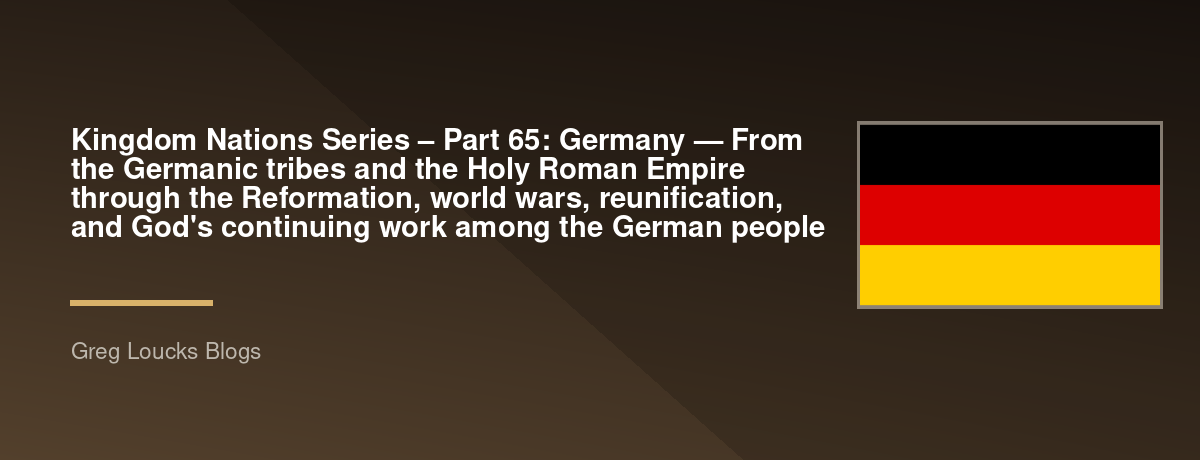
🌎 Kingdom Nations Series – Part 65: 🇩🇪 Germany — From the Germanic tribes and the Holy Roman Empire through the Reformation, world wars, reunification, and God's continuing work among the German people

🌎 Kingdom Nations Series – Part 66 🇩🇪 Chapter 1 – Part 1 Germany: Heart of Central Europe Geography, Rivers, Forests, and God's Providential Design "The earth is the LORD's and the fullness thereof, the world and those who dwell therein." — Psalm 24:1 Introduction Located in the heart of Central Europe, Germany is a land of broad river valleys, dense forests, fertile plains, alpine mountains, and historic cities that have shaped European civilization for more than two thousand years. Its forests. Great rivers. Rolling hills. Northern coastlines. Alpine peaks. And fertile farmlands have influenced the history of kings, reformers, scientists, artists, and missionaries. Germany has long served as a crossroads between northern and southern Europe. East and west. The Baltic and the Alps. The Rhine and the Danube. Empires marched across its plains. Merchants traveled its rivers. Missionaries carried the Gospel. Scholars preserved learning. Reformers proclaimed biblical truth. Long before Germanic tribes settled these lands... Long before the Holy Roman Empire... Long before the Protestant Reformation... God prepared this nation. He raised its mountains. He planted its forests. He carved its rivers. He established its fertile valleys. The Psalmist proclaimed: "The heavens declare the glory of God, and the sky above proclaims His handiwork."(Psalm 19:1) Every forest. Every mountain. Every river. Every valley. Declares the wisdom of its Creator. Where Is Germany? Germany is located in Central Europe. It borders: Denmark Poland Czechia Austria Switzerland France Luxembourg Belgium Netherlands Its northern coastline borders: North Sea Baltic Sea Germany's central location has made it one of Europe's most important crossroads for trade, culture, and diplomacy. Size and Geography Germany covers approximately 357,592 square kilometers (138,067 square miles). Major geographic regions include: North German Plain Central Uplands Rhine Valley Bavarian Plateau Black Forest Bavarian Alps Baltic Coast North Sea Coast These varied landscapes have shaped regional cultures and economies for centuries. Mountains Southern Germany contains portions of the majestic Alps. Major mountain regions include: Bavarian Alps Black Forest (Schwarzwald) Harz Mountains Ore Mountains (Erzgebirge) Bavarian Forest Germany's highest peak is: Zugspitze — approximately 2,962 meters (9,718 feet). These mountains provide: Fresh water. Tourism. Hydroelectric power. Forests. Wildlife habitat. Natural beauty. Rivers Germany possesses one of Europe's greatest river systems. Major rivers include: Rhine Danube Elbe Main Weser Oder Moselle These rivers provide: Transportation. Trade. Agriculture. Fresh water. Hydroelectric power. Fishing. The Rhine River has played one of the most significant roles in German history. The Danube River begins in Germany before flowing southeast across Europe to the Black Sea. Coastlines Germany enjoys coastlines along both the: North Sea Baltic Sea Its shores include: Beaches. Estuaries. Islands. Salt marshes. Fishing communities. Major ports. These coastlines have supported trade and maritime commerce for centuries. Forests Approximately one-third of Germany is covered by forests. Major tree species include: Beech. Oak. Spruce. Pine. Fir. Maple. Germany's forests provide: Timber. Wildlife habitat. Recreation. Carbon storage. Watershed protection. The famous Black Forest has inspired countless legends and cultural traditions. Climate Germany has a temperate climate. Conditions include: Warm summers. Cool winters. Moderate rainfall. Snow in mountain regions. Oceanic influences in the west. Continental influences in the east. These conditions support productive agriculture and diverse ecosystems. Wildlife Germany supports abundant wildlife. Animals include: Red deer. Roe deer. Wild boar. Red foxes. European badgers. Lynx. Wildcats. Golden eagles. Beavers. Numerous migratory birds. Conservation efforts have helped restore several native species. National Parks Germany protects much of its natural heritage. Major national parks include: Bavarian Forest National Park Berchtesgaden National Park Harz National Park Jasmund National Park Saxon Switzerland National Park Wadden Sea National Parks These preserve: Ancient forests. Mountain ecosystems. Coastal wetlands. River valleys. Rare wildlife. Unique geological formations. Responsible stewardship reflects gratitude for God's creation. Natural Resources Germany possesses important natural resources. These include: Coal. Lignite. Potash. Salt. Natural gas. Timber. Fertile farmland. Renewable energy resources. Its highly educated workforce has become one of its greatest national strengths. Agriculture Germany has a highly productive agricultural sector. Major products include: Wheat. Barley. Rye. Potatoes. Sugar beets. Rapeseed. Grapes. Apples. Dairy products. Pork. Germany's fertile plains and river valleys have supported farming for centuries. Cities Several cities play important national roles. Berlin The national capital. Largest city. Political center. Cultural hub. Historic symbol of reunification. Munich Capital of Bavaria. Technology center. Financial hub. Gateway to the Alps. Hamburg Germany's largest port. Commercial center. Maritime gateway. Frankfurt Financial capital. Home to the European Central Bank. Major transportation hub. Cologne Historic cathedral city. Cultural center. Major Rhine River city. Population Germany has a population of approximately 84 million people. Most residents live in: Berlin. Hamburg. Munich. Cologne. Frankfurt. Stuttgart. The Ruhr metropolitan region. Germany is the most populous country in the European Union. Languages The official language is: German Recognized regional and minority languages include: Low German Danish Sorbian Frisian Romani Germany is also home to many immigrant communities speaking numerous additional languages. One day believers from every language spoken throughout Germany will worship Jesus Christ together before His throne. Geography and Providence Germany's geography has shaped its history. Its rivers encouraged trade. Its forests provided resources. Its mountains protected communities. Its central location connected Europe. Long before kingdoms and empires arose, God prepared this land according to His sovereign purposes. Lessons from Germany's Geography Several enduring truths emerge. God Positions Nations for His Purposes Germany's location has made it a meeting place of cultures, commerce, scholarship, and Christian influence. Creation Reflects God's Glory The Alps, Black Forest, Rhine Valley, rivers, and coastlines proclaim the wisdom and beauty of the Creator. Stewardship Honors the Creator Protecting forests, rivers, wildlife, and agricultural lands reflects faithful care for God's gifts. Every Nation Has a Place in God's Redemptive Plan Germany has profoundly influenced Christian history, education, science, music, philosophy, and missions. God continues calling its people to Himself. Looking Ahead The next chapter explores ancient Germany. We will examine: Early Germanic tribes Roman frontier The Franks Charlemagne The Holy Roman Empire Martin Luther and the Protestant Reformation The Thirty Years' War German unification World Wars I and II Division during the Cold War The road to reunification Germany's story is one of remarkable achievement, profound tragedy, spiritual renewal, and God's enduring providence across two millennia of history. End of Chapter 1 – Part 1 Next: Chapter 1 – Part 2: Ancient Germany—From the Germanic Tribes to Reunification 🌎 Kingdom Nations Series – Part 66 🇩🇪 Chapter 1 – Part 2 Ancient Germany From the Germanic Tribes to Reunification (Prehistory–1990) "Remember the days of old; consider the years of many generations." — Deuteronomy 32:7 Introduction Few nations have shaped the course of European and Christian history as profoundly as Germany. Its forests sheltered ancient tribes. Its rivers carried merchants and missionaries. Its monasteries preserved learning. Its universities advanced scholarship. Its reformers challenged corruption. Its wars reshaped continents. Throughout every generation, however, God remained sovereign. The prophet Daniel declared: "He changes times and seasons; He removes kings and sets up kings."(Daniel 2:21) Empires rise. Nations unite. Kingdoms divide. Wars begin and end. But God's Kingdom remains forever. The First Peoples Long before written history, numerous peoples inhabited present-day Germany. Early communities depended upon: Agriculture. Hunting. Fishing. Animal husbandry. Metalworking. Trade. Fertile river valleys encouraged permanent settlements, while forests provided abundant resources. The Germanic Tribes By the first millennium BC, numerous Germanic tribes occupied much of Central Europe. Among them were: Cherusci Suebi Alemanni Saxons Franks Goths Bavarii Thuringians Lombards Although politically independent, these tribes shared many cultural and linguistic similarities. They valued: Family. Honor. Courage. Community. Leadership through tribal councils. Rome and Germania The Roman Empire expanded northward into parts of present-day Germany. Roman influence introduced: Roads. Trade. Military forts. Architecture. Commerce. Urban development. In AD 9, Germanic leader Arminius defeated three Roman legions in the Battle of the Teutoburg Forest. This victory permanently limited Roman expansion east of the Rhine River. The Franks Among the Germanic peoples, the Franks became the most influential. Under Clovis I, they established a powerful kingdom that eventually extended across much of Western Europe. Clovis accepted Christianity around AD 496, strengthening ties between the Frankish kingdom and the Christian Church. His conversion significantly influenced the future religious development of Europe. Charlemagne One of history's greatest rulers, Charlemagne united much of Western and Central Europe. Crowned Holy Roman Emperor in AD 800, he promoted: Christian education. Missionary work. Legal reform. Church construction. Learning. Bible scholarship. His reign became known as the Carolingian Renaissance, preserving classical learning and strengthening Christian influence throughout Europe. The Holy Roman Empire For nearly one thousand years, much of Germany formed the heart of the: Holy Roman Empire The empire consisted of numerous kingdoms, duchies, bishoprics, and free cities. Although politically diverse, the empire profoundly influenced: Law. Education. Architecture. Christian theology. European diplomacy. Its cathedrals and monasteries became important centers of learning. The Protestant Reformation One of the most significant events in Christian history began in Germany. In 1517, Martin Luther published his Ninety-five Theses in Wittenberg. The Reformation emphasized: The authority of Scripture. Salvation by grace through faith. The priesthood of all believers. Bible translation. Preaching. Congregational worship. Luther translated the Bible into German, making Scripture more accessible to ordinary people. The Reformation transformed both Germany and the wider Christian world. The Apostle Paul wrote: "For by grace you have been saved through faith."(Ephesians 2:8) The Thirty Years' War Between 1618 and 1648, much of Germany suffered during the Thirty Years' War. The conflict brought: Massive destruction. Population decline. Economic hardship. Religious conflict. Political instability. The war profoundly reshaped Central Europe and highlighted the terrible human cost of prolonged conflict. Enlightenment and Scholarship During the eighteenth century, German universities became internationally respected. German scholars contributed significantly to: Science. Music. Philosophy. Medicine. Mathematics. Engineering. The nation became one of Europe's leading intellectual centers. German Unification For centuries Germany remained divided among numerous states. In 1871, following the leadership of Otto von Bismarck, the German Empire was officially proclaimed. Unification strengthened: Industry. Transportation. Education. Military power. Economic development. Germany rapidly became one of Europe's leading industrial nations. World War I Germany played a central role in the First World War (1914–1918). The conflict resulted in: Millions of deaths. Economic devastation. Political upheaval. The collapse of the German Empire. The postwar years proved extremely difficult for the nation. World War II One of history's darkest chapters unfolded during the rule of Adolf Hitler and the Nazi regime. The Second World War brought: Widespread destruction. The Holocaust. Immense human suffering. Occupation across Europe. Millions of deaths. The systematic murder of six million Jews and millions of other victims remains one of history's greatest atrocities. Following Germany's defeat in 1945, the nation faced rebuilding, repentance, and reconstruction. Scripture reminds us: "The wages of sin is death, but the free gift of God is eternal life in Christ Jesus our Lord."(Romans 6:23) History demonstrates both humanity's capacity for great evil and the desperate need for God's redeeming grace. Division During the Cold War Following World War II, Germany was divided into: West Germany (Federal Republic of Germany) East Germany (German Democratic Republic) The city of Berlin itself was also divided. The Berlin Wall, constructed in 1961, became a global symbol of separation and political division. Reunification A peaceful movement for freedom spread across Eastern Europe during the late twentieth century. The Berlin Wall fell on November 9, 1989. On October 3, 1990, Germany was officially reunified. Families were reunited. Borders reopened. A divided nation became one once again. Lessons from Ancient Germany Several enduring truths emerge. God's Word Changes History Martin Luther's translation of Scripture and the Protestant Reformation transformed the Church and influenced millions of believers around the world. Knowledge Is a Gift to Be Used Wisely Germany's contributions to education, science, music, and scholarship demonstrate the blessings of wisdom when used for God's glory and humanity's good. Sin Has Devastating Consequences The tragedies of war, tyranny, and genocide remind humanity of the destructive power of sin and the urgent need for repentance, justice, and reconciliation. God's Kingdom Outlasts Every Empire The Roman Empire. The Frankish Kingdom. The Holy Roman Empire. The German Empire. The Third Reich. East Germany. West Germany. Every earthly kingdom eventually passes away. The Kingdom of Jesus Christ alone is everlasting. Looking Ahead The next chapter explores modern Germany. We will examine: Reunified Germany Democratic government The European Union Economic leadership Education Science and innovation Christianity today Contemporary challenges Hope for the future Modern Germany would emerge as one of the world's leading democracies, combining economic strength, scientific innovation, and a continuing effort to remember history while building a peaceful future. End of Chapter 1 – Part 2 Next: Chapter 2 – Part 1: Modern Germany—Reunification, Contemporary Society, and the Church (1990–Present) 🌎 Kingdom Nations Series – Part 66 🇩🇪 Chapter 2 – Part 1 Modern Germany Reunification, Contemporary Society, and the Church (1990–Present) "Seek the welfare of the city where I have sent you... and pray to the LORD on its behalf." — Jeremiah 29:7 Introduction Following the reunification of East and West Germany on October 3, 1990, Germany entered a new chapter marked by reconciliation, democratic stability, economic leadership, and renewed influence throughout Europe. Today Germany stands among the world's leading nations in: Engineering. Science. Education. Manufacturing. Medicine. Renewable energy. International diplomacy. Humanitarian assistance. Throughout every achievement and challenge, however, God's faithfulness remains unchanged. The writer of Hebrews reminds believers: "Jesus Christ is the same yesterday and today and forever."(Hebrews 13:8) Governments change. Economies rise and fall. Generations come and go. But Christ reigns forever. Reunification On October 3, 1990, Germany officially became one nation again. Reunification required enormous efforts to integrate: Governments. Economies. Education systems. Transportation. Infrastructure. Communities. Families separated for decades were reunited. The rebuilding of national unity became one of modern Germany's greatest achievements. Democratic Government Germany is a federal parliamentary republic. Its national government includes: The Federal President. The Federal Chancellor. The Bundestag. The Bundesrat. An independent judiciary. Sixteen federal states (Bundesländer). Germany's democratic institutions emphasize: Rule of law. Human rights. Federalism. Free elections. Constitutional government. These principles have helped build one of the world's most stable democracies. European Leadership Germany plays a leading role within Europe. It is a founding member of: The European Union. NATO. The G7. The G20. The United Nations. Germany works closely with neighboring nations to promote: Peace. Trade. Scientific cooperation. Economic development. Humanitarian assistance. International diplomacy. Economy Germany possesses Europe's largest economy. Major industries include: Automobile manufacturing. Mechanical engineering. Chemical production. Pharmaceuticals. Information technology. Robotics. Renewable energy. Finance. Precision manufacturing. German products are exported throughout the world. Innovation and skilled craftsmanship remain hallmarks of the German economy. Science and Innovation Germany continues making important contributions to global research. Areas of leadership include: Medicine. Physics. Chemistry. Engineering. Artificial intelligence. Renewable energy. Environmental science. Biotechnology. Research universities and scientific institutes continue advancing knowledge for the benefit of humanity. Education Germany has one of the world's strongest educational systems. Educational opportunities include: Primary education. Secondary schools. Technical education. Apprenticeships. Universities. Research institutes. Vocational training remains especially respected and has become a model for many other nations. Healthcare Germany maintains a highly developed healthcare system. Services include: Public and private hospitals. Medical research. Preventive care. Emergency medicine. Specialized treatment centers. Mental health services. Healthcare workers continue serving communities throughout the nation. Transportation Germany possesses one of Europe's most advanced transportation networks. Major infrastructure includes: Autobahns. High-speed railways. International airports. River ports. Canals. Public transit systems. Efficient transportation supports commerce and connects Germany with the rest of Europe. Renewable Energy Germany has invested significantly in sustainable energy. Major sources include: Wind power. Solar energy. Hydroelectric power. Biomass. Energy efficiency initiatives. Responsible stewardship seeks to preserve God's creation for future generations. Christianity Today Christianity has shaped Germany for more than 1,500 years. Major Christian traditions include: Roman Catholic Church. Evangelical Church in Germany (EKD). Free Churches. Baptist churches. Pentecostal churches. Methodist churches. Orthodox churches. Independent evangelical fellowships. Churches minister through: Biblical teaching. Prayer. Youth ministry. Refugee assistance. Christian education. Community outreach. Compassion ministries. Although church attendance has declined in many regions, faithful congregations continue proclaiming the Gospel. Religious Diversity Modern Germany is home to many religious communities. These include: Christianity. Islam. Judaism. Buddhism. Hinduism. Other faith communities. Many Germans also identify with no religious affiliation. Followers of Christ are called to proclaim the Gospel with humility, biblical truth, grace, and love. Contemporary Challenges Modern Germany continues addressing important issues. These include: An aging population. Immigration. Housing. Energy security. Economic competitiveness. Secularization. Mental health. Environmental sustainability. Churches continue responding through: Prayer. Discipleship. Youth ministry. Community service. Refugee assistance. Biblical teaching. Compassion ministries. Hope for the Future Germany possesses remarkable strengths. Strong democratic institutions. World-class education. Scientific leadership. Engineering excellence. Economic stability. Rich cultural heritage. Global influence. These strengths provide hope for future generations. Yet Scripture reminds believers that lasting hope cannot rest upon governments, technology, or economic success. Jesus declared: "In the world you will have tribulation. But take heart; I have overcome the world."(John 16:33) Germany's greatest hope remains Jesus Christ. Lessons from Modern Germany Several enduring truths emerge. Wisdom Builds Strong Nations Education, innovation, and integrity become lasting blessings when guided by humility and truth. Reconciliation Is Possible Germany's postwar rebuilding and reunification demonstrate that healing can follow even deep division. Stewardship Honors God Responsible care for creation, technology, and human flourishing reflects gratitude for God's gifts. Christ Is Germany's Lasting Hope Empires fall. Political systems change. Economies evolve. Generations pass. Jesus Christ alone remains the eternal King whose Kingdom will never end. Looking Ahead The final chapter explores Germany through a Kingdom perspective. We will examine: Religious demographics Worldview analysis Reached and less-reached peoples Bible translation Evangelism opportunities Strategic prayer Germany in God's redemptive plan Why gregloucks.com/germany matters Germany before the throne in Revelation 7 History tells the story of reformers, scholars, inventors, tragedy, reconciliation, and renewal. The Kingdom perspective reveals God's continuing work among the people of Germany. End of Chapter 2 – Part 1 Next: Chapter 3 – Part 1: Germany Before the Throne—Kingdom Vision, Mission Strategy, and Final Reflections 🌎 Kingdom Nations Series – Part 66 🇩🇪 Chapter 3 – Part 1 Germany Before the Throne Kingdom Vision, Mission Strategy, and Final Reflections "After this I looked, and behold, a great multitude that no one could number, from every nation, from all tribes and peoples and languages, standing before the throne and before the Lamb." — Revelation 7:9 Introduction Germany is a nation where mighty rivers flow through fertile valleys. Where ancient forests blanket rolling hills. Where medieval cathedrals rise above historic cities. Where reformers proclaimed God's Word. Where composers filled the world with music. Where scientists and engineers transformed modern civilization. Its mountains. Its rivers. Its forests. Its cities. Its churches. Its people. All testify to the wisdom and faithfulness of God. Yet Germany's greatest treasure is not its engineering. Not its universities. Not its music. Not its remarkable history. Its greatest treasure is its people. Every child. Every family. Every craftsman. Every teacher. Every engineer. Every student. Every believer. Created in the image of God. The Lord who formed the Rhine Valley, raised the Bavarian Alps, and planted the Black Forest knows every heart throughout Germany. The prophet Isaiah declared: "I, the LORD, the first, and with the last; I am He."(Isaiah 41:4) His faithfulness reaches every village, every city, every generation, and every home. Germany in God's Redemptive Story Few nations have influenced the history of Christianity as profoundly as Germany. For centuries God has worked among the German people. He has used: Missionaries. Monks. Pastors. Martin Luther. Bible translators. Christian educators. Church planters. Faithful families. Theologians. Churches established: Monasteries. Universities. Hospitals. Schools. Bible colleges. Mission societies. Orphanages. Compassion ministries. Germany became one of the birthplaces of the Protestant Reformation. The translation of Scripture into German transformed biblical literacy across Europe and influenced countless later Bible translations. Jesus declared: "Sanctify them in the truth; Your word is truth."(John 17:17) His Word continues changing lives throughout Germany today. A Nation of Many Peoples Modern Germany is one of Europe's most diverse nations. Among its communities are: Germans Turks Poles Russians Ukrainians Italians Syrians Romanians Greeks Croatians Numerous other international communities Together they contribute unique: Languages. Science. Music. Engineering. Business. Art. Education. Family traditions. The Gospel proclaims one Savior for every tribe and every language. The Apostle Peter declared: "You are a chosen race, a royal priesthood, a holy nation."(1 Peter 2:9) The Church Today Christianity continues serving Germany through many faithful congregations. Major Christian traditions include: Evangelical Church in Germany (EKD) Roman Catholic Church Baptist churches Pentecostal churches Methodist churches Free Evangelical churches Orthodox churches Independent evangelical fellowships Churches minister through: Biblical teaching. Prayer. Youth ministry. University outreach. Family counseling. Refugee ministries. Community service. Compassion ministries. Church planting. Many congregations are also investing in international ministry as Germany becomes home to people from every continent. Religious Demographics Religion continues influencing German society in diverse ways. Broadly speaking: Protestant and Roman Catholic churches remain the two largest historic Christian traditions. Orthodox churches have grown through immigration. Evangelical and Free Churches continue active ministry. Islam represents a significant religious community. Judaism continues rebuilding and serving historic communities. Many Germans identify with no religious affiliation. Followers of Christ are called to proclaim the Gospel with biblical conviction, humility, wisdom, and compassion. Worldview Analysis Several worldviews influence Germany today. Historic Christianity Christianity has shaped: Education. Law. Music. Literature. Architecture. Healthcare. Humanitarian service. The influence of Scripture continues to shape much of Germany's cultural heritage. Secular Humanism Modern Germany often emphasizes: Science. Reason. Individual liberty. Human rights. Technological progress. While these contribute greatly to society, Scripture reminds us that true wisdom begins with the fear of the Lord. Innovation and Stewardship German society values: Precision. Responsibility. Engineering. Research. Environmental stewardship. Hard work. These qualities can reflect God's gifts of creativity, diligence, and wise stewardship when directed toward His purposes. Hope Through Christ Economic strength. Technology. Education. Political stability. Scientific achievement. Cannot satisfy the deepest needs of the human heart. Only Jesus Christ offers forgiveness, reconciliation with God, and eternal life. Reached and Less-Reached Communities Important ministry opportunities remain among: University students. Young professionals. Immigrant communities. Refugees. Children and youth. Urban neighborhoods. People with little church involvement. The Great Commission continues calling believers to make disciples throughout Germany. Bible Translation God's Word is available in: German. Low German. Danish. Sorbian. Frisian. Russian. Turkish. Arabic. English. Numerous immigrant languages. Audio Scriptures. Children's Bibles. Digital Bible applications. Bible translation and Scripture distribution continue helping every community encounter God's Word in a language they understand. The writer of Hebrews declared: "For the word of God is living and active, sharper than any two-edged sword."(Hebrews 4:12) Opportunities for Evangelism Germany offers many opportunities for Kingdom ministry. University Ministry Universities provide opportunities for: Bible studies. Apologetics. Leadership development. Student discipleship. Mentoring. Tomorrow's leaders are being shaped today. Cross-Cultural Ministry Germany's diverse population creates opportunities for: Hospitality. Language ministries. International student outreach. Refugee assistance. Friendship evangelism. God continues bringing the nations to Germany. Church Renewal Many congregations continue praying for: Spiritual revival. Biblical discipleship. Strong families. Faithful preaching. New church plants. God continues strengthening His Church. Compassion Ministry Believers demonstrate Christ's love through: Food assistance. Homeless ministries. Counseling. Prison ministry. Medical outreach. Community service. Practical compassion reflects the heart of Jesus. Creation and Stewardship Germany's: Alps. Rhine River. Black Forest. Baltic coast. North Sea. River valleys. Farmland. All proclaim the greatness of their Creator. Believers are called to steward these gifts wisely for future generations. Prayer for Germany Pray: For wisdom for national leaders. For pastors and church leaders. For spiritual renewal throughout Germany. For university students and young professionals. For Christian families. For churches serving immigrant and refugee communities. For Bible-centered discipleship. For unity among believers. For faithful stewardship of Germany's natural resources. For every person in Germany to hear and respond to the Gospel. Paul encouraged believers: "Continue steadfastly in prayer, being watchful in it with thanksgiving."(Colossians 4:2) Why gregloucks.com/germany Matters The Germany page exists to help believers understand this influential European nation through a biblical worldview. Each country profile includes: Geography Administrative divisions Cities Government Economy History Languages Christian history Religious demographics Worldview analysis Mission opportunities Evangelism strategies Strategic prayer Biblical reflection Together these studies form a global Kingdom atlas designed to encourage: Prayer. Discipleship. Mission. Biblical understanding. Love for the nations. History becomes a testimony of God's providence. Knowledge becomes an act of worship. Germany Before the Throne History does not end with the Germanic tribes. Nor with Charlemagne. Nor with the Holy Roman Empire. Nor with Martin Luther. Nor with the Reformation. Nor with unification. Nor with division. Nor with reunification. History culminates before the throne of Jesus Christ. John saw that glorious future. Believers from: Berlin. Hamburg. Munich. Cologne. Frankfurt. Stuttgart. Leipzig. Dresden. The Rhine Valley. Bavaria. The Black Forest. Every village. Every language. Every people. Will stand before the Lamb. Some first heard the Gospel through early missionaries. Others through Luther's German Bible. Some through faithful parents. Others through pastors, teachers, missionaries, Bible translators, or acts of compassion. Their stories will differ. Their Redeemer will be the same. Together they will proclaim: "Salvation belongs to our God who sits on the throne, and to the Lamb!"(Revelation 7:10) That is Germany's eternal destiny. Not merely remarkable engineering. Not merely great universities. Not merely musical genius. But redeemed men, women, and children from every tribe and language worshiping Jesus Christ forever. Final Reflections Germany teaches us that: God's Word can transform history. Knowledge is a gift to be stewarded wisely. Repentance and reconciliation are possible through God's grace. Faithful believers can influence generations. History ultimately belongs to Jesus Christ. Most importantly, Germany reminds us that every forest, every river, every family, and every nation finds its true purpose in glorifying its Creator. The forests. The rivers. The mountains. The churches. The families. The people. All ultimately belong to the King of Kings. His Kingdom alone will never end. Final Commission As you study Germany, remember that this series is more than a history of nations. It is an invitation to see the world through the lens of Scripture. Every nation matters. Every language matters. Every people group matters. Every believer has a place in God's global mission. May the Church in Germany continue proclaiming Christ with wisdom, humility, courage, compassion, and unwavering faith. May future generations know both the remarkable history of their nation and the eternal hope found only in Jesus Christ. And may the Lamb receive the full reward of His sacrifice from the people of Germany. Amen. End of Kingdom Nations Series – Part 66: 🇩🇪 Germany Coming Next: 🌎 Kingdom Nations Series – Part 67: 🇬🇭 Ghana — From the ancient Akan kingdoms and the Ashanti Empire through European trade, colonial rule, independence, and God's continuing work among the Ghanaian people.
Read more 🌎 Kingdom Nations Series – Part 65: 🇩🇪 Germany — From the Germanic tribes and the Holy Roman Empire through the Reformation, world wars, reunification, and God's continuing work among the German people

🌎 Kingdom Nations Series – Part 64: 🇬🇪 Georgia — From the Kingdom of Colchis and Iberia through early Christianity, medieval kingdoms, Russian rule, independence, and God's continuing work among the Georgian people

🌎 Kingdom Nations Series – Part 65 🇬🇪 Chapter 1 – Part 1 Georgia: At the Crossroads of Europe and Asia Geography, Mountains, Rivers, and God's Providential Design "The earth is the LORD's and the fullness thereof, the world and those who dwell therein." — Psalm 24:1 Introduction Nestled between Eastern Europe and Western Asia, Georgia is a land of towering mountains, fertile valleys, ancient vineyards, rushing rivers, and one of the oldest Christian civilizations in the world. Its snow-covered peaks. Deep gorges. Rolling vineyards. Black Sea coastline. Ancient forests. And fertile plains have shaped a nation renowned for its resilience, hospitality, and enduring faith. Situated between Europe and Asia, Georgia has served for thousands of years as a bridge between civilizations. Empires have crossed its mountains. Merchants traveled its valleys. Missionaries proclaimed the Gospel. Kings defended its independence. Yet through every generation, God remained faithful. Long before the kingdoms of Colchis and Iberia... Long before Christianity transformed the nation... Long before medieval cathedrals crowned its hills... God prepared this land. He raised the Caucasus Mountains. He carved the valleys. He watered the vineyards. He established the rivers. The Psalmist proclaimed: "He made the moon to mark the seasons; the sun knows its time for setting."(Psalm 104:19) Every mountain. Every vineyard. Every river. Every valley. Declares the wisdom of its Creator. Where Is Georgia? Georgia is located at the crossroads of Eastern Europe and Western Asia. It borders: Russia Azerbaijan Armenia Türkiye (Turkey) Its western boundary meets the: Black Sea Its strategic location has made Georgia an important crossroads between: Europe. Asia. The Middle East. The Caucasus. For thousands of years, merchants, armies, and missionaries have traveled through this region. Size and Geography Georgia covers approximately 69,700 square kilometers (26,911 square miles). Major geographic regions include: Greater Caucasus Mountains Lesser Caucasus Mountains Kartli Plain Kakheti Colchis Lowland Black Sea Coast Javakheti Plateau The country's dramatic elevation changes create remarkable ecological diversity. Mountains Georgia is dominated by the spectacular Caucasus Mountains. Major mountain systems include: Greater Caucasus Lesser Caucasus Likhi Range Trialeti Range The nation's highest peak is: Mount Shkhara — approximately 5,193 meters (17,037 feet). These mountains provide: Fresh water. Natural defenses. Tourism. Wildlife habitat. Glaciers. Hydroelectric resources. The Caucasus has often been called one of the great mountain barriers of the world. Rivers Georgia contains numerous rivers. Major rivers include: Kura (Mtkvari) Rioni Enguri Alazani Aragvi These waterways provide: Fresh water. Agriculture. Hydroelectric power. Transportation. Fishing. Wildlife habitat. The Kura River is Georgia's longest river. The Black Sea Coast Georgia enjoys approximately 310 kilometers (190 miles) of Black Sea coastline. Its shores include: Pebble beaches. Subtropical forests. Ports. Wetlands. Resort communities. The Black Sea has connected Georgia with Europe and the Mediterranean for thousands of years. Forests Approximately 40 percent of Georgia is covered by forests. Common trees include: Beech. Oak. Chestnut. Fir. Spruce. Pine. These forests provide: Wildlife habitat. Timber. Fresh water protection. Recreation. Medicinal plants. Many forest ecosystems remain remarkably well preserved. Climate Georgia possesses diverse climates. These include: Humid subtropical conditions along the Black Sea. Continental climates inland. Alpine climates in the mountains. Semi-arid regions in the southeast. This diversity supports a wide variety of crops and ecosystems. Wildlife Georgia supports remarkable biodiversity. Animals include: Brown bears. Wolves. Lynx. Wild boar. Red deer. Chamois. Bezoar ibex. Golden eagles. Vultures. Numerous endemic species. The Caucasus Mountains are considered one of the world's biodiversity hotspots. National Parks Georgia protects much of its natural heritage. Major national parks include: Borjomi-Kharagauli National Park Tusheti National Park Kazbegi National Park Kolkheti National Park Mtirala National Park Vashlovani National Park These preserve: Mountain ecosystems. Ancient forests. Wetlands. Grasslands. Rare wildlife. Subtropical habitats. Responsible stewardship reflects gratitude for God's creation. Natural Resources Georgia possesses valuable natural resources. These include: Fresh water. Hydroelectric potential. Manganese. Copper. Gold. Forests. Mineral springs. Fertile agricultural land. The country's rivers provide significant renewable energy potential. Agriculture Agriculture has shaped Georgian life for thousands of years. Major products include: Grapes. Wine. Hazelnuts. Tea. Citrus fruits. Wheat. Corn. Vegetables. Livestock. Georgia is widely regarded as one of the birthplaces of wine, with a winemaking tradition stretching back more than 8,000 years. Cities Several cities play important national roles. Tbilisi The national capital. Largest city. Political center. Economic hub. Historic crossroads. Batumi Major Black Sea port. Tourism center. Commercial gateway. Kutaisi Historic capital. Educational center. Industrial city. Rustavi Manufacturing center. Growing metropolitan community. Zugdidi Regional center of western Georgia. Gateway to Samegrelo. Population Georgia has a population of approximately 3.7 million people. Most residents live in: Tbilisi. Kutaisi. Batumi. Rustavi. Other regional centers. Mountain communities continue preserving unique traditions. Languages The official language is: Georgian Other recognized and widely spoken languages include: Abkhaz (in Abkhazia) Armenian Azerbaijani Russian Mingrelian Svan The Georgian language possesses one of the world's most unique alphabets. One day believers from every language spoken throughout Georgia will worship Jesus Christ together before His throne. Geography and Providence Georgia's geography has shaped its history. Its mountains protected kingdoms. Its rivers sustained civilizations. Its valleys encouraged agriculture. Its coast connected continents. Long before modern borders were drawn, God prepared this remarkable land according to His sovereign purposes. Lessons from Georgia's Geography Several enduring truths emerge. God Prepares Nations for His Purposes Georgia's strategic location has connected civilizations, cultures, and the Gospel across continents. Creation Reflects God's Glory The Caucasus Mountains, forests, rivers, vineyards, and Black Sea coastline proclaim the wisdom and beauty of the Creator. Stewardship Honors the Creator Protecting mountains, forests, rivers, and wildlife reflects faithful care for God's gifts. Every Nation Has a Place in God's Redemptive Plan Georgia's unique history and ancient Christian heritage demonstrate God's continuing work among the nations. Looking Ahead The next chapter explores ancient Georgia. We will examine: Prehistoric settlements The Kingdom of Colchis The Kingdom of Iberia The coming of Christianity Saint Nino Georgia's Golden Age Mongol invasions Persian and Ottoman influence Russian rule The road to modern Georgia Georgia's story is one of ancient kingdoms, unwavering faith, remarkable resilience, and God's providence across more than three thousand years of history. End of Chapter 1 – Part 1 Next: Chapter 1 – Part 2: Ancient Georgia—From Colchis and Iberia to Independence 🌎 Kingdom Nations Series – Part 65 🇬🇪 Chapter 1 – Part 2 Ancient Georgia From Colchis and Iberia to Independence (Prehistory–1991) "Remember the days of old; consider the years of many generations." — Deuteronomy 32:7 Introduction Few nations have preserved their identity through as many centuries of conquest, invasion, and foreign rule as Georgia. Nestled within the Caucasus Mountains, Georgia has stood at the crossroads of Europe and Asia for thousands of years. Empires marched through its valleys. Kings defended its mountain fortresses. Missionaries proclaimed the Gospel. Monasteries preserved Scripture. Believers remained faithful through persecution. Throughout every generation, however, God remained sovereign. The prophet Daniel declared: "His dominion is an everlasting dominion, and His kingdom endures from generation to generation."(Daniel 4:34) Empires come and go. Borders shift. Kingdoms rise and fall. But God's Kingdom remains forever. The First Settlers Archaeological discoveries reveal that Georgia has been inhabited since prehistoric times. Some of the world's earliest evidence of human occupation has been found within present-day Georgia. Early communities depended upon: Agriculture. Animal husbandry. Fishing. Trade. Metalworking. Village life. The fertile valleys and abundant rivers supported growing civilizations. The Kingdom of Colchis By the first millennium BC, western Georgia became known as the: Kingdom of Colchis Colchis gained fame throughout the ancient world through: Trade. Agriculture. Metalworking. Black Sea commerce. Greek mythology. The ancient Greek legend of Jason and the Argonauts placed the mythical Golden Fleece in Colchis, reflecting the region's wealth and importance. The Kingdom of Iberia Eastern Georgia developed into the: Kingdom of Iberia (Kartli) The kingdom became an important regional power. Its rulers maintained relationships with: Rome. Persia. Neighboring Caucasian kingdoms. The Silk Road. Its strategic location brought both prosperity and frequent conflict. The Coming of Christianity Georgia became one of the world's earliest Christian nations. According to historic Christian tradition, Saint Nino preached the Gospel during the early fourth century. King Mirian III accepted Christianity, and in approximately AD 337, Christianity became the official religion of the kingdom. Churches were established throughout the land. Monasteries flourished. Scripture was translated. Christian education expanded. Jesus declared: "You are the light of the world."(Matthew 5:14) The light of Christ spread across the Caucasus. The Georgian Alphabet One of Georgia's greatest cultural achievements was the development of the unique: Georgian alphabet The script enabled: Bible translation. Christian literature. Education. Historical records. Worship. The written language became central to preserving both faith and national identity. The Golden Age Between the eleventh and early thirteenth centuries, Georgia experienced its celebrated: Golden Age Under rulers including King David IV ("the Builder") and Queen Tamar, Georgia became one of the strongest kingdoms in the Caucasus. The era witnessed: Military victories. Church construction. Literary achievement. Economic prosperity. Expansion of education. Growth of monasteries. Many of Georgia's magnificent cathedrals and monasteries date from this remarkable period. Mongol Invasions Beginning in the thirteenth century, Mongol armies invaded Georgia. The invasions brought: Political instability. Economic decline. Destruction. Heavy taxation. Although the Georgian kingdom survived, its strength was greatly weakened. Persian and Ottoman Influence For centuries Georgia found itself caught between two competing empires: The Persian Empire. The Ottoman Empire. Many regions experienced repeated invasions and changing political control. Despite these hardships, Georgian Christianity remained central to the nation's identity. The Church preserved: Language. Culture. History. Faith. National unity. Russian Rule In 1801, eastern Georgia was formally annexed by the Russian Empire. Later, the remainder of Georgia also came under Russian control. Russian rule introduced: Administrative reforms. Infrastructure. Industrial development. Educational institutions. At the same time, many Georgians sought to preserve: Their language. Their Orthodox Christian heritage. Their national identity. Brief Independence Following the collapse of the Russian Empire, Georgia declared independence on: May 26, 1918 The Democratic Republic of Georgia lasted only a few years before Soviet forces invaded in 1921. Soviet Rule Georgia became one of the republics of the: Soviet Union During the Soviet era: Many churches were closed. Religious activity faced restrictions. Christian leaders experienced persecution. Private worship often continued despite government opposition. Even under official atheism, many believers remained faithful. Jesus had promised: "I will build My church, and the gates of hell shall not prevail against it."(Matthew 16:18) The Church endured. The Road to Independence During the late twentieth century, movements for greater freedom and national self-determination gained momentum. Following the dissolution of the Soviet Union, Georgia restored its independence on: April 9, 1991 A new chapter in Georgian history had begun. Lessons from Ancient Georgia Several enduring truths emerge. Faith Preserves Nations Christianity shaped Georgia's identity through centuries of invasion and hardship. God's Word Endures The Georgian alphabet, Bible translation, and faithful teaching preserved both Scripture and national heritage. Perseverance Honors God Generation after generation remained faithful despite conquest, persecution, and political upheaval. God's Kingdom Outlasts Every Empire The Kingdom of Colchis. The Kingdom of Iberia. The Mongol Empire. The Persian Empire. The Ottoman Empire. The Russian Empire. The Soviet Union. Every earthly kingdom eventually passes away. The Kingdom of Jesus Christ alone is everlasting. Looking Ahead The next chapter explores modern Georgia. We will examine: Restored independence Democratic development Contemporary government Economic reforms Education Tourism The Georgian Orthodox Church today Contemporary challenges Hope for the future Modern Georgia would emerge as a resilient democracy seeking to preserve its ancient Christian heritage while engaging the opportunities and challenges of the twenty-first century. End of Chapter 1 – Part 2 Next: Chapter 2 – Part 1: Modern Georgia—Independence, Contemporary Society, and the Church (1991–Present) 🌎 Kingdom Nations Series – Part 65 🇬🇪 Chapter 2 – Part 1 Modern Georgia Independence, Contemporary Society, and the Church (1991–Present) "Unless the LORD builds the house, those who build it labor in vain." — Psalm 127:1 Introduction Following the restoration of its independence on April 9, 1991, Georgia entered a new era marked by political transformation, economic reform, renewed religious freedom, and national rebuilding. Emerging from decades of Soviet rule, the Georgian people sought to restore democratic institutions while preserving one of the world's oldest Christian traditions. Today Georgia is recognized for: Ancient Christian heritage. Mountain landscapes. Growing tourism. Hospitality. Wine production. Strategic international partnerships. Cultural resilience. Throughout every challenge and opportunity, God's faithfulness has remained unchanged. The prophet Isaiah declared: "Those who hope in the LORD shall renew their strength."(Isaiah 40:31) Governments may change. Economies may develop. Generations may pass. But the Lord remains forever. Restored Independence On April 9, 1991, Georgia officially restored its independence following the collapse of the Soviet Union. The new republic faced immediate challenges. These included: Economic instability. Political transition. Regional conflicts. Institution building. National reconstruction. Despite significant difficulties, Georgia continued strengthening its democratic system and national identity. Democratic Government Georgia is a democratic republic. Its government includes: The President. The Prime Minister. The Parliament. An independent judiciary. Local self-governing municipalities. Since independence, Georgia has pursued constitutional reforms designed to strengthen democratic institutions, transparency, and the rule of law. Economic Development Georgia has undertaken significant economic reforms. Major sectors include: Tourism. Agriculture. Wine production. Hydroelectric power. Transportation. Construction. Financial services. Information technology. The nation serves as an important transportation corridor connecting Europe and Asia. Agriculture Agriculture remains an important part of Georgian life. Major products include: Wine grapes. Hazelnuts. Tea. Citrus fruits. Wheat. Corn. Vegetables. Livestock. Georgia's ancient winemaking tradition continues to contribute significantly to both its culture and economy. Tourism Tourism has become one of Georgia's fastest-growing industries. Visitors come to experience: The Caucasus Mountains. Ancient monasteries. Historic churches. Black Sea beaches. Traditional villages. National parks. Wine regions. Unique cuisine. Tourism supports local businesses while introducing visitors to Georgia's remarkable history and culture. Education Education continues expanding throughout the country. The nation has invested in: Primary education. Secondary schools. Universities. Vocational training. Research institutions. Teacher development. Educational reform remains an important national priority. Healthcare Healthcare services have continued developing since independence. Medical care includes: Public hospitals. Private clinics. Emergency services. Maternal healthcare. Preventive medicine. Medical education. Healthcare professionals continue serving communities across both urban and rural Georgia. Transportation Georgia's location makes transportation especially important. Modern infrastructure includes: International highways. Railways. Black Sea ports. International airports. Mountain highways. Energy pipelines. These transportation networks strengthen commerce between Europe and Asia. Christianity Today Georgia remains one of the world's most historically Christian nations. Major Christian traditions include: Georgian Orthodox Church. Armenian Apostolic Church. Roman Catholic Church. Baptist churches. Pentecostal churches. Evangelical churches. Independent fellowships. Churches minister through: Biblical teaching. Prayer. Youth ministry. Family counseling. Community service. Christian education. Compassion ministries. The Georgian Orthodox Church continues playing a significant role in national life and cultural identity. Religious Diversity Modern Georgia includes several religious communities. These include: Orthodox Christianity. Islam. Armenian Apostolic Christianity. Roman Catholicism. Protestant Christianity. Judaism. Other faith communities. Georgia's constitution protects freedom of religion while recognizing the historic importance of the Georgian Orthodox Church. Followers of Christ are called to demonstrate biblical truth with humility, wisdom, and love. Contemporary Challenges Modern Georgia continues addressing important issues. These include: Economic development. Population decline. Regional security. Youth employment. Judicial reform. Rural development. Infrastructure. Relations with neighboring regions. Churches continue responding through: Prayer. Discipleship. Youth ministry. Compassion ministries. Community development. Family support. Biblical teaching. Environmental Stewardship Georgia possesses extraordinary natural beauty. Its stewardship efforts include protecting: The Caucasus Mountains. Ancient forests. Black Sea ecosystems. National parks. Rivers. Wildlife. Responsible stewardship reflects gratitude for God's creation and care for future generations. Hope for the Future Georgia possesses remarkable strengths. Ancient Christian heritage. Strong family traditions. Beautiful landscapes. Growing tourism. Rich agricultural resources. Strategic location. Resilient people. These strengths provide hope for future generations. Yet Scripture reminds believers that lasting hope cannot rest upon governments, economies, or national history. The Apostle Paul wrote: "For we walk by faith, not by sight."(2 Corinthians 5:7) Georgia's greatest hope remains Jesus Christ. Lessons from Modern Georgia Several enduring truths emerge. Faith Strengthens Nations Georgia's Christian heritage has provided hope through centuries of hardship and renewal. Freedom Requires Responsibility Political liberty flourishes alongside integrity, justice, and servant leadership. Hospitality Reflects God's Love Welcoming strangers and caring for neighbors remain enduring expressions of biblical compassion. Christ Is Georgia's Lasting Hope Empires collapse. Governments change. Borders shift. Generations pass. Jesus Christ alone remains the eternal King whose Kingdom will never end. Looking Ahead The final chapter explores Georgia through a Kingdom perspective. We will examine: Religious demographics Worldview analysis Reached and less-reached peoples Bible translation Evangelism opportunities Strategic prayer Georgia in God's redemptive plan Why gregloucks.com/georgia matters Georgia before the throne in Revelation 7 History tells the story of ancient kingdoms, unwavering faith, and remarkable perseverance. The Kingdom perspective reveals God's continuing work among the people of Georgia. End of Chapter 2 – Part 1 Next: Chapter 3 – Part 1: Georgia Before the Throne—Kingdom Vision, Mission Strategy, and Final Reflections 🌎 Kingdom Nations Series – Part 65 🇬🇪 Chapter 3 – Part 1 Georgia Before the Throne Kingdom Vision, Mission Strategy, and Final Reflections "After this I looked, and behold, a great multitude that no one could number, from every nation, from all tribes and peoples and languages, standing before the throne and before the Lamb." — Revelation 7:9 Introduction Georgia is a nation where towering mountains touch the clouds. Where ancient monasteries overlook fertile valleys. Where vineyards have flourished for thousands of years. Where the Gospel has shaped a civilization since the earliest centuries of the Church. Its mountains. Its rivers. Its forests. Its vineyards. Its churches. Its people. All testify to the wisdom and faithfulness of God. Yet Georgia's greatest treasure is not its breathtaking landscapes. Not its ancient churches. Not its historic monasteries. Not its celebrated hospitality. Its greatest treasure is its people. Every child. Every family. Every shepherd. Every farmer. Every teacher. Every student. Every believer. Created in the image of God. The Lord who raised the Caucasus Mountains and watered the valleys of Kartli and Kakheti knows every heart throughout Georgia. The prophet Isaiah declared: "Fear not, for I am with you; be not dismayed, for I am your God."(Isaiah 41:10) His faithfulness reaches every mountain village, every Black Sea community, every city, and every generation. Georgia in God's Redemptive Story Georgia occupies a unique place in Christian history. It became one of the earliest nations to embrace Christianity as its official faith. For centuries God has faithfully worked among the Georgian people. He has used: Saint Nino. Pastors. Monks. Bible translators. Missionaries. Christian families. Church planters. Faithful local believers. Churches established: Monasteries. Schools. Hospitals. Bible education. Youth ministries. Community outreach. Compassion ministries. Centers of learning. During centuries of invasion and foreign rule, the Church helped preserve both biblical faith and national identity. Jesus declared: "Be faithful unto death, and I will give you the crown of life."(Revelation 2:10) The witness of faithful believers continues throughout Georgia today. A Nation of Many Peoples Modern Georgia is home to diverse communities. Among them are: Georgians Armenians Azerbaijanis Abkhaz Ossetians Russians Greeks Assyrians Yezidis Other ethnic communities Together they contribute unique: Languages. Music. Art. Architecture. Agriculture. Business. Scholarship. Family traditions. The Gospel proclaims one Savior for every tribe and every language. The Apostle Paul wrote: "For there is no distinction between Jew and Greek; for the same Lord is Lord of all."(Romans 10:12) The Church Today Christianity remains central to Georgia's national identity. Major Christian traditions include: Georgian Orthodox Church Armenian Apostolic Church Roman Catholic Church Baptist churches Pentecostal churches Evangelical churches Independent Christian fellowships Churches minister through: Biblical teaching. Prayer. Youth discipleship. Christian education. Family counseling. Community outreach. Compassion ministries. Mission work. Faithful congregations continue serving both urban and rural communities. Religious Demographics Religion continues shaping Georgian society. Broadly speaking: The Georgian Orthodox Church remains the largest Christian body. The Armenian Apostolic Church serves many Armenian communities. Protestant and Evangelical churches continue active ministry. Islam is practiced by several ethnic communities. Smaller Jewish, Catholic, and other religious communities contribute to the nation's religious diversity. Followers of Christ are called to proclaim the Gospel with biblical conviction, humility, and Christlike love. Worldview Analysis Several worldviews influence Georgia today. Historic Christianity Christianity has shaped: Education. Law. Art. Architecture. Music. Literature. Family life. National identity. The Gospel has influenced Georgian society for more than sixteen centuries. Cultural Heritage Georgia treasures: Hospitality. Family. Respect for elders. Ancient traditions. Historical memory. Community life. These values often complement biblical principles of honoring others and loving one's neighbor. National Identity Centuries of perseverance have strengthened Georgia's appreciation for: Freedom. Faith. Family. Cultural preservation. Responsible citizenship. These qualities continue shaping modern society. Hope Through Christ Ancient history. Beautiful churches. National traditions. Economic progress. Cannot satisfy humanity's deepest need. Only Jesus Christ offers forgiveness, reconciliation with God, and eternal life. Reached and Less-Reached Communities Important ministry opportunities remain among: Children. University students. Young professionals. Mountain communities. Urban neighborhoods. Ethnic minority communities. People with little biblical understanding. The Great Commission continues calling believers to make disciples throughout Georgia. Bible Translation God's Word is available in: Georgian. Abkhaz. Armenian. Azerbaijani. Russian. Ossetian (selected portions and resources). Audio Scriptures. Children's Bibles. Digital Bible applications. Bible translation continues ensuring that every community can encounter God's Word in the language of their hearts. The Psalmist declared: "Forever, O LORD, Your word is firmly fixed in the heavens."(Psalm 119:89) Opportunities for Evangelism Georgia offers many opportunities for Kingdom ministry. Student Ministry Universities provide opportunities for: Bible studies. Leadership development. Discipleship. Apologetics. Mentoring. Tomorrow's leaders are being equipped today. Village Ministry Mountain villages and rural communities continue benefiting from: Church planting. Pastoral training. Bible teaching. Children's ministry. Family discipleship. Healthy churches strengthen healthy communities. Compassion Ministry Believers demonstrate Christ's love through: Medical outreach. Food assistance. Counseling. Youth programs. Family support. Community development. Practical compassion reflects the heart of Jesus. Cross-Cultural Ministry Georgia's position between Europe and Asia creates opportunities for: International student ministry. Neighboring ethnic outreach. Hospitality. Mission partnerships. Friendship evangelism. God continues bringing many peoples through Georgia. Prayer for Georgia Pray: For wisdom for national leaders. For pastors and church leaders. For continued spiritual renewal. For Christian families. For university students and young adults. For churches serving ethnic minority communities. For biblical discipleship throughout the nation. For peace, justice, and reconciliation. For faithful stewardship of Georgia's natural beauty. For every person in Georgia to hear and respond to the Gospel. Paul encouraged believers: "Be constant in prayer."(Romans 12:12) Why gregloucks.com/georgia Matters The Georgia page exists to help believers understand this remarkable Caucasian nation through a biblical worldview. Each country profile includes: Geography Administrative divisions Cities Government Economy History Languages Christian history Religious demographics Worldview analysis Mission opportunities Evangelism strategies Strategic prayer Biblical reflection Together these studies form a global Kingdom atlas designed to encourage: Prayer. Discipleship. Mission. Biblical understanding. Love for the nations. History becomes a testimony of God's providence. Knowledge becomes an act of worship. Georgia Before the Throne History does not end with Colchis. Nor with Iberia. Nor with Saint Nino. Nor with King David the Builder. Nor with Queen Tamar. Nor with centuries of invasion. Nor with Soviet rule. Nor with restored independence. History culminates before the throne of Jesus Christ. John saw that glorious future. Believers from: Tbilisi. Batumi. Kutaisi. Rustavi. Zugdidi. Kakheti. Svaneti. The Caucasus Mountains. The Black Sea coast. Every village. Every language. Every people. Will stand before the Lamb. Some first heard the Gospel through Saint Nino. Others through faithful parents. Some through pastors. Others through monks, Bible translators, missionaries, teachers, or acts of compassion. Their stories will differ. Their Redeemer will be the same. Together they will proclaim: "Salvation belongs to our God who sits on the throne, and to the Lamb!"(Revelation 7:10) That is Georgia's eternal destiny. Not merely ancient monasteries. Not merely magnificent mountains. Not merely enduring traditions. But redeemed men, women, and children from every tribe and language worshiping Jesus Christ forever. Final Reflections Georgia teaches us that: Faith can preserve a nation through centuries of hardship. God's Word strengthens both people and culture. Hospitality reflects the heart of Christ. Perseverance glorifies God. History ultimately belongs to Jesus Christ. Most importantly, Georgia reminds us that every mountain, every valley, every family, and every nation finds its true purpose in glorifying its Creator. The mountains. The rivers. The vineyards. The churches. The families. The people. All ultimately belong to the King of Kings. His Kingdom alone will never end. Final Commission As you study Georgia, remember that this series is more than a history of nations. It is an invitation to see the world through the lens of Scripture. Every nation matters. Every language matters. Every people group matters. Every believer has a place in God's global mission. May the Church in Georgia continue proclaiming Christ with wisdom, humility, courage, compassion, and unwavering faith. May future generations know both the remarkable heritage of their nation and the eternal hope found only in Jesus Christ. And may the Lamb receive the full reward of His sacrifice from the people of Georgia. Amen. End of Kingdom Nations Series – Part 65: 🇬🇪 Georgia Coming Next: 🌎 Kingdom Nations Series – Part 66: 🇩🇪 Germany — From the Germanic tribes and the Holy Roman Empire through the Reformation, world wars, reunification, and God's continuing work among the German people.

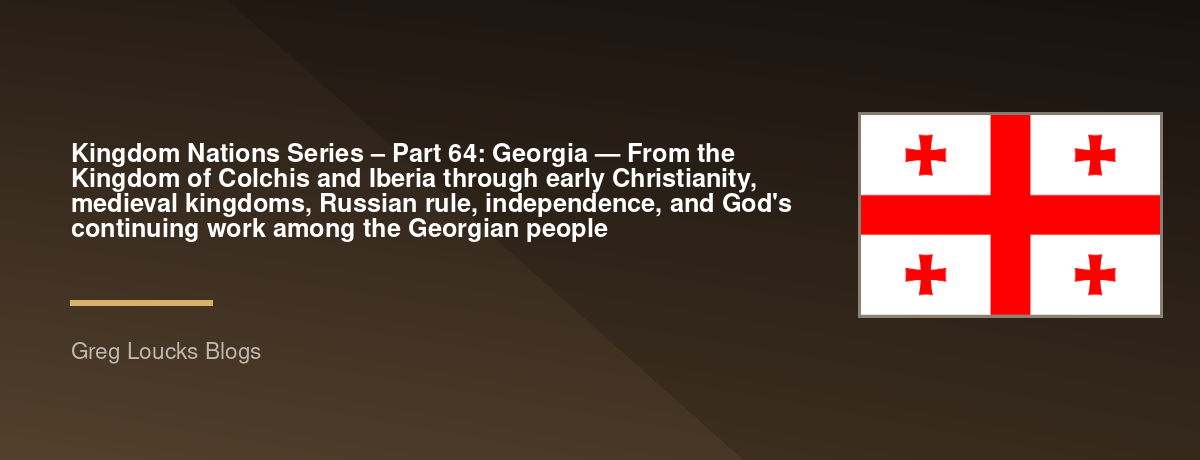
Read more 🌎 Kingdom Nations Series – Part 64: 🇬🇪 Georgia — From the Kingdom of Colchis and Iberia through early Christianity, medieval kingdoms, Russian rule, independence, and God's continuing work among the Georgian people

🌎 Kingdom Nations Series – Part 63: 🇬🇲 The Gambia — From the ancient empires of West Africa and the Gambia River kingdoms through European trade, British colonial rule, independence, modern democracy, and God's continuing work among the Gambian people

🌎 Kingdom Nations Series – Part 64 🇬🇲 Chapter 1 – Part 1 The Gambia: The River That Shaped a Nation Geography, Rivers, Coastlines, and God's Providential Design "The earth is the LORD's and the fullness thereof, the world and those who dwell therein." — Psalm 24:1 Introduction Nestled within West Africa, The Gambia is the smallest country on the African mainland, yet it possesses a remarkable history shaped by one extraordinary feature—the Gambia River. Its winding river. Mangrove forests. Atlantic coastline. Savannas. Wetlands. And fertile floodplains have sustained life for thousands of years. Unlike nearly every other nation, The Gambia is built almost entirely around a single river. Flowing more than 1,100 kilometers (680 miles) from the Fouta Djallon Highlands of Guinea to the Atlantic Ocean, the Gambia River has served as the nation's lifeline. It has provided: Transportation. Food. Trade. Agriculture. Communication. Settlement. Long before kingdoms flourished along its banks... Long before European ships entered its estuary... Long before the Gospel reached West Africa... God prepared this land. He carved its river. He nourished its forests. He filled its wetlands with life. He established its fertile valleys. The Psalmist proclaimed: "You visit the earth and water it; You greatly enrich it; the river of God is full of water."(Psalm 65:9) Every river. Every mangrove. Every bird. Every village. Declares the wisdom of its Creator. Where Is The Gambia? The Gambia is located in West Africa. It is almost completely surrounded by: Senegal Its western boundary meets the: Atlantic Ocean The country follows the course of the Gambia River for approximately 480 kilometers (300 miles) inland. Its unusual shape makes it one of the world's most geographically distinctive nations. Size and Geography The Gambia covers approximately 11,295 square kilometers (4,361 square miles). It is the smallest country on mainland Africa. Major geographic regions include: Atlantic Coastal Plain Lower Gambia Valley Central River Region Upper River Region Mangrove Swamps Savannah Woodlands The country's geography is remarkably flat, with gently rolling terrain throughout most of the nation. The Gambia River The Gambia River is the defining feature of the nation. It begins in the highlands of Guinea before flowing through Senegal and The Gambia into the Atlantic Ocean. The river provides: Fresh water. Fishing. Transportation. Agriculture. Wildlife habitat. Tourism. For centuries, villages and towns have depended upon its waters. Coastline The Gambia has approximately 80 kilometers (50 miles) of Atlantic coastline. Its coast includes: Sandy beaches. Estuaries. Mangrove forests. Fishing communities. Tourist resorts. The Atlantic Ocean has long connected The Gambia with neighboring nations and the wider world. Wetlands and Mangroves The lower river contains extensive wetlands. These include: Mangrove forests. Tidal marshes. Floodplains. Estuaries. These ecosystems provide habitat for: Fish. Crabs. Birds. Crocodiles. Manatees. They also protect coastal communities from erosion. Forests Although much of the country consists of savanna, forested areas remain important. Common vegetation includes: Baobab trees. Acacia. Mahogany. Oil palms. Mangroves. Gallery forests. These forests provide: Wildlife habitat. Firewood. Medicinal plants. Building materials. Shade. Climate The Gambia has a tropical climate. Conditions include: A rainy season. A long dry season. Warm temperatures year-round. Seasonal winds from the Sahara. The seasonal rains support farming throughout much of the country. Wildlife The Gambia supports remarkable biodiversity. Animals include: Hippopotamuses. Crocodiles. Monkeys. Bushbucks. Warthogs. Dolphins. Manatees. Numerous reptiles. More than 500 species of birds. The country is internationally recognized as one of Africa's premier birdwatching destinations. National Parks and Protected Areas The Gambia protects important ecosystems through several reserves. Major protected areas include: Kiang West National Park River Gambia National Park Abuko Nature Reserve Bao Bolong Wetland Reserve Tanbi Wetland Complex These preserve: Wetlands. River habitats. Savannas. Forests. Bird populations. Endangered wildlife. Responsible stewardship reflects gratitude for God's creation. Natural Resources The Gambia possesses several natural resources. These include: Fisheries. Fertile agricultural land. Fresh water. Forests. Sand and gravel. Titanium-bearing mineral sands (limited). Tourism resources. The nation's greatest natural resource remains the fertile Gambia River basin. Agriculture Agriculture employs a significant portion of the population. Major products include: Groundnuts (peanuts). Rice. Millet. Maize. Sorghum. Cassava. Vegetables. Livestock. Fishing remains an important source of food and income. Groundnuts have historically been one of The Gambia's most important export crops. Cities Several cities play important national roles. Banjul The national capital. Located on St. Mary's Island near the river's mouth. Government center. Historic port. Serekunda The largest city. Commercial center. Rapidly growing urban community. Brikama Educational center. Agricultural region. Known for woodcarving and craftsmanship. Farafenni Major transportation hub. Gateway to northern regions. Trading center. Population The Gambia has a population of approximately 2.9 million people. Most residents live along: The Gambia River. The Atlantic coast. The greater Banjul metropolitan area. The country has one of the youngest populations in Africa. Languages The official language is: English Widely spoken national languages include: Mandinka Wolof Fula (Fulfulde) Jola Serer Sarahule (Soninke) Arabic is also used in Islamic religious education. One day believers from every language spoken throughout The Gambia will worship Jesus Christ together before His throne. Geography and Providence The Gambia's geography has shaped its history. Its river sustained civilizations. Its fertile plains supported agriculture. Its coastline encouraged trade. Its wetlands protected wildlife. Long before colonial borders were drawn, God prepared this land according to His sovereign purposes. Lessons from The Gambia's Geography Several enduring truths emerge. God Provides Through Living Water The Gambia River demonstrates God's faithful provision for generations of people. Creation Reflects God's Glory The river, wetlands, forests, birds, and coastlines proclaim the wisdom and beauty of the Creator. Stewardship Honors the Creator Protecting rivers, wetlands, wildlife, and forests reflects faithful care for God's gifts. Every Nation Has a Place in God's Redemptive Plan Though geographically small, The Gambia has a significant place in God's unfolding purposes among the nations. Looking Ahead The next chapter explores ancient The Gambia. We will examine: Early settlements The Ghana, Mali, and Songhai Empires The Kingdom of Kaabu Trans-Saharan trade European exploration The Atlantic slave trade British colonial rule The coming of Christianity The road to independence The Gambia's story is one of great West African kingdoms, river commerce, colonial transformation, enduring faith, and God's continuing providence along one of Africa's great rivers. End of Chapter 1 – Part 1 Next: Chapter 1 – Part 2: Ancient The Gambia—From the Great West African Empires to Independence 🌎 Kingdom Nations Series – Part 64 🇬🇲 Chapter 1 – Part 2 Ancient The Gambia From the Great West African Empires to Independence (Prehistory–1965) "Remember the days of old; consider the years of many generations." — Deuteronomy 32:7 Introduction Long before The Gambia became an independent nation, the fertile banks of the Gambia River nurtured thriving communities that traded, farmed, fished, and participated in some of West Africa's greatest civilizations. Merchants traveled by canoe. Kings ruled powerful kingdoms. Islamic scholars established centers of learning. European ships entered the river. Missionaries proclaimed the Gospel. Colonial governments reshaped society. Throughout every generation, however, God remained sovereign. The prophet Isaiah declared: "The grass withers, the flower fades, but the word of our God will stand forever."(Isaiah 40:8) Empires rise. Kingdoms fall. Borders change. But God's Kingdom remains forever. The First Peoples Archaeological evidence shows that people have lived along the Gambia River for thousands of years. Early communities depended upon: Fishing. Hunting. Agriculture. River transportation. Trade. Village cooperation. The fertile floodplains provided abundant food and fresh water, encouraging permanent settlements. The Great West African Empires For many centuries, the region surrounding present-day The Gambia was influenced by several powerful West African empires. These included: Ghana Empire Mali Empire Songhai Empire Although The Gambia itself was not always governed directly by these empires, the river became an important part of their extensive trade networks. Merchants exchanged: Gold. Salt. Ivory. Leather. Textiles. Iron tools. Agricultural products. Trade helped connect West Africa with North Africa and the Mediterranean world. The Kingdom of Kaabu One of the most influential regional powers was the Kingdom of Kaabu. Founded during the era of the Mali Empire, Kaabu controlled much of the region surrounding the upper Gambia River. The kingdom became known for: Military strength. Agriculture. Trade. Oral traditions. Regional leadership. Many of today's ethnic communities trace aspects of their history to the Kaabu Kingdom. Traditional Societies Numerous ethnic groups established thriving communities throughout the region. Among them were: Mandinka Wolof Fula Jola Serer Sarahule (Soninke) Leadership often rested with: Village chiefs. Clan elders. Family leaders. Religious scholars. Community councils. These societies valued: Hospitality. Family. Respect for elders. Community cooperation. Oral history. The Spread of Islam Beginning around the eleventh century, Islam gradually spread throughout the Gambia River region. Muslim merchants and scholars introduced: Arabic literacy. Islamic education. Trade networks. Religious scholarship. Mosques. Over time, Islam became deeply rooted among many Gambian communities and continues to shape the nation's culture today. European Exploration In the fifteenth century, Portuguese explorers reached the Gambia River. They were later followed by: Dutch traders. French merchants. British traders. Commercial companies. Missionaries. European interest focused largely on commerce along the river. The Atlantic Slave Trade Like much of West Africa, The Gambia was deeply affected by the Atlantic slave trade. For centuries, countless men, women, and children were forcibly taken from West Africa and transported across the Atlantic. The slave trade brought: Human suffering. Family separation. Political instability. Economic disruption. The legacy of this tragedy remains an important part of Gambian history and serves as a reminder of humanity's need for justice, repentance, and reconciliation. Scripture declares: "He has told you, O man, what is good... to do justice, and to love kindness, and to walk humbly with your God."(Micah 6:8) British Colonial Rule During the nineteenth century, Britain gradually established control over the Gambia River. In 1888, The Gambia became a separate British colony. British administration introduced: Colonial government. Mission schools. Road construction. Healthcare. Modern administration. Expansion of commerce. Banjul became the administrative capital. Christianity Comes to The Gambia Christian missionaries arrived during the colonial period. They established: Churches. Schools. Medical clinics. Bible teaching ministries. Teacher training. Literacy programs. Although Christians remain a minority within The Gambia, the Church has faithfully contributed to: Education. Healthcare. Community service. Compassion ministries. The Gospel continues to be proclaimed with humility and love. Jesus declared: "You are the light of the world."(Matthew 5:14) Toward Self-Government Following World War II, constitutional reforms gradually expanded local political participation. Gambian leaders worked toward: Representative government. Economic development. Educational advancement. National unity. Negotiations with Britain continued throughout the 1950s and early 1960s. Independence On February 18, 1965, The Gambia became an independent nation within the Commonwealth. The new country inherited: A functioning civil service. Growing educational institutions. Christian and Muslim religious communities. Strong agricultural traditions. The life-giving Gambia River. A new chapter in national history had begun. Lessons from Ancient The Gambia Several enduring truths emerge. God Provides Through Rivers The Gambia River has sustained generations of people through God's faithful provision. Trade Can Bless or Harm Commerce brought prosperity to many communities, yet the Atlantic slave trade reminds us that economic gain without justice produces great suffering. The Gospel Brings Hope Christian schools, churches, and medical ministries have faithfully served communities while proclaiming the love of Christ. God's Kingdom Outlasts Every Empire The Ghana Empire. The Mali Empire. The Songhai Empire. The Kingdom of Kaabu. The British Empire. Every earthly kingdom eventually passes away. The Kingdom of Jesus Christ alone is everlasting. Looking Ahead The next chapter explores modern The Gambia. We will examine: Independence Democratic government Economy Agriculture Tourism Education Healthcare Christianity today Religious diversity Contemporary challenges Hope for the future Modern The Gambia would emerge as one of West Africa's most peaceful nations while continuing to build upon its rich cultural heritage, strong family traditions, and growing Christian witness. End of Chapter 1 – Part 2 Next: Chapter 2 – Part 1: Modern The Gambia—Independence, Contemporary Society, and the Church (1965–Present) 🌎 Kingdom Nations Series – Part 64 🇬🇲 Chapter 2 – Part 1 Modern The Gambia Independence, Contemporary Society, and the Church (1965–Present) "Blessed is the nation whose God is the LORD, the people whom He has chosen as His heritage." — Psalm 33:12 Introduction Since gaining independence on February 18, 1965, The Gambia has worked to strengthen democratic institutions, expand education, develop its economy, and improve the well-being of its people. Although geographically small, the nation occupies an important place in West Africa because of its strategic location along the Gambia River and its long tradition of peaceful coexistence among diverse ethnic and religious communities. Today The Gambia is recognized for: Agriculture. Tourism. River commerce. Hospitality. Religious tolerance. Rich cultural traditions. Throughout every season of growth and challenge, God's faithfulness has remained constant. The prophet Jeremiah declared: "The steadfast love of the LORD never ceases; His mercies never come to an end."(Lamentations 3:22) Governments may change. Economies may fluctuate. Generations may pass. But the Lord remains faithful forever. Independence On February 18, 1965, The Gambia became an independent constitutional monarchy within the Commonwealth. In 1970, following a national referendum, the country became the: Republic of The Gambia The new republic began building: National institutions. Educational systems. Healthcare services. Infrastructure. Economic development. National unity. Government The Gambia is a presidential republic. Its national institutions include: The President. The Vice President. The National Assembly. The Judiciary. Local government authorities. The country has experienced periods of both democratic government and political transition. In recent years, efforts have focused on: Strengthening democratic institutions. Rule of law. Constitutional governance. Human rights. Public accountability. Economy The Gambian economy depends upon several important sectors. These include: Agriculture. Fishing. Tourism. Trade. Transportation. Small business. Financial services. International development partnerships. Small and medium-sized enterprises play an important role in local employment. Agriculture Agriculture remains one of the nation's largest employers. Major products include: Groundnuts (peanuts). Rice. Millet. Maize. Cassava. Vegetables. Fruit. Livestock. Fishing also supports many rural families along the Gambia River. Seasonal farming remains central to village life. Tourism Tourism has become one of The Gambia's leading industries. Visitors are drawn by: Atlantic beaches. Birdwatching. Wildlife reserves. River cruises. Historic sites. Warm hospitality. Rich cultural traditions. Tourism creates employment while introducing visitors to Gambian history and culture. Education Education continues expanding throughout the country. The nation has invested in: Primary education. Secondary schools. Universities. Teacher training. Technical education. Adult literacy. Educational opportunities continue preparing young Gambians for leadership and service. Healthcare Healthcare services continue developing. Medical care includes: Public hospitals. Regional clinics. Maternal healthcare. Vaccination programs. Disease prevention. Community health initiatives. Healthcare workers continue serving both urban and rural communities throughout the country. Transportation Transportation has improved significantly since independence. Important infrastructure includes: Road networks. River ferries. Atlantic ports. International airport. Bridges across the Gambia River. Modern communications. Improved transportation strengthens commerce and connects communities. Christianity Today Although Muslims form the majority of the population, Christianity has maintained a faithful presence in The Gambia for generations. Major Christian traditions include: Roman Catholic Church. Anglican Church. Methodist Church. Baptist churches. Pentecostal churches. Evangelical churches. Independent fellowships. Churches minister through: Biblical teaching. Prayer. Education. Medical ministries. Youth programs. Compassion ministries. Community service. Christians have made important contributions to education, healthcare, and humanitarian work throughout the nation. Religious Diversity The Gambia is widely recognized for peaceful relationships between religious communities. Major religious groups include: Islam. Christianity. Traditional African beliefs. Many families and communities have long demonstrated mutual respect despite differing religious traditions. Followers of Christ are called to proclaim the Gospel with: Love. Humility. Truth. Wisdom. Respect. Grace. Contemporary Challenges Modern The Gambia continues addressing important issues. These include: Youth unemployment. Economic development. Healthcare access. Climate change. River conservation. Infrastructure. Educational opportunity. Rural poverty. Churches continue responding through: Prayer. Education. Compassion ministries. Medical outreach. Youth discipleship. Community development. Environmental Stewardship The Gambia's natural beauty includes: The Gambia River. Mangrove forests. Wetlands. Atlantic beaches. Savannas. Bird sanctuaries. Protecting these resources remains essential for future generations. Faithful stewardship reflects gratitude for God's gifts. Hope for the Future The Gambia possesses many strengths. Strong family traditions. Young population. Rich cultural heritage. Agricultural potential. Growing educational opportunities. Peaceful communities. Religious cooperation. These strengths provide hope for future generations. Yet Scripture reminds believers that lasting hope cannot rest upon tourism, agriculture, or economic development alone. The Apostle Paul wrote: "For our citizenship is in heaven, and from it we await a Savior, the Lord Jesus Christ."(Philippians 3:20) The nation's greatest hope remains Jesus Christ. Lessons from Modern The Gambia Several enduring truths emerge. Peace Is a Precious Gift The Gambia demonstrates the value of peaceful coexistence and respect among neighbors. Rivers Sustain Life The Gambia River continues reminding the nation of God's faithful provision. The Church Serves Through Compassion Christian ministries strengthen communities through education, healthcare, mercy, and faithful Gospel witness. Christ Is The Gambia's Lasting Hope Governments change. Economies rise and fall. Generations pass. Jesus Christ alone remains the eternal King whose Kingdom will never end. Looking Ahead The final chapter explores The Gambia through a Kingdom perspective. We will examine: Religious demographics Worldview analysis Reached and less-reached peoples Bible translation Evangelism opportunities Strategic prayer The Gambia in God's redemptive plan Why gregloucks.com/the-gambia matters The Gambia before the throne in Revelation 7 History tells the story of mighty rivers, ancient kingdoms, resilient communities, and enduring faith. The Kingdom perspective reveals God's continuing work among the people of The Gambia. End of Chapter 2 – Part 1 Next: Chapter 3 – Part 1: The Gambia Before the Throne—Kingdom Vision, Mission Strategy, and Final Reflections 🌎 Kingdom Nations Series – Part 64 🇬🇲 Chapter 3 – Part 1 The Gambia Before the Throne Kingdom Vision, Mission Strategy, and Final Reflections "After this I looked, and behold, a great multitude that no one could number, from every nation, from all tribes and peoples and languages, standing before the throne and before the Lamb." — Revelation 7:9 Introduction The Gambia is a nation where one great river gives life to an entire country. Where mangrove forests shelter countless birds. Where villages line the riverbanks. Where Atlantic waves meet golden beaches. Where families, communities, and generations have learned to live beside the waters that God has provided. Its river. Its wetlands. Its forests. Its coastline. Its churches. Its people. All testify to the wisdom and faithfulness of God. Yet The Gambia's greatest treasure is not its river. Not its fertile farmland. Not its beautiful coastline. Not its rich cultural heritage. Its greatest treasure is its people. Every child. Every family. Every fisherman. Every farmer. Every teacher. Every student. Every believer. Created in the image of God. The Lord who formed the Gambia River and filled its waters with life knows every heart throughout the nation. The prophet Isaiah declared: "When you pass through the waters, I will be with you; and through the rivers, they shall not overwhelm you."(Isaiah 43:2) His faithfulness reaches every village, every riverbank, every city, and every generation. The Gambia in God's Redemptive Story Though geographically small, The Gambia has never been overlooked by God. For generations He has worked among its people. He has used: Missionaries. Pastors. Bible translators. Teachers. Medical missionaries. Christian families. Church planters. Faithful local believers. Churches have established: Schools. Medical clinics. Bible training centers. Youth ministries. Children's ministries. Community development programs. Compassion ministries. Literacy programs. The Gospel has been faithfully proclaimed alongside acts of mercy and service. Jesus declared: "The Son of Man came not to be served but to serve, and to give His life as a ransom for many."(Mark 10:45) His example continues guiding believers throughout The Gambia. A Nation of Many Peoples The Gambia is home to numerous ethnic communities. Among them are: Mandinka Fula (Fulɓe) Wolof Jola Sarahule (Soninke) Serer Manjago Aku Bainunka Smaller ethnic communities Together they contribute unique: Languages. Music. Dance. Storytelling. Agriculture. Fishing traditions. Family life. Hospitality. The Gospel proclaims one Savior for every tribe and every language. The Apostle Paul wrote: "There is one Lord, one faith, one baptism."(Ephesians 4:5) The Church Today Although Christians are a minority, the Church continues serving faithfully throughout the nation. Major Christian traditions include: Roman Catholic Church Anglican Church Methodist Church Baptist churches Pentecostal churches Evangelical churches Independent Christian fellowships Churches minister through: Biblical teaching. Prayer. Education. Youth discipleship. Medical outreach. Family ministries. Compassion ministries. Community service. The Christian community continues demonstrating Christ's love through humble service and faithful witness. Religious Demographics Religion remains central to Gambian society. Broadly speaking: Islam is practiced by the vast majority of the population. Christianity represents a small but active minority. Traditional African beliefs continue to influence some cultural practices. The Gambia is widely recognized for peaceful relationships between many Muslim and Christian families. Followers of Christ are called to proclaim the Gospel with: Grace. Truth. Humility. Wisdom. Love. Respect. Worldview Analysis Several worldviews influence The Gambia today. Islamic Heritage Islam has shaped: Education. Community life. Family traditions. Religious festivals. Charitable giving. The Church is called to demonstrate Christlike love while faithfully proclaiming the Gospel. Traditional African Culture Gambian society highly values: Respect for elders. Family unity. Hospitality. Community responsibility. Oral history. These values often provide meaningful opportunities for biblical discipleship while pointing people to Christ. Community Life Village life continues emphasizing: Shared responsibility. Mutual care. Generosity. Family relationships. Cooperation. Scripture affirms loving one's neighbor and serving one another with humility. Hope Through Christ Agriculture. River commerce. Tourism. Economic development. Cannot satisfy humanity's deepest need. Only Jesus Christ offers forgiveness, reconciliation with God, and eternal life. Reached and Less-Reached Communities Important ministry opportunities remain among: Children. University students. Young professionals. River communities. Rural villages. Urban neighborhoods. Muslim-background communities. People with limited access to biblical teaching. The Great Commission continues calling believers to make disciples throughout The Gambia. Bible Translation God's Word is available in: English. Mandinka. Wolof. Fula (Fulfulde). Jola. Serer (selected resources). Audio Scriptures. Children's Bibles. Digital Bible applications. Bible translation continues helping every community encounter God's Word in the language of their hearts. The Psalmist declared: "The sum of Your word is truth, and every one of Your righteous rules endures forever."(Psalm 119:160) Opportunities for Evangelism The Gambia offers many opportunities for Kingdom ministry. Village Ministry Many communities continue benefiting from: Church planting. Leadership development. Pastoral training. Bible teaching. Discipleship. Healthy churches strengthen healthy communities. Student Ministry Young people represent the future of The Gambia. Churches continue investing through: Bible clubs. Youth camps. Leadership development. Christian schools. Campus ministries. Tomorrow's leaders are being equipped today. Compassion Ministry Believers demonstrate Christ's love through: Medical missions. Food assistance. Educational support. Clean water projects. Family counseling. Community development. Practical compassion reflects the heart of Jesus. Friendship Evangelism The Gambia's culture of hospitality creates opportunities for: Personal relationships. Respectful conversations. Neighborly service. Family ministry. Long-term discipleship. Lives are often transformed through faithful friendships centered on Christ. Prayer for The Gambia Pray: For wisdom for national leaders. For pastors and church leaders. For courage among Christian believers. For peaceful relationships between religious communities. For Bible translation where needed. For children and young adults. For churches serving rural communities. For responsible stewardship of the Gambia River and natural resources. For unity among believers. For every person in The Gambia to hear and respond to the Gospel. Paul encouraged believers: "Praying at all times in the Spirit, with all prayer and supplication."(Ephesians 6:18) Why gregloucks.com/the-gambia Matters The Gambia page exists to help believers understand this unique West African nation through a biblical worldview. Each country profile includes: Geography Administrative divisions Cities Government Economy History Languages Christian history Religious demographics Worldview analysis Mission opportunities Evangelism strategies Strategic prayer Biblical reflection Together these studies form a global Kingdom atlas designed to encourage: Prayer. Discipleship. Mission. Biblical understanding. Love for the nations. History becomes a testimony of God's providence. Knowledge becomes an act of worship. The Gambia Before the Throne History does not end with the great West African empires. Nor with the Kingdom of Kaabu. Nor with the Atlantic trade. Nor with British colonial rule. Nor with independence. Nor with modern democracy. History culminates before the throne of Jesus Christ. John saw that glorious future. Believers from: Banjul. Serekunda. Brikama. Farafenni. Basse Santa Su. The banks of the Gambia River. The Atlantic coast. Every village. Every language. Every people. Will stand before the Lamb. Some first heard the Gospel through missionaries. Others through faithful parents. Some through pastors. Others through teachers, Bible translators, Christian friends, or acts of compassion. Their stories will differ. Their Redeemer will be the same. Together they will proclaim: "Salvation belongs to our God who sits on the throne, and to the Lamb!"(Revelation 7:10) That is The Gambia's eternal destiny. Not merely a river nation. Not merely peaceful villages. Not merely beautiful coastlines. But redeemed men, women, and children from every tribe and language worshiping Jesus Christ forever. Final Reflections The Gambia teaches us that: God faithfully provides for His people. Hospitality reflects His love. The Gospel crosses every cultural boundary. Faithful service bears lasting fruit. History ultimately belongs to Jesus Christ. Most importantly, The Gambia reminds us that every river, every village, every family, and every nation finds its true purpose in glorifying its Creator. The river. The wetlands. The forests. The churches. The families. The people. All ultimately belong to the King of Kings. His Kingdom alone will never end. Final Commission As you study The Gambia, remember that this series is more than a history of nations. It is an invitation to see the world through the lens of Scripture. Every nation matters. Every language matters. Every people group matters. Every believer has a place in God's global mission. May the Church in The Gambia continue proclaiming Christ with wisdom, humility, courage, compassion, and unwavering faith. May future generations know both the remarkable history of their nation and the eternal hope found only in Jesus Christ. And may the Lamb receive the full reward of His sacrifice from the people of The Gambia. Amen. End of Kingdom Nations Series – Part 64: 🇬🇲 The Gambia Coming Next: 🌎 Kingdom Nations Series – Part 65: 🇬🇪 Georgia — From the Kingdom of Colchis and Iberia through early Christianity, medieval kingdoms, Russian rule, independence, and God's continuing work among the Georgian people.

Read more 🌎 Kingdom Nations Series – Part 63: 🇬🇲 The Gambia — From the ancient empires of West Africa and the Gambia River kingdoms through European trade, British colonial rule, independence, modern democracy, and God's continuing work among the Gambian people

🌎 Kingdom Nations Series – Part 62: 🇬🇦 Gabon — From the ancient Bantu migrations and Atlantic trade through French Equatorial Africa, independence, modern Central Africa, and God's continuing work among the people of Gabon

🌎 Kingdom Nations Series – Part 63 🇬🇦 Chapter 1 – Part 1 Gabon: The Emerald Heart of Central Africa Geography, Rainforests, Rivers, and God's Providential Design "The earth is the LORD's and the fullness thereof, the world and those who dwell therein." — Psalm 24:1 Introduction Situated along the Atlantic coast of Central Africa, Gabon is a nation of dense tropical rainforests, mighty rivers, coastal lagoons, pristine beaches, and extraordinary biodiversity. Its ancient forests. Flowing rivers. Mangrove swamps. Mountain ranges. Atlantic coastline. And rich wildlife have made Gabon one of Africa's most environmentally significant nations. Nearly 90 percent of Gabon remains covered by rainforest, making it one of the most heavily forested countries on Earth. These forests shelter countless species and serve as one of Africa's greatest natural treasures. Long before the first villages appeared... Long before European ships reached its shores... Long before missionaries proclaimed the Gospel... God prepared this land. He clothed it with forests. He filled its rivers with life. He established its mountains. He created its wildlife. The Psalmist proclaimed: "O LORD, how manifold are Your works! In wisdom have You made them all; the earth is full of Your creatures."(Psalm 104:24) Every forest. Every elephant. Every river. Every mountain. Declares the glory of its Creator. Where Is Gabon? Gabon is located in Central Africa. It borders: Equatorial Guinea Cameroon Republic of the Congo Its western boundary lies along the: Atlantic Ocean The country also straddles the Equator, giving it a warm tropical climate throughout the year. Its coastal location has connected Central Africa with Atlantic trade routes for centuries. Size and Geography Gabon covers approximately 267,667 square kilometers (103,347 square miles). Major geographic regions include: Atlantic Coastal Plain Crystal Mountains Chaillu Massif Interior Rainforests Ogooué River Basin Coastal Lagoons The nation's landscapes are dominated by tropical forests and river systems. Mountains Although much of Gabon consists of lowlands, several mountain regions rise above the forests. Major mountain areas include: Crystal Mountains Chaillu Massif Monts de Cristal The nation's highest point is: Mount Bengoué — approximately 1,070 meters (3,510 feet). These highlands help generate rainfall and support unique ecosystems. Rivers Rivers are central to Gabon's geography. Major rivers include: Ogooué River Ivindo River Ngounié River Nyanga River Komo River The Ogooué River is the country's principal river and one of Central Africa's most important waterways. Its rivers provide: Fresh water. Transportation. Fishing. Hydroelectric potential. Wildlife habitat. Agriculture. Coastline Gabon possesses approximately 885 kilometers (550 miles) of Atlantic coastline. Its shores include: Sandy beaches. Mangrove forests. River estuaries. Lagoons. Sea turtle nesting grounds. The coastline supports: Fishing. Tourism. Shipping. Marine biodiversity. Rainforests Nearly ninety percent of Gabon is covered by tropical rainforest. Common trees include: Okoumé. Mahogany. Ebony. African teak. Rosewood. Palm species. These forests provide: Wildlife habitat. Fresh water protection. Carbon storage. Timber resources. Medicinal plants. The Congo Basin rainforest, of which Gabon forms an important part, is the world's second-largest tropical rainforest after the Amazon. Wildlife Gabon is one of Africa's greatest wildlife sanctuaries. Animals include: Forest elephants. Western lowland gorillas. Chimpanzees. Leopards. Forest buffalo. Mandrills. Hippos. Crocodiles. Sea turtles. Whales. Hundreds of bird species. Many of these species are globally threatened and receive legal protection. National Parks Gabon has become a global leader in conservation. Major national parks include: Loango National Park Lopé National Park Ivindo National Park Moukalaba-Doudou National Park Akanda National Park Pongara National Park In 2002, Gabon established 13 national parks, protecting approximately 11 percent of the country's land area. These preserve: Rainforests. Savannas. Wetlands. Coastal ecosystems. Rare wildlife. Responsible stewardship reflects gratitude for God's creation. Climate Gabon has an equatorial tropical climate. Conditions include: Warm temperatures year-round. High humidity. Heavy seasonal rainfall. Dry seasons. Abundant vegetation. The consistent climate supports one of Africa's richest ecosystems. Natural Resources Gabon possesses abundant natural resources. These include: Petroleum. Manganese. Gold. Iron ore. Timber. Natural gas. Fresh water. Marine fisheries. Hydroelectric potential. Oil has long been one of Gabon's largest exports. Agriculture Although much of Gabon is forested, agriculture remains important. Major products include: Cassava. Plantains. Bananas. Sugarcane. Palm oil. Cocoa. Coffee. Vegetables. Livestock. Fishing also contributes significantly to local food supplies. Cities Several cities play important national roles. Libreville The national capital. Largest city. Government center. Atlantic port. Commercial hub. Port-Gentil Major oil center. Largest seaport. Industrial city. Economic powerhouse. Franceville Mining center. Educational community. Regional administrative city. Oyem Northern commercial center. Agricultural region. Important transportation hub. Population Gabon has a population of approximately 2.5 million people. Most residents live in: Libreville. Port-Gentil. Franceville. Other urban centers along the coast and major rivers. Despite its large territory, Gabon remains one of Africa's least densely populated countries. Languages The official language is: French Many indigenous languages are also spoken, including: Fang Myene Punu Nzebi Teke Kota These languages reflect Gabon's rich cultural diversity. One day believers from every language spoken throughout Gabon will worship Jesus Christ together before His throne. Geography and Providence Gabon's geography has shaped its history. Its forests protected communities. Its rivers connected villages. Its coastline encouraged trade. Its abundant wildlife reflected God's creative power. Long before colonial borders were established, God prepared this land according to His sovereign purposes. Lessons from Gabon's Geography Several enduring truths emerge. God Provides Through Creation Gabon's forests, rivers, and oceans demonstrate God's abundant provision. Creation Reflects God's Majesty The rainforests, wildlife, rivers, and coastlines proclaim the wisdom and beauty of the Creator. Stewardship Honors the Creator Protecting forests, endangered wildlife, and marine ecosystems reflects faithful care for God's gifts. Every Nation Has a Place in God's Redemptive Plan Though smaller in population than many African nations, Gabon occupies an important place in God's unfolding purposes among the nations. Looking Ahead The next chapter explores ancient Gabon. We will examine: Early hunter-gatherers Bantu migrations Kingdoms and chiefdoms Atlantic trade European exploration French colonial rule The coming of Christianity French Equatorial Africa The road to independence The birth of modern Gabon Gabon's story is one of ancient forests, resilient peoples, colonial transformation, growing Christian witness, and God's continuing providence in the heart of Central Africa. End of Chapter 1 – Part 1 Next: Chapter 1 – Part 2: Ancient Gabon—From the Bantu Migrations to Independence 🌎 Kingdom Nations Series – Part 63 🇬🇦 Chapter 1 – Part 2 Ancient Gabon From the Bantu Migrations to Independence (Prehistory–1960) "Remember the days of old; consider the years of many generations." — Deuteronomy 32:7 Introduction Long before Gabon became an independent nation, its dense rainforests and winding rivers were home to generations of people who learned to live in harmony with one of Earth's richest ecosystems. Hunters traveled beneath towering trees. Fishermen navigated broad rivers. Chiefs led growing communities. Merchants crossed the Atlantic coast. Missionaries proclaimed the Gospel. Colonial governments reshaped society. Throughout every generation, however, God remained sovereign. The Psalmist declared: "The counsel of the LORD stands forever, the plans of His heart to all generations."(Psalm 33:11) Empires rise. Kingdoms fall. Borders change. But God's Kingdom remains forever. The First Peoples Archaeological evidence indicates that the region now known as Gabon has been inhabited for thousands of years. Among its earliest inhabitants were hunter-gatherer peoples, including ancestors of many of today's forest-dwelling communities. These early societies depended upon: Hunting. Fishing. Gathering. Forest knowledge. River travel. Seasonal movement. The tropical rainforest provided abundant food, medicine, shelter, and materials for daily life. The Bantu Migrations Beginning around 2,000 years ago, waves of Bantu-speaking peoples migrated into Central Africa. These migrations transformed Gabon's cultural landscape. The newcomers introduced: Agriculture. Ironworking. Permanent villages. Animal husbandry. Advanced pottery. Trade. Many of Gabon's present-day ethnic groups trace their heritage to these migrations. Traditional Kingdoms and Chiefdoms Rather than forming one large kingdom, Gabon developed numerous independent chiefdoms and regional societies. Among the prominent peoples were: Fang Myene Punu Kota Nzebi Teke Mpongwe Leadership was generally exercised through: Chiefs. Clan elders. Family leaders. Councils. Community traditions. These societies developed rich cultural traditions expressed through music, sculpture, storytelling, and ceremonial life. Traditional Beliefs Before Christianity arrived, many Gabonese communities practiced traditional African religions. These beliefs often included: Belief in a supreme creator. Ancestral reverence. Spirit beings. Sacred forests. Healing ceremonies. Community rituals. Many religious practices emphasized maintaining harmony between people, nature, and the spiritual world. The Gospel would later proclaim the one true Creator revealed in Scripture. Atlantic Trade Beginning in the fifteenth century, Gabon's Atlantic coastline attracted increasing European interest. Portuguese sailors were among the first Europeans to explore the region. The wide estuary near present-day Libreville reminded them of the shape of a hooded cloak, called a gabão in Portuguese. From this word came the modern name: Gabon Trade developed in: Ivory. Timber. Beeswax. Palm products. Textiles. Metal goods. Unfortunately, the Atlantic slave trade also brought suffering to many parts of West and Central Africa, including coastal communities connected to regional trading networks. European Exploration Portuguese explorers were followed by: Dutch traders. French merchants. British ships. Missionaries. Commercial companies. European contact introduced: New trade opportunities. New technologies. New diseases. Political change. Missionary activity. The Atlantic coast became increasingly connected to global commerce. Christianity Comes to Gabon Christian missionaries arrived in Gabon during the nineteenth century. Both Catholic and Protestant missionaries established: Churches. Schools. Medical clinics. Bible teaching ministries. Literacy programs. Mission stations. The Gospel gradually spread throughout coastal communities and later into the interior. Jesus declared: "Go therefore and make disciples of all nations."(Matthew 28:19) His command reached the forests and rivers of Gabon. French Colonial Rule During the late nineteenth century, France expanded its influence across Central Africa. In 1885, Gabon formally became part of the growing French colonial system. French administration introduced: Colonial government. Road construction. Mission schools. Commercial forestry. Healthcare initiatives. French language education. Although colonial rule brought infrastructure and educational development, it also limited local political authority and directed much of Gabon's economy toward French interests. French Equatorial Africa In 1910, Gabon became one of four territories forming: French Equatorial Africa The federation also included: Middle Congo (now Republic of the Congo) Ubangi-Shari (now Central African Republic) Chad Libreville became an important administrative and commercial center. Missionaries continued expanding educational and medical work throughout the territory. World War II During the Second World War, Gabon initially remained under the authority of Vichy France. In 1940, Free French forces gained control of Gabon after a brief military campaign. Following the war, political reforms gradually increased African participation in government. Calls for self-government continued to grow throughout French Equatorial Africa. The Road to Independence Following constitutional reforms during the 1950s, Gabon moved steadily toward self-government. Political leaders worked to establish: Representative institutions. Economic development. Administrative experience. National unity. Negotiations with France ultimately prepared Gabon for independence. Independence On August 17, 1960, Gabon became an independent republic. The new nation inherited: Rich natural resources. Extensive rainforests. French administrative institutions. Growing educational systems. Expanding Christian churches. A new chapter in Gabon's history had begun. Lessons from Ancient Gabon Several enduring truths emerge. God Prepared the Forest Long Before Nations Existed The rainforests, rivers, and wildlife reveal God's wisdom long before modern political boundaries were established. The Gospel Reached the Heart of Central Africa Missionaries, pastors, and local believers faithfully carried the Good News into villages throughout Gabon. Diversity Is Part of God's Design Gabon's many ethnic groups demonstrate the richness of God's creative work among the nations. God's Kingdom Outlasts Every Empire Traditional chiefdoms. European trading companies. French colonial rule. French Equatorial Africa. Every earthly government eventually passes away. The Kingdom of Jesus Christ alone is everlasting. Looking Ahead The next chapter explores modern Gabon. We will examine: Independence Democratic institutions Oil and natural resources Conservation leadership Education Healthcare Christianity today Contemporary challenges Hope for the future Modern Gabon would emerge as one of Africa's wealthier nations per capita while seeking to balance economic development, environmental stewardship, and national unity. End of Chapter 1 – Part 2 Next: Chapter 2 – Part 1: Modern Gabon—Independence, Conservation, Contemporary Society, and the Church (1960–Present) 🌎 Kingdom Nations Series – Part 63 🇬🇦 Chapter 2 – Part 1 Modern Gabon Independence, Conservation, Contemporary Society, and the Church (1960–Present) "The LORD is good to all, and His mercy is over all that He has made." — Psalm 145:9 Introduction Since gaining independence on August 17, 1960, Gabon has sought to balance economic development, political stability, and environmental conservation. Although one of Africa's least populated countries, Gabon possesses abundant natural resources and some of the world's most intact tropical rainforests. Today the nation is recognized for: Rainforest conservation. Wildlife protection. Petroleum production. Political influence in Central Africa. Growing educational opportunities. Christian heritage. Throughout every season of prosperity and challenge, God's faithfulness has remained constant. The prophet Jeremiah declared: "Great is Your faithfulness."(Lamentations 3:23) Natural wealth may change. Governments may change. Generations may pass. But the Lord remains forever. Independence On August 17, 1960, Gabon officially became an independent republic. The nation inherited: French administrative institutions. Expanding schools. Christian churches. Growing cities. Rich natural resources. The new republic began building its own national identity while maintaining close diplomatic ties with France and neighboring African nations. Government Gabon is a presidential republic. Its national institutions include: The President. The Prime Minister. The National Assembly. The Senate. The Constitutional Court. Local governments. In recent decades, Gabon has experienced periods of political transition while continuing efforts to strengthen public institutions, constitutional governance, and civic participation. Economy Gabon possesses one of the highest per-capita incomes in sub-Saharan Africa due largely to its natural resources. Major industries include: Petroleum. Mining. Forestry. Fishing. Agriculture. Construction. Tourism. Financial services. Economic diversification has become an important national priority. Oil and Energy Oil production has played a major role in Gabon's economy for decades. Petroleum exports have supported: Infrastructure. Education. Healthcare. Public investment. Economic growth. At the same time, leaders have increasingly sought to expand industries beyond oil to prepare for future generations. Mining Gabon is one of the world's leading producers of manganese. Other important minerals include: Gold. Iron ore. Industrial minerals. Mining contributes significantly to: Employment. Exports. Industrial development. National revenue. Conservation Leadership Gabon has become an international leader in environmental protection. Major conservation efforts include: Rainforest preservation. Marine protected areas. Wildlife conservation. Anti-poaching initiatives. Sustainable forestry. Climate protection. The nation protects millions of hectares of rainforest through its extensive national park system. These forests help absorb enormous amounts of carbon dioxide while preserving countless species. Responsible stewardship reflects gratitude for God's creation. Education Education continues expanding throughout Gabon. The nation has invested in: Primary schools. Secondary schools. Universities. Technical education. Teacher training. Vocational programs. Literacy has improved significantly since independence. Education prepares future generations for leadership and service. Healthcare Healthcare services continue developing across Gabon. Medical care includes: Public hospitals. Regional clinics. Maternal healthcare. Vaccination programs. Disease prevention. Medical education. Community health services. Healthcare workers continue serving both urban and rural communities. Transportation Modern transportation continues strengthening national development. Important infrastructure includes: Road networks. Atlantic ports. International airports. River transportation. Railways. Digital communications. Improved transportation supports commerce and connects remote communities. Christianity Today Christianity remains the largest religion in Gabon. Major Christian traditions include: Roman Catholic Church. Evangelical churches. Pentecostal churches. Baptist churches. Independent African churches. Other Protestant fellowships. Churches minister through: Biblical teaching. Prayer. Youth ministry. Medical missions. Christian education. Compassion ministries. Family counseling. Community outreach. The Church continues serving both cities and remote villages throughout the country. Religious Diversity Modern Gabon includes several religious communities. These include: Christianity. Islam. Traditional African beliefs. Other faith communities. Many Gabonese families maintain cultural traditions while identifying as Christians. Followers of Christ are called to proclaim the Gospel with humility, biblical truth, and genuine love for every person. Contemporary Challenges Modern Gabon continues addressing important issues. These include: Economic diversification. Youth employment. Healthcare access. Infrastructure development. Government transparency. Rural development. Environmental protection. Sustainable use of natural resources. Churches continue responding through: Prayer. Education. Medical outreach. Compassion ministries. Youth discipleship. Community development. Hope for the Future Gabon possesses remarkable strengths. Extensive rainforests. Rich biodiversity. Abundant natural resources. Young population. Growing educational opportunities. Strategic location. Strong Christian witness. These strengths provide hope for future generations. Yet Scripture reminds believers that lasting hope cannot rest upon oil, forests, or mineral wealth alone. The Apostle Peter wrote: "Blessed be the God and Father of our Lord Jesus Christ! According to His great mercy, He has caused us to be born again to a living hope."(1 Peter 1:3) The nation's greatest hope remains Jesus Christ. Lessons from Modern Gabon Several enduring truths emerge. God's Creation Is Worth Protecting Gabon's rainforests and wildlife remind believers of humanity's responsibility to care for God's creation. Wise Stewardship Builds Strong Nations Natural resources are gifts to be managed faithfully for both present and future generations. The Church Serves the Whole Person Faithful ministry includes evangelism, education, compassion, healthcare, and community development. Christ Is Gabon's Lasting Hope Economies fluctuate. Governments change. Natural resources are finite. Generations pass. Jesus Christ alone remains the eternal King whose Kingdom will never end. Looking Ahead The final chapter explores Gabon through a Kingdom perspective. We will examine: Religious demographics Worldview analysis Reached and less-reached peoples Bible translation Evangelism opportunities Strategic prayer Gabon in God's redemptive plan Why gregloucks.com/gabon matters Gabon before the throne in Revelation 7 History tells the story of ancient forests, resilient peoples, conservation leadership, and growing Christian witness. The Kingdom perspective reveals God's continuing work among the people of Gabon. End of Chapter 2 – Part 1 Next: Chapter 3 – Part 1: Gabon Before the Throne—Kingdom Vision, Mission Strategy, and Final Reflections 🌎 Kingdom Nations Series – Part 63 🇬🇦 Chapter 3 – Part 1 Gabon Before the Throne Kingdom Vision, Mission Strategy, and Final Reflections "After this I looked, and behold, a great multitude that no one could number, from every nation, from all tribes and peoples and languages, standing before the throne and before the Lamb." — Revelation 7:9 Introduction Gabon is a nation where ancient rainforests stretch beyond the horizon. Where mighty rivers carve pathways through dense jungle. Where forest elephants roam beneath towering trees. Where Atlantic waves meet untouched beaches. Where villages and growing cities alike bear witness to God's sustaining grace. Its rainforests. Its rivers. Its mountains. Its coastlines. Its churches. Its people. All testify to the wisdom and faithfulness of God. Yet Gabon's greatest treasure is not its petroleum. Not its minerals. Not its forests. Not its extraordinary wildlife. Its greatest treasure is its people. Every child. Every family. Every fisherman. Every farmer. Every student. Every pastor. Every believer. Created in the image of God. The Lord who formed the forests of the Congo Basin and filled the Ogooué River with life knows every heart throughout Gabon. The prophet Isaiah declared: "I have loved you with an everlasting love; therefore I have continued My faithfulness to you."(Jeremiah 31:3) His love reaches every village, every river, every forest, and every generation throughout Gabon. Gabon in God's Redemptive Story Though modern Gabon is a young nation, God has been at work among its people for countless generations. He has used: Missionaries. Pastors. Bible translators. Christian teachers. Medical missionaries. Church planters. Faithful families. Local believers. Churches have established: Schools. Medical clinics. Bible institutes. Youth ministries. Children's ministries. Community development projects. Compassion ministries. Leadership training. The Gospel has spread from coastal communities into the interior forests, bringing hope through Jesus Christ. Jesus declared: "The Son of Man came to seek and to save the lost."(Luke 19:10) His mission continues throughout Gabon today. A Nation of Many Peoples Gabon is home to many ethnic communities. Among them are: Fang Punu Myene Nzebi Kota Teke Obamba Shira Akele Vili Numerous smaller peoples Together they contribute unique: Languages. Music. Wood carving. Dance. Storytelling. Agriculture. Fishing traditions. Family life. The Gospel proclaims one Savior for every tribe and every language. The Apostle Peter declared: "God shows no partiality, but in every nation anyone who fears Him and does what is right is acceptable to Him."(Acts 10:34–35) The Church Today Christianity remains the largest religion in Gabon. Major Christian traditions include: Roman Catholic Church Evangelical churches Pentecostal churches Baptist churches Independent African churches Other Protestant fellowships Churches minister through: Biblical teaching. Prayer. Youth discipleship. Christian education. Medical outreach. Community development. Family counseling. Church planting. The Church continues growing through faithful local leadership and the work of the Holy Spirit. Religious Demographics Religion remains an important part of Gabonese society. Broadly speaking: Christianity represents the majority of the population. Roman Catholicism remains the largest Christian tradition. Evangelical and Pentecostal churches continue growing. Islam is practiced by a minority of the population. Traditional African beliefs continue influencing some communities, often alongside Christian practice. Followers of Christ are called to proclaim the Gospel with biblical truth, humility, compassion, and love. Worldview Analysis Several worldviews continue influencing Gabon today. Historic Christianity Christianity has shaped: Education. Healthcare. Family life. Community leadership. Compassion ministries. National celebrations. The Gospel continues transforming lives throughout the nation. Traditional African Beliefs Many cultural traditions emphasize: Respect for elders. Family unity. Community responsibility. Spiritual awareness. Care for creation. While many of these values strengthen community life, Scripture calls every person to worship the one true God revealed in Jesus Christ. Stewardship of Creation Gabon's forests encourage appreciation for: Wildlife. Natural beauty. Environmental responsibility. Sustainable resource management. These priorities reflect biblical principles of caring wisely for God's creation. Hope Through Christ Natural wealth. Oil production. Mineral resources. Economic growth. Cannot satisfy the deepest needs of the human heart. Only Jesus Christ offers forgiveness, reconciliation with God, and eternal life. Reached and Less-Reached Communities Important ministry opportunities remain among: Children. University students. Young professionals. Remote forest villages. Fishing communities. Urban neighborhoods. Smaller ethnic groups. People with limited access to biblical teaching. The Great Commission continues calling believers to make disciples throughout Gabon. Bible Translation God's Word is available in: French. Fang. Myene. Punu. Nzebi. Several additional Gabonese languages. Audio Scriptures. Children's Bibles. Digital Bible applications. Bible translation work continues so that every people group may hear God's Word in the language of their hearts. The writer of Hebrews declared: "For the word of God is living and active."(Hebrews 4:12) Opportunities for Evangelism Gabon offers many opportunities for Kingdom ministry. Village Ministry Thousands of communities continue benefiting from: Church planting. Leadership development. Pastoral training. Discipleship. Biblical education. Healthy local churches strengthen healthy communities. Youth Ministry Young people represent Gabon's future. Churches continue investing through: Bible camps. Student ministries. Leadership development. Christian schools. Youth conferences. Tomorrow's leaders are being equipped today. Compassion Ministry Believers demonstrate Christ's love through: Medical missions. Food assistance. Education. Clean water projects. Family counseling. Community development. Practical compassion reflects the heart of Jesus. Creation Care Gabon provides unique opportunities to demonstrate biblical stewardship through: Wildlife conservation. Forest protection. Sustainable forestry. Environmental education. Responsible resource management. Caring for creation can become a testimony to the Creator. Prayer for Gabon Pray: For wisdom for national leaders. For pastors and church leaders. For spiritual renewal throughout the nation. For Christian families. For Bible translation in every remaining language. For youth and children. For churches serving remote communities. For responsible stewardship of Gabon's forests and wildlife. For unity among believers. For every person in Gabon to hear and respond to the Gospel. Paul encouraged believers: "Devote yourselves to prayer, being watchful and thankful."(Colossians 4:2) Why gregloucks.com/gabon Matters The Gabon page exists to help believers understand this remarkable Central African nation through a biblical worldview. Each country profile includes: Geography Administrative divisions Cities Government Economy History Languages Christian history Religious demographics Worldview analysis Mission opportunities Evangelism strategies Strategic prayer Biblical reflection Together these studies form a global Kingdom atlas designed to encourage: Prayer. Discipleship. Mission. Biblical understanding. Love for the nations. History becomes a testimony of God's providence. Knowledge becomes an act of worship. Gabon Before the Throne History does not end with the ancient forest peoples. Nor with the Bantu migrations. Nor with Atlantic trade. Nor with French Equatorial Africa. Nor with independence. Nor with modern Gabon. History culminates before the throne of Jesus Christ. John saw that glorious future. Believers from: Libreville. Port-Gentil. Franceville. Oyem. Lambaréné. The Ogooué River. The Crystal Mountains. The Atlantic coast. Every village. Every language. Every people. Will stand before the Lamb. Some first heard the Gospel through missionaries. Others through faithful parents. Some through pastors. Others through teachers, Bible translators, Christian friends, or acts of compassion. Their stories will differ. Their Redeemer will be the same. Together they will proclaim: "Salvation belongs to our God who sits on the throne, and to the Lamb!"(Revelation 7:10) That is Gabon's eternal destiny. Not merely magnificent rainforests. Not merely rich natural resources. Not merely extraordinary wildlife. But redeemed men, women, and children from every tribe and language worshiping Jesus Christ forever. Final Reflections Gabon teaches us that: God's creation reveals His glory. The Gospel reaches even the deepest forests. Faithful stewardship honors the Creator. The Church flourishes through service and discipleship. History ultimately belongs to Jesus Christ. Most importantly, Gabon reminds us that every forest, every river, every family, and every nation finds its true purpose in glorifying its Creator. The forests. The rivers. The wildlife. The churches. The families. The people. All ultimately belong to the King of Kings. His Kingdom alone will never end. Final Commission As you study Gabon, remember that this series is more than a history of nations. It is an invitation to see the world through the lens of Scripture. Every nation matters. Every language matters. Every people group matters. Every believer has a place in God's global mission. May the Church in Gabon continue proclaiming Christ with wisdom, humility, courage, compassion, and unwavering faith. May future generations know both the remarkable beauty of their homeland and the eternal hope found only in Jesus Christ. And may the Lamb receive the full reward of His sacrifice from the people of Gabon. Amen. End of Kingdom Nations Series – Part 63: 🇬🇦 Gabon Coming Next: 🌎 Kingdom Nations Series – Part 64: 🇬🇲 The Gambia — From the ancient empires of West Africa and the Gambia River kingdoms through European trade, British colonial rule, independence, modern democracy, and God's continuing work among the Gambian people.

Read more 🌎 Kingdom Nations Series – Part 62: 🇬🇦 Gabon — From the ancient Bantu migrations and Atlantic trade through French Equatorial Africa, independence, modern Central Africa, and God's continuing work among the people of Gabon

🌎 Kingdom Nations Series – Part 61: 🇫🇷 France — From ancient Gaul and the Roman Empire through the Franks, the Reformation, the French Revolution, modern Europe, and God's continuing work among the French people

🌎 Kingdom Nations Series – Part 62 🇫🇷 Chapter 1 – Part 1 France: Crossroads of Western Civilization Geography, Rivers, Mountains, and God's Providential Design "The earth is the LORD's and the fullness thereof, the world and those who dwell therein." — Psalm 24:1 Introduction Stretching from the Atlantic Ocean to the Mediterranean Sea, France is a nation of majestic mountains, fertile river valleys, rugged coastlines, ancient forests, and some of Europe's most productive farmland. Its snow-covered Alps. Rolling vineyards. Broad river valleys. Ancient forests. Mediterranean beaches. And Atlantic cliffs have shaped one of the world's most influential civilizations. France has long stood at the crossroads of Europe. Its geography has connected northern and southern Europe. East and west. The Atlantic world and the Mediterranean. For thousands of years merchants, missionaries, scholars, artists, and kings have crossed its landscapes. Long before Gaul became known to Rome... Long before medieval cathedrals rose above its cities... Long before missionaries carried the Gospel across Western Europe... God prepared this land. He raised its mountains. He carved its rivers. He spread fertile plains across its valleys. He established its coastlines. The Psalmist proclaimed: "He sends out His command to the earth; His word runs swiftly."(Psalm 147:15) Every mountain. Every vineyard. Every river. Every coastline. Declares the wisdom of its Creator. Where Is France? France is located in Western Europe. It borders: Belgium Luxembourg Germany Switzerland Italy Monaco Spain Andorra Its coastlines border: Atlantic Ocean English Channel Bay of Biscay Mediterranean Sea France also possesses overseas regions and territories located throughout: The Caribbean. South America. The Indian Ocean. The Pacific Ocean. These give France one of the world's largest maritime territories. Size and Geography Metropolitan France covers approximately 551,695 square kilometers (213,011 square miles). Major geographic regions include: Paris Basin Loire Valley Brittany Normandy Burgundy Provence Alsace Massif Central French Alps Pyrenees Its varied landscapes have shaped regional cultures for centuries. Mountains France contains several important mountain systems. These include: French Alps Pyrenees Jura Mountains Vosges Mountains Massif Central The nation's highest peak is: Mont Blanc — approximately 4,805 meters (15,766 feet), located on the border with Italy. These mountains provide: Fresh water. Hydroelectric power. Tourism. Wildlife habitat. Natural beauty. Rivers France possesses numerous important rivers. Major rivers include: Seine Loire Rhône Garonne Dordogne Meuse Moselle These waterways provide: Transportation. Agriculture. Commerce. Fresh water. Hydroelectric power. The Loire River is France's longest river. Coastlines France enjoys more than 3,400 kilometers (2,100 miles) of mainland coastline. Its shores include: Rocky cliffs. Sandy beaches. Estuaries. Natural harbors. Salt marshes. Mediterranean coves. The Atlantic and Mediterranean have shaped French trade, exploration, fishing, and culture for centuries. Forests Approximately one-third of France is covered by forests. Common tree species include: Oak. Beech. Pine. Chestnut. Fir. Spruce. French forests provide: Wildlife habitat. Timber. Recreation. Carbon storage. Natural beauty. Many forests have existed since ancient times. Climate France experiences several climate zones. These include: Oceanic climate in the west. Continental climate in the east. Mediterranean climate in the south. Mountain climates in alpine regions. This diversity supports remarkable agricultural production. Wildlife France supports abundant wildlife. Animals include: Red deer. Wild boar. Roe deer. Foxes. Brown bears (Pyrenees). Wolves. Lynx. Golden eagles. Flamingos. Many migratory birds. Protected national parks preserve numerous native species. National Parks France protects much of its natural heritage. Major national parks include: Vanoise National Park Écrins National Park Cévennes National Park Mercantour National Park Pyrenees National Park Calanques National Park These preserve: Mountain ecosystems. Mediterranean coastlines. Forests. Wetlands. Wildlife. Rare plant species. Responsible stewardship reflects gratitude for God's creation. Natural Resources France possesses valuable natural resources. These include: Fertile farmland. Timber. Iron ore. Bauxite. Hydroelectric power. Wind energy. Solar energy. Marine resources. The nation's fertile agricultural land remains among its greatest natural blessings. Agriculture France is one of Europe's leading agricultural producers. Major products include: Wheat. Barley. Corn. Grapes. Wine. Cheese. Dairy products. Beef. Poultry. Apples. Vegetables. Lavender. French agriculture has influenced world cuisine for centuries. Cities Several cities play important national roles. Paris The national capital. Largest city. Political center. Financial hub. Global cultural capital. Marseille France's largest Mediterranean port. Historic trading center. Multicultural city. Lyon Major commercial center. Historic city. Center of gastronomy. Toulouse Aerospace center. Technology hub. University city. Strasbourg Seat of the European Parliament. Historic Alsatian city. Important center of European cooperation. Population France has a population of approximately 68 million people. Most residents live in: Paris. Lyon. Marseille. Toulouse. Lille. Bordeaux. Nantes. France is one of Europe's most populous nations. Languages The official language is: French Regional languages include: Breton Occitan Alsatian Corsican Basque Catalan Flemish Franco-Provençal Numerous immigrant communities also speak many additional languages. One day believers from every language spoken throughout France will worship Jesus Christ together before His throne. Geography and Providence France's geography has shaped its history. Its rivers encouraged trade. Its mountains protected borders. Its fertile plains supported civilizations. Its coastlines connected Europe with the wider world. Long before the rise of kingdoms and republics, God prepared this land according to His sovereign purposes. Lessons from France's Geography Several enduring truths emerge. God Positions Nations for His Purposes France's central location has allowed it to influence Europe, Africa, the Americas, and much of the world throughout history. Creation Reflects God's Glory The Alps, rivers, vineyards, forests, and coastlines proclaim the wisdom and beauty of the Creator. Stewardship Honors the Creator Protecting forests, rivers, farmland, wildlife, and coastlines reflects faithful care for God's gifts. Every Nation Has a Place in God's Redemptive Plan France has played a significant role in world history, Christian history, missions, education, science, and culture. God continues calling its people to Himself. Looking Ahead The next chapter explores ancient France. We will examine: Prehistoric France Celtic Gaul Julius Caesar and the Roman conquest The coming of Christianity Clovis and the Franks Charlemagne Medieval France The Hundred Years' War The Protestant Reformation The French Revolution Napoleon The road to modern France France's story is one of kingdoms, revolutions, faith, conflict, remarkable cultural influence, and God's continuing providence across more than two thousand years of history. End of Chapter 1 – Part 1 Next: Chapter 1 – Part 2: Ancient France—From Celtic Gaul to the French Revolution and the Road to Modern France 🌎 Kingdom Nations Series – Part 62 🇫🇷 Chapter 1 – Part 2 Ancient France From Celtic Gaul to the French Revolution and the Road to Modern France (Prehistory–1945) "Remember the days of old; consider the years of many generations." — Deuteronomy 32:7 Introduction Few nations have shaped the course of Western civilization as profoundly as France. Its lands have witnessed the rise of Celtic tribes. The march of Roman legions. The spread of Christianity. The reign of powerful kings. The construction of magnificent cathedrals. The upheaval of revolution. The rise and fall of empires. Throughout every age, however, God remained sovereign. The prophet Daniel declared: "The Most High rules the kingdom of men and gives it to whom He will."(Daniel 4:25) Kings reign. Empires expand. Revolutions reshape nations. Yet God's Kingdom alone endures forever. The First Peoples People have lived in present-day France for hundreds of thousands of years. Some of Europe's most famous prehistoric cave paintings were created here. Early communities depended upon: Hunting. Fishing. Gathering. Agriculture. Animal husbandry. Trade. The fertile river valleys encouraged permanent settlements that gradually developed into organized societies. Celtic Gaul Before the Roman conquest, much of modern France was known as: Gaul The region was inhabited by numerous Celtic tribes. These communities became known for: Agriculture. Metalworking. Trade. Fortified settlements. Skilled craftsmanship. Strong warrior traditions. Although politically independent, many tribes shared similar languages and cultural practices. Julius Caesar and the Roman Conquest Between 58 and 50 BC, Julius Caesar led Roman armies in the conquest of Gaul. After years of conflict, including the famous resistance led by Vercingetorix, Gaul became part of the Roman Empire. Roman rule introduced: Roads. Cities. Aqueducts. Law. Architecture. Latin language. Commerce. The Roman legacy profoundly influenced the future development of France. Christianity Comes to Gaul Christianity began spreading throughout Gaul during the second and third centuries. Early believers established: Churches. Christian communities. Centers of worship. Missionary work. Many Christians endured persecution before Christianity was officially recognized throughout the Roman Empire. As the Gospel spread, the spiritual landscape of Gaul was transformed. Jesus declared: "I will build My church, and the gates of hell shall not prevail against it."(Matthew 16:18) His Church continued growing throughout Gaul. The Franks Following the decline of Roman authority, Germanic tribes entered Gaul. Among them, the Franks became the most influential. Under the leadership of Clovis I, the Frankish Kingdom united much of the region. Clovis accepted Christianity around AD 496, becoming one of Europe's first major Christian kings after the fall of Rome. His conversion strengthened the relationship between the Frankish monarchy and the Church. Charlemagne One of history's greatest rulers, Charlemagne, expanded the Frankish Kingdom into a vast European empire. Crowned Emperor by Pope Leo III in AD 800, he encouraged: Christian education. Biblical scholarship. Legal reform. Church construction. Missionary work. His reign became known as the Carolingian Renaissance, a period of renewed learning and cultural development. Medieval France Throughout the Middle Ages, France became one of Europe's most powerful kingdoms. The era witnessed: Construction of great cathedrals. Growth of universities. Expansion of trade. Development of Gothic architecture. Rise of monasteries. Paris emerged as one of Europe's leading centers of learning. The University of Paris became internationally renowned for theology and scholarship. The Hundred Years' War Between 1337 and 1453, France and England fought the Hundred Years' War. The conflict brought: Political instability. Economic hardship. Population decline. Military innovation. One of the war's most remarkable figures was Joan of Arc, who inspired French forces during a critical period of the conflict. Her leadership became a lasting symbol of courage and national identity. The Protestant Reformation During the sixteenth century, the teachings of the Protestant Reformation reached France. French Protestants became known as: Huguenots The nation experienced periods of religious conflict between Catholics and Protestants. Despite persecution and hardship, many believers remained faithful to their convictions. The Gospel continued spreading through Scripture, preaching, and personal witness. The Age of Exploration French explorers carried their nation's influence across the world. France established colonies and trading relationships throughout: North America. The Caribbean. Africa. Asia. The Pacific. Missionaries often accompanied explorers, bringing Christian teaching to many distant lands. The French Revolution In 1789, the French Revolution dramatically transformed France. The revolution sought political reform but also brought years of violence and instability. Major changes included: The end of absolute monarchy. New political institutions. The Declaration of the Rights of Man. Profound social transformation. The Revolution permanently reshaped both France and much of Europe. Napoleon Bonaparte Following the Revolution, Napoleon Bonaparte rose to power. As Emperor, he expanded French influence across much of Europe. His legacy includes: The Napoleonic Code. Administrative reform. Educational improvements. Military innovation. Although his empire eventually fell, many of his legal reforms continue influencing governments around the world. The Nineteenth Century Following Napoleon's defeat, France experienced alternating periods of: Monarchy. Republic. Empire. Political reform. Industrialization. Colonial expansion. Scientific advancement. The nation became a major center of literature, philosophy, science, and the arts. World War I France endured enormous suffering during the First World War (1914–1918). The nation experienced: Heavy casualties. Battlefield destruction. Economic hardship. National sacrifice. Communities rebuilt with remarkable resilience after the war. World War II In 1940, Nazi Germany invaded France. The country experienced occupation, resistance, persecution, and liberation. Many courageous individuals participated in the French Resistance, risking their lives to oppose tyranny and assist the Allied cause. Following liberation in 1944, France began rebuilding once again. Lessons from Ancient France Several enduring truths emerge. God Works Through History Even amid conquest, revolution, and war, God's sovereign purposes continued unfolding. The Gospel Transforms Nations Christianity profoundly shaped French education, law, architecture, literature, and culture for centuries. Freedom Requires Wisdom France's history demonstrates both the blessings of liberty and the importance of justice, humility, and moral responsibility. God's Kingdom Outlasts Every Empire The Roman Empire. The Frankish Kingdom. The French monarchy. Napoleon's Empire. Every earthly kingdom eventually passes away. The Kingdom of Jesus Christ alone is everlasting. Looking Ahead The next chapter explores modern France. We will examine: The Fifth Republic Democratic government European leadership Economy Education Science and technology Christianity today Religious diversity Contemporary challenges Hope for the future Modern France would emerge as one of Europe's leading democracies while continuing to influence world culture, diplomacy, science, and global affairs. End of Chapter 1 – Part 2 Next: Chapter 2 – Part 1: Modern France—The Fifth Republic, Contemporary Society, and the Church (1945–Present) 🌎 Kingdom Nations Series – Part 62 🇫🇷 Chapter 2 – Part 1 Modern France The Fifth Republic, Contemporary Society, and the Church (1945–Present) "Righteousness exalts a nation, but sin is a reproach to any people." — Proverbs 14:34 Introduction Following the devastation of the Second World War, France entered a period of remarkable reconstruction, economic growth, and renewed international influence. Today France stands among the world's leading nations in: Democracy. Science. Technology. Education. Arts. Agriculture. Diplomacy. Culture. As a founding member of the modern European project, France continues shaping both Europe and the wider world. Yet amid every political change and technological advancement, God's faithfulness remains constant. The prophet Malachi declared: "For I the LORD do not change."(Malachi 3:6) Governments rise. Cultures evolve. Generations pass. But the Lord remains forever. Rebuilding After World War II Following liberation in 1944, France faced enormous challenges. The nation rebuilt: Cities. Transportation networks. Industry. Housing. Agriculture. Public institutions. The resilience of the French people helped transform the country into one of Europe's strongest postwar economies. The Fourth Republic In 1946, France established the Fourth Republic. The new government emphasized: Democratic institutions. Economic recovery. International cooperation. Social reforms. However, frequent political instability eventually led to constitutional reform. The Fifth Republic In 1958, France adopted a new constitution establishing the Fifth Republic. Under the leadership of Charles de Gaulle, the new system strengthened executive leadership while maintaining democratic government. Today's institutions include: The President. The Prime Minister. The National Assembly. The Senate. An independent judiciary. The Fifth Republic remains France's current constitutional system. European Leadership France has played a leading role in European cooperation. Major milestones include: Founding membership in the European Economic Community. Leadership in the European Union. Participation in the Schengen Area. Adoption of the euro in 2002. Support for international diplomacy. France continues working closely with neighboring nations while maintaining its national identity. Economy France possesses one of the world's largest economies. Major industries include: Aerospace. Automobile manufacturing. Luxury goods. Agriculture. Tourism. Energy. Finance. Pharmaceuticals. Technology. France remains one of Europe's leading exporters and innovators. Agriculture French agriculture continues supplying food around the world. Major products include: Wheat. Corn. Barley. Wine grapes. Cheese. Milk. Beef. Poultry. Apples. Lavender. France remains one of the world's most respected agricultural producers. Science and Innovation France has contributed greatly to modern science. Areas of achievement include: Medicine. Engineering. Physics. Mathematics. Space exploration. Artificial intelligence. Renewable energy. Nuclear technology. Research institutions continue advancing scientific knowledge for the benefit of society. Education Education remains a national priority. France has developed an extensive educational system including: Primary schools. Secondary schools. Universities. Technical institutions. Research centers. Higher education attracts students from across the world. Learning continues to play a central role in French society. Arts and Culture France has profoundly influenced global culture. Its contributions include: Literature. Painting. Architecture. Cinema. Fashion. Music. Philosophy. Cuisine. Museums. French artistic achievement continues inspiring people worldwide. Tourism France is consistently among the world's most visited countries. Visitors come to experience: Historic cathedrals. Museums. Castles. Mediterranean beaches. The Alps. Wine regions. Picturesque villages. Cultural festivals. Tourism contributes significantly to the national economy. Christianity Today Christianity has shaped France for nearly two millennia. Major Christian traditions include: Roman Catholic Church. Protestant churches. Evangelical churches. Orthodox churches. Baptist churches. Pentecostal churches. Independent evangelical fellowships. Churches minister through: Biblical teaching. Prayer. Youth ministry. Family counseling. Education. Compassion ministries. Refugee assistance. Community outreach. Although church attendance has declined in many areas, faithful congregations continue proclaiming the Gospel throughout France. Religious Diversity Modern France is home to numerous religious communities. These include: Christianity. Islam. Judaism. Buddhism. Hinduism. Other religious traditions. Many people also identify with no religious affiliation. Followers of Christ are called to proclaim the Gospel with grace, truth, humility, and love. Contemporary Challenges Modern France continues addressing important issues. These include: Secularization. Immigration. Economic inequality. Housing. Population aging. Environmental sustainability. National security. Cultural integration. Churches continue responding through: Prayer. Discipleship. Compassion ministries. Youth outreach. Community service. Cross-cultural ministry. Biblical teaching. Environmental Stewardship France protects many remarkable natural environments. These include: The Alps. The Pyrenees. Atlantic coastlines. Mediterranean ecosystems. Ancient forests. River valleys. National parks. Responsible stewardship reflects gratitude for God's gifts and care for future generations. Hope for the Future France possesses remarkable strengths. Strong democratic institutions. World-class universities. Scientific leadership. Rich cultural heritage. Productive agriculture. Global influence. Creative innovation. These strengths provide hope for future generations. Yet Scripture reminds believers that lasting hope cannot rest upon governments, economies, or cultural achievement. Jesus declared: "I am the way, and the truth, and the life."(John 14:6) France's greatest hope remains Jesus Christ. Lessons from Modern France Several enduring truths emerge. Knowledge Is a Gift from God Education, scientific discovery, and creativity flourish when pursued with humility and wisdom. Freedom Requires Responsibility Liberty is strengthened through justice, integrity, and love for one's neighbor. Compassion Builds Strong Communities Serving the vulnerable reflects the character of Christ. Christ Is France's Lasting Hope Kings change. Republics evolve. Cultures develop. Generations pass. Jesus Christ alone remains the eternal King whose Kingdom will never end. Looking Ahead The final chapter explores France through a Kingdom perspective. We will examine: Religious demographics Worldview analysis Reached and less-reached peoples Bible translation Evangelism opportunities Strategic prayer France in God's redemptive plan Why gregloucks.com/france matters France before the throne in Revelation 7 History tells the story of kingdoms, revolutions, scholarship, and global influence. The Kingdom perspective reveals God's continuing work among the people of France. End of Chapter 2 – Part 1 Next: Chapter 3 – Part 1: France Before the Throne—Kingdom Vision, Mission Strategy, and Final Reflections 🌎 Kingdom Nations Series – Part 62 🇫🇷 Chapter 3 – Part 1 France Before the Throne Kingdom Vision, Mission Strategy, and Final Reflections "After this I looked, and behold, a great multitude that no one could number, from every nation, from all tribes and peoples and languages, standing before the throne and before the Lamb." — Revelation 7:9 Introduction France is a nation where snow-covered mountains meet fertile vineyards. Where mighty rivers flow through ancient cities. Where medieval cathedrals rise above village squares. Where artists, scholars, missionaries, and reformers have helped shape the history of Western civilization. Its mountains. Its rivers. Its forests. Its coastlines. Its churches. Its people. All testify to the wisdom and faithfulness of God. Yet France's greatest treasure is not its architecture. Not its literature. Not its art. Not its scientific achievements. Its greatest treasure is its people. Every child. Every family. Every farmer. Every teacher. Every artist. Every engineer. Every student. Every believer. Created in the image of God. The Lord who formed the Alps, carved the Loire Valley, and established the coasts of Normandy and Provence knows every heart throughout France. The prophet Isaiah declared: "The LORD has comforted His people and will have compassion on His afflicted."(Isaiah 49:13) His love reaches every village, every city, every coastline, and every generation. France in God's Redemptive Story For nearly two thousand years, God has faithfully worked among the people of France. He has used: Early Christian martyrs. Missionaries. Pastors. Monks. Bible translators. Reformers. Christian educators. Church planters. Faithful congregations. French missionaries later carried the Gospel throughout: Africa. North America. Asia. The Pacific. The Caribbean. Churches established: Universities. Hospitals. Orphanages. Schools. Bible colleges. Compassion ministries. Mission agencies. Community outreach. France has played a significant role in both the preservation and worldwide proclamation of the Christian faith. Jesus declared: "You are the light of the world. A city set on a hill cannot be hidden."(Matthew 5:14) His Church continues shining throughout France today. A Nation of Many Peoples Modern France is one of Europe's most diverse nations. Among its communities are: French Bretons Alsatians Basques Corsicans Catalans Overseas French peoples North African communities Sub-Saharan African communities Middle Eastern communities Asian communities Other international residents Together they contribute unique: Languages. Music. Cuisine. Business. Science. Education. Art. Family traditions. The Gospel proclaims one Savior for every tribe and every language. The Apostle John wrote: "Whoever loves has been born of God and knows God."(1 John 4:7) The Church Today Christianity continues serving France through many faithful congregations. Major Christian traditions include: Roman Catholic Church Protestant churches Evangelical churches Reformed churches Lutheran churches Baptist churches Pentecostal churches Orthodox churches Independent evangelical fellowships Churches minister through: Biblical teaching. Prayer. Youth ministry. University outreach. Family counseling. Community service. Refugee ministries. Compassion ministries. Church planting. Many churches are seeing renewed interest among younger believers, immigrant communities, and new church plants. Religious Demographics Religion continues influencing French society in diverse ways. Broadly speaking: Roman Catholicism remains the largest historic Christian tradition. Protestant and Evangelical churches continue growing in many regions. Orthodox Christian communities have expanded through immigration. Islam represents a significant religious community. Judaism has maintained a historic presence for centuries. Many people identify with no religious affiliation. Followers of Christ are called to proclaim the Gospel with biblical conviction, humility, compassion, and grace. Worldview Analysis Several worldviews influence France today. Historic Christianity Christianity has shaped: Law. Education. Architecture. Art. Music. Literature. Humanitarian service. The influence of the Gospel remains deeply woven into French history. Secular Humanism Modern France places strong emphasis upon: Reason. Science. Individual liberty. Human rights. Democratic government. While these have contributed greatly to society, Scripture reminds us that wisdom begins with reverence for God. Cultural Heritage French society highly values: History. Art. Cuisine. Language. Scholarship. Creativity. These gifts reflect humanity's God-given creativity when used with wisdom and humility. Hope Through Christ Political freedom. Education. Scientific achievement. Economic success. Cultural influence. Cannot satisfy the deepest needs of the human heart. Only Jesus Christ offers forgiveness, reconciliation with God, and eternal life. Reached and Less-Reached Communities Important ministry opportunities remain among: University students. Young professionals. Urban neighborhoods. Immigrant communities. Children and youth. Artists. Business leaders. Rural communities. The Great Commission continues calling believers to make disciples throughout France. Bible Translation God's Word is available in: French. Breton. Occitan. Alsatian (portions and resources). Corsican. Basque. Catalan. Numerous immigrant languages. Audio Scriptures. Children's Bibles. Digital Bible applications. Bible translation and Scripture distribution continue ensuring that every community can encounter God's Word in a language they understand. The prophet Isaiah declared: "The grass withers, the flower fades, but the word of our God will stand forever."(Isaiah 40:8) Opportunities for Evangelism France offers many opportunities for Kingdom ministry. University Ministry Universities provide opportunities for: Bible studies. Apologetics. Student discipleship. Leadership development. Mentoring. Tomorrow's leaders are being shaped today. Urban Ministry Large cities provide opportunities for: Church planting. Community outreach. Mercy ministries. Cross-cultural evangelism. Neighborhood discipleship. The Gospel continues transforming lives in every community. Cross-Cultural Ministry France's diverse population creates opportunities for: Hospitality. Language ministries. Refugee assistance. International student outreach. Friendship evangelism. God continues bringing the nations to France. Compassion Ministry Believers demonstrate Christ's love through: Food assistance. Homeless ministries. Counseling. Family support. Prison ministry. Community outreach. Practical compassion reflects the heart of Jesus. Creation and Stewardship France's: Alps. Pyrenees. River valleys. Atlantic coast. Mediterranean shores. Forests. Farmland. All proclaim the greatness of their Creator. Believers are called to steward these gifts wisely for future generations. Prayer for France Pray: For wisdom for national leaders. For pastors and church leaders. For spiritual renewal throughout France. For university students and young professionals. For Christian families. For churches serving multicultural communities. For Bible-centered discipleship. For unity among believers. For faithful stewardship of France's natural resources. For every person in France to hear and respond to the Gospel. Paul encouraged believers: "Pray without ceasing."(1 Thessalonians 5:17) Why gregloucks.com/france Matters The France page exists to help believers understand this influential nation through a biblical worldview. Each country profile includes: Geography Administrative divisions Cities Government Economy History Languages Christian history Religious demographics Worldview analysis Mission opportunities Evangelism strategies Strategic prayer Biblical reflection Together these studies form a global Kingdom atlas designed to encourage: Prayer. Discipleship. Mission. Biblical understanding. Love for the nations. History becomes a testimony of God's providence. Knowledge becomes an act of worship. France Before the Throne History does not end with Celtic Gaul. Nor with the Roman Empire. Nor with Clovis. Nor with Charlemagne. Nor with the Gothic cathedrals. Nor with the Reformation. Nor with the French Revolution. Nor with the Republic. History culminates before the throne of Jesus Christ. John saw that glorious future. Believers from: Paris. Marseille. Lyon. Toulouse. Bordeaux. Lille. Strasbourg. Normandy. Provence. Brittany. Corsica. Every village. Every language. Every people. Will stand before the Lamb. Some first heard the Gospel through the early Church. Others through medieval missionaries. Some through faithful parents. Others through pastors, Bible translators, reformers, missionaries, teachers, or acts of compassion. Their stories will differ. Their Redeemer will be the same. Together they will proclaim: "Salvation belongs to our God who sits on the throne, and to the Lamb!"(Revelation 7:10) That is France's eternal destiny. Not merely magnificent cathedrals. Not merely artistic genius. Not merely political influence. But redeemed men, women, and children from every tribe and language worshiping Jesus Christ forever. Final Reflections France teaches us that: Faith has shaped civilizations. Knowledge and creativity are gifts from God. Freedom flourishes alongside truth and responsibility. The Gospel continues reaching every generation. History ultimately belongs to Jesus Christ. Most importantly, France reminds us that every mountain, every river, every family, and every nation finds its true purpose in glorifying its Creator. The mountains. The rivers. The vineyards. The churches. The families. The people. All ultimately belong to the King of Kings. His Kingdom alone will never end. Final Commission As you study France, remember that this series is more than a history of nations. It is an invitation to see the world through the lens of Scripture. Every nation matters. Every language matters. Every people group matters. Every believer has a place in God's global mission. May the Church in France continue proclaiming Christ with wisdom, humility, courage, compassion, and unwavering faith. May future generations know both the remarkable history of their nation and the eternal hope found only in Jesus Christ. And may the Lamb receive the full reward of His sacrifice from the people of France. Amen. End of Kingdom Nations Series – Part 62: 🇫🇷 France Coming Next: 🌎 Kingdom Nations Series – Part 63: 🇬🇦 Gabon — From the ancient Bantu migrations and Atlantic trade through French Equatorial Africa, independence, modern Central Africa, and God's continuing work among the people of Gabon.

Read more 🌎 Kingdom Nations Series – Part 61: 🇫🇷 France — From ancient Gaul and the Roman Empire through the Franks, the Reformation, the French Revolution, modern Europe, and God's continuing work among the French people

🌎 Kingdom Nations Series – Part 60: 🇫🇮 Finland — From the ancient Finnic peoples through Swedish and Russian rule, independence, modern Nordic society, and God's continuing work among the Finnish people

🌎 Kingdom Nations Series – Part 61 🇫🇮 Chapter 1 – Part 1 Finland: Land of a Thousand Lakes Geography, Forests, Lakes, and God's Providential Design "The earth is the LORD's and the fullness thereof, the world and those who dwell therein." — Psalm 24:1 Introduction Stretching across the northern reaches of Europe, Finland is a land of vast forests, shimmering lakes, rugged coastlines, and the dancing lights of the aurora borealis. Its evergreen forests. Crystal-clear lakes. Rolling hills. Arctic wilderness. Thousands of islands. And peaceful rivers have shaped one of the world's most beautiful and resilient nations. Known as the "Land of a Thousand Lakes," Finland actually contains nearly 188,000 lakes, making water one of its defining features. For centuries its people have lived in harmony with forests, rivers, and changing seasons. Long before Finland became a nation... Long before Christianity reached the north... Long before medieval kingdoms competed for the Baltic... God prepared this land. He carved its lakes through ancient glaciers. He covered it with forests. He established its rivers. He scattered islands across the Baltic Sea. The Psalmist proclaimed: "You make springs gush forth in the valleys; they flow between the hills."(Psalm 104:10) Every forest. Every lake. Every island. Every northern sky. Declares the wisdom and glory of its Creator. Where Is Finland? Finland is located in Northern Europe. It borders: Sweden Norway Russia Its southern coastline borders: Gulf of Finland Baltic Sea Its western coastline borders: Gulf of Bothnia Across the Gulf of Finland lies: Estonia Its strategic location has connected Scandinavia, the Baltic region, and Eastern Europe for centuries. Size and Geography Finland covers approximately 338,455 square kilometers (130,678 square miles). Major geographic regions include: Finnish Lakeland Lapland Ostrobothnia Kainuu Southern Coastal Plain Åland Islands Most of the country was shaped by glaciers during the last Ice Age. Lakes Finland is famous for its lakes. The nation contains approximately 188,000 lakes, more than almost any other country on Earth. Major lakes include: Lake Saimaa Lake Päijänne Lake Inari Lake Oulujärvi Lake Pielinen The lakes provide: Fresh water. Transportation. Fishing. Hydroelectric power. Recreation. Wildlife habitat. Lake Saimaa is Finland's largest lake. Forests Approximately three-fourths of Finland is covered by forests. Major tree species include: Pine. Spruce. Birch. Aspen. Alder. These forests provide: Timber. Wildlife habitat. Recreation. Carbon storage. Economic resources. Finland is one of Europe's most heavily forested nations. Islands Finland possesses more than 170,000 islands. Major island groups include: Åland Islands Archipelago Sea Gulf of Finland islands These islands feature: Fishing villages. Lighthouses. Historic churches. Maritime culture. Unique ecosystems. Rivers Major rivers include: Kemijoki Tornionjoki Oulujoki Kymijoki Kokemäenjoki These rivers provide: Fresh water. Hydroelectric power. Transportation. Wildlife habitat. Agriculture. The Kemijoki is Finland's longest river. Mountains and Highlands Although Finland is generally low in elevation, its northern regions contain rugged hills and fells. The highest point is: Halti — approximately 1,324 meters (4,344 feet). The northern highlands form part of the greater Scandinavian mountain system. Lapland Northern Finland includes the remarkable region of: Lapland Known for: Arctic tundra. Reindeer. Northern lights. Midnight sun. Snow-covered forests. Sámi culture. Lapland possesses one of Europe's most unique natural environments. Climate Finland has a cool northern climate. The nation experiences: Cold snowy winters. Mild summers. Colorful autumns. Bright spring seasons. Long winter nights. Midnight sun in the north. The changing seasons have profoundly shaped Finnish culture. Wildlife Finland supports abundant wildlife. Animals include: Brown bears. Wolves. Lynx. Wolverines. Moose. Reindeer. Foxes. Beavers. Whooper swans. Saimaa ringed seals. Many species thrive within Finland's extensive forests and wetlands. National Parks Finland protects much of its natural heritage. Major national parks include: Urho Kekkonen National Park Lemmenjoki National Park Nuuksio National Park Oulanka National Park Koli National Park These preserve: Ancient forests. Wetlands. Arctic landscapes. Lakes. Wildlife. Mountain environments. Responsible stewardship reflects gratitude for God's creation. Natural Resources Finland possesses valuable natural resources. These include: Timber. Fresh water. Nickel. Copper. Gold. Chromium. Peat. Hydroelectric power. Renewable energy potential. The forests remain Finland's greatest natural resource. Agriculture Although much of Finland is forested, agriculture remains important. Major products include: Barley. Oats. Wheat. Potatoes. Dairy products. Berries. Rapeseed. Livestock. Short growing seasons require efficient farming practices. Cities Several cities play important national roles. Helsinki The national capital. Largest city. Political center. Financial hub. Major Baltic port. Tampere Industrial center. Technology hub. Educational city. Turku Finland's oldest city. Historic capital. Major port. Cultural center. Oulu Technology center. Northern university city. Innovation hub. Rovaniemi Gateway to Lapland. Administrative center of Finnish Lapland. Tourism destination. Population Finland has a population of approximately 5.6 million people. Most residents live in: Helsinki. Tampere. Turku. Oulu. The southern portion of the country. Northern Finland remains sparsely populated. Languages The official national languages are: Finnish Swedish The Sámi languages are officially recognized within the Sámi Homeland in northern Finland. English is widely spoken throughout the country. One day believers from every language spoken throughout Finland will worship Jesus Christ together before His throne. Geography and Providence Finland's geography has shaped its history. Its forests provided protection. Its lakes connected communities. Its islands encouraged maritime trade. Its northern wilderness preserved unique cultures. Long before Finland became an independent nation, God prepared this land according to His sovereign purposes. Lessons from Finland's Geography Several enduring truths emerge. God Provides Through Creation Finland's forests, lakes, rivers, and fertile lands reveal God's faithful provision. Creation Reflects God's Majesty The forests, northern lights, lakes, and Arctic landscapes proclaim the wisdom and beauty of the Creator. Stewardship Honors the Creator Protecting forests, freshwater resources, wildlife, and fragile Arctic ecosystems reflects faithful care for God's gifts. Every Nation Has a Place in God's Redemptive Plan Though situated at Europe's northern edge, Finland has an important place in God's unfolding purposes among the nations. Looking Ahead The next chapter explores ancient Finland. We will examine: The first settlers after the Ice Age The Finnic peoples The Sámi people Viking trade Swedish rule The coming of Christianity Lutheran Reformation Russian rule National awakening Independence The Winter War The road to modern Finland Finland's story is one of resilience, faith, perseverance, and a people who have flourished amid forests, lakes, and the long northern winters. End of Chapter 1 – Part 1 Next: Chapter 1 – Part 2: Ancient Finland—From the First Settlers to Independence and the Winter War 🌎 Kingdom Nations Series – Part 61 🇫🇮 Chapter 1 – Part 2 Ancient Finland From the First Settlers to Independence and the Winter War (Prehistory–1945) "Remember the days of old; consider the years of many generations." — Deuteronomy 32:7 Introduction Long before Finland became an independent republic, its forests, lakes, and northern wilderness were home to generations of resilient people who learned to flourish in one of Europe's most demanding environments. Hunters followed migrating game. Families settled beside lakes. Merchants crossed the Baltic Sea. Kings ruled from distant capitals. Missionaries proclaimed the Gospel. Empires struggled for control. Throughout every generation, however, God remained sovereign. The prophet Daniel declared: "Blessed be the name of God forever and ever, to whom belong wisdom and might."(Daniel 2:20) Kingdoms rise. Borders change. Empires fall. But God's Kingdom remains forever. The First Settlers Following the retreat of the great glaciers after the last Ice Age, people gradually settled the land that would become Finland. Early communities survived through: Fishing. Hunting. Gathering. Seasonal migration. Trade. The abundance of lakes, forests, and wildlife made permanent settlement increasingly possible. The Finnic Peoples The ancestors of modern Finns belonged to the Finnic peoples, members of the larger Uralic language family. These communities developed a distinctive culture centered upon: Agriculture. Fishing. Forestry. Animal husbandry. Village life. Oral tradition. The Finnish language gradually developed into one of Europe's oldest surviving non-Indo-European languages. The Sámi People Northern Finland has long been home to the Sámi, the Indigenous people of northern Scandinavia. For centuries the Sámi practiced: Reindeer herding. Fishing. Hunting. Craftsmanship. Trade. Seasonal migration. Today the Sámi continue preserving their: Languages. Music. Traditional clothing. Culture. Connection to the Arctic environment. Their heritage remains an important part of Finland's national story. Viking Age and Baltic Trade Between the eighth and eleventh centuries, Finland became connected to expanding Baltic trade networks. Merchants exchanged: Furs. Iron. Timber. Amber. Fish. Salt. Although Vikings rarely established permanent settlements in Finland, Scandinavian merchants and travelers frequently visited its shores. These commercial relationships connected Finland with: Sweden. Norway. The Baltic peoples. Novgorod. Western Europe. Swedish Rule Beginning in the twelfth and thirteenth centuries, Sweden gradually extended its authority into Finland. For nearly 600 years, Finland remained part of the Kingdom of Sweden. Swedish rule introduced: Written law. Organized government. Castles. Trade expansion. Education. Greater integration with Western Europe. Swedish also became an important administrative language. Christianity Comes to Finland Christianity gradually spread into Finland during the Middle Ages. Missionaries established: Churches. Parishes. Monasteries. Schools. Christian teaching gradually replaced many earlier religious traditions. The Gospel spread through patient ministry, local churches, and faithful believers. Jesus declared: "Go therefore and make disciples of all nations."(Matthew 28:19) Finland became part of God's growing Church among the nations. The Lutheran Reformation During the sixteenth century, the teachings of Martin Luther reached Finland through Sweden. The Lutheran Reformation emphasized: The authority of Scripture. Salvation by grace through faith. Education. Bible translation. Congregational worship. One of Finland's greatest reformers was Mikael Agricola, often called the father of written Finnish. Agricola translated the New Testament into Finnish and helped establish the written form of the language. His work greatly increased literacy and biblical understanding throughout the country. Russian Rule Following the Finnish War (1808–1809), Sweden ceded Finland to the Russian Empire. Finland became the: Grand Duchy of Finland Although ruled by the Russian emperor, Finland retained considerable autonomy. The nation preserved: Its laws. Its Lutheran faith. Its educational institutions. Its developing national identity. During the nineteenth century, Finnish culture experienced a remarkable national awakening. National Awakening Throughout the nineteenth century, Finland experienced a cultural renaissance. Writers. Artists. Musicians. Educators. Pastors. Worked to strengthen Finnish language and identity. The publication of the national epic, the Kalevala, helped preserve ancient Finnish folklore and inspired national pride. Education expanded rapidly, laying the foundation for Finland's future success. Independence Following the Russian Revolution, Finland declared independence on: December 6, 1917 The new republic soon faced internal conflict during the Finnish Civil War (1918). Despite these early struggles, democratic institutions gradually strengthened, and Finland emerged as an independent European nation. The Winter War One of the defining moments in Finnish history came during the Winter War (1939–1940). The Soviet Union invaded Finland in November 1939. Despite being vastly outnumbered, Finnish soldiers defended their homeland with extraordinary courage and determination. Although Finland ultimately ceded some territory under the peace agreement, the nation's fierce resistance earned worldwide admiration. The Winter War became a lasting symbol of: Perseverance. Unity. Sacrifice. National resilience. World War II Following the Winter War, Finland became involved in the Continuation War (1941–1944) against the Soviet Union during the broader conflict of World War II. The war brought: Great hardship. Loss of life. Displacement. Economic challenges. Following the war, Finland focused on rebuilding its society while preserving its independence and democratic institutions. Lessons from Ancient Finland Several enduring truths emerge. God Sustains His People Through Difficult Seasons Finland's long winters, wars, and hardships reveal the importance of perseverance rooted in hope. God's Word Shapes Nations The Lutheran Reformation and Mikael Agricola's translation of Scripture strengthened education, literacy, and spiritual life. Unity Strengthens Communities The resilience displayed during the Winter War demonstrated the strength that comes through shared purpose and sacrificial service. God's Kingdom Outlasts Every Empire The Viking Age. The Kingdom of Sweden. The Russian Empire. World War II. Every earthly kingdom eventually passes away. The Kingdom of Jesus Christ alone is everlasting. Looking Ahead The next chapter explores modern Finland. We will examine: Postwar reconstruction Democratic government The Nordic welfare model Education Technology and innovation Membership in the European Union NATO membership Christianity today Contemporary challenges Hope for the future Modern Finland would emerge as one of the world's most peaceful, educated, and innovative nations while continuing to preserve its rich cultural heritage and enduring Christian legacy. End of Chapter 1 – Part 2 Next: Chapter 2 – Part 1: Modern Finland—Reconstruction, Innovation, Contemporary Society, and the Church (1945–Present) 🌎 Kingdom Nations Series – Part 61 🇫🇮 Chapter 2 – Part 1 Modern Finland Reconstruction, Innovation, Contemporary Society, and the Church (1945–Present) "The LORD gives wisdom; from His mouth come knowledge and understanding." — Proverbs 2:6 Introduction Following the devastation of World War II, Finland began one of the most remarkable national transformations in modern history. From a war-torn nation rebuilding its economy and infrastructure, Finland grew into one of the world's leading societies in education, technology, innovation, and quality of life. Today Finland is known for: Excellent education. Strong democratic institutions. Technological innovation. Environmental stewardship. Economic stability. Peaceful society. Throughout every season of rebuilding and prosperity, however, God's faithfulness has remained unchanged. The prophet Isaiah declared: "Those who wait for the LORD shall renew their strength."(Isaiah 40:31) Nations may rebuild. Economies may grow. Technology may advance. But true wisdom always begins with the Lord. Rebuilding After World War II The Second World War left Finland with enormous challenges. The nation faced: Territorial losses. Economic hardship. War reparations. Housing shortages. Population displacement. Rather than surrendering to discouragement, Finland rebuilt through: Hard work. Innovation. National unity. Education. Responsible leadership. The determination of the Finnish people became admired throughout the world. Democratic Government Finland is a parliamentary republic. Its national government includes: The President. The Prime Minister. The Parliament (Eduskunta). An independent judiciary. Regional and municipal governments. Regular elections, the rule of law, and constitutional government have strengthened public trust for generations. The Nordic Welfare Model Finland developed a comprehensive system of public services. These include: Universal education. Public healthcare. Social services. Public libraries. Parental support. Retirement programs. The nation's goal has been to provide opportunity and dignity for all citizens while encouraging responsibility and participation. Education Finland is internationally recognized for educational excellence. Its schools emphasize: Critical thinking. Creativity. Problem solving. Reading. Science. Mathematics. Arts. Teacher professionalism. Students consistently perform well in international assessments. Education is viewed as an investment in future generations. Technology and Innovation Finland has become a global leader in innovation. Major sectors include: Telecommunications. Software development. Artificial intelligence. Clean technology. Forestry technology. Engineering. Medical research. Cybersecurity. Innovation has strengthened Finland's economy while creating opportunities for international cooperation. Economy Finland possesses a highly diversified economy. Major industries include: Technology. Manufacturing. Forestry. Paper products. Renewable energy. Mining. Shipbuilding. Tourism. Research. International trade remains vital because of Finland's strategic location within Northern Europe. European Union Finland joined the European Union in 1995. Membership strengthened: Trade. Regional cooperation. Economic development. Freedom of movement. Scientific collaboration. Finland later adopted the euro as its national currency in 2002. NATO Membership Following significant changes in European security, Finland became a member of NATO in 2023. Membership reflected Finland's longstanding commitment to national defense, international cooperation, and regional security. The nation continues seeking peace while maintaining a strong commitment to protecting its independence. Scripture reminds believers: "If possible, so far as it depends on you, live peaceably with all."(Romans 12:18) Healthcare Finland provides comprehensive healthcare through: Public hospitals. Health clinics. Preventive care. Mental health services. Medical research. Emergency medicine. Healthcare professionals continue serving communities across both urban and rural regions. Environmental Stewardship Finland places great emphasis on protecting creation. Conservation efforts include: Forest management. Lake protection. Renewable energy. Wildlife conservation. Clean air initiatives. Sustainable forestry. Responsible stewardship reflects gratitude for God's gifts. Christianity Today Christianity has shaped Finland for nearly a thousand years. Major Christian traditions include: Evangelical Lutheran Church of Finland. Finnish Orthodox Church. Roman Catholic Church. Pentecostal churches. Baptist churches. Free churches. Independent evangelical fellowships. Churches minister through: Biblical teaching. Youth ministry. Family support. Christian education. Refugee assistance. Compassion ministries. Community outreach. Although regular church attendance has declined in recent decades, faithful congregations continue proclaiming the Gospel throughout Finland. Contemporary Challenges Modern Finland continues addressing important issues. These include: An aging population. Low birth rates. Secularization. Mental health. Immigration. Workforce shortages. Climate change. Regional security. Churches continue responding through: Prayer. Discipleship. Family ministries. Youth outreach. Community service. Compassion ministries. Hope for the Future Finland possesses many strengths. Excellent education. Stable democracy. Strong institutions. Innovation. Natural beauty. Highly skilled workforce. Rich cultural heritage. These strengths provide hope for future generations. Yet Scripture reminds believers that lasting hope cannot rest upon education, technology, or economic success alone. The Apostle Paul wrote: "For no one can lay a foundation other than that which is laid, which is Jesus Christ."(1 Corinthians 3:11) Christ remains Finland's greatest hope. Lessons from Modern Finland Several enduring truths emerge. Wisdom Builds Strong Nations Education, integrity, and responsible leadership create opportunities for future generations. Innovation Can Serve Humanity Scientific discovery and technological advancement reflect God's gift of creativity when used to bless others. Stewardship Honors the Creator Caring for forests, lakes, wildlife, and natural resources demonstrates gratitude for God's provision. Christ Is Finland's Lasting Hope Empires change. Economies rise. Technology advances. Generations pass. Jesus Christ alone remains the eternal King whose Kingdom will never end. Looking Ahead The final chapter explores Finland through a Kingdom perspective. We will examine: Religious demographics Worldview analysis Reached and less-reached peoples Bible translation Evangelism opportunities Strategic prayer Finland in God's redemptive plan Why gregloucks.com/finland matters Finland before the throne in Revelation 7 History tells the story of perseverance, education, innovation, and resilience. The Kingdom perspective reveals God's continuing work among the people of Finland. End of Chapter 2 – Part 1 Next: Chapter 3 – Part 1: Finland Before the Throne—Kingdom Vision, Mission Strategy, and Final Reflections 🌎 Kingdom Nations Series – Part 61 🇫🇮 Chapter 3 – Part 1 Finland Before the Throne Kingdom Vision, Mission Strategy, and Final Reflections "After this I looked, and behold, a great multitude that no one could number, from every nation, from all tribes and peoples and languages, standing before the throne and before the Lamb." — Revelation 7:9 Introduction Finland is a land where vast forests meet crystal-clear lakes. Where Arctic skies glow with the northern lights. Where quiet villages and modern cities exist in harmony with nature. Where generations have learned perseverance through long winters and difficult seasons. Where the Gospel has shaped society for centuries. Its forests. Its lakes. Its rivers. Its islands. Its churches. Its people. All testify to the wisdom and faithfulness of God. Yet Finland's greatest treasure is not its forests. Not its educational system. Not its innovation. Not its natural beauty. Its greatest treasure is its people. Every child. Every family. Every fisherman. Every farmer. Every teacher. Every engineer. Every student. Every believer. Created in the image of God. The Lord who carved Finland's lakes through ancient glaciers knows every heart throughout the nation. The prophet Isaiah declared: "Fear not, for I have redeemed you; I have called you by name, you are Mine."(Isaiah 43:1) His love reaches every village, every island, every forest, and every city throughout Finland. Finland in God's Redemptive Story For nearly one thousand years, God has faithfully worked among the Finnish people. He has used: Missionaries. Pastors. Mikael Agricola. Bible translators. Christian families. Teachers. Church planters. Youth leaders. Faithful congregations. Churches have established: Schools. Universities. Hospitals. Bible colleges. Children's ministries. Youth ministries. Compassion ministries. Community outreach. The translation of Scripture into Finnish transformed literacy, education, and spiritual life throughout the nation. Jesus declared: "I am the resurrection and the life. Whoever believes in Me, though he die, yet shall he live."(John 11:25) His Gospel continues offering hope throughout Finland today. A Nation of Many Peoples Modern Finland includes a growing diversity of peoples. Among them are: Finns Finland Swedes Sámi Russians Estonians Ukrainians Somalis Iraqis Other international communities Together they contribute unique: Languages. Music. Science. Education. Business. Technology. Art. Family traditions. The Gospel proclaims one Savior for every tribe and every language. The Apostle Paul wrote: "For there is one God, and there is one mediator between God and men, the man Christ Jesus."(1 Timothy 2:5) The Church Today Christianity continues serving Finland through many faithful congregations. Major Christian traditions include: Evangelical Lutheran Church of Finland Finnish Orthodox Church Roman Catholic Church Pentecostal churches Baptist churches Free churches Independent evangelical fellowships Churches minister through: Biblical teaching. Prayer. Youth ministry. Family counseling. University outreach. Refugee ministries. Community service. Compassion ministries. Many congregations are also planting new churches and engaging in cross-cultural ministry. Religious Demographics Religion continues influencing Finnish society in a variety of ways. Broadly speaking: The Evangelical Lutheran Church remains the largest Christian body, though membership has declined in recent decades. The Finnish Orthodox Church preserves an ancient Christian tradition. Evangelical, Pentecostal, Baptist, and Free Churches continue faithful ministry across the country. Immigration has introduced growing Muslim, Catholic, Orthodox, and other religious communities. An increasing number of Finns identify with no religious affiliation. Followers of Christ are called to proclaim the Gospel with humility, biblical conviction, and Christlike compassion. Worldview Analysis Several worldviews influence Finland today. Historic Christianity Christianity has profoundly shaped: Education. Law. Literacy. Music. Architecture. Social responsibility. The influence of Scripture continues to be seen throughout Finnish history. Secular Humanism Modern Finland is among Europe's more secular societies. Many people place confidence in: Education. Science. Technology. Personal freedom. Social institutions. While these contribute greatly to society, Scripture reminds us that humanity's deepest need is reconciliation with God through Jesus Christ. Stewardship of Creation Finnish culture values: Clean forests. Pure lakes. Wildlife conservation. Responsible forestry. Environmental stewardship. These priorities reflect biblical principles of caring wisely for God's creation. Hope Through Christ Economic stability. Excellent education. Innovation. Peaceful society. Cannot satisfy the deepest needs of the human heart. Only Jesus Christ offers forgiveness, eternal life, and lasting peace. Reached and Less-Reached Communities Important ministry opportunities remain among: University students. Young professionals. Children and youth. Urban communities. Immigrant populations. The Sámi people. People with little or no church involvement. The Great Commission continues calling believers to make disciples throughout Finland. Bible Translation God's Word is available in: Finnish. Swedish. Northern Sámi. Inari Sámi. Skolt Sámi. Russian. English. Audio Scriptures. Children's Bibles. Digital Bible applications. Scripture continues reaching people throughout Finland in the languages of their hearts. The Psalmist declared: "Your word is a lamp to my feet and a light to my path."(Psalm 119:105) Opportunities for Evangelism Finland offers many opportunities for Kingdom ministry. University Ministry Finland's universities provide opportunities for: Bible studies. Apologetics. Student discipleship. Leadership development. Mentoring. Tomorrow's leaders are being shaped today. Cross-Cultural Ministry Growing international communities create opportunities for: Hospitality. Language ministries. Refugee assistance. Church planting. Friendship evangelism. God is bringing the nations to Finland. Youth Ministry Churches continue investing through: Children's programs. Youth camps. Christian schools. Leadership training. Campus ministries. The next generation will shape Finland's future. Compassion Ministry Believers demonstrate Christ's love through: Food assistance. Counseling. Support for the elderly. Family ministries. Refugee assistance. Community outreach. Practical compassion reflects the heart of Jesus. Creation and Stewardship Finland's: Ancient forests. Thousands of lakes. Northern lights. Arctic wilderness. Wildlife. Baltic coastline. All proclaim the greatness of their Creator. Believers are called to steward these gifts wisely for future generations. Prayer for Finland Pray: For wisdom for national leaders. For pastors and church leaders. For spiritual renewal throughout Finland. For university students and young professionals. For Christian families. For churches ministering among immigrant communities. For Bible-centered discipleship. For unity among believers. For faithful stewardship of Finland's natural resources. For every person in Finland to hear and respond to the Gospel. Paul encouraged believers: "Continue steadfastly in prayer, being watchful in it with thanksgiving."(Colossians 4:2) Why gregloucks.com/finland Matters The Finland page exists to help believers understand this remarkable Nordic nation through a biblical worldview. Each country profile includes: Geography Administrative divisions Cities Government Economy History Languages Christian history Religious demographics Worldview analysis Mission opportunities Evangelism strategies Strategic prayer Biblical reflection Together these studies form a global Kingdom atlas designed to encourage: Prayer. Discipleship. Mission. Biblical understanding. Love for the nations. History becomes a testimony of God's providence. Knowledge becomes an act of worship. Finland Before the Throne History does not end with the first Finnic settlers. Nor with the Sámi people. Nor with Swedish rule. Nor with the Lutheran Reformation. Nor with the Winter War. Nor with modern Finland. History culminates before the throne of Jesus Christ. John saw that glorious future. Believers from: Helsinki. Tampere. Turku. Oulu. Rovaniemi. Lapland. The Åland Islands. The Lakeland region. Every village. Every language. Every people. Will stand before the Lamb. Some first heard the Gospel through medieval missionaries. Others through Mikael Agricola's Finnish Bible. Some through faithful parents. Others through pastors, Bible translators, teachers, missionaries, or acts of compassion. Their stories will differ. Their Redeemer will be the same. Together they will proclaim: "Salvation belongs to our God who sits on the throne, and to the Lamb!"(Revelation 7:10) That is Finland's eternal destiny. Not merely peaceful forests. Not merely thousands of lakes. Not merely educational excellence. But redeemed men, women, and children from every tribe and language worshiping Jesus Christ forever. Final Reflections Finland teaches us that: Perseverance produces strength. God's Word transforms nations. Wisdom and education are gifts to be stewarded faithfully. Creation reflects the glory of its Creator. History ultimately belongs to Jesus Christ. Most importantly, Finland reminds us that every forest, every lake, every family, and every nation finds its true purpose in glorifying its Creator. The forests. The lakes. The northern skies. The churches. The families. The people. All ultimately belong to the King of Kings. His Kingdom alone will never end. Final Commission As you study Finland, remember that this series is more than a history of nations. It is an invitation to see the world through the lens of Scripture. Every nation matters. Every language matters. Every people group matters. Every believer has a place in God's global mission. May the Church in Finland continue proclaiming Christ with wisdom, humility, courage, compassion, and unwavering faith. May future generations know both the remarkable beauty of their homeland and the eternal hope found only in Jesus Christ. And may the Lamb receive the full reward of His sacrifice from the people of Finland. Amen. End of Kingdom Nations Series – Part 61: 🇫🇮 Finland Coming Next: 🌎 Kingdom Nations Series – Part 62: 🇫🇷 France — From ancient Gaul and the Roman Empire through the Franks, the Reformation, the French Revolution, modern Europe, and God's continuing work among the French people.

Read more 🌎 Kingdom Nations Series – Part 60: 🇫🇮 Finland — From the ancient Finnic peoples through Swedish and Russian rule, independence, modern Nordic society, and God's continuing work among the Finnish people

🌎 Kingdom Nations Series – Part 59: 🇫🇯 Fiji — From the first Austronesian settlers and Melanesian heritage through Christian revival, independence, modern Pacific society, and God's continuing work among the islands of Fiji

🌎 Kingdom Nations Series – Part 60 🇫🇯 Chapter 1 – Part 1 Fiji: Jewels of the South Pacific Geography, Islands, Oceans, and God's Providential Design "The sea is His, for He made it, and His hands formed the dry land." — Psalm 95:5 Introduction Scattered across the brilliant blue waters of the South Pacific Ocean, Fiji is an island nation of volcanic mountains, tropical rainforests, coral reefs, white-sand beaches, and vibrant cultures. Its emerald islands. Crystal-clear lagoons. Mangrove forests. Fertile valleys. Coral reefs. And towering waterfalls have shaped one of the Pacific's most beautiful nations. Though isolated by thousands of miles of open ocean, Fiji has long been a crossroads of Melanesian and Polynesian cultures and today serves as an important center for the South Pacific. Long before canoes crossed the Pacific... Long before missionaries brought the Gospel... Long before Fiji became an independent nation... God prepared these islands. He raised volcanic mountains from the sea. He surrounded them with coral reefs. He filled their forests with life. He established them in the vast Pacific according to His sovereign wisdom. The Psalmist proclaimed: "Those who go down to the sea in ships... have seen the works of the LORD, and His wonders in the deep."(Psalm 107:23–24) Every island. Every reef. Every waterfall. Every ocean current. Declares the glory of its Creator. Where Is Fiji? Fiji is located in the South Pacific Ocean, northeast of New Zealand. Nearby nations include: Vanuatu Tonga Samoa Tuvalu Solomon Islands Its vast Exclusive Economic Zone covers hundreds of thousands of square miles of ocean. Although relatively small in land area, Fiji occupies an important position in the Pacific region. Size and Geography Fiji covers approximately 18,274 square kilometers (7,056 square miles) of land. The nation consists of more than 330 islands, of which about one-third are permanently inhabited. Major island groups include: Viti Levu Vanua Levu Yasawa Islands Mamanuca Islands Lau Islands Kadavu Lomaiviti Islands Each island group possesses unique landscapes and traditions. The Major Islands Two islands dominate the nation. Viti Levu The largest island. Home to the capital city, Suva. Center of government. Commerce. Education. Transportation. Most of Fiji's population lives here. Vanua Levu The second-largest island. Known for: Agriculture. Rainforests. Fishing. Eco-tourism. Traditional villages. Together these islands form the heart of modern Fiji. Mountains Fiji's islands are volcanic in origin. Major mountain ranges include: Nakauvadra Range Tomanivi Highlands The highest peak is: Mount Tomanivi — approximately 1,324 meters (4,344 feet). The mountains influence: Rainfall. Agriculture. Climate. Water resources. Biodiversity. Rivers Several important rivers flow through Fiji. Major rivers include: Rewa River Sigatoka River Ba River Navua River These waterways provide: Fresh water. Transportation. Agriculture. Hydroelectric power. Wildlife habitat. The Rewa River is Fiji's longest river. Coastlines Fiji possesses thousands of kilometers of coastline. Its shores include: Coral reefs. Mangrove forests. White-sand beaches. Rocky cliffs. Natural harbors. Fishing villages. The surrounding Pacific Ocean remains central to everyday life. Coral Reefs Fiji is internationally known for its extraordinary coral reefs. These include: Barrier reefs. Fringing reefs. Soft coral gardens. Marine sanctuaries. The nation is often called: "The Soft Coral Capital of the World." The reefs support: Fish. Sea turtles. Sharks. Dolphins. Whales. Countless marine species. Climate Fiji has a tropical maritime climate. Conditions include: Warm temperatures year-round. Wet and dry seasons. Tropical rainfall. Cyclone season. Mountain microclimates. The climate supports lush vegetation throughout much of the country. Forests Much of Fiji remains forested. These include: Tropical rainforests. Cloud forests. Mangrove forests. Coastal woodlands. Palm forests. These ecosystems provide habitat for many native species. Wildlife Fiji supports remarkable biodiversity. Animals include: Fijian crested iguana. Flying foxes. Fruit bats. Sea turtles. Parrots. Kingfishers. Fruit doves. Numerous endemic birds. The surrounding waters support one of the richest marine ecosystems in the Pacific. National Parks and Protected Areas Fiji protects much of its natural heritage. Major protected areas include: Bouma National Heritage Park Koroyanitu National Heritage Park Sigatoka Sand Dunes National Park Sovi Basin Protected Area These preserve: Rainforests. Mountains. Coral reefs. Wetlands. Native wildlife. Responsible stewardship reflects gratitude for God's creation. Natural Resources Fiji possesses valuable natural resources. These include: Timber. Fresh water. Marine fisheries. Gold. Hydroelectric potential. Fertile agricultural land. Tourism resources. The nation's greatest natural resource remains its extraordinary biodiversity. Agriculture Agriculture remains an important part of Fiji's economy. Major products include: Sugarcane. Coconuts. Cassava. Taro. Rice. Ginger. Tropical fruits. Vegetables. Livestock. Sugar has historically been one of Fiji's most important exports. Cities Several cities play important national roles. Suva The national capital. Largest city. Government center. Regional Pacific hub. Educational center. Nadi International gateway. Home to Fiji's largest airport. Tourism center. Commercial hub. Lautoka Major port city. Sugar industry. Manufacturing. Western commercial center. Labasa Principal city of Vanua Levu. Agricultural center. Growing regional community. Population Fiji has a population of approximately 940,000 people. The population includes: Indigenous iTaukei Fijians. Indo-Fijians. Rotumans. Pacific Islanders. Chinese communities. Europeans. Other international residents. This diversity has enriched Fiji's culture for generations. Languages The official languages are: English Fijian Fiji Hindi Other Pacific languages are also spoken within smaller communities. One day believers from every language spoken throughout Fiji will worship Jesus Christ together before His throne. Geography and Providence Fiji's geography has shaped its history. Its islands encouraged maritime culture. Its reefs protected communities. Its forests provided resources. Its fertile valleys supported agriculture. Its location connected peoples across the Pacific. Long before navigators first reached these islands, God prepared Fiji according to His sovereign purposes. Lessons from Fiji's Geography Several enduring truths emerge. God Rules Over the Seas The countless islands of Fiji remind us that no place is beyond God's sovereign care. Creation Reflects God's Glory The reefs, rainforests, waterfalls, and mountains proclaim the wisdom and beauty of the Creator. Stewardship Honors the Creator Protecting Fiji's coral reefs, forests, wildlife, and oceans reflects faithful care for God's gifts. Every Island Matters in God's Kingdom Though separated by vast oceans, the islands of Fiji are fully known by the Lord, who calls people from every nation and island to Himself. Looking Ahead The next chapter explores ancient Fiji. We will examine: The first Austronesian settlers Lapita culture Melanesian heritage Traditional Fijian society European exploration Cannibalism and tribal warfare The arrival of Christianity British colonial rule Indian indentured labor The road to independence Fiji's story is one of remarkable transformation—from isolated island chiefdoms to one of the Pacific's strongest Christian nations, demonstrating God's providence across generations. End of Chapter 1 – Part 1 Next: Chapter 1 – Part 2: Ancient Fiji—From the Lapita People to Christianity and the Road to Independence 🌎 Kingdom Nations Series – Part 60 🇫🇯 Chapter 1 – Part 2 Ancient Fiji From the Lapita People to Christianity and the Road to Independence (Prehistory–1970) "Remember the days of old; consider the years of many generations." — Deuteronomy 32:7 Introduction Long before Fiji became an independent nation, generations of Pacific Islanders crossed thousands of miles of open ocean to settle its volcanic islands. Expert navigators sailed by the stars. Chiefs united villages. Families cultivated fertile valleys. Warriors defended their people. Missionaries proclaimed the Gospel. Colonial governments reshaped society. Throughout every generation, however, God remained sovereign. The prophet Daniel declared: "He changes times and seasons; He removes kings and sets up kings."(Daniel 2:21) Empires rise. Chiefdoms change. Generations pass. But God's Kingdom remains forever. The First Settlers Archaeological evidence indicates that the first people arrived in Fiji approximately 3,000 to 3,500 years ago. These early settlers were skilled seafarers who navigated vast distances across the Pacific Ocean. They established villages by: Fishing. Farming. Canoe building. Trade. Community cooperation. Their courage and remarkable navigation skills made settlement throughout the Pacific possible. The Lapita Culture The earliest known settlers belonged to the Lapita culture, one of the Pacific's most influential prehistoric civilizations. The Lapita people became known for: Ocean navigation. Decorated pottery. Agriculture. Fishing. Trade. Village life. Their distinctive pottery has been discovered throughout Melanesia and western Polynesia. Lapita culture laid the foundations for later Fijian civilization. The Development of Fijian Society Over many centuries, Fiji developed into a network of independent chiefdoms. Communities organized themselves around: Extended families. Village life. Clan relationships. Traditional chiefs. Agriculture. Fishing. Oral history. Leadership often rested upon hereditary chiefs who guided their people in times of peace and conflict. Traditional Beliefs Before Christianity, many Fijians practiced traditional religious beliefs centered upon: Ancestral spirits. Nature spirits. Sacred places. Ceremonies. Oral traditions. These beliefs shaped daily life and community identity. The Gospel would later bring a new understanding of the one true Creator revealed in Scripture. Warfare and Cannibalism Historical records indicate that warfare occurred among some Fijian chiefdoms before the arrival of Christianity. Some communities also practiced ritual cannibalism, particularly in the context of warfare and traditional religious customs. Although this practice has often drawn attention in popular history, it should not define Fiji's identity. The arrival of Christianity brought profound moral and spiritual transformation, leading many communities to abandon these customs and embrace reconciliation, forgiveness, and the sanctity of human life. The Apostle Paul wrote: "Therefore, if anyone is in Christ, he is a new creation. The old has passed away; behold, the new has come."(2 Corinthians 5:17) European Exploration Dutch explorer Abel Tasman sighted Fiji in 1643. More than a century later, Captain James Cook sailed through nearby Pacific waters, although he did not land in Fiji. In 1789, Captain William Bligh, following the mutiny aboard the Bounty, navigated through the Fijian islands. European contact gradually increased through: Explorers. Whalers. Traders. Missionaries. These encounters introduced new opportunities as well as significant challenges. The Arrival of Christianity One of the most important turning points in Fiji's history came with the arrival of Christian missionaries. In 1835, Methodist missionaries, including William Cross and David Cargill, began proclaiming the Gospel in Fiji. Missionaries established: Churches. Schools. Bible translation projects. Teacher training. Medical ministries. Many chiefs embraced Christianity. As communities accepted Christ, practices such as ritual warfare and cannibalism declined dramatically. The Gospel transformed families, villages, and the nation. Jesus declared: "You shall know the truth, and the truth shall set you free."(John 8:32) King Cakobau During the nineteenth century, Ratu Seru Epenisa Cakobau emerged as Fiji's most influential chief. He worked to unite many of Fiji's competing chiefdoms. His leadership strengthened: National unity. Diplomatic relationships. Political stability. Relations with missionaries. Eventually, Cakobau accepted Christianity and encouraged its spread throughout the islands. British Colony In 1874, Fiji became a colony of the British Empire. British administration introduced: Modern government. Legal reforms. Infrastructure. Public education. Healthcare. Commercial agriculture. Traditional chiefly leadership continued alongside colonial administration. Indian Indentured Labor Beginning in 1879, the British brought thousands of laborers from India to work on Fiji's sugar plantations. These workers contributed greatly to Fiji's: Agriculture. Business. Education. Culture. Religion. Their descendants, known today as Indo-Fijians, remain an important part of Fiji's diverse society. Education Christian missions established many of Fiji's earliest schools. Students studied: Reading. Writing. Mathematics. Agriculture. Biblical studies. Vocational skills. Mission education played a major role in increasing literacy throughout the islands. Toward Independence Following World War II, calls for self-government gradually increased. Political leaders worked toward: Representative government. Constitutional reform. Economic development. National cooperation. Negotiations with Britain prepared Fiji for independence. Independence On October 10, 1970, Fiji became an independent nation within the Commonwealth. The new country inherited: Strong Christian influence. Traditional chiefly institutions. A multicultural population. Growing educational systems. Remarkable natural beauty. A new chapter in Fiji's history had begun. Lessons from Ancient Fiji Several enduring truths emerge. God Reaches Even the Most Remote Islands The Gospel crossed vast oceans because God's love extends to every people and every nation. Christ Transforms Cultures The dramatic changes brought by Christianity demonstrate the transforming power of the Gospel in both individuals and societies. Diversity Can Become Strength The blending of Indigenous Fijian and Indo-Fijian communities has contributed to Fiji's unique national identity. God's Kingdom Outlasts Every Empire The ancient chiefdoms. The British Empire. Colonial governments. Every earthly kingdom eventually passes away. The Kingdom of Jesus Christ alone is everlasting. Looking Ahead The next chapter explores modern Fiji. We will examine: Independence Democratic government Contemporary society Economy Education Healthcare Christianity today Contemporary challenges Hope for the future Modern Fiji would emerge as one of the South Pacific's most influential island nations while continuing to preserve its Christian heritage, rich cultural traditions, and extraordinary natural beauty. End of Chapter 1 – Part 2 Next: Chapter 2 – Part 1: Modern Fiji—Independence, Contemporary Society, and the Church (1970–Present) 🌎 Kingdom Nations Series – Part 60 🇫🇯 Chapter 2 – Part 1 Modern Fiji Independence, Contemporary Society, and the Church (1970–Present) "Unless the LORD builds the house, those who build it labor in vain." — Psalm 127:1 Introduction Since gaining independence on October 10, 1970, the Republic of Fiji has grown into one of the South Pacific's most influential island nations. Known for its warm hospitality, multicultural society, and strong Christian heritage, Fiji serves as an important political, educational, and economic center for Oceania. The nation is recognized for: Beautiful islands. Regional leadership. Tourism. Agriculture. Peacekeeping. Christian influence. Throughout every season of opportunity and challenge, God's faithfulness has remained constant. The prophet Isaiah declared: "You will keep him in perfect peace whose mind is stayed on You, because he trusts in You."(Isaiah 26:3) True peace is ultimately found not in governments or economies, but in the Lord. Independence On October 10, 1970, Fiji became an independent nation after nearly a century of British colonial rule. The new nation inherited: Democratic institutions. Growing educational systems. Strong Christian churches. Traditional chiefly leadership. A multicultural population. Independence marked the beginning of a new chapter in Fiji's history while maintaining close ties with the Commonwealth. Government Fiji is a parliamentary republic. Its national institutions include: The President. The Prime Minister. The Parliament. An independent judiciary. Local government authorities. Since independence, Fiji has experienced periods of both democratic government and military intervention. In recent years, democratic institutions have continued to develop while promoting constitutional governance and national unity. Economy Fiji has one of the Pacific's most diversified economies. Major industries include: Tourism. Agriculture. Sugar production. Fishing. Forestry. Manufacturing. Financial services. Transportation. Tourism remains the nation's largest source of foreign income. Visitors from around the world are drawn to Fiji's: Coral reefs. Beaches. Resorts. Culture. Hospitality. Natural beauty. Agriculture Agriculture continues supporting many Fijian families. Major products include: Sugarcane. Cassava. Taro. Coconuts. Ginger. Rice. Pineapples. Bananas. Livestock. Commercial farming and small family farms both contribute significantly to the national economy. Education Education remains a national priority. The country has expanded: Primary education. Secondary schools. Universities. Technical colleges. Teacher training. Vocational education. Fiji's universities attract students from throughout the Pacific Islands. Education continues preparing future generations for leadership and service. Healthcare Healthcare services continue improving across Fiji. Medical care includes: Public hospitals. Regional health centers. Community clinics. Maternal healthcare. Vaccination programs. Disease prevention. Medical education. Healthcare workers serve communities across both urban centers and remote islands. Fiji and the Pacific Fiji plays an important regional role. The nation serves as a center for: Pacific diplomacy. Regional education. International aviation. Trade. Disaster response. Humanitarian assistance. International organizations maintain regional offices in Suva, reflecting Fiji's leadership within Oceania. Peacekeeping For decades, Fiji has contributed personnel to international peacekeeping missions. Fijian service members have participated in operations supporting: Peace. Humanitarian relief. International cooperation. Conflict stabilization. Their service has earned international respect and reflects Fiji's commitment to global peace. Christianity Today Christianity continues shaping Fiji's national life. Major Christian traditions include: Methodist Church of Fiji. Roman Catholic Church. Assemblies of God. Anglican Church. Seventh-day Adventist Church. Baptist churches. Pentecostal churches. Independent evangelical fellowships. Churches minister through: Biblical teaching. Youth ministry. Education. Medical outreach. Marriage counseling. Community development. Disaster relief. Compassion ministries. Christian faith continues influencing many aspects of Fijian culture and community life. Religious Diversity Modern Fiji is home to several religious communities. These include: Christianity. Hinduism. Islam. Sikhism. Other faith communities. The nation's religious diversity reflects its multicultural population. Followers of Christ are called to demonstrate humility, compassion, wisdom, and faithful witness toward all people. Contemporary Challenges Modern Fiji continues addressing important issues. These include: Climate change. Sea-level rise. Cyclones. Economic diversification. Youth employment. Healthcare access. Housing. Environmental conservation. Churches continue responding through: Prayer. Disaster relief. Community outreach. Family ministries. Youth discipleship. Compassion. Environmental Stewardship Fiji's: Coral reefs. Mangrove forests. Rainforests. Volcanic mountains. Marine wildlife. Freshwater rivers. All proclaim the wisdom of their Creator. Protecting these resources remains essential for future generations. Faithful stewardship reflects gratitude for God's gifts. Hope for the Future Fiji possesses many strengths. Strong Christian heritage. Regional leadership. Rich cultural traditions. Beautiful natural resources. Young population. Educational opportunities. Warm hospitality. These strengths provide hope for future generations. Yet Scripture reminds believers that lasting hope cannot rest upon tourism, economic growth, or political stability alone. The Apostle Peter wrote: "Blessed be the God and Father of our Lord Jesus Christ! According to His great mercy, He has caused us to be born again to a living hope."(1 Peter 1:3) The nation's greatest hope remains Jesus Christ. Lessons from Modern Fiji Several enduring truths emerge. Diversity Can Strengthen Unity Fiji demonstrates that people from many cultural backgrounds can contribute to a shared national identity. Service Reflects God's Heart Fiji's contributions to peacekeeping, disaster relief, and humanitarian service demonstrate the value of serving others. Creation Is a Sacred Trust Protecting the islands, oceans, forests, and reefs honors the Creator who entrusted them to humanity. Christ Is Fiji's Lasting Hope Governments change. Storms come. Economies fluctuate. Generations pass. Jesus Christ alone remains the eternal King whose Kingdom will never end. Looking Ahead The final chapter explores Fiji through a Kingdom perspective. We will examine: Religious demographics Worldview analysis Reached and less-reached peoples Bible translation Evangelism opportunities Strategic prayer Fiji in God's redemptive plan Why gregloucks.com/fiji matters Fiji before the throne in Revelation 7 History tells the story of courageous navigators, transformed cultures, resilient communities, and enduring faith. The Kingdom perspective reveals God's continuing work among the islands and peoples of Fiji. End of Chapter 2 – Part 1 Next: Chapter 3 – Part 1: Fiji Before the Throne—Kingdom Vision, Mission Strategy, and Final Reflections 🌎 Kingdom Nations Series – Part 60 🇫🇯 Chapter 3 – Part 1 Fiji Before the Throne Kingdom Vision, Mission Strategy, and Final Reflections "After this I looked, and behold, a great multitude that no one could number, from every nation, from all tribes and peoples and languages, standing before the throne and before the Lamb." — Revelation 7:9 Introduction Fiji is a nation where emerald mountains rise above turquoise seas. Where coral reefs teem with life. Where tropical forests shelter waterfalls and rare wildlife. Where villages gather for worship on Sunday mornings. Where the Gospel transformed a people and continues to shape generations. Its islands. Its reefs. Its forests. Its rivers. Its churches. Its people. All testify to the wisdom and goodness of God. Yet Fiji's greatest treasure is not its breathtaking scenery. Not its coral reefs. Not its welcoming hospitality. Not its rich cultural traditions. Its greatest treasure is its people. Every child. Every family. Every fisherman. Every farmer. Every teacher. Every student. Every believer. Created in the image of God. The Lord who scattered Fiji's islands across the Pacific knows every heart throughout the nation. The prophet Isaiah declared: "Fear not, for I have redeemed you; I have called you by name, you are Mine."(Isaiah 43:1) His love reaches every island, every village, and every family throughout Fiji. Fiji in God's Redemptive Story Few Pacific nations have experienced such a remarkable transformation through the Gospel. God has faithfully worked among the people of Fiji for nearly two centuries. He has used: Missionaries. Pastors. Village chiefs. Bible translators. Teachers. Christian families. Medical missionaries. Evangelists. Faithful local believers. Churches have established: Schools. Hospitals. Bible colleges. Children's ministries. Youth ministries. Community development programs. Disaster relief ministries. Mission training centers. The Gospel transformed villages once divided by warfare into communities centered on forgiveness, worship, and reconciliation. Jesus declared: "I am the vine; you are the branches. Whoever abides in Me... bears much fruit."(John 15:5) His Church continues bearing fruit throughout the islands. A Nation of Many Peoples Modern Fiji is home to a diverse population. Among its communities are: Indigenous iTaukei Fijians Indo-Fijians Rotumans Banabans Chinese communities Europeans Pacific Islanders Other international residents Together they contribute unique: Languages. Music. Cuisine. Business. Agriculture. Art. Dance. Family traditions. The Gospel proclaims one Savior for every tribe and every language. The Apostle Paul declared: "There is neither Jew nor Greek... for you are all one in Christ Jesus."(Galatians 3:28) The Church Today Christianity remains central to Fiji's national life. Major Christian traditions include: Methodist Church of Fiji Roman Catholic Church Assemblies of God Anglican Church Seventh-day Adventist Church Baptist churches Pentecostal churches Independent evangelical fellowships Churches minister through: Biblical teaching. Prayer. Discipleship. Youth ministry. Marriage counseling. Medical outreach. Christian education. Community development. Disaster relief. Many churches also send missionaries throughout the Pacific Islands. Religious Demographics Religion continues shaping Fiji's culture. Broadly speaking: Christianity is the largest religion in Fiji. Most Indigenous iTaukei Fijians identify as Christians. Hinduism remains the second-largest religion, primarily among many Indo-Fijians. Islam and Sikhism are also represented within Fiji's multicultural society. Followers of Christ are called to demonstrate humility, compassion, holiness, and faithful witness toward all people. Worldview Analysis Several worldviews influence Fiji today. Historic Christianity Christianity has shaped: Education. Healthcare. Music. Family life. Community leadership. National celebrations. The Gospel continues influencing every generation. Traditional Pacific Culture Fijian culture values: Respect for elders. Hospitality. Community responsibility. Family unity. Generosity. Service. These values often harmonize with biblical principles of loving one's neighbor and honoring others. Multicultural Society Fiji's diversity encourages daily interaction among people of different cultures and faiths. Christians have opportunities to demonstrate: Grace. Truth. Kindness. Forgiveness. Christlike love. Hope Through Christ Tourism. Natural beauty. Economic opportunity. National traditions. Cannot satisfy the deepest needs of the human heart. Only Jesus Christ offers forgiveness, eternal life, and lasting peace. Reached and Less-Reached Communities Important ministry opportunities remain among: Children. Youth. University students. Remote island communities. Urban neighborhoods. Indo-Fijian communities. International workers. Tourism employees. The Great Commission continues calling believers to make disciples throughout Fiji's many islands. Bible Translation God's Word is available in: Fijian. English. Fiji Hindi. Rotuman. Audio Scriptures. Children's Bibles. Digital Bible applications. Bible translation and Scripture distribution continue helping every community hear God's Word in the language of their hearts. The Psalmist declared: "The unfolding of Your words gives light; it imparts understanding to the simple."(Psalm 119:130) Opportunities for Evangelism Fiji offers many opportunities for Kingdom ministry. Island Ministry Many smaller islands continue benefiting from: Church planting. Leadership training. Bible teaching. Youth discipleship. Pastoral encouragement. Faithful local churches remain essential across the archipelago. Youth Ministry Young people represent Fiji's future. Churches continue investing through: Bible camps. Youth conferences. Leadership development. Christian schools. Discipleship groups. Tomorrow's leaders are being equipped today. Compassion Ministry Believers demonstrate Christ's love through: Disaster relief. Medical missions. Food assistance. Counseling. Family support. Community development. Practical compassion reflects the heart of Jesus. Pacific Missions Fiji has become an important missionary-sending nation within Oceania. Many Fijian believers now serve throughout: Melanesia. Polynesia. Micronesia. Australia. New Zealand. Asia. God continues using Fiji to bless other nations. Creation and Stewardship Fiji's: Coral reefs. Rainforests. Mangrove forests. Waterfalls. Volcanic mountains. Pacific islands. All proclaim the greatness of their Creator. Believers are called to steward these gifts wisely for future generations. Prayer for Fiji Pray: For wisdom for national leaders. For pastors and church leaders. For spiritual renewal throughout the islands. For Christian families. For youth and children. For churches serving remote island communities. For disaster preparedness and recovery. For responsible stewardship of Fiji's oceans and forests. For unity among believers. For every person in Fiji to hear and respond to the Gospel. Paul encouraged believers: "Rejoice in hope, be patient in tribulation, be constant in prayer."(Romans 12:12) Why gregloucks.com/fiji Matters The Fiji page exists to help believers understand this remarkable Pacific nation through a biblical worldview. Each country profile includes: Geography Administrative divisions Cities Government Economy History Languages Christian history Religious demographics Worldview analysis Mission opportunities Evangelism strategies Strategic prayer Biblical reflection Together these studies form a global Kingdom atlas designed to encourage: Prayer. Discipleship. Mission. Biblical understanding. Love for the nations. History becomes a testimony of God's providence. Knowledge becomes an act of worship. Fiji Before the Throne History does not end with the Lapita people. Nor with the great island chiefdoms. Nor with the arrival of missionaries. Nor with British rule. Nor with independence. Nor with modern Fiji. History culminates before the throne of Jesus Christ. John saw that glorious future. Believers from: Suva. Nadi. Lautoka. Labasa. Levuka. Vanua Levu. Viti Levu. The Yasawa Islands. The Lau Islands. The Mamanuca Islands. Every village. Every language. Every people. Will stand before the Lamb. Some first heard the Gospel through Methodist missionaries. Others through faithful parents. Some through pastors. Others through Christian teachers, Bible translators, medical missionaries, or acts of compassion. Their stories will differ. Their Redeemer will be the same. Together they will proclaim: "Salvation belongs to our God who sits on the throne, and to the Lamb!"(Revelation 7:10) That is Fiji's eternal destiny. Not merely tropical beauty. Not merely coral reefs. Not merely island traditions. But redeemed men, women, and children from every tribe and language worshiping Jesus Christ forever. Final Reflections Fiji teaches us that: God's grace reaches even the most distant islands. The Gospel transforms entire cultures. Hospitality reflects the love of Christ. Creation proclaims the glory of its Creator. History ultimately belongs to Jesus Christ. Most importantly, Fiji reminds us that every island, every reef, every family, and every nation finds its true purpose in glorifying its Creator. The islands. The oceans. The forests. The churches. The families. The people. All ultimately belong to the King of Kings. His Kingdom alone will never end. Final Commission As you study Fiji, remember that this series is more than a history of nations. It is an invitation to see the world through the lens of Scripture. Every nation matters. Every language matters. Every people group matters. Every believer has a place in God's global mission. May the Church in Fiji continue proclaiming Christ with wisdom, humility, courage, compassion, and unwavering faith. May future generations know both the remarkable beauty of their islands and the eternal hope found only in Jesus Christ. And may the Lamb receive the full reward of His sacrifice from the people of Fiji. Amen. End of Kingdom Nations Series – Part 60: 🇫🇯 Fiji Coming Next: 🌎 Kingdom Nations Series – Part 61: 🇫🇮 Finland — From the ancient Finnic peoples through Swedish and Russian rule, independence, modern Nordic society, and God's continuing work among the Finnish people.

Read more 🌎 Kingdom Nations Series – Part 59: 🇫🇯 Fiji — From the first Austronesian settlers and Melanesian heritage through Christian revival, independence, modern Pacific society, and God's continuing work among the islands of Fiji

Kingdom Nation Series Part 58: 🇪🇹 Ethiopia — From the Kingdom of D'mt and Aksum, one of the world's oldest Christian nations, through imperial history, modern Ethiopia, and God's continuing work among the peoples of the Horn of Africa

🌎 Kingdom Nations Series – Part 59 🇪🇹 Chapter 1 – Part 1 Ethiopia: Highlands of Ancient Faith Geography, Mountains, Rivers, and God's Providential Design "The earth is the LORD's and the fullness thereof, the world and those who dwell therein." — Psalm 24:1 Introduction Rising from the heart of the Horn of Africa, Ethiopia is a land of towering mountains, deep valleys, fertile highlands, ancient lakes, and one of the world's oldest continuous civilizations. Its rugged plateaus. Volcanic peaks. Great Rift Valley. Ancient rivers. Coffee forests. And fertile plains have shaped a nation unlike any other in Africa. Ethiopia occupies a unique place in both world history and biblical history. It is one of the few African nations mentioned repeatedly in Scripture. It became one of the world's earliest Christian kingdoms. It preserved its independence through much of the colonial era. Its rich heritage has influenced Africa, the Middle East, and beyond for thousands of years. Long before kingdoms rose upon its highlands... Long before the Queen of Sheba journeyed to Jerusalem... Long before the Gospel reached the Ethiopian court official... God prepared this land. He raised its mountains. He carved its valleys. He sent its rivers toward distant nations. He established Ethiopia among the ancient kingdoms of the earth. The Psalmist proclaimed: "He set the earth on its foundations, so that it should never be moved."(Psalm 104:5) Every mountain. Every river. Every forest. Every valley. Declares the majesty of its Creator. Where Is Ethiopia? Ethiopia is located in the Horn of Africa. It borders: Eritrea Djibouti Somalia Kenya South Sudan Sudan Although landlocked today, Ethiopia has historically maintained close connections with the Red Sea through neighboring regions. Its location has made it an important crossroads between: Africa. The Middle East. The Mediterranean world. The Indian Ocean trade network. Size and Geography Ethiopia covers approximately 1,104,300 square kilometers (426,372 square miles). It is one of Africa's largest countries. Major geographic regions include: Ethiopian Highlands Great Rift Valley Afar Depression Ogaden Plateau Western Lowlands Blue Nile Basin Few African countries possess such remarkable geographic diversity. Mountains The Ethiopian Highlands are often called: "The Roof of Africa." Major mountain regions include: Simien Mountains Bale Mountains Choke Mountains Ahmar Mountains The nation's highest peak is: Ras Dashen — approximately 4,550 meters (14,928 feet). These highlands have shaped Ethiopia's: Climate. Agriculture. History. Defense. Culture. The Great Rift Valley The Great Rift Valley passes directly through Ethiopia. This remarkable geological feature includes: Volcanic mountains. Ancient lakes. Hot springs. Escarpments. Fertile valleys. The Rift Valley has influenced settlement, agriculture, biodiversity, and human history for millions of years. Rivers Ethiopia is often called: "The Water Tower of Africa." Major rivers include: Blue Nile (Abay) Awash River Omo River Baro River Tekeze River Wabe Shebelle River These rivers provide: Agriculture. Hydroelectric power. Fresh water. Transportation. Wildlife habitat. The Blue Nile supplies much of the water that eventually reaches Egypt. Lakes Ethiopia contains numerous beautiful lakes. Among them are: Lake Tana Lake Ziway Lake Langano Lake Abaya Lake Chamo Lake Tana serves as the source of the Blue Nile and contains many ancient island monasteries. Climate Because of its varied elevations, Ethiopia experiences diverse climates. These include: Cool mountain climates. Temperate highlands. Savannas. Semi-arid regions. Hot desert environments. This diversity supports extraordinary agriculture and biodiversity. Forests Ethiopia contains several important forest ecosystems. These include: Montane forests. Juniper forests. Bamboo forests. Cloud forests. Coffee forests. Many of the world's original Arabica coffee plants originated within Ethiopia's forests. Wildlife Ethiopia supports many unique species. Animals include: Ethiopian wolf. Gelada baboon. Walia ibex. Mountain nyala. African elephant. Lion. Leopard. Hippo. Numerous endemic birds. Several species occur nowhere else on Earth. National Parks Ethiopia protects much of its natural heritage. Major national parks include: Simien Mountains National Park Bale Mountains National Park Awash National Park Omo National Park Nech Sar National Park These preserve: Mountain ecosystems. Grasslands. Forests. Wildlife. Volcanic landscapes. Rare species. The Simien Mountains National Park is recognized as a UNESCO World Heritage Site. Natural Resources Ethiopia possesses valuable natural resources. These include: Gold. Potash. Natural gas. Copper. Tantalum. Forests. Fresh water. Hydroelectric potential. Fertile agricultural land. These resources contribute significantly to national development. Agriculture Agriculture remains the foundation of Ethiopia's economy. Major products include: Coffee. Teff. Maize. Wheat. Barley. Sorghum. Beans. Oilseeds. Livestock. Coffee remains Ethiopia's most famous agricultural export. The nation is widely recognized as the birthplace of Arabica coffee. Cities Several cities play important national roles. Addis Ababa The national capital. Largest city. Diplomatic center of Africa. Headquarters of the African Union. Economic hub. Gondar Historic imperial capital. Known for castles and ancient churches. UNESCO World Heritage Site. Axum (Aksum) Ancient capital of the Kingdom of Aksum. Center of early Ethiopian Christianity. Famous for monumental stelae. Bahir Dar Gateway to Lake Tana. Near the Blue Nile Falls. Tourism center. Dire Dawa Major commercial city. Transportation hub. Historic railway center. Population Ethiopia has a population of approximately 130 million people. It is the second-most populous nation in Africa. Its population includes dozens of ethnic groups living throughout: Highlands. Lowlands. Urban centers. Rural villages. Languages Ethiopia recognizes numerous languages. The federal working language is: Amharic Other widely spoken languages include: Oromo Tigrinya Somali Afar Sidamo Wolaytta Hadiyya Gurage More than 80 languages are spoken throughout Ethiopia. One day believers from every language spoken across Ethiopia will worship Jesus Christ together before His throne. Geography and Providence Ethiopia's geography has shaped its history. Its mountains protected kingdoms. Its rivers sustained civilizations. Its forests preserved biodiversity. Its valleys supported agriculture. Its strategic location connected Africa with the Middle East. Long before emperors ruled from the highlands, God prepared this land according to His sovereign purposes. Lessons from Ethiopia's Geography Several enduring truths emerge. God Prepares Nations for His Purposes Ethiopia's strategic location and abundant natural resources helped shape one of the world's oldest civilizations. Creation Reflects God's Majesty The mountains, rivers, forests, and valleys proclaim the wisdom and glory of the Creator. Stewardship Honors the Creator Protecting Ethiopia's forests, wildlife, rivers, and fertile lands reflects faithful care for God's gifts. Every Nation Has a Place in God's Redemptive Plan Few nations appear so prominently in both biblical history and world history. Ethiopia's story reminds us that God has always been working among the nations. Looking Ahead The next chapter explores ancient Ethiopia. We will examine: The Kingdom of D'mt The Land of Cush in the Bible The Queen of Sheba The Kingdom of Aksum The Ethiopian eunuch in Acts The coming of Christianity Islamic history Medieval Ethiopia The Solomonic Dynasty Italian occupation Emperor Haile Selassie The road to modern Ethiopia Ethiopia's story is one of ancient kingdoms, biblical history, enduring faith, remarkable resilience, and God's continuing providence through more than three thousand years of civilization. End of Chapter 1 – Part 1 Next: Chapter 1 – Part 2: Ancient Ethiopia—From Cush and Aksum to the Solomonic Dynasty and the Road to Modern Ethiopia 🌎 Kingdom Nations Series – Part 59 🇪🇹 Chapter 1 – Part 2 Ancient Ethiopia From Cush and Aksum to the Solomonic Dynasty and the Road to Modern Ethiopia (Prehistory–1991) "Remember the days of old; consider the years of many generations." — Deuteronomy 32:7 Introduction Few nations possess a history as ancient, continuous, and influential as Ethiopia. For thousands of years, kingdoms flourished upon its highlands. Trade crossed its mountains. Empires sought its wealth. Prophets mentioned it in Scripture. The Gospel reached its people in the earliest days of the Church. Christian kings ruled from its ancient capitals. Throughout every generation, however, God remained sovereign. The prophet Isaiah declared: "The LORD of hosts has sworn: 'As I have planned, so shall it be, and as I have purposed, so shall it stand.'"(Isaiah 14:24) Empires have risen. Dynasties have fallen. Borders have changed. But God's Kingdom remains forever. The First Peoples Archaeological discoveries indicate that Ethiopia has been inhabited for hundreds of thousands of years. Some of humanity's earliest known ancestors have been discovered within Ethiopia. Ancient communities developed: Agriculture. Animal husbandry. Trade. Metalworking. Permanent settlements. The Ethiopian Highlands became one of Africa's earliest centers of civilization. Cush in the Bible The Bible frequently refers to the ancient land of Cush, which included much of present-day Ethiopia and Sudan. Scripture mentions Cush dozens of times. Among the notable references are: Genesis 2 Isaiah Jeremiah Ezekiel Zephaniah Psalms One of the most beautiful prophetic promises declares: "From beyond the rivers of Cush My worshipers... shall bring My offering."(Zephaniah 3:10) Even in the Old Testament, God revealed His heart for the people of Ethiopia. The Kingdom of D'mt Around the eighth century BC, the Kingdom of D'mt emerged across parts of present-day Ethiopia and Eritrea. The kingdom became known for: Agriculture. Stone architecture. Trade. Writing. Religious life. Although historians continue studying its origins, D'mt laid important foundations for later Ethiopian civilization. The Queen of Sheba One of Ethiopia's most famous historical traditions concerns the Queen of Sheba. According to 1 Kings 10 and 2 Chronicles 9, the Queen of Sheba visited King Solomon in Jerusalem after hearing of his wisdom. She brought: Gold. Precious stones. Spices. Rich gifts. The Bible does not explicitly identify Sheba as Ethiopia, though Ethiopian tradition has long associated her kingdom with the region. According to later Ethiopian tradition recorded in the Kebra Nagast, the Queen of Sheba bore a son named Menelik I, regarded as the founder of the Solomonic royal line. While this tradition holds deep cultural importance, it should be understood as part of Ethiopian national tradition rather than an event explicitly recorded in Scripture. The Kingdom of Aksum Beginning around the first century AD, the Kingdom of Aksum became one of the greatest civilizations of the ancient world. Its territory included much of modern Ethiopia and Eritrea. Aksum became famous for: International trade. Stone monuments (stelae). Architecture. Coinage. Agriculture. Government. Its merchants traded with: Rome. Egypt. Arabia. Persia. India. At its height, Aksum ranked among the world's great empires. The Ethiopian Eunuch One of the most significant moments in biblical history occurred in Acts 8. An Ethiopian official serving the queen of the Ethiopians traveled to Jerusalem to worship. While returning home, he encountered Philip the Evangelist. Philip explained the prophecy of Isaiah concerning Jesus. The Ethiopian believed the Gospel. He was baptized immediately. Scripture records: "He went on his way rejoicing."(Acts 8:39) This event represents one of the earliest recorded conversions of an African believer in the New Testament and demonstrates God's desire for the Gospel to reach every nation. Christianity Comes to Ethiopia During the fourth century, Christianity became firmly established through the ministry of Frumentius. King Ezana of Aksum accepted Christianity. Churches spread throughout the kingdom. Monasteries were established. Scripture was translated. Christian worship flourished. Ethiopia became one of the earliest officially Christian nations in the world. Jesus promised: "I will build My church, and the gates of hell shall not prevail against it."(Matthew 16:18) His promise has remained true throughout Ethiopian history. Monastic Tradition Ethiopian monasteries became important centers of: Prayer. Biblical scholarship. Education. Art. Manuscript preservation. Mission. Many ancient biblical manuscripts have survived because faithful Ethiopian believers carefully preserved them for centuries. The Coming of Islam During the seventh century, some of the earliest Muslim refugees found protection in the Christian Kingdom of Aksum during the First Hijrah. According to Islamic tradition, the Christian king offered them refuge from persecution. Over time, Muslim communities became established throughout portions of Ethiopia. For centuries, Christians and Muslims have lived throughout different regions of the country. The Solomonic Dynasty In 1270, the Solomonic Dynasty was restored under Yekuno Amlak. The dynasty claimed descent from King Solomon and the Queen of Sheba through the traditions preserved in the Kebra Nagast. For centuries, Ethiopian emperors defended: Christianity. National independence. Religious education. Monastic life. The dynasty remained influential until the twentieth century. European Contact Portuguese explorers and missionaries reached Ethiopia during the fifteenth and sixteenth centuries. European contacts introduced: Diplomatic alliances. Military assistance. Trade. Religious dialogue. Scientific knowledge. Despite foreign influence, Ethiopia maintained its distinct Christian identity. Italian Occupation In 1935, Fascist Italy invaded Ethiopia. After fierce resistance, the country was occupied for several years. Many Ethiopians suffered: War. Displacement. Economic hardship. Loss of life. During World War II, Allied forces and Ethiopian resistance fighters liberated the country in 1941. Emperor Haile Selassie Following liberation, Emperor Haile Selassie I guided Ethiopia through decades of modernization. His reign emphasized: Education. Infrastructure. International diplomacy. African cooperation. Religious freedom. He became one of Africa's most internationally recognized leaders. Revolution and Change In 1974, the monarchy ended when the military government known as the Derg took power. The following years brought: Political upheaval. Civil conflict. Economic hardship. Famine. Religious restrictions. Many churches endured persecution while continuing to proclaim the Gospel faithfully. Toward Modern Ethiopia The Derg government ended in 1991, opening the way for a new constitutional system and significant political change. A new chapter in Ethiopian history was about to begin. Lessons from Ancient Ethiopia Several enduring truths emerge. God Has Worked in Ethiopia for Millennia From the biblical references to Cush to the conversion of the Ethiopian official, Scripture demonstrates God's long-standing concern for this land. The Gospel Took Deep Root Ethiopia became one of the earliest Christian civilizations, preserving the faith through centuries of change. Faithfulness Preserves Heritage Generations of believers protected biblical manuscripts, churches, and Christian learning even during times of hardship. God's Kingdom Outlasts Every Empire Cush. D'mt. Aksum. The Solomonic Dynasty. Italian occupation. The Derg. Every earthly kingdom eventually passes away. The Kingdom of Jesus Christ alone is everlasting. Looking Ahead The next chapter explores modern Ethiopia. We will examine: The Federal Democratic Republic Contemporary government Economic growth Education Healthcare Christianity today Religious diversity Contemporary challenges Hope for the future Modern Ethiopia would emerge as one of Africa's most influential nations while continuing to build upon one of the world's oldest Christian heritages. End of Chapter 1 – Part 2 Next: Chapter 2 – Part 1: Modern Ethiopia—Federal Republic, Contemporary Society, and the Church (1991–Present) 🌎 Kingdom Nations Series – Part 59 🇪🇹 Chapter 2 – Part 1 Modern Ethiopia Federal Republic, Contemporary Society, and the Church (1991–Present) "Unless the LORD builds the house, those who build it labor in vain." — Psalm 127:1 Introduction Following profound political change in 1991, Ethiopia entered a new era of nation-building, constitutional reform, and economic development. Today, Ethiopia is one of Africa's largest and most influential nations. It is known for: Ancient Christian heritage. Cultural diversity. Rapid population growth. Agricultural strength. Economic development. Regional leadership. Throughout every season of progress and challenge, however, God's faithfulness has remained constant. The prophet Jeremiah declared: "The LORD is good to those who wait for Him, to the soul who seeks Him."(Lamentations 3:25) Governments may change. Economies may grow. Generations may pass. But the Lord remains faithful forever. A New Federal Republic In 1991, the military government known as the Derg came to an end. Following a transitional period, Ethiopia adopted a new constitution in 1995, establishing the: Federal Democratic Republic of Ethiopia The nation adopted a federal system recognizing its many ethnic and linguistic communities. The new government emphasized: Regional administration. National development. Infrastructure. Education. Healthcare. Economic reform. Government Ethiopia is a federal republic. Its national institutions include: The President. The Prime Minister. The House of Peoples' Representatives. The House of Federation. An independent judiciary. The country is divided into regional states and chartered cities, each with varying degrees of self-government. Economy Ethiopia possesses one of Africa's largest economies. Major industries include: Agriculture. Coffee production. Manufacturing. Construction. Mining. Textiles. Tourism. Information technology. Renewable energy. Coffee remains Ethiopia's most recognized export and supports millions of farming families. Agriculture Agriculture continues employing much of the population. Major crops include: Coffee. Teff. Wheat. Maize. Barley. Sorghum. Beans. Oilseeds. Sugarcane. Livestock. The fertile Ethiopian Highlands continue serving as one of Africa's most productive agricultural regions. Infrastructure Since the 1990s, Ethiopia has invested heavily in infrastructure. Major developments include: Highways. Railways. Airports. Hydroelectric dams. Universities. Industrial parks. Telecommunications. Improved transportation has strengthened both domestic commerce and international trade. The Grand Ethiopian Renaissance Dam One of Africa's largest infrastructure projects is the: Grand Ethiopian Renaissance Dam (GERD) Constructed on the Blue Nile, the project seeks to increase: Hydroelectric power. Energy production. Industrial growth. Economic development. The project has also generated regional discussions concerning the management of Nile River water resources. The Bible reminds believers that wisdom, justice, and peace should guide relationships between nations. Education Education has expanded dramatically. The nation has invested in: Primary schools. Secondary schools. Universities. Technical colleges. Teacher training. Scientific research. Millions of young Ethiopians now have greater access to education than previous generations. Healthcare Healthcare continues improving throughout Ethiopia. Major priorities include: Maternal healthcare. Child health. Vaccination programs. Disease prevention. Medical education. Community health workers. International partnerships have supported many public health improvements over recent decades. Christianity Today Christianity remains one of Ethiopia's defining characteristics. Major Christian traditions include: Ethiopian Orthodox Tewahedo Church. Ethiopian Evangelical churches. Roman Catholic Church. Pentecostal churches. Baptist churches. Lutheran churches. Independent evangelical fellowships. Churches minister through: Biblical teaching. Prayer. Education. Medical missions. Youth ministry. Family discipleship. Compassion ministries. Church planting. Ethiopia remains home to one of the world's oldest continuous Christian communities. Religious Diversity Modern Ethiopia is home to several major religious communities. These include: Christianity. Islam. Traditional African beliefs. Other religious minorities. Throughout history, religious communities have contributed to Ethiopia's cultural and historical development. Christians are called to proclaim the Gospel with humility, truth, compassion, and respect for every person. Contemporary Challenges Modern Ethiopia continues addressing important issues. These include: Economic development. Population growth. Food security. Drought. Regional conflicts. Infrastructure needs. Healthcare access. Employment opportunities. Ethnic tensions. Churches continue responding through: Prayer. Relief work. Education. Medical outreach. Peacemaking. Community development. Compassion ministries. Environmental Stewardship Ethiopia's remarkable environment includes: High mountain ecosystems. Coffee forests. Great Rift Valley lakes. Grasslands. Rivers. Wildlife reserves. The nation has increasingly emphasized: Reforestation. Soil conservation. Watershed restoration. Sustainable agriculture. Responsible stewardship reflects gratitude for God's creation. Hope for the Future Ethiopia possesses extraordinary strengths. Ancient Christian heritage. Young population. Rich agricultural resources. Growing educational opportunities. Remarkable cultural diversity. Regional leadership. Strong entrepreneurial spirit. These strengths provide hope for future generations. Yet Scripture reminds believers that lasting hope cannot rest upon governments or economic progress alone. The prophet Isaiah declared: "Those who wait for the LORD shall renew their strength."(Isaiah 40:31) The nation's greatest hope remains Jesus Christ. Lessons from Modern Ethiopia Several enduring truths emerge. Ancient Faith Continues to Inspire Ethiopia's Christian heritage continues influencing millions of believers today. Diversity Can Become Strength The many peoples and languages of Ethiopia demonstrate the richness of God's creation and the importance of unity amid diversity. Wisdom Builds Nations Education, responsible leadership, and peaceful cooperation strengthen future generations. Christ Is Ethiopia's Lasting Hope Empires rise. Governments change. Economies develop. Generations pass. Jesus Christ alone remains the eternal King whose Kingdom will never end. Looking Ahead The final chapter explores Ethiopia through a Kingdom perspective. We will examine: Religious demographics Worldview analysis Reached and less-reached peoples Bible translation Evangelism opportunities Strategic prayer Ethiopia in God's redemptive plan Why gregloucks.com/ethiopia matters Ethiopia before the throne in Revelation 7 History tells the story of ancient kingdoms, enduring faith, resilience, and hope. The Kingdom perspective reveals God's continuing work among the peoples of Ethiopia. End of Chapter 2 – Part 1 Next: Chapter 3 – Part 1: Ethiopia Before the Throne—Kingdom Vision, Mission Strategy, and Final Reflections 🌎 Kingdom Nations Series – Part 59 🇪🇹 Chapter 3 – Part 1 Ethiopia Before the Throne Kingdom Vision, Mission Strategy, and Final Reflections "After this I looked, and behold, a great multitude that no one could number, from every nation, from all tribes and peoples and languages, standing before the throne and before the Lamb." — Revelation 7:9 Introduction Ethiopia is a land where towering mountains touch the clouds. Where the Blue Nile begins its long journey across Africa. Where ancient monasteries stand upon rocky cliffs. Where coffee forests flourish beneath towering trees. Where one of the world's oldest Christian traditions continues to worship the risen Christ. Its mountains. Its rivers. Its forests. Its valleys. Its churches. Its people. All testify to the wisdom and faithfulness of God. Yet Ethiopia's greatest treasure is not its ancient civilization. Not its biblical history. Not its natural beauty. Not its remarkable cultural diversity. Its greatest treasure is its people. Every child. Every family. Every farmer. Every shepherd. Every merchant. Every student. Every believer. Created in the image of God. The Lord who formed Ethiopia's mountains and rivers knows every heart throughout the nation. The prophet Zephaniah declared: "From beyond the rivers of Cush My worshipers, the daughter of My dispersed ones, shall bring My offering."(Zephaniah 3:10) Long before modern Ethiopia existed, God revealed His desire to receive worship from the peoples of this land. Ethiopia in God's Redemptive Story Few nations occupy such a unique place in biblical history. God has worked among the people of Ethiopia for thousands of years. He has used: The prophets. The Kingdom of Aksum. Frumentius. King Ezana. The Ethiopian eunuch. Missionaries. Pastors. Bible translators. Christian families. Faithful believers. Churches have established: Monasteries. Schools. Hospitals. Universities. Bible colleges. Children's ministries. Medical missions. Compassion ministries. Church planting movements. Throughout empires, famines, wars, political transitions, and times of revival, the Gospel has continued bearing fruit. Jesus declared: "And I, when I am lifted up from the earth, will draw all people to Myself."(John 12:32) His invitation extends to every people group throughout Ethiopia. A Nation of Many Peoples Ethiopia is one of the world's most culturally diverse nations. Among its largest ethnic communities are: Oromo Amhara Somali Tigrayan Sidama Gurage Afar Wolayta Hadiya Gamo Anuak Nuer Numerous other peoples Together they contribute unique: Languages. Music. Poetry. Architecture. Agriculture. Art. Cuisine. Family traditions. The Gospel proclaims one Savior for every tribe and every language. Paul declared: "For there is no distinction between Jew and Greek; for the same Lord is Lord of all."(Romans 10:12) The Church Today Christianity remains one of Ethiopia's defining characteristics. Major Christian traditions include: Ethiopian Orthodox Tewahedo Church Ethiopian Evangelical churches Roman Catholic Church Lutheran churches Baptist churches Pentecostal churches Independent evangelical fellowships Churches minister through: Biblical teaching. Prayer. Discipleship. Medical missions. Education. Bible translation. Youth ministry. Compassion ministries. Church planting. Ethiopia continues sending missionaries throughout Africa and beyond. Religious Demographics Religion remains central to Ethiopian life. Broadly speaking: Christianity represents a majority of the population. The Ethiopian Orthodox Tewahedo Church remains one of the world's oldest Christian communions. Protestant and Evangelical churches have experienced significant growth during the past century. Islam has been present since the seventh century and remains an important part of Ethiopian society. Traditional beliefs continue among some communities. Followers of Christ are called to proclaim the Gospel with humility, compassion, wisdom, and unwavering faithfulness. Worldview Analysis Several worldviews continue influencing Ethiopia today. Ancient Christianity Christianity has shaped: Education. Architecture. Art. Music. Law. Literature. Family life. National identity. The Gospel continues influencing Ethiopian society after more than sixteen centuries. Islamic Heritage Islam has contributed significantly to Ethiopia's: Commerce. Scholarship. Architecture. Community life. History. Believers are called to love their neighbors while faithfully proclaiming Jesus Christ. Community and Family Ethiopian culture highly values: Family. Respect for elders. Hospitality. Community responsibility. Shared celebrations. Scripture affirms these values while pointing every family toward the eternal family of God through Christ. Hope Through Christ Political reform. Economic growth. Education. Technology. National history. Cannot remove humanity's deepest spiritual need. Only Jesus Christ offers forgiveness, reconciliation with God, and eternal life. Reached and Less-Reached Communities Important ministry opportunities remain among: University students. Children and youth. Urban professionals. Remote mountain villages. Pastoral communities. Nomadic peoples. Refugees and displaced families. Unreached ethnic groups. The Great Commission continues calling believers to make disciples throughout Ethiopia. Bible Translation God's Word is available in many Ethiopian languages, including: Amharic. Oromo. Tigrinya. Somali. Afar. Sidamo. Wolaytta. Gurage (selected varieties). Numerous additional Ethiopian languages. Audio Scriptures. Children's Bibles. Digital Bible applications. Bible translation continues so that every Ethiopian people group may hear God's Word in the language of their hearts. The prophet Isaiah declared: "So shall My word be that goes out from My mouth; it shall not return to Me empty."(Isaiah 55:11) Opportunities for Evangelism Ethiopia offers remarkable opportunities for Kingdom ministry. Church Planting Growing communities continue creating opportunities for: New congregations. Leadership development. Discipleship. Biblical education. Healthy churches strengthen healthy communities. Youth Ministry One of Africa's youngest populations provides tremendous opportunities for: Student ministry. University outreach. Bible camps. Mentoring. Leadership development. The next generation will shape Ethiopia's future. Compassion Ministry Churches continue serving through: Medical care. Food assistance. Clean water projects. Education. Orphan care. Disaster relief. Practical compassion demonstrates the love of Christ. Bible Translation Although many languages already have Scripture, additional translation work continues among smaller language communities. Every people deserves the opportunity to encounter God's Word in their own language. Creation and Stewardship Ethiopia's: Simien Mountains. Blue Nile. Great Rift Valley. Coffee forests. Grasslands. Lakes. Wildlife. All proclaim the greatness of their Creator. Believers are called to steward these gifts wisely for future generations. Prayer for Ethiopia Pray: For wisdom for national leaders. For peace and reconciliation throughout the nation. For pastors and church leaders. For unity among Christian believers. For Bible translation in every remaining language. For children and young adults. For families affected by conflict or poverty. For responsible stewardship of Ethiopia's natural resources. For missionaries serving throughout the country. For every person in Ethiopia to hear and respond to the Gospel. Paul encouraged believers: "Pray at all times in the Spirit, with all prayer and supplication."(Ephesians 6:18) Why gregloucks.com/ethiopia Matters The Ethiopia page exists to help believers understand this remarkable nation through a biblical worldview. Each country profile includes: Geography Administrative divisions Cities Government Economy History Languages Christian history Religious demographics Worldview analysis Mission opportunities Evangelism strategies Strategic prayer Biblical reflection Together these studies form a global Kingdom atlas designed to encourage: Prayer. Discipleship. Mission. Biblical understanding. Love for the nations. History becomes a testimony of God's providence. Knowledge becomes an act of worship. Ethiopia Before the Throne History does not end with the land of Cush. Nor with the Queen of Sheba. Nor with the Kingdom of D'mt. Nor with the Kingdom of Aksum. Nor with the Ethiopian eunuch. Nor with the Solomonic emperors. Nor with modern Ethiopia. History culminates before the throne of Jesus Christ. John saw that glorious future. Believers from: Addis Ababa. Axum. Gondar. Bahir Dar. Dire Dawa. Mekelle. Jimma. The Simien Mountains. The Rift Valley. Every village. Every language. Every people. Will stand before the Lamb. Some first heard the Gospel through Philip's testimony recorded in Scripture. Others through Frumentius. Some through faithful parents. Others through pastors, missionaries, Bible translators, teachers, or acts of compassion. Their stories will differ. Their Redeemer will be the same. Together they will proclaim: "Salvation belongs to our God who sits on the throne, and to the Lamb!"(Revelation 7:10) That is Ethiopia's eternal destiny. Not merely ancient kingdoms. Not merely imperial history. Not merely remarkable landscapes. But redeemed men, women, and children from every tribe and language worshiping Jesus Christ forever. Final Reflections Ethiopia teaches us that: God has worked among the nations since ancient times. The Gospel transforms civilizations. Faithfulness preserves truth across generations. The Church flourishes through both endurance and renewal. History ultimately belongs to Jesus Christ. Most importantly, Ethiopia reminds us that every mountain, every river, every family, and every nation finds its true purpose in glorifying its Creator. The mountains. The rivers. The forests. The churches. The families. The people. All ultimately belong to the King of Kings. His Kingdom alone will never end. Final Commission As you study Ethiopia, remember that this series is more than a history of nations. It is an invitation to see the world through the lens of Scripture. Every nation matters. Every language matters. Every people group matters. Every believer has a place in God's global mission. May the Church in Ethiopia continue proclaiming Christ with wisdom, humility, courage, compassion, and unwavering faith. May future generations know both the remarkable history of their nation and the eternal hope found only in Jesus Christ. And may the Lamb receive the full reward of His sacrifice from the peoples of Ethiopia. Amen. End of Kingdom Nations Series – Part 59: 🇪🇹 Ethiopia Coming Next: 🌎 Kingdom Nations Series – Part 60: 🇫🇯 Fiji — From the first Austronesian settlers and Melanesian heritage through Christian revival, independence, modern Pacific society, and God's continuing work among the islands of Fiji.

Read more Kingdom Nation Series Part 58: 🇪🇹 Ethiopia — From the Kingdom of D'mt and Aksum, one of the world's oldest Christian nations, through imperial history, modern Ethiopia, and God's continuing work among the peoples of the Horn of Africa

🌎 Kingdom Nations Series – Part 57: 🇸🇿 Eswatini (Swaziland) — From the Nguni migrations and the Dlamini monarchy through British protection, independence, modern Southern African society, and God's continuing work among the people of Eswatini

🌎 Kingdom Nations Series – Part 58 🇸🇿 Chapter 1 – Part 1 Eswatini: The Kingdom of the Mountains Geography, Highlands, Rivers, and God's Providential Design "The earth is the LORD's and the fullness thereof, the world and those who dwell therein." — Psalm 24:1 Introduction Nestled in the heart of Southern Africa, the Kingdom of Eswatini is a land of rolling mountains, fertile valleys, winding rivers, and rich cultural traditions. Its green highlands. Granite mountains. Savannas. Forests. Wildlife reserves. And fertile river valleys have shaped one of Africa's last remaining absolute monarchies. Though one of Africa's smallest nations, Eswatini possesses extraordinary natural beauty and a rich cultural heritage that has endured through centuries of change. Long before kingdoms arose... Long before European explorers entered Southern Africa... Long before missionaries proclaimed the Gospel... God prepared this land. He raised its mountains. He carved its valleys. He filled its rivers. He clothed its hills with forests. The Psalmist proclaimed: "The mountains and the hills before you shall break forth into singing, and all the trees of the field shall clap their hands."(Isaiah 55:12) Every mountain. Every river. Every forest. Every valley. Declares the glory of its Creator. Where Is Eswatini? Eswatini is located in Southern Africa. It borders: South Africa Mozambique Although landlocked, it lies only a short distance from the Indian Ocean. Its location has long connected inland Southern Africa with the coastal regions of southeastern Africa. Size and Geography Eswatini covers approximately 17,364 square kilometers (6,704 square miles). Despite its modest size, the country possesses remarkable geographic diversity. Major regions include: Highveld Middleveld Lowveld Lubombo Plateau Each region has its own climate, vegetation, and agricultural importance. Mountains The western portion of Eswatini consists of beautiful mountain ranges. Major highland regions include: Highveld Mdzimba Mountains Ngwenya Highlands The country's highest point is: Emlembe — approximately 1,862 meters (6,109 feet). These highlands receive abundant rainfall and support forests, rivers, and agriculture. Valleys Broad valleys separate the mountain ranges. These valleys provide fertile land for: Agriculture. Livestock. Communities. Transportation. Many of Eswatini's largest towns developed within these productive regions. Rivers Several important rivers flow across Eswatini. Major rivers include: Great Usutu (Lusutfu) River Komati River Mbuluzi River Ngwavuma River These waterways provide: Fresh water. Irrigation. Hydroelectric power. Wildlife habitat. Agricultural support. The Great Usutu River is the nation's longest river. Climate Eswatini enjoys a varied subtropical climate. Conditions include: Cool mountain climates. Warm central valleys. Hot lowlands. Seasonal rainfall. Dry winters. The elevation differences create numerous ecological zones across the country. Forests Forests cover significant portions of western Eswatini. Tree species include: Pine plantations. Eucalyptus. Indigenous forests. Acacia. Wild fig. Mountain woodlands. Forests support: Timber production. Wildlife. Watershed protection. Recreation. Grasslands and Savannas Much of Eswatini consists of: Grasslands. Savannas. Shrublands. These landscapes support both wildlife and livestock farming while preserving native biodiversity. Wildlife Eswatini supports remarkable wildlife. Animals include: Elephants. White rhinoceroses. Black rhinoceroses. Lions. Leopards. Buffalo. Hippos. Zebras. Giraffes. Numerous antelope species. Birdlife is equally abundant throughout the kingdom. National Parks and Reserves Eswatini protects much of its natural heritage. Major conservation areas include: Hlane Royal National Park Mlilwane Wildlife Sanctuary Mkhaya Game Reserve Malolotja Nature Reserve These preserve: Savannas. Mountain forests. Wetlands. Rare wildlife. Bird habitats. Endangered species. Responsible stewardship reflects gratitude for God's creation. Natural Resources Eswatini possesses valuable natural resources. These include: Coal. Forests. Asbestos (historically). Clay. Granite. Fresh water. Hydroelectric potential. Agricultural land. The nation's natural beauty also supports tourism. Agriculture Agriculture remains an important part of Eswatini's economy. Major products include: Sugarcane. Citrus fruits. Maize. Cotton. Pineapple. Vegetables. Beef cattle. Timber. Sugar production is one of the country's largest export industries. Cities Several cities play important national roles. Mbabane Administrative capital. Government center. Largest city. Commercial hub. Mountain setting. Lobamba Traditional royal capital. Home of the monarchy. Parliament. National Museum. Important cultural center. Manzini Largest commercial city. Transportation center. Industrial hub. Major marketplace. Siteki Regional administrative center. Educational community. Gateway to eastern Eswatini. Population Eswatini has a population of approximately 1.2 million people. Most residents live in: Mbabane. Manzini. Lobamba. Rural villages throughout the kingdom. The population remains relatively young. Languages The official languages are: siSwati English siSwati remains the primary language spoken throughout the country. English is widely used in: Government. Education. Business. International communication. One day believers from every language spoken throughout Eswatini will worship Jesus Christ together before His throne. Geography and Providence Eswatini's geography has shaped its history. Its mountains protected communities. Its rivers sustained agriculture. Its fertile valleys supported villages. Its wildlife reflected God's abundant creativity. Long before modern borders were drawn, God prepared this land according to His sovereign purposes. Lessons from Eswatini's Geography Several enduring truths emerge. God Provides Through Creation Eswatini's rivers, fertile valleys, and forests reveal God's faithful provision. Creation Displays God's Glory The mountains, wildlife, rivers, and grasslands proclaim the wisdom and beauty of the Creator. Stewardship Honors the Creator Protecting forests, wildlife, rivers, and endangered species reflects faithful care for God's gifts. Every Nation Has a Place in God's Redemptive Plan Though one of Africa's smallest kingdoms, Eswatini holds an important place in God's unfolding purposes among the nations. Looking Ahead The next chapter explores ancient Eswatini. We will examine: Early Bantu settlements Nguni migrations The rise of the Dlamini dynasty King Sobhuza I King Mswati II Encounters with European settlers British protection Christianity's arrival The road to independence The birth of modern Eswatini The story of Eswatini is one of monarchy, resilience, cultural identity, Christian influence, and a people who have preserved their traditions while embracing the opportunities of the modern world. End of Chapter 1 – Part 1 Next: Chapter 1 – Part 2: Ancient Eswatini—The Dlamini Kingdom, British Protection, Christianity, and the Road to Independence 🌎 Kingdom Nations Series – Part 58 🇸🇿 Chapter 1 – Part 2 Ancient Eswatini The Dlamini Kingdom, British Protection, Christianity, and the Road to Independence (Prehistory–1968) "Remember the days of old; consider the years of many generations." — Deuteronomy 32:7 Introduction Long before Eswatini became an independent kingdom, its fertile valleys and mountain highlands were home to generations of African communities whose courage, leadership, and traditions shaped the nation's identity. Early farmers cultivated the land. Pastoralists raised cattle. Chiefs united clans. Kings established a kingdom. Missionaries proclaimed the Gospel. Colonial powers expanded their influence. Throughout every generation, however, God remained sovereign. The prophet Daniel declared: "His kingdom is an everlasting kingdom, and His dominion endures from generation to generation."(Daniel 4:3) Earthly kingdoms rise and fall. God's Kingdom alone endures forever. The First Peoples Archaeological evidence shows that people have lived in present-day Eswatini for thousands of years. Early communities depended upon: Hunting. Gathering. Fishing. Agriculture. Livestock herding. Trade. Ironworking. As agriculture expanded, permanent settlements developed throughout the fertile valleys. Early Bantu Settlement Beginning more than a thousand years ago, Bantu-speaking peoples gradually settled throughout southern Africa. These communities introduced: Iron tools. Crop cultivation. Permanent villages. Animal husbandry. Regional trade. Their descendants became the ancestors of many modern peoples throughout Southern Africa. The Nguni Migrations Between the fifteenth and eighteenth centuries, various Nguni-speaking peoples migrated into the region. These migrations gradually formed the cultural foundations of modern Eswatini. Communities emphasized: Family loyalty. Clan identity. Agriculture. Cattle ownership. Leadership through chiefs. Traditional law. Cattle became an important symbol of: Wealth. Responsibility. Marriage. Community life. The Rise of the Dlamini Dynasty The ruling Dlamini clan gradually united many local chiefdoms into a single kingdom. Through wise leadership and cooperation, the kingdom expanded its influence across the region. The monarchy became an important symbol of: National unity. Cultural identity. Continuity. Stability. The Dlamini dynasty remains one of Africa's oldest continuing royal houses. King Sobhuza I During the early nineteenth century, King Sobhuza I (Somhlolo) played a foundational role in establishing the Swazi nation. He strengthened: National unity. Regional diplomacy. Military organization. Traditional leadership. Many Swazis regard him as the founding father of the kingdom. His leadership helped preserve independence during a time of major upheaval throughout southern Africa. King Mswati II King Mswati II, who ruled during the mid-nineteenth century, greatly expanded the kingdom. The modern name Eswatini is derived from his name. Under his leadership, the kingdom strengthened: Territorial boundaries. Military organization. Political authority. Relations with neighboring peoples. He became one of the most respected rulers in Swazi history. European Contact European explorers, traders, and missionaries increasingly entered the region during the nineteenth century. They introduced: New trade goods. Firearms. Western education. Christian teaching. Medical knowledge. Written language. These encounters brought both opportunities and significant challenges. Christianity Arrives Christian missionaries began working in Eswatini during the nineteenth century. They established: Churches. Schools. Bible translation efforts. Medical ministries. Teacher training. The Gospel gradually spread throughout the kingdom. Many Swazi families embraced Christianity while continuing to value important aspects of their cultural heritage. Jesus declared: "Go therefore and make disciples of all nations."(Matthew 28:19) The Great Commission reached Eswatini through faithful believers who proclaimed Christ with love and perseverance. British Protection As European competition for influence increased in southern Africa, Eswatini sought to preserve its independence. Following the Second Boer War, Britain assumed administrative authority. In 1903, Eswatini became the: British Protectorate of Swaziland Unlike many colonies, traditional leadership continued alongside British administration. The monarchy remained central to national identity. Education Mission schools became important centers of learning. Students received instruction in: Reading. Writing. Mathematics. Agriculture. Biblical studies. Teacher education. Christian education significantly contributed to rising literacy throughout the kingdom. Toward Self-Government Following World War II, movements for African self-government grew throughout the continent. In Swaziland, political leaders sought: Greater representation. Constitutional reform. Economic development. National self-government. Negotiations with Britain gradually prepared the kingdom for independence. Independence On September 6, 1968, Swaziland gained independence from the United Kingdom. The new nation entered the international community as a sovereign kingdom. It inherited: A respected monarchy. Rich cultural traditions. Growing educational institutions. Christian communities. Remarkable natural beauty. A new chapter in national history had begun. From Swaziland to Eswatini For fifty years the nation was internationally known as: The Kingdom of Swaziland On April 19, 2018, King Mswati III officially restored the country's traditional name: Kingdom of Eswatini The name means: "Land of the Swazi." The change emphasized national identity, history, and cultural heritage. Lessons from Ancient Eswatini Several enduring truths emerge. God Preserves Nations Through centuries of migration, regional conflict, and colonial influence, God preserved the Swazi people and their identity. Wise Leadership Strengthens Communities The leadership of Sobhuza I and Mswati II helped establish a kingdom that has endured for generations. The Gospel Transforms Cultures Christianity became deeply rooted in Eswatini through faithful missionaries, pastors, teachers, and local believers. God's Kingdom Outlasts Every Earthly Kingdom The early chiefdoms. Regional kingdoms. The British Empire. Colonial administrations. Every earthly government eventually passes away. The Kingdom of Jesus Christ alone is everlasting. Looking Ahead The next chapter explores modern Eswatini. We will examine: Independence The modern monarchy Government Economic development Education Healthcare Christianity today Contemporary challenges Hope for the future Modern Eswatini would become one of Africa's few remaining monarchies while continuing to preserve its cultural heritage, Christian witness, and hope for future generations. End of Chapter 1 – Part 2 Next: Chapter 2 – Part 1: Modern Eswatini—Independence, Monarchy, Contemporary Society, and the Church (1968–Present) 🌎 Kingdom Nations Series – Part 58 🇸🇿 Chapter 2 – Part 1 Modern Eswatini Independence, Monarchy, Contemporary Society, and the Church (1968–Present) "Blessed is the nation whose God is the LORD, the people whom He has chosen as His heritage." — Psalm 33:12 Introduction Since gaining independence on September 6, 1968, the Kingdom of Eswatini has continued to preserve its rich cultural heritage while navigating the opportunities and challenges of the modern world. The kingdom is known for: Its ancient monarchy. Strong cultural traditions. Beautiful natural landscapes. Christian influence. Wildlife conservation. Agricultural economy. Throughout every season of change, however, God's faithfulness has remained constant. The prophet Jeremiah declared: "The steadfast love of the LORD never ceases; His mercies never come to an end; they are new every morning."(Lamentations 3:22–23) Governments may change. Generations may pass. But the Lord remains faithful forever. Independence On September 6, 1968, Swaziland became an independent nation after more than sixty years as a British Protectorate. The new kingdom entered independence with: A constitutional monarchy. Growing educational institutions. Expanding healthcare. Strong agricultural traditions. Deep cultural identity. National celebrations each year commemorate Independence Day as a reminder of God's providence and the sacrifices of previous generations. The Modern Monarchy Eswatini remains one of the world's few remaining absolute monarchies. The monarchy continues to play a central role in: National leadership. Cultural preservation. Traditional ceremonies. Community identity. The royal family serves as an enduring symbol of national continuity. Traditional institutions continue alongside modern government structures. Government Eswatini functions as a sovereign kingdom with national institutions that include: The King. The Prime Minister. The Parliament. The Judiciary. Regional administrations. The nation is divided into four administrative regions: Hhohho Manzini Lubombo Shiselweni Each region contains towns, rural communities, and traditional chiefdoms. Economy Eswatini has developed a diversified economy. Major industries include: Agriculture. Sugar production. Forestry. Manufacturing. Tourism. Mining. Textiles. Financial services. Sugar remains one of the country's largest exports. Trade with neighboring South Africa plays an important role in national development. Agriculture Agriculture continues supporting many families. Major products include: Sugarcane. Maize. Citrus fruits. Cotton. Pineapples. Vegetables. Beef cattle. Timber. Small family farms remain an important part of rural life. Education Education has expanded significantly since independence. The country has invested in: Primary schools. Secondary education. Universities. Technical colleges. Teacher training. Adult literacy. Higher education continues preparing future generations for leadership and service. Healthcare Healthcare services continue improving throughout the kingdom. Healthcare includes: Public hospitals. Community clinics. Maternal healthcare. Childhood immunization. Disease prevention. Medical education. Healthcare professionals continue serving both urban and rural communities. Wildlife Conservation Eswatini has become a leader in wildlife conservation. Protected areas safeguard: Elephants. Rhinos. Lions. Leopards. Buffalo. Rare birds. Native ecosystems. Conservation also supports tourism and environmental stewardship. The biblical call to care for creation encourages responsible protection of these gifts. Christianity Today Christianity continues playing an important role throughout Eswatini. Major Christian traditions include: Roman Catholic Church. Church of the Nazarene. Methodist Church. Anglican Church. Lutheran Church. Pentecostal churches. Baptist churches. Independent evangelical fellowships. Churches minister through: Biblical teaching. Youth ministry. Education. Medical missions. Community development. Family counseling. Compassion ministries. Christian schools continue making important contributions to national education. Contemporary Challenges Modern Eswatini continues addressing important issues. These include: Youth unemployment. Economic diversification. Healthcare access. Housing. Food security. Water management. Rural development. The long-term impact of HIV/AIDS. Churches continue responding through: Prayer. Medical outreach. Family support. Discipleship. Education. Community ministries. Environmental Stewardship Eswatini's: Mountains. Savannas. Forests. Rivers. Wildlife reserves. Wetlands. All proclaim the wisdom of their Creator. Responsible stewardship protects these natural blessings for future generations. Hope for the Future Eswatini possesses many strengths. Strong cultural identity. Beautiful natural resources. Christian heritage. Growing educational opportunities. Young population. Stable national institutions. These strengths provide hope for the future. Yet Scripture reminds believers that lasting hope cannot rest upon human institutions alone. The Psalmist declared: "The LORD is my light and my salvation; whom shall I fear?"(Psalm 27:1) The kingdom's greatest hope remains Jesus Christ. Lessons from Modern Eswatini Several enduring truths emerge. Heritage Should Be Honored Preserving culture while embracing biblical truth strengthens future generations. Communities Grow Through Service Education, healthcare, and compassionate ministry strengthen both families and the nation. Stewardship Honors God Protecting creation reflects gratitude for the blessings God has entrusted to humanity. Christ Is Eswatini's Lasting Hope Kings reign. Governments change. Economies develop. Generations pass. Jesus Christ alone remains the eternal King whose Kingdom will never end. Looking Ahead The final chapter explores Eswatini through a Kingdom perspective. We will examine: Religious demographics Worldview analysis Reached and less-reached peoples Bible translation Evangelism opportunities Strategic prayer Eswatini in God's redemptive plan Why gregloucks.com/eswatini matters Eswatini before the throne in Revelation 7 History tells the story of faithful leadership, enduring traditions, resilience, and hope. The Kingdom perspective reveals God's continuing work among the people of Eswatini. End of Chapter 2 – Part 1 Next: Chapter 3 – Part 1: Eswatini Before the Throne—Kingdom Vision, Mission Strategy, and Final Reflections 🌎 Kingdom Nations Series – Part 58 🇸🇿 Chapter 3 – Part 1 Eswatini Before the Throne Kingdom Vision, Mission Strategy, and Final Reflections "After this I looked, and behold, a great multitude that no one could number, from every nation, from all tribes and peoples and languages, standing before the throne and before the Lamb." — Revelation 7:9 Introduction Eswatini is a kingdom where green mountains meet wide savannas. Where rivers nourish fertile valleys. Where ancient traditions continue alongside modern life. Where wildlife roams protected reserves. Where churches faithfully proclaim the Gospel across towns and rural villages. Its mountains. Its forests. Its rivers. Its grasslands. Its wildlife. Its people. All testify to the wisdom and goodness of God. Yet Eswatini's greatest treasure is not its monarchy. Not its wildlife. Not its beautiful landscapes. Not its rich cultural heritage. Its greatest treasure is its people. Every child. Every family. Every farmer. Every teacher. Every shepherd. Every student. Every believer. Created in the image of God. The Lord who formed Eswatini's mountains and valleys knows every heart throughout the kingdom. The prophet Zephaniah declared: "The LORD your God is in your midst, a mighty one who will save; He will rejoice over you with gladness."(Zephaniah 3:17) His love reaches every village, every chiefdom, and every city throughout Eswatini. Eswatini in God's Redemptive Story For more than a century, God has faithfully worked among the people of Eswatini. He has used: Missionaries. Pastors. Teachers. Bible translators. Christian families. Church planters. Evangelists. Medical missionaries. Faithful local believers. Churches have established: Schools. Hospitals. Bible colleges. Children's ministries. Youth ministries. Compassion ministries. Community outreach. Discipleship programs. Christian education has played a significant role in shaping the nation. Through times of peace, hardship, and change, the Gospel has continued transforming lives. Jesus declared: "I am the good shepherd. The good shepherd lays down His life for the sheep."(John 10:11) Christ continues calling the people of Eswatini to Himself. A Nation of Many Peoples Although predominantly Swazi, Eswatini includes several communities. Among them are: Swazi Zulu Tsonga Shangaan European descendants Mozambican communities South African residents Other international workers Together they contribute unique: Languages. Music. Dance. Art. Agriculture. Business. Hospitality. Family traditions. The Gospel proclaims one Savior for every tribe and every language. The Apostle Peter wrote: "You are a chosen race, a royal priesthood, a holy nation."(1 Peter 2:9) God's Kingdom welcomes people from every nation. The Church Today Christianity remains central to life throughout Eswatini. Major Christian traditions include: Roman Catholic Church Church of the Nazarene Methodist Church Anglican Church Lutheran Church Baptist churches Pentecostal churches Zion Christian churches Independent evangelical fellowships Churches minister through: Biblical teaching. Prayer. Youth ministry. Christian education. Marriage counseling. Medical outreach. Community development. Disaster relief. Many congregations also provide practical assistance to families facing poverty, unemployment, and health challenges. Religious Demographics Religion continues shaping Eswatini's national identity. Broadly speaking: Christianity is the faith of the overwhelming majority of the population. Protestant churches represent the largest portion of Christians. Roman Catholic communities remain active throughout the kingdom. African Independent Churches contribute significantly to Christian life. Traditional religious practices continue to influence some cultural customs. Followers of Christ are called to remain faithful to Scripture while demonstrating humility, compassion, and holiness. Worldview Analysis Several worldviews influence Eswatini today. Historic Christianity Christianity has influenced: Education. Healthcare. Family life. Music. Community leadership. National celebrations. The Gospel continues shaping many aspects of society. Traditional Culture Swazi culture highly values: Respect for elders. Family unity. Hospitality. Community responsibility. Traditional ceremonies. Scripture affirms honoring family and community while calling every person to worship God alone. Community Responsibility Eswatini places great importance upon: Shared responsibility. Care for neighbors. Respect for authority. Service to the community. These values often complement biblical principles of loving one's neighbor and serving others. Hope Through Christ Strong traditions. Economic progress. Political institutions. National identity. Cannot remove humanity's deepest spiritual need. Only Jesus Christ provides forgiveness, reconciliation with God, and eternal life. Reached and Less-Reached Communities Important ministry opportunities remain among: Children. Young adults. University students. Rural villages. Urban communities. Healthcare workers. Families affected by poverty. People recovering from addiction. The Great Commission continues calling believers to make disciples throughout Eswatini. Bible Translation God's Word is available in: siSwati. English. Zulu. Xitsonga. Audio Scriptures. Children's Bibles. Digital Bible applications. Scripture continues allowing people to encounter God's truth in the language of their hearts. The Psalmist declared: "Forever, O LORD, Your word is firmly fixed in the heavens."(Psalm 119:89) Opportunities for Evangelism Eswatini offers many opportunities for Kingdom ministry. Youth Ministry Young people represent the future of the kingdom. Churches continue investing through: Children's ministries. Youth camps. Leadership training. Discipleship. Christian education. Tomorrow's leaders are being equipped today. Compassion Ministry Believers demonstrate Christ's love through: Medical missions. Food assistance. Orphan care. HIV/AIDS support ministries. Counseling. Community development. Practical compassion reflects the heart of Jesus. Family Ministry Churches strengthen communities through: Marriage enrichment. Parenting support. Family counseling. Men's ministries. Women's ministries. Healthy families strengthen healthy nations. Rural Ministry Many communities remain in rural areas. Churches continue serving through: Village evangelism. Bible teaching. Leadership training. Agricultural assistance. Community outreach. Faithful local ministry remains essential. Creation and Stewardship Eswatini's: Mountains. Savannas. Forests. Wildlife reserves. Rivers. Grasslands. All proclaim the greatness of their Creator. Believers are called to steward these gifts wisely for future generations. Prayer for Eswatini Pray: For wisdom for the King and national leaders. For pastors and church leaders. For spiritual renewal throughout the kingdom. For Christian families. For children and youth. For churches serving rural communities. For healthcare workers and medical ministries. For responsible stewardship of wildlife and natural resources. For unity among believers. For every person in Eswatini to hear and respond to the Gospel. Paul encouraged believers: "Devote yourselves to prayer, being watchful and thankful."(Colossians 4:2) Why gregloucks.com/eswatini Matters The Eswatini page exists to help believers understand this unique African kingdom through a biblical worldview. Each country profile includes: Geography Administrative divisions Cities Government Economy History Languages Christian history Religious demographics Worldview analysis Mission opportunities Evangelism strategies Strategic prayer Biblical reflection Together these studies form a global Kingdom atlas designed to encourage: Prayer. Discipleship. Mission. Biblical understanding. Love for the nations. History becomes a testimony of God's providence. Knowledge becomes an act of worship. Eswatini Before the Throne History does not end with the Nguni migrations. Nor with King Sobhuza I. Nor with King Mswati II. Nor with British protection. Nor with independence. Nor with the modern kingdom. History culminates before the throne of Jesus Christ. John saw that glorious future. Believers from: Mbabane. Lobamba. Manzini. Siteki. Piggs Peak. Nhlangano. The Highveld. The Lowveld. Every village. Every language. Every people. Will stand before the Lamb. Some first heard the Gospel through missionaries. Others through faithful parents. Some through pastors. Others through Christian teachers, Bible translators, medical missionaries, or acts of compassion. Their stories will differ. Their Redeemer will be the same. Together they will proclaim: "Salvation belongs to our God who sits on the throne, and to the Lamb!"(Revelation 7:10) That is Eswatini's eternal destiny. Not merely a beautiful kingdom. Not merely a preserved culture. Not merely a historic monarchy. But redeemed men, women, and children from every tribe and language worshiping Jesus Christ forever. Final Reflections Eswatini teaches us that: Strong communities are built upon faithful service. Cultural heritage can be preserved while honoring Christ. Compassion transforms lives. The Gospel reaches every generation. History ultimately belongs to Jesus Christ. Most importantly, Eswatini reminds us that every mountain, every river, every family, and every nation finds its true purpose in glorifying its Creator. The mountains. The rivers. The forests. The churches. The families. The people. All ultimately belong to the King of Kings. His Kingdom alone will never end. Final Commission As you study Eswatini, remember that this series is more than a history of nations. It is an invitation to see the world through the lens of Scripture. Every nation matters. Every language matters. Every people group matters. Every believer has a place in God's global mission. May the Church in Eswatini continue proclaiming Christ with wisdom, humility, courage, compassion, and unwavering faith. May future generations know both the rich heritage of their kingdom and the eternal hope found only in Jesus Christ. And may the Lamb receive the full reward of His sacrifice from the people of Eswatini. Amen. End of Kingdom Nations Series – Part 58: 🇸🇿 Eswatini Coming Next: 🌎 Kingdom Nations Series – Part 59: 🇪🇹 Ethiopia — From the Kingdom of D'mt and Aksum, one of the world's oldest Christian nations, through imperial history, modern Ethiopia, and God's continuing work among the peoples of the Horn of Africa.

Read more 🌎 Kingdom Nations Series – Part 57: 🇸🇿 Eswatini (Swaziland) — From the Nguni migrations and the Dlamini monarchy through British protection, independence, modern Southern African society, and God's continuing work among the people of Eswatini

🌎 Kingdom Nations Series – Part 56: 🇪🇪 Estonia — From the ancient Finnic peoples through medieval Livonia, the Reformation, independence, Soviet occupation, modern democracy, and God's continuing work among the Estonian people

🌎 Kingdom Nations Series – Part 57 🇪🇪 Chapter 1 – Part 1 Estonia: The Northern Baltic Nation Geography, Forests, Islands, and God's Providential Design "The earth is the LORD's and the fullness thereof, the world and those who dwell therein." — Psalm 24:1 Introduction Along the eastern shores of the Baltic Sea lies Estonia, a nation of ancient forests, thousands of islands, peaceful lakes, and medieval cities. Its evergreen woodlands. Rocky coastlines. Peat bogs. Crystal-clear rivers. Baltic islands. And fertile plains have shaped one of Northern Europe's most distinctive nations. Although small in size, Estonia has stood for centuries at the meeting point of Scandinavia, Eastern Europe, and the Baltic world. Merchants. Missionaries. Kings. Scholars. Farmers. Sailors. Reformers. All have helped shape its remarkable history. Long before Tallinn's medieval walls were built... Long before Christianity reached the Baltic peoples... Long before Estonia became one of the world's most digitally connected nations... God prepared this land. He raised its forests. He scattered islands across the Baltic. He filled its lakes. He established its seasons. The Psalmist proclaimed: "He made the moon to mark the seasons; the sun knows its time for setting."(Psalm 104:19) Every forest. Every island. Every river. Every coastline. Declares the wisdom of its Creator. Where Is Estonia? Estonia is located in Northern Europe along the eastern coast of the Baltic Sea. It borders: Latvia Russia Its coastline borders: The Baltic Sea Gulf of Finland Gulf of Riga Across the Gulf of Finland lies: Finland Across the Baltic Sea lies: Sweden Its location has made Estonia an important bridge between Northern and Eastern Europe. Size and Geography Estonia covers approximately 45,339 square kilometers (17,505 square miles). Major geographic regions include: Northern Limestone Plateau Central Lowlands Southern Highlands Western Islands Eastern Lake District Baltic Coastal Plain The landscape is generally low and gently rolling, shaped by ancient glaciers. Coastline Estonia possesses approximately 3,794 kilometers (2,357 miles) of coastline, including its islands. Its shores feature: Rocky beaches. Sandy coastlines. Cliffs. Wetlands. Natural harbors. Coastal meadows. The Baltic Sea has shaped Estonia's culture, economy, and history for thousands of years. Islands Estonia has more than 2,300 islands. The largest include: Saaremaa Hiiumaa Muhu Vormsi Kihnu These islands are known for: Lighthouses. Fishing villages. Ancient churches. Windmills. Unique wildlife. Traditional culture. The islands remain an important part of Estonia's national identity. Lakes Estonia contains more than 1,500 lakes. Major lakes include: Lake Peipus Lake Võrtsjärv Lake Peipus, shared with Russia, is one of Europe's largest lakes. The lakes support: Fishing. Freshwater resources. Bird habitats. Recreation. Agriculture. Rivers Important rivers include: Narva River Emajõgi River Pärnu River Võhandu River Kasari River These waterways provide: Fresh water. Transportation. Hydroelectric potential. Wildlife habitat. Agriculture. Forests Approximately half of Estonia is covered by forests. Common trees include: Pine. Spruce. Birch. Oak. Aspen. Alder. The forests provide: Wildlife habitat. Timber. Recreation. Carbon storage. Natural beauty. Peat Bogs and Wetlands Estonia is famous for its: Peat bogs. Marshes. Wetlands. Raised bogs. These ecosystems support rare plants and wildlife while storing significant amounts of carbon. Boardwalks allow visitors to explore these unique landscapes responsibly. Climate Estonia has a humid continental climate. The nation experiences: Warm summers. Colorful autumns. Cold snowy winters. Cool springs. The Baltic Sea moderates temperatures, especially along the coast. Wildlife Estonia supports remarkable wildlife. Animals include: Brown bears. Wolves. Lynx. Moose. Wild boar. Beavers. Otters. White-tailed eagles. Thousands of migratory birds. Estonia possesses one of Europe's healthiest populations of large wild mammals. National Parks Estonia protects much of its natural heritage. Major national parks include: Lahemaa National Park Soomaa National Park Matsalu National Park Karula National Park Vilsandi National Park These preserve: Forests. Coastal habitats. Wetlands. Bogs. Islands. Rare wildlife. Responsible stewardship reflects gratitude for God's creation. Natural Resources Estonia possesses valuable natural resources. These include: Oil shale. Peat. Timber. Limestone. Clay. Fresh water. Marine fisheries. Wind energy. Solar potential. Oil shale has historically been one of Estonia's most important energy resources. Agriculture Agriculture continues contributing to Estonia's economy. Major products include: Barley. Wheat. Oats. Potatoes. Rapeseed. Dairy products. Pork. Vegetables. Berries. Modern agriculture combines traditional practices with advanced technology. Cities Several cities play important national roles. Tallinn The national capital. Largest city. UNESCO World Heritage Site. Financial center. Technology hub. Historic Hanseatic city. Tartu University city. Educational center. Cultural capital. Home to Estonia's oldest university. Narva Border city. Industrial center. Historic fortress town. Gateway to Russia. Pärnu Coastal resort city. Tourism center. Known as Estonia's "Summer Capital." Kuressaare Principal city of Saaremaa Island. Historic castle town. Tourism destination. Population Estonia has a population of approximately 1.4 million people. Most residents live in: Tallinn. Tartu. Narva. Pärnu. Numerous small towns and villages throughout the countryside. It is one of Europe's least densely populated nations. Languages The official language is: Estonian Recognized minority languages include: Russian Võro Seto English is widely spoken, especially among younger generations and in business. One day believers from every language spoken throughout Estonia will worship Jesus Christ together before His throne. Geography and Providence Estonia's geography has shaped its history. Its forests provided shelter. Its coastline encouraged trade. Its islands fostered maritime culture. Its lakes sustained communities. Long before kingdoms and nations emerged, God prepared this land according to His sovereign purposes. Lessons from Estonia's Geography Several enduring truths emerge. God Shapes Nations with Purpose Estonia's location between East and West prepared it to become a meeting place of cultures, commerce, and ideas. Creation Reflects God's Beauty The forests, lakes, islands, and coastlines proclaim the wisdom and creativity of the Creator. Stewardship Honors the Creator Protecting wetlands, forests, wildlife, and marine ecosystems reflects faithful care for God's gifts. Every Nation Has a Place in God's Redemptive Plan Though small in population, Estonia occupies a meaningful place in both European history and God's unfolding purposes among the nations. Looking Ahead The next chapter explores ancient Estonia. We will examine: The earliest Finnic peoples Viking trade The Northern Crusades Medieval Livonia The Hanseatic League Swedish and Russian rule The Protestant Reformation National awakening The first independence Soviet and Nazi occupations The Singing Revolution The restoration of independence The story of Estonia is one of perseverance, cultural identity, Christian influence, and a people who have faithfully preserved their language and heritage through centuries of change. End of Chapter 1 – Part 1 Next: Chapter 1 – Part 2: Ancient Estonia—From the Finnic Peoples to the Singing Revolution and the Road to Modern Independence 🌎 Kingdom Nations Series – Part 57 🇪🇪 Chapter 1 – Part 2 Ancient Estonia From the Finnic Peoples to the Singing Revolution and the Road to Modern Independence (Prehistory–1991) "Remember the days of old; consider the years of many generations." — Deuteronomy 32:7 Introduction Long before Estonia became a modern republic, its forests, islands, and Baltic coastline were home to resilient peoples who preserved their language and culture through centuries of foreign rule. Finnic tribes settled the land. Viking merchants crossed its seas. Missionaries brought Christianity. Knights built castles. Kings ruled from distant capitals. Empires competed for influence. Generations longed for freedom. Throughout every age, however, God remained sovereign. The prophet Daniel declared: "He changes times and seasons; He removes kings and sets up kings."(Daniel 2:21) Empires rise. Borders change. Governments pass away. But God's Kingdom endures forever. The First Peoples People have inhabited present-day Estonia since shortly after the last Ice Age. Early communities depended upon: Fishing. Hunting. Gathering. Agriculture. Animal husbandry. Trade. The forests, rivers, and Baltic coast provided abundant resources for growing settlements. The Ancient Finnic Peoples The ancestors of modern Estonians belonged to the Finnic peoples, part of the broader Uralic language family. Early Estonian communities became known for: Agriculture. Fishing. Shipbuilding. Woodworking. Trade. Village cooperation. The Estonian language developed from these early Finnic roots and remains one of Europe's oldest continuously spoken languages. Baltic Trade Long before written history, Estonia participated in Baltic trade networks. Merchants exchanged: Amber. Furs. Honey. Wax. Iron. Salt. Timber. Trade connected Estonia with: Scandinavia. The Baltic peoples. Eastern Europe. The emerging Viking world. The Viking Age Between the eighth and eleventh centuries, Estonia became part of the wider Viking world. Although often overshadowed by Scandinavian history, Estonian sailors and merchants actively participated in Baltic commerce. Coastal settlements developed through: Fishing. Maritime trade. Shipbuilding. Regional diplomacy. Occasional warfare. The Baltic Sea became a highway connecting cultures throughout Northern Europe. The Northern Crusades During the early thirteenth century, German and Danish crusaders entered the Baltic region. The Northern Crusades sought both political control and the expansion of Christianity. After years of conflict, much of Estonia came under the authority of: The Livonian Brothers of the Sword The Teutonic Order Danish rulers in northern Estonia Churches. Monasteries. Castles. Cathedrals. Began appearing throughout the region. Christianity gradually became established across Estonia. Medieval Livonia For centuries Estonia formed part of the medieval territory known as Livonia. The region became governed by a combination of: Church authorities. Military orders. German nobles. Local administrations. German influence shaped: Law. Architecture. Education. Commerce. Urban development. The Hanseatic League Estonian cities flourished through membership in the Hanseatic League, a powerful commercial alliance of Northern Europe. Important trading cities included: Tallinn Tartu Merchants traded: Grain. Timber. Flax. Salt. Textiles. Metal goods. Tallinn became one of the Baltic's wealthiest medieval cities. The Protestant Reformation During the sixteenth century, the teachings of Martin Luther spread rapidly into Estonia. Most churches embraced the Lutheran Reformation. Important changes included: Bible teaching. Congregational worship. Christian education. Greater emphasis on Scripture. Expansion of literacy. The Lutheran tradition would shape Estonian culture for centuries. Swedish Rule During the seventeenth century, much of Estonia came under Swedish rule. Many Estonians later remembered this period as one of important reforms. Sweden encouraged: Education. Church organization. Legal reform. Administration. In 1632, the University of Tartu was founded, becoming one of Northern Europe's oldest universities. Russian Rule Following the Great Northern War, Estonia became part of the Russian Empire in 1721. Although political authority changed, Estonians continued preserving: Their language. Their traditions. Their Lutheran heritage. Their cultural identity. The nineteenth century witnessed a growing movement toward national awakening. National Awakening Throughout the nineteenth century, Estonian writers, educators, pastors, and musicians encouraged renewed appreciation for: The Estonian language. Literature. History. Music. National identity. The first nationwide song festivals became powerful expressions of unity. These traditions remain central to Estonian culture today. The First Independence Following the collapse of the Russian Empire during World War I, Estonia declared independence on: February 24, 1918 The young republic established: Democratic government. Educational reforms. Economic development. International diplomacy. For the first time, Estonia existed as an independent modern nation. World War II The Second World War brought profound hardship. Estonia experienced successive occupations by: The Soviet Union. Nazi Germany. The Soviet Union again. Thousands experienced: Displacement. Imprisonment. Persecution. Loss of life. Churches and communities faced enormous challenges during these difficult years. Soviet Occupation Following World War II, Estonia remained part of the Soviet Union for nearly five decades. During this period: Political freedoms were limited. Many religious activities faced restrictions. National identity was often suppressed. Yet Estonians continued preserving: Their language. Their culture. Their music. Their Christian heritage. Hope endured even during difficult times. The Singing Revolution During the late 1980s, Estonia became internationally known for the: Singing Revolution Hundreds of thousands of Estonians gathered peacefully to sing traditional hymns and patriotic songs while calling for freedom. These remarkable demonstrations became one of history's most peaceful independence movements. Music became a testimony of hope. Restoration of Independence On August 20, 1991, Estonia restored its independence. The nation peacefully emerged once again as a sovereign republic. Freedom was regained through remarkable courage, perseverance, and peaceful determination. A new chapter in Estonia's history had begun. Lessons from Ancient Estonia Several enduring truths emerge. God Preserves Identity Despite centuries of foreign rule, the Estonian people preserved their language, culture, and heritage. Peace Can Overcome Oppression The Singing Revolution demonstrates that courage, truth, and peaceful perseverance can transform history. God's Word Shapes Nations The Protestant Reformation strengthened biblical teaching, education, and literacy throughout Estonia. God's Kingdom Outlasts Every Empire The Livonian Order. The Danish Crown. The Swedish Empire. The Russian Empire. The Soviet Union. Every earthly kingdom eventually passes away. The Kingdom of Jesus Christ alone is everlasting. Looking Ahead The next chapter explores modern Estonia. We will examine: Restored independence Democratic government Membership in NATO and the European Union The digital revolution Education Contemporary society Christianity today Hope for the future Modern Estonia would become one of Europe's most technologically advanced democracies while continuing to preserve its ancient language, rich cultural heritage, and enduring hope for future generations. End of Chapter 1 – Part 2 Next: Chapter 2 – Part 1: Modern Estonia—Restored Independence, Digital Innovation, Contemporary Society, and the Church (1991–Present) 🌎 Kingdom Nations Series – Part 57 🇪🇪 Chapter 2 – Part 1 Modern Estonia Restored Independence, Digital Innovation, Contemporary Society, and the Church (1991–Present) "See, I am doing a new thing; now it springs forth, do you not perceive it?" — Isaiah 43:19 Introduction When Estonia restored its independence on August 20, 1991, it faced the enormous task of rebuilding a free nation after nearly fifty years of Soviet occupation. In just a few decades, Estonia has transformed into one of the world's most innovative democracies. The nation has become known for: Digital government. Entrepreneurship. Education. Economic freedom. Environmental stewardship. International cooperation. Throughout this remarkable transformation, however, God's faithfulness has remained constant. The Psalmist declared: "Unless the LORD builds the house, those who build it labor in vain."(Psalm 127:1) Technology may transform society. But only God transforms hearts. Restored Independence On August 20, 1991, Estonia officially restored its independence following the collapse of the Soviet Union. The newly restored republic immediately focused on: Rebuilding democratic institutions. Establishing a free-market economy. Restoring civil liberties. Strengthening international relationships. Protecting national identity. The peaceful restoration of independence became one of Europe's great success stories. Democratic Government Estonia is a parliamentary republic. Its government includes: The President. The Prime Minister. The Riigikogu (Parliament). An independent judiciary. Local governments. Regular elections and the peaceful transfer of power have strengthened Estonia's democratic institutions. Joining Europe Estonia sought closer cooperation with Europe following independence. Major milestones included: Joining NATO in 2004 Joining the European Union in 2004 Adopting the euro in 2011 Joining the Schengen Area These developments strengthened: Economic growth. Security. Trade. International cooperation. Freedom of movement. The Digital Revolution Estonia has become one of the world's most digitally advanced nations. Government services include: Digital identification. Online voting. Electronic tax filing. Digital healthcare records. Online business registration. Secure digital signatures. These innovations have made public services faster, more transparent, and widely accessible. Estonia's commitment to digital innovation has inspired governments around the world. Entrepreneurship Estonia has developed a thriving technology sector. The country has produced internationally recognized technology companies and startup entrepreneurs. Important industries include: Information technology. Software development. Cybersecurity. Artificial intelligence. Financial technology. Engineering. Renewable energy. Innovation has become an important part of Estonia's modern identity. Education Education is one of Estonia's greatest strengths. The nation consistently ranks among the world's leading educational systems. Schools emphasize: Critical thinking. Science. Mathematics. Languages. Technology. Creativity. Universities continue contributing to research and international scholarship. Education prepares future generations for both service and leadership. Economy Modern Estonia has developed a diversified economy. Major industries include: Technology. Manufacturing. Forestry. Agriculture. Transportation. Finance. Tourism. Renewable energy. International trade remains essential because of Estonia's strategic Baltic location. Environmental Stewardship Estonia actively protects its natural heritage. Conservation efforts include: Forest management. Wetland restoration. Marine conservation. Wildlife protection. Renewable energy. Sustainable forestry. These efforts reflect careful stewardship of God's creation. Healthcare Estonia provides modern healthcare through: Public hospitals. Family physicians. Emergency medicine. Preventive healthcare. Medical research. Digital health services. Technology continues improving healthcare delivery throughout the nation. Christianity Today Christianity has shaped Estonia for more than eight centuries. Major Christian traditions include: Evangelical Lutheran Church of Estonia. Estonian Orthodox Church. Roman Catholic Church. Baptist churches. Methodist churches. Pentecostal churches. Independent evangelical fellowships. Churches minister through: Biblical teaching. Youth ministry. Family support. Community service. Christian education. Compassion ministries. Although Estonia is often described as one of Europe's most secular societies, faithful congregations continue proclaiming the Gospel throughout the country. Contemporary Challenges Modern Estonia continues addressing important issues. These include: Population decline. Low birth rates. Secularization. Regional security. Energy independence. Housing. Mental health. Workforce development. The Church continues responding through: Prayer. Discipleship. Community outreach. Youth ministry. Family ministries. Compassion. Estonia and Cybersecurity Estonia has become an international leader in cybersecurity. Following significant cyberattacks in 2007, Estonia invested heavily in: Cyber defense. Digital resilience. Secure communications. Technology research. International cooperation. The nation now serves as a global example of responsible digital security. Hope for the Future Estonia possesses remarkable strengths. Stable democracy. Excellent education. Digital innovation. Strong institutions. Rich cultural heritage. Beautiful natural landscapes. Resilient communities. These strengths provide hope for future generations. Yet Scripture reminds believers that lasting hope cannot rest upon technology or economic success. The Apostle Paul wrote: "For no one can lay a foundation other than that which is laid, which is Jesus Christ."(1 Corinthians 3:11) Christ remains Estonia's greatest hope. Lessons from Modern Estonia Several enduring truths emerge. Freedom Requires Responsibility Political liberty flourishes when citizens practice integrity, wisdom, and justice. Innovation Is a Gift from God Human creativity reflects the image of the Creator when used to bless others. Education Shapes Generations Knowledge combined with wisdom equips people to serve both God and neighbor. Christ Is Estonia's Lasting Hope Technology advances. Governments change. Economies grow. Generations pass. Jesus Christ alone remains the eternal King whose Kingdom will never end. Looking Ahead The final chapter explores Estonia through a Kingdom perspective. We will examine: Religious demographics Worldview analysis Reached and less-reached peoples Bible translation Evangelism opportunities Strategic prayer Estonia in God's redemptive plan Why gregloucks.com/estonia matters Estonia before the throne in Revelation 7 History tells the story of perseverance, freedom, and innovation. The Kingdom perspective reveals God's continuing work among the Estonian people. End of Chapter 2 – Part 1 Next: Chapter 3 – Part 1: Estonia Before the Throne—Kingdom Vision, Mission Strategy, and Final Reflections 🌎 Kingdom Nations Series – Part 57 🇪🇪 Chapter 3 – Part 1 Estonia Before the Throne Kingdom Vision, Mission Strategy, and Final Reflections "After this I looked, and behold, a great multitude that no one could number, from every nation, from all tribes and peoples and languages, standing before the throne and before the Lamb." — Revelation 7:9 Introduction Estonia is a nation where ancient forests meet the Baltic Sea. Where medieval church spires rise above cobblestone streets. Where thousands of islands dot peaceful waters. Where songs of freedom helped restore a nation. Where innovation and tradition exist side by side. Its forests. Its islands. Its lakes. Its coastlines. Its historic churches. All testify to the wisdom and providence of God. Yet Estonia's greatest treasure is not its digital innovation. Not its medieval cities. Not its beautiful landscapes. Not its remarkable educational system. Its greatest treasure is its people. Every child. Every family. Every farmer. Every engineer. Every teacher. Every student. Every believer. Created in the image of God. The Lord who formed Estonia's forests and coastlines knows every heart throughout the nation. The prophet Jeremiah declared: "I have loved you with an everlasting love; therefore I have continued My faithfulness to you."(Jeremiah 31:3) His love extends from Tallinn's ancient walls to the quiet villages of Saaremaa and the forests surrounding Lake Peipus. Estonia in God's Redemptive Story For centuries, God has faithfully worked among the Estonian people. He has used: Missionaries. Pastors. Teachers. Bible translators. Reformers. Christian families. Church planters. Youth leaders. Faithful congregations. Churches have established: Schools. Universities. Hospitals. Bible studies. Children's ministries. Youth camps. Compassion ministries. Community outreach. From the arrival of Christianity in the Baltic to the Protestant Reformation and beyond, the Gospel has continued transforming lives. Jesus declared: "I am the light of the world. Whoever follows Me will not walk in darkness, but will have the light of life."(John 8:12) His light continues shining throughout Estonia. A Nation of Many Peoples Modern Estonia reflects both historic heritage and growing diversity. Among its communities are: Estonians Russians Ukrainians Finns Belarusians Latvians Seto people Võro people Other international residents Together they contribute unique: Languages. Music. Literature. Technology. Business. Agriculture. Art. Family traditions. The Gospel proclaims one Savior for every tribe, language, and nation. Paul reminds believers: "There is one body and one Spirit... one Lord, one faith, one baptism."(Ephesians 4:4–5) The Church Today Christianity continues serving Estonia through a variety of traditions. Major Christian communities include: Evangelical Lutheran Church of Estonia Estonian Orthodox Church Roman Catholic Church Baptist churches Methodist churches Pentecostal churches Free churches Independent evangelical fellowships Churches minister through: Biblical teaching. Discipleship. Youth ministry. Family counseling. Community service. Music ministry. University outreach. Compassion ministries. Faithful congregations continue proclaiming Christ despite the challenges of increasing secularization. Religious Demographics Religion continues influencing Estonian society in diverse ways. Broadly speaking: A significant portion of the population identifies with no religious affiliation. Lutheranism has historically shaped Estonia's culture and heritage. Orthodox Christianity is especially significant among many Russian-speaking communities. Roman Catholic and evangelical churches continue serving faithfully. Interest in spirituality, history, and cultural traditions remains present even among many who do not regularly attend church. Followers of Christ are called to live as faithful witnesses through humility, wisdom, truth, and genuine love. Worldview Analysis Several worldviews influence Estonia today. Historic Christianity Christianity has shaped: Education. Literature. Architecture. Music. Law. National identity. The influence of the Gospel remains visible throughout Estonian history. Secular Humanism Modern Estonia is among Europe's most secular societies. Many people place confidence in: Science. Technology. Education. Personal freedom. Innovation. Economic development. While these contribute greatly to society, Scripture reminds us that humanity's deepest need is reconciliation with God through Jesus Christ. Digital Society Technology has become an important part of daily life. Digital innovation improves: Education. Healthcare. Government. Business. Communication. When used wisely, technology becomes a tool for serving others rather than replacing human relationships. Hope Through Christ Political freedom. Digital innovation. Economic success. Educational excellence. Cannot satisfy the deepest needs of the human heart. Only Jesus Christ offers forgiveness, eternal life, and lasting peace. Reached and Less-Reached Communities Important ministry opportunities remain among: University students. Young professionals. Technology workers. Children and youth. Russian-speaking communities. Secular urban populations. International students. Families. The Great Commission continues calling believers to make disciples throughout Estonia. Bible Translation God's Word is available in: Estonian. Russian. English. Finnish. Audio Scriptures. Children's Bibles. Digital Bible applications. Modern Bible translations allow people throughout Estonia to encounter God's Word in languages they understand. The Psalmist declared: "Your word is a lamp to my feet and a light to my path."(Psalm 119:105) Opportunities for Evangelism Estonia offers unique opportunities for Kingdom ministry. University Ministry Universities provide opportunities for: Bible studies. Apologetics. Discipleship. Leadership development. Mentoring. Students today will become tomorrow's leaders. Digital Ministry Estonia's technological leadership creates opportunities for: Online evangelism. Digital discipleship. Bible applications. Christian podcasts. Virtual Bible studies. Technology can carry the Gospel far beyond physical borders. Family Ministry Churches strengthen society through: Marriage ministry. Parenting support. Children's discipleship. Counseling. Youth mentoring. Healthy families strengthen healthy communities. Community Ministry Believers demonstrate Christ's love through: Food assistance. Care for the elderly. Prison ministry. Community service. Refugee assistance. Acts of compassion reflect the heart of Jesus. Creation and Stewardship Estonia's: Ancient forests. Baltic coastline. Thousands of islands. Peat bogs. Lakes. Wildlife. All proclaim the greatness of their Creator. Believers are called to steward these gifts wisely for future generations. Prayer for Estonia Pray: For wisdom for national leaders. For pastors and church leaders. For spiritual renewal throughout Estonia. For university students and young professionals. For Christian families. For churches ministering in secular communities. For Bible distribution and discipleship. For unity among believers. For responsible stewardship of Estonia's natural resources. For every person in Estonia to hear and respond to the Gospel. Paul encouraged believers: "Continue steadfastly in prayer, being watchful in it with thanksgiving."(Colossians 4:2) Why gregloucks.com/estonia Matters The Estonia page exists to help believers understand this remarkable Baltic nation through a biblical worldview. Each country profile includes: Geography Administrative divisions Cities Government Economy History Languages Christian history Religious demographics Worldview analysis Mission opportunities Evangelism strategies Strategic prayer Biblical reflection Together these studies form a global Kingdom atlas designed to encourage: Prayer. Discipleship. Mission. Biblical understanding. Love for the nations. History becomes a testimony of God's providence. Knowledge becomes an act of worship. Estonia Before the Throne History does not end with the ancient Finnic peoples. Nor with the Northern Crusades. Nor with the Hanseatic League. Nor with the Protestant Reformation. Nor with Swedish or Russian rule. Nor with the Singing Revolution. Nor with digital innovation. History culminates before the throne of Jesus Christ. John saw that glorious future. Believers from: Tallinn. Tartu. Narva. Pärnu. Kuressaare. Saaremaa. Hiiumaa. Lake Peipus. Every village. Every language. Every people. Will stand before the Lamb. Some first heard the Gospel through medieval missionaries. Others through Lutheran pastors. Some through faithful parents. Others through Christian teachers, Bible translators, youth leaders, or acts of compassion. Their stories will differ. Their Redeemer will be the same. Together they will proclaim: "Salvation belongs to our God who sits on the throne, and to the Lamb!"(Revelation 7:10) That is Estonia's eternal destiny. Not merely medieval castles. Not merely technological achievement. Not merely political freedom. But redeemed men, women, and children from every tribe and language worshiping Jesus Christ forever. Final Reflections Estonia teaches us that: Faith can endure through centuries of change. Freedom is strengthened by truth and responsibility. Innovation is a gift that should be used wisely. The Gospel speaks to every generation. History ultimately belongs to Jesus Christ. Most importantly, Estonia reminds us that every forest, every island, every family, and every nation finds its true purpose in glorifying its Creator. The forests. The lakes. The Baltic Sea. The churches. The families. The people. All ultimately belong to the King of Kings. His Kingdom alone will never end. Final Commission As you study Estonia, remember that this series is more than a history of nations. It is an invitation to see the world through the lens of Scripture. Every nation matters. Every language matters. Every people group matters. Every believer has a place in God's global mission. May the Church in Estonia continue proclaiming Christ with wisdom, humility, courage, compassion, and unwavering faith. May future generations know both the remarkable history of their nation and the eternal hope found only in Jesus Christ. And may the Lamb receive the full reward of His sacrifice from the people of Estonia. Amen. End of Kingdom Nations Series – Part 57: 🇪🇪 Estonia Coming Next: 🌎 Kingdom Nations Series – Part 58: 🇸🇿 Eswatini (Swaziland) — From the Nguni migrations and the Dlamini monarchy through British protection, independence, modern Southern African society, and God's continuing work among the people of Eswatini.

Read more 🌎 Kingdom Nations Series – Part 56: 🇪🇪 Estonia — From the ancient Finnic peoples through medieval Livonia, the Reformation, independence, Soviet occupation, modern democracy, and God's continuing work among the Estonian people

🌎 Kingdom Nations Series – Part 55 🇪🇷 Eritrea Gateway of the Red Sea

🌎 Kingdom Nations Series – Part 56 🇪🇷 Chapter 1 – Part 1 Eritrea: Gateway of the Red Sea Geography, Mountains, Islands, and God's Providential Design "The earth is the LORD's and the fullness thereof, the world and those who dwell therein." — Psalm 24:1 Introduction Stretching along the western shores of the Red Sea, Eritrea is one of Africa's most historically significant nations. Its rugged mountains. Ancient highlands. Volcanic deserts. Coral islands. Fertile valleys. And strategic coastline have connected Africa, Arabia, and Asia for thousands of years. Long before modern nations existed... Long before ancient kingdoms traded across the Red Sea... Long before Christianity reached the Horn of Africa... God prepared this land. He lifted its mountains. He carved its valleys. He formed its coastline. He scattered islands across the Red Sea. He placed Eritrea at one of the world's most important crossroads. The Psalmist proclaimed: "The earth is the LORD's and the fullness thereof, the world and those who dwell therein."(Psalm 24:1) Every mountain. Every desert. Every island. Every coastline. Declares the majesty of its Creator. Where Is Eritrea? Eritrea is located in the Horn of Africa. It borders: Sudan Ethiopia Djibouti Its eastern coastline borders: The Red Sea Across the Red Sea lie: Saudi Arabia Yemen Its location has made Eritrea an important bridge between Africa and the Middle East throughout history. Size and Geography Eritrea covers approximately 117,600 square kilometers (45,406 square miles). Major geographic regions include: Eritrean Highlands Western Lowlands Eastern Escarpment Coastal Plain Danakil Depression Dahlak Archipelago The country's dramatic elevation changes create remarkable geographic diversity. Coastline Eritrea possesses approximately 2,200 kilometers (1,367 miles) of coastline, including its many islands. Its shores feature: Coral reefs. Natural harbors. Mangrove forests. Salt flats. Rocky coastlines. Sandy beaches. For thousands of years these waters have carried merchants, missionaries, pilgrims, and explorers. The Dahlak Archipelago One of Eritrea's greatest natural treasures is the: Dahlak Archipelago It contains more than 200 islands scattered throughout the Red Sea. The islands are known for: Coral reefs. Pearl diving. Marine wildlife. Fishing communities. Ancient trade routes. Today they remain one of the Red Sea's richest marine ecosystems. Mountains Much of Eritrea consists of rugged highlands. Major mountain regions include: Eritrean Highlands Nakfa Mountains Eastern Escarpment The nation's highest point is: Mount Soira — approximately 3,018 meters (9,902 feet). These mountains influence: Climate. Agriculture. Rainfall. Settlement patterns. Biodiversity. Valleys and Lowlands Between the mountains lie fertile valleys supporting agriculture. The western lowlands gradually descend toward Sudan. The eastern escarpment falls dramatically toward the Red Sea coastal plain. This remarkable elevation change creates several distinct ecological zones. Rivers Most of Eritrea's rivers are seasonal. Important rivers include: Gash River Barka River Anseba River Mareb River These waterways provide: Agriculture. Seasonal grazing. Wildlife habitat. Groundwater recharge. Although many rivers flow only during rainy seasons, they remain vital to life across Eritrea. The Danakil Depression Southeastern Eritrea includes part of the Danakil Depression, one of the hottest and lowest regions on Earth. This extraordinary landscape contains: Salt flats. Volcanic formations. Lava fields. Mineral deposits. Extreme desert environments. The region reminds us of both the beauty and power of God's creation. Climate Eritrea's climate varies greatly according to elevation. The country includes: Cool highlands. Warm valleys. Hot deserts. Semi-arid plains. Coastal tropical zones. Rainfall varies dramatically between the highlands and the coastal lowlands. Forests Although much of Eritrea is semi-arid, important forests remain. Vegetation includes: Juniper woodlands. Acacia forests. Mountain shrubs. Riverine forests. Mangrove ecosystems. Conservation efforts seek to restore areas affected by deforestation. Wildlife Eritrea supports remarkable wildlife. Animals include: Nubian ibex. Dorcas gazelles. Hyenas. Leopards. Baboons. Ostriches. Flamingos. Sea turtles. Dugongs. Dolphins. The Red Sea also supports one of the world's richest coral reef ecosystems. Protected Areas Important conservation areas include: Semenawi Bahri National Park Dahlak Marine ecosystems Coastal mangrove reserves Mountain forest conservation areas These protect: Marine habitats. Coral reefs. Mountain ecosystems. Rare wildlife. Migratory birds. Responsible stewardship reflects gratitude for God's creation. Natural Resources Eritrea possesses valuable natural resources. These include: Gold. Copper. Zinc. Potash. Salt. Marble. Granite. Marine fisheries. Renewable solar potential. Mining has become an increasingly important sector of the national economy. Agriculture Agriculture supports much of the population. Major products include: Sorghum. Millet. Barley. Wheat. Corn. Vegetables. Coffee. Livestock. Goats. Camels. Rainfall often determines annual harvests. Cities Several cities play important national roles. Asmara The national capital. Largest city. Administrative center. UNESCO World Heritage Site. Known for remarkable Italian-era architecture. Massawa Historic Red Sea port. Commercial center. Ancient trading city. Gateway to the Dahlak Islands. Keren Agricultural center. Historic market city. Important transportation hub. Assab Southern Red Sea port. Industrial center. Strategic maritime location. Mendefera Highland city. Agricultural region. Regional administrative center. Population Eritrea has a population of approximately 3.7 million people. Most residents live in: Asmara. Keren. Massawa. Mendefera. Numerous rural villages throughout the highlands. The population remains relatively young and culturally diverse. Languages Eritrea has no single legally designated official language at the national level, but government institutions commonly use Tigrinya, Arabic, and English. Nationally recognized languages include: Tigrinya Tigre Afar Saho Bilen Kunama Nara Arabic English is widely used in higher education and international communication. One day believers from every language spoken throughout Eritrea will worship Jesus Christ together before His throne. Geography and Providence Eritrea's geography has shaped its history. Its coastline connected civilizations. Its mountains protected communities. Its islands encouraged trade. Its deserts challenged generations. Its strategic position linked Africa with Arabia. Long before kingdoms rose and fell, God prepared this land according to His sovereign purposes. Lessons from Eritrea's Geography Several enduring truths emerge. God Places Nations According to His Purpose Eritrea's location has connected continents, cultures, and civilizations for thousands of years. Creation Reflects God's Majesty The mountains, deserts, islands, and coral reefs proclaim the wisdom and greatness of the Creator. Stewardship Honors the Creator Protecting marine ecosystems, forests, wildlife, and fragile desert environments reflects faithful care for God's gifts. Every Nation Has a Place in God's Redemptive Plan Though often overlooked on the world stage, Eritrea occupies an important place in both biblical history and God's unfolding purposes for the nations. Looking Ahead The next chapter explores ancient Eritrea. We will examine: The Land of Punt Early Cushitic peoples The Kingdom of Aksum The coming of Christianity The spread of Islam along the Red Sea Ottoman and Egyptian influence Italian Eritrea British administration Federation with Ethiopia The struggle for independence The story of Eritrea is one of ancient civilizations, enduring faith, remarkable resilience, and a people who have stood at the crossroads of Africa and the Middle East for thousands of years. End of Chapter 1 – Part 1 Next: Chapter 1 – Part 2: Ancient Eritrea—From Punt and Aksum to Italian Rule and the Road to Independence 🌎 Kingdom Nations Series – Part 56 🇪🇷 Chapter 1 – Part 2 Ancient Eritrea From the Land of Punt to Italian Rule and the Road to Independence (Prehistory–1993) "Remember the days of old; consider the years of many generations." — Deuteronomy 32:7 Introduction Long before Eritrea became an independent nation, its mountains, deserts, and Red Sea coast connected some of the world's earliest civilizations. Ancient traders sailed its waters. Kings ruled powerful kingdoms. Missionaries preached the Gospel. Merchants crossed the Red Sea. Empires competed for its ports. Generations struggled for freedom. Throughout every age, however, God remained sovereign. The prophet Isaiah declared: "I am the LORD; I have spoken, and I will bring it to pass."(Isaiah 46:11) Empires have risen. Kingdoms have fallen. Borders have changed. But the purposes of God have endured forever. The First Peoples Archaeological discoveries indicate that people have lived in present-day Eritrea for tens of thousands of years. Early communities depended upon: Fishing. Hunting. Pastoralism. Agriculture. Trade. The fertile highlands and Red Sea coastline supported growing settlements long before written history. The Land of Punt Many historians believe that parts of modern Eritrea participated in the ancient civilization known as the Land of Punt, described in Egyptian records as early as the third millennium BC. Punt became famous for exporting: Frankincense. Myrrh. Gold. Ivory. Ebony. Exotic animals. Incense from the Horn of Africa became highly valued throughout the ancient Near East. The exact location of Punt remains debated, but Eritrea was almost certainly part of the broader region associated with this ancient trading network. Early Cushitic and Semitic Peoples Over many centuries, Cushitic- and Semitic-speaking peoples settled throughout the region. Communities developed: Agriculture. Livestock herding. Metalworking. Maritime trade. Regional kingdoms. Many of today's ethnic groups trace their heritage to these early peoples. The Kingdom of D'mt Around the eighth century BC, the Kingdom of D'mt emerged in areas spanning present-day Eritrea and northern Ethiopia. The kingdom became known for: Agriculture. Stone architecture. Trade. Early writing. Religious development. Although relatively little is known, D'mt laid important foundations for later civilizations. The Kingdom of Aksum Beginning around the first century AD, the Kingdom of Aksum became one of Africa's greatest civilizations. Its territory included much of present-day Eritrea. Aksum became renowned for: International trade. Architecture. Stone monuments. Coinage. Government. Agriculture. Trade routes connected Aksum with: Rome. Egypt. Arabia. Persia. India. The kingdom became one of the ancient world's great commercial powers. The Coming of Christianity One of the most significant events in Eritrean history occurred during the fourth century. King Ezana of Aksum accepted Christianity after the ministry of Frumentius, who later became the first bishop of Aksum. Christianity spread rapidly throughout the kingdom. Churches were established. Scripture was taught. Christian communities flourished. Eritrea became one of the earliest regions in the world to embrace Christianity as a national faith. Jesus promised: "I will build My church, and the gates of hell shall not prevail against it."(Matthew 16:18) That promise has remained true throughout Eritrea's long history. Monastic Christianity Over the centuries, monasteries became important centers of: Prayer. Biblical learning. Education. Agriculture. Community service. The Eritrean Orthodox tradition preserves many ancient Christian practices that trace their roots to these early centuries. The Coming of Islam During the seventh century, Islam spread rapidly throughout the Red Sea region. According to Islamic tradition, some of the earliest Muslim refugees crossed the Red Sea seeking safety in the Kingdom of Aksum during the First Hijrah. Muslim communities gradually developed along Eritrea's coastline. For centuries, Christians and Muslims lived throughout different regions of the country. Both traditions have shaped Eritrea's history and culture. Ottoman Influence Beginning in the sixteenth century, the Ottoman Empire established influence along portions of Eritrea's Red Sea coast. The Ottomans sought to control: Red Sea trade. Strategic ports. Maritime commerce. Although Ottoman authority remained strongest along the coast, inland communities often retained significant local autonomy. Egyptian Administration During the nineteenth century, Egypt expanded its influence into parts of Eritrea. Egyptian control introduced: Military forts. Administrative reforms. Commercial development. Infrastructure improvements. However, competing regional powers continued challenging control of the area. Italian Eritrea In 1890, Italy formally established the colony of: Italian Eritrea Italian rule brought: Railroads. Road construction. Urban planning. Modern administration. Industrial development. Asmara developed into one of Africa's most architecturally distinctive cities. Many of its Art Deco and Modernist buildings remain preserved today. British Administration During World War II, British forces defeated Italy in East Africa. Beginning in 1941, Eritrea came under British military administration. Following the war, international debate centered on Eritrea's political future. Federation with Ethiopia In 1952, the United Nations established Eritrea as an autonomous federation with Ethiopia. Initially Eritrea retained: Its own parliament. Flag. Constitution. Local government. Over time, however, autonomy was gradually reduced. In 1962, Ethiopia formally annexed Eritrea. This action marked the beginning of decades of armed conflict. The War for Independence The Eritrean struggle for independence became one of Africa's longest liberation wars. Beginning in 1961, Eritrean movements sought independence through armed resistance. The conflict lasted more than thirty years. Entire communities experienced: Displacement. Hardship. Economic disruption. Great personal sacrifice. Despite immense suffering, many Eritreans remained committed to the goal of national independence. Independence In 1993, following a United Nations-supervised referendum, Eritrea officially became an independent nation. The people overwhelmingly voted in favor of independence. On May 24, 1993, Eritrea joined the community of independent nations. A new chapter in the nation's history had begun. Lessons from Ancient Eritrea Several enduring truths emerge. God Uses Crossroads for His Purposes Eritrea's position between Africa and Arabia made it a place where cultures, trade, and faith met for thousands of years. The Gospel Has Deep Roots Christianity has flourished in Eritrea since the fourth century, making it one of the world's oldest Christian lands. Freedom Often Comes Through Great Sacrifice The long struggle for independence reminds us of the high cost many people have paid for self-determination and peace. God's Kingdom Outlasts Every Empire The Kingdom of Punt. D'mt. Aksum. The Ottoman Empire. Italian colonial rule. British administration. Every earthly kingdom eventually passes away. The Kingdom of Jesus Christ alone is everlasting. Looking Ahead The next chapter explores modern Eritrea. We will examine: Independence Nation-building Government Economy Education Healthcare Christianity today Islam in modern Eritrea Contemporary challenges Hope for the future Modern Eritrea would emerge as one of Africa's newest nations while continuing to build upon one of the continent's oldest and richest historical legacies. End of Chapter 1 – Part 2 Next: Chapter 2 – Part 1: Modern Eritrea—Independence, Nation-Building, Contemporary Society, and the Church (1993–Present) 🌎 Kingdom Nations Series – Part 56 🇪🇷 Chapter 1 – Part 2 Ancient Eritrea From the Land of Punt to Italian Rule and the Road to Independence (Prehistory–1993) "Remember the days of old; consider the years of many generations." — Deuteronomy 32:7 Introduction Long before Eritrea became an independent nation, its mountains, deserts, and Red Sea coast connected some of the world's earliest civilizations. Ancient traders sailed its waters. Kings ruled powerful kingdoms. Missionaries preached the Gospel. Merchants crossed the Red Sea. Empires competed for its ports. Generations struggled for freedom. Throughout every age, however, God remained sovereign. The prophet Isaiah declared: "I am the LORD; I have spoken, and I will bring it to pass."(Isaiah 46:11) Empires have risen. Kingdoms have fallen. Borders have changed. But the purposes of God have endured forever. The First Peoples Archaeological discoveries indicate that people have lived in present-day Eritrea for tens of thousands of years. Early communities depended upon: Fishing. Hunting. Pastoralism. Agriculture. Trade. The fertile highlands and Red Sea coastline supported growing settlements long before written history. The Land of Punt Many historians believe that parts of modern Eritrea participated in the ancient civilization known as the Land of Punt, described in Egyptian records as early as the third millennium BC. Punt became famous for exporting: Frankincense. Myrrh. Gold. Ivory. Ebony. Exotic animals. Incense from the Horn of Africa became highly valued throughout the ancient Near East. The exact location of Punt remains debated, but Eritrea was almost certainly part of the broader region associated with this ancient trading network. Early Cushitic and Semitic Peoples Over many centuries, Cushitic- and Semitic-speaking peoples settled throughout the region. Communities developed: Agriculture. Livestock herding. Metalworking. Maritime trade. Regional kingdoms. Many of today's ethnic groups trace their heritage to these early peoples. The Kingdom of D'mt Around the eighth century BC, the Kingdom of D'mt emerged in areas spanning present-day Eritrea and northern Ethiopia. The kingdom became known for: Agriculture. Stone architecture. Trade. Early writing. Religious development. Although relatively little is known, D'mt laid important foundations for later civilizations. The Kingdom of Aksum Beginning around the first century AD, the Kingdom of Aksum became one of Africa's greatest civilizations. Its territory included much of present-day Eritrea. Aksum became renowned for: International trade. Architecture. Stone monuments. Coinage. Government. Agriculture. Trade routes connected Aksum with: Rome. Egypt. Arabia. Persia. India. The kingdom became one of the ancient world's great commercial powers. The Coming of Christianity One of the most significant events in Eritrean history occurred during the fourth century. King Ezana of Aksum accepted Christianity after the ministry of Frumentius, who later became the first bishop of Aksum. Christianity spread rapidly throughout the kingdom. Churches were established. Scripture was taught. Christian communities flourished. Eritrea became one of the earliest regions in the world to embrace Christianity as a national faith. Jesus promised: "I will build My church, and the gates of hell shall not prevail against it."(Matthew 16:18) That promise has remained true throughout Eritrea's long history. Monastic Christianity Over the centuries, monasteries became important centers of: Prayer. Biblical learning. Education. Agriculture. Community service. The Eritrean Orthodox tradition preserves many ancient Christian practices that trace their roots to these early centuries. The Coming of Islam During the seventh century, Islam spread rapidly throughout the Red Sea region. According to Islamic tradition, some of the earliest Muslim refugees crossed the Red Sea seeking safety in the Kingdom of Aksum during the First Hijrah. Muslim communities gradually developed along Eritrea's coastline. For centuries, Christians and Muslims lived throughout different regions of the country. Both traditions have shaped Eritrea's history and culture. Ottoman Influence Beginning in the sixteenth century, the Ottoman Empire established influence along portions of Eritrea's Red Sea coast. The Ottomans sought to control: Red Sea trade. Strategic ports. Maritime commerce. Although Ottoman authority remained strongest along the coast, inland communities often retained significant local autonomy. Egyptian Administration During the nineteenth century, Egypt expanded its influence into parts of Eritrea. Egyptian control introduced: Military forts. Administrative reforms. Commercial development. Infrastructure improvements. However, competing regional powers continued challenging control of the area. Italian Eritrea In 1890, Italy formally established the colony of: Italian Eritrea Italian rule brought: Railroads. Road construction. Urban planning. Modern administration. Industrial development. Asmara developed into one of Africa's most architecturally distinctive cities. Many of its Art Deco and Modernist buildings remain preserved today. British Administration During World War II, British forces defeated Italy in East Africa. Beginning in 1941, Eritrea came under British military administration. Following the war, international debate centered on Eritrea's political future. Federation with Ethiopia In 1952, the United Nations established Eritrea as an autonomous federation with Ethiopia. Initially Eritrea retained: Its own parliament. Flag. Constitution. Local government. Over time, however, autonomy was gradually reduced. In 1962, Ethiopia formally annexed Eritrea. This action marked the beginning of decades of armed conflict. The War for Independence The Eritrean struggle for independence became one of Africa's longest liberation wars. Beginning in 1961, Eritrean movements sought independence through armed resistance. The conflict lasted more than thirty years. Entire communities experienced: Displacement. Hardship. Economic disruption. Great personal sacrifice. Despite immense suffering, many Eritreans remained committed to the goal of national independence. Independence In 1993, following a United Nations-supervised referendum, Eritrea officially became an independent nation. The people overwhelmingly voted in favor of independence. On May 24, 1993, Eritrea joined the community of independent nations. A new chapter in the nation's history had begun. Lessons from Ancient Eritrea Several enduring truths emerge. God Uses Crossroads for His Purposes Eritrea's position between Africa and Arabia made it a place where cultures, trade, and faith met for thousands of years. The Gospel Has Deep Roots Christianity has flourished in Eritrea since the fourth century, making it one of the world's oldest Christian lands. Freedom Often Comes Through Great Sacrifice The long struggle for independence reminds us of the high cost many people have paid for self-determination and peace. God's Kingdom Outlasts Every Empire The Kingdom of Punt. D'mt. Aksum. The Ottoman Empire. Italian colonial rule. British administration. Every earthly kingdom eventually passes away. The Kingdom of Jesus Christ alone is everlasting. Looking Ahead The next chapter explores modern Eritrea. We will examine: Independence Nation-building Government Economy Education Healthcare Christianity today Islam in modern Eritrea Contemporary challenges Hope for the future Modern Eritrea would emerge as one of Africa's newest nations while continuing to build upon one of the continent's oldest and richest historical legacies. End of Chapter 1 – Part 2 Next: Chapter 2 – Part 1: Modern Eritrea—Independence, Nation-Building, Contemporary Society, and the Church (1993–Present) 🌎 Kingdom Nations Series – Part 56 🇪🇷 Chapter 2 – Part 1 Modern Eritrea Independence, Nation-Building, Contemporary Society, and the Church (1993–Present) "Unless the LORD builds the house, those who build it labor in vain." — Psalm 127:1 Introduction After decades of conflict and sacrifice, Eritrea emerged as an independent nation on May 24, 1993. Its independence marked the beginning of a new chapter built upon perseverance, resilience, and hope. Since independence, Eritrea has sought to strengthen: National unity. Infrastructure. Education. Healthcare. Economic development. Regional cooperation. Throughout every season of challenge and progress, however, God has remained faithful. The prophet Isaiah declared: "You will keep in perfect peace those whose minds are steadfast, because they trust in You."(Isaiah 26:3) True peace ultimately comes not through governments or military strength, but through trusting the Lord. Independence On May 24, 1993, Eritrea officially became an independent republic following a United Nations-supervised referendum. More than 99 percent of participating voters supported independence. Isaias Afwerki became Eritrea's first president. The new nation inherited: Ancient cultural traditions. Strategic Red Sea ports. A resilient population. Significant reconstruction needs. International recognition brought new opportunities as well as significant responsibilities. Nation-Building Following independence, Eritrea began rebuilding after decades of war. National priorities included: Road construction. Schools. Healthcare facilities. Government institutions. Transportation. Water systems. Agricultural development. Many communities worked together to restore infrastructure damaged during years of conflict. Government Eritrea is a republic. Its national institutions include: The President. The National Assembly. Government ministries. Regional administrations. The country is divided into six administrative regions, known as zobas: Anseba Central (Maekel) Gash-Barka Northern Red Sea Southern Red Sea Debub (Southern) Each region contains diverse ethnic communities and landscapes. Economy Eritrea's economy continues developing through several major sectors. These include: Agriculture. Mining. Livestock. Fishing. Manufacturing. Construction. Transportation. Port services. Mining has become increasingly important, particularly the production of: Gold. Copper. Zinc. Potash. Agriculture continues supporting many rural families. Ports and Trade Eritrea's principal ports include: Massawa Assab These ports occupy important positions along the Red Sea. Historically they have served as gateways connecting: Africa. The Middle East. Asia. Europe. Expanding maritime trade remains an important long-term opportunity. Education Education remains a national priority. The country has expanded: Primary education. Secondary schools. Technical education. Vocational training. Universities. Teacher education. Literacy programs. Education provides opportunities for future generations to contribute to national development. Healthcare Healthcare services continue expanding throughout Eritrea. These include: Public hospitals. Community clinics. Maternal healthcare. Vaccination programs. Medical education. Disease prevention. Healthcare workers continue serving communities across both urban and rural areas. Christianity Today Christianity has shaped Eritrea for more than sixteen centuries. Major Christian traditions include: Eritrean Orthodox Tewahedo Church. Roman Catholic Church. Evangelical Lutheran Church. Other Protestant communities. The Eritrean Orthodox Church preserves one of the world's oldest continuous Christian traditions. Churches minister through: Biblical teaching. Prayer. Education. Community service. Family ministry. Compassion ministries. Throughout history, believers have demonstrated remarkable perseverance under changing political circumstances. Islam in Eritrea Islam has also been part of Eritrea's history for nearly fourteen centuries. Muslim communities have contributed significantly to: Education. Commerce. Culture. Architecture. Scholarship. Community life. Christians are called to relate to all people with humility, respect, compassion, and truth while faithfully bearing witness to Jesus Christ. Contemporary Challenges Modern Eritrea continues addressing important issues. These include: Economic development. Employment opportunities. Water management. Agricultural productivity. Regional peace. Infrastructure. Healthcare access. Migration. The Church continues responding through: Prayer. Discipleship. Compassion ministries. Family support. Education. Community service. Environmental Stewardship Eritrea's remarkable environment includes: Red Sea coral reefs. Mangrove forests. Mountain ecosystems. Desert landscapes. Wildlife habitats. Marine fisheries. Responsible stewardship protects these resources for future generations. Creation reflects God's wisdom and power. Hope for the Future Eritrea possesses many strengths. Ancient Christian heritage. Strategic location. Rich mineral resources. Young population. Growing infrastructure. Remarkable resilience. Strong cultural identity. These strengths provide hope for future generations. Yet Scripture reminds believers that no nation ultimately flourishes through natural resources or political independence alone. The Psalmist declared: "Some trust in chariots and some in horses, but we trust in the name of the LORD our God."(Psalm 20:7) The nation's greatest hope remains Jesus Christ. Lessons from Modern Eritrea Several enduring truths emerge. Perseverance Produces Strength The Eritrean people have demonstrated extraordinary endurance through decades of hardship and rebuilding. Peace Is Precious Generations that experience conflict often understand more deeply the value of reconciliation and stability. Ancient Faith Still Matters Eritrea's Christian heritage continues reminding believers that God's faithfulness extends across centuries. Christ Is Eritrea's Lasting Hope Governments change. Economies develop. Borders shift. Generations pass. Jesus Christ alone remains the eternal King whose Kingdom will never end. Looking Ahead The final chapter explores Eritrea through a Kingdom perspective. We will examine: Religious demographics Worldview analysis Reached and less-reached peoples Bible translation Evangelism opportunities Strategic prayer Eritrea in God's redemptive plan Why gregloucks.com/eritrea matters Eritrea before the throne in Revelation 7 History tells the story of ancient kingdoms, enduring faith, sacrifice, and perseverance. The Kingdom perspective reveals God's continuing work among the peoples of Eritrea. End of Chapter 2 – Part 1 Next: Chapter 3 – Part 1: Eritrea Before the Throne—Kingdom Vision, Mission Strategy, and Final Reflections 🌎 Kingdom Nations Series – Part 56 🇪🇷 Chapter 3 – Part 1 Eritrea Before the Throne Kingdom Vision, Mission Strategy, and Final Reflections "After this I looked, and behold, a great multitude that no one could number, from every nation, from all tribes and peoples and languages, standing before the throne and before the Lamb." — Revelation 7:9 Introduction Eritrea is a land where mountains rise above the clouds. Where ancient monasteries overlook rugged valleys. Where coral reefs flourish beneath the waters of the Red Sea. Where deserts stretch toward distant horizons. Where one of the world's oldest Christian traditions continues to bear witness to Jesus Christ. Its mountains. Its islands. Its deserts. Its coastlines. Its ancient churches. All testify to the wisdom and providence of God. Yet Eritrea's greatest treasure is not its strategic location. Not its mineral wealth. Not its ancient history. Not its remarkable landscapes. Its greatest treasure is its people. Every child. Every family. Every farmer. Every fisherman. Every shepherd. Every merchant. Every believer. Created in the image of God. The Lord who formed Eritrea's mountains and seas knows every heart throughout the nation. The prophet Isaiah declared: "Fear not, for I have redeemed you; I have called you by name, you are Mine."(Isaiah 43:1) His love extends from the highlands of Asmara to the shores of the Red Sea. Eritrea in God's Redemptive Story Few nations possess a Christian heritage as ancient as Eritrea's. For more than sixteen centuries, God has faithfully worked among its people. He has used: Frumentius. King Ezana. Monks. Pastors. Missionaries. Bible translators. Christian families. Church leaders. Faithful believers. Churches have established: Monasteries. Schools. Hospitals. Bible teaching ministries. Children's ministries. Compassion ministries. Community outreach. Throughout changing kingdoms, colonial rule, war, and independence, the Gospel has continued bearing witness to Jesus Christ. Jesus promised: "I am with you always, to the end of the age."(Matthew 28:20) His presence has sustained believers throughout Eritrea's long history. A Nation of Many Peoples Eritrea is home to remarkable cultural diversity. Its officially recognized ethnic groups include: Tigrinya Tigre Afar Saho Bilen Kunama Nara Rashaida Hidareb (Beja) Together they contribute unique: Languages. Music. Poetry. Agricultural traditions. Architecture. Craftsmanship. Hospitality. Family customs. The Gospel proclaims one Savior for every tribe, language, and people. Paul wrote: "For there is one God, and there is one mediator between God and men, the man Christ Jesus."(1 Timothy 2:5) The Church Today Christianity remains one of Eritrea's oldest and most significant religious traditions. Major Christian communities include: Eritrean Orthodox Tewahedo Church Roman Catholic Church Evangelical Lutheran Church of Eritrea Other Protestant fellowships Churches minister through: Biblical teaching. Prayer. Discipleship. Youth ministry. Christian education. Family support. Community service. Medical ministries. The Eritrean Orthodox Church preserves one of the world's oldest continuous liturgical traditions, tracing its heritage to the early centuries of Christianity. Religious Demographics Religion continues shaping Eritrean society. Broadly speaking: Christianity and Islam together make up nearly the entire population. The Eritrean Orthodox Tewahedo Church is the largest Christian community. Roman Catholic and Lutheran churches maintain historic ministries throughout the country. Islam has been present since the earliest centuries of Islamic history and is especially prominent in several coastal and lowland regions. Traditional beliefs continue in limited areas among some communities. Followers of Christ are called to demonstrate humility, wisdom, holiness, and genuine love toward all people. Worldview Analysis Several worldviews continue shaping Eritrea today. Ancient Christianity Christianity has influenced: Education. Art. Architecture. Family life. Community values. National history. Its influence remains visible throughout Eritrean culture. Islamic Heritage For nearly fourteen centuries, Islam has contributed significantly to Eritrea's: Trade. Scholarship. Community life. Cultural traditions. The Gospel calls believers to love their neighbors while faithfully proclaiming Christ. Community and Family Family relationships remain central to Eritrean society. Strong communities provide: Support. Identity. Shared responsibility. Hospitality. Scripture celebrates families while pointing people to the eternal family of God through Jesus Christ. Hope Through Christ Political independence. Economic growth. Military strength. Natural resources. Cannot remove humanity's deepest spiritual need. Only Jesus Christ offers forgiveness, reconciliation with God, and eternal life. Reached and Less-Reached Communities Important ministry opportunities remain among: Young adults. University students. Remote highland villages. Nomadic communities. Afar communities. Rashaida communities. Urban professionals. Children and youth. The Great Commission continues calling believers to make disciples throughout Eritrea. Bible Translation God's Word is available in: Tigrinya. Tigre. Arabic. Afar. Kunama. Saho (portions and resources). English. Audio Scriptures. Children's Bibles. Digital Bible applications. Continued Bible translation helps every people group encounter God's Word in the language of their hearts. The prophet Isaiah declared: "The grass withers, the flower fades, but the word of our God will stand forever."(Isaiah 40:8) Opportunities for Evangelism Eritrea offers many opportunities for Kingdom ministry. Discipleship Churches continue strengthening believers through: Bible study. Leadership development. Prayer. Family discipleship. Youth mentoring. Healthy disciples strengthen healthy churches. Compassion Ministry Believers demonstrate Christ's love through: Medical care. Education. Food assistance. Community development. Care for vulnerable families. Practical compassion reflects the heart of Jesus. Youth Ministry Young people represent the future of Eritrea. Churches continue investing through: Children's programs. Leadership training. Bible education. Mentoring. Christian fellowship. The next generation is vital to the future of the Church. Cross-Cultural Ministry Eritrea's location along the Red Sea provides opportunities for ministry among: Travelers. Business communities. International workers. Neighboring peoples. The strategic position of Eritrea continues creating opportunities for the Gospel. Creation and Stewardship Eritrea's: Red Sea coral reefs. Dahlak Islands. Mountain forests. Desert landscapes. Salt flats. Marine wildlife. All proclaim the greatness of their Creator. Believers are called to steward these gifts wisely for future generations. Prayer for Eritrea Pray: For wisdom for national leaders. For peace throughout the Horn of Africa. For pastors and church leaders. For unity among Christian believers. For Bible translation and Scripture distribution. For young people seeking Christ. For compassionate ministries serving communities in need. For responsible stewardship of Eritrea's natural resources. For peaceful relationships among all ethnic communities. For every person in Eritrea to hear and respond to the Gospel. Paul encouraged believers: "Pray without ceasing."(1 Thessalonians 5:17) Why gregloucks.com/eritrea Matters The Eritrea page exists to help believers understand this remarkable nation through a biblical worldview. Each country profile includes: Geography Administrative divisions Cities Government Economy History Languages Christian history Religious demographics Worldview analysis Mission opportunities Evangelism strategies Strategic prayer Biblical reflection Together these studies form a global Kingdom atlas designed to encourage: Prayer. Discipleship. Mission. Biblical understanding. Love for the nations. History becomes a testimony of God's providence. Knowledge becomes an act of worship. Eritrea Before the Throne History does not end with the Land of Punt. Nor with the Kingdom of Aksum. Nor with King Ezana. Nor with the coming of Christianity. Nor with Ottoman rule. Nor with Italian Eritrea. Nor with the long struggle for independence. History culminates before the throne of Jesus Christ. John saw that glorious future. Believers from: Asmara. Massawa. Keren. Assab. Mendefera. The Dahlak Islands. The Eritrean Highlands. The Danakil lowlands. Every village. Every language. Every people. Will stand before the Lamb. Some first heard the Gospel through Frumentius. Others through faithful parents. Some through pastors. Others through missionaries, Bible translators, Christian friends, or acts of compassion. Their stories will differ. Their Redeemer will be the same. Together they will proclaim: "Salvation belongs to our God who sits on the throne, and to the Lamb!"(Revelation 7:10) That is Eritrea's eternal destiny. Not merely ancient kingdoms. Not merely strategic ports. Not merely national independence. But redeemed men, women, and children from every tribe and language worshiping Jesus Christ forever. Final Reflections Eritrea teaches us that: Ancient faith can endure through changing generations. God uses strategic places to accomplish His purposes. Perseverance produces lasting strength. The Gospel transcends every culture and language. History ultimately belongs to Jesus Christ. Most importantly, Eritrea reminds us that every mountain, every island, every family, and every nation finds its true purpose in glorifying its Creator. The mountains. The deserts. The Red Sea. The churches. The families. The people. All ultimately belong to the King of Kings. His Kingdom alone will never end. Final Commission As you study Eritrea, remember that this series is more than a history of nations. It is an invitation to see the world through the lens of Scripture. Every nation matters. Every language matters. Every people group matters. Every believer has a place in God's global mission. May the Church in Eritrea continue proclaiming Christ with wisdom, humility, courage, compassion, and unwavering faith. May future generations know both the remarkable history of their nation and the eternal hope found only in Jesus Christ. And may the Lamb receive the full reward of His sacrifice from the people of Eritrea. Amen. End of Kingdom Nations Series – Part 56: 🇪🇷 Eritrea Coming Next: 🌎 Kingdom Nations Series – Part 57: 🇪🇪 Estonia — From the ancient Finnic peoples through medieval Livonia, the Reformation, independence, Soviet occupation, modern democracy, and God's continuing work among the Estonian people.

Read more 🌎 Kingdom Nations Series – Part 55 🇪🇷 Eritrea Gateway of the Red Sea

🌎 Kingdom Nations Series – Part 54: 🇬🇶 Equatorial Guinea — From the Bubi and Fang peoples through Portuguese and Spanish colonial rule, independence, modern Central Africa, and God's continuing work among the peoples of Equatorial Guinea

🌎 Kingdom Nations Series – Part 55 🇬🇶 Chapter 1 – Part 1 Equatorial Guinea: Rainforests of Central Africa Geography, Islands, Volcanoes, and God's Providential Design "The earth is the LORD's and the fullness thereof, the world and those who dwell therein." — Psalm 24:1 Introduction Nestled along the west coast of Central Africa, Equatorial Guinea is one of Africa's smallest yet most geographically unique nations. Its tropical rainforests. Volcanic islands. Mountain peaks. Mangrove-lined coast. Rich rivers. And Atlantic waters have shaped a nation unlike any other on the continent. Unlike most African countries, Equatorial Guinea consists of both a mainland region and several islands scattered across the Gulf of Guinea. This remarkable geography has influenced its history, cultures, languages, and economy for centuries. Long before the first Bubi villages... Long before the Fang migrated into the mainland... Long before Portuguese sailors sighted its islands... God prepared this land. He raised volcanic mountains. He planted dense rainforests. He filled its rivers with life. He surrounded its shores with abundant seas. The Psalmist proclaimed: "How many are Your works, O LORD! In wisdom have You made them all; the earth is full of Your creatures."(Psalm 104:24) Every island. Every rainforest. Every volcano. Every river. Declares the wisdom of its Creator. Where Is Equatorial Guinea? Equatorial Guinea is located on the western coast of Central Africa. It borders: Cameroon Gabon Its western boundary is the: Atlantic Ocean (Gulf of Guinea) The nation consists of: Río Muni (mainland) Bioko Island Annobón Island Corisco Island Elobey Grande Elobey Chico Several smaller islands Its location gives the country access to rich marine resources and important shipping routes. Size and Geography Equatorial Guinea covers approximately 28,051 square kilometers (10,831 square miles). The country has two principal geographic regions: Mainland Río Muni Insular Region These are separated by nearly 160 kilometers (100 miles) of ocean. The varied geography creates remarkable ecological diversity. Bioko Island Bioko is the nation's largest island. It is home to: The national capital, Malabo. Volcanic mountains. Dense rainforests. Black-sand beaches. Unique wildlife. The island's volcanic origin has created rich soils and dramatic landscapes. Volcanoes Bioko contains several volcanic peaks. The highest is: Pico Basile — approximately 3,011 meters (9,879 feet). Pico Basile is the highest mountain in Equatorial Guinea. The volcanic landscape contributes to: Heavy rainfall. Fertile soils. Cloud forests. Rich biodiversity. Mainland Río Muni The mainland region contains: Rolling hills. Rainforests. River valleys. Coastal plains. Mangrove swamps. Most of the country's population lives within this region. The mainland also contains much of the nation's agricultural land. Rivers Several rivers flow through Río Muni. Among the most important are: Benito River (Mbini) Wele River Campo River These rivers provide: Fresh water. Transportation. Fishing. Agriculture. Hydroelectric potential. Wildlife habitat. Coastline Equatorial Guinea possesses approximately 296 kilometers (184 miles) of Atlantic coastline. Its shores include: Mangrove forests. Estuaries. Beaches. Fishing villages. Coastal wetlands. Marine ecosystems. The Gulf of Guinea supports abundant marine biodiversity. Climate Equatorial Guinea has an equatorial tropical climate. Conditions include: High temperatures. Heavy rainfall. High humidity. Distinct wet and dry seasons. Cloud forests in higher elevations. The abundant rainfall supports lush vegetation throughout much of the country. Rainforests Dense tropical rainforests cover much of Equatorial Guinea. These forests contain: Towering hardwood trees. Tropical vines. Orchids. Medicinal plants. Wetlands. Extraordinary biodiversity. The forests remain among Central Africa's greatest natural treasures. Wildlife Equatorial Guinea supports remarkable wildlife. Animals include: Western lowland gorillas. Chimpanzees. Forest elephants. Leopards. Mandrills. Red colobus monkeys. Sea turtles. African gray parrots. Numerous reptiles and amphibians. Many species depend upon healthy rainforest ecosystems. National Parks Several protected areas preserve the nation's biodiversity. Among them are: Pico Basilé National Park Monte Alén National Park Altos de Nsork National Park These parks protect: Rainforests. Mountain ecosystems. Rare wildlife. Watersheds. Endangered species. Responsible stewardship reflects gratitude for God's creation. Natural Resources Equatorial Guinea possesses significant natural resources. These include: Petroleum. Natural gas. Timber. Fish. Gold. Fertile farmland. Fresh water. Oil and natural gas have become major contributors to the national economy. Agriculture Agriculture continues supporting many rural communities. Major products include: Cocoa. Coffee. Cassava. Bananas. Plantains. Yams. Palm oil. Fruit. Fishing also remains important for coastal communities. Cities Several cities play important national roles. Malabo National capital. Located on Bioko Island. Political center. Commercial port. Government headquarters. Bata Largest city. Located on the mainland. Commercial center. Transportation hub. Industrial center. Ebebiyín Northern inland city. Important border crossing. Regional trade center. Luba Historic port. Located on Bioko Island. Fishing and shipping center. Mongomo Important administrative city. Growing regional center. Population Equatorial Guinea has a population of approximately 1.8 million people. Most residents live in: Bata. Malabo. The mainland region. The nation is one of Africa's least populous sovereign states. Languages Official languages include: Spanish French Portuguese Widely spoken Indigenous languages include: Fang Bubi Ndowe Annobonese Creole This multilingual heritage reflects the country's diverse history and cultures. One day believers from every language spoken throughout Equatorial Guinea will worship Jesus Christ together before His throne. Geography and Providence Equatorial Guinea's geography has shaped its history. Its islands encouraged maritime trade. Its forests sustained Indigenous peoples. Its rivers nourished communities. Its coastline connected Africa with the wider world. Long before history recorded its first settlements, God prepared this remarkable land according to His sovereign purposes. Lessons from Equatorial Guinea's Geography Several enduring truths emerge. God Delights in Diversity From volcanic islands to dense rainforests, Equatorial Guinea displays the remarkable variety of God's creation. Creation Provides for Humanity The forests, rivers, oceans, and fertile soils reveal God's generous provision. Stewardship Honors the Creator Protecting wildlife, rainforests, and marine ecosystems reflects faithful care for God's gifts. Every Nation Has a Place in God's Redemptive Plan Though small in size, Equatorial Guinea occupies a meaningful place in God's unfolding purposes among the nations. Looking Ahead The next chapter explores ancient Equatorial Guinea. We will examine: The Bubi people The Fang migrations Early coastal communities Portuguese exploration Spanish colonial rule Christianity's arrival The road to independence The history of Equatorial Guinea is one of diverse peoples, colonial change, resilient cultures, and God's providence through every generation. End of Chapter 1 – Part 1 Next: Chapter 1 – Part 2: Ancient Equatorial Guinea—The Bubi, Fang, Colonial Rule, and the Road to Independence 🌎 Kingdom Nations Series – Part 55 🇬🇶 Chapter 1 – Part 2 Ancient Equatorial Guinea The Bubi, Fang, Colonial Rule, and the Road to Independence (Prehistory–1968) "Remember the days of old; consider the years of many generations." — Deuteronomy 32:7 Introduction Long before Equatorial Guinea became an independent nation, its forests, islands, and rivers were home to diverse African peoples. The Bubi settled volcanic islands. The Fang established thriving mainland communities. Coastal peoples traded across the Gulf of Guinea. European explorers arrived. Missionaries proclaimed the Gospel. Colonial governments reshaped society. A desire for freedom eventually gave birth to a sovereign nation. Throughout every generation, however, God remained sovereign. The prophet Daniel declared: "He does according to His will among the host of heaven and among the inhabitants of the earth."(Daniel 4:35) Empires rise. Colonies change. Governments pass away. But God's Kingdom remains forever. The First Peoples Archaeological and linguistic evidence indicates that people have lived in present-day Equatorial Guinea for thousands of years. Early communities depended upon: Fishing. Hunting. Agriculture. River travel. Forest resources. Village life. The dense rainforests and coastal waters provided abundant food and natural resources. The Bubi People The Bubi became the principal Indigenous people of Bioko Island. Scholars generally believe their ancestors migrated from the African mainland many centuries before European contact. The Bubi became known for: Agriculture. Fishing. Clan leadership. Forest knowledge. Pottery. Traditional music. Community cooperation. They cultivated: Yams. Plantains. Bananas. Cassava. Cocoyams. Palm products. Because Bioko was separated from the mainland, the Bubi developed a distinct culture and language. Mainland Peoples On the mainland, numerous ethnic communities flourished. Among the most prominent were: Fang Ndowe Kombe Bujeba Balengue These communities developed: Agriculture. Ironworking. Trade. Wood carving. Oral traditions. Regional leadership. Their societies were closely connected through kinship and trade. The Fang Migrations Beginning several centuries ago, the Fang gradually migrated into much of mainland Río Muni. The Fang became one of Central Africa's largest ethnic groups. They became known for: Agriculture. Skilled hunting. Village organization. Oral history. Extended family networks. Today the Fang constitute the largest ethnic community within Equatorial Guinea. Coastal Trade Before European colonization, coastal peoples traded with neighboring regions. Goods exchanged included: Salt. Iron tools. Ivory. Palm oil. Fish. Agricultural products. Trade connected the Gulf of Guinea with inland Central Africa. Portuguese Exploration In 1472, Portuguese navigator Fernão do Pó reached Bioko Island. The island was originally named: Fernando Pó In honor of the explorer. Portugal established trading relationships throughout the region, though permanent colonial development remained limited during the early centuries. Spanish Administration Under the Treaty of El Pardo (1778), Portugal transferred Fernando Pó and nearby territories to Spain. Spain sought to strengthen its influence along the Gulf of Guinea. Eventually Spanish administration extended over: Bioko. Annobón. Río Muni. Nearby islands. Spanish became the primary language of government and education. Christianity Arrives Missionaries accompanied colonial expansion. They established: Churches. Schools. Medical clinics. Bible instruction. Vocational training. Charitable ministries. Roman Catholicism became the dominant Christian tradition. Later Protestant missionaries also contributed through: Education. Bible translation. Healthcare. Community development. The Gospel gradually spread among many communities throughout both the mainland and islands. Colonial Economy During the nineteenth and twentieth centuries, colonial agriculture expanded. Major products included: Cocoa. Coffee. Timber. Palm products. Bananas. Plantations became especially important on Bioko Island. Labor migration from neighboring countries also increased during this period. Education Mission schools played an important role in expanding literacy. They taught: Reading. Writing. Mathematics. Vocational skills. Biblical instruction. Many future national leaders received education through Christian schools. The Road to Independence Following World War II, African independence movements accelerated across the continent. Equatorial Guinea gradually gained greater political participation and local self-government. Constitutional reforms prepared the territory for national independence. Independence On October 12, 1968, Equatorial Guinea officially became an independent republic. The new nation inherited: Rich Indigenous traditions. Spanish linguistic heritage. Christian influence. Abundant natural resources. Extraordinary biodiversity. A new chapter in the nation's history had begun. Lessons from Ancient Equatorial Guinea Several enduring truths emerge. Every People Reflects God's Image The Bubi, Fang, Ndowe, Kombe, and other peoples demonstrate the creativity and dignity God has given to every culture. The Gospel Crosses Every Culture Christianity spread among island and mainland communities, bringing the hope of Christ across languages and ethnic traditions. Freedom Is a Precious Gift The journey from colonial rule to independence reminds us that responsible self-government carries both opportunity and responsibility. God's Kingdom Outlasts Every Empire The Bubi chiefdoms. The Fang communities. The Portuguese trading era. The Spanish colonial administration. Every earthly kingdom eventually passes away. The Kingdom of Jesus Christ alone is everlasting. Looking Ahead The next chapter explores modern Equatorial Guinea. We will examine: Independence Early political challenges Oil and natural gas development Economic transformation Contemporary society Christianity today Environmental stewardship Hope for the future Modern Equatorial Guinea would become one of Africa's most resource-rich nations while continuing to balance economic opportunity, cultural diversity, and the stewardship of God's remarkable creation. End of Chapter 1 – Part 2 Next: Chapter 2 – Part 1: Modern Equatorial Guinea—Independence, Natural Resources, Contemporary Society, and the Church (1968–Present) 🌎 Kingdom Nations Series – Part 55 🇬🇶 Chapter 2 – Part 1 Modern Equatorial Guinea Independence, Natural Resources, Contemporary Society, and the Church (1968–Present) "The LORD is good, a stronghold in the day of trouble; He knows those who take refuge in Him." — Nahum 1:7 Introduction Since gaining independence on October 12, 1968, Equatorial Guinea has experienced one of the most dramatic transformations in modern Africa. The nation has known: Political change. Economic growth. Oil discoveries. Infrastructure development. International investment. Social challenges. Throughout every generation, however, God has remained faithful. The Psalmist declared: "Your faithfulness endures to all generations; You have established the earth, and it stands fast."(Psalm 119:90) Human governments change. Economies rise and fall. But God's Kingdom remains forever. Independence On October 12, 1968, Equatorial Guinea officially became an independent republic. The nation assumed responsibility for: National government. Foreign relations. Economic policy. Education. Healthcare. Infrastructure. Citizens celebrated the beginning of self-government after nearly two centuries of Spanish colonial administration. Early Challenges The first years of independence proved difficult. The country experienced: Political instability. Economic decline. Emigration. Institutional weakness. Reduced investment. Many skilled professionals left the country during this period, creating significant challenges for national development. Despite these hardships, the people of Equatorial Guinea continued working toward a more stable future. Political Development Since 1979, the country has experienced greater governmental continuity while continuing to develop: Public administration. Transportation infrastructure. Education. Healthcare. Economic planning. International cooperation. Like many developing nations, Equatorial Guinea continues seeking effective governance and sustainable national development. Oil and Natural Gas One of the most significant turning points in modern Equatorial Guinea occurred during the 1990s. Large offshore discoveries of: Petroleum. Natural gas. Transformed the national economy. Oil production rapidly made Equatorial Guinea one of sub-Saharan Africa's largest petroleum producers on a per-capita basis. Energy exports became the country's primary source of national income. Economic Development Energy revenues have supported major investments in: Roads. Airports. Ports. Government buildings. Electric power. Telecommunications. Urban development. The nation continues working to diversify its economy beyond petroleum. Growing sectors include: Agriculture. Fishing. Construction. Tourism. Forestry. Financial services. Economic diversification remains an important national goal. Infrastructure Modern Equatorial Guinea has expanded: Highways. Bridges. Hospitals. Schools. Universities. Public buildings. Ports. Airports. Infrastructure improvements have strengthened connections between mainland and island communities. Education Education continues receiving national attention. The country has invested in: Primary schools. Secondary schools. Universities. Teacher training. Vocational education. Adult literacy. Education remains essential for preparing future generations. Healthcare Healthcare services continue expanding through: Public hospitals. Regional clinics. Medical education. Preventive medicine. Vaccination programs. Community healthcare. Improving healthcare access remains an important national priority. Christianity Today Christianity continues playing an important role throughout Equatorial Guinea. Major Christian traditions include: Roman Catholic Church. Evangelical churches. Pentecostal churches. Presbyterian churches. Methodist churches. Independent Christian fellowships. Churches minister through: Biblical teaching. Youth discipleship. Marriage ministry. Christian education. Medical missions. Community outreach. Compassion ministries. Many churches also support literacy, family counseling, and humanitarian assistance. Contemporary Challenges Modern Equatorial Guinea continues addressing important issues. These include: Economic diversification. Employment. Healthcare access. Educational opportunity. Environmental conservation. Infrastructure maintenance. Rural development. Responsible resource management. The Church continues responding through: Prayer. Discipleship. Community development. Education. Medical outreach. Compassion ministries. Family support. Environmental Stewardship Equatorial Guinea possesses extraordinary natural treasures. These include: Rainforests. Volcanic mountains. Mangrove forests. Atlantic coastlines. Marine ecosystems. Rare wildlife. Protected national parks. Faithful stewardship protects these gifts for future generations. Creation reflects God's wisdom and generosity. Hope for the Future Equatorial Guinea possesses remarkable strengths. Rich biodiversity. Abundant natural resources. Young population. Strategic Atlantic location. Growing infrastructure. Christian heritage. Cultural diversity. These strengths provide hope for future generations. Yet Scripture reminds believers that lasting hope is not found in natural resources or economic prosperity. The Apostle Paul wrote: "Now may the Lord of peace Himself give you peace at all times in every way."(2 Thessalonians 3:16) Christ remains the nation's greatest hope. Lessons from Modern Equatorial Guinea Several enduring truths emerge. Natural Resources Are Gifts to Steward Oil, forests, fisheries, and fertile land are blessings that should be managed wisely and responsibly. Strong Communities Build Strong Nations Families, churches, schools, and local communities strengthen society through faithful service. Hope Is Greater Than Hardship Even after difficult beginnings, nations can continue growing through perseverance, wisdom, and cooperation. Christ Is Equatorial Guinea's Lasting Hope Governments change. Economies fluctuate. Resources are discovered and depleted. Jesus Christ alone remains the eternal King whose Kingdom will never end. Looking Ahead The final chapter explores Equatorial Guinea through a Kingdom perspective. We will examine: Religious demographics Worldview analysis Reached and less-reached peoples Bible translation Evangelism opportunities Strategic prayer Equatorial Guinea in God's redemptive plan Why gregloucks.com/equatorial-guinea matters Equatorial Guinea before the throne in Revelation 7 History tells the story of rainforests, islands, resilience, and transformation. The Kingdom perspective reveals God's continuing work among the peoples of Equatorial Guinea. End of Chapter 2 – Part 1 Next: Chapter 3 – Part 1: Equatorial Guinea Before the Throne—Kingdom Vision, Mission Strategy, and Final Reflections 🌎 Kingdom Nations Series – Part 55 🇬🇶 Chapter 3 – Part 1 Equatorial Guinea Before the Throne Kingdom Vision, Mission Strategy, and Final Reflections "After this I looked, and behold, a great multitude that no one could number, from every nation, from all tribes and peoples and languages, standing before the throne and before the Lamb." — Revelation 7:9 Introduction Equatorial Guinea is a nation where dense rainforests meet the Atlantic Ocean. Where volcanic peaks rise above tropical islands. Where rivers flow through ancient forests. Where diverse peoples and languages have lived for generations. Its rainforests. Its mountains. Its islands. Its rivers. Its churches. Its people. All testify to the wisdom and providence of God. Yet Equatorial Guinea's greatest treasure is not its petroleum. Not its rainforests. Not its extraordinary wildlife. Not its volcanic landscapes. Its greatest treasure is its people. Every child. Every family. Every farmer. Every fisherman. Every teacher. Every student. Every believer. Created in the image of God. The Lord who formed Bioko Island and the forests of Río Muni knows every heart throughout Equatorial Guinea. The prophet Isaiah declared: "Fear not, for I have redeemed you; I have called you by name, you are Mine."(Isaiah 43:1) His love reaches every island, every village, every coastal community, and every rainforest settlement. Equatorial Guinea in God's Redemptive Story For centuries God has faithfully worked among the peoples of Equatorial Guinea. He has used: Missionaries. Pastors. Teachers. Bible translators. Church planters. Christian families. Medical workers. Compassion ministries. Churches have established: Schools. Hospitals. Bible institutes. Youth ministries. Community outreach. Medical clinics. Leadership training. Discipleship programs. Across both the mainland and the islands, the Gospel continues transforming lives. Jesus declared: "Go into all the world and proclaim the gospel to the whole creation."(Mark 16:15) Christ continues building His Church throughout Equatorial Guinea. A Nation of Many Peoples Equatorial Guinea reflects remarkable cultural diversity. Among its peoples are: Fang Bubi Ndowe Kombe Bujeba Balengue Bisio Annobonese Fernandinos Other African and international communities Together they contribute unique: Languages. Music. Dance. Craftsmanship. Agriculture. Fishing. Family traditions. Hospitality. The Gospel proclaims one Savior for every tribe, language, and nation. Paul wrote: "For there is no distinction... for the same Lord is Lord of all."(Romans 10:12) The Church Today Christianity remains central to national life. Major Christian traditions include: Roman Catholic Church Evangelical churches Pentecostal churches Presbyterian churches Methodist churches Independent Christian fellowships Churches minister through: Biblical teaching. Youth discipleship. Marriage ministry. Christian education. Medical missions. Bible translation. Community outreach. Compassion ministries. Many churches also provide literacy training, healthcare assistance, and family support. Religious Demographics Religion continues shaping society. Broadly speaking: Christianity is the faith of the overwhelming majority of the population. Roman Catholicism has been the largest Christian tradition since the colonial era. Evangelical and Pentecostal churches have experienced continued growth. Small Muslim and other religious communities are also present. Followers of Christ are called to demonstrate humility, holiness, compassion, and faithful witness. Worldview Analysis Several worldviews continue influencing Equatorial Guinea today. Historic Christianity Christianity has shaped: Education. Family life. Community service. Healthcare. National celebrations. Churches continue serving communities through both evangelism and compassionate ministry. Traditional Cultural Heritage Many communities continue preserving traditional customs, languages, and family structures. Christians seek to proclaim the Gospel while honoring the God-given dignity of every culture. Stewardship of Creation Equatorial Guinea possesses extraordinary biodiversity. Its: Rainforests. Marine ecosystems. Wildlife. Volcanoes. Rivers. Are gifts entrusted by God for wise stewardship. Hope Through Christ Natural resources. Economic development. Political institutions. Scientific progress. Cannot satisfy humanity's deepest spiritual need. Only Jesus Christ offers forgiveness, reconciliation with God, and eternal life. Reached and Less-Reached Communities Important ministry opportunities remain among: Remote rainforest villages. Island communities. Children. University students. Young adults. Fishing communities. Rural agricultural regions. International workers. The Great Commission continues calling believers to make disciples throughout Equatorial Guinea. Bible Translation God's Word is available in: Spanish. Fang. Bubi. Additional local languages (including portions and ongoing translation work). Audio Scriptures. Children's Bibles. Digital Bible platforms. Bible translation continues helping people encounter God's Word in the languages they understand best. The writer of Hebrews declared: "For the word of God is living and active."(Hebrews 4:12) Opportunities for Evangelism Equatorial Guinea offers many opportunities for Kingdom ministry. Youth Ministry Churches continue investing in: Children's discipleship. Youth conferences. Leadership development. Bible clubs. Christian education. The next generation is being equipped for faithful service. Community Ministry Churches strengthen communities through: Medical outreach. Food assistance. Family counseling. Disaster response. Community development. Literacy programs. The love of Christ becomes visible through practical service. Bible Translation Continuing translation work allows more communities to read Scripture in their own language. The Gospel speaks clearly to every people and every culture. Creation Ministry Equatorial Guinea's rainforests and wildlife provide opportunities to proclaim the Creator through faithful stewardship and environmental care. Creation points beyond itself to the One who made it. Creation and Stewardship Equatorial Guinea's: Rainforests. Volcanic islands. Atlantic coast. Mangroves. Rivers. Mountain forests. Wildlife. All proclaim the greatness of their Creator. Believers are called to steward these gifts wisely for future generations. Prayer for Equatorial Guinea Pray: For wisdom for national leaders. For pastors and church leaders. For spiritual renewal throughout the nation. For Christian families. For Bible translation ministries. For churches serving remote communities. For responsible stewardship of petroleum revenues and natural resources. For protection of the nation's rainforests and wildlife. For unity among believers. For every person in Equatorial Guinea to hear and respond to the Gospel. Paul encouraged believers: "Pray at all times in the Spirit."(Ephesians 6:18) Why gregloucks.com/equatorial-guinea Matters The Equatorial Guinea page exists to help believers understand this unique Central African nation through a biblical worldview. Each country profile includes: Geography Administrative divisions Cities Government Economy History Languages Christian history Religious demographics Worldview analysis Mission opportunities Evangelism strategies Strategic prayer Biblical reflection Together these studies form a global Kingdom atlas designed to encourage: Prayer. Discipleship. Mission. Biblical understanding. Love for the nations. History becomes a testimony of God's providence. Knowledge becomes an act of worship. Equatorial Guinea Before the Throne History does not end with the Bubi. Nor with the Fang migrations. Nor with Portuguese exploration. Nor with Spanish colonial rule. Nor with independence. Nor with the discovery of petroleum. History culminates before the throne of Jesus Christ. John saw that glorious future. Believers from: Malabo. Bata. Luba. Mongomo. Ebebiyín. Bioko Island. Annobón. Río Muni. Every village. Every language. Every people. Will stand before the Lamb. Some first heard the Gospel through missionaries. Others through faithful parents. Some through pastors. Others through Christian teachers, Bible translators, medical workers, or acts of compassion. Their stories will differ. Their Redeemer will be the same. Together they will proclaim: "Salvation belongs to our God who sits on the throne, and to the Lamb!"(Revelation 7:10) That is Equatorial Guinea's eternal destiny. Not merely abundant oil. Not merely beautiful rainforests. Not merely volcanic islands. But redeemed men, women, and children from every tribe and language worshiping Jesus Christ forever. Final Reflections Equatorial Guinea teaches us that: God delights in cultural diversity. Creation reflects His wisdom and generosity. The Gospel crosses every language and ethnicity. Faithful stewardship honors the Creator. History ultimately belongs to Jesus Christ. Most importantly, Equatorial Guinea reminds us that even one of Africa's smallest nations holds a significant place within God's eternal Kingdom. The forests. The rivers. The islands. The churches. The families. The people. All ultimately belong to the King of Kings. His Kingdom alone will never end. Final Commission As you study Equatorial Guinea, remember that this series is more than a history of nations. It is an invitation to see the world through the lens of Scripture. Every nation matters. Every language matters. Every people group matters. Every believer has a place in God's global mission. May the Church in Equatorial Guinea continue proclaiming Christ with wisdom, humility, courage, compassion, and unwavering faith. May future generations know both the extraordinary beauty of their nation and the eternal hope found only in Jesus Christ. And may the Lamb receive the full reward of His sacrifice from the peoples of Equatorial Guinea. Amen. End of Kingdom Nations Series – Part 55: 🇬🇶 Equatorial Guinea Coming Next: 🌎 Kingdom Nations Series – Part 56: 🇪🇷 Eritrea — From the ancient Kingdom of Aksum and early Christianity through Ottoman and Italian rule, independence, modern East Africa, and God's continuing work among the peoples of Eritrea.

Read more 🌎 Kingdom Nations Series – Part 54: 🇬🇶 Equatorial Guinea — From the Bubi and Fang peoples through Portuguese and Spanish colonial rule, independence, modern Central Africa, and God's continuing work among the peoples of Equatorial Guinea

Everything

One feed with all of it - requests, prayers and news, as they are posted.

Or choose a section

Follow the blogs

Every blog is filed under one of four sections. Take the lot, or just the ones you want.

What would you like to be sent?

One confirmation email, then only the posts.

Feed readers: RSS Atom JSON

Subscribe to the blogs

Choose which blogs you want. Every post in a section you pick reaches you by email.

What would you like to hear about?

Comments and reactions 0

No comments yet. Yours would be the first.

Add emoji to your comment (optional, as many as you like)