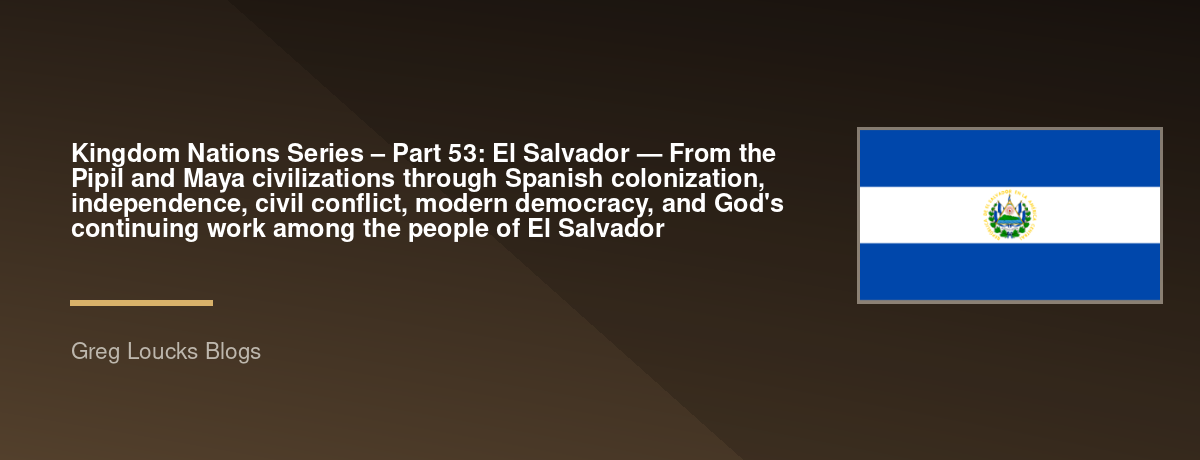
🌎 Kingdom Nations Series – Part 53: 🇸🇻 El Salvador — From the Pipil and Maya civilizations through Spanish colonization, independence, civil conflict, modern democracy, and God's continuing work among the people of El Salvador

🌎 Kingdom Nations Series – Part 54 🇸🇻 Chapter 1 – Part 1 El Salvador: The Land of Volcanoes Geography, Mountains, Pacific Coast, and God's Providential Design "The earth is the LORD's and the fullness thereof, the world and those who dwell therein." — Psalm 24:1 Introduction Known as the "Land of Volcanoes," El Salvador is the smallest nation in mainland Central America, yet it possesses an extraordinary richness of natural beauty, history, and culture. Its volcanic peaks. Fertile valleys. Coffee-covered mountains. Pacific coastline. Lush forests. Crystal lakes. And resilient people have shaped one of Central America's most distinctive nations. Though modest in size, El Salvador has played an important role in the history of the Americas. Its fertile volcanic soils have sustained civilizations for thousands of years. Its people have demonstrated remarkable perseverance through natural disasters, conflict, and rebuilding. Long before the first Pipil settlements... Long before Spanish explorers arrived... Long before churches were established among its mountains... God prepared this land. He raised its volcanoes. He enriched its soil. He formed its rivers. He placed it beside the Pacific Ocean. The Psalmist declared: "The mountains rose, the valleys sank down to the place that You appointed for them."(Psalm 104:8) Every volcano. Every valley. Every forest. Every coastline. Declares the glory of the Creator. Where Is El Salvador? El Salvador is located in Central America. It borders: Guatemala Honduras Its southern boundary is the: Pacific Ocean Unlike the other Central American nations (except Belize), El Salvador has no Caribbean coastline. Its location has historically connected Mesoamerica with the rest of Central America. Size and Geography El Salvador covers approximately 21,041 square kilometers (8,124 square miles). Despite its small size, the country contains remarkable geographic diversity. Major regions include: Pacific Coastal Plain Central Plateau Northern Highlands Volcanic Belt The country's volcanic origin has created exceptionally fertile soils. Volcanoes El Salvador is famous for its volcanoes. More than twenty volcanoes rise across the country. Among the best known are: Santa Ana (Ilamatepec) Izalco San Miguel (Chaparrastique) San Salvador San Vicente Conchagua The highest volcano is: Santa Ana Volcano — approximately 2,381 meters (7,812 feet). Several volcanoes remain active today. These mountains have both enriched and challenged the nation through fertile soils and periodic eruptions. Mountains Mountain ranges cover much of northern and central El Salvador. These highlands influence: Climate. Agriculture. Rainfall. Biodiversity. Settlement patterns. Coffee plantations thrive upon many volcanic slopes. Rivers Although relatively short, El Salvador's rivers remain vital. Major rivers include: Lempa River Paz River Goascorán River Grande de San Miguel River The Lempa River is the nation's longest river. Its waters provide: Hydroelectric power. Irrigation. Fresh water. Agriculture. Transportation. Lakes Several beautiful lakes lie within volcanic basins. Major lakes include: Lake Ilopango Lake Coatepeque Lake Güija Cerrón Grande Reservoir These waters support: Fishing. Tourism. Wildlife. Recreation. Freshwater resources. Pacific Coast El Salvador has approximately 307 kilometers (191 miles) of Pacific coastline. Its shores include: Black-sand beaches. Surfing beaches. Mangrove forests. Fishing villages. Sea cliffs. Estuaries. The coastline has become internationally known for excellent surfing conditions. Climate El Salvador has a tropical climate. Conditions include: Warm temperatures. Distinct wet and dry seasons. Mountain microclimates. Volcanic highlands. Pacific breezes. The higher elevations provide cooler temperatures than the coastal plain. Forests The nation contains several important forest ecosystems. These include: Cloud forests. Tropical dry forests. Pine-oak forests. Mangroves. Riparian forests. Protected forests preserve important biodiversity despite extensive historical deforestation. Wildlife El Salvador supports a variety of wildlife. Animals include: White-tailed deer. Ocelots. Howler monkeys. Armadillos. Iguanas. Sea turtles. Parrots. Hummingbirds. Numerous migratory birds. Marine life flourishes along the Pacific coast. National Parks El Salvador protects several important natural areas. Among them are: El Imposible National Park Montecristo National Park Los Volcanes National Park Walter Thilo Deininger Natural Park These preserve: Cloud forests. Volcanoes. Wildlife. Watersheds. Rare plant species. Responsible stewardship honors God's creation. Natural Resources El Salvador possesses valuable natural resources. These include: Geothermal energy. Hydroelectric potential. Fertile farmland. Volcanic soils. Marine fisheries. Forests. The country has become a leader in geothermal energy production because of its volcanic activity. Agriculture Agriculture remains an important part of the economy. Major crops include: Coffee. Sugarcane. Corn. Beans. Rice. Fruit. Vegetables. Cattle. Coffee has long served as one of El Salvador's most important agricultural products. Cities Several cities play important national roles. San Salvador The national capital. Largest city. Political center. Commercial hub. Educational center. Located near the San Salvador Volcano. Santa Ana Historic city. Agricultural center. Coffee-producing region. Known for beautiful colonial architecture. San Miguel Eastern commercial center. Agricultural region. Home to the San Miguel Volcano. Santa Tecla Growing metropolitan city. Educational center. Business hub. Sonsonate Historic agricultural city. Gateway to western volcanoes and Pacific beaches. Population El Salvador has a population of approximately 6.3 million people. Most residents live in: San Salvador. Santa Ana. San Miguel. Santa Tecla. The nation is one of the most densely populated countries in the Americas. Languages The official language is: Spanish Indigenous languages historically spoken include: Nawat (Pipil) Efforts continue to preserve the Nawat language and Indigenous cultural heritage. One day believers from every language spoken throughout El Salvador will worship Jesus Christ together before His throne. Geography and Providence El Salvador's geography has shaped its history. Its volcanoes enriched agriculture. Its rivers sustained communities. Its mountains protected settlements. Its Pacific coast connected trade. Long before recorded history, God prepared this remarkable land according to His sovereign purposes. Lessons from El Salvador's Geography Several enduring truths emerge. God Provides Through Creation Volcanic soils, rivers, and fertile valleys reveal God's generous provision. Strength Often Grows Through Challenge The same volcanoes that create danger also provide rich farmland and abundant resources. Stewardship Honors the Creator Protecting forests, rivers, wildlife, and volcanic landscapes reflects faithful care for God's creation. Every Nation Has a Place in God's Redemptive Plan Though geographically small, El Salvador occupies an important place within Central America and within God's purposes for the nations. Looking Ahead The next chapter explores ancient El Salvador. We will examine: Early Indigenous civilizations The Maya The Pipil people Spanish conquest Christianity's arrival Colonial society Independence The birth of modern El Salvador The story of El Salvador is one of resilient people, fertile lands, enduring faith, and God's providence throughout centuries of change. End of Chapter 1 – Part 1 Next: Chapter 1 – Part 2: Ancient El Salvador—The Maya, Pipil, Colonial Rule, and the Road to Independence 🌎 Kingdom Nations Series – Part 54 🇸🇻 Chapter 1 – Part 2 Ancient El Salvador The Maya, Pipil, Colonial Rule, and the Road to Independence (Prehistory–1841) "Remember the days of old; consider the years of many generations." — Deuteronomy 32:7 Introduction Long before El Salvador became an independent republic, its fertile valleys and volcanic highlands were home to thriving Indigenous civilizations. The Maya built ceremonial centers. The Pipil established prosperous kingdoms. Farmers cultivated rich volcanic soils. Spanish explorers arrived. Missionaries proclaimed the Gospel. Colonial cities developed. A desire for freedom eventually gave birth to a new nation. Throughout every generation, however, God remained sovereign. The prophet Isaiah declared: "The counsel of the LORD stands forever, the plans of His heart to all generations."(Psalm 33:11) Empires have risen. Kingdoms have fallen. But God's eternal Kingdom remains forever. The First Peoples Archaeological evidence shows that people have lived in present-day El Salvador for thousands of years. Early communities depended upon: Agriculture. Fishing. Hunting. Trade. Village life. The fertile volcanic landscape supported growing populations and encouraged the development of organized societies. The Maya Civilization During the first millennium AD, parts of western El Salvador became closely connected with the great Maya civilization. The Maya became known for: Astronomy. Mathematics. Architecture. Writing. Agriculture. Calendar systems. Trade. One of the most important archaeological sites is: Joya de Cerén Often called: "The Pompeii of the Americas." Around AD 600, a volcanic eruption buried the farming village beneath layers of ash. Because it was preserved so suddenly, archaeologists have gained extraordinary insight into everyday Maya life. Today Joya de Cerén is recognized as a UNESCO World Heritage Site. The Pipil People Following the decline of Classic Maya influence, the Pipil became the dominant Indigenous people throughout much of central and western El Salvador. The Pipil spoke: Nawat A language related to the Nahuatl spoken by the Aztecs. Their kingdom became known as: Cuzcatlán Meaning approximately: "Land of Precious Things." The Pipil developed: Agriculture. Trade. Military organization. Religious ceremonies. Regional markets. Their principal crops included: Maize. Beans. Squash. Cacao. Cotton. Fruit. Their society flourished for centuries before European contact. Trade Throughout Mesoamerica The peoples of El Salvador participated in extensive trade networks. Merchants exchanged: Cacao. Obsidian. Salt. Cotton. Ceramics. Jade. Feathers. Agricultural products. Trade connected El Salvador with: Guatemala. Honduras. Southern Mexico. Other Mesoamerican civilizations. Spanish Conquest In the early sixteenth century, Spanish conquistadors entered the region. Among the principal leaders was: Pedro de Alvarado The Pipil fiercely resisted Spanish conquest. Several battles occurred before Spanish authority became firmly established. Despite determined resistance, Spain gradually incorporated the region into its growing American empire. Colonial El Salvador During the colonial era, El Salvador became part of the: Captaincy General of Guatemala Spanish administration introduced: European government. Colonial towns. Catholic missions. New agricultural practices. International commerce. Indigo production became one of the colony's most valuable exports. Christianity Arrives Missionaries accompanied Spanish settlement. They established: Churches. Schools. Hospitals. Religious instruction. Charitable ministries. Roman Catholicism became firmly established throughout the region. Although colonial history included injustice and conflict, the Gospel gradually became an enduring part of Salvadoran society. Agriculture and Indigo During the colonial period, El Salvador became one of the world's leading producers of: Indigo The valuable blue dye was exported throughout Europe. Indigo cultivation shaped: Agriculture. Trade. Colonial wealth. Settlement patterns. For centuries, indigo served as the backbone of the colonial economy. Daily Life Colonial society included: Spanish settlers. Indigenous communities. People of mixed ancestry. African descendants. Merchants. Farmers. Craftsmen. Religious leaders. These diverse communities contributed to the cultural foundations of modern El Salvador. Independence Growing independence movements spread throughout Central America during the early nineteenth century. On September 15, 1821, Spain recognized the independence of the Captaincy General of Guatemala. Initially, El Salvador briefly became part of: The First Mexican Empire Soon afterward, it joined the: Federal Republic of Central America Many Salvadoran leaders supported representative government and greater regional cooperation. Becoming a Republic Political differences eventually weakened the Central American federation. In 1841, El Salvador formally became an independent republic. The new nation inherited: Rich Indigenous traditions. Spanish colonial heritage. Christian influence. Fertile agricultural lands. A growing national identity. A new chapter in Salvadoran history had begun. Lessons from Ancient El Salvador Several enduring truths emerge. God Gives Wisdom to Every People The achievements of the Maya and Pipil demonstrate the creativity, intelligence, and dignity God has given to every culture. The Gospel Transforms Societies Christianity became an enduring influence upon Salvadoran education, community life, and charitable service. Freedom Often Requires Perseverance The journey from colonial rule to independence reminds us that liberty often demands courage, sacrifice, and faithful leadership. God's Kingdom Outlasts Every Earthly Kingdom The Maya city-states. The Kingdom of Cuzcatlán. The Spanish Empire. The Federal Republic of Central America. Every earthly government eventually passes away. The Kingdom of Jesus Christ alone is everlasting. Looking Ahead The next chapter explores modern El Salvador. We will examine: Republican government Coffee economy Democratic development Civil conflict Peace and national renewal Contemporary society Christianity today Hope for the future Modern El Salvador would experience remarkable challenges and inspiring resilience while continuing to shape its future through faith, hard work, and hope. End of Chapter 1 – Part 2 Next: Chapter 2 – Part 1: Modern El Salvador—Republic, Democracy, Contemporary Society, and the Church (1841–Present) 🌎 Kingdom Nations Series – Part 54 🇸🇻 Chapter 2 – Part 1 Modern El Salvador Republic, Democracy, Contemporary Society, and the Church (1841–Present) "The LORD is my rock and my fortress and my deliverer." — Psalm 18:2 Introduction Since becoming an independent republic in 1841, El Salvador has experienced remarkable achievements alongside profound challenges. The nation has witnessed: Economic growth. Political reform. Natural disasters. Civil conflict. Democratic renewal. Cultural resilience. Throughout every generation, however, God has remained faithful. The prophet Jeremiah declared: "The steadfast love of the LORD never ceases; His mercies never come to an end."(Lamentations 3:22–23) Governments change. Economies rise and fall. Generations come and go. But God's faithfulness never fails. Building the Republic Following independence, El Salvador focused on establishing: National institutions. Representative government. Economic development. Infrastructure. Education. Like many young nations, the republic experienced periods of political instability as leaders sought to define the country's future. Despite these challenges, a distinct Salvadoran identity steadily emerged. The Coffee Economy During the late nineteenth century, coffee became the foundation of El Salvador's economy. The country's volcanic soil and mountain climate proved ideal for coffee cultivation. Coffee exports transformed: Agriculture. Trade. Transportation. Employment. Government revenue. For many decades El Salvador became one of the world's leading coffee producers. The industry also encouraged the construction of: Roads. Railways. Ports. Commercial centers. Economic Development Throughout the twentieth century the economy gradually diversified. Major industries today include: Manufacturing. Textiles. Food processing. Coffee. Sugar. Tourism. Financial services. Technology. Remittances from Salvadorans living abroad also contribute significantly to the national economy. Political Change Throughout the twentieth century, El Salvador experienced periods of: Military influence. Constitutional reform. Political transition. Democratic elections. Changing governments reflected both the opportunities and challenges of nation-building. Civil Conflict Between 1979 and 1992, El Salvador endured a devastating civil war. The conflict brought tremendous suffering to families and communities throughout the country. Many churches served by providing: Humanitarian aid. Medical care. Shelter. Prayer. Peacemaking efforts. Following years of negotiation, the Chapultepec Peace Accords were signed in 1992, formally ending the conflict. The peace agreement opened a new chapter of democratic development and national reconciliation. Jesus taught: "Blessed are the peacemakers, for they shall be called sons of God."(Matthew 5:9) Democratic Development Since the peace accords, El Salvador has continued strengthening: Democratic institutions. Free elections. Judicial reforms. Public administration. Civil society. Although challenges remain, peaceful political participation has become an increasingly important part of national life. Dollarization In 2001, El Salvador adopted the United States dollar as legal tender alongside its own monetary reforms. The change sought to promote: Economic stability. International investment. Trade. Financial confidence. The economy continues adapting to changing regional and global markets. Contemporary Economy Modern El Salvador continues expanding in: Technology. Business services. Manufacturing. Tourism. Agriculture. Renewable energy. International trade. Surf tourism has also become an increasingly important contributor to economic growth. Education Education remains a national priority. The country has expanded: Primary education. Secondary schools. Universities. Technical institutes. Vocational training. Digital education. Educational opportunities continue preparing future generations for leadership and service. Healthcare Healthcare services continue improving through: Public hospitals. Private hospitals. Community clinics. Preventive medicine. Maternal healthcare. Medical education. Healthcare workers continue serving communities throughout the country. Christianity Today Christianity remains central to Salvadoran society. Major Christian traditions include: Roman Catholic Church. Evangelical churches. Pentecostal churches. Baptist churches. Methodist churches. Seventh-day Adventist Church. Independent Christian fellowships. Churches minister through: Biblical teaching. Youth discipleship. Family counseling. Community outreach. Disaster relief. Education. Medical ministries. Compassion ministries. Evangelical churches have experienced significant growth during recent decades. Contemporary Challenges Modern El Salvador continues addressing important issues. These include: Economic opportunity. Education. Employment. Natural disasters. Migration. Housing. Environmental protection. Community safety. The Church continues responding through: Prayer. Discipleship. Family ministry. Community development. Youth outreach. Compassion. Biblical teaching. Environmental Stewardship El Salvador's: Volcanoes. Coffee-growing mountains. Pacific coastline. Cloud forests. Mangrove ecosystems. Rivers. Wildlife. All proclaim God's creative wisdom. Faithful stewardship protects these gifts for future generations. Hope for the Future El Salvador possesses many strengths. Resilient communities. Strong Christian faith. Rich cultural traditions. Young population. Growing innovation. Natural beauty. Entrepreneurial spirit. These strengths provide hope for future generations. Yet Scripture reminds believers that lasting hope cannot rest in economic progress alone. The Apostle Peter wrote: "Set your hope fully on the grace that will be brought to you at the revelation of Jesus Christ."(1 Peter 1:13) Christ remains El Salvador's greatest hope. Lessons from Modern El Salvador Several enduring truths emerge. Peace Requires Perseverance National reconciliation grows through justice, forgiveness, wisdom, and faithful leadership. Communities Flourish Through Service Families, churches, schools, and local communities working together strengthen the nation. Hope Can Rise from Hardship The history of El Salvador demonstrates remarkable resilience in the face of adversity. Christ Is El Salvador's Lasting Hope Governments change. Economies fluctuate. Natural disasters occur. Jesus Christ alone remains the eternal King whose Kingdom will never end. Looking Ahead The final chapter explores El Salvador through a Kingdom perspective. We will examine: Religious demographics Worldview analysis Reached and less-reached peoples Bible translation Evangelism opportunities Strategic prayer El Salvador in God's redemptive plan Why gregloucks.com/el-salvador matters El Salvador before the throne in Revelation 7 History tells the story of volcanoes, resilience, struggle, and renewal. The Kingdom perspective reveals God's continuing work among the people of El Salvador. End of Chapter 2 – Part 1 Next: Chapter 3 – Part 1: El Salvador Before the Throne—Kingdom Vision, Mission Strategy, and Final Reflections 🌎 Kingdom Nations Series – Part 54 🇸🇻 Chapter 3 – Part 1 El Salvador Before the Throne Kingdom Vision, Mission Strategy, and Final Reflections "After this I looked, and behold, a great multitude that no one could number, from every nation, from all tribes and peoples and languages, standing before the throne and before the Lamb." — Revelation 7:9 Introduction El Salvador is a nation where volcanoes rise above fertile valleys. Where Pacific waves meet black-sand beaches. Where coffee grows on mountain slopes. Where ancient civilizations flourished. Where resilient communities have rebuilt after earthquakes, eruptions, conflict, and hardship. Its volcanoes. Its rivers. Its forests. Its coastline. Its churches. Its people. All testify to the faithfulness and providence of God. Yet El Salvador's greatest treasure is not its volcanic landscapes. Not its coffee. Not its beaches. Not its rich history. Its greatest treasure is its people. Every child. Every family. Every farmer. Every teacher. Every fisherman. Every student. Every believer. Created in the image of God. The Lord who formed El Salvador's mountains and valleys knows every heart throughout the nation. The prophet Zechariah declared: "Not by might, nor by power, but by My Spirit, says the LORD of hosts."(Zechariah 4:6) The future of El Salvador rests not merely in human strength but in the faithful work of God. El Salvador in God's Redemptive Story For centuries God has faithfully worked among the people of El Salvador. He has used: Missionaries. Pastors. Teachers. Bible translators. Church planters. Christian families. Medical workers. Compassion ministries. Churches have established: Schools. Hospitals. Bible institutes. Children's ministries. Youth programs. Community outreach. Disaster relief. Leadership training. Throughout seasons of peace and conflict, the Gospel has continued transforming lives. Jesus declared: "I will build My church, and the gates of hell shall not prevail against it."(Matthew 16:18) Christ continues building His Church throughout El Salvador. A Nation of Many Peoples Modern El Salvador reflects a rich cultural heritage. Among its communities are: Mestizos Pipil (Nawat) Lenca Kakawira (Cacaopera) Afro-descendant communities International residents Salvadorans returning from abroad Together they contribute unique: Languages. Music. Cuisine. Agriculture. Craftsmanship. Business. Family traditions. Hospitality. The Gospel proclaims one Savior for every tribe, language, and nation. Paul wrote: "There is one body and one Spirit... one Lord, one faith, one baptism."(Ephesians 4:4–5) The Church Today Christianity remains central to Salvadoran society. Major Christian traditions include: Roman Catholic Church Evangelical churches Pentecostal churches Baptist churches Methodist churches Seventh-day Adventist Church Independent Christian fellowships Churches minister through: Biblical teaching. Youth discipleship. Marriage ministry. Christian education. Disaster response. Medical missions. Community development. Compassion ministries. Many churches also minister among Salvadoran communities living abroad. Religious Demographics Religion continues shaping Salvadoran society. Broadly speaking: Christianity is the faith of the overwhelming majority of the population. Roman Catholicism has influenced the nation since the colonial era. Evangelical and Pentecostal churches have experienced significant growth in recent decades. Small communities of other faiths are also present. Followers of Christ are called to demonstrate humility, holiness, compassion, and faithful witness. Worldview Analysis Several worldviews continue influencing El Salvador today. Historic Christianity Christianity has shaped: Family life. Education. National celebrations. Community service. Charitable ministries. Churches continue serving communities through both evangelism and practical care. Family and Community Salvadoran culture places great value upon: Family. Hospitality. Respect. Community cooperation. Hard work. Resilience. These values provide meaningful opportunities for Christ-centered discipleship. Hope After Hardship The nation's history has produced remarkable perseverance. Many communities continue rebuilding with hope, courage, and determination. The Gospel reminds believers that lasting hope is ultimately found in Christ. Hope Through Christ Economic opportunity. Political reform. Personal achievement. Cannot satisfy humanity's deepest spiritual need. Only Jesus Christ offers forgiveness, reconciliation with God, and eternal life. Reached and Less-Reached Communities Important ministry opportunities remain among: Children. University students. Young professionals. Rural villages. Indigenous communities. Urban neighborhoods. Prison populations. Salvadoran diaspora communities. The Great Commission continues calling believers to make disciples throughout El Salvador. Bible Translation God's Word is available in: Spanish. Nawat (portions and resources). Audio Scriptures. Children's Bibles. Digital Bible applications. Bible translation and Scripture distribution continue helping people encounter God's Word in languages they understand. The prophet Isaiah declared: "The grass withers, the flower fades, but the word of our God will stand forever."(Isaiah 40:8) Opportunities for Evangelism El Salvador offers many opportunities for Kingdom ministry. Youth Ministry Churches continue investing in: Children's discipleship. Youth camps. Leadership development. Bible clubs. Campus ministry. The next generation is being prepared for faithful service. Community Ministry Churches strengthen neighborhoods through: Food distribution. Family counseling. Addiction recovery. Medical outreach. Disaster relief. Community development. The love of Christ becomes visible through practical service. Indigenous Ministry Christian ministries continue serving Indigenous communities through: Bible translation. Leadership training. Education. Healthcare. Discipleship. Every people group deserves the opportunity to hear the Gospel in a language they understand. Global Mission Millions of Salvadorans live outside their homeland. This creates opportunities for: Diaspora ministry. Church planting. International evangelism. Cross-cultural discipleship. The Gospel continues reaching Salvadorans wherever they live. Creation and Stewardship El Salvador's: Volcanoes. Pacific coastline. Coffee mountains. Cloud forests. Mangroves. Lakes. Rivers. All proclaim the greatness of their Creator. Believers are called to steward these gifts wisely for future generations. Prayer for El Salvador Pray: For wisdom for national leaders. For pastors and church leaders. For spiritual renewal throughout the nation. For Christian families. For young people. For Indigenous communities. For churches serving vulnerable neighborhoods. For responsible stewardship of natural resources. For unity among believers. For every person in El Salvador to hear and respond to the Gospel. Paul encouraged believers: "Rejoice in hope, be patient in tribulation, be constant in prayer."(Romans 12:12) Why gregloucks.com/el-salvador Matters The El Salvador page exists to help believers understand this resilient Central American nation through a biblical worldview. Each country profile includes: Geography Administrative divisions Cities Government Economy History Languages Christian history Religious demographics Worldview analysis Mission opportunities Evangelism strategies Strategic prayer Biblical reflection Together these studies form a global Kingdom atlas designed to encourage: Prayer. Discipleship. Mission. Biblical understanding. Love for the nations. History becomes a testimony of God's providence. Knowledge becomes an act of worship. El Salvador Before the Throne History does not end with the Maya. Nor with the Pipil Kingdom of Cuzcatlán. Nor with Spanish colonization. Nor with independence. Nor with civil conflict. Nor with modern democracy. History culminates before the throne of Jesus Christ. John saw that glorious future. Believers from: San Salvador. Santa Ana. San Miguel. Santa Tecla. Sonsonate. The volcanic highlands. The Pacific coast. The coffee-growing mountains. Every department. Every language. Every people. Will stand before the Lamb. Some first heard the Gospel through missionaries. Others through faithful parents. Some through pastors. Others through Christian teachers, Bible translators, relief workers, or acts of compassion. Their stories will differ. Their Redeemer will be the same. Together they will proclaim: "Salvation belongs to our God who sits on the throne, and to the Lamb!"(Revelation 7:10) That is El Salvador's eternal destiny. Not merely beautiful volcanoes. Not merely coffee plantations. Not merely a resilient history. But redeemed men, women, and children from every tribe and language worshiping Jesus Christ forever. Final Reflections El Salvador teaches us that: God brings hope after hardship. Faith grows through perseverance. Communities are strengthened by love and service. History ultimately belongs to Jesus Christ. The Gospel continues transforming lives across every generation. Most importantly, El Salvador reminds us that even the smallest nations occupy an important place within God's eternal Kingdom. The volcanoes. The rivers. The forests. The churches. The families. The people. All ultimately belong to the King of Kings. His Kingdom alone will never end. Final Commission As you study El Salvador, remember that this series is more than a history of nations. It is an invitation to see the world through the lens of Scripture. Every nation matters. Every language matters. Every people group matters. Every believer has a place in God's global mission. May the Church in El Salvador continue proclaiming Christ with wisdom, humility, courage, compassion, and unwavering faith. May future generations know both the remarkable resilience of their nation and the eternal hope found only in Jesus Christ. And may the Lamb receive the full reward of His sacrifice from the people of El Salvador. Amen. End of Kingdom Nations Series – Part 54: 🇸🇻 El Salvador Coming Next: 🌎 Kingdom Nations Series – Part 55: 🇬🇶 Equatorial Guinea — From the Bubi and Fang peoples through Portuguese and Spanish colonial rule, independence, modern Central Africa, and God's continuing work among the peoples of Equatorial Guinea.
Read more 🌎 Kingdom Nations Series – Part 53: 🇸🇻 El Salvador — From the Pipil and Maya civilizations through Spanish colonization, independence, civil conflict, modern democracy, and God's continuing work among the people of El Salvador

🌎 Kingdom Nations Series – Part 52: 🇪🇬 Egypt — From the pharaohs and the pyramids through the Exodus, the prophets, the Holy Family's journey, the early Church, Islamic history, modern Egypt, and God's continuing work among the Egyptian people

🌎 Kingdom Nations Series – Part 53 🇪🇬 Chapter 1 – Part 1 Egypt: Gift of the Nile Geography, Deserts, the Nile, and God's Providential Design "The earth is the LORD's and the fullness thereof, the world and those who dwell therein." — Psalm 24:1 Introduction Few nations have shaped human history as profoundly as Egypt. Its mighty river. Ancient deserts. Fertile floodplains. Towering pyramids. Sacred mountains. And strategic location between Africa, Asia, and Europe have made Egypt one of history's greatest civilizations. For thousands of years Egypt has stood at the crossroads of continents. Empires marched through its valleys. Merchants crossed its deserts. Prophets proclaimed God's Word. The Israelites found refuge—and later slavery—along the Nile. The Holy Family sought safety within its borders. The Gospel took deep root through one of the world's oldest Christian communities. Long before Pharaoh ruled. Long before Moses was born. Long before Joseph interpreted dreams. God prepared this land. He formed the Nile. He raised the mountains. He spread the deserts. He established Egypt's place among the nations. The prophet Isaiah declared: "Blessed be Egypt My people."(Isaiah 19:25) This remarkable prophecy reminds us that even one of history's greatest empires ultimately belongs to God. Where Is Egypt? Egypt is located in the northeastern corner of Africa. It also includes the Sinai Peninsula, placing part of the nation within Asia. Egypt borders: Libya Sudan Israel Gaza Its coastlines border: Mediterranean Sea Red Sea The Suez Canal connects the Mediterranean and Red Seas, making Egypt one of the world's most strategically important nations. Size and Geography Egypt covers approximately 1,001,450 square kilometers (386,662 square miles). Although vast in area, nearly all of Egypt's population lives along the: Nile River Nile Delta Major geographic regions include: Nile Valley Nile Delta Western Desert Eastern Desert Sinai Peninsula More than ninety percent of Egypt consists of desert. The Nile River The Nile River is Egypt's lifeline. Flowing more than 6,600 kilometers (4,100 miles) from East Africa to the Mediterranean Sea, it is among the world's longest rivers. For thousands of years the Nile has provided: Fresh water. Agriculture. Transportation. Trade. Food. Settlement. Ancient Greek historian Herodotus famously described Egypt as: "The gift of the Nile." Without the Nile, Egyptian civilization could never have flourished. The Nile Delta As the Nile enters the Mediterranean Sea, it forms one of the world's great river deltas. The Nile Delta contains: Rich farmland. Large cities. Fishing communities. Wetlands. Bird habitats. It remains Egypt's primary agricultural region. Deserts Egypt contains two major deserts. Western Desert Part of the vast Sahara. Features include: Sand dunes. Rock plateaus. Oases. Salt depressions. Ancient caravan routes. Eastern Desert Located between the Nile and the Red Sea. Known for: Mountains. Minerals. Ancient gold mines. Trade routes. Monasteries. The deserts have shaped Egyptian history for millennia. The Sinai Peninsula The Sinai Peninsula links Africa and Asia. Its rugged mountains include: Mount Catherine Mount Sinai (traditional location) For many believers, Sinai recalls the giving of the Law through Moses. The peninsula continues serving as a bridge between continents. Mountains Egypt's mountains are concentrated primarily in: The Sinai Peninsula. The Eastern Desert. The highest peak is: Mount Catherine — approximately 2,629 meters (8,625 feet). These mountains contain ancient monasteries, unique wildlife, and important historical sites. Coastlines Egypt possesses approximately 2,450 kilometers (1,522 miles) of coastline. Its shores include: Mediterranean beaches. Red Sea coral reefs. Fishing villages. Commercial ports. Tourism centers. Marine ecosystems. The Red Sea hosts some of the world's richest coral reefs. Climate Egypt has an arid desert climate. Conditions include: Hot summers. Mild winters. Minimal rainfall. Dry desert winds. Warm Mediterranean coastlines. The Nile Valley provides fertile land within an otherwise dry environment. Wildlife Egypt's diverse habitats support: Gazelles. Desert foxes. Nubian ibex. Camels. Migratory birds. Flamingos. Crocodiles (far south). Marine turtles. Dolphins. Colorful coral reef fish. The Nile and Red Sea continue supporting remarkable ecosystems. National Parks Egypt protects many important natural areas. Among them are: Ras Mohammed National Park White Desert National Park Wadi El Rayan Gebel Elba National Park Protectorate of Saint Catherine These preserve: Coral reefs. Mountain ecosystems. Desert landscapes. Rare wildlife. Ancient natural formations. Responsible stewardship honors God's creation. Natural Resources Egypt possesses significant natural resources. These include: Natural gas. Petroleum. Gold. Phosphates. Limestone. Marble. Granite. Solar energy. Wind energy. The Nile itself remains one of Egypt's greatest natural blessings. Agriculture Nearly all Egyptian agriculture depends upon irrigation from the Nile. Major crops include: Wheat. Rice. Cotton. Sugarcane. Corn. Dates. Citrus fruits. Vegetables. Egyptian cotton is internationally renowned for its exceptional quality. Cities Several cities play major national roles. Cairo National capital. Africa's largest metropolitan area. Political center. Educational center. Historic Islamic city. Home to the nearby Pyramids of Giza. Alexandria Historic Mediterranean port. Founded by Alexander the Great. Commercial center. Ancient center of Christian theology. Giza Home to: The Great Pyramid. The Sphinx. Modern residential communities. Luxor Ancient Thebes. Temple complexes. Valley of the Kings. Major archaeological center. Aswan Southern Nile city. Gateway to Nubia. Home to the Aswan High Dam. Population Egypt has a population of more than 110 million people, making it one of Africa's most populous nations. Most residents live along: The Nile Valley. The Nile Delta. Cairo. Alexandria. The fertile river corridor. Languages The official language is: Arabic Other languages spoken include: Egyptian Arabic Nubian languages Beja Siwi Berber English (widely studied) French (used in some settings) The historic Coptic language remains important in the worship and heritage of the Coptic Orthodox Church. One day believers from every language spoken throughout Egypt will worship Jesus Christ together before His throne. Geography and Providence Egypt's geography has shaped world history. The Nile sustained civilizations. The deserts protected kingdoms. The Sinai connected continents. The Red Sea opened trade. The Mediterranean welcomed commerce. Long before history recorded the first Pharaoh, God prepared this remarkable land according to His sovereign purposes. Lessons from Egypt's Geography Several enduring truths emerge. God Prepares Nations for His Purposes Egypt's location made it central to biblical history and to the history of civilization itself. Water Is a Gift from God The Nile reminds us that all life ultimately depends upon God's faithful provision. Creation Reveals God's Majesty Deserts, rivers, mountains, and seas together proclaim the greatness of their Creator. Every Nation Has a Place in God's Redemptive Plan From the Nile Valley to the Sinai Peninsula, Egypt occupies a unique place in both biblical history and God's unfolding plan for the nations. Looking Ahead The next chapter explores ancient Egypt. We will examine: Predynastic Egypt The Pharaohs The pyramids Joseph in Egypt Moses and the Exodus The divided kingdoms The prophets Alexander the Great Roman Egypt The Holy Family's flight into Egypt The birth of the Coptic Church Egypt's story is unlike any other nation—a history woven deeply into the pages of Scripture and God's redemptive work throughout the world. End of Chapter 1 – Part 1 Next: Chapter 1 – Part 2: Ancient Egypt—From the Pharaohs to the Early Church 🌎 Kingdom Nations Series – Part 53 🇪🇬 Chapter 1 – Part 2 Ancient Egypt From the Pharaohs to the Early Church (Prehistory–AD 641) "Remember the days of old; consider the years of many generations." — Deuteronomy 32:7 Introduction Few nations occupy as much space in both world history and the Bible as Egypt. Its Pharaohs ruled one of history's longest-lasting civilizations. Its monuments became wonders of the ancient world. Its wisdom influenced neighboring kingdoms. Its river sustained millions. Its deserts sheltered prophets. Its cities welcomed the Holy Family. Its churches helped shape Christian theology. Throughout every generation, however, God remained sovereign. The prophet Isaiah declared: "The LORD has established His throne in the heavens, and His kingdom rules over all."(Psalm 103:19) Pharaohs ruled Egypt. But God ruled history. Predynastic Egypt Long before the pyramids were built, communities settled along the Nile River. Early Egyptians depended upon: Agriculture. Fishing. Animal husbandry. River trade. Craftsmanship. The annual flooding of the Nile enriched the surrounding farmland, allowing villages to prosper. Over time these settlements grew into organized kingdoms. The Unification of Egypt Around 3100 BC, King Narmer (Menes) united Upper and Lower Egypt. This marked the beginning of the First Dynasty. The unification established: A centralized government. Royal authority. Written administration. Organized taxation. Large public works. Egypt would remain one of the world's greatest civilizations for nearly three thousand years. The Age of the Pharaohs Ancient Egypt was ruled by kings known as: Pharaohs The Pharaoh was regarded as both political ruler and religious leader. The Old, Middle, and New Kingdoms produced remarkable achievements in: Architecture. Engineering. Medicine. Astronomy. Mathematics. Writing. Agriculture. Administration. Egyptian civilization became one of the ancient world's greatest centers of learning. The Great Pyramids Among Egypt's most famous monuments are: The Great Pyramid of Khufu The Pyramid of Khafre The Pyramid of Menkaure Built on the Giza Plateau, these structures have stood for more than four thousand years. The Great Pyramid remained the tallest human-made structure on Earth for nearly four millennia. These remarkable achievements continue to testify to human creativity, organization, and engineering skill. Egyptian Religion Ancient Egyptian religion included belief in numerous gods and goddesses. Important religious practices included: Temple worship. Offerings. Festivals. Burial rituals. Mummification. Belief in the afterlife. Scripture repeatedly distinguishes the living God from idols made by human hands. The Exodus would later demonstrate God's authority over every false god. Joseph in Egypt One of the Bible's most remarkable accounts takes place in Egypt. Joseph, sold into slavery by his brothers, eventually became a trusted official under Pharaoh. Through God's wisdom he prepared Egypt for years of famine. As a result: Egypt survived famine. Many surrounding nations found food. Joseph's family was preserved. The nation of Israel found refuge in Egypt. Joseph declared: "You meant evil against me, but God meant it for good."(Genesis 50:20) God used Egypt to preserve His covenant people. Moses and the Exodus Generations after Joseph, the Israelites became enslaved in Egypt. God raised up Moses to lead His people to freedom. The Exodus became one of Scripture's defining events. God demonstrated His power through: The ten plagues. The Passover. The crossing of the Red Sea. The defeat of Pharaoh's army. The giving of the Law at Sinai. The Exodus revealed God's faithfulness to His promises and His compassion for the oppressed. Egypt and the Prophets Throughout the Old Testament, Egypt frequently appears in Israel's history. Sometimes Egypt provided refuge. At other times it became a political rival. Prophets including: Isaiah. Jeremiah. Ezekiel. Hosea. Delivered messages concerning Egypt. Yet Isaiah also proclaimed remarkable hope: "Blessed be Egypt My people."(Isaiah 19:25) This extraordinary prophecy anticipates God's redemptive work extending even to Egypt. Alexander the Great In 332 BC, Alexander the Great conquered Egypt. He founded the city of: Alexandria Alexandria quickly became one of the world's greatest centers of: Learning. Trade. Philosophy. Science. Culture. The famous Library of Alexandria attracted scholars from throughout the ancient world. The Ptolemaic Kingdom Following Alexander's death, Egypt came under the rule of the: Ptolemaic Dynasty This Greek-speaking kingdom ruled for nearly three centuries. During this period: Greek culture flourished. Alexandria prospered. Jewish communities expanded. The Septuagint, the Greek translation of the Old Testament, was produced in Alexandria, making the Scriptures accessible to many throughout the Mediterranean world. Roman Egypt In 30 BC, Egypt became part of the Roman Empire. Its fertile Nile Valley supplied grain for much of Rome. Roman rule brought: Roads. Trade. Administrative reforms. Military security. It also prepared the infrastructure through which the Gospel would later spread. The Holy Family in Egypt One of Egypt's greatest biblical honors came shortly after the birth of Jesus. An angel warned Joseph in a dream: "Rise, take the child and His mother, and flee to Egypt."(Matthew 2:13) Mary. Joseph. And the infant Jesus found refuge in Egypt while King Herod sought to kill Him. This fulfilled the prophecy: "Out of Egypt I called My Son."(Matthew 2:15; Hosea 11:1) Many Egyptian Christians cherish traditions connected with the Holy Family's journey throughout the country. The Birth of the Church Christianity spread rapidly throughout Egypt during the first century. According to longstanding Christian tradition, Mark the Evangelist brought the Gospel to Alexandria. The Egyptian Church became one of Christianity's earliest and most influential communities. Alexandria produced notable Christian leaders including: Athanasius Clement of Alexandria Origen Cyril of Alexandria These theologians helped defend essential Christian doctrines concerning: The Trinity. The deity of Christ. The authority of Scripture. The Desert Fathers During the third and fourth centuries, Egypt became the birthplace of Christian monasticism. Believers sought lives devoted to: Prayer. Scripture. Fasting. Worship. Service. Among the most influential were: Anthony the Great Pachomius Macarius of Egypt Their example profoundly influenced Christian spirituality throughout the world. Lessons from Ancient Egypt Several enduring truths emerge. God Uses Nations for His Purposes Egypt became both a place of refuge and a place of deliverance within God's redemptive plan. Earthly Power Is Temporary The Pharaohs built mighty monuments, yet every earthly kingdom eventually passes away. God's Promises Never Fail From Joseph to Moses to the Holy Family, God faithfully fulfilled His Word across the centuries. Christ Is Greater Than Every Empire The Pharaohs. The Ptolemies. The Romans. All passed into history. Jesus Christ alone reigns forever. Looking Ahead The next chapter explores modern Egypt. We will examine: The Arab conquest Islamic Egypt The Fatimids and Mamluks Ottoman rule Muhammad Ali The Suez Canal Modern independence Contemporary Egypt The Coptic Church today Hope for the future Egypt's history would continue through conquest, transformation, and renewal while remaining one of the most influential nations in Africa and the Middle East. End of Chapter 1 – Part 2 Next: Chapter 2 – Part 1: Modern Egypt—From the Arab Conquest to the Present 🌎 Kingdom Nations Series – Part 53 🇪🇬 Chapter 2 – Part 1 Modern Egypt From the Arab Conquest to the Present (AD 641–Present) "The LORD has established His throne in the heavens, and His kingdom rules over all." — Psalm 103:19 Introduction Following the early centuries of Christianity, Egypt entered a new chapter that would reshape its language, culture, and government for generations. Arab armies entered the Nile Valley. Islam gradually became the majority religion. New dynasties ruled from Cairo. The Suez Canal transformed global commerce. Modern Egypt emerged as one of Africa's and the Middle East's most influential nations. Yet through every empire, every conquest, and every political change, God has remained faithful. The prophet Malachi declared: "For I the LORD do not change."(Malachi 3:6) Kingdoms rise. Empires fall. The Kingdom of Christ endures forever. The Arab Conquest In AD 641, Arab Muslim armies entered Egypt under the leadership of Amr ibn al-As. Following the conquest: Arabic gradually replaced Greek and Coptic as the primary language of government. Islam steadily expanded throughout the country. Egypt became part of the growing Islamic world. Although many Egyptians embraced Islam over time, the ancient Coptic Christian community continued preserving its faith and traditions. The Founding of Fustat Following the conquest, Fustat became Egypt's new capital. The city grew into an important center for: Government. Trade. Scholarship. Religion. Over time, Fustat became part of the expanding city now known as Cairo. The Fatimid Caliphate During the tenth century, Egypt became the center of the Fatimid Caliphate. The Fatimids founded: Cairo (Al-Qāhirah) Cairo rapidly became one of the world's greatest cities. The Fatimids encouraged: Architecture. Scholarship. Commerce. Education. Trade. Many of Cairo's oldest districts date from this remarkable period. Saladin and the Ayyubids In the twelfth century, Saladin (Ṣalāḥ ad-Dīn) established the Ayyubid Dynasty. He became famous for: Recapturing Jerusalem. Military leadership. Diplomacy. Religious tolerance. Strengthening Egypt. Saladin remains one of the most respected leaders in Middle Eastern history. The Citadel of Cairo, begun during his reign, continues overlooking the city today. The Mamluk Sultanate From the thirteenth through early sixteenth centuries, Egypt was ruled by the: Mamluk Sultanate The Mamluks became known for: Military strength. Trade. Scholarship. Islamic architecture. Their victory against the Mongols at the Battle of Ain Jalut (1260) helped halt further Mongol expansion into the Middle East. Ottoman Egypt In 1517, the Ottoman Empire incorporated Egypt. For nearly four centuries Egypt remained an important Ottoman province. During this period: Trade expanded. Agriculture continued flourishing. Islamic scholarship grew. The Coptic Church continued preserving its ancient Christian heritage. Muhammad Ali Pasha In the early nineteenth century, Muhammad Ali Pasha initiated sweeping reforms. He modernized: Agriculture. Industry. Military organization. Education. Government administration. Many historians regard him as the founder of modern Egypt. The Suez Canal One of the greatest engineering achievements of the nineteenth century was the completion of the: Suez Canal Opened in 1869, the canal connected: The Mediterranean Sea. The Red Sea. It dramatically shortened shipping routes between: Europe. Asia. Africa. Today the canal remains one of the world's most important waterways. British Influence During the late nineteenth century, Britain gained increasing influence over Egypt. In 1882, British forces occupied the country. Although Egypt retained its monarchy, British political influence remained significant for decades. National movements gradually sought greater independence. Independence In 1922, Egypt gained formal independence as the: Kingdom of Egypt Although British influence continued in certain areas, Egyptian self-government steadily increased. The nation's modern political institutions continued developing. The Modern Republic In 1952, the Free Officers Movement overthrew the monarchy. The following year Egypt became a republic. Gamal Abdel Nasser emerged as one of the nation's most influential modern leaders. His government emphasized: Arab nationalism. Industrial development. Economic modernization. Regional leadership. The Aswan High Dam Completed in 1970, the Aswan High Dam transformed Egypt. It provided: Hydroelectric power. Flood control. Reliable irrigation. Water storage. The dam significantly increased agricultural productivity while reshaping the Nile's annual flooding cycle. Contemporary Egypt Today Egypt serves as one of Africa's and the Middle East's leading nations. Major sectors include: Agriculture. Tourism. Manufacturing. Natural gas. Petroleum. Shipping. Construction. Telecommunications. Finance. The nation continues serving as an important center of diplomacy and regional cooperation. Christianity Today Egypt remains home to one of the world's oldest Christian communities. Major Christian traditions include: Coptic Orthodox Church Coptic Catholic Church Greek Orthodox Church Roman Catholic Church Anglican Church Evangelical Protestant churches The Coptic Orthodox Church traces its heritage to the earliest centuries of Christianity. Despite periods of hardship and persecution, Egyptian Christians have faithfully preserved their witness for nearly two thousand years. Contemporary Challenges Modern Egypt continues addressing important issues. These include: Population growth. Water management. Economic development. Employment. Urbanization. Regional security. Environmental sustainability. Religious harmony. The Church continues responding through: Prayer. Education. Medical ministries. Compassion. Discipleship. Community outreach. Environmental Stewardship Egypt's: Nile River. Mediterranean coast. Red Sea reefs. Deserts. Wetlands. Oases. Sinai mountains. All proclaim God's creative wisdom. Faithful stewardship protects these treasures for future generations. Hope for the Future Egypt possesses remarkable strengths. Ancient history. Strategic geography. Rich cultural heritage. Strong educational institutions. Growing infrastructure. Historic Christian communities. These strengths provide hope for future generations. Yet Scripture reminds believers that true hope cannot rest in governments or civilizations. The Apostle Paul wrote: "For no one can lay a foundation other than that which is laid, which is Jesus Christ."(1 Corinthians 3:11) Christ remains Egypt's greatest hope. Lessons from Modern Egypt Several enduring truths emerge. God Preserves His People Through centuries of change, the Christian faith has endured in Egypt despite many challenges. Strategic Places Influence the World Egypt's geography continues making it one of the world's most significant nations. Ancient Heritage and Modern Progress Can Coexist History and innovation together contribute to the nation's future. Christ Is Egypt's Lasting Hope Empires have ruled. Dynasties have changed. Governments have risen and fallen. Jesus Christ alone remains the eternal King whose Kingdom will never end. Looking Ahead The final chapter explores Egypt through a Kingdom perspective. We will examine: Religious demographics Worldview analysis The Coptic Church Reached and less-reached peoples Bible translation Evangelism opportunities Strategic prayer Egypt in God's redemptive plan Why gregloucks.com/egypt matters Egypt before the throne in Revelation 7 History tells the story of pharaohs, prophets, empires, and civilizations. The Kingdom perspective reveals God's continuing work among the people of Egypt. End of Chapter 2 – Part 1 Next: Chapter 3 – Part 1: Egypt Before the Throne—Kingdom Vision, Mission Strategy, and Final Reflections 🌎 Kingdom Nations Series – Part 53 🇪🇬 Chapter 3 – Part 1 Egypt Before the Throne Kingdom Vision, Mission Strategy, and Final Reflections "After this I looked, and behold, a great multitude that no one could number, from every nation, from all tribes and peoples and languages, standing before the throne and before the Lamb." — Revelation 7:9 Introduction Egypt is a land where deserts meet a life-giving river. Where the pyramids have stood for thousands of years. Where prophets walked. Where Joseph served. Where Moses was raised. Where the Israelites lived. Where the Holy Family found refuge. Where one of the world's oldest Christian communities still worships today. Its deserts. Its mountains. Its river. Its ancient cities. Its churches. Its people. All testify to the providence and sovereignty of God. Yet Egypt's greatest treasure is not its monuments. Not its pyramids. Not its ancient temples. Not its strategic location. Its greatest treasure is its people. Every child. Every family. Every farmer. Every fisherman. Every merchant. Every student. Every believer. Created in the image of God. The Lord who formed the Nile and called Abraham knows every heart throughout Egypt. The prophet Isaiah proclaimed: "In that day there will be an altar to the LORD in the midst of the land of Egypt."(Isaiah 19:19) God's love extends from Alexandria to Aswan, from Cairo to the Sinai, and from the Nile Delta to the Western Desert. Egypt in God's Redemptive Story No nation outside Israel appears more frequently in Scripture than Egypt. God has used Egypt throughout His redemptive plan. It became: A place of refuge for Abraham. The home of Joseph. The place where Israel grew into a nation. The setting of the Exodus. A refuge for the infant Jesus. The birthplace of one of Christianity's oldest churches. For centuries God has worked through: Prophets. Missionaries. Monks. Pastors. Bible translators. Christian scholars. Church fathers. Faithful families. The Egyptian Church has blessed Christianity through: Biblical scholarship. Theology. Monasticism. Prayer. Martyrdom. Faithful witness. The Apostle Paul wrote: "For from Him and through Him and to Him are all things."(Romans 11:36) Egypt's history ultimately points to Christ. A Nation of Many Peoples Modern Egypt includes many communities. Among them are: Egyptian Arabs Copts Nubians Bedouin peoples Beja communities Siwi Berbers Sudanese residents Refugees from neighboring countries International workers Together they contribute unique: Languages. Music. Architecture. Art. Cuisine. Craftsmanship. Scholarship. Family traditions. The Gospel proclaims one Savior for every tribe, language, and nation. John declared: "The true light, which gives light to everyone, was coming into the world."(John 1:9) The Church Today Egypt remains home to one of the world's oldest continuous Christian communities. Major Christian traditions include: Coptic Orthodox Church Coptic Catholic Church Greek Orthodox Church Roman Catholic Church Anglican Church Evangelical Protestant churches Churches minister through: Biblical teaching. Medical ministries. Christian education. Seminaries. Bible translation. Youth ministry. Community outreach. Compassion ministries. Despite significant challenges throughout history, Egyptian believers continue serving Christ with remarkable faithfulness. Religious Demographics Religion continues shaping Egyptian society. Broadly speaking: Islam is the faith of the overwhelming majority of the population. Christianity represents the nation's largest religious minority. The Coptic Orthodox Church remains the largest Christian body. Small communities of other Christian traditions and additional faiths are also present. Followers of Christ are called to demonstrate humility, wisdom, compassion, courage, and faithful witness. Worldview Analysis Several worldviews continue influencing Egypt today. Islamic Heritage For nearly fourteen centuries, Islam has shaped much of Egypt's: Culture. Law. Architecture. Education. Daily life. Christians are called to love their neighbors while faithfully proclaiming the Gospel. Ancient Heritage Egypt's remarkable history continues influencing national identity. Its archaeological treasures remind the world that civilizations rise and fall. Scripture teaches that only God's Kingdom is everlasting. Christian Heritage The Coptic Church has preserved an extraordinary Christian witness through nearly two thousand years. Its history demonstrates perseverance, worship, discipleship, and unwavering faith. Many believers throughout the world continue drawing encouragement from the testimony of Egyptian Christians. Hope Through Christ Political stability. Economic growth. Scientific achievement. Historic monuments. Cannot satisfy humanity's deepest spiritual need. Only Jesus Christ offers forgiveness, reconciliation with God, and eternal life. Reached and Less-Reached Communities Important ministry opportunities remain among: University students. Urban professionals. Rural villages. Bedouin communities. Nubian communities. Refugee populations. Children and youth. University campuses. The Great Commission continues calling believers to make disciples throughout Egypt. Bible Translation God's Word is available in: Arabic. Coptic. English. Nubian languages. Audio Scriptures. Children's Bibles. Digital Bible applications. Bible translation continues helping people throughout Egypt encounter God's Word in languages they understand. The Psalmist declared: "Forever, O LORD, Your word is firmly fixed in the heavens."(Psalm 119:89) Opportunities for Evangelism Egypt offers many opportunities for Kingdom ministry. Biblical Education Churches continue serving through: Seminaries. Bible colleges. Leadership development. Pastoral training. Theological education. The next generation of Christian leaders is being equipped for faithful service. Compassion Ministry Believers demonstrate Christ's love through: Medical care. Education. Food assistance. Care for refugees. Community development. Support for vulnerable families. Practical compassion reflects the heart of Christ. Youth Ministry Young people represent a significant portion of Egypt's population. Churches invest through: Youth discipleship. Bible studies. Leadership development. Children's ministries. Christian education. Tomorrow's leaders are being prepared today. Global Mission Egypt's location at the crossroads of Africa, Asia, and Europe provides unique opportunities for: Cross-cultural ministry. Biblical scholarship. Regional partnerships. Mission training. Hospitality. The nations continue passing through Egypt. Creation and Stewardship Egypt's: Nile River. Sinai Mountains. Mediterranean coast. Red Sea reefs. Deserts. Oases. Ancient farmlands. All proclaim the greatness of their Creator. Believers are called to steward these gifts wisely for future generations. Prayer for Egypt Pray: For wisdom for national leaders. For peace throughout the Middle East and North Africa. For pastors and church leaders. For the Coptic Church and other Christian communities. For Bible translation and theological education. For Christian families. For young people. For responsible stewardship of the Nile and Egypt's natural resources. For unity among believers. For every person in Egypt to hear and respond to the Gospel. Paul encouraged believers: "Continue steadfastly in prayer, being watchful in it with thanksgiving."(Colossians 4:2) Why gregloucks.com/egypt Matters The Egypt page exists to help believers understand one of Scripture's most significant nations through a biblical worldview. Each country profile includes: Geography Administrative divisions Cities Government Economy History Languages Biblical history Christian history Religious demographics Worldview analysis Mission opportunities Evangelism strategies Strategic prayer Biblical reflection Together these studies form a global Kingdom atlas designed to encourage: Prayer. Discipleship. Mission. Biblical understanding. Love for the nations. History becomes a testimony of God's providence. Knowledge becomes an act of worship. Egypt Before the Throne History does not end with the Pharaohs. Nor with the pyramids. Nor with the Exodus. Nor with Alexandria. Nor with the Roman Empire. Nor with the Arab conquest. Nor with modern Egypt. History culminates before the throne of Jesus Christ. John saw that glorious future. Believers from: Cairo. Alexandria. Giza. Luxor. Aswan. The Nile Delta. The Sinai Peninsula. The Western Desert. Upper Egypt. Every village. Every language. Every people. Will stand before the Lamb. Some first heard the Gospel through Mark the Evangelist. Others through faithful parents. Some through Coptic priests. Others through missionaries, Bible translators, Christian schools, or acts of compassion. Their stories will differ. Their Redeemer will be the same. Together they will proclaim: "Salvation belongs to our God who sits on the throne, and to the Lamb!"(Revelation 7:10) That is Egypt's eternal destiny. Not merely mighty monuments. Not merely ancient dynasties. Not merely the Nile. But redeemed men, women, and children from every tribe and language worshiping Jesus Christ forever. Final Reflections Egypt teaches us that: God rules over every empire. His promises never fail. The Gospel flourishes even through centuries of hardship. Faithful witness leaves an eternal legacy. History ultimately belongs to Jesus Christ. Most importantly, Egypt reminds us that the God who delivered Israel, protected the Holy Family, and sustained the early Church is still calling people to Himself today. The Nile. The deserts. The mountains. The churches. The families. The people. All ultimately belong to the King of Kings. His Kingdom alone will never end. Final Commission As you study Egypt, remember that this series is more than a history of nations. It is an invitation to see the world through the lens of Scripture. Every nation matters. Every language matters. Every people group matters. Every believer has a place in God's global mission. May the Church in Egypt continue proclaiming Christ with wisdom, humility, courage, compassion, and unwavering faith. May future generations know both the extraordinary history of their nation and the eternal hope found only in Jesus Christ. And may the Lamb receive the full reward of His sacrifice from the people of Egypt. Amen. End of Kingdom Nations Series – Part 53: 🇪🇬 Egypt Coming Next: 🌎 Kingdom Nations Series – Part 54: 🇸🇻 El Salvador — From the Pipil and Maya civilizations through Spanish colonization, independence, civil conflict, modern democracy, and God's continuing work among the people of El Salvador.

Read more 🌎 Kingdom Nations Series – Part 52: 🇪🇬 Egypt — From the pharaohs and the pyramids through the Exodus, the prophets, the Holy Family's journey, the early Church, Islamic history, modern Egypt, and God's continuing work among the Egyptian people

🌎 Kingdom Nations Series – Part 51: 🇪🇨 Ecuador — From ancient Andean civilizations and the Inca Empire through Spanish colonization, independence, modern democracy, the Galápagos Islands, and God's continuing work among the peoples of Ecuador

🌎 Kingdom Nations Series – Part 52 🇪🇨 Chapter 1 – Part 1 Ecuador: The Land of the Equator Geography, Andes, Amazon, Galápagos, and God's Providential Design "The earth is the LORD's and the fullness thereof, the world and those who dwell therein." — Psalm 24:1 Introduction Straddling the Equator on the western edge of South America, Ecuador is one of the world's most geographically diverse nations. Its snow-capped volcanoes. Towering Andes Mountains. Dense Amazon rainforests. Pacific coastlines. Cloud forests. Tropical islands. And fertile valleys have shaped a nation rich in both natural beauty and cultural heritage. Though relatively small, Ecuador contains four distinct geographic regions that support extraordinary biodiversity. Few places on Earth display such remarkable variety within such a compact area. Long before the first Indigenous communities cultivated these valleys... Long before the Inca Empire reached these mountains... Long before Spanish explorers crossed the Pacific coast... God prepared this land. He raised its volcanoes. He carved its valleys. He filled its forests with life. He placed the Equator across its mountains. The Psalmist proclaimed: "You have fixed all the boundaries of the earth; You have made summer and winter."(Psalm 74:17) Every volcano. Every rainforest. Every island. Every river. Declares the glory of its Creator. Where Is Ecuador? Ecuador is located in northwestern South America. It borders: Colombia Peru Its western boundary is the: Pacific Ocean Far offshore lie the famous: Galápagos Islands Its location gives Ecuador access to both the Pacific coast and the vast Amazon Basin. Size and Geography Ecuador covers approximately 256,370 square kilometers (98,985 square miles). The country is divided into four major natural regions: Costa (Pacific Coast) Sierra (Andes Highlands) Oriente (Amazon Rainforest) Galápagos Islands Each region possesses its own climate, ecosystems, and cultural traditions. The Andes Mountains The Andes dominate central Ecuador. Major ranges include: Cordillera Occidental Cordillera Oriental Between them lies the fertile Inter-Andean Valley, where many of Ecuador's largest cities are located. The mountains influence: Climate. Agriculture. Transportation. Culture. Water resources. Volcanoes Ecuador contains numerous volcanoes. Among the best known are: Chimborazo Cotopaxi Cayambe Tungurahua Antisana Sangay The country's highest mountain is: Chimborazo — approximately 6,263 meters (20,548 feet). Because Earth bulges at the Equator, Chimborazo's summit is the point on Earth's surface farthest from the planet's center. Several Ecuadorian volcanoes remain active. Rivers Numerous rivers originate in the Andes. Major rivers include: Napo Pastaza Guayas Esmeraldas Putumayo Many eastern rivers eventually flow into the mighty Amazon River. These waterways support: Agriculture. Transportation. Hydroelectric power. Fresh water. Wildlife. The Amazon Rainforest Nearly half of Ecuador lies within the Amazon Basin. The rainforest contains: Dense tropical forests. Wetlands. Rivers. Indigenous territories. Extraordinary biodiversity. Countless plant and animal species. The Amazon remains one of God's greatest displays of living creation. The Pacific Coast Ecuador's Pacific coastline stretches approximately 2,237 kilometers (1,390 miles). Its shores include: Beaches. Mangrove forests. Fishing villages. Commercial ports. Marine reserves. Coastal plains. The Pacific supports important fishing and shipping industries. The Galápagos Islands Nearly 1,000 kilometers (620 miles) west of mainland Ecuador lie the: Galápagos Islands These volcanic islands became internationally famous through: Unique wildlife. Marine ecosystems. Volcanic landscapes. Scientific research. Species found there include: Giant tortoises. Marine iguanas. Blue-footed boobies. Galápagos penguins. Sea lions. Darwin's finches. The islands remain one of the world's greatest natural laboratories. Climate Because of its varied geography, Ecuador possesses multiple climate zones. These include: Tropical rainforest. Cloud forest. Temperate mountain valleys. High-altitude alpine tundra. Coastal tropical climates. Despite lying on the Equator, elevation creates remarkable climatic diversity. Forests Ecuador's forests include: Amazon rainforest. Cloud forests. Dry tropical forests. Mangroves. Mountain forests. These ecosystems support some of the world's richest biodiversity. Wildlife Ecuador ranks among the world's most biodiverse countries. Wildlife includes: Jaguars. Spectacled bears. Tapirs. Sloths. Macaws. Andean condors. Poison dart frogs. Pink river dolphins. Giant tortoises. Whales. Thousands of orchid species. Many species occur nowhere else on Earth. National Parks Ecuador protects much of its natural heritage. Major parks include: Galápagos National Park Yasuní National Park Cotopaxi National Park Sangay National Park Cajas National Park Machalilla National Park These preserve: Volcanoes. Rainforests. Cloud forests. Marine ecosystems. High-altitude grasslands. Rare wildlife. Several are recognized as UNESCO World Heritage Sites. Natural Resources Ecuador possesses valuable natural resources. These include: Petroleum. Gold. Copper. Silver. Forests. Fresh water. Marine fisheries. Fertile farmland. Renewable energy potential. Natural resources remain important to the nation's economy. Agriculture Agriculture continues playing a major role. Major products include: Bananas. Cocoa. Coffee. Flowers. Rice. Corn. Sugarcane. Palm oil. Potatoes. Livestock. Ecuador ranks among the world's leading exporters of bananas and high-quality cacao. Cities Several cities play important national roles. Quito The national capital. One of the world's highest capital cities. Historic colonial center. UNESCO World Heritage Site. Political center. Guayaquil Largest city. Principal seaport. Commercial center. Industrial hub. Cuenca Historic colonial city. Educational center. UNESCO World Heritage Site. Known for culture and craftsmanship. Santo Domingo Major transportation center. Agricultural region. Rapidly growing city. Loja Historic university city. Known for music, education, and cultural traditions. Population Ecuador has a population of approximately 18 million people. Most residents live in: Quito. Guayaquil. Cuenca. The Andean highlands. The Pacific coastal region. The nation reflects a rich blend of Indigenous, Mestizo, Afro-Ecuadorian, and immigrant communities. Languages The official language is: Spanish Official languages of intercultural relations include: Kichwa (Quechua) Shuar Many additional Indigenous languages continue to be spoken throughout the Amazon and Andes. One day believers from every language spoken throughout Ecuador will worship Jesus Christ together before His throne. Geography and Providence Ecuador's geography has shaped its history. Its mountains protected civilizations. Its rivers connected the Amazon. Its coast welcomed commerce. Its forests sustained Indigenous peoples. Its islands reveal God's astonishing creativity. Long before human history unfolded, God prepared this remarkable land according to His sovereign purposes. Lessons from Ecuador's Geography Several enduring truths emerge. God's Creation Displays Infinite Creativity Few nations demonstrate such extraordinary ecological diversity within so small a territory. Diversity Reflects God's Wisdom Mountains, forests, islands, and oceans together reveal different aspects of the Creator's handiwork. Stewardship Honors the Creator Protecting rainforests, wildlife, rivers, and marine ecosystems reflects faithful care for God's gifts. Every Nation Has a Place in God's Redemptive Plan From the Amazon Basin to the Galápagos Islands, Ecuador occupies a unique place within God's unfolding purposes. Looking Ahead The next chapter explores ancient Ecuador. We will examine: Early Indigenous civilizations The Valdivia culture The Quitu and Cañari peoples The Inca Empire Spanish conquest Colonial Ecuador Christianity's arrival Independence The birth of the modern republic The history of Ecuador is one of remarkable civilizations, breathtaking creation, enduring faith, and God's continuing providence through every generation. End of Chapter 1 – Part 1 Next: Chapter 1 – Part 2: Ancient Ecuador—From Early Civilizations to Independence 🌎 Kingdom Nations Series – Part 52 🇪🇨 Chapter 1 – Part 2 Ancient Ecuador From Early Civilizations to Independence (Prehistory–1830) "Remember the days of old; consider the years of many generations." — Deuteronomy 32:7 Introduction Long before Ecuador became an independent republic, its mountains, forests, and coastlines were home to remarkable civilizations. Early farmers cultivated fertile valleys. Skilled artisans shaped gold and pottery. Indigenous kingdoms flourished. The Inca Empire expanded northward. Spanish explorers arrived. Missionaries proclaimed the Gospel. A struggle for freedom eventually gave birth to a new nation. Throughout every generation, however, God remained sovereign. The prophet Daniel declared: "He changes times and seasons; He removes kings and sets up kings."(Daniel 2:21) Empires rise. Civilizations flourish. Kingdoms fall. The Kingdom of God alone endures forever. The First Peoples Archaeological evidence indicates that people have lived in present-day Ecuador for more than 10,000 years. Early communities depended upon: Hunting. Fishing. Gathering. Agriculture. River trade. Village life. The country's remarkable geographic diversity encouraged many distinct cultures to develop. The Valdivia Culture Among Ecuador's earliest advanced civilizations was the Valdivia culture, which flourished along the Pacific coast beginning around 3500 BC. The Valdivia became known for: Agriculture. Fishing. Ceramics. Village organization. Trade. Their pottery ranks among the oldest known ceramic traditions in the Americas. The famous Valdivia figurines remain important archaeological treasures. Other Early Civilizations Over the centuries many Indigenous cultures flourished throughout Ecuador. Among them were: Machalilla Chorrera Bahía Jama-Coaque La Tolita Manteño These societies developed: Trade networks. Agriculture. Goldworking. Textiles. Architecture. Navigation. Many maintained commercial relationships with neighboring regions throughout the Pacific coast and Andes. The Highland Peoples In Ecuador's Andean valleys, numerous Indigenous peoples established organized communities. Among the best known were: Quitu Cañari Caranqui Puruhá These societies cultivated: Maize. Potatoes. Beans. Quinoa. Coca. Llamas and alpacas also played important roles in transportation and agriculture. The Inca Empire During the fifteenth century, the Inca Empire expanded northward into present-day Ecuador. Although some communities resisted, much of the region eventually became incorporated into the empire. The Incas introduced: Road systems. Terraced agriculture. Administrative organization. Engineering. State-supported agriculture. The city of Quito became one of the empire's most important northern centers. Civil War Before the Spanish Arrival Shortly before Spanish explorers arrived, the Inca Empire experienced a devastating civil war. The conflict centered primarily between: Atahualpa Huáscar Atahualpa emerged victorious. However, the empire had been greatly weakened, making it more vulnerable to Spanish conquest. Spanish Conquest In the 1530s, Spanish conquistadors entered Ecuador. Following the fall of the Inca Empire, Spain established colonial authority throughout the region. Spanish rule introduced: European government. Catholic missions. Colonial cities. New agricultural systems. International trade. The colonial era transformed Ecuador's political, economic, and cultural life. Christianity Arrives Missionaries accompanied Spanish settlement. They established: Churches. Cathedrals. Schools. Hospitals. Monasteries. Charitable ministries. Roman Catholicism became deeply rooted throughout Ecuador. Many missionaries also learned Indigenous languages and worked to translate Christian teaching for local communities. Although the colonial period included injustice and conflict, the Gospel gradually became an enduring part of Ecuadorian society. The Royal Audience of Quito In 1563, Spain established the: Royal Audience of Quito This administrative region governed much of present-day Ecuador. Quito became: A political center. A religious center. An educational center. A center for art and architecture. Its churches, monasteries, and colonial buildings remain among South America's finest historical treasures. The Quito School of Art During the colonial era, Ecuador became internationally known for the: Quito School of Art Artists produced: Religious paintings. Wood carvings. Gold leaf sculptures. Altarpieces. Sacred architecture. These works blended European artistic traditions with Indigenous craftsmanship. Many remain preserved in churches throughout Ecuador today. Independence Movements Inspired by growing independence movements throughout Latin America, Ecuadorians increasingly sought self-government. On August 10, 1809, Quito became the site of one of South America's earliest independence uprisings. Although the first revolt was suppressed, it inspired future generations. Today August 10 is remembered as Ecuador's First Cry of Independence. The Battle of Pichincha On May 24, 1822, patriot forces under Antonio José de Sucre, serving alongside the broader independence movement inspired by Simón Bolívar, defeated Spanish forces at the: Battle of Pichincha The victory secured Ecuador's liberation from Spanish colonial rule. The battle took place on the slopes of the Pichincha Volcano overlooking Quito. Gran Colombia Following independence, Ecuador joined the new republic of: Gran Colombia This union included: Present-day Colombia Venezuela Panama Ecuador Although ambitious, political differences eventually led to its dissolution. The Birth of Ecuador In 1830, Ecuador peacefully separated from Gran Colombia and became an independent republic. The new nation inherited: Rich Indigenous traditions. Spanish colonial heritage. Christian influence. Remarkable geographic diversity. A strong sense of national identity. A new chapter in Ecuador's history had begun. Lessons from Ancient Ecuador Several enduring truths emerge. God Works Through Every Generation From ancient civilizations to colonial cities, God's providence has guided history toward His greater purposes. Every Culture Bears God's Image The achievements of Indigenous civilizations remind us that God has gifted every people with creativity, wisdom, and dignity. Freedom Often Requires Perseverance The road to independence demonstrates that liberty is often won through courage, sacrifice, and faithful leadership. God's Kingdom Outlasts Every Empire The Valdivia culture. The Inca Empire. The Spanish Empire. Gran Colombia. Every earthly kingdom eventually passes away. The Kingdom of Jesus Christ alone is everlasting. Looking Ahead The next chapter explores modern Ecuador. We will examine: Republican government Democratic development Economic transformation Oil production Environmental stewardship The Galápagos Islands Contemporary society Christianity today Hope for the future Modern Ecuador would become one of South America's most geographically diverse nations while continuing to balance economic development, environmental stewardship, and cultural diversity. End of Chapter 1 – Part 2 Next: Chapter 2 – Part 1: Modern Ecuador—Republic, Democracy, Contemporary Society, and the Church (1830–Present) 🌎 Kingdom Nations Series – Part 52 🇪🇨 Chapter 2 – Part 1 Modern Ecuador Republic, Democracy, Contemporary Society, and the Church (1830–Present) "Righteousness exalts a nation, but sin is a reproach to any people." — Proverbs 14:34 Introduction Since becoming an independent republic in 1830, Ecuador has traveled a remarkable journey. The nation has experienced: Political transformation. Economic development. Territorial conflicts. Democratic reform. Environmental leadership. Cultural renewal. Throughout every season of change, however, God has remained faithful. The prophet Isaiah declared: "The LORD is our judge; the LORD is our lawgiver; the LORD is our king; He will save us."(Isaiah 33:22) Governments change. Generations pass. But God's Kingdom remains forever. The Early Republic Following its separation from Gran Colombia in 1830, Ecuador began building an independent national government. The young republic faced many challenges. Among them were: Creating stable institutions. Strengthening national unity. Developing transportation. Growing the economy. Balancing regional interests. Despite political instability during its early decades, Ecuador gradually established itself as a sovereign nation. Political Development Throughout the nineteenth and twentieth centuries, Ecuador experienced periods of: Democratic government. Military rule. Constitutional reform. Political transition. Regional conflict. Over time, democratic institutions became increasingly established. Today Ecuador functions as a constitutional republic with: A President. A National Assembly. An independent judiciary. Provincial governments. Regular elections. Border Disputes For many decades Ecuador and Peru disputed portions of their shared border. Several conflicts occurred during the nineteenth and twentieth centuries. Following negotiations, the Brazilia Presidential Act (1998) established a lasting international boundary. The agreement strengthened: Regional peace. Trade. Diplomatic cooperation. Cross-border development. Jesus taught: "Blessed are the peacemakers."(Matthew 5:9) Economic Development Modern Ecuador possesses a diversified economy. Major industries include: Petroleum. Agriculture. Fishing. Tourism. Manufacturing. Mining. Commerce. Financial services. Hydroelectric power. Oil production has remained one of Ecuador's largest sources of export revenue since the 1970s. Agriculture Agriculture continues serving as an important pillar of the economy. Major exports include: Bananas. Cocoa. Coffee. Flowers. Shrimp. Palm oil. Tuna. Many Ecuadorian agricultural products are recognized internationally for their quality. Dollarization In 2000, Ecuador adopted the United States dollar as its official currency. The change helped stabilize inflation and strengthen economic confidence during a period of financial uncertainty. Dollarization continues shaping Ecuador's economy today. Environmental Leadership Ecuador has become internationally recognized for environmental conservation. The nation protects: Amazon rainforests. Cloud forests. Marine reserves. The Galápagos Islands. Volcanic ecosystems. Many protected areas balance environmental stewardship with sustainable development. The extraordinary biodiversity of Ecuador reflects God's creative abundance. The Galápagos Islands The Galápagos Islands remain one of Ecuador's greatest treasures. The islands contribute through: Scientific research. Conservation. Ecotourism. Marine protection. Environmental education. Strict conservation efforts seek to preserve their unique wildlife for future generations. Education Education continues expanding throughout Ecuador. The nation has invested in: Primary education. Secondary schools. Universities. Technical institutes. Teacher training. Scientific research. Education remains essential for future national development. Healthcare Healthcare services continue improving through: Public hospitals. Private hospitals. Community clinics. Preventive medicine. Medical education. Regional health initiatives. Expanding healthcare access remains an important national priority. Christianity Today Christianity continues playing a significant role throughout Ecuadorian society. Major Christian traditions include: Roman Catholic Church. Evangelical churches. Pentecostal churches. Baptist churches. Methodist churches. Lutheran churches. Seventh-day Adventist Church. Independent Christian fellowships. Churches minister through: Biblical teaching. Youth discipleship. Family counseling. Christian education. Medical missions. Community outreach. Compassion ministries. Evangelical churches have experienced considerable growth during recent decades. Indigenous Communities Ecuador remains home to numerous Indigenous peoples. Among them are: Kichwa Shuar Achuar Huaorani (Waorani) Cofán (A'i) Siona Secoya Tsáchila Chachi Awá Many churches partner with Indigenous communities through: Bible translation. Education. Healthcare. Leadership training. Community development. The Gospel continues reaching people in their own languages and cultures. Contemporary Challenges Modern Ecuador continues addressing important issues. These include: Economic inequality. Environmental conservation. Illegal mining. Migration. Urban growth. Natural disasters. Public security. Employment opportunities. The Church continues responding through: Prayer. Discipleship. Compassion ministries. Community development. Family support. Evangelism. Environmental Stewardship Ecuador's: Amazon rainforest. Andes Mountains. Galápagos Islands. Cloud forests. Mangroves. Volcanoes. Marine ecosystems. All proclaim God's creative wisdom. Faithful stewardship honors the Creator and protects His gifts for future generations. Hope for the Future Ecuador possesses remarkable strengths. Extraordinary biodiversity. Rich cultural heritage. Strong Christian communities. Growing education. Natural resources. Young population. Entrepreneurial spirit. These strengths provide hope for future generations. Yet Scripture reminds believers that lasting hope is found only in Christ. The Apostle Paul wrote: "For in Him all the fullness of God was pleased to dwell."(Colossians 1:19) Christ remains Ecuador's greatest hope. Lessons from Modern Ecuador Several enduring truths emerge. Diversity Is a Blessing The many peoples, cultures, languages, and ecosystems of Ecuador reveal the richness of God's creative design. Stewardship Requires Wisdom Natural resources are blessings that should be managed responsibly for both present and future generations. Peace Strengthens Nations Cooperation and reconciliation allow nations to flourish more fully. Christ Is Ecuador's Lasting Hope Governments change. Economies fluctuate. Natural disasters occur. Jesus Christ alone remains the eternal King whose Kingdom will never end. Looking Ahead The final chapter explores Ecuador through a Kingdom perspective. We will examine: Religious demographics Worldview analysis Reached and less-reached peoples Bible translation Evangelism opportunities Strategic prayer Ecuador in God's redemptive plan Why gregloucks.com/ecuador matters Ecuador before the throne in Revelation 7 History tells the story of mountains, civilizations, freedom, and stewardship. The Kingdom perspective reveals God's continuing work among the peoples of Ecuador. End of Chapter 2 – Part 1 Next: Chapter 3 – Part 1: Ecuador Before the Throne—Kingdom Vision, Mission Strategy, and Final Reflections 🌎 Kingdom Nations Series – Part 52 🇪🇨 Chapter 3 – Part 1 Ecuador Before the Throne Kingdom Vision, Mission Strategy, and Final Reflections "After this I looked, and behold, a great multitude that no one could number, from every nation, from all tribes and peoples and languages, standing before the throne and before the Lamb." — Revelation 7:9 Introduction Ecuador is a nation where snow-capped volcanoes overlook tropical rainforests. Where mighty rivers descend from the Andes into the Amazon Basin. Where the Pacific Ocean meets fertile coastal plains. Where the remarkable Galápagos Islands reveal the astonishing creativity of God. Its mountains. Its forests. Its rivers. Its islands. Its coastlines. Its peoples. All testify to the wisdom and majesty of the Creator. Yet Ecuador's greatest treasure is not its biodiversity. Not its volcanoes. Not its natural resources. Not its ancient civilizations. Its greatest treasure is its people. Every child. Every family. Every farmer. Every fisherman. Every teacher. Every student. Every believer. Created in the image of God. The Lord who placed the Equator across this land knows every heart throughout Ecuador. The prophet Zephaniah declared: "The LORD your God is in your midst, a mighty one who will save; He will rejoice over you with gladness."(Zephaniah 3:17) His love reaches every province, every mountain village, every Amazon community, and every coastal city. Ecuador in God's Redemptive Story For centuries God has faithfully worked among the peoples of Ecuador. He has used: Missionaries. Pastors. Bible translators. Teachers. Medical workers. Christian families. Church planters. Evangelists. Compassion ministries. Churches have established: Schools. Hospitals. Bible institutes. Children's ministries. Universities. Disaster relief programs. Community development projects. Leadership training. From the colonial churches of Quito to Indigenous congregations deep within the Amazon, the Gospel continues transforming lives. Jesus declared: "The harvest is plentiful, but the laborers are few."(Matthew 9:37) God continues calling His people to faithfully proclaim Christ throughout Ecuador. A Nation of Many Peoples Ecuador reflects remarkable cultural diversity. Among its peoples are: Mestizos Kichwa Shuar Achuar Huaorani (Waorani) Cofán (A'i) Siona Secoya Tsáchila Chachi Awá Afro-Ecuadorians Montubios European and Asian immigrant communities Together they contribute unique: Languages. Music. Art. Agriculture. Cuisine. Craftsmanship. Family traditions. The Gospel proclaims one Savior for every tribe, language, and nation. Paul reminds believers: "There is one Lord, one faith, one baptism."(Ephesians 4:5) The Church Today Christianity remains a central influence throughout Ecuador. Major Christian traditions include: Roman Catholic Church Evangelical churches Pentecostal churches Baptist churches Methodist churches Lutheran churches Seventh-day Adventist Church Independent Christian fellowships Churches minister through: Biblical teaching. Church planting. Youth discipleship. Marriage ministry. Medical missions. Community outreach. Disaster relief. Bible translation. Many Ecuadorian believers also serve as missionaries throughout Latin America and beyond. Religious Demographics Religion continues shaping Ecuadorian society. Broadly speaking: Christianity is the faith of the overwhelming majority of the population. Roman Catholicism has influenced Ecuador for nearly five centuries. Evangelical churches have grown significantly in both urban and rural communities. Indigenous Christian fellowships continue expanding in many regions. Small Jewish, Muslim, Baháʼí, Buddhist, and other religious communities are also present. Followers of Christ are called to demonstrate humility, compassion, holiness, and faithful witness. Worldview Analysis Several worldviews influence Ecuador today. Historic Christianity Christianity has shaped: Education. Family life. Architecture. Art. National celebrations. Community service. The Gospel continues influencing Ecuadorian society through churches, schools, and charitable ministries. Indigenous Heritage Many Indigenous communities preserve traditions that reflect centuries of cultural identity. Christians seek to proclaim the Gospel while honoring the God-given dignity, languages, and cultural heritage of every people. Stewardship of Creation Ecuador possesses one of Earth's richest collections of biodiversity. Responsible stewardship includes caring for: Rainforests. Rivers. Wildlife. Marine ecosystems. Mountains. The biblical command to care for creation reminds believers that the earth ultimately belongs to the Lord. Hope Through Christ Natural beauty. Economic development. Scientific achievement. Political progress. Cannot remove humanity's deepest spiritual need. Only Jesus Christ offers forgiveness, reconciliation with God, and eternal life. Reached and Less-Reached Communities Important ministry opportunities remain among: Remote Amazon villages. Urban youth. University students. Mountain communities. Afro-Ecuadorian communities. Indigenous peoples. Coastal fishing villages. International migrants. The Great Commission continues calling believers to make disciples throughout Ecuador. Bible Translation God's Word is available in: Spanish. Kichwa. Shuar. Numerous additional Indigenous languages. Audio Scriptures. Children's Bibles. Digital Bible platforms. Bible translation continues helping many Indigenous communities encounter God's Word in their own language. The Psalmist declared: "Your word is a lamp to my feet and a light to my path."(Psalm 119:105) Opportunities for Evangelism Ecuador offers many opportunities for Kingdom ministry. Indigenous Ministry Churches continue serving Indigenous communities through: Bible translation. Leadership development. Discipleship. Education. Healthcare. The Gospel continues bearing fruit among many Indigenous peoples. University Ministry Growing universities provide opportunities for: Campus Bible studies. Christian apologetics. Leadership mentoring. Student discipleship. Tomorrow's leaders are being equipped today. Compassion Ministry Churches strengthen communities through: Medical clinics. Food distribution. Clean water projects. Disaster response. Family counseling. Community development. The love of Christ becomes visible through practical service. Environmental Ministry Ecuador's extraordinary biodiversity provides opportunities to proclaim the Creator through creation care and faithful stewardship. Creation continually points beyond itself to its Maker. Creation and Stewardship Ecuador's: Andes Mountains. Amazon rainforest. Galápagos Islands. Pacific coastline. Cloud forests. Volcanoes. Rivers. All proclaim the greatness of their Creator. Believers are called to steward these gifts wisely for future generations. Prayer for Ecuador Pray: For wisdom for national leaders. For pastors and church leaders. For spiritual renewal throughout Ecuador. For Indigenous churches and Christian leaders. For Bible translation ministries. For Christian families. For university students. For responsible stewardship of Ecuador's extraordinary biodiversity. For unity among believers. For every person in Ecuador to hear and respond to the Gospel. Paul encouraged believers: "Devote yourselves to prayer, being watchful and thankful."(Colossians 4:2) Why gregloucks.com/ecuador Matters The Ecuador page exists to help believers understand this remarkable South American nation through a biblical worldview. Each country profile includes: Geography Administrative divisions Cities Government Economy History Languages Christian history Religious demographics Worldview analysis Mission opportunities Evangelism strategies Strategic prayer Biblical reflection Together these studies form a global Kingdom atlas designed to encourage: Prayer. Discipleship. Mission. Biblical understanding. Love for the nations. History becomes a testimony of God's providence. Knowledge becomes an act of worship. Ecuador Before the Throne History does not end with the Valdivia. Nor with the Inca Empire. Nor with Spanish colonization. Nor with independence. Nor with modern democracy. History culminates before the throne of Jesus Christ. John saw that glorious future. Believers from: Quito. Guayaquil. Cuenca. Loja. Santo Domingo. The Amazon Basin. The Galápagos Islands. The Andes Mountains. The Pacific coast. Every province. Every language. Every people. Will stand before the Lamb. Some first heard the Gospel through missionaries. Others through faithful parents. Some through pastors. Others through Bible translators, Christian teachers, medical workers, or acts of compassion. Their stories will differ. Their Redeemer will be the same. Together they will proclaim: "Salvation belongs to our God who sits on the throne, and to the Lamb!"(Revelation 7:10) That is Ecuador's eternal destiny. Not merely majestic volcanoes. Not merely ancient civilizations. Not merely extraordinary biodiversity. But redeemed men, women, and children from every tribe and language worshiping Jesus Christ forever. Final Reflections Ecuador teaches us that: God's creation reflects His infinite wisdom. Every culture bears His image. The Gospel transcends every language and people. Faithful stewardship honors the Creator. History ultimately belongs to Jesus Christ. Most importantly, Ecuador reminds us that from the highest Andean peaks to the deepest Amazon forests, Christ is building His Church. The mountains. The rivers. The forests. The islands. The churches. The families. The people. All ultimately belong to the King of Kings. His Kingdom alone will never end. Final Commission As you study Ecuador, remember that this series is more than a history of nations. It is an invitation to see the world through the lens of Scripture. Every nation matters. Every language matters. Every people group matters. Every believer has a place in God's global mission. May the Church in Ecuador continue proclaiming Christ with wisdom, humility, courage, compassion, and unwavering faith. May future generations know both the breathtaking beauty of their nation and the eternal hope found only in Jesus Christ. And may the Lamb receive the full reward of His sacrifice from the peoples of Ecuador. Amen. End of Kingdom Nations Series – Part 52: 🇪🇨 Ecuador Coming Next: 🌎 Kingdom Nations Series – Part 53: 🇪🇬 Egypt — From the pharaohs and the pyramids through the Exodus, the prophets, the Holy Family's journey, the early Church, Islamic history, modern Egypt, and God's continuing work among the Egyptian people.

Read more 🌎 Kingdom Nations Series – Part 51: 🇪🇨 Ecuador — From ancient Andean civilizations and the Inca Empire through Spanish colonization, independence, modern democracy, the Galápagos Islands, and God's continuing work among the peoples of Ecuador

🌎 Kingdom Nations Series – Part 50: 🇩🇴 Dominican Republic — From the Taíno people and the first permanent European settlement in the Americas through colonial history, independence, modern Caribbean society, and God's continuing work among the Dominica

🌎 Kingdom Nations Series – Part 51 🇩🇴 Chapter 1 – Part 1 Dominican Republic: Crossroads of the Caribbean Geography, Mountains, Valleys, and God's Providential Design "The heavens declare the glory of God, and the sky above proclaims His handiwork." — Psalm 19:1 Introduction Occupying the eastern two-thirds of the island of Hispaniola, the Dominican Republic is a land of remarkable beauty and historic significance. Its towering mountains. Fertile valleys. Tropical forests. White-sand beaches. Coral reefs. Rolling plains. And rushing rivers have shaped one of the Caribbean's most influential nations. More than any other country in the Americas, the Dominican Republic occupies a unique place in history. Here stood the first permanent European settlement in the Americas. Here the first cathedral, university, hospital, and colonial government of the New World were established. For centuries, peoples from Europe, Africa, and the Indigenous Caribbean have contributed to the nation's rich cultural heritage. Long before explorers crossed the Atlantic... Long before Santo Domingo became the first colonial capital... Long before churches were established throughout the island... God prepared this land. He raised its mountains. He carved its valleys. He nourished its rivers. He surrounded it with warm Caribbean waters. The Psalmist proclaimed: "You visit the earth and water it; You greatly enrich it."(Psalm 65:9) Every mountain. Every river. Every valley. Every coastline. Declares the goodness of its Creator. Where Is the Dominican Republic? The Dominican Republic is located in the Greater Antilles of the Caribbean. It shares the island of Hispaniola with: Haiti It is bordered by: The Atlantic Ocean (north) The Caribbean Sea (south) Nearby nations include: Puerto Rico Cuba Jamaica The Bahamas Its central Caribbean location has made it an important crossroads of commerce and culture for centuries. Size and Geography The Dominican Republic covers approximately 48,671 square kilometers (18,792 square miles). Major geographic regions include: Cibao Valley Cordillera Central Cordillera Septentrional Sierra de Bahoruco Eastern Coastal Plain Enriquillo Basin The country possesses one of the Caribbean's most geographically diverse landscapes. Mountains The Dominican Republic contains the highest mountains in the Caribbean. Major mountain ranges include: Cordillera Central Cordillera Septentrional Cordillera Oriental Sierra de Bahoruco Sierra de Neiba The highest peak is: Pico Duarte — approximately 3,098 meters (10,164 feet). Pico Duarte is the highest mountain in the Caribbean. The mountains influence: Rainfall. Agriculture. Climate. Water resources. Biodiversity. Valleys Several fertile valleys support agriculture and population centers. Among them are: Cibao Valley San Juan Valley Vega Real These valleys produce: Rice. Tobacco. Coffee. Cocoa. Vegetables. Fruit. Livestock. The fertile soils have made agriculture central to Dominican history. Rivers The Dominican Republic has numerous rivers. Major rivers include: Yaque del Norte Yuna Yaque del Sur Ozama Haina These rivers provide: Fresh water. Hydroelectric power. Agriculture. Transportation. Wildlife habitat. The Yaque del Norte is the country's longest river. Coastlines The nation has approximately 1,600 kilometers (994 miles) of coastline. Its shores include: White-sand beaches. Mangrove forests. Coral reefs. Rocky cliffs. Fishing villages. Natural harbors. The country's beautiful coastline has helped make tourism one of its leading industries. Lakes The Dominican Republic contains remarkable inland waters. These include: Lake Enriquillo Laguna de Oviedo Rincón Lagoon Lake Enriquillo is the largest lake in the Caribbean and one of the few hypersaline lakes in the Western Hemisphere. It also lies below sea level. Climate The Dominican Republic has a tropical climate. Conditions include: Warm temperatures. Seasonal rainfall. Mountain cloud forests. Coastal breezes. Hurricane seasons. The mountains create diverse microclimates throughout the country. Forests The nation contains a variety of forests. These include: Tropical rainforests. Dry forests. Pine forests. Cloud forests. Mangroves. Protected forests preserve many unique Caribbean species. Wildlife The Dominican Republic supports remarkable biodiversity. Animals include: Hispaniolan solenodon. Hispaniolan hutia. Sea turtles. Manatees. Humpback whales. Flamingos. Parrots. Numerous endemic reptiles and amphibians. Many species occur nowhere else on Earth. National Parks The Dominican Republic has an extensive protected area system. Major parks include: Jaragua National Park Los Haitises National Park Armando Bermúdez National Park José del Carmen Ramírez National Park Cotubanamá National Park These preserve: Rainforests. Coral reefs. Mangroves. Mountains. Wetlands. Rare wildlife. They demonstrate the importance of caring for God's creation. Natural Resources The Dominican Republic possesses valuable natural resources. These include: Gold. Silver. Nickel. Limestone. Marble. Fertile farmland. Fresh water. Forests. Marine fisheries. These resources have supported the nation's economic development. Agriculture Agriculture remains an important sector. Major products include: Sugarcane. Coffee. Cocoa. Rice. Bananas. Plantains. Tobacco. Avocados. Citrus fruits. Livestock. Dominican cocoa and tobacco are internationally respected. Cities Several cities play important national roles. Santo Domingo The national capital. Largest city. Oldest continuously inhabited European-founded city in the Americas. Political center. Commercial hub. Historic colonial treasure. Santiago de los Caballeros Second-largest city. Agricultural center. Manufacturing hub. Educational center. La Romana Tourism center. Port city. Sugar industry. Puerto Plata Historic Atlantic port. Tourism destination. Cruise ship center. San Pedro de Macorís Industrial city. Historic sugar center. Important baseball heritage. Population The Dominican Republic has a population of approximately 11.5 million people. Most residents live in: Santo Domingo. Santiago. La Romana. San Cristóbal. Puerto Plata. The nation is the second-most populous country in the Caribbean. Languages The official language is: Spanish Other languages spoken include: Dominican Spanish dialects Haitian Creole (particularly in border areas and immigrant communities) English (especially in tourism) One day believers from every language spoken throughout the Dominican Republic will worship Jesus Christ together before His throne. Geography and Providence The geography of the Dominican Republic has shaped its history. Its fertile valleys supported civilizations. Its harbors welcomed explorers. Its mountains protected communities. Its rivers sustained agriculture. Long before history recorded the first settlements, God prepared this land according to His sovereign purposes. Lessons from the Dominican Republic's Geography Several enduring truths emerge. God Prepares Places for His Purposes The Dominican Republic's strategic location made it a gateway between the Old and New Worlds. Creation Reflects God's Glory The mountains, forests, rivers, and seas proclaim the beauty and wisdom of their Creator. Stewardship Honors the Creator Protecting forests, coral reefs, wildlife, and freshwater resources reflects faithful care for God's gifts. Every Nation Has a Place in God's Redemptive Plan From the highest Caribbean mountains to the oldest colonial city in the Americas, the Dominican Republic occupies a unique place in history and in God's unfolding purposes. Looking Ahead The next chapter explores ancient Dominican history. We will examine: The Taíno people Christopher Columbus The founding of Santo Domingo Spanish colonization The first churches in the Americas African slavery French influence on Hispaniola Haitian rule The Dominican struggle for independence The birth of the Dominican Republic The story of the Dominican Republic is one of first beginnings, remarkable endurance, cultural diversity, and God's continuing providence through centuries of change. End of Chapter 1 – Part 1 Next: Chapter 1 – Part 2: Ancient Dominican Republic—The Taíno, Columbus, Colonial Hispaniola, and the Road to Independence 🌎 Kingdom Nations Series – Part 51 🇩🇴 Chapter 1 – Part 2 Ancient Dominican Republic The Taíno, Columbus, Colonial Hispaniola, and the Road to Independence (Prehistory–1844) "Remember the days of old; consider the years of many generations." — Deuteronomy 32:7 Introduction Long before the Dominican Republic became an independent nation, the island of Hispaniola stood at the center of one of history's greatest turning points. Indigenous communities cultivated fertile valleys. European explorers crossed the Atlantic. The first permanent European city in the Americas was established. The Gospel was proclaimed. Empires competed for control. Slavery reshaped society. New nations emerged. Throughout every generation, however, God remained sovereign. The prophet Isaiah declared: "The LORD of hosts has sworn: 'As I have planned, so shall it be, and as I have purposed, so shall it stand.'"(Isaiah 14:24) Human history unfolds according to God's sovereign purposes. The First Peoples Long before European arrival, Hispaniola was home to thriving Indigenous civilizations. Among the earliest inhabitants were: Archaic peoples Igneri (Arawakan ancestors) Taíno The island's fertile land supported large populations through: Agriculture. Fishing. Hunting. Trade. Craftsmanship. Village life. The Taíno became the dominant Indigenous culture throughout much of Hispaniola before European contact. The Taíno People The Taíno developed an organized and peaceful society. They became known for: Farming. Fishing. Canoe building. Cotton weaving. Pottery. Wood carving. Trade. Music. Communal leadership. Their principal crops included: Cassava. Maize. Sweet potatoes. Beans. Peppers. Tobacco. Pineapples. The island was divided among several regional chiefdoms known as cacicazgos, each governed by a cacique (chief). The Taíno possessed a rich cultural and spiritual heritage long before European arrival. Christopher Columbus On December 5, 1492, Christopher Columbus landed on Hispaniola during his first voyage. He described the island as one of the most beautiful places he had ever seen. Later that year, after the loss of the Santa María, Columbus established La Navidad, the first European settlement in the Americas. The settlement did not survive, but it marked the beginning of permanent European involvement in the Caribbean. Santo Domingo In 1498, Bartholomew Columbus, Christopher's brother, founded Santo Domingo. The city became: The first permanent European city in the Americas. The capital of Spain's New World empire. The center of colonial administration. A major commercial port. A center for missionary activity. Many important "firsts" in the Americas were established here, including: The first cathedral. The first university. The first hospital. The first monastery. The first royal court. Santo Domingo became the gateway through which much of Spain's exploration of the Americas began. Christianity Arrives Missionaries accompanied Spanish settlers to Hispaniola. They established: Churches. Schools. Hospitals. Monasteries. Charitable ministries. Roman Catholicism became firmly rooted throughout the colony. Some missionaries also courageously defended the dignity of Indigenous peoples. Among the best known was Bartolomé de las Casas, who spoke against the mistreatment of the Taíno and argued that Indigenous people possessed equal human dignity before God. His advocacy remains one of the earliest sustained Christian defenses of human rights in the Americas. Decline of the Taíno Within a few decades, the Taíno population declined dramatically because of multiple factors, including: European diseases. Forced labor systems. Violence. Social disruption. This tragic loss remains one of the greatest human tragedies in Caribbean history. Scripture reminds us that every human being bears God's image and possesses immeasurable worth. African Slavery As the Indigenous population declined, enslaved Africans were brought to Hispaniola to work primarily on: Sugar plantations. Ranches. Construction. Mining. Thousands endured severe hardship and injustice. Despite these injustices, African peoples contributed profoundly to the island's: Culture. Music. Cuisine. Language. Agriculture. Christian life. Their descendants remain an essential part of Dominican society today. Colonial Rivalries During the seventeenth century, Spain's control over western Hispaniola weakened. French settlers gradually established colonies in the west. The Treaty of Ryswick (1697) formally recognized French control over the western portion of the island. Eventually Hispaniola became divided between: Spanish Santo Domingo (east) French Saint-Domingue (west) The two colonies developed along very different political, economic, and cultural paths. Haitian Independence In 1804, the French colony of Saint-Domingue became the independent nation of Haiti following the only successful large-scale slave revolt in modern history. This transformed the political landscape of Hispaniola. The eastern Spanish colony continued following a different historical path. Haitian Rule In 1822, Haitian forces unified the island under Haitian administration. For twenty-two years, the eastern portion of Hispaniola remained under Haitian rule. This period brought significant political and economic changes. Many Dominicans increasingly desired independent self-government while maintaining their own cultural and political identity. Dominican Independence On February 27, 1844, Dominican patriots proclaimed the independence of the Dominican Republic. Among the most important leaders were: Juan Pablo Duarte Francisco del Rosario Sánchez Ramón Matías Mella Together with the secret society La Trinitaria, they helped inspire the movement for national independence. The Dominican Republic became one of the first independent republics in the Caribbean. Lessons from Ancient Dominican History Several enduring truths emerge. Every Person Bears God's Image The histories of the Taíno, Europeans, and Africans remind us that all people possess equal dignity before their Creator. The Gospel Calls Believers to Justice Faithful Christians such as Bartolomé de las Casas demonstrated that following Christ includes defending the vulnerable and speaking against injustice. Freedom Requires Courage The struggle for Dominican independence reminds us that responsible liberty often requires sacrifice, wisdom, and perseverance. God's Kingdom Outlasts Every Empire The Taíno chiefdoms. The Spanish Empire. The French colonial system. The Haitian administration. Every earthly kingdom eventually passes away. The Kingdom of Jesus Christ alone is everlasting. Looking Ahead The next chapter explores modern Dominican history. We will examine: Nation-building after independence Restoration of sovereignty Democratic development Economic transformation Tourism Baseball and national culture Contemporary society Christianity today Hope for the future Modern Dominican history is one of resilience, growth, cultural richness, and a continuing search for justice, opportunity, and hope. End of Chapter 1 – Part 2 Next: Chapter 2 – Part 1: Modern Dominican Republic—Nation-Building, Democracy, Contemporary Society, and the Church (1844–Present) 🌎 Kingdom Nations Series – Part 51 🇩🇴 Chapter 2 – Part 1 Modern Dominican Republic Nation-Building, Democracy, Contemporary Society, and the Church (1844–Present) "Unless the LORD watches over the city, the watchman stays awake in vain." — Psalm 127:1 Introduction Since declaring independence on February 27, 1844, the Dominican Republic has traveled a remarkable path. The nation has experienced: Wars. Political change. Foreign occupation. Economic growth. Democratic development. Cultural flourishing. Throughout every season, however, God has remained faithful. The prophet Jeremiah declared: "Blessed is the man who trusts in the LORD, whose trust is the LORD."(Jeremiah 17:7) The Dominican Republic's greatest strength has never rested solely in its economy, government, or geography, but ultimately in the faithfulness of God. The Early Republic Following independence in 1844, the young republic faced enormous challenges. Among them were: Building national institutions. Defending its sovereignty. Developing its economy. Establishing political stability. Maintaining unity. The nation's founders sought to establish a lasting Dominican identity while protecting their newly won independence. The Restoration War In 1861, the Dominican Republic was re-annexed by Spain. Many Dominicans opposed the decision. The Restoration War (1863–1865) followed. After two years of conflict, Spain withdrew, and Dominican sovereignty was restored. The victory strengthened national identity and confirmed the people's desire for self-government. Political Development The late nineteenth and early twentieth centuries brought periods of both progress and instability. Governments changed frequently. Economic conditions fluctuated. Regional leaders competed for influence. Despite these challenges, democratic institutions gradually developed. United States Occupation From 1916 to 1924, the Dominican Republic was occupied by the United States. During this period: Infrastructure expanded. Roads were constructed. Public administration was reorganized. Financial reforms were introduced. The occupation also generated significant political debate concerning national sovereignty. Following the withdrawal of American forces, Dominican self-government resumed. The Trujillo Era From 1930 to 1961, Rafael Trujillo ruled the Dominican Republic through an authoritarian regime. His government invested in: Infrastructure. Public works. Economic development. At the same time, political freedoms were severely restricted, and many citizens suffered persecution and human rights abuses. This period remains one of the most difficult chapters in Dominican history. Scripture reminds us: "Learn to do good; seek justice, correct oppression."(Isaiah 1:17) Democratic Renewal Following Trujillo's assassination in 1961, the Dominican Republic experienced political transition. The nation gradually strengthened: Constitutional government. Democratic elections. Judicial institutions. Civil society. Today the Dominican Republic functions as a representative democracy with regular elections and peaceful transfers of power. Economic Growth Modern Dominican society has experienced significant economic expansion. Major industries include: Tourism. Manufacturing. Agriculture. Mining. Construction. Financial services. Telecommunications. Free-trade zones. The country has become one of the Caribbean's largest economies. Tourism Tourism serves as one of the nation's leading industries. Visitors come to enjoy: Historic Santo Domingo. Punta Cana. Puerto Plata. Samaná. La Romana. Beautiful beaches. Mountain adventures. Historic colonial architecture. Whale watching. National parks. Millions of visitors contribute to the nation's economy each year. Baseball Baseball occupies a special place within Dominican culture. The country has produced many internationally respected players who have competed throughout the world. Beyond athletics, baseball teaches: Discipline. Teamwork. Perseverance. Leadership. Community. The sport has become an important part of Dominican identity. Education Education continues expanding throughout the nation. The Dominican Republic has invested in: Primary education. Secondary schools. Universities. Technical education. Teacher development. Vocational training. Education remains essential for future economic and social development. Healthcare Healthcare services continue improving through: Public hospitals. Private hospitals. Community clinics. Preventive medicine. Medical education. International partnerships. Continued investment seeks to improve healthcare access across the country. Christianity Today Christianity continues playing a central role in Dominican society. Major Christian traditions include: Roman Catholic Church. Evangelical churches. Pentecostal churches. Baptist churches. Methodist churches. Seventh-day Adventist Church. Episcopal (Anglican) Church. Independent Christian fellowships. Churches minister through: Biblical teaching. Youth discipleship. Marriage enrichment. Christian education. Community outreach. Medical missions. Disaster relief. Compassion ministries. Evangelical churches have experienced notable growth during recent decades. Contemporary Challenges Modern Dominican society continues addressing important issues. These include: Economic inequality. Housing. Healthcare access. Education. Migration. Environmental conservation. Natural disasters. Youth employment. The Church continues responding through: Prayer. Discipleship. Community development. Educational ministries. Compassion. Family support. Evangelism. Environmental Stewardship The Dominican Republic's: Mountains. Rainforests. Coral reefs. Mangroves. National parks. Marine ecosystems. Agricultural valleys. All reveal God's wisdom and generosity. Faithful stewardship protects these gifts for future generations. Hope for the Future The Dominican Republic possesses remarkable strengths. Strong families. Rich Christian heritage. Growing economy. Expanding education. Beautiful natural resources. Entrepreneurial spirit. Resilient communities. These strengths provide hope for future generations. Yet Scripture reminds believers that true hope is found in Christ alone. The Apostle Peter wrote: "Blessed be the God and Father of our Lord Jesus Christ! According to His great mercy, He has caused us to be born again to a living hope."(1 Peter 1:3) Christ remains the nation's greatest hope. Lessons from Modern Dominican History Several enduring truths emerge. Freedom Requires Stewardship Political liberty flourishes when accompanied by justice, integrity, and responsible leadership. Communities Grow Through Service Strong families, churches, schools, and local communities strengthen the nation. Prosperity Is a Blessing to Be Shared Economic growth creates opportunities to serve others with generosity and compassion. Christ Is the Dominican Republic's Lasting Hope Governments change. Economies expand. Generations rise and fall. Jesus Christ alone remains the eternal King whose Kingdom will never end. Looking Ahead The final chapter explores the Dominican Republic through a Kingdom perspective. We will examine: Religious demographics Worldview analysis Reached and less-reached peoples Bible translation Evangelism opportunities Strategic prayer The Dominican Republic in God's redemptive plan Why gregloucks.com/dominican-republic matters The Dominican Republic before the throne in Revelation 7 History tells the story of perseverance, faith, freedom, and renewal. The Kingdom perspective reveals God's continuing work among the Dominican people. End of Chapter 2 – Part 1 Next: Chapter 3 – Part 1: Dominican Republic Before the Throne—Kingdom Vision, Mission Strategy, and Final Reflections 🌎 Kingdom Nations Series – Part 51 🇩🇴 Chapter 3 – Part 1 Dominican Republic Before the Throne Kingdom Vision, Mission Strategy, and Final Reflections "After this I looked, and behold, a great multitude that no one could number, from every nation, from all tribes and peoples and languages, standing before the throne and before the Lamb." — Revelation 7:9 Introduction The Dominican Republic is a nation where history and beauty meet. Where towering mountains rise above fertile valleys. Where tropical forests give way to white-sand beaches. Where the oldest European city in the Americas still stands. Its rivers. Its coastlines. Its rainforests. Its coral reefs. Its historic churches. Its vibrant communities. All testify to the wisdom and providence of God. Yet the Dominican Republic's greatest treasure is not its colonial history. Not its beaches. Not its mountains. Not its growing economy. Its greatest treasure is its people. Every child. Every family. Every farmer. Every fisherman. Every teacher. Every student. Every believer. Created in the image of God. The Lord who prepared Hispaniola long before history was written knows every heart throughout the Dominican Republic. The prophet Jeremiah declared: "I have loved you with an everlasting love; therefore I have continued My faithfulness to you."(Jeremiah 31:3) His faithful love reaches every province, every city, and every village across the nation. The Dominican Republic in God's Redemptive Story The Dominican Republic occupies a unique place in Christian history. It became the gateway through which Christianity first spread across much of the Americas. For more than five centuries God has used: Missionaries. Pastors. Teachers. Bible translators. Christian educators. Church planters. Evangelists. Medical workers. Faithful families. Churches have established: Schools. Universities. Hospitals. Children's ministries. Bible institutes. Compassion ministries. Disaster relief programs. Community development projects. From the first cathedral in the Americas to today's growing evangelical churches, the Gospel continues transforming lives. Jesus declared: "Go therefore and make disciples of all nations."(Matthew 28:19) The Dominican Republic continues participating in that Great Commission. A Nation of Many Peoples Modern Dominican society reflects centuries of cultural diversity. Among its communities are: Dominicans Haitians Afro-Dominicans European descendants Middle Eastern communities Chinese communities Venezuelan immigrants Other Caribbean and international residents Together they contribute unique: Languages. Music. Cuisine. Art. Business. Agriculture. Family traditions. Hospitality. The Gospel proclaims one Savior for every nation, tribe, and language. Paul wrote: "For everyone who calls on the name of the Lord will be saved."(Romans 10:13) The Church Today Christianity remains central to Dominican society. Major Christian traditions include: Roman Catholic Church Evangelical churches Pentecostal churches Baptist churches Methodist churches Seventh-day Adventist Church Episcopal (Anglican) Church Independent Christian fellowships Churches minister through: Biblical teaching. Youth discipleship. Marriage ministry. Church planting. Christian education. Medical missions. Community outreach. Disaster response. Many Dominican churches also participate in missionary work throughout the Caribbean and Latin America. Religious Demographics Religion continues shaping Dominican culture. Broadly speaking: Christianity is the faith of the overwhelming majority of the population. Roman Catholicism has shaped the nation's history for more than five centuries. Evangelical and Pentecostal churches have experienced significant growth in recent decades. Smaller Jewish, Muslim, and other religious communities are also present. Followers of Christ are called to demonstrate humility, compassion, holiness, and faithful witness in every area of life. Worldview Analysis Several worldviews continue influencing Dominican society. Historic Christianity Christianity has influenced: Family life. Education. Law. Music. National celebrations. Charitable ministries. Churches continue playing an important role within Dominican communities. Family and Community Dominican culture places great value upon: Family. Hospitality. Respect for elders. Community life. Celebration. Mutual support. These values provide meaningful opportunities for churches to model Christ-centered relationships. Material Opportunity Economic growth has created new opportunities throughout the nation. Yet Scripture reminds believers: "What does it profit a man to gain the whole world and forfeit his soul?"(Mark 8:36) Prosperity alone cannot satisfy the deepest needs of the human heart. Hope Through Christ Political freedom. Economic success. Tourism. Education. Cultural achievement. All are blessings. But only Jesus Christ offers forgiveness, eternal life, and reconciliation with God. Reached and Less-Reached Communities Important ministry opportunities remain among: Children. University students. Young professionals. Rural mountain communities. Urban neighborhoods. Haitian immigrant communities. Tourism workers. Athletes. The Great Commission continues calling believers to make disciples throughout the Dominican Republic. Bible Translation God's Word is available in: Spanish. Haitian Creole. English. Audio Scriptures. Children's Bibles. Digital Bible platforms. Accessible Scripture continues helping people encounter God's truth in languages they understand. The prophet Isaiah declared: "So shall My word be that goes out from My mouth; it shall not return to Me empty."(Isaiah 55:11) Opportunities for Evangelism The Dominican Republic offers many opportunities for Kingdom ministry. Youth Ministry Churches continue investing in: Children's discipleship. Youth conferences. Christian schools. Leadership development. Campus ministry. Tomorrow's leaders are being prepared today. Community Ministry Churches strengthen communities through: Food distribution. Medical clinics. Family counseling. Addiction recovery. Prison ministry. Community development. The love of Christ becomes visible through practical service. Sports Ministry Baseball's importance provides opportunities for: Character development. Team chaplaincy. Youth outreach. Mentoring. Bible studies. Many athletes have used their influence to encourage faith and integrity. Missions The Dominican Republic increasingly sends missionaries throughout: The Caribbean. Latin America. North America. Europe. Africa. Dominican believers continue participating in God's global mission. Creation and Stewardship The Dominican Republic's: Mountains. Rainforests. Coral reefs. Mangrove forests. Beaches. Rivers. National parks. All proclaim the greatness of their Creator. Believers are called to steward these gifts wisely for future generations. Prayer for the Dominican Republic Pray: For wisdom for national leaders. For pastors and church leaders. For spiritual renewal throughout the nation. For Christian families. For unity among believers. For ministries serving children and youth. For churches ministering among Haitian communities. For responsible stewardship of the nation's natural resources. For missionaries sent from the Dominican Republic. For every person to hear and respond to the Gospel. Paul encouraged believers: "Pray without ceasing."(1 Thessalonians 5:17) Why gregloucks.com/dominican-republic Matters The Dominican Republic page exists to help believers understand this historic Caribbean nation through a biblical worldview. Each country profile includes: Geography Administrative divisions Cities Government Economy History Languages Christian history Religious demographics Worldview analysis Mission opportunities Evangelism strategies Strategic prayer Biblical reflection Together these studies form a global Kingdom atlas designed to encourage: Prayer. Discipleship. Mission. Biblical understanding. Love for the nations. History becomes a testimony of God's providence. Knowledge becomes an act of worship. The Dominican Republic Before the Throne History does not end with the Taíno. Nor with Columbus. Nor with Santo Domingo. Nor with colonial empires. Nor with independence. Nor with modern democracy. History culminates before the throne of Jesus Christ. John saw that glorious future. Believers from: Santo Domingo. Santiago de los Caballeros. Puerto Plata. La Romana. San Pedro de Macorís. Punta Cana. The Cibao Valley. The Cordillera Central. The Caribbean coast. Every province. Every language. Every people. Will stand before the Lamb. Some first heard the Gospel through early missionaries. Others through faithful parents. Some through pastors. Others through Christian teachers, missionaries, Bible translators, teammates, or acts of compassion. Their stories will differ. Their Redeemer will be the same. Together they will proclaim: "Salvation belongs to our God who sits on the throne, and to the Lamb!"(Revelation 7:10) That is the Dominican Republic's eternal destiny. Not merely beautiful beaches. Not merely historic cities. Not merely economic success. But redeemed men, women, and children from every tribe and language worshiping Jesus Christ forever. Final Reflections The Dominican Republic teaches us that: God prepares nations for His purposes. The Gospel transforms lives across every culture. The Church flourishes through faithful service. History ultimately belongs to Jesus Christ. Hope is found in Christ alone. Most importantly, the Dominican Republic reminds us that from the first churches of the New World to the present day, God's redemptive work continues. The mountains. The valleys. The coastlines. The churches. The families. The people. All ultimately belong to the King of Kings. His Kingdom alone will never end. Final Commission As you study the Dominican Republic, remember that this series is more than a history of nations. It is an invitation to see the world through the lens of Scripture. Every nation matters. Every language matters. Every people group matters. Every believer has a place in God's global mission. May the Church in the Dominican Republic continue proclaiming Christ with wisdom, humility, courage, compassion, and unwavering faith. May future generations know both the remarkable history of their nation and the eternal hope found only in Jesus Christ. And may the Lamb receive the full reward of His sacrifice from the people of the Dominican Republic. Amen. End of Kingdom Nations Series – Part 51: 🇩🇴 Dominican Republic Coming Next: 🌎 Kingdom Nations Series – Part 52: 🇪🇨 Ecuador — From ancient Andean civilizations and the Inca Empire through Spanish colonization, independence, modern democracy, the Galápagos Islands, and God's continuing work among the peoples of Ecuador.

Read more 🌎 Kingdom Nations Series – Part 50: 🇩🇴 Dominican Republic — From the Taíno people and the first permanent European settlement in the Americas through colonial history, independence, modern Caribbean society, and God's continuing work among the Dominica

🌎 Kingdom Nations Series – Part 49: 🇩🇲 Dominica — From the Kalinago people and the Caribbean's "Nature Island" through European colonization, independence, modern Caribbean society, and God's continuing work among the people of Dominica

🌎 Kingdom Nations Series – Part 50 🇩🇲 Chapter 1 – Part 1 Dominica: The Nature Island of the Caribbean Geography, Rainforests, Volcanoes, and God's Providential Design "The earth is the LORD's and the fullness thereof, the world and those who dwell therein." — Psalm 24:1 Introduction Rising dramatically from the turquoise waters of the eastern Caribbean, Dominica is one of the world's most spectacular tropical islands. Its lush rainforests. Towering volcanic peaks. Boiling lakes. Crystal-clear rivers. Waterfalls. Black-sand beaches. And fertile valleys have earned it the title: "The Nature Island of the Caribbean." Unlike many neighboring islands known for wide beaches and coral atolls, Dominica remains largely untouched by mass development. It is a land where creation flourishes. Where parrots soar above cloud forests. Where hot springs bubble from beneath the earth. Where rivers descend from rugged mountains to the Caribbean Sea. Long before the first canoe reached its shores... Long before European ships crossed the Atlantic... Long before churches were built among its valleys... God prepared this island. He raised its mountains. He filled its forests with life. He carved its rivers. He surrounded it with warm Caribbean waters. The Psalmist proclaimed: "You make springs gush forth in the valleys; they flow between the hills."(Psalm 104:10) Every waterfall. Every rainforest. Every volcano. Every valley. Declares the glory of its Creator. Where Is Dominica? Dominica is located in the Lesser Antilles of the eastern Caribbean. It lies: South of Guadeloupe North of Martinique It is bordered by: The Caribbean Sea (west) The Atlantic Ocean (east) Its central location has connected Caribbean peoples for thousands of years. Size and Geography Dominica covers approximately 751 square kilometers (290 square miles). Despite its small size, the island contains extraordinary geographic diversity. Major regions include: Central Highlands Northern Mountains Roseau Valley Layou Valley Morne Trois Pitons region Atlantic coastal plains Much of the island consists of steep volcanic terrain. Coastlines Dominica has approximately 148 kilometers (92 miles) of coastline. Its shores include: Black-sand beaches. Rocky cliffs. Hidden coves. Fishing villages. Coral reefs. Sea cliffs. Unlike many Caribbean islands, Dominica's coastline remains largely natural and undeveloped. Mountains Dominica is among the most mountainous islands in the Caribbean. Major peaks include: Morne Diablotins Morne Trois Pitons Morne Anglais Morne Watt The highest peak is: Morne Diablotins — approximately 1,447 meters (4,747 feet). The island's rugged terrain contributes to its remarkable biodiversity. Volcanoes Dominica was formed through volcanic activity. Although no volcano has erupted in recorded history, geothermal activity remains active. Volcanic features include: Boiling springs. Steam vents. Hot sulfur pools. Fumaroles. Geothermal valleys. The island possesses one of the highest concentrations of geothermal features in the Caribbean. Boiling Lake Dominica's most famous natural wonder is: Boiling Lake It is one of the world's largest boiling lakes. Superheated groundwater continually releases steam and bubbling water through volcanic activity beneath the surface. The lake reminds us of the immense power contained within God's creation. Rivers Dominica is known as "The Island of 365 Rivers." Major rivers include: Roseau River Layou River Indian River Pagua River Castle Bruce River These rivers provide: Fresh water. Hydroelectric power. Agriculture. Wildlife habitat. Recreation. Few Caribbean islands possess such abundant freshwater resources. Climate Dominica has a tropical rainforest climate. Conditions include: Warm temperatures year-round. Heavy rainfall. High humidity. Mountain cloud forests. Occasional hurricanes. The island's mountains create numerous microclimates supporting exceptional biodiversity. Forests Approximately two-thirds of Dominica remains forested. Its forests include: Tropical rainforests. Cloud forests. Montane forests. Mangrove forests. Palm groves. These forests shelter hundreds of unique plant and animal species. Wildlife Dominica supports remarkable biodiversity. Animals include: The Imperial Amazon Parrot (Sisserou). The Red-necked Amazon Parrot. Agoutis. Tree frogs. Bats. Sea turtles. Whales. Dolphins. Numerous tropical birds. The Sisserou Parrot serves as Dominica's national bird and appears on the national flag. National Parks Dominica protects much of its natural heritage. Major protected areas include: Morne Trois Pitons National Park Cabrits National Park Northern Forest Reserve These preserve: Rainforests. Volcanic landscapes. Waterfalls. Rare wildlife. Cloud forests. Hot springs. Morne Trois Pitons National Park is recognized as a UNESCO World Heritage Site. Natural Resources Dominica possesses valuable natural resources. These include: Fresh water. Geothermal energy. Forests. Fisheries. Fertile volcanic soils. Hydroelectric potential. Its natural beauty remains one of its greatest treasures. Agriculture Agriculture continues playing an important role. Major products include: Bananas. Plantains. Citrus fruits. Coconuts. Root crops. Cocoa. Coffee. Vegetables. Spices. Small-scale farming supports many rural communities. Cities Several communities play important national roles. Roseau The national capital. Largest city. Government center. Commercial hub. Historic Caribbean port. Portsmouth Second-largest town. Important harbor. Tourism center. Gateway to Cabrits National Park. Marigot Transportation center. Gateway to Douglas-Charles Airport. Fishing community. Castle Bruce Agricultural community. Atlantic coastal town. Known for beautiful surrounding landscapes. Population Dominica has a population of approximately 70,000 people. Most residents live in: Roseau. Portsmouth. Marigot. Dozens of small villages throughout the island. Dominica remains one of the least densely populated Caribbean nations. Languages The official language is: English Other widely spoken languages include: Dominican Creole French (Kwéyòl) Some members of the Indigenous Kalinago community also preserve elements of their ancestral cultural heritage. One day believers from every language spoken throughout Dominica will worship Jesus Christ together before His throne. Geography and Providence Dominica's geography has shaped its history. Its mountains protected Indigenous communities. Its rivers sustained villages. Its forests preserved biodiversity. Its volcanic soils nourished agriculture. Long before explorers named the island, God prepared this land according to His sovereign purposes. Lessons from Dominica's Geography Several enduring truths emerge. God's Creation Displays Extraordinary Beauty Dominica's forests, rivers, waterfalls, and volcanoes reveal the creativity and majesty of the Creator. Water Is a Gift from God The island's abundant rivers remind us of God's faithful provision for life. Stewardship Honors the Creator Protecting rainforests, wildlife, rivers, and marine ecosystems reflects faithful care for God's creation. Every Nation Has a Place in God's Redemptive Plan Though small in size, Dominica reflects God's care for every people and every corner of His world. Looking Ahead The next chapter explores ancient Dominica. We will examine: The Kalinago (Carib) people Christopher Columbus French and British colonial history Christianity's arrival Emancipation The road to independence The birth of modern Dominica The story of Dominica is one of resilience, remarkable natural beauty, enduring Indigenous heritage, and a people whose history has been shaped by both creation and perseverance. End of Chapter 1 – Part 1 Next: Chapter 1 – Part 2: Ancient Dominica—The Kalinago, Colonial Rule, Christianity, and the Road to Independence 🌎 Kingdom Nations Series – Part 50 🇩🇲 Chapter 1 – Part 2 Ancient Dominica The Kalinago, Colonial Rule, Christianity, and the Road to Independence (Prehistory–1978) "Remember the days of old; consider the years of many generations." — Deuteronomy 32:7 Introduction Long before Dominica became an independent nation, its towering mountains and dense rainforests were home to one of the Caribbean's most resilient Indigenous peoples. The Kalinago navigated its rivers. Villages flourished along its coast. European explorers later arrived. Empires struggled for control. Missionaries proclaimed the Gospel. Freedom gradually emerged. Throughout every generation, however, God remained sovereign. The prophet Daniel declared: "His dominion is an everlasting dominion, and His kingdom endures from generation to generation."(Daniel 4:34) Empires have risen. Colonies have changed hands. But God's Kingdom remains forever. The First Peoples Archaeological evidence indicates that people settled Dominica thousands of years before European exploration. Early inhabitants depended upon: Fishing. Hunting. Farming. Canoe travel. Trade with neighboring islands. Among the earliest peoples were the: Ortoiroid peoples Arawakan settlers These early communities laid the foundations for later Caribbean civilizations. The Kalinago By the late first millennium AD, the Kalinago (historically called the Caribs by Europeans) became the dominant Indigenous people of Dominica. The Kalinago became known for: Expert canoe building. Seafaring. Fishing. Agriculture. Wood carving. Community leadership. They cultivated: Cassava. Sweet potatoes. Maize. Peppers. Beans. Cotton. Dominica's rugged mountains helped the Kalinago preserve their independence longer than many neighboring islands. Today Dominica is home to the Caribbean's largest remaining Kalinago Territory, preserving an important part of the island's Indigenous heritage. Christopher Columbus On November 3, 1493, during his second voyage, Christopher Columbus sighted the island. Because the day was a Sunday, he named it: Dominica Derived from the Latin phrase meaning: "The Lord's Day." Unlike many Caribbean islands, Dominica was not immediately colonized because of its difficult terrain and the determined resistance of the Kalinago people. European Rivalry For centuries both: France Great Britain claimed Dominica. Its strategic location made it valuable for: Trade. Military operations. Regional influence. Throughout the seventeenth and eighteenth centuries, control of the island shifted several times between the two European powers. French Settlement French settlers established communities across the island. They introduced: Plantations. Catholic churches. Sugar cultivation. Coffee production. Cocoa farming. French language and culture deeply influenced Dominica, effects still visible today in the island's Creole language and traditions. British Rule Following the Treaty of Paris (1763), Britain formally gained control of Dominica. Although France briefly reoccupied the island during later conflicts, British authority was ultimately confirmed. Under British administration: English became the official language. British legal institutions developed. Plantation agriculture expanded. Colonial government became more organized. Christianity Arrives Christianity spread through both French and British missionary efforts. Missionaries established: Churches. Schools. Medical ministries. Religious education. Roman Catholicism became firmly established during French rule. Later, Protestant churches expanded under British administration. The Gospel gradually became an important part of Dominican society. Slavery Like many Caribbean colonies, Dominica developed plantation agriculture using enslaved Africans. Thousands were forced into labor producing: Sugar. Coffee. Cocoa. Other export crops. Slavery brought profound suffering and injustice. Scripture teaches that every human being bears the image of God and possesses equal dignity before the Creator. Emancipation The Slavery Abolition Act took effect throughout most of the British Empire in 1834, followed by a period of apprenticeship before full emancipation. Freedom gradually transformed Dominican society. Formerly enslaved families established: Villages. Churches. Schools. Small farms. Local businesses. Christian congregations became important centers of community life. Toward Self-Government During the twentieth century, Dominica experienced increasing political development. Local leaders sought: Greater self-government. Economic opportunity. Improved education. Representative democracy. Step by step, responsibility shifted from colonial administration to local leadership. Independence On November 3, 1978, exactly 485 years after Columbus first sighted the island, Dominica became an independent nation within the Commonwealth. The new republic inherited: Rich natural beauty. A resilient people. Strong cultural traditions. Democratic institutions. A growing national identity. A new chapter in the island's history had begun. Lessons from Ancient Dominica Several enduring truths emerge. God Preserves Cultures The survival of the Kalinago people reminds us that every culture possesses God-given dignity and deserves respect. Freedom Is Precious The journey from colonial rule to independence demonstrates the value of justice, liberty, and responsible self-government. The Gospel Crosses Every Culture Christianity spread among Indigenous peoples, African descendants, and European settlers alike, proclaiming one Savior for all. God's Kingdom Outlasts Every Empire The Indigenous chiefdoms. The French Empire. The British Empire. Colonial governments. Every earthly kingdom eventually passes away. The Kingdom of Jesus Christ alone is everlasting. Looking Ahead The next chapter explores modern Dominica. We will examine: Independence Democratic government Hurricanes and national resilience Economic development Ecotourism Contemporary society Christianity today Hope for the future Modern Dominica would become known worldwide for its extraordinary natural beauty, resilient people, and commitment to protecting one of the Caribbean's richest natural environments while continuing to grow as an independent nation. End of Chapter 1 – Part 2 Next: Chapter 2 – Part 1: Modern Dominica—Independence, Resilience, Contemporary Society, and the Church (1978–Present) 🌎 Kingdom Nations Series – Part 50 🇩🇲 Chapter 2 – Part 1 Modern Dominica Independence, Resilience, Contemporary Society, and the Church (1978–Present) "God is our refuge and strength, a very present help in trouble." — Psalm 46:1 Introduction Since gaining independence on November 3, 1978, the Commonwealth of Dominica has become known around the world as a nation of remarkable resilience. Though small in size and population, Dominica has repeatedly overcome: Powerful hurricanes. Economic challenges. Global market changes. Natural disasters. Regional uncertainty. Throughout every season, however, God has remained faithful. The prophet Nahum declared: "The LORD is good, a stronghold in the day of trouble; He knows those who take refuge in Him."(Nahum 1:7) The story of modern Dominica is one of perseverance, stewardship, and hope. Independence On November 3, 1978, Dominica officially became an independent republic within the Commonwealth of Nations. Patrick Roland John became the nation's first Prime Minister. The young nation immediately began building: Democratic institutions. Public education. Healthcare systems. Economic development. International partnerships. Although small, Dominica entered independence with a strong sense of national identity. Democratic Government Dominica operates as a parliamentary democracy. Its government includes: The President. The Prime Minister. The House of Assembly. An independent judiciary. Local government. Regular democratic elections have contributed to peaceful political transitions throughout the nation's history. Economic Development Dominica's economy has gradually diversified. Major industries include: Agriculture. Tourism. Ecotourism. Fishing. Construction. Education. Financial services. Geothermal energy development. Agriculture continues producing: Bananas. Plantains. Citrus fruits. Cocoa. Coffee. Vegetables. Spices. At the same time, tourism centered on nature and adventure has become increasingly important. The Nature Island Dominica has intentionally developed a reputation as: "The Nature Island of the Caribbean." Unlike many neighboring islands that emphasize resort tourism, Dominica promotes: Rainforest hiking. River adventures. Whale watching. Scuba diving. Waterfalls. Hot springs. Volcanic landscapes. Eco-friendly tourism supports both the economy and environmental conservation. Hurricanes and Resilience Like many Caribbean nations, Dominica faces frequent tropical storms and hurricanes. Among the most significant disasters was: Hurricane Maria (2017). The hurricane caused widespread destruction to: Homes. Schools. Hospitals. Roads. Agriculture. Electrical systems. Yet the Dominican people demonstrated remarkable courage, rebuilding communities with determination and hope. Scripture reminds believers: "Though he fall, he shall not be cast headlong, for the LORD upholds his hand."(Psalm 37:24) Environmental Leadership Dominica has become an international leader in environmental protection. National priorities include: Rainforest conservation. Marine protection. Renewable energy. Sustainable tourism. Climate resilience. Geothermal development. The government continues seeking environmentally responsible economic growth while preserving the island's extraordinary biodiversity. Education Education remains an important national priority. The country has expanded: Primary schools. Secondary schools. Teacher training. Technical education. Higher education partnerships. Adult literacy. Education continues opening opportunities for future generations. Healthcare Dominica provides healthcare through: Public hospitals. Community health clinics. Preventive medicine. Maternal healthcare. Emergency services. Regional medical partnerships. Healthcare improvements remain an important national goal. Christianity Today Christianity continues playing a central role in Dominican society. Major Christian traditions include: Roman Catholic Church. Methodist Church. Seventh-day Adventist Church. Pentecostal churches. Baptist churches. Evangelical churches. Anglican Church. Churches minister through: Biblical teaching. Youth ministry. Marriage enrichment. Counseling. Children's programs. Disaster relief. Community service. Christian faith remains an important source of hope during times of national challenge. Contemporary Challenges Modern Dominica continues addressing important issues. These include: Hurricane recovery. Climate change. Economic diversification. Youth employment. Housing. Healthcare access. Infrastructure. Population migration. Churches continue responding through: Prayer. Discipleship. Community outreach. Relief ministries. Family support. Compassion. Environmental Stewardship Dominica's remarkable natural environment includes: Rainforests. Cloud forests. Volcanic peaks. Waterfalls. Coral reefs. Rivers. Whale habitats. Rare wildlife. Responsible stewardship protects these gifts for future generations. Creation reflects God's wisdom and generosity. Hope for the Future Dominica possesses many strengths. Extraordinary natural beauty. Strong family values. Growing ecotourism. Rich cultural traditions. Stable democracy. Resilient communities. Christian heritage. These strengths provide hope for future generations. Yet Scripture reminds believers that true hope is not found in economic success alone. The Apostle Paul wrote: "May the God of hope fill you with all joy and peace in believing."(Romans 15:13) Christ remains the nation's greatest hope. Lessons from Modern Dominica Several enduring truths emerge. Resilience Reflects Courage Dominica repeatedly demonstrates that hope can overcome hardship. God's Creation Is Worth Protecting The island's commitment to environmental stewardship reflects gratitude for God's gifts. Communities Grow Stronger Together Families, churches, and neighbors working together strengthen the nation. Christ Is Dominica's Lasting Hope Storms come. Economies change. Governments change. Generations pass. Jesus Christ alone remains the eternal King whose Kingdom will never end. Looking Ahead The final chapter explores Dominica through a Kingdom perspective. We will examine: Religious demographics Worldview analysis Reached and less-reached peoples Bible translation Evangelism opportunities Strategic prayer Dominica in God's redemptive plan Why gregloucks.com/dominica matters Dominica before the throne in Revelation 7 History tells the story of resilience, creation, and hope. The Kingdom perspective reveals God's continuing work among the people of Dominica. End of Chapter 2 – Part 1 Next: Chapter 3 – Part 1: Dominica Before the Throne—Kingdom Vision, Mission Strategy, and Final Reflections 🌎 Kingdom Nations Series – Part 50 🇩🇲 Chapter 3 – Part 1 Dominica Before the Throne Kingdom Vision, Mission Strategy, and Final Reflections "After this I looked, and behold, a great multitude that no one could number, from every nation, from all tribes and peoples and languages, standing before the throne and before the Lamb." — Revelation 7:9 Introduction Dominica is an island where waterfalls cascade through emerald rainforests. Where volcanic mountains rise into the clouds. Where rivers carve deep valleys before meeting the Caribbean Sea. Where the songs of tropical birds echo through ancient forests. Its rivers. Its mountains. Its rainforests. Its coral reefs. Its fertile valleys. All testify to the wisdom and creativity of God. Yet Dominica's greatest treasure is not its waterfalls. Not its volcanoes. Not its rainforests. Not its remarkable biodiversity. Its greatest treasure is its people. Every child. Every family. Every farmer. Every fisherman. Every teacher. Every believer. Created in the image of God. The Lord who shaped Dominica's mountains and rivers knows every heart upon this beautiful island. The prophet Isaiah declared: "For the mountains may depart and the hills be removed, but My steadfast love shall not depart from you."(Isaiah 54:10) His love reaches every village, every valley, and every coastal community throughout Dominica. Dominica in God's Redemptive Story For centuries God has faithfully worked among the people of Dominica. He has used: Missionaries. Pastors. Teachers. Christian families. Bible translators. Church planters. Evangelists. Medical workers. Compassion ministries. Churches have established: Schools. Clinics. Children's ministries. Youth ministries. Bible studies. Community outreach. Family counseling. Disaster relief programs. Throughout times of colonial rule, emancipation, independence, and natural disasters, the Gospel has continued bringing hope. Jesus declared: "I came that they may have life and have it abundantly."(John 10:10) His abundant life remains the greatest hope for Dominica. A Nation of Many Peoples Modern Dominica reflects a rich cultural heritage. Among its communities are: Afro-Dominicans Kalinago Mixed-heritage Caribbean peoples Europeans Syrians and Lebanese Chinese families Other international residents Together they contribute unique: Languages. Music. Cuisine. Storytelling. Craftsmanship. Agriculture. Hospitality. Family traditions. The Gospel proclaims one Savior for every nation, tribe, and language. Paul reminds believers: "There is neither Jew nor Greek... for you are all one in Christ Jesus."(Galatians 3:28) The Church Today Christianity continues shaping Dominican society. Major Christian traditions include: Roman Catholic Church Methodist Church Anglican Church Seventh-day Adventist Church Pentecostal churches Baptist churches Evangelical churches Churches minister through: Biblical teaching. Youth ministry. Family discipleship. Marriage counseling. Community service. Children's education. Disaster response. Compassion ministries. Many churches also serve communities recovering from hurricanes and economic hardship. Religious Demographics Religion continues playing an important role throughout Dominica. Broadly speaking: Christianity is the faith of the overwhelming majority of the population. Roman Catholicism remains the largest Christian tradition. Protestant churches contribute significantly to education, evangelism, and community life. Small communities of other faiths are also present. Followers of Christ are called to demonstrate humility, holiness, compassion, and faithful witness. Worldview Analysis Several worldviews influence Dominica today. Historic Christianity Christianity has shaped: Family life. Education. National celebrations. Community service. Moral values. Charitable ministries. The Gospel continues influencing Dominican society. Caribbean Community Dominicans value: Strong families. Hospitality. Community relationships. Music. Celebration. Resilience. These cultural strengths provide opportunities for churches to demonstrate Christ-centered community. Stewardship of Creation Dominica recognizes the value of protecting: Rainforests. Wildlife. Coral reefs. Freshwater rivers. Volcanic landscapes. The biblical call to stewardship encourages believers to care faithfully for God's creation. Hope Through Christ Economic growth. Tourism. Natural beauty. Cannot remove humanity's deepest spiritual need. Only Jesus Christ reconciles people to God and offers eternal life. Reached and Less-Reached Communities Opportunities for Kingdom ministry remain among: Children. University students. Young adults. Remote villages. The Kalinago Territory. Tourism workers. International visitors. Families recovering from natural disasters. The Great Commission continues calling believers to make disciples throughout Dominica. Bible Translation God's Word is available in: English. Dominican Creole French (portions and resources). Audio Scriptures. Children's Bibles. Digital Bible applications. Scripture continues helping people encounter God's truth in languages they understand. The writer of Hebrews declared: "The word of God is living and active."(Hebrews 4:12) Opportunities for Evangelism Dominica offers many opportunities for Kingdom ministry. Youth Ministry Churches continue investing in: Children's discipleship. Youth camps. Leadership development. Bible clubs. Mentoring. Tomorrow's leaders are being prepared today. Community Ministry Churches strengthen communities through: Food distribution. Family counseling. Senior care. Prayer ministries. Disaster response. Community development. The love of Christ becomes visible through faithful service. Creation Ministry Dominica's extraordinary natural beauty provides opportunities to proclaim the Creator. Nature-based outreach can remind people that: "The heavens declare the glory of God."(Psalm 19:1) Creation points beyond itself to the One who made it. Hospitality Ministry Thousands of visitors experience Dominica each year. Christian hospitality offers opportunities for: Friendship. Witness. Service. Encouragement. Cross-cultural ministry. The nations come to Dominica. Creation and Stewardship Dominica's: Rainforests. Waterfalls. Cloud forests. Coral reefs. Whale habitats. Volcanic peaks. Rivers. All proclaim the greatness of their Creator. Believers are called to steward these gifts wisely for future generations. Prayer for Dominica Pray: For wisdom for national leaders. For pastors and church leaders. For spiritual renewal across the island. For Christian families. For youth and children. For churches serving the Kalinago community. For hurricane preparedness and recovery. For responsible stewardship of Dominica's natural beauty. For unity among believers. For every person in Dominica to hear and respond to the Gospel. Paul encouraged believers: "Rejoice in hope, be patient in tribulation, be constant in prayer."(Romans 12:12) Why gregloucks.com/dominica Matters The Dominica page exists to help believers understand this remarkable Caribbean nation through a biblical worldview. Each country profile includes: Geography Administrative divisions Cities Government Economy History Languages Christian history Religious demographics Worldview analysis Mission opportunities Evangelism strategies Strategic prayer Biblical reflection Together these studies form a global Kingdom atlas designed to encourage: Prayer. Discipleship. Mission. Biblical understanding. Love for the nations. History becomes a testimony of God's providence. Knowledge becomes an act of worship. Dominica Before the Throne History does not end with the Kalinago. Nor with European colonization. Nor with emancipation. Nor with independence. Nor with hurricanes. History culminates before the throne of Jesus Christ. John saw that glorious future. Believers from: Roseau. Portsmouth. Marigot. Castle Bruce. The Kalinago Territory. The mountain villages. The Atlantic coast. The Caribbean coast. Every valley. Every language. Every people. Will stand before the Lamb. Some first heard the Gospel through missionaries. Others through faithful parents. Some through pastors. Others through Christian teachers, Bible translators, relief workers, or acts of compassion. Their stories will differ. Their Redeemer will be the same. Together they will proclaim: "Salvation belongs to our God who sits on the throne, and to the Lamb!"(Revelation 7:10) That is Dominica's eternal destiny. Not merely waterfalls. Not merely rainforests. Not merely volcanic mountains. But redeemed men, women, and children from every tribe and language worshiping Jesus Christ forever. Final Reflections Dominica teaches us that: God's creation reveals His glory. Resilience grows through faith and community. Small nations matter greatly in God's Kingdom. The Gospel brings hope through every generation. History ultimately belongs to Jesus Christ. Most importantly, Dominica reminds us that every river, every mountain, every family, and every nation finds its true purpose in glorifying its Creator. The forests. The rivers. The mountains. The churches. The families. The people. All ultimately belong to the King of Kings. His Kingdom alone will never end. Final Commission As you study Dominica, remember that this series is more than a history of nations. It is an invitation to see the world through the lens of Scripture. Every nation matters. Every language matters. Every people group matters. Every believer has a place in God's global mission. May the Church in Dominica continue proclaiming Christ with wisdom, humility, courage, compassion, and unwavering faith. May future generations know both the remarkable beauty of their island and the eternal hope found only in Jesus Christ. And may the Lamb receive the full reward of His sacrifice from the people of Dominica. Amen. End of Kingdom Nations Series – Part 50: 🇩🇲 Dominica Coming Next: 🌎 Kingdom Nations Series – Part 51: 🇩🇴 Dominican Republic — From the Taíno people and the first permanent European settlement in the Americas through colonial history, independence, modern Caribbean society, and God's continuing work among the Dominican people.

Read more 🌎 Kingdom Nations Series – Part 49: 🇩🇲 Dominica — From the Kalinago people and the Caribbean's "Nature Island" through European colonization, independence, modern Caribbean society, and God's continuing work among the people of Dominica

🌎 Kingdom Nations Series – Part 48: 🇩🇯 Djibouti — From the Afar and Issa peoples through ancient Red Sea trade, Islamic history, French Somaliland, modern independence, and God's continuing work among the peoples of the Horn of Africa

🌎 Kingdom Nations Series – Part 49 🇩🇯 Chapter 1 – Part 1 Djibouti: The Gateway of the Red Sea Geography, Deserts, Volcanoes, and God's Providential Design "The earth is the LORD's and the fullness thereof, the world and those who dwell therein." — Psalm 24:1 Introduction At the narrow entrance to the Red Sea, where Africa meets the Middle East, lies the small but strategically vital nation of Djibouti. Its volcanic landscapes. Salt lakes. Desert plains. Ancient trade routes. Deep-water ports. And rugged mountains have shaped the history of one of the world's most important maritime crossroads. Though modest in size, Djibouti sits beside the Bab el-Mandeb Strait, one of the busiest shipping lanes on Earth. For thousands of years: Merchants. Sailors. Pilgrims. Explorers. Empires. Missionaries. Armies. Have crossed these waters. Long before ships carried global commerce through the Red Sea... Long before caravans crossed the deserts... Long before modern ports connected continents... God prepared this land. He formed its mountains. He carved its rift valleys. He created its salt lakes. He placed Djibouti at one of the world's great crossroads. The Psalmist proclaimed: "Your righteousness is like the highest mountains, Your judgments are like the great deep."(Psalm 36:6) Every desert. Every volcanic plain. Every coastline. Every mountain. Declares the majesty of the Creator. Where Is Djibouti? Djibouti is located in the Horn of Africa. It borders: Eritrea Ethiopia Somalia Its eastern coastline borders: The Red Sea The Gulf of Aden Across the Red Sea lies: Yemen Its location makes Djibouti one of the world's most strategically important maritime nations. Size and Geography Djibouti covers approximately 23,200 square kilometers (8,958 square miles). Major geographic regions include: Coastal Plains Grand Bara Desert Little Bara Desert Goda Mountains Day Forest Rift Valley lowlands Lake Assal Basin Much of the country lies within the East African Rift System, where tectonic plates continue slowly separating. Coastlines Djibouti has approximately 370 kilometers (230 miles) of coastline. Its shores include: Rocky coastlines. Coral reefs. Natural harbors. Mangrove areas. Salt flats. Deep-water ports. The nation's coastline has supported maritime trade for thousands of years. Mountains Although much of Djibouti is desert, several mountain ranges rise dramatically above the surrounding plains. Major mountain regions include: Goda Mountains Mabla Mountains Mousa Ali Range The country's highest point is: Mousa Ali — approximately 2,028 meters (6,654 feet). Mousa Ali lies near the border shared with Eritrea and Ethiopia. Volcanoes Djibouti is one of Africa's most geologically active regions. Its landscape includes: Ancient volcanoes. Lava fields. Basalt plateaus. Geothermal springs. Volcanic craters. These features testify to the ongoing geological activity beneath the East African Rift. Lakes Djibouti contains some of Africa's most remarkable lakes. Among them are: Lake Assal Lake Abbe Lake Assal is one of the saltiest bodies of water on Earth and the lowest point in Africa, lying approximately 155 meters (509 feet) below sea level. Lake Abbe is famous for its striking limestone chimneys and geothermal activity. Climate Djibouti has an arid desert climate. Conditions include: Extremely hot summers. Minimal rainfall. Dry winds. High evaporation. Warm winters. Despite the harsh climate, people have adapted successfully for thousands of years. Forests Forests are rare throughout Djibouti. The country's primary forested area is: Day Forest National Park This region contains: Juniper forests. Acacia woodlands. Native shrubs. Rare plant species. It represents one of the country's most important ecological treasures. Wildlife Djibouti supports remarkable desert and marine biodiversity. Animals include: Dorcas gazelles. Beisa oryx. Hyenas. Jackals. Baboons. Antelope. Sea turtles. Whale sharks. Dolphins. Migratory birds. The Gulf of Tadjoura is internationally known for seasonal gatherings of whale sharks. Protected Areas Djibouti has established several important conservation areas. Among them are: Day Forest National Park Moucha Islands Marine Area Lake Assal Protected Region These preserve: Mountain forests. Marine ecosystems. Coral reefs. Rare wildlife. Unique geological formations. Responsible stewardship reflects gratitude for God's creation. Natural Resources Djibouti possesses valuable natural resources. These include: Salt. Geothermal energy. Limestone. Marine fisheries. Solar energy. Wind resources. Its strategic location also serves as one of its greatest economic assets. Agriculture Because of its arid climate, agriculture is limited. Economic activity focuses primarily on: Livestock. Goats. Sheep. Camels. Small-scale fruit production. Vegetables in irrigated areas. Fishing. Food imports remain important for meeting national needs. Cities Several cities play important national roles. Djibouti City The national capital. Largest city. Principal seaport. Commercial center. Home to most of the nation's population. Ali Sabieh Regional trade center. Gateway to Ethiopia. Transportation hub. Tadjoura Historic port city. Ancient center of Islamic scholarship and trade. Obock Historic coastal settlement. Important early colonial center. Gateway to the Red Sea. Population Djibouti has a population of approximately 1.2 million people. Most residents live in: Djibouti City. Ali Sabieh. Tadjoura. Smaller towns throughout the country. The population is relatively young and highly urbanized. Languages The official languages are: French Arabic Widely spoken national languages include: Somali Afar English is increasingly used in international business and diplomacy. One day believers from every language spoken throughout Djibouti will worship Jesus Christ together before His throne. Geography and Providence Djibouti's geography has shaped its history. Its ports welcomed merchants. Its deserts protected caravan routes. Its strait connected continents. Its mountains sustained isolated communities. Long before modern shipping transformed global trade, God prepared this land according to His sovereign purposes. Lessons from Djibouti's Geography Several enduring truths emerge. God Places Nations with Purpose Djibouti's strategic location has connected Africa, the Middle East, and Asia for thousands of years. Creation Displays God's Power The deserts, volcanoes, salt lakes, and seas testify to the Creator's wisdom and majesty. Stewardship Honors the Creator Protecting fragile deserts, coral reefs, forests, and marine ecosystems reflects faithful care for God's gifts. Every Nation Has a Place in God's Redemptive Plan Though geographically small, Djibouti occupies one of the world's most strategic locations and holds an important place within God's purposes. Looking Ahead The next chapter explores ancient Djibouti. We will examine: The Afar and Issa peoples Ancient trade routes The Kingdom of Aksum Islamic influence French Somaliland The road to independence The birth of modern Djibouti The story of Djibouti is one of resilience, trade, cultural diversity, and a people living at one of the world's great crossroads between continents. End of Chapter 1 – Part 1 Next: Chapter 1 – Part 2: Ancient Djibouti—The Afar, Issa, Red Sea Trade, Colonial Rule, and the Road to Independence 🌎 Kingdom Nations Series – Part 49 🇩🇯 Chapter 1 – Part 2 Ancient Djibouti The Afar, Issa, Red Sea Trade, Colonial Rule, and the Road to Independence (Prehistory–1977) "Remember the days of old; consider the years of many generations." — Deuteronomy 32:7 Introduction Long before Djibouti became an independent republic, its deserts, mountains, and coastlines connected Africa with Arabia and the wider world. Nomadic herders crossed its plains. Caravans transported salt across the desert. Merchant ships sailed through the Red Sea. Islamic scholars taught in coastal towns. Colonial powers established ports. The modern nation slowly emerged. Throughout every generation, however, God remained sovereign. The prophet Isaiah declared: "I am God, and there is none like Me, declaring the end from the beginning."(Isaiah 46:9–10) Empires have risen. Trade routes have changed. God's purposes have remained unchanged. The First Peoples People have lived in the region surrounding modern Djibouti for thousands of years. Early communities depended upon: Fishing. Hunting. Pastoralism. Trade. Seasonal migration. The harsh climate encouraged a lifestyle built around mobility, family, and careful stewardship of scarce resources. The Afar People Among Djibouti's oldest peoples are the Afar. For centuries they have lived throughout present-day: Djibouti Eritrea Ethiopia Traditionally the Afar became known for: Camel herding. Goat herding. Salt caravans. Desert survival. Trade. Strong clan relationships. Their knowledge of the desert allowed commerce to flourish across some of Africa's harshest environments. The Issa Somali Another major people group is the Issa, a branch of the broader Somali people. Historically they became known for: Pastoralism. Trade. Camel raising. Clan leadership. Regional diplomacy. Today the Issa constitute one of Djibouti's largest communities and have played a significant role in the nation's political development. Ancient Trade Routes Djibouti's location made it one of Africa's earliest commercial crossroads. Trade routes connected: The Horn of Africa. Arabia. Egypt. The Nile Valley. The Mediterranean. India. Merchants transported: Salt. Livestock. Ivory. Incense. Spices. Textiles. Gold. These exchanges brought both economic prosperity and cultural diversity. The Kingdom of Aksum During the first centuries AD, the nearby Kingdom of Aksum became one of Africa's greatest civilizations. Although centered primarily in present-day Ethiopia and Eritrea, Aksum's influence extended into areas surrounding modern Djibouti. The kingdom became known for: International trade. Coinage. Architecture. Christianity. Relations with the Roman and Byzantine Empires. Its commercial networks strengthened Djibouti's importance within Red Sea commerce. The Coming of Islam During the seventh century, Islam spread rapidly throughout the Horn of Africa. Because of Djibouti's close proximity to the Arabian Peninsula, Muslim merchants and scholars established lasting communities along the coast. Islam profoundly influenced: Law. Education. Language. Architecture. Culture. Trade. Today Islam remains the faith of the overwhelming majority of Djibouti's population. Medieval Coastal Trade Throughout the Middle Ages, Djibouti's coastal settlements continued serving as centers for: Shipping. Commerce. Pilgrimage. Scholarship. Cultural exchange. Its ports linked East Africa with: Yemen. Egypt. Persia. India. The wider Islamic world. European Interest During the nineteenth century, European powers increasingly sought influence over the Red Sea. The opening of the Suez Canal in 1869 dramatically increased Djibouti's strategic importance. Control of Red Sea shipping became a major international priority. French Somaliland Beginning in the 1880s, France established control over the territory. The colony became known as: French Somaliland French administration developed: Modern ports. Railways. Government institutions. Commercial infrastructure. The railway connecting Djibouti with Addis Ababa became one of East Africa's most important transportation corridors. The Port of Djibouti Djibouti City grew rapidly during the colonial era. Its harbor became a major gateway for Ethiopian trade. The port connected: Africa. Europe. The Middle East. Asia. Even today, Djibouti's port remains one of the busiest and most strategically significant in Africa. Toward Independence Following World War II, movements supporting greater self-government expanded. Several referendums addressed the territory's future. In 1967, the colony was renamed: French Territory of the Afars and the Issas Political negotiations gradually advanced toward independence. Independence On June 27, 1977, Djibouti officially became an independent republic. The new nation inherited: A strategic location. A modern port. Cultural diversity. Strong regional relationships. Important economic opportunities. A new chapter in Djibouti's history had begun. Lessons from Ancient Djibouti Several enduring truths emerge. God Provides Even in Harsh Places Life has flourished in Djibouti's deserts because God equips people to live wisely within the environments He creates. Trade Connects Nations Djibouti's position demonstrates how commerce can connect peoples, cultures, and ideas across continents. Every Culture Bears God's Image The Afar. The Issa. Arab traders. African merchants. European settlers. All bear equal dignity as people created in God's image. God's Kingdom Outlasts Every Empire The ancient trade kingdoms. Aksum. Colonial administrations. European empires. Every earthly government eventually passes away. The Kingdom of Jesus Christ alone is everlasting. Looking Ahead The next chapter explores modern Djibouti. We will examine: Independence Nation-building Regional diplomacy The Port of Djibouti International military partnerships Contemporary society Islam and religious life Christianity today Hope for the future Modern Djibouti would become one of Africa's most strategically important nations while serving as a gateway between continents and cultures. End of Chapter 1 – Part 2 Next: Chapter 2 – Part 1: Modern Djibouti—Independence, Strategic Partnerships, Contemporary Society, and the Church (1977–Present) 🌎 Kingdom Nations Series – Part 49 🇩🇯 Chapter 2 – Part 1 Modern Djibouti Independence, Strategic Partnerships, Contemporary Society, and the Church (1977–Present) "The LORD will guide you continually and satisfy your desire in scorched places and make your bones strong." — Isaiah 58:11 Introduction Since gaining independence on June 27, 1977, Djibouti has become one of Africa's most strategically significant nations. Though small in population and territory, the country sits beside one of the world's busiest maritime corridors. Its location has made Djibouti an international center for: Shipping. Diplomacy. Military cooperation. Regional trade. Humanitarian assistance. Throughout every season of change, however, God has remained faithful. The prophet Jeremiah declared: "For I know the plans I have for you, declares the LORD, plans for welfare and not for evil, to give you a future and a hope."(Jeremiah 29:11) True hope is ultimately found not in geography or politics, but in the Lord. Independence On June 27, 1977, Djibouti officially became an independent republic. Hassan Gouled Aptidon became the nation's first president. The new government faced important responsibilities: Building national institutions. Strengthening unity. Developing infrastructure. Managing limited natural resources. Establishing international partnerships. Despite its small size, Djibouti quickly assumed an important regional role. National Unity Djibouti's population consists primarily of two major ethnic communities: Afar Issa (Somali) Maintaining peaceful cooperation between these communities has remained an important national priority. Although periods of political tension have occurred, continued efforts toward dialogue and national stability have shaped the country's development. Scripture reminds believers: "How good and pleasant it is when brothers dwell in unity!"(Psalm 133:1) Strategic Importance Few nations possess a geographic location as significant as Djibouti. The country overlooks the Bab el-Mandeb Strait, connecting: The Red Sea. The Gulf of Aden. The Indian Ocean. The Mediterranean (through the Suez Canal). A substantial portion of global maritime trade passes near Djibouti's coastline. Its ports serve both commercial shipping and humanitarian relief efforts throughout East Africa. The Port of Djibouti The Port of Djibouti is the nation's economic heart. It serves as: A major container port. A logistics center. A fuel terminal. A gateway for regional commerce. Because neighboring Ethiopia is landlocked, much of its international trade passes through Djibouti's port facilities. Modern expansion has strengthened Djibouti's position as one of Africa's leading transportation hubs. International Partnerships Djibouti hosts several international military facilities. Countries maintaining a presence include: France United States Japan Italy China These partnerships support: Maritime security. Counter-piracy operations. Regional stability. Humanitarian coordination. International cooperation reflects Djibouti's strategic importance. Economic Development Modern Djibouti's economy centers upon: Port services. Shipping. Transportation. Logistics. Banking. Telecommunications. Construction. Renewable energy projects. Unlike many neighboring nations, agriculture plays only a limited economic role because of the country's arid climate. Infrastructure Recent decades have brought significant investment in: Railways. Highways. Ports. Industrial zones. Water systems. Energy projects. The modern railway linking Djibouti City with Addis Ababa has strengthened regional trade between Djibouti and Ethiopia. Education Education continues expanding throughout the country. The nation has invested in: Primary education. Secondary schools. Universities. Technical education. Vocational training. Adult literacy. Educational opportunities continue improving for younger generations. Healthcare Healthcare services continue developing through: Public hospitals. Community clinics. Maternal healthcare. Vaccination programs. International partnerships. Preventive medicine. Expanding healthcare remains an important national priority. Religion Today Religion continues playing an important role in Djiboutian society. Broadly speaking: Islam is the religion of the overwhelming majority of the population. Small Christian communities are present, including Roman Catholic and Protestant congregations. Foreign workers and expatriates contribute additional Christian diversity. The Constitution provides for freedom of religion, though Christian communities remain relatively small. Believers are called to live with humility, wisdom, and Christlike love toward all people. Christianity Today Although Christians represent only a small percentage of the population, churches continue serving faithfully. Christian ministries include: Roman Catholic congregations. Evangelical fellowships. International churches. Humanitarian ministries. Educational partnerships. Medical outreach. Believers often demonstrate Christ's love through practical service, compassion, and personal relationships. Contemporary Challenges Modern Djibouti continues addressing important issues. These include: Water scarcity. Youth unemployment. Food security. Housing. Climate change. Economic diversification. Regional instability. Population growth. The Church continues responding through: Prayer. Compassion ministries. Education. Medical service. Discipleship. Community outreach. Environmental Stewardship Djibouti's unique environment includes: Coral reefs. Mangrove forests. Desert ecosystems. Volcanic landscapes. Salt lakes. Marine wildlife. Responsible stewardship protects these remarkable resources for future generations. Creation reflects God's wisdom even in the harshest environments. Hope for the Future Djibouti possesses remarkable strengths. Strategic location. Growing infrastructure. Regional influence. Young population. International partnerships. Expanding education. Economic opportunity. These strengths provide hope for future generations. Yet Scripture reminds believers that lasting hope cannot rest upon geography or commerce. The Apostle Peter wrote: "Set your hope fully on the grace that will be brought to you at the revelation of Jesus Christ."(1 Peter 1:13) Christ alone offers eternal hope. Lessons from Modern Djibouti Several enduring truths emerge. God Uses Strategic Places Throughout history, God has often used crossroads where many peoples meet to accomplish His purposes. Peace Benefits Entire Regions Stability in Djibouti contributes to peace, commerce, and humanitarian work across East Africa and the Middle East. Compassion Opens Doors Medical care, education, and humanitarian service provide opportunities to demonstrate Christ's love. Christ Is Djibouti's Lasting Hope Ports grow. Governments change. Economies develop. International partnerships evolve. Jesus Christ alone remains the eternal King whose Kingdom will never end. Looking Ahead The final chapter explores Djibouti through a Kingdom perspective. We will examine: Religious demographics Worldview analysis Reached and less-reached peoples Bible translation Evangelism opportunities Strategic prayer Djibouti in God's redemptive plan Why gregloucks.com/djibouti matters Djibouti before the throne in Revelation 7 History tells the story of deserts, trade, resilience, and international cooperation. The Kingdom perspective reveals God's continuing work among the peoples of Djibouti. End of Chapter 2 – Part 1 Next: Chapter 3 – Part 1: Djibouti Before the Throne—Kingdom Vision, Mission Strategy, and Final Reflections 🌎 Kingdom Nations Series – Part 49 🇩🇯 Chapter 3 – Part 1 Djibouti Before the Throne Kingdom Vision, Mission Strategy, and Final Reflections "After this I looked, and behold, a great multitude that no one could number, from every nation, from all tribes and peoples and languages, standing before the throne and before the Lamb." — Revelation 7:9 Introduction Djibouti is a nation where continents meet. Where deserts touch the sea. Where volcanic mountains overlook one of the world's busiest shipping lanes. Where cultures from Africa, Arabia, and beyond have crossed paths for thousands of years. Its salt lakes. Its coral reefs. Its rugged mountains. Its ancient caravan routes. Its bustling ports. All testify to the wisdom and providence of God. Yet Djibouti's greatest treasure is not its strategic location. Not its ports. Not its trade routes. Not its military importance. Its greatest treasure is its people. Every child. Every family. Every shepherd. Every fisherman. Every merchant. Every believer. Created in the image of God. The Lord who placed Djibouti beside the Red Sea knows every heart throughout the nation. The prophet Ezekiel declared: "I will seek the lost, and I will bring back the strayed."(Ezekiel 34:16) His compassion reaches every village, every desert settlement, and every neighborhood of Djibouti City. Djibouti in God's Redemptive Story Though Christianity represents a small minority today, God has never forgotten the peoples of Djibouti. Across generations He has used: Faithful missionaries. Bible translators. Medical workers. Teachers. Humanitarian ministries. Christian families. Evangelists. Church planters. International believers. Christian organizations have served through: Schools. Medical clinics. Literacy programs. Community development. Disaster relief. Children's ministries. Compassion outreach. Acts of mercy often open doors for relationships, trust, and faithful Christian witness. Jesus declared: "Let your light shine before others, so that they may see your good works and give glory to your Father who is in heaven."(Matthew 5:16) A Nation of Many Peoples Djibouti is home to several distinct communities. Among them are: Afar Issa Somali Other Somali communities Arabs Ethiopians Eritreans Yemenis French residents International workers Refugees from neighboring countries Together they contribute unique: Languages. Music. Poetry. Hospitality. Cuisine. Trade traditions. Family customs. The Gospel proclaims one Savior for every tribe, language, and nation. The Apostle Peter wrote: "God shows no partiality, but in every nation anyone who fears Him and does what is right is acceptable to Him."(Acts 10:34–35) The Church Today Christian communities in Djibouti remain relatively small but continue serving faithfully. These include: Roman Catholic congregations Protestant churches Evangelical fellowships International Christian communities Churches minister through: Biblical teaching. Prayer. Medical outreach. Education. Humanitarian service. Family support. Discipleship. Compassion ministries. Many believers quietly demonstrate Christ's love through faithful service and personal relationships. Religious Demographics Religion continues shaping Djiboutian society. Broadly speaking: Islam is the faith of the overwhelming majority of the population. Christianity represents a small minority. Most Christian believers belong to Roman Catholic, Protestant, or evangelical traditions. International workers contribute additional Christian diversity. Followers of Christ are called to live with humility, wisdom, respect, and genuine love toward all people. Worldview Analysis Several worldviews influence Djibouti today. Islamic Heritage Islam has shaped: Family life. Law. Education. Community identity. Daily rhythms. Cultural traditions. Christians are called to love their neighbors while faithfully bearing witness to Jesus Christ through truth, compassion, and integrity. Tribal Identity Clan and family relationships remain deeply important throughout Djibouti. Strong family bonds provide: Support. Identity. Community. Mutual responsibility. The Gospel affirms the importance of family while inviting every person into the family of God through Christ. International Crossroads Djibouti's strategic location creates daily interaction among people from many nations. Business. Diplomacy. Shipping. Military cooperation. Humanitarian work. Education. This international environment provides unique opportunities for cross-cultural relationships. Hope Through Christ Political partnerships. Economic growth. Strategic geography. International investment. Cannot satisfy humanity's deepest spiritual need. Only Jesus Christ offers forgiveness, reconciliation with God, and eternal life. Reached and Less-Reached Communities Important ministry opportunities remain among: Afar communities. Issa Somali communities. University students. Port workers. International professionals. Refugees. Children and youth. Nomadic populations. The Great Commission continues calling believers to make disciples throughout Djibouti. Bible Translation God's Word is available in: Arabic. French. Somali. Afar. English. Audio Scriptures. Children's Bible resources. Digital Bible applications. Continued Bible translation and Scripture distribution remain important for ensuring that every people group can encounter God's Word in their own language. The Psalmist declared: "The sum of Your word is truth."(Psalm 119:160) Opportunities for Evangelism Djibouti offers unique opportunities for Kingdom ministry. Compassion Ministry Practical service continues opening doors through: Medical care. Education. Clean water projects. Food assistance. Community development. Acts of compassion demonstrate the love of Christ. International Ministry Because people from many nations live and work in Djibouti, churches have opportunities for: Cross-cultural evangelism. Hospitality. Language ministries. International Bible studies. Business outreach. The nations gather in Djibouti every day. Youth Ministry Young people represent a large portion of the population. Churches invest through: Education. Leadership development. Discipleship. Mentoring. Children's ministries. Tomorrow's leaders are being shaped today. Prayer Ministry Prayer remains one of the Church's greatest ministries. Believers pray for: Peace. Wisdom. Open hearts. Strong families. Faithful witness. Revival. Creation and Stewardship Djibouti's: Red Sea coast. Gulf of Aden. Volcanic mountains. Salt lakes. Coral reefs. Desert landscapes. Marine wildlife. All proclaim the greatness of their Creator. Believers are called to steward these gifts wisely for future generations. Prayer for Djibouti Pray: For wisdom for national leaders. For peace throughout the Horn of Africa. For pastors and Christian workers. For Bible translation and Scripture distribution. For humanitarian ministries. For Christian unity. For families and young people. For opportunities to demonstrate Christ's love through practical service. For responsible stewardship of Djibouti's natural resources. For every person in Djibouti to hear and respond to the Gospel. Paul encouraged believers: "Praying at all times in the Spirit."(Ephesians 6:18) Why gregloucks.com/djibouti Matters The Djibouti page exists to help believers understand this strategically important nation through a biblical worldview. Each country profile includes: Geography Administrative divisions Cities Government Economy History Languages Christian history Religious demographics Worldview analysis Mission opportunities Evangelism strategies Strategic prayer Biblical reflection Together these studies form a global Kingdom atlas designed to encourage: Prayer. Discipleship. Mission. Biblical understanding. Love for the nations. History becomes a testimony of God's providence. Knowledge becomes an act of worship. Djibouti Before the Throne History does not end with the salt caravans. Nor with the ancient trade routes. Nor with the Kingdom of Aksum. Nor with French Somaliland. Nor with modern independence. Nor with international ports. History culminates before the throne of Jesus Christ. John saw that glorious future. Believers from: Djibouti City. Ali Sabieh. Tadjoura. Obock. Dikhil. Arta. The Afar mountains. The shores of the Gulf of Tadjoura. The shores of Lake Assal. Every village. Every language. Every people. Will stand before the Lamb. Some first heard the Gospel through missionaries. Others through faithful friends. Some through humanitarian workers. Others through Bible translators, Christian families, or acts of compassion. Their stories will differ. Their Redeemer will be the same. Together they will proclaim: "Salvation belongs to our God who sits on the throne, and to the Lamb!"(Revelation 7:10) That is Djibouti's eternal destiny. Not merely strategic ports. Not merely international commerce. Not merely desert landscapes. But redeemed men, women, and children from every tribe and language worshiping Jesus Christ forever. Final Reflections Djibouti teaches us that: God often uses strategic places for His purposes. Faithful service speaks powerfully across cultures. The Gospel crosses every border. Hope can flourish even in harsh environments. History ultimately belongs to Jesus Christ. Most importantly, Djibouti reminds us that no nation is too small to matter in God's Kingdom. The deserts. The mountains. The ports. The churches. The families. The people. All ultimately belong to the King of Kings. His Kingdom alone will never end. Final Commission As you study Djibouti, remember that this series is more than a history of nations. It is an invitation to see the world through the lens of Scripture. Every nation matters. Every language matters. Every people group matters. Every believer has a place in God's global mission. May the Church in Djibouti continue proclaiming Christ with wisdom, humility, courage, compassion, and unwavering faith. May future generations know both the remarkable history of their nation and the eternal hope found only in Jesus Christ. And may the Lamb receive the full reward of His sacrifice from the people of Djibouti. Amen. End of Kingdom Nations Series – Part 49: 🇩🇯 Djibouti Coming Next: 🌎 Kingdom Nations Series – Part 50: 🇩🇲 Dominica — From the Kalinago people and the Caribbean's "Nature Island" through European colonization, independence, modern Caribbean society, and God's continuing work among the people of Dominica.

Read more 🌎 Kingdom Nations Series – Part 48: 🇩🇯 Djibouti — From the Afar and Issa peoples through ancient Red Sea trade, Islamic history, French Somaliland, modern independence, and God's continuing work among the peoples of the Horn of Africa

🌎 Kingdom Nations Series – Part 47: 🇩🇰 Denmark — From the ancient Danes and Viking Age through the Christianization of Scandinavia, the Danish Kingdom, the Reformation, modern constitutional monarchy, and God's continuing work among the Danish people

🌎 Kingdom Nations Series – Part 48 🇩🇰 Chapter 1 – Part 1 Denmark: Gateway to Scandinavia Geography, Seas, Islands, and God's Providential Design "The sea is His, for He made it, and His hands formed the dry land." — Psalm 95:5 Introduction Situated between the North Sea and the Baltic Sea, Denmark has served for thousands of years as the gateway between continental Europe and Scandinavia. Its windswept coastlines. Rolling farmland. Ancient beech forests. Thousands of islands. Quiet fishing villages. And thriving maritime cities have shaped one of Europe's oldest kingdoms. Though modest in size, Denmark has exercised remarkable influence upon European history. Viking explorers. Christian missionaries. Merchants. Kings. Scientists. Writers. Reformers. All have helped shape this extraordinary nation. Long before Viking ships sailed northern waters... Long before Copenhagen became a royal capital... Long before Christianity reached Scandinavia... God prepared this land. He formed its islands. He shaped its coastlines. He filled its fields with fertile soil. He surrounded it with life-giving seas. The Psalmist proclaimed: "The earth is full of the steadfast love of the LORD."(Psalm 33:5) Every island. Every fjord. Every meadow. Every harbor. Declares the goodness of its Creator. Where Is Denmark? Denmark is located in Northern Europe. It borders: Germany It is surrounded by: North Sea Baltic Sea Skagerrak Strait Kattegat Strait Øresund Strait Across its surrounding waters lie: Norway Sweden Poland Denmark's location has made it one of Europe's most important maritime crossroads. Size and Geography Denmark covers approximately 42,943 square kilometers (16,580 square miles). The kingdom includes: The Jutland Peninsula More than 400 named islands The largest islands include: Zealand (Sjælland) Funen (Fyn) Vendsyssel-Thy Lolland Falster Bornholm (in the Baltic Sea) Although relatively flat, Denmark possesses varied coastal landscapes and productive farmland. Coastlines Denmark has over 7,300 kilometers (4,500 miles) of coastline. Its shores feature: Sand dunes. Beaches. Cliffs. Salt marshes. Bays. Natural harbors. No location within Denmark lies far from the sea. The oceans have shaped Danish history, trade, and identity for centuries. Islands Denmark is often called a nation of islands. Hundreds of inhabited and uninhabited islands contribute to: Fishing. Agriculture. Tourism. Shipping. Maritime culture. Bridges and ferries now connect much of the country. The Øresund Bridge links Denmark with neighboring Sweden. Rivers and Lakes Because Denmark is relatively flat, its rivers are generally short. Important rivers include: Gudenå Skjern River Vidå Major lakes include: Arresø Esrum Lake Mossø These waterways support: Agriculture. Wildlife. Recreation. Freshwater resources. Climate Denmark has a temperate maritime climate. Characteristics include: Cool summers. Mild winters. Frequent rainfall. Strong coastal winds. Moderate seasonal variation. The surrounding seas help regulate temperatures throughout the year. Forests Although much of Denmark is agricultural land, forests remain important. Common trees include: Beech. Oak. Spruce. Pine. Ash. Modern reforestation programs have expanded woodland areas throughout the country. Wildlife Denmark supports diverse wildlife. Animals include: Red deer. Roe deer. Foxes. Badgers. Otters. Harbor seals. Porpoises. Swans. Migratory birds. Marine ecosystems support abundant fish and seabirds. National Parks Denmark has established several national parks. These include: Thy National Park Mols Bjerge National Park Wadden Sea National Park Skjoldungernes Land National Park Kongernes Nordsjælland National Park These preserve: Coastal dunes. Wetlands. Forests. Marine habitats. Historic landscapes. The Wadden Sea, shared with Germany and the Netherlands, is recognized as a UNESCO World Heritage Site because of its global ecological importance. Natural Resources Denmark possesses valuable natural resources. These include: Fertile farmland. Wind energy. Natural gas. Petroleum (North Sea). Marine fisheries. Clay. Sand. Gravel. Renewable energy has become one of Denmark's greatest modern strengths. Agriculture Agriculture has shaped Danish society for centuries. Major products include: Wheat. Barley. Rye. Potatoes. Sugar beets. Rapeseed. Dairy products. Pork. Poultry. Denmark is internationally respected for its efficient and sustainable agricultural practices. Cities Several cities play important national roles. Copenhagen (København) The national capital. Largest city. Royal residence. Political center. Financial hub. One of Scandinavia's leading cultural cities. Aarhus Second-largest city. University center. Port city. Technology and innovation hub. Odense Birthplace of Hans Christian Andersen. Historic city. Manufacturing and educational center. Aalborg Northern commercial center. Industrial city. Major port. Esbjerg North Sea port. Energy center. Fishing industry. Gateway to offshore wind development. Population Denmark has a population of approximately 6 million people. Most residents live in: Copenhagen. Aarhus. Odense. Aalborg. Other regional towns across Jutland and the islands. The country consistently ranks among the world's highest in quality of life. Languages The official language is: Danish Recognized minority languages include: German (in southern Jutland) Other commonly spoken languages include: English Greenlandic Faroese Various immigrant languages One day believers from every language spoken throughout Denmark will worship Jesus Christ together before His throne. Geography and Providence Denmark's geography has shaped its history. Its seas encouraged exploration. Its islands fostered maritime skill. Its fertile farmland sustained generations. Its central location connected northern Europe. Long before Viking longships crossed the North Sea, God prepared this land according to His sovereign purposes. Lessons from Denmark's Geography Several enduring truths emerge. God Uses Small Nations for Great Purposes Though geographically small, Denmark has influenced exploration, commerce, education, and Christian history across Europe. The Sea Connects Nations Denmark's surrounding waters became highways for trade, cultural exchange, and eventually the spread of the Gospel throughout Scandinavia. Stewardship Honors the Creator Protecting coastlines, wetlands, forests, wildlife, and marine ecosystems reflects faithful care for God's creation. Every Nation Has a Place in God's Redemptive Plan From the islands of Zealand to the beaches of Jutland, Denmark occupies a unique place within God's unfolding purposes. Looking Ahead The next chapter explores ancient Denmark. We will examine: The first settlers The Iron Age The Viking Age The Danish Kingdom The Christianization of Denmark King Harald Bluetooth Medieval Denmark The Kalmar Union The Protestant Reformation The road to modern Denmark The history of Denmark is one of exploration, kingdom-building, Christian transformation, and enduring influence throughout Northern Europe. End of Chapter 1 – Part 1 Next: Chapter 1 – Part 2: Ancient Denmark—From the Vikings to the Reformation and the Road to Modern Denmark 🌎 Kingdom Nations Series – Part 48 🇩🇰 Chapter 1 – Part 2 Ancient Denmark From the Vikings to the Reformation and the Road to Modern Denmark (Prehistory–1849) "Remember the days of old; consider the years of many generations." — Deuteronomy 32:7 Introduction Long before Denmark became one of Europe's oldest constitutional monarchies, its islands and peninsulas were home to hunters, farmers, traders, and some of history's greatest seafarers. Stone Age settlers cultivated the land. Bronze Age craftsmen forged remarkable works of art. Viking explorers crossed oceans. Kings united the Danish people. Missionaries proclaimed the Gospel. Reformers translated Scripture. Throughout every generation, however, God remained sovereign. The prophet Daniel declared: "He removes kings and sets up kings."(Daniel 2:21) Empires rise. Kingdoms fall. But the Kingdom of Jesus Christ endures forever. The First Settlers Archaeological evidence indicates that people have lived in present-day Denmark since the end of the last Ice Age. Early communities relied upon: Fishing. Hunting. Gathering. Animal husbandry. Agriculture. As farming gradually spread throughout Scandinavia, permanent villages began appearing across the Danish islands and Jutland Peninsula. The Bronze Age Between approximately 1700 BC and 500 BC, Denmark entered a prosperous Bronze Age. This era became known for: Metalworking. Trade. Burial mounds. Sun symbolism. Beautiful bronze artifacts. Trade connected Denmark with: Central Europe. The British Isles. The Baltic region. Bronze Age culture laid important foundations for later Scandinavian civilizations. The Iron Age Beginning around 500 BC, Denmark entered the Iron Age. Communities developed: Improved agriculture. Village organization. Iron tools. Regional trade. Military leadership. During this period the earliest ancestors of the Danish people gradually emerged. The Viking Age One of Denmark's most influential historical periods began around AD 793. The Viking Age transformed northern Europe. Danish Vikings became renowned as: Explorers. Merchants. Shipbuilders. Warriors. Settlers. Craftsmen. Using their remarkable longships, they traveled throughout: England. Ireland. France. Iceland. Greenland. The Baltic. Russia. The Mediterranean. While some Viking expeditions involved warfare and raiding, many centered on trade, settlement, diplomacy, and cultural exchange. Viking Society Viking communities emphasized: Family loyalty. Agriculture. Maritime skill. Law. Craftsmanship. Trade. Regional assemblies known as Things helped resolve disputes and establish laws. These early legal traditions influenced later Scandinavian governance. The Jelling Stones Among Denmark's greatest historical treasures are the Jelling Stones. Commissioned by King Harald Bluetooth during the tenth century, these remarkable monuments commemorate: The unification of Denmark. The introduction of Christianity. The Danish royal family. The larger stone has often been called "Denmark's birth certificate." Harald Bluetooth King Harald Bluetooth ruled during the tenth century. He became known for: Uniting much of Denmark. Strengthening royal authority. Encouraging Christianity. Constructing fortifications. Improving administration. Modern Bluetooth wireless technology was named in his honor because of his role in uniting different peoples. Christianity Comes to Denmark Christian missionaries gradually introduced the Gospel to Denmark beginning in the eighth and ninth centuries. Among the earliest missionaries was: Ansgar, often called the "Apostle of the North." Churches were established. Mission stations expanded. Christian teaching spread throughout the kingdom. King Harald Bluetooth publicly embraced Christianity around AD 965, greatly accelerating the Christianization of Denmark. The Gospel gradually replaced Norse pagan worship across the kingdom. Medieval Denmark Following its Christianization, Denmark developed into a powerful medieval kingdom. Churches. Monasteries. Cathedrals. Schools. Hospitals. Were established throughout the country. Christianity profoundly shaped Danish law, education, art, and culture. The Kalmar Union In 1397, Denmark entered the Kalmar Union, joining: Denmark. Norway. Sweden. Under a single monarch. Although political tensions eventually weakened the union, it represented one of medieval Europe's largest kingdoms. The Protestant Reformation The teachings of Martin Luther spread rapidly into Denmark during the early sixteenth century. In 1536, King Christian III officially established the Lutheran Reformation. Major changes included: The adoption of Lutheran theology. Translation of Scripture. Reorganization of church leadership. Expansion of biblical education. The Evangelical Lutheran Church became the national church. The Reformation encouraged wider access to Scripture and increased literacy among the Danish people. Education Following the Reformation, education expanded significantly. Churches promoted: Reading. Writing. Catechism. Biblical instruction. Schools became increasingly available throughout the kingdom. Literacy continued growing over the following centuries. Danish Exploration Denmark continued expanding its influence through exploration and commerce. Danish sailors established connections throughout: The North Atlantic. Greenland. Iceland. The Faroe Islands. The Baltic Sea. International trade strengthened Denmark's economy and global influence. Toward Constitutional Government During the eighteenth and early nineteenth centuries, ideas concerning representative government gradually spread across Europe. Denmark experienced: Agricultural reform. Economic modernization. Educational advancement. Political discussion. These developments prepared the way for constitutional monarchy. In 1849, Denmark adopted its first democratic constitution, transforming the kingdom into a constitutional monarchy. Lessons from Ancient Denmark Several enduring truths emerge. God Can Transform Cultures The transition from Norse paganism to Christianity demonstrates the life-changing power of the Gospel. Leadership Matters Wise rulers such as Harald Bluetooth helped shape the nation's future through both political unity and support for Christianity. God's Word Changes Society The Reformation expanded access to Scripture, education, and biblical teaching across Denmark. God's Kingdom Outlasts Every Earthly Kingdom The Viking chieftains. The medieval Danish kingdom. The Kalmar Union. Every earthly government eventually passes away. The Kingdom of Jesus Christ alone is everlasting. Looking Ahead The next chapter explores modern Denmark. We will examine: Constitutional monarchy Industrialization World Wars The welfare state Modern democracy Membership in NATO The European Union relationship Contemporary Danish society The Church today Modern Denmark would become one of the world's most prosperous democracies while continuing to wrestle with questions of faith, identity, and secularization. End of Chapter 1 – Part 2 Next: Chapter 2 – Part 1: Modern Denmark—Constitutional Monarchy, Democracy, Contemporary Society, and the Church (1849–Present) 🌎 Kingdom Nations Series – Part 48 🇩🇰 Chapter 2 – Part 1 Modern Denmark Constitutional Monarchy, Democracy, Contemporary Society, and the Church (1849–Present) "Blessed is the nation whose God is the LORD, the people whom He has chosen as His heritage." — Psalm 33:12 Introduction Since adopting its first democratic constitution in 1849, Denmark has developed into one of the world's oldest constitutional monarchies and one of its most stable democracies. The nation has experienced: Industrial growth. Constitutional reform. Two World Wars. Economic transformation. Expansion of education. Scientific innovation. Strong social institutions. Throughout every generation, however, God has remained faithful. The prophet Isaiah declared: "The grass withers, the flower fades, but the word of our God will stand forever."(Isaiah 40:8) Governments change. Generations pass. But God's Kingdom remains forever. The Constitutional Monarchy On June 5, 1849, Denmark adopted its first democratic constitution. The new constitution: Limited royal authority. Established representative government. Protected civil liberties. Created an elected parliament. Denmark became a constitutional monarchy while retaining its royal family. The Danish monarch now serves primarily as the nation's ceremonial head of state while elected officials govern daily political affairs. Industrialization During the late nineteenth century Denmark modernized rapidly. The nation expanded: Railroads. Manufacturing. Agriculture. Trade. Shipping. Urban development. Cooperative farming became especially successful. Danish farmers organized cooperatives that improved: Efficiency. Exports. Food production. Economic stability. Agriculture remained one of Denmark's greatest strengths. World War I Denmark remained neutral during World War I. Although not directly involved in the fighting, the war affected: Trade. Shipping. Economic activity. Food supplies. Neutrality helped Denmark avoid much of the destruction experienced elsewhere in Europe. World War II On April 9, 1940, Nazi Germany occupied Denmark. Although the occupation lasted until 1945, many Danes courageously resisted Nazi rule. One of Denmark's most remarkable acts occurred in 1943, when thousands of Danish citizens helped rescue most of Denmark's Jewish population by transporting them across the Øresund Strait to neutral Sweden. This rescue remains one of the most inspiring examples of courage and compassion during the Holocaust. The Apostle Paul wrote: "Do not be overcome by evil, but overcome evil with good."(Romans 12:21) Postwar Recovery Following World War II, Denmark rebuilt rapidly. The nation invested in: Housing. Education. Healthcare. Infrastructure. Scientific research. Economic modernization. These efforts contributed to decades of sustained prosperity. NATO Membership In 1949, Denmark became one of the founding members of: NATO Membership strengthened: National security. International cooperation. Collective defense. Peacekeeping partnerships. Denmark has participated in numerous humanitarian and peace-support missions around the world. The Danish Welfare Model During the second half of the twentieth century, Denmark developed a comprehensive social welfare system. This includes: Universal healthcare. Public education. Social insurance. Retirement programs. Family support. Employment assistance. These programs seek to provide security while encouraging active participation in society. Economy Today Modern Denmark has one of Europe's strongest economies. Major industries include: Renewable energy. Shipping. Pharmaceuticals. Agriculture. Food production. Information technology. Biotechnology. Design. Engineering. Financial services. Denmark is internationally recognized for innovation and sustainable development. Renewable Energy Denmark has become a global leader in renewable energy. Major investments include: Offshore wind farms. Onshore wind power. Energy efficiency. Green technology. Sustainable infrastructure. These efforts reflect careful stewardship of natural resources. Education Education remains one of Denmark's greatest strengths. The nation includes: Primary schools. Secondary schools. Universities. Technical institutes. Research centers. Vocational education. Danish universities contribute significantly to international research in: Medicine. Engineering. Environmental science. Technology. The humanities. Healthcare Denmark provides comprehensive healthcare through a publicly funded system. Healthcare includes: Hospitals. Community clinics. Preventive medicine. Emergency care. Medical education. Specialized treatment centers. The nation consistently ranks highly in public health outcomes. Christianity Today Christianity has shaped Denmark for more than one thousand years. Major Christian traditions include: Evangelical Lutheran Church of Denmark. Roman Catholic Church. Baptist churches. Pentecostal churches. Methodist churches. Independent evangelical fellowships. Orthodox churches. Christian ministries serve through: Biblical teaching. Family ministry. Youth outreach. Counseling. Humanitarian aid. Community service. Although church attendance has declined in recent decades, faithful congregations continue proclaiming the Gospel throughout Denmark. Contemporary Challenges Modern Denmark continues addressing important issues. These include: Population aging. Immigration. Integration. Housing. Mental health. Family stability. Environmental sustainability. Religious secularization. The Church continues responding through: Prayer. Discipleship. Compassion ministries. Community outreach. Support for families. Youth ministry. Environmental Stewardship Denmark's: Coastlines. Wetlands. Forests. Farmland. Marine ecosystems. Wildlife. Wind resources. All reflect God's provision. Faithful stewardship protects these gifts for future generations. Hope for the Future Denmark possesses remarkable strengths. Strong democratic institutions. Highly educated citizens. Scientific innovation. Stable economy. Global leadership in sustainability. Historic Christian heritage. Resilient communities. These strengths provide hope for future generations. Yet Scripture reminds believers that lasting hope cannot rest upon prosperity alone. The Psalmist declared: "The LORD is my strength and my shield; in Him my heart trusts."(Psalm 28:7) The greatest hope for Denmark remains Jesus Christ. Lessons from Modern Denmark Several enduring truths emerge. Freedom Flourishes with Responsibility Political liberty is strengthened through integrity, justice, and faithful service. Compassion Strengthens Society The care shown for vulnerable people reflects biblical principles of loving one's neighbor. Innovation Is a Gift from God Human creativity reflects the wisdom of the Creator when used for the good of others. Christ Is Denmark's Lasting Hope Governments change. Economies evolve. Technologies advance. Jesus Christ alone remains the eternal King whose Kingdom will never end. Looking Ahead The final chapter explores Denmark through a Kingdom perspective. We will examine: Religious demographics Worldview analysis Reached and less-reached peoples Bible translation Evangelism opportunities Strategic prayer Denmark in God's redemptive plan Why gregloucks.com/denmark matters Denmark before the throne in Revelation 7 History tells the story of exploration, reform, democracy, and innovation. The Kingdom perspective reveals God's continuing work among the Danish people. End of Chapter 2 – Part 1 Next: Chapter 3 – Part 1: Denmark Before the Throne—Kingdom Vision, Mission Strategy, and Final Reflections 🌎 Kingdom Nations Series – Part 48 🇩🇰 Chapter 3 – Part 1 Denmark Before the Throne Kingdom Vision, Mission Strategy, and Final Reflections "After this I looked, and behold, a great multitude that no one could number, from every nation, from all tribes and peoples and languages, standing before the throne and before the Lamb." — Revelation 7:9 Introduction Denmark is a nation where the sea shapes daily life. Where ancient castles overlook quiet harbors. Where Viking ships once sailed beyond the horizon. Where church spires rise above villages and modern cities alike. Its islands. Its coastlines. Its forests. Its fertile fields. Its centuries-old churches. All testify to the creativity and providence of God. Yet Denmark's greatest treasure is not its maritime history. Not its royal heritage. Not its prosperity. Not its innovation. Its greatest treasure is its people. Every child. Every family. Every fisherman. Every farmer. Every teacher. Every student. Every believer. Created in the image of God. The Lord who formed Denmark's islands and seas knows every heart throughout the kingdom. The prophet Zephaniah declared: "The LORD your God is in your midst, a mighty one who will save; He will rejoice over you with gladness."(Zephaniah 3:17) His love extends from Copenhagen to the Faroe Islands, from the beaches of Jutland to the cliffs of Bornholm. Denmark in God's Redemptive Story For more than a thousand years, God has faithfully worked among the Danish people. He has used: Missionaries. Pastors. Kings. Bible translators. Christian educators. Church planters. Evangelists. Parents. Faithful congregations. Christian relief organizations. Churches have established: Schools. Hospitals. Universities. Bible colleges. Children's ministries. Youth ministries. Family counseling. Compassion ministries. Mission agencies. From the days of Ansgar to modern missionary movements, the Gospel has continued transforming lives. Jesus promised: "This gospel of the kingdom will be proclaimed throughout the whole world."(Matthew 24:14) Denmark has not only received the Gospel but has also helped carry it to many nations. A Nation of Many Peoples Although Denmark is primarily Danish, it includes a growing diversity of peoples. Among them are: Danes Greenlanders Faroese Germans Turks Poles Ukrainians Syrians Iraqis Somali communities Other international residents Together they contribute unique: Languages. Music. Cuisine. Art. Business. Scholarship. Family traditions. The Gospel proclaims one Savior for every nation and every language. Paul wrote: "For everyone who calls on the name of the Lord will be saved."(Romans 10:13) The Church Today Christianity remains an important part of Denmark's history and identity. Major Christian traditions include: Evangelical Lutheran Church of Denmark Roman Catholic Church Baptist churches Pentecostal churches Methodist churches Lutheran Free Churches Orthodox churches Independent evangelical fellowships Churches minister through: Biblical teaching. Youth ministry. Marriage ministry. Counseling. Church planting. International missions. Community outreach. Compassion ministries. Many congregations are also reaching immigrants, international students, and refugees with the love of Christ. Religious Demographics Religion continues influencing Danish society. Broadly speaking: The Evangelical Lutheran Church remains the largest Christian body. Roman Catholic and Orthodox communities have grown through immigration. Evangelical churches continue serving local communities. Many Danes identify as culturally Christian while participating infrequently in church life. A significant portion of the population identifies with no religious affiliation. Followers of Christ are called to live as faithful witnesses through humility, truth, compassion, and holy living. Worldview Analysis Several worldviews continue shaping Denmark today. Historic Christianity Christianity has influenced: Law. Education. Literature. Music. Architecture. National traditions. The legacy of the Gospel remains visible throughout Danish culture. Secular Humanism Like many Northern European societies, Denmark has become increasingly secular. Many people place confidence in: Science. Education. Economic security. Personal autonomy. Social institutions. While these can contribute to the common good, Scripture reminds us that humanity's deepest need is reconciliation with God through Jesus Christ. Human Dignity Denmark has long emphasized: Human rights. Equality before the law. Care for the vulnerable. Education. Social responsibility. These values resonate with biblical principles that every person is created in God's image. Christians are called to affirm human dignity while pointing people to the ultimate source of that dignity in the Creator. Hope Through Christ Material prosperity. Political stability. Technological innovation. Cannot satisfy the deepest longing of the human heart. Jesus declared: "I am the way, and the truth, and the life."(John 14:6) Only Christ offers eternal hope. Reached and Less-Reached Communities Important ministry opportunities remain among: University students. Young professionals. Secular urban communities. Immigrant families. International workers. Muslim-background communities. Children and youth. The elderly. The Great Commission continues calling believers to make disciples throughout Denmark. Bible Translation God's Word is available in: Danish. Greenlandic. Faroese. German. English. Numerous digital Bible resources. Audio Scriptures. Children's Bibles. Accessible translations allow people throughout the kingdom to encounter God's Word in languages they understand. The prophet Isaiah declared: "The word of our God will stand forever."(Isaiah 40:8) Opportunities for Evangelism Denmark offers many opportunities for Kingdom ministry. University Ministry Universities provide opportunities for: Campus Bible studies. Discipleship. Apologetics. Mentoring. Leadership development. Tomorrow's leaders are being equipped today. International Ministry Growing immigrant communities create opportunities for: Cross-cultural evangelism. Language ministries. Refugee assistance. Hospitality. Church planting. The nations have come to Denmark, creating new opportunities for the Gospel. Family Ministry Churches strengthen society through: Marriage enrichment. Parenting support. Children's discipleship. Youth mentoring. Counseling. Healthy families contribute to healthy communities. Compassion Ministry Believers demonstrate Christ's love through: Food assistance. Homeless outreach. Prison ministry. Senior care. Support for refugees. Community service. Practical compassion reflects the heart of Jesus. Creation and Stewardship Denmark's: North Sea coast. Baltic islands. Beech forests. Farmland. Wetlands. Marine wildlife. Wind-swept shores. All proclaim the greatness of their Creator. Believers are called to steward these gifts wisely for future generations. Prayer for Denmark Pray: For wisdom for national leaders. For pastors and church leaders. For spiritual renewal throughout Denmark. For university students and young adults. For Christian families. For churches ministering to immigrants and refugees. For Bible distribution and discipleship. For unity among believers. For faithful stewardship of Denmark's natural resources. For every person in Denmark to hear and respond to the Gospel. Paul encouraged believers: "Continue steadfastly in prayer, being watchful in it with thanksgiving."(Colossians 4:2) Why gregloucks.com/denmark Matters The Denmark page exists to help believers understand this historic kingdom through a biblical worldview. Each country profile includes: Geography Administrative divisions Cities Government Economy History Languages Christian history Religious demographics Worldview analysis Mission opportunities Evangelism strategies Strategic prayer Biblical reflection Together these studies form a global Kingdom atlas designed to encourage: Prayer. Discipleship. Mission. Biblical understanding. Love for the nations. History becomes a testimony of God's providence. Knowledge becomes an act of worship. Denmark Before the Throne History does not end with the Vikings. Nor with Harald Bluetooth. Nor with the Kalmar Union. Nor with the Protestant Reformation. Nor with constitutional government. Nor with technological innovation. History culminates before the throne of Jesus Christ. John saw that glorious future. Believers from: Copenhagen. Aarhus. Odense. Aalborg. Esbjerg. Bornholm. The islands of Funen and Zealand. The plains of Jutland. The Faroe Islands. Greenland. Every village. Every language. Every people. Will stand before the Lamb. Some first heard the Gospel through Ansgar. Others through Lutheran pastors. Some through faithful parents. Others through missionaries, Bible translators, Christian schools, or acts of compassion. Their stories will differ. Their Redeemer will be the same. Together they will proclaim: "Salvation belongs to our God who sits on the throne, and to the Lamb!"(Revelation 7:10) That is Denmark's eternal destiny. Not merely prosperous cities. Not merely Viking history. Not merely constitutional monarchy. But redeemed men, women, and children from every tribe and language worshiping Jesus Christ forever. Final Reflections Denmark teaches us that: The Gospel can transform entire cultures. Faithful stewardship honors the Creator. Small nations can greatly influence the world. Prosperity is a blessing, but Christ is the greatest treasure. History ultimately belongs to God. Most importantly, Denmark reminds us that Jesus Christ reigns above every kingdom. The seas. The islands. The forests. The churches. The families. The people. All ultimately belong to the King of Kings. His Kingdom alone will never end. Final Commission As you study Denmark, remember that this series is more than a history of nations. It is an invitation to see the world through the lens of Scripture. Every nation matters. Every language matters. Every people group matters. Every believer has a place in God's global mission. May the Church in Denmark continue proclaiming Christ with wisdom, humility, courage, compassion, and unwavering faith. May future generations know both the remarkable history of their nation and the eternal hope found only in Jesus Christ. And may the Lamb receive the full reward of His sacrifice from the people of Denmark. Amen. End of Kingdom Nations Series – Part 48: 🇩🇰 Denmark Coming Next: 🌎 Kingdom Nations Series – Part 49: 🇩🇯 Djibouti — From the Afar and Issa peoples through ancient Red Sea trade, Islamic history, French Somaliland, modern independence, and God's continuing work among the peoples of the Horn of Africa.

Read more 🌎 Kingdom Nations Series – Part 47: 🇩🇰 Denmark — From the ancient Danes and Viking Age through the Christianization of Scandinavia, the Danish Kingdom, the Reformation, modern constitutional monarchy, and God's continuing work among the Danish people

🌎 Kingdom Nations Series – Part 46: 🇨🇿 Czech Republic — From the ancient Celtic and Slavic peoples through Great Moravia, Saints Cyril and Methodius, Jan Hus, the Bohemian Kingdom, the Reformation, Czechoslovakia, the Velvet Revolution, modern Czechia

🌎 Kingdom Nations Series – Part 47 🇨🇿 Chapter 1 – Part 1 Czech Republic (Czechia): The Heart of Europe Geography, Mountains, Rivers, and God's Providential Design "The earth is the LORD's and the fullness thereof, the world and those who dwell therein." — Psalm 24:1 Introduction Nestled in the very heart of Europe, the Czech Republic (Czechia) is a land of rolling hills, ancient forests, medieval castles, and historic cities whose influence has reached far beyond its borders. Its fertile river valleys. Mountain ranges. Dense woodlands. Historic market towns. And magnificent castles have shaped the lives of its people for thousands of years. Although it has no coastline, Czechia has long stood at the crossroads of European civilization. Merchants. Kings. Scholars. Reformers. Artists. Missionaries. Scientists. All have helped shape this remarkable nation. Few countries have contributed as profoundly to Christian reform, education, literature, and European history. Long before Celtic tribes settled these valleys... Long before Prague became one of Europe's great capitals... Long before the Gospel reached the Slavic peoples... God prepared this land. He raised its mountains. He carved its rivers. He clothed its hills with forests. He established every season. The Psalmist proclaimed: "The LORD by wisdom founded the earth; by understanding He established the heavens."(Proverbs 3:19) Every river. Every forest. Every mountain. Every village. Declares the wisdom of its Creator. Where Is Czechia? The Czech Republic is located in Central Europe. It borders: Germany Poland Slovakia Austria Although landlocked, its central location has made it an important crossroads connecting eastern and western Europe for centuries. Size and Geography Czechia covers approximately 78,871 square kilometers (30,452 square miles). Major geographic regions include: Bohemia Moravia Czech Silesia The country consists primarily of rolling hills, fertile plains, river valleys, and mountain borders. Mountains Several mountain ranges form the natural boundaries of Czechia. Major ranges include: Krkonoše (Giant Mountains) Šumava Mountains Ore Mountains (Krušné hory) Jeseníky Mountains Beskydy Mountains The nation's highest peak is: Sněžka — approximately 1,603 meters (5,259 feet). These mountains influence: Climate. Water resources. Forestry. Tourism. Wildlife. Rivers Czechia serves as the source of several major European rivers. Important rivers include: Vltava Elbe (Labe) Morava Ohře Sázava These rivers support: Agriculture. Transportation. Hydroelectric power. Fresh water. Industry. Wildlife habitats. The Vltava River, flowing through Prague, is the country's longest river. Forests Nearly one-third of Czechia is covered by forests. These include: Beech forests. Spruce forests. Oak woodlands. Mixed mountain forests. Forests provide: Wildlife habitat. Timber. Recreation. Watershed protection. Natural beauty. Climate Czechia has a temperate continental climate. Its seasons include: Warm summers. Colorful autumns. Cold winters. Mild springs. These seasonal rhythms have shaped agriculture and daily life for centuries. Wildlife The country's forests and mountains provide habitat for: Red deer. Roe deer. Wild boar. Foxes. European lynx. Otters. Golden eagles. Owls. Numerous migratory birds. Conservation efforts have helped restore several native species. National Parks Czechia has several outstanding national parks. These include: Krkonoše National Park Šumava National Park Bohemian Switzerland National Park Podyjí National Park These preserve: Mountain ecosystems. River valleys. Ancient forests. Sandstone formations. Rare wildlife. Protected landscapes reflect responsible stewardship of God's creation. Natural Resources Czechia possesses valuable natural resources. These include: Coal. Limestone. Kaolin clay. Glassmaking materials. Timber. Agricultural land. Fresh water. Historically, mining and manufacturing contributed significantly to the nation's development. Agriculture Agriculture has long supported Czech communities. Major products include: Wheat. Barley. Rapeseed. Sugar beets. Potatoes. Hops. Fruit. Vegetables. Livestock. Czech hops are internationally respected and have long contributed to brewing traditions. Cities Several cities play important national roles. Prague (Praha) The national capital. Largest city. Political center. Historic cultural treasure. One of Europe's best-preserved medieval cities. Brno Largest city in Moravia. Educational center. Technology hub. Judicial center. Ostrava Industrial center. Mining history. Manufacturing hub. Plzeň (Pilsen) Historic brewing city. Engineering center. Cultural destination. Olomouc Historic university city. Religious center. Known for remarkable Baroque architecture. Population Czechia has a population of approximately 11 million people. Most residents live in: Prague. Brno. Ostrava. Regional cities throughout Bohemia and Moravia. The nation enjoys one of Central Europe's highest standards of living. Languages The official language is: Czech Recognized minority languages include: Slovak Polish German Romani English is also widely studied and spoken, particularly among younger generations. One day believers from every language spoken throughout Czechia will worship Jesus Christ together before His throne. Geography and Providence The geography of Czechia has shaped its history. Its rivers encouraged trade. Its mountains protected kingdoms. Its fertile plains supported agriculture. Its central location connected European civilizations. Long before reformers preached or kings ruled, God prepared this land according to His sovereign purposes. Lessons from Czechia's Geography Several enduring truths emerge. God Places Nations According to His Purpose Czechia's central location allowed it to become an important crossroads of European history, learning, and the spread of ideas. Creation Reflects God's Wisdom The forests, mountains, rivers, and valleys reveal the Creator's beauty and order. Stewardship Honors the Creator Protecting forests, rivers, wildlife, and fertile farmland reflects faithful care for God's gifts. Every Nation Has a Place in God's Redemptive Plan Though modest in size, Czechia has profoundly influenced European culture, Christian thought, and education. Looking Ahead The next chapter explores ancient Czechia. We will examine: Celtic tribes Germanic migrations The arrival of the Slavs Great Moravia Saints Cyril and Methodius The Kingdom of Bohemia Charles IV Jan Hus The Hussite movement The Habsburg era The road to modern Czechia The story of Czechia is one of learning, reform, perseverance, and a people whose influence has shaped both Europe and the history of the Christian Church. End of Chapter 1 – Part 1 Next: Chapter 1 – Part 2: Ancient Czechia—From Celtic Tribes to Jan Hus, the Reformation, and the Road to Modern Czechia 🌎 Kingdom Nations Series – Part 47 🇨🇿 Chapter 1 – Part 2 Ancient Czechia From Celtic Tribes to Jan Hus, the Reformation, and the Road to Modern Czechia (Prehistory–1993) "Remember the days of old; consider the years of many generations." — Deuteronomy 32:7 Introduction Long before the Czech Republic became an independent nation, the lands of Bohemia, Moravia, and Czech Silesia stood at the center of European history. Celtic tribes settled its valleys. Germanic peoples crossed its forests. Slavic communities established kingdoms. Missionaries brought the Gospel. Kings built castles. Universities educated scholars. Reformers challenged corruption. Empires ruled. Nations changed. Yet throughout every generation, God remained sovereign. The prophet Isaiah declared: "The counsel of the LORD stands forever, the plans of His heart to all generations."(Psalm 33:11) Earthly kingdoms rise and fall. The Kingdom of God alone remains forever. The First Peoples Human settlement in present-day Czechia reaches back tens of thousands of years. Early communities depended upon: Hunting. Fishing. Gathering. Agriculture. Animal husbandry. Trade. The fertile valleys of the Elbe and Morava Rivers became home to growing settlements long before written history. The Celtic Boii By the fourth century BC, Celtic tribes known as the Boii settled much of present-day Bohemia. In fact, the name Bohemia derives from the Latin expression meaning "home of the Boii." The Boii became known for: Metalworking. Trade. Agriculture. Fortified settlements. Regional commerce. Their influence helped establish the region as an important center of Central Europe. Germanic Peoples Beginning in the first century BC, various Germanic tribes entered the region. Among them were: Marcomanni Quadi These peoples interacted with the expanding Roman Empire through both trade and warfare. Although the Romans never permanently conquered Bohemia, Roman influence reached the region through commerce and diplomacy. The Arrival of the Slavs During the sixth century AD, Slavic peoples migrated into Bohemia and Moravia. These communities established: Villages. Agricultural settlements. Regional principalities. Trade networks. The Czech people gradually emerged from these early Slavic communities. Great Moravia During the ninth century, the Kingdom of Great Moravia became one of the most important Slavic states in Europe. Its rulers encouraged: Christianity. Education. Diplomacy. Literacy. Church organization. Great Moravia became a foundation for later Czech and Slovak history. Saints Cyril and Methodius In 863 AD, two remarkable missionaries arrived: Saint Cyril Saint Methodius Sent from the Byzantine Empire, they preached the Gospel among the Slavic peoples. Their lasting contributions included: Translating portions of Scripture into the Slavic language. Developing the Glagolitic alphabet, the first alphabet created specifically for Slavic languages. Training local clergy. Promoting worship in the people's own language. Their work laid the foundation for Christian literacy throughout much of Eastern Europe. The principle that people should hear God's Word in their own language continues influencing Bible translation today. The Duchy of Bohemia Following the decline of Great Moravia, the Přemyslid dynasty established the Duchy of Bohemia. Bohemia gradually became: Politically stable. Economically prosperous. Increasingly Christian. Closely connected to the Holy Roman Empire. Prague emerged as an important regional center. The Kingdom of Bohemia In 1198, Bohemia became a kingdom. Over the following centuries it grew into one of Europe's wealthiest and most influential realms. Its prosperity came through: Trade. Mining. Agriculture. Craftsmanship. Education. The kingdom played a central role within the Holy Roman Empire. Charles IV Among Bohemia's greatest rulers was Charles IV. During the fourteenth century he transformed Prague into one of Europe's leading cities. His accomplishments included: Founding Charles University in 1348, the first university in Central Europe. Constructing the famous Charles Bridge. Expanding Prague Castle. Encouraging education, architecture, and scholarship. His reign is often remembered as a golden age of medieval Bohemia. Jan Hus One of Czechia's most influential historical figures was Jan Hus. A priest, university professor, and preacher, Hus called for: Faithfulness to Scripture. Moral reform within the Church. Integrity among clergy. Greater access to biblical teaching. Influenced in part by the writings of John Wycliffe, Hus emphasized the authority of God's Word. In 1415, he was condemned for heresy at the Council of Constance and executed. Before his death he remained steadfast in his convictions. His life inspired generations seeking religious reform. The Hussite Movement Following Hus's execution, his followers organized the Hussite movement. The Hussite Wars reshaped Bohemia during the fifteenth century. Although marked by conflict, the movement helped advance important discussions concerning: Biblical authority. Church reform. Preaching. Congregational participation. Many historians regard Hus as an important forerunner of the Protestant Reformation. Habsburg Rule In 1526, Bohemia came under the rule of the Habsburg Monarchy. For centuries the Habsburgs governed the Czech lands. Their rule brought: Political stability in many periods. Architectural development. Economic growth. Catholic renewal following the Reformation. The Thirty Years' War (1618–1648) began in Bohemia after the Defenestration of Prague, one of Europe's most significant historical events. The war brought enormous suffering throughout Central Europe. National Revival During the eighteenth and nineteenth centuries, Czech intellectuals promoted a cultural and linguistic revival. They encouraged: The Czech language. Literature. Music. Education. National identity. These efforts preserved Czech culture during periods of foreign political domination. Czechoslovakia Following the collapse of the Austro-Hungarian Empire after World War I, the independent state of Czechoslovakia was established in 1918. It became one of Central Europe's leading democratic republics. Following World War II, communist rule was established. The Church experienced varying degrees of restriction, and many believers endured persecution. Yet the Gospel continued to be proclaimed. The Velvet Revolution In 1989, the peaceful Velvet Revolution ended communist rule in Czechoslovakia. Democratic government was restored. Freedom of religion expanded. Political reforms reshaped society. The Velvet Divorce On January 1, 1993, Czechoslovakia peacefully separated into: The Czech Republic Slovakia The peaceful transition became known as the Velvet Divorce. The Czech Republic entered a new chapter as an independent nation. Lessons from Ancient Czechia Several enduring truths emerge. God's Word Transforms Nations The ministries of Cyril, Methodius, and Jan Hus demonstrate the enduring power of Scripture to shape history. Education Is a Gift Universities, scholarship, and literacy have long strengthened Czech society and enriched Christian thought. Reform Requires Courage Those who faithfully pursue biblical truth often influence generations far beyond their own lifetime. God's Kingdom Outlasts Every Empire The Celtic tribes. Great Moravia. The Kingdom of Bohemia. The Holy Roman Empire. The Habsburg Monarchy. Czechoslovakia. Every earthly kingdom eventually comes to an end. The Kingdom of Jesus Christ alone is everlasting. Looking Ahead The next chapter explores modern Czechia. We will examine: Democratic development Economic transformation Membership in NATO and the European Union Contemporary society Religious life The Church today Hope for the future Modern Czechia would become one of Central Europe's most prosperous democracies while continuing to wrestle with questions of faith, identity, and spiritual renewal. End of Chapter 1 – Part 2 Next: Chapter 2 – Part 1: Modern Czechia—Democracy, European Integration, Contemporary Society, and the Church (1993–Present) 🌎 Kingdom Nations Series – Part 47 🇨🇿 Chapter 2 – Part 1 Modern Czechia Democracy, European Integration, Contemporary Society, and the Church (1993–Present) "Righteousness exalts a nation, but sin is a reproach to any people." — Proverbs 14:34 Introduction On January 1, 1993, the Czech Republic (Czechia) peacefully emerged as an independent nation following the dissolution of Czechoslovakia. Unlike many countries whose independence came through war, Czechia's birth resulted from peaceful negotiation and democratic cooperation. Since then, the nation has experienced: Political stability. Economic transformation. Technological innovation. European integration. Growing prosperity. Throughout every season of change, God has remained faithful. The prophet Jeremiah declared: "Blessed is the man who trusts in the LORD, whose trust is the LORD."(Jeremiah 17:7) True security rests not in governments or economies, but in the Lord. The Birth of the Czech Republic On January 1, 1993, the Czech Republic officially became an independent nation. The peaceful separation from Slovakia became known as the: Velvet Divorce The transition demonstrated that political disagreements could be resolved through peaceful dialogue rather than violence. The new republic inherited: Strong democratic institutions. A skilled workforce. Industrial capacity. Historic universities. Rich cultural traditions. These provided a solid foundation for future development. Democratic Government Czechia is a parliamentary democracy. Its government includes: The President. The Prime Minister. The Parliament. An independent judiciary. Regional governments. Regular democratic elections. The nation emphasizes: Rule of law. Civil liberties. Freedom of speech. Freedom of religion. Constitutional government. These institutions have contributed to long-term political stability. Economic Transformation Following independence, Czechia transitioned from a centrally planned economy to a modern market economy. Major reforms included: Privatization. International investment. Trade expansion. Banking reform. Industrial modernization. Entrepreneurship. The country became one of Central Europe's strongest economies. Membership in NATO In 1999, Czechia joined: NATO Membership strengthened: National security. International cooperation. Regional stability. Military partnerships. The nation now contributes to numerous international peacekeeping and humanitarian missions. European Union Membership On May 1, 2004, Czechia joined the: European Union Membership expanded: Trade. Education. Scientific cooperation. Infrastructure investment. Freedom of movement. Business opportunities. Czech companies increasingly participate in global markets. Economy Today Modern Czechia possesses a highly diversified economy. Major industries include: Automobile manufacturing. Engineering. Information technology. Electronics. Machinery. Pharmaceuticals. Glassmaking. Tourism. Financial services. Renewable technologies. The country ranks among Europe's important manufacturing centers. Education Education remains one of Czechia's greatest strengths. The nation includes: Primary schools. Secondary schools. Technical institutes. Universities. Research centers. International academic partnerships. Charles University continues serving as one of Europe's leading centers of higher education. Scientific research and innovation remain national priorities. Healthcare Czechia provides a modern healthcare system. Healthcare includes: Hospitals. Specialized medical centers. Preventive medicine. Medical education. Emergency care. Community clinics. Healthcare outcomes rank among the strongest in Central Europe. Christianity Today Christianity has shaped Czech history for more than one thousand years. Major Christian traditions include: Roman Catholic Church. Evangelical Church of Czech Brethren. Hussite Church. Orthodox Church. Baptist churches. Pentecostal churches. Lutheran churches. Independent evangelical fellowships. Churches minister through: Biblical teaching. Youth ministry. Christian education. Counseling. Humanitarian aid. Family ministries. Community outreach. Although Czechia is often described as one of Europe's most secular societies, faithful churches continue proclaiming the Gospel with courage and hope. Contemporary Challenges Modern Czechia continues addressing important issues. These include: Population aging. Housing affordability. Energy security. Immigration. Economic competitiveness. Environmental stewardship. Mental health. Family stability. The Church continues responding through: Prayer. Discipleship. Compassion ministries. Youth outreach. Counseling. Community service. Environmental Stewardship Czechia's forests, rivers, mountains, and farmland remain valuable gifts from God. Protecting: Woodlands. National parks. Freshwater resources. Wildlife. Agricultural land. Benefits both present and future generations. Faithful stewardship honors the Creator. Hope for the Future Czechia possesses remarkable strengths. Highly educated citizens. Strong democratic institutions. Advanced manufacturing. Historic universities. Rich cultural heritage. Growing technology sector. Resilient communities. These strengths provide hope for future generations. Yet Scripture reminds believers that no nation ultimately flourishes through wealth alone. The Psalmist declared: "Unless the LORD builds the house, those who build it labor in vain."(Psalm 127:1) The nation's greatest hope remains Jesus Christ. Lessons from Modern Czechia Several enduring truths emerge. Freedom Brings Responsibility Political freedom is strengthened through integrity, justice, and service to others. Knowledge Is a Blessing Education equips individuals to serve society with wisdom and creativity. The Gospel Still Changes Lives Even within increasingly secular cultures, the message of Christ continues transforming hearts. Christ Is Czechia's Lasting Hope Governments change. Economies rise and fall. Political systems evolve. Jesus Christ alone remains the eternal King whose Kingdom will never end. Looking Ahead The final chapter explores Czechia through a Kingdom perspective. We will examine: Religious demographics Worldview analysis Reached and less-reached peoples Bible translation Evangelism opportunities Strategic prayer Czechia in God's redemptive plan Why gregloucks.com/czech-republic matters Czechia before the throne in Revelation 7 History tells the story of scholarship, reform, perseverance, and democratic renewal. The Kingdom perspective reveals God's continuing work among the people of Czechia. End of Chapter 2 – Part 1 Next: Chapter 3 – Part 1: Czechia Before the Throne—Kingdom Vision, Mission Strategy, and Final Reflections 🌎 Kingdom Nations Series – Part 47 🇨🇿 Chapter 3 – Part 1 Czechia Before the Throne Kingdom Vision, Mission Strategy, and Final Reflections "After this I looked, and behold, a great multitude that no one could number, from every nation, from all tribes and peoples and languages, standing before the throne and before the Lamb." — Revelation 7:9 Introduction Czechia is a land where ancient castles crown wooded hills. Where rivers wind through medieval cities. Where scholars shaped universities. Where reformers called the Church back to Scripture. Its forests. Its mountains. Its historic towns. Its magnificent cathedrals. Its centuries of learning. All testify to the creativity and providence of God. Yet Czechia's greatest treasure is not its architecture. Not its universities. Not its castles. Not its cultural heritage. Its greatest treasure is its people. Every child. Every family. Every student. Every worker. Every artist. Every believer. Created in the image of God. The Lord who formed the valleys of Bohemia and Moravia knows every heart throughout Czechia. The prophet Isaiah declared: "Fear not, for I have redeemed you; I have called you by name, you are Mine."(Isaiah 43:1) That promise extends from Prague to Brno, from the forests of Šumava to the mountains of Krkonoše. Czechia in God's Redemptive Story God has faithfully worked throughout the Czech lands for more than a thousand years. He has used: Saints Cyril and Methodius. Jan Hus. Faithful pastors. Bible translators. Christian teachers. Missionaries. Evangelists. Church planters. Christian scholars. Faithful families. Churches have established: Schools. Universities. Monasteries. Hospitals. Bible institutes. Children's ministries. Family ministries. Compassion ministries. Throughout changing kingdoms and political systems, the Gospel has continued bearing witness to Jesus Christ. Jesus promised: "Heaven and earth will pass away, but My words will not pass away."(Matthew 24:35) God's Word continues enduring throughout Czechia today. A Nation of Many Peoples Although primarily Czech, the nation includes a variety of historic communities. Among them are: Czechs Moravians Slovaks Poles Germans Roma Ukrainians Vietnamese communities Additional international residents Together they contribute unique: Languages. Music. Literature. Architecture. Cuisine. Art. Scientific achievement. Family traditions. The Gospel proclaims one Savior for every people and language. Paul reminds believers: "For there is no distinction... the same Lord is Lord of all."(Romans 10:12) The Church Today Christianity continues maintaining a faithful witness throughout Czechia. Major Christian traditions include: Roman Catholic Church Evangelical Church of Czech Brethren Czechoslovak Hussite Church Orthodox Church Baptist churches Pentecostal churches Lutheran churches Independent evangelical fellowships Churches minister through: Biblical teaching. Discipleship. Youth ministry. Christian education. Family counseling. Community outreach. Humanitarian ministries. Church planting. Though Christians represent a minority within an increasingly secular society, many churches continue serving faithfully with humility and perseverance. Religious Demographics Religion continues shaping Czech society in diverse ways. Broadly speaking: Christianity remains the largest religious tradition, though practiced by a minority of the population. Roman Catholicism has deeply influenced Czech history and culture. Protestant traditions trace much of their heritage to Jan Hus and the Reformation. Many Czechs identify with no religious affiliation. Small Jewish, Muslim, Buddhist, Hindu, and other religious communities also contribute to the nation's diversity. Followers of Christ are called to proclaim the Gospel with wisdom, grace, humility, and genuine love. Worldview Analysis Several worldviews influence Czechia today. Historic Christianity Christianity has profoundly shaped: Education. Architecture. Literature. Music. Universities. Charitable ministries. Although church attendance has declined, Christian history remains deeply woven into Czech culture. Secular Humanism Many citizens approach life through secular or non-religious perspectives. Common priorities include: Scientific inquiry. Personal freedom. Education. Career development. Individual responsibility. Christians are called to engage these conversations thoughtfully while pointing to the hope found in Christ. Intellectual Curiosity Czechia possesses a rich tradition of scholarship and critical thinking. Believers have opportunities to engage: Universities. Scientific communities. Artists. Writers. Researchers. With both intellectual honesty and biblical truth. Hope Through Christ Knowledge. Prosperity. Political freedom. Scientific achievement. Cannot remove humanity's deepest need. Only Jesus Christ reconciles sinners to God and offers eternal life. Reached and Less-Reached Communities Important ministry opportunities remain among: University students. Young professionals. Artists. Scientists. Secular urban communities. Immigrant populations. Roma communities. Children and youth. The Great Commission continues calling believers to make disciples throughout Czechia. Bible Translation God's Word is available in: Czech. Slovak. Polish. German. Romani (selected dialects). Audio Scriptures. Children's Bibles. Digital Bible resources. The translation and distribution of Scripture continue helping people encounter God's Word in languages they understand. The Psalmist declared: "The unfolding of Your words gives light."(Psalm 119:130) Opportunities for Evangelism Czechia offers many opportunities for Kingdom ministry. University Ministry Universities remain strategic places for: Campus Bible studies. Discipleship. Apologetics. Leadership development. Mentoring. Future leaders are being equipped today. Intellectual Engagement Churches continue engaging society through: Public lectures. Christian apologetics. Publishing. Academic dialogue. Thoughtful conversations about faith and reason. The Gospel welcomes sincere questions while pointing to Christ as the source of truth. Family Ministry Churches strengthen communities through: Marriage ministry. Parenting support. Children's discipleship. Counseling. Home Bible studies. Strong families strengthen healthy communities. Compassion Ministry Believers demonstrate Christ's love through: Food assistance. Homeless outreach. Support for refugees. Counseling. Community service. Practical compassion reflects the heart of Jesus. Creation and Stewardship Czechia's: Forests. Mountains. Rivers. National parks. Historic countryside. Agricultural lands. Wildlife. All proclaim the greatness of their Creator. Believers are called to steward these gifts wisely for future generations. Prayer for Czechia Pray: For wisdom for national leaders. For pastors and church leaders. For spiritual renewal throughout the nation. For university students and young adults. For Christian families. For churches faithfully serving secular communities. For Bible translation and Scripture distribution. For ministries among immigrants and the Roma. For responsible stewardship of Czechia's natural beauty. For every person in Czechia to hear and respond to the Gospel. Paul encouraged believers: "Continue steadfastly in prayer."(Colossians 4:2) Why gregloucks.com/czech-republic Matters The Czechia page exists to help believers understand this remarkable nation through a biblical worldview. Each country profile includes: Geography Administrative divisions Cities Government Economy History Languages Christian history Religious demographics Worldview analysis Mission opportunities Evangelism strategies Strategic prayer Biblical reflection Together these studies form a global Kingdom atlas designed to encourage: Prayer. Discipleship. Mission. Biblical understanding. Love for the nations. History becomes a testimony of God's providence. Knowledge becomes an act of worship. Czechia Before the Throne History does not end with the Celtic Boii. Nor with Great Moravia. Nor with Charles IV. Nor with Jan Hus. Nor with the Habsburg Empire. Nor with Czechoslovakia. Nor with the Velvet Revolution. History culminates before the throne of Jesus Christ. John saw that glorious future. Believers from: Prague. Brno. Ostrava. Plzeň. Olomouc. Liberec. The valleys of Bohemia. The hills of Moravia. The mountains of Silesia. Every village. Every language. Every people. Will stand before the Lamb. Some first heard the Gospel through Cyril and Methodius. Others through Jan Hus's call to biblical faithfulness. Some through faithful parents. Others through pastors, missionaries, Christian friends, Bible translators, or acts of compassion. Their stories will differ. Their Redeemer will be the same. Together they will proclaim: "Salvation belongs to our God who sits on the throne, and to the Lamb!"(Revelation 7:10) That is Czechia's eternal destiny. Not merely beautiful castles. Not merely academic excellence. Not merely political freedom. But redeemed men, women, and children from every tribe and language worshiping Jesus Christ forever. Final Reflections Czechia teaches us that: God's Word changes history. Faithful reform begins with Scripture. Education is a gift to be used for God's glory. The Gospel remains relevant in every culture, including secular societies. Christ alone offers lasting hope. Most importantly, Czechia reminds us that history belongs to Jesus Christ. The forests. The rivers. The universities. The churches. The families. The people. All ultimately belong to the King of Kings. His Kingdom alone will never end. Final Commission As you study Czechia, remember that this series is more than a history of nations. It is an invitation to see the world through the lens of Scripture. Every nation matters. Every language matters. Every people group matters. Every believer has a place in God's global mission. May the Church in Czechia continue proclaiming Christ with wisdom, humility, courage, compassion, and unwavering faith. May future generations know both the remarkable history of their nation and the eternal hope found only in Jesus Christ. And may the Lamb receive the full reward of His sacrifice from the people of Czechia. Amen. End of Kingdom Nations Series – Part 47: 🇨🇿 Czech Republic (Czechia) Coming Next: 🌎 Kingdom Nations Series – Part 48: 🇩🇰 Denmark — From the ancient Danes and Viking Age through the Christianization of Scandinavia, the Danish Kingdom, the Reformation, modern constitutional monarchy, and God's continuing work among the Danish people.

Read more 🌎 Kingdom Nations Series – Part 46: 🇨🇿 Czech Republic — From the ancient Celtic and Slavic peoples through Great Moravia, Saints Cyril and Methodius, Jan Hus, the Bohemian Kingdom, the Reformation, Czechoslovakia, the Velvet Revolution, modern Czechia

🌎 Kingdom Nations Series – Part 45: 🇨🇾 Cyprus — From the ancient kingdoms of the eastern Mediterranean through Greek and Roman rule, the early Church of Barnabas and Paul, Byzantine and Ottoman eras, modern independence, and God's continuing work on th

🌎 Kingdom Nations Series – Part 46 🇨🇾 Chapter 1 – Part 1 Cyprus: The Island of Barnabas Geography, Mountains, Coastlines, and God's Providential Design "The earth is the LORD's and the fullness thereof, the world and those who dwell therein." — Psalm 24:1 Introduction Resting in the eastern Mediterranean Sea, Cyprus has served as a bridge between Europe, Asia, and Africa for thousands of years. Its sunlit coastlines. Mountain forests. Ancient olive groves. Copper-rich hills. Fertile plains. And strategic harbors have drawn merchants, kings, conquerors, and missionaries since antiquity. Among all Mediterranean islands, Cyprus occupies a unique place in biblical history. It was the homeland of Barnabas. The destination of one of the Apostle Paul's earliest missionary journeys. The location where entire communities first heard the Gospel through the apostles. Long before Phoenician traders arrived... Long before Greek colonies flourished... Long before Roman governors ruled... God prepared this island. He raised its mountains. He enriched its soil. He surrounded it with the Mediterranean Sea. He positioned Cyprus at the crossroads of nations. The Psalmist proclaimed: "You have established all the boundaries of the earth."(Psalm 74:17) Every coastline. Every mountain. Every vineyard. Every harbor. Declares the wisdom of the Creator. Where Is Cyprus? Cyprus lies in the eastern Mediterranean Sea. It is located south of: Türkiye (Turkey) West of: Syria Lebanon Northwest of: Israel North of: Egypt Its position has made Cyprus one of history's most important crossroads between continents. Size and Geography Cyprus covers approximately 9,251 square kilometers (3,572 square miles). Major geographic regions include: Mesaoria Plain Troodos Mountains Kyrenia Mountains Akamas Peninsula Karpas Peninsula Southern Coastal Plains Though relatively small, Cyprus possesses remarkable geographic diversity. Coastlines Cyprus has approximately 650 kilometers (400 miles) of coastline. Its shores feature: Rocky cliffs. Golden beaches. Natural harbors. Sea caves. Lagoons. Mediterranean coves. The surrounding sea has supported trade, fishing, and maritime travel since ancient times. Mountains Two principal mountain ranges define the island. Troodos Mountains Located in central Cyprus. Known for: Dense forests. Traditional villages. Ancient monasteries. Mineral deposits. The highest peak is: Mount Olympus (Chionistra) — approximately 1,952 meters (6,404 feet). Kyrenia Mountains Stretching along the northern coast. Known for: Steep limestone ridges. Historic castles. Scenic overlooks. Unique ecosystems. These mountains have long provided natural defensive barriers. Plains Between the mountain ranges lies the fertile: Mesaoria Plain This region supports: Agriculture. Grain production. Fruit orchards. Villages. Urban development. It has been one of Cyprus's principal farming regions for thousands of years. Rivers Because Cyprus experiences long dry summers, most rivers are seasonal. Important waterways include: Pedieos River Kouris River Yialias River Reservoirs and careful water management remain essential for modern agriculture and daily life. Climate Cyprus enjoys a classic Mediterranean climate. Characteristics include: Hot, dry summers. Mild, wet winters. Abundant sunshine. Long growing seasons. This climate supports vineyards, citrus groves, and olive cultivation. Forests Although much of ancient Cyprus was heavily forested, today forests remain concentrated primarily in the Troodos Mountains. Common trees include: Pine. Cedar. Oak. Cypress. Juniper. These forests protect watersheds and wildlife while providing beautiful mountain landscapes. Wildlife Cyprus supports a rich variety of wildlife. Animals include: Cyprus mouflon (wild sheep). Foxes. Hedgehogs. Hares. Sea turtles. Flamingos. Migratory birds. Numerous reptiles. The island lies along one of the world's great migratory bird routes. National Parks and Protected Areas Cyprus has established important protected areas. These include: Troodos National Forest Park Akamas National Forest Park Cape Greco National Forest Park Protected areas preserve: Mediterranean forests. Mountain ecosystems. Marine habitats. Sea turtle nesting beaches. Rare plant species. Wildlife corridors. Conservation reflects responsible stewardship of God's creation. Natural Resources Historically and today, Cyprus possesses valuable natural resources. These include: Copper. Gypsum. Marble. Timber. Agricultural land. Marine fisheries. Natural gas (offshore). The island's rich copper deposits gave Cyprus worldwide importance in the ancient world. In fact, the English word "copper" ultimately derives from the Latin phrase meaning "metal of Cyprus." Agriculture Agriculture has sustained Cyprus for millennia. Major products include: Olives. Olive oil. Grapes. Wine. Citrus fruits. Potatoes. Vegetables. Almonds. Carobs. Halloumi cheese. Cypriot agriculture reflects thousands of years of Mediterranean farming traditions. Cities Several cities have played important historical and modern roles. Nicosia (Lefkosia) The capital city. Political center. Largest city. Located near the center of the island. Today it remains one of the few divided capitals in the world. Limassol Major commercial port. Financial center. Tourism destination. Largest seaport. Larnaca Historic harbor. International airport. Ancient Christian heritage. Traditional fishing community. Paphos UNESCO World Heritage Site. Important biblical location. Historic Roman city. Tourism center. Famagusta Historic medieval port. Once one of the Mediterranean's richest cities. Known for remarkable Venetian fortifications. Population Cyprus has a population of approximately 1.3 million people. The island includes: Greek Cypriot communities. Turkish Cypriot communities. Smaller Armenian, Maronite, and Latin Christian communities. International residents from across Europe and the Middle East. Languages The official languages of the Republic of Cyprus are: Greek Turkish English is also widely spoken. Minority languages include: Armenian Cypriot Arabic (Maronite Arabic) One day believers from every language spoken throughout Cyprus will worship Jesus Christ together before His throne. Geography and Providence Cyprus's geography shaped its history. Its harbors welcomed merchants. Its mountains sheltered monasteries. Its fertile plains supported villages. Its location connected three continents. Long before apostles preached the Gospel here, God prepared this island according to His sovereign purposes. Lessons from Cyprus's Geography Several enduring truths emerge. God Positions Nations for His Purposes Cyprus became a bridge connecting peoples, cultures, and eventually the spread of the Gospel. Creation Displays God's Beauty The Mediterranean Sea, mountain forests, and fertile plains proclaim God's creative glory. Stewardship Honors the Creator Protecting forests, coastlines, wildlife, and marine ecosystems reflects faithful care for God's gifts. Every Nation Has a Place in God's Redemptive Plan Though geographically small, Cyprus occupies a uniquely significant place in biblical and Christian history. Looking Ahead The next chapter explores ancient Cyprus. We will examine: The earliest settlers Bronze Age civilizations Phoenician influence Greek and Roman rule Barnabas and Paul's missionary journey The early Church Byzantine Cyprus Crusaders, Venetians, Ottomans, and the road to modern Cyprus Few nations outside Israel appear as prominently in the Book of Acts as Cyprus, making its history especially meaningful for students of Scripture. End of Chapter 1 – Part 1 Next: Chapter 1 – Part 2: Ancient Cyprus—From the Bronze Age to the Early Church and the Road to Modern Cyprus 🌎 Kingdom Nations Series – Part 46 🇨🇾 Chapter 1 – Part 2 Ancient Cyprus From the Bronze Age to the Early Church and the Road to Modern Cyprus (Prehistory–1960) "Remember the days of old; consider the years of many generations." — Deuteronomy 32:7 Introduction Long before Cyprus became an independent republic, it stood at the crossroads of three continents. Merchants crossed its harbors. Kings ruled prosperous city-kingdoms. Copper from its mountains supplied the ancient world. Empires competed for control of its strategic location. Most importantly, the Gospel of Jesus Christ reached Cyprus during the earliest years of the Church. Few places outside the Holy Land occupy such an important place in the Book of Acts. Throughout every generation, however, God remained sovereign over history. The prophet Daniel declared: "His kingdom shall never be destroyed."(Daniel 2:44) Empires have risen. Empires have fallen. God's Kingdom alone remains forever. The First Settlers Archaeological evidence shows that people settled Cyprus more than 10,000 years ago. Early inhabitants relied upon: Fishing. Hunting. Agriculture. Animal husbandry. Trade. Permanent villages gradually developed throughout the island. The island's fertile land and strategic location encouraged continual settlement. The Bronze Age By approximately 2500 BC, Cyprus became one of the Mediterranean's leading sources of copper. Its copper deposits fueled international trade with: Egypt. Mesopotamia. Anatolia. The Levant. The Aegean world. Copper became so closely associated with Cyprus that the Latin word cuprum ("metal of Cyprus") eventually gave English the word copper. The island prospered through commerce and craftsmanship. Ancient City-Kingdoms During the Late Bronze Age and Iron Age, Cyprus contained numerous independent city-kingdoms. Among the best known were: Salamis Kition Paphos Soli Amathus Kourion Lapithos These cities developed: Trade. Shipbuilding. Agriculture. Metalworking. Religious centers. Diplomatic relationships with neighboring civilizations. Phoenician and Greek Influence Beginning in the first millennium BC, Phoenician traders established settlements along Cyprus's coast. Later, Greek settlers significantly influenced the island. Greek culture shaped: Language. Architecture. Literature. Religion. Government. Over time, Hellenic culture became dominant throughout much of Cyprus. Persian Rule During the sixth century BC, Cyprus came under the rule of the Persian Empire. Although local kings often retained limited authority, Persia controlled the island for nearly two centuries. Cyprus remained strategically valuable because of its location between East and West. Alexander the Great In 333 BC, the armies of Alexander the Great defeated the Persians. Cyprus became part of Alexander's expanding empire. Following his death, the island came under the control of the Ptolemaic Kingdom of Egypt. Greek culture continued flourishing during this period. Roman Cyprus In 58 BC, the Roman Republic annexed Cyprus. Under Roman administration, the island experienced: Political stability. Road construction. Economic growth. Maritime trade. Urban development. Roman rule prepared the setting for one of the greatest events in the island's history. Barnabas and Paul Cyprus occupies a special place in the New Testament. Barnabas, one of the early Church's greatest missionaries, was born on Cyprus. In Acts 13, Barnabas and the Apostle Paul began what is traditionally recognized as Paul's first missionary journey. They traveled across Cyprus proclaiming the Gospel. Among the cities they visited were: Salamis Paphos At Paphos they encountered: Sergius Paulus, the Roman proconsul. Elymas (Bar-Jesus), a false prophet. After witnessing God's power through Paul's ministry, Sergius Paulus believed in Christ. Acts records: "Then the proconsul believed, when he saw what had occurred, for he was astonished at the teaching of the Lord."(Acts 13:12) Cyprus therefore became one of the earliest regions outside Judea where Roman officials openly embraced the Gospel. The Early Church Christianity spread rapidly across Cyprus. Churches were established in many cities. Tradition remembers Barnabas as one of the founders of the Cypriot Church. Believers endured periods of persecution under several Roman emperors. Yet the Gospel continued spreading. Jesus fulfilled His promise: "I will build My church."(Matthew 16:18) Byzantine Cyprus Following the division of the Roman Empire, Cyprus became part of the Byzantine Empire. For nearly a thousand years the island developed as an important center of Eastern Christianity. Churches. Monasteries. Icons. Biblical scholarship. Christian education. All flourished during this era. The Church of Cyprus received recognition as an autocephalous (self-governing) church, a status it continues to hold today. Crusaders and Lusignan Rule During the Third Crusade, Richard the Lionheart captured Cyprus in 1191. Soon afterward the island came under the rule of the Lusignan dynasty. During this period: Medieval castles were built. Trade expanded. Western European influence increased. Roman Catholic institutions grew alongside the long-established Orthodox Church. Venetian Cyprus In 1489, Cyprus became part of the Republic of Venice. Venetian rulers strengthened: Fortifications. Harbors. Commerce. Military defenses. Many of Cyprus's famous city walls date from this period. Ottoman Rule In 1571, the Ottoman Empire conquered Cyprus. Ottoman administration lasted more than three centuries. During this era: Islam became established. Mosques were constructed. Greek Orthodox communities continued under Ottoman administration. The island developed into a multicultural society where Christian and Muslim communities lived side by side, though not without periods of tension. British Administration In 1878, Britain assumed administrative control of Cyprus. The island formally became a British Crown Colony in 1925. British rule introduced: Modern administration. Expanded education. Transportation improvements. Judicial reforms. Growing political participation. At the same time, movements seeking self-determination increased among many Cypriots. Toward Independence Following World War II, demands for independence intensified. Negotiations eventually produced agreements establishing an independent republic. On August 16, 1960, the Republic of Cyprus officially gained independence from the United Kingdom. A new chapter in Cypriot history had begun. Lessons from Ancient Cyprus Several enduring truths emerge. God Prepared Cyprus for the Gospel The island's strategic location enabled Barnabas and Paul to carry the Good News throughout the Mediterranean world. The Church Can Endure Through Changing Empires Persian. Greek. Roman. Byzantine. Ottoman. British. Empires changed, but the Church continued proclaiming Christ. Geography Serves God's Mission Cyprus's harbors and trade routes became highways for the spread of Christianity. God's Kingdom Outlasts Every Empire The city-kingdoms. The Persian Empire. The Roman Empire. The Byzantine Empire. Venice. The Ottoman Empire. The British Empire. Every earthly kingdom eventually comes to an end. The Kingdom of Jesus Christ alone is everlasting. Looking Ahead The next chapter explores modern Cyprus. We will examine: Independence Intercommunal conflict The events of 1974 The island's division The Republic of Cyprus European Union membership Modern society Christianity today Hope for the future Modern Cyprus would become one of the eastern Mediterranean's most prosperous nations while continuing to seek reconciliation and lasting peace between its communities. End of Chapter 1 – Part 2 Next: Chapter 2 – Part 1: Modern Cyprus—Independence, Division, European Integration, and Contemporary Society (1960–Present) 🌎 Kingdom Nations Series – Part 46 🇨🇾 Chapter 2 – Part 1 Modern Cyprus Independence, Division, European Integration, and Contemporary Society (1960–Present) "If possible, so far as it depends on you, live peaceably with all." — Romans 12:18 Introduction When the Republic of Cyprus gained independence in 1960, many hoped the island would enter a new era of peace and prosperity. Instead, Cyprus would experience: Political tension. Intercommunal conflict. Foreign intervention. National division. Economic transformation. European integration. Throughout every season, however, God has remained faithful. The prophet Isaiah declared: "You keep him in perfect peace whose mind is stayed on You, because he trusts in You."(Isaiah 26:3) True peace ultimately begins not through political agreements but through reconciliation with God. Independence On August 16, 1960, Cyprus became an independent republic after decades of British administration. The new Constitution sought to balance representation between the island's two largest communities: Greek Cypriots Turkish Cypriots The new republic joined the international community while seeking to establish stable democratic institutions. Early Challenges Although independence brought hope, political disagreements soon emerged regarding: Constitutional authority. Power-sharing. National identity. Relations between communities. Tensions gradually increased during the early 1960s. Despite many efforts toward compromise, trust became increasingly difficult to maintain. Intercommunal Conflict Beginning in 1963, violence erupted between segments of the Greek Cypriot and Turkish Cypriot communities. The conflict resulted in: Loss of life. Displacement. Political instability. Separated communities. The United Nations established a peacekeeping mission in 1964. The United Nations Peacekeeping Force in Cyprus (UNFICYP) continues serving on the island today, making it one of the UN's longest-running peacekeeping missions. The Events of 1974 In July 1974, a coup supported by the military government then ruling Greece sought to unite Cyprus with Greece. Shortly afterward, Türkiye launched a military intervention, citing its rights as a guarantor power under the 1960 treaties. The events of 1974 resulted in: Large-scale population displacement. Division of the island. Thousands of missing persons. Long-term humanitarian challenges. Since then, the island has remained divided by a United Nations-administered buffer zone, commonly known as the Green Line. The political status of Northern Cyprus remains internationally disputed. A Divided Island Today Cyprus remains divided into: The Republic of Cyprus, which exercises effective control over the southern part of the island and is internationally recognized. The northern part of the island, administered by Turkish Cypriot authorities. Families, churches, villages, and communities were deeply affected by the division. Many continue praying for lasting reconciliation and peaceful solutions. Jesus taught: "Blessed are the peacemakers, for they shall be called sons of God."(Matthew 5:9) Economic Development Despite political division, the Republic of Cyprus developed one of the strongest economies in the eastern Mediterranean. Major industries include: Tourism. Shipping. Financial services. Information technology. Education. Construction. Professional services. Agriculture. Energy exploration. Cyprus also became an important international business center. European Union Membership On May 1, 2004, the Republic of Cyprus joined the European Union. Membership strengthened: Trade. Investment. Educational cooperation. Regional development. International partnerships. Cyprus later adopted the euro as its official currency in 2008. Education Cyprus has invested heavily in education. The nation includes: Primary schools. Secondary schools. Universities. Technical institutes. Research centers. International colleges. Higher education has become an increasingly important sector of the economy. Healthcare Healthcare services continue expanding through: Public hospitals. Private hospitals. Community clinics. Medical education. Preventive healthcare. Modern healthcare contributes to one of the region's high standards of living. Christianity Today Cyprus possesses one of Christianity's oldest continuous traditions. Major Christian communities include: Church of Cyprus (Greek Orthodox) Armenian Apostolic Church Maronite Catholic Church Roman Catholic Church Anglican Church Protestant churches Evangelical churches Baptist churches Pentecostal churches Churches minister through: Biblical teaching. Historic monasteries. Christian education. Youth ministry. Family counseling. Community outreach. Humanitarian service. The island remains deeply connected to the history of the early Church through Barnabas and Paul's missionary work. Contemporary Challenges Modern Cyprus continues addressing important issues. These include: National reconciliation. The island's political division. Housing affordability. Migration. Water management. Energy development. Environmental conservation. Population growth. The Church continues responding through: Prayer. Peacemaking. Discipleship. Compassion ministries. Family support. Community outreach. Environmental Stewardship Cyprus's natural beauty remains one of its greatest blessings. Protecting: Mediterranean coastlines. Sea turtle nesting beaches. Mountain forests. Wetlands. Marine ecosystems. Native wildlife. Honors God's creation and serves future generations. Hope for the Future Cyprus possesses remarkable strengths. Rich biblical heritage. Highly educated population. Strong tourism industry. Growing technology sector. Strategic location. Historic Christian communities. Resilient people. These strengths provide hope for future generations. Yet Scripture reminds believers that lasting hope cannot be built solely upon political agreements or economic success. The Apostle Paul wrote: "For He Himself is our peace."(Ephesians 2:14) Only Jesus Christ brings lasting reconciliation. Lessons from Modern Cyprus Several enduring truths emerge. Peace Requires Reconciliation Lasting peace grows through forgiveness, justice, humility, and mutual respect. History Leaves Deep Wounds The events of the twentieth century remind us that healing often requires patience, compassion, and truth. The Church Can Be a Ministry of Reconciliation Christians are called to model forgiveness, unity, and hope in divided societies. Christ Is Cyprus's Lasting Hope Governments change. Borders change. Political negotiations continue. Jesus Christ alone remains the eternal King whose Kingdom will never end. Looking Ahead The final chapter explores Cyprus through a Kingdom perspective. We will examine: Religious demographics Worldview analysis Reached and less-reached peoples Bible translation Evangelism opportunities Strategic prayer Cyprus in God's redemptive plan Why gregloucks.com/cyprus matters Cyprus before the throne in Revelation 7 History tells the story of division, perseverance, and hope. The Kingdom perspective reveals God's continuing work among the peoples of Cyprus. End of Chapter 2 – Part 1 Next: Chapter 3 – Part 1: Cyprus Before the Throne—Kingdom Vision, Mission Strategy, and Final Reflections 🌎 Kingdom Nations Series – Part 46 🇨🇾 Chapter 3 – Part 1 Cyprus Before the Throne Kingdom Vision, Mission Strategy, and Final Reflections "After this I looked, and behold, a great multitude that no one could number, from every nation, from all tribes and peoples and languages, standing before the throne and before the Lamb." — Revelation 7:9 Introduction Cyprus is an island where continents meet. Where the mountains overlook the Mediterranean Sea. Where ancient monasteries crown forested hills. Where apostles once walked its roads proclaiming the Gospel. Its crystal-blue waters. Its vineyards. Its olive groves. Its historic churches. Its resilient people. All testify to the providence and creativity of God. Yet Cyprus's greatest treasure is not its copper. Not its beaches. Not its ancient ruins. Not its strategic location. Its greatest treasure is its people. Every child. Every family. Every farmer. Every fisherman. Every student. Every believer. Created in the image of God. The Lord who placed Cyprus at the crossroads of three continents knows every heart upon this island. The prophet Zechariah declared: "The LORD their God will save them on that day as the flock of His people."(Zechariah 9:16) His saving grace extends across every village, every city, and every community of Cyprus. Cyprus in God's Redemptive Story Cyprus occupies a remarkable place in biblical history. God used this island during the earliest expansion of Christianity. He sent: Barnabas. The Apostle Paul. John Mark. Early evangelists. Faithful pastors. Church leaders. Bible teachers. Missionaries. Generations of believers. Churches have established: Monasteries. Schools. Hospitals. Seminaries. Bible institutes. Universities. Children's ministries. Compassion ministries. Family ministries. Christian education has shaped the island for centuries. Jesus promised: "You will be My witnesses... to the end of the earth."(Acts 1:8) Cyprus became one of the first great stepping stones in fulfilling that promise. A Nation of Many Peoples Cyprus reflects centuries of cultural diversity. Among its communities are: Greek Cypriots Turkish Cypriots Armenians Maronites Latins British residents International immigrant communities Refugees from neighboring regions Together they contribute unique: Languages. Music. Cuisine. Architecture. Literature. Family traditions. Art. The Gospel proclaims one Savior for every people and language. Paul reminds believers: "There is neither Jew nor Greek... for you are all one in Christ Jesus."(Galatians 3:28) The Church Today Cyprus possesses one of Christianity's oldest continuous traditions. Major Christian communities include: Church of Cyprus (Greek Orthodox) Armenian Apostolic Church Maronite Catholic Church Roman Catholic Church Anglican Church Evangelical churches Baptist churches Pentecostal churches Churches minister through: Biblical teaching. Discipleship. Christian education. Youth ministry. Family counseling. Humanitarian outreach. Bible distribution. Compassion ministries. The island remains a living testimony to nearly two thousand years of Christian witness. Religious Demographics Religion continues shaping Cypriot society. Broadly speaking: Christianity is the majority religion in the internationally recognized Republic of Cyprus. The Greek Orthodox Church has played a central role in the island's history and culture. Muslim communities are primarily found among Turkish Cypriots in the northern part of the island. Smaller Christian traditions, including Armenian, Maronite, Catholic, Protestant, and Evangelical churches, contribute to the island's religious diversity. Some residents identify with no religious affiliation. Followers of Christ are called to demonstrate humility, reconciliation, truth, and love toward all people. Worldview Analysis Several worldviews continue shaping Cyprus today. Historic Christianity Christianity influences: Family life. Education. Historic preservation. National celebrations. Charitable ministries. Community service. The island's Christian heritage remains visible throughout everyday life. Secular Europe Like many European societies, Cyprus has experienced increasing secularization. Many pursue: Career success. Material prosperity. Personal independence. Consumer lifestyles. Jesus reminds believers: "Seek first the kingdom of God and His righteousness."(Matthew 6:33) Division and Reconciliation The political division of the island has shaped multiple generations. Christians are called to become: Peacemakers. Bridge builders. Ministers of reconciliation. Ambassadors for Christ. The Gospel offers hope where history has left wounds. Hope Through Christ Political negotiations. Economic progress. International agreements. Cannot provide eternal peace. Only Jesus Christ reconciles humanity to God and offers lasting hope. Reached and Less-Reached Communities Significant ministry opportunities remain among: University students. Young professionals. International workers. Tourism employees. Immigrant communities. Muslim-background communities. Children and youth. Those with little personal exposure to the Gospel. The Great Commission continues calling believers to make disciples throughout Cyprus. Bible Translation God's Word is available in: Greek. Turkish. English. Armenian. Arabic. Numerous digital Bible resources. Audio Scriptures. Children's Bibles. Scripture continues reaching both long-established communities and newer immigrant populations. The prophet Isaiah declared: "So shall My word be... it shall not return to Me empty."(Isaiah 55:11) Opportunities for Evangelism Cyprus offers unique opportunities for Kingdom ministry. University Ministry International students from Europe, Asia, Africa, and the Middle East study throughout Cyprus. Churches minister through: Campus Bible studies. Discipleship. Mentoring. Leadership development. Cross-cultural outreach. Reconciliation Ministry The divided history of Cyprus creates opportunities for ministries focused on: Forgiveness. Healing. Dialogue. Peacemaking. Prayer. The Gospel brings reconciliation where politics often cannot. International Ministry Cyprus serves as a gateway between continents. Mission opportunities include: Refugee ministry. International church planting. Business ministry. Hospitality. Cross-cultural evangelism. The island continues serving as a bridge between nations. Compassion Ministry Churches continue serving through: Food assistance. Refugee support. Family counseling. Medical partnerships. Community outreach. Practical compassion demonstrates Christ's love. Creation and Stewardship Cyprus's: Mediterranean coastlines. Troodos Mountains. Olive groves. Sea turtle nesting beaches. Forests. Wildflowers. Historic vineyards. All proclaim the greatness of their Creator. Believers are called to steward these gifts wisely for future generations. Prayer for Cyprus Pray: For wisdom for national leaders. For peace and reconciliation across the island. For pastors and church leaders. For university students and young adults. For churches serving refugees and immigrants. For Bible translation and Scripture distribution. For Christian unity across traditions. For responsible stewardship of Cyprus's natural beauty. For renewed spiritual revival. For every person in Cyprus to hear and respond to the Gospel. Paul encouraged believers: "Be steadfast in prayer."(Romans 12:12) Why gregloucks.com/cyprus Matters The Cyprus page exists to help believers understand this remarkable island through a biblical worldview. Each country profile includes: Geography Administrative divisions Cities Government Economy History Languages Christian history Religious demographics Worldview analysis Mission opportunities Evangelism strategies Strategic prayer Biblical reflection Together these studies form a global Kingdom atlas designed to encourage: Prayer. Discipleship. Mission. Biblical understanding. Love for the nations. History becomes a testimony of God's providence. Knowledge becomes an act of worship. Cyprus Before the Throne History does not end with the Bronze Age kingdoms. Nor with the Greeks. Nor with the Romans. Nor with Barnabas and Paul's missionary journey. Nor with the Byzantine Empire. Nor with Ottoman rule. Nor with British administration. Nor with political division. History culminates before the throne of Jesus Christ. John saw that glorious future. Believers from: Nicosia. Limassol. Larnaca. Paphos. Famagusta. The Troodos Mountains. The Kyrenia range. The villages of the Mesaoria Plain. Every community. Every language. Every people. Will stand before the Lamb. Some first heard the Gospel through Barnabas. Others through Paul. Some through faithful parents. Others through local churches, missionaries, Christian schools, Bible translators, or acts of compassion. Their stories will differ. Their Redeemer will be the same. Together they will proclaim: "Salvation belongs to our God who sits on the throne, and to the Lamb!"(Revelation 7:10) That is Cyprus's eternal destiny. Not merely beautiful coastlines. Not merely ancient history. Not merely political reconciliation. But redeemed men, women, and children from every tribe and language worshiping Jesus Christ forever. Final Reflections Cyprus teaches us that: God prepares nations for His purposes. The Gospel crosses every border. The Church can flourish through changing empires. True peace is found only in Christ. History ultimately serves God's redemptive plan. Most importantly, Cyprus reminds us that history belongs to Jesus Christ. The mountains. The coastlines. The olive groves. The churches. The families. The people. All ultimately belong to the King of Kings. His Kingdom alone will never end. Final Commission As you study Cyprus, remember that this series is more than a history of nations. It is an invitation to see the world through the lens of Scripture. Every nation matters. Every language matters. Every people group matters. Every believer has a place in God's global mission. May the Church in Cyprus continue proclaiming Christ with wisdom, humility, courage, compassion, and unwavering faith. May future generations know both the remarkable biblical history of their island and the eternal hope found only in Jesus Christ. And may the Lamb receive the full reward of His sacrifice from the people of Cyprus. Amen. End of Kingdom Nations Series – Part 46: 🇨🇾 Cyprus Coming Next: 🌎 Kingdom Nations Series – Part 47: 🇨🇿 Czech Republic — From the ancient Celtic and Slavic peoples through Great Moravia, Saints Cyril and Methodius, Jan Hus, the Bohemian Kingdom, the Reformation, Czechoslovakia, the Velvet Revolution, modern Czechia, and God's continuing work among the Czech people.

Read more 🌎 Kingdom Nations Series – Part 45: 🇨🇾 Cyprus — From the ancient kingdoms of the eastern Mediterranean through Greek and Roman rule, the early Church of Barnabas and Paul, Byzantine and Ottoman eras, modern independence, and God's continuing work on th

🌎 Kingdom Nations Series – Part 44: 🇨🇺 Cuba — From the Caribbean's largest island through the Taíno people, Spanish colonization, the struggle for independence, the Cuban Revolution, modern society, the growth of the Church, and God's continuing work a

🌎 Kingdom Nations Series – Part 45 🇨🇺 Chapter 1 – Part 1 Cuba: The Pearl of the Antilles Geography, Islands, Mountains, and God's Providential Design "The sea is His, for He made it, and His hands formed the dry land." — Psalm 95:5 Introduction Floating between the Gulf of Mexico, the Caribbean Sea, and the Atlantic Ocean, Cuba is the largest island in the Caribbean and one of the most historically influential nations in the Western Hemisphere. Its white-sand beaches. Coral reefs. Rolling tobacco fields. Limestone valleys. Mountain ranges. Tropical forests. And colorful colonial cities have shaped its story for thousands of years. Located at the entrance to the Gulf of Mexico, Cuba has long occupied one of the world's most strategic maritime locations. Indigenous peoples. Spanish explorers. European merchants. Missionaries. Pirates. Revolutionaries. Travelers. All have passed through this remarkable island. Long before kingdoms rose... Long before Christopher Columbus arrived... Long before Havana became a great port... God prepared this island. He raised its mountains. He surrounded it with warm seas. He filled its forests with life. He established every season. The Psalmist proclaimed: "The heavens declare the glory of God, and the sky above proclaims His handiwork."(Psalm 19:1) Every coastline. Every mountain. Every coral reef. Every palm tree. Declares the glory of its Creator. Where Is Cuba? Cuba is located in the Caribbean Sea. It lies: South of Florida (United States) East of Mexico's Yucatán Peninsula West of Haiti and the Dominican Republic North of Jamaica Its waters connect: The Gulf of Mexico. The Caribbean Sea. The Atlantic Ocean. Its strategic location has made Cuba an important center of trade, commerce, and international affairs for centuries. Size and Geography Cuba covers approximately 109,884 square kilometers (42,426 square miles). It consists of: The main island of Cuba Isla de la Juventud (Isle of Youth) More than 4,000 smaller islands and cays Major geographic regions include: Western Cuba Central Plains Eastern Highlands Zapata Peninsula Guanahacabibes Peninsula Camagüey Plains The island stretches more than 1,200 kilometers (750 miles) from east to west. Coastlines Cuba possesses more than 5,700 kilometers (3,500 miles) of coastline. Its shores include: White-sand beaches. Rocky cliffs. Mangrove forests. Coral reefs. Natural harbors. Bays. The island is surrounded by warm tropical waters that support extraordinary marine biodiversity. Mountains Several mountain ranges shape Cuba's landscape. Major ranges include: Sierra Maestra Escambray Mountains Sierra del Rosario Guaniguanico Mountains The country's highest peak is: Pico Turquino (1,974 meters / 6,476 feet) The Sierra Maestra has played an important role in both Cuban history and ecology. Rivers Although relatively short, Cuba's rivers provide valuable freshwater resources. Major rivers include: Cauto River Toa River Zaza River Almendares River These rivers support: Agriculture. Fresh water. Wildlife. Hydroelectric projects. Community life. The Cauto River is Cuba's longest river. Climate Cuba has a tropical climate. Conditions include: Warm temperatures throughout the year. Distinct wet and dry seasons. Occasional hurricanes. Abundant sunshine. Its climate supports rich agriculture and diverse ecosystems. Forests Nearly one-third of Cuba remains forested. Its forests include: Tropical hardwoods. Pine forests. Mangroves. Wetlands. Palm groves. Cloud forests in higher elevations. These ecosystems provide habitat for many unique species. Wildlife Cuba is home to remarkable biodiversity. Animals include: Cuban crocodiles. West Indian manatees. Hutia (native rodents). Cuban solenodons. Flamingos. Parrots. Bee hummingbirds—the world's smallest birds. Sea turtles. Numerous reptiles and amphibians. Many Cuban species are found nowhere else on Earth. National Parks Cuba has established numerous protected areas. Major parks include: Alejandro de Humboldt National Park Viñales National Park Desembarco del Granma National Park Ciénaga de Zapata National Park Turquino National Park These preserve: Rainforests. Coral reefs. Wetlands. Mountain ecosystems. Rare wildlife. Several are recognized as UNESCO World Heritage Sites or Biosphere Reserves. Natural Resources Cuba possesses valuable natural resources. These include: Nickel. Cobalt. Chromium. Copper. Petroleum. Natural gas. Fertile farmland. Marine fisheries. Its mineral wealth remains among the most significant in the Caribbean. Agriculture Agriculture has long played a central role in Cuban life. Major products include: Sugarcane. Tobacco. Coffee. Rice. Citrus fruits. Bananas. Cassava. Beans. Vegetables. Cuba's cigars, produced from carefully cultivated tobacco, are internationally renowned. Cities Several cities play important national roles. Havana (La Habana) The national capital. Largest city. Political center. Historic seaport. Cultural heart of the nation. Santiago de Cuba Second-largest city. Historic center. Important Caribbean port. Known for its rich musical heritage. Camagüey Agricultural center. Colonial city. UNESCO World Heritage Site. Holguín Major eastern city. Commercial center. Gateway to nearby beaches. Santa Clara Educational center. Historic city. Transportation hub. Population Cuba has a population of approximately 11 million people. Most Cubans live in urban areas, especially around: Havana. Santiago de Cuba. Camagüey. The population is highly educated and enjoys widespread access to healthcare and education. Languages The official language is: Spanish Other languages spoken include: Haitian Creole (among immigrant communities) English (particularly in tourism) Small heritage language communities Cuban Spanish has developed its own distinctive vocabulary and pronunciation. One day believers from every language spoken throughout Cuba will worship Jesus Christ together before His throne. Geography and Providence Cuba's geography has shaped its history. Its harbors welcomed ships. Its fertile plains supported agriculture. Its mountains sheltered communities. Its strategic location influenced world events. Long before modern history unfolded, God prepared this island according to His sovereign purposes. Lessons from Cuba's Geography Several enduring truths emerge. God Provides Through Creation Cuba's fertile land, warm climate, and surrounding seas demonstrate God's abundant provision. Islands Can Influence the World Though geographically isolated, Cuba has exercised remarkable influence throughout history. Stewardship Honors the Creator Protecting coral reefs, forests, wetlands, and wildlife reflects faithful care for God's creation. Every Nation Has a Place in God's Plan From Havana's harbor to the mountains of the Sierra Maestra, Cuba occupies an important place within God's redemptive purposes. Looking Ahead The next chapter explores Cuba before the modern republic. We will examine: The Taíno and Ciboney peoples Christopher Columbus Spanish colonization Christianity's arrival Sugar plantations Slavery The struggle for independence The birth of the Cuban nation The story of Cuba is one of resilience, cultural richness, and a people whose history has repeatedly shaped the Caribbean and the wider world. End of Chapter 1 – Part 1 Next: Chapter 1 – Part 2: Ancient Cuba—The Taíno, Spanish Rule, Christianity, Independence, and the Road to the Republic 🌎 Kingdom Nations Series – Part 45 🇨🇺 Chapter 1 – Part 2 Ancient Cuba The Taíno, Spanish Rule, Christianity, Independence, and the Road to the Republic (Prehistory–1902) "Remember the days of old; consider the years of many generations." — Deuteronomy 32:7 Introduction Long before Cuba became an independent republic, its fertile plains, tropical forests, and sheltered bays were home to thriving Indigenous communities. Fishermen sailed its coastal waters. Farmers cultivated cassava and maize. Chiefs governed villages. Spanish explorers later established colonies. Missionaries proclaimed the Gospel. Sugar plantations transformed the economy. The struggle for liberty eventually reshaped the island forever. Throughout every generation, however, God remained sovereign over history. The prophet Isaiah declared: "The grass withers, the flower fades, but the word of our God will stand forever."(Isaiah 40:8) Empires rise and fall. The Kingdom of God alone endures forever. The First Peoples Archaeological evidence indicates that people settled Cuba thousands of years before European exploration. Among the earliest inhabitants were: Guanahatabey Ciboney (Siboney) Taíno These communities depended upon: Fishing. Hunting. Agriculture. Gathering. Canoe travel. Trade between Caribbean islands. Their villages were often located near rivers and coastlines where food was abundant. The Taíno By the time Europeans arrived, the Taíno were the dominant Indigenous people across much of Cuba. They cultivated: Cassava. Maize. Sweet potatoes. Beans. Peppers. Cotton. The Taíno organized their society under hereditary leaders known as caciques. They became known for: Agriculture. Wood carving. Pottery. Navigation. Community cooperation. Their culture flourished throughout much of the Caribbean. Christopher Columbus On October 28, 1492, during his first voyage to the Americas, Christopher Columbus landed on Cuba. He claimed the island for Spain. European exploration soon brought dramatic changes to the lives of the island's Indigenous peoples. Spanish settlements gradually expanded across Cuba. Spanish Colonization During the early sixteenth century, Spain established permanent settlements. Among the earliest towns were: Baracoa Santiago de Cuba Havana Trinidad Sancti Spíritus Havana eventually became one of Spain's most important ports in the New World. Spanish rule introduced: European law. Catholic institutions. Colonial government. New agricultural practices. International trade. Christianity Arrives Roman Catholic missionaries accompanied Spanish settlers. Missionaries established: Churches. Mission settlements. Schools. Hospitals. Religious instruction. The Gospel spread throughout colonial Cuba, although missionary work often occurred within the broader context of Spanish colonial expansion. Christianity gradually became deeply rooted in Cuban society. Indigenous Decline European diseases, warfare, forced labor, and social disruption caused devastating losses among Indigenous populations. Many Taíno communities declined rapidly during the sixteenth century. Although much of their population diminished, Taíno heritage survives through: Family ancestry. Agricultural traditions. Place names. Language. Cuisine. Cultural memory. The Sugar Economy Beginning in the seventeenth century and expanding dramatically during the eighteenth and nineteenth centuries, sugar became Cuba's dominant industry. Large plantations produced: Sugar. Molasses. Rum. Tobacco also became one of Cuba's most valuable exports. These industries connected Cuba to international markets. African Slavery To meet growing labor demands, hundreds of thousands of enslaved Africans were brought to Cuba. Their forced labor transformed the island's economy. African peoples also contributed greatly to Cuba's: Music. Cuisine. Language. Art. Religious traditions. Agriculture. The institution of slavery brought immense suffering and injustice. Scripture teaches that every person is created in the image of God and possesses equal dignity before the Creator. Havana By the eighteenth century, Havana had become one of the most important cities in the Spanish Empire. Its harbor served as a gathering point for Spanish treasure fleets crossing the Atlantic. The city became known for: Massive fortifications. Commerce. Shipbuilding. Military importance. Colonial architecture. Today its historic district remains a UNESCO World Heritage Site. Reform and National Identity During the nineteenth century, many Cubans increasingly desired: Political representation. Economic reform. Greater local authority. National independence. A distinct Cuban identity gradually emerged from the island's diverse peoples and shared experiences. The Ten Years' War In 1868, the Ten Years' War began. It represented Cuba's first major struggle for independence from Spain. Although independence was not immediately achieved, the conflict strengthened the growing desire for freedom. José Martí Among Cuba's most influential national figures was José Martí. He became known as: Writer. Poet. Journalist. Patriot. Advocate for Cuban independence. Martí inspired many Cubans through his vision of liberty, education, justice, and national unity. His writings continue influencing Cuban culture today. The Cuban War of Independence In 1895, Cuban revolutionaries launched another war for independence. Leaders sought: National freedom. Political self-government. An end to Spanish colonial rule. The conflict intensified over several years and attracted international attention. The Spanish-American War In 1898, following the explosion of the USS Maine in Havana Harbor, the Spanish-American War began. The conflict ended Spanish rule over Cuba. Spain relinquished control of the island under the Treaty of Paris (1898). For a period, Cuba came under United States military administration while preparations were made for independence. Independence On May 20, 1902, the Republic of Cuba officially became an independent nation. The new republic faced the challenge of building democratic institutions while navigating strong political and economic influences from abroad. A new chapter in Cuban history had begun. Lessons from Ancient Cuba Several enduring truths emerge. Freedom Often Requires Sacrifice Generations of Cubans sacrificed greatly in pursuit of independence and self-government. The Gospel Crosses Every Culture Christianity spread across the island while reaching people from many different backgrounds. Every Human Life Has Dignity The tragedy of slavery reminds us that every person bears God's image and deserves justice and compassion. God's Kingdom Outlasts Every Empire The Taíno chiefdoms. The Spanish Empire. Colonial administrations. Every earthly government eventually comes to an end. The Kingdom of Jesus Christ alone is everlasting. Looking Ahead The next chapter explores modern Cuba. We will examine: The early republic The Cuban Revolution Fidel Castro The socialist state Relations with the United States Contemporary Cuban society The growth of Christianity Hope for the future Modern Cuba would become one of the most influential and closely watched nations of the twentieth century, while the Church continued faithfully proclaiming the Gospel through changing political eras. End of Chapter 1 – Part 2 Next: Chapter 2 – Part 1: Modern Cuba—Revolution, Socialism, Contemporary Society, and the Church (1902–Present) 🌎 Kingdom Nations Series – Part 45 🇨🇺 Chapter 2 – Part 1 Modern Cuba Revolution, Socialism, Contemporary Society, and the Church (1902–Present) "The LORD is my light and my salvation; whom shall I fear?" — Psalm 27:1 Introduction The modern history of Cuba is one of the most influential and debated stories of the twentieth and twenty-first centuries. From the birth of the republic... To political instability... To revolution... To decades of socialist government... To economic hardship... To gradual reforms... Cuba has occupied a unique place in world affairs. Throughout every era, however, God has remained faithful. The Psalmist declared: "God is our refuge and strength, a very present help in trouble."(Psalm 46:1) His faithfulness has endured through every political system and every generation. The Early Republic Following independence in 1902, Cuba became a sovereign republic. Its early governments worked to develop: National institutions. Public education. Infrastructure. Agriculture. International trade. The United States maintained significant political and economic influence during the republic's early decades. Sugar exports remained the foundation of the Cuban economy. Economic Development During the first half of the twentieth century, Cuba experienced periods of prosperity. Major industries included: Sugar production. Tobacco. Coffee. Mining. Tourism. Shipping. Havana became one of the Caribbean's largest commercial and cultural centers. Yet prosperity was not shared equally. Many rural communities remained poor, and political corruption became a growing concern. Political Instability Throughout the 1930s and 1940s, Cuba experienced frequent political changes. Military influence increased. Governments rose and fell. Public dissatisfaction grew. In 1952, Fulgencio Batista seized power through a military coup, canceling planned elections. His government expanded economic development in some sectors while facing increasing criticism over corruption, political repression, and inequality. The Cuban Revolution Opposition to Batista eventually led to the Cuban Revolution. Among its leaders were: Fidel Castro Raúl Castro Ernesto "Che" Guevara Camilo Cienfuegos After years of armed struggle, revolutionary forces entered Havana on January 1, 1959. Batista fled the country. The revolution dramatically transformed Cuban society. Fidel Castro Fidel Castro became the dominant political leader of Cuba for nearly five decades. His government introduced sweeping reforms including: Land redistribution. Expansion of education. Universal healthcare. Nationalization of many industries. Economic central planning. Over time, Cuba aligned closely with the Soviet Union, becoming one of the world's leading socialist states. The Cold War During the Cold War, Cuba became a major focus of international attention. Significant events included: The Bay of Pigs Invasion (1961). The Cuban Missile Crisis (1962). Close relations with the Soviet Union. Support for revolutionary movements abroad. The Cuban Missile Crisis brought the United States and Soviet Union to the brink of nuclear war before a peaceful resolution was reached. Education One of the revolution's major priorities was education. Government initiatives expanded: Literacy programs. Primary education. Secondary schools. Universities. Scientific research. Cuba achieved one of the highest literacy rates in Latin America. Education remains a defining feature of modern Cuban society. Healthcare Cuba developed a comprehensive public healthcare system. Healthcare includes: Preventive medicine. Community clinics. Hospitals. Medical education. Vaccination programs. International medical missions. The nation has gained international recognition for its medical training and healthcare outreach. Economic Challenges Following the collapse of the Soviet Union in 1991, Cuba entered a severe economic crisis known as the "Special Period." The nation experienced: Fuel shortages. Food shortages. Transportation difficulties. Reduced industrial production. Economic restructuring. Gradually, Cuba diversified parts of its economy through: Tourism. Small private businesses. Foreign investment. Agricultural reforms. Despite improvements, economic challenges continue affecting many Cuban families. Contemporary Economy Today Cuba's economy includes: Tourism. Healthcare services. Biotechnology. Agriculture. Nickel mining. Tobacco. Rum production. Professional medical services. Economic reforms continue gradually while maintaining many aspects of the socialist system. Christianity Today Christianity has remained present throughout every period of Cuban history. Major Christian traditions include: Roman Catholic Church. Baptist churches. Pentecostal churches. Methodist churches. Presbyterian churches. Assemblies of God. Independent evangelical churches. During parts of the socialist era, churches experienced significant government restrictions. In recent decades, religious freedom has expanded in several areas, and many churches have experienced renewed growth. Christian ministries continue serving through: Biblical teaching. Discipleship. Youth ministry. Family counseling. Community outreach. Compassion ministries. House churches have also played an important role in many communities. Contemporary Challenges Modern Cuba continues addressing important issues. These include: Economic opportunity. Housing. Population decline. Emigration. Infrastructure. Food security. Energy supply. Hurricane recovery. The Church continues responding through: Prayer. Family ministry. Compassion. Discipleship. Community support. Practical service. Environmental Stewardship Cuba possesses remarkable natural resources. These include: Coral reefs. Mangrove forests. Tropical wetlands. Mountain forests. Marine ecosystems. Agricultural land. Faithful stewardship of these gifts honors the Creator and benefits future generations. Hope for the Future Cuba possesses many strengths. Highly educated people. Strong healthcare institutions. Rich musical heritage. Remarkable cultural resilience. Natural beauty. Growing Christian communities. These strengths offer hope for future generations. Yet Scripture reminds believers that lasting hope rests not in political systems or economic reforms. The Apostle Peter wrote: "Blessed be the God and Father of our Lord Jesus Christ! According to His great mercy, He has caused us to be born again to a living hope."(1 Peter 1:3) True hope is found in Jesus Christ alone. Lessons from Modern Cuba Several enduring truths emerge. Hope Endures Through Hardship Even during seasons of uncertainty, God remains faithful to His people. Education Is a Valuable Gift Knowledge equips individuals to serve their communities wisely and compassionately. The Church Can Flourish Under Difficult Circumstances Throughout changing political eras, believers have continued proclaiming the Gospel with courage and perseverance. Christ Is Cuba's Lasting Hope Governments change. Economic systems evolve. Political ideologies rise and fall. Jesus Christ alone remains the eternal King whose Kingdom will never end. Looking Ahead The final chapter explores Cuba through a Kingdom perspective. We will examine: Religious demographics Worldview analysis Reached and less-reached peoples Bible translation Evangelism opportunities Strategic prayer Cuba in God's redemptive plan Why gregloucks.com/cuba matters Cuba before the throne in Revelation 7 History tells the story of revolution, resilience, and renewal. The Kingdom perspective reveals God's continuing work among the Cuban people. End of Chapter 2 – Part 1 Next: Chapter 3 – Part 1: Cuba Before the Throne—Kingdom Vision, Mission Strategy, and Final Reflections 🌎 Kingdom Nations Series – Part 45 🇨🇺 Chapter 3 – Part 1 Cuba Before the Throne Kingdom Vision, Mission Strategy, and Final Reflections "After this I looked, and behold, a great multitude that no one could number, from every nation, from all tribes and peoples and languages, standing before the throne and before the Lamb." — Revelation 7:9 Introduction Cuba is an island where tropical seas meet fertile valleys. Where colonial cities overlook ancient harbors. Where tobacco fields stretch beneath blue skies. Where mountains rise above the Caribbean. Its coral reefs. Its forests. Its rivers. Its music. Its resilient people. All reflect the creativity and sustaining power of God. Yet Cuba's greatest treasure is not its cigars. Not its sugar. Not its music. Not its beautiful beaches. Its greatest treasure is its people. Every child. Every family. Every farmer. Every fisherman. Every teacher. Every believer. Created in the image of God. The Lord who placed Cuba in the heart of the Caribbean knows every heart throughout the island. The prophet Jeremiah declared: "I have loved you with an everlasting love; therefore I have continued My faithfulness to you."(Jeremiah 31:3) That everlasting love extends from Havana to Santiago de Cuba, from the tobacco fields of Pinar del Río to the mountains of the Sierra Maestra. Cuba in God's Redemptive Story For more than five centuries, God has faithfully continued His work throughout Cuba. He has used: Missionaries. Pastors. Bible translators. Christian teachers. Medical missionaries. Evangelists. Church planters. Faithful parents. Youth leaders. Christian humanitarian ministries. Churches have established: Schools. Hospitals. Bible institutes. Seminaries. Children's ministries. Family ministries. Community outreach. Compassion ministries. House churches. Throughout seasons of both freedom and restriction, the Gospel has continued bearing fruit. Jesus declared: "I will build My church, and the gates of Hades shall not prevail against it."(Matthew 16:18) Christ continues building His Church throughout Cuba today. A Nation of Many Peoples Cuba reflects a rich blend of cultures. Among its peoples are: Cubans of Spanish heritage Afro-Cubans Mixed-heritage (Mestizo and Mulatto) communities Descendants of the Taíno Chinese Cuban communities Haitian immigrant communities Other Caribbean and international communities Together they contribute unique: Languages. Music. Dance. Cuisine. Literature. Art. Family traditions. The Gospel proclaims one Savior for every people and language. Paul reminds believers: "For you are all one in Christ Jesus."(Galatians 3:28) The Church Today Christianity continues to grow throughout Cuba. Major Christian traditions include: Roman Catholic Church Baptist churches Pentecostal churches Methodist churches Presbyterian churches Assemblies of God Independent evangelical churches House church networks Churches minister through: Biblical preaching. Discipleship. Prayer. Youth ministry. Family counseling. Community outreach. Food assistance. Compassion ministries. House churches have become an important expression of Christian fellowship in many communities. Religious Demographics Religion continues shaping Cuban society. Broadly speaking: Christianity remains the largest religious tradition. Roman Catholicism has influenced Cuban culture for centuries. Evangelical and Pentecostal churches have experienced notable growth. Afro-Cuban religious traditions continue influencing some cultural and family practices. Some Cubans identify with no religious affiliation. Followers of Christ are called to demonstrate humility, grace, truth, and steadfast love toward all people. Worldview Analysis Several worldviews continue influencing Cuba today. Historic Christianity Christianity influences: Family life. Community service. Education. National celebrations. Charitable ministries. Churches continue serving communities throughout the island. Secular Socialism For decades, many Cubans have lived within a socialist political and economic system. Christians are called to honor governing authorities while remembering that ultimate allegiance belongs to Jesus Christ alone. As Peter declared: "We must obey God rather than men."(Acts 5:29) Afro-Cuban Religious Traditions Some Cubans practice or blend traditions such as Santería and other Afro-Cuban religious expressions alongside or apart from Christianity. The Gospel calls every culture and every person to worship the one true God revealed through Jesus Christ. Hope Through Christ Economic uncertainty. Political change. Migration. Natural disasters. Cannot overcome the hope found in Jesus Christ. The Apostle Paul wrote: "Rejoice in hope, be patient in tribulation, be constant in prayer."(Romans 12:12) Reached and Less-Reached Communities Important ministry opportunities remain among: University students. Young professionals. Children and youth. Rural farming communities. Urban neighborhoods. Tourism workers. Artists and musicians. Cuban communities with limited access to biblical resources. The Great Commission continues calling believers to make disciples throughout every province of Cuba. Bible Translation God's Word is available in: Spanish. Audio Scriptures. Children's Bibles. Digital Bible resources. Study Bibles. Scripture resources also continue expanding for deaf communities and additional language needs within the Caribbean region. The writer of Hebrews reminds believers: "The word of God is living and active."(Hebrews 4:12) Opportunities for Evangelism Cuba offers many opportunities for Kingdom ministry. Leadership Development The growing Church benefits from continued training for: Pastors. Teachers. Evangelists. Church planters. Youth leaders. Strong biblical leadership strengthens future generations. House Church Ministry House churches continue providing opportunities for: Discipleship. Prayer. Small-group fellowship. Leadership multiplication. Community outreach. Simple, biblical communities continue bearing fruit. Family Ministry Healthy families strengthen healthy churches. Churches invest through: Marriage ministry. Parenting. Children's discipleship. Counseling. Home Bible studies. Compassion Ministry Churches continue serving through: Food assistance. Medical outreach. Disaster relief. Support for the elderly. Care for vulnerable families. Practical compassion reflects the heart of Christ. Creation and Stewardship Cuba's: Caribbean coastlines. Coral reefs. Mangrove forests. Mountains. Tropical forests. Wetlands. Rivers. Wildlife. All proclaim the greatness of their Creator. Believers are called to steward these gifts wisely for future generations. Prayer for Cuba Pray: For wisdom for national leaders. For pastors and church leaders. For continued spiritual renewal. For Christian families. For young people and university students. For churches serving their communities. For Bible distribution and discipleship. For compassion ministries serving those in need. For unity among believers. For every Cuban to hear and respond to the Gospel. Paul encouraged believers: "Pray without ceasing."(1 Thessalonians 5:17) Why gregloucks.com/cuba Matters The Cuba page exists to help believers understand this remarkable nation through a biblical worldview. Each country profile includes: Geography Administrative divisions Cities Government Economy History Languages Christian history Religious demographics Worldview analysis Mission opportunities Evangelism strategies Strategic prayer Biblical reflection Together these studies form a global Kingdom atlas designed to encourage: Prayer. Discipleship. Mission. Biblical understanding. Love for the nations. History becomes a testimony of God's providence. Knowledge becomes an act of worship. Cuba Before the Throne History does not end with the Taíno. Nor with Spanish colonial rule. Nor with the struggle for independence. Nor with the revolution. Nor with political ideologies. History culminates before the throne of Jesus Christ. John saw that glorious future. Believers from: Havana. Santiago de Cuba. Camagüey. Holguín. Santa Clara. Pinar del Río. Matanzas. The Sierra Maestra. The Zapata wetlands. Every village. Every province. Every language. Every people. Will stand before the Lamb. Some first heard the Gospel through missionaries. Others through faithful parents. Some through local churches. Others through house churches, Bible translators, Christian friends, or acts of compassion. Their stories will differ. Their Redeemer will be the same. Together they will proclaim: "Salvation belongs to our God who sits on the throne, and to the Lamb!"(Revelation 7:10) That is Cuba's eternal destiny. Not merely political change. Not merely economic reform. Not merely beautiful coastlines. But redeemed men, women, and children from every tribe and language worshiping Jesus Christ forever. Final Reflections Cuba teaches us that: God remains faithful through every political era. The Church can flourish under difficult circumstances. Hope endures through hardship. Every human life bears God's image. The Gospel cannot be confined by borders or governments. Most importantly, Cuba reminds us that history belongs to Jesus Christ. The mountains. The coastlines. The cities. The churches. The families. The people. All ultimately belong to the King of Kings. His Kingdom alone will never end. Final Commission As you study Cuba, remember that this series is more than a history of nations. It is an invitation to see the world through the lens of Scripture. Every nation matters. Every language matters. Every people group matters. Every believer has a place in God's global mission. May the Church in Cuba continue proclaiming Christ with wisdom, humility, courage, compassion, and unwavering faith. May future generations know both the remarkable history of their nation and the eternal hope found only in Jesus Christ. And may the Lamb receive the full reward of His sacrifice from the people of Cuba. Amen. End of Kingdom Nations Series – Part 45: 🇨🇺 Cuba Coming Next: 🌎 Kingdom Nations Series – Part 46: 🇨🇾 Cyprus — From the ancient kingdoms of the eastern Mediterranean through Greek and Roman rule, the early Church of Barnabas and Paul, Byzantine and Ottoman eras, modern independence, and God's continuing work on the island of Cyprus.

Read more 🌎 Kingdom Nations Series – Part 44: 🇨🇺 Cuba — From the Caribbean's largest island through the Taíno people, Spanish colonization, the struggle for independence, the Cuban Revolution, modern society, the growth of the Church, and God's continuing work a

🌎 Kingdom Nations Series – Part 43: 🇭🇷 Croatia — From the Adriatic coast and the Dinaric Alps through Illyrian tribes, the Roman Empire, the medieval Croatian kingdom, the Habsburg era, Yugoslavia, independence, and God's continuing work among the Croa

🌎 Kingdom Nations Series – Part 44 🇭🇷 Chapter 1 – Part 1 Croatia: The Crossroads of the Adriatic Geography, Mountains, Islands, and God's Providential Design "The earth is the LORD's and the fullness thereof, the world and those who dwell therein." — Psalm 24:1 Introduction Situated along the sparkling waters of the Adriatic Sea, Croatia is a land where mountains meet the sea, ancient cities rise above stone coastlines, and thousands of islands dot one of Europe's most beautiful shores. Its rugged coastline. Crystal-clear waters. The Dinaric Alps. Fertile plains. Ancient forests. And medieval towns have shaped Croatian history for thousands of years. Located at the meeting point of Central Europe, Southeastern Europe, and the Mediterranean, Croatia has long been a crossroads of civilizations. Romans. Byzantines. Croatian kings. Venetian merchants. Ottoman armies. Habsburg emperors. All have left their mark upon this remarkable land. Long before kingdoms rose... Long before Roman legions marched... Long before ships sailed the Adriatic... God prepared this land. He lifted mountains from the earth. He carved rivers through valleys. He scattered islands across the sea. He filled forests with life. The Psalmist proclaimed: "Your righteousness is like the mighty mountains; Your judgments are like the great deep."(Psalm 36:6) Every mountain. Every island. Every river. Every vineyard. Declares the glory of its Creator. Where Is Croatia? Croatia is located in Southeastern Europe. It borders: Slovenia Hungary Serbia Bosnia and Herzegovina Montenegro Its western coastline borders the: Adriatic Sea Croatia's location has made it a bridge between: Central Europe. The Balkans. The Mediterranean. For centuries, merchants, pilgrims, soldiers, and missionaries traveled through this region. Size and Geography Croatia covers approximately 56,600 square kilometers (21,850 square miles). Major geographic regions include: Adriatic Coast Dalmatia Istrian Peninsula Slavonia Central Croatia Lika Gorski Kotar Dinaric Alps Despite its moderate size, Croatia contains remarkable geographic diversity. The Adriatic Coast Croatia possesses one of Europe's most spectacular coastlines. Its shoreline extends for more than 1,700 kilometers (1,050 miles) on the mainland and several thousand additional kilometers when its islands are included. The coast features: Rocky cliffs. Pebble beaches. Hidden coves. Historic ports. Fishing villages. Mediterranean vegetation. The Adriatic has supported trade and maritime life for thousands of years. Croatia's Islands Croatia has more than 1,200 islands, islets, and reefs, though only a small number are permanently inhabited. Among the best known are: Krk Cres Brač Hvar Korčula Pag Mljet Vis The islands have long served as centers of: Fishing. Trade. Shipbuilding. Olive cultivation. Viticulture. Tourism. Each possesses its own unique cultural traditions. Mountains The Dinaric Alps dominate much of Croatia's interior. Major mountain areas include: Velebit Dinara Biokovo Risnjak The country's highest peak is Dinara, rising approximately 1,831 meters (6,007 feet). These mountains influence: Climate. Wildlife. Water resources. Transportation. Settlement patterns. Rivers Croatia's rivers have shaped its history and economy. Major rivers include: Danube Sava Drava Kupa Neretva These rivers provide: Transportation. Agriculture. Hydroelectric power. Fresh water. Trade. Wildlife habitat. The Danube connects Croatia with much of Central and Eastern Europe. Lakes Croatia is famous for its spectacular lakes. The most celebrated is: Plitvice Lakes Its cascading waterfalls and turquoise lakes have made it one of Europe's most visited national parks. Other important lakes include: Vransko Lake Lake Peruća Prokljan Lake Freshwater ecosystems support abundant wildlife. Climate Croatia experiences several climate zones. These include: Mediterranean climate along the coast. Continental climate in the interior. Mountain climate in the highlands. This diversity supports a wide variety of agriculture and ecosystems. Wildlife Croatia's forests and mountains provide habitat for: Brown bears. Gray wolves. Eurasian lynx. Red deer. Wild boar. Golden eagles. Otters. Dolphins in the Adriatic Sea. Numerous migratory birds. The country remains one of Europe's important wildlife refuges. National Parks Croatia has established several outstanding national parks. Major parks include: Plitvice Lakes National Park Krka National Park Paklenica National Park Mljet National Park Brijuni National Park Northern Velebit National Park Kornati National Park Risnjak National Park These preserve: Waterfalls. Forests. Mountain ecosystems. Marine environments. Rare wildlife. Karst landscapes. Several are internationally recognized for their exceptional beauty. Natural Resources Croatia possesses valuable natural resources. These include: Fresh water. Forests. Fertile farmland. Natural gas. Petroleum. Limestone. Hydroelectric power. Marine fisheries. Tourism. Its natural beauty has become one of its greatest economic assets. Agriculture Agriculture has supported Croatian communities for centuries. Major products include: Wheat. Corn. Barley. Grapes. Olives. Sunflowers. Sugar beets. Fruit. Vegetables. Wine. Olive oil and Croatian wines are internationally respected. Cities Several cities play important national roles. Zagreb The national capital. Largest city. Political center. Educational hub. Economic center. Split Historic coastal city. Major port. Gateway to Dalmatia. Home to Diocletian's Palace. Rijeka Croatia's principal commercial port. Industrial center. Maritime gateway. Dubrovnik Historic walled city. UNESCO World Heritage Site. One of Europe's most famous cultural destinations. Osijek Largest city in Slavonia. Agricultural center. Regional economic hub. Population Croatia has a population of approximately 3.8 million people. Most citizens live in: Zagreb. The Adriatic coastal cities. The fertile plains of Slavonia. Population decline and aging remain important demographic challenges. Languages The official language is: Croatian Recognized minority languages include several spoken by historic communities, including: Serbian Italian Hungarian Czech Slovak Ruthenian Ukrainian Croatian is written primarily using the Latin alphabet and belongs to the South Slavic branch of the Indo-European language family. One day believers from every language spoken throughout Croatia will worship Jesus Christ together before His throne. Geography and Providence Croatia's geography has shaped its history. Its coastline welcomed commerce. Its mountains protected kingdoms. Its rivers connected civilizations. Its fertile plains sustained generations of families. Long before national borders existed, God prepared this land according to His sovereign purposes. Lessons from Croatia's Geography Several enduring truths emerge. God Is the Creator of Beauty Croatia's mountains, islands, rivers, and coastlines reveal the beauty and order of God's creation. Seas Connect Rather Than Divide The Adriatic Sea became a highway for commerce, culture, and the spread of ideas across Europe. Stewardship Honors the Creator Protecting forests, coastlines, rivers, and wildlife reflects faithful care for God's gifts. Every Nation Has a Place in God's Plan Though modest in size, Croatia has occupied an important place in the history of Europe and in God's unfolding purposes. Looking Ahead The next chapter explores Croatia before independence. We will examine: The Illyrian tribes Roman rule The arrival of the Croats The medieval Croatian Kingdom Union with Hungary Venetian influence Ottoman expansion Habsburg rule Christianity throughout Croatian history Croatia's story is one of resilience, faith, cultural preservation, and a people who stood at the crossroads of empires for more than two thousand years. End of Chapter 1 – Part 1 Next: Chapter 1 – Part 2: Ancient Croatia—Illyrians, Rome, Medieval Kingdom, Habsburg Rule, Christianity, and the Road to Modern Croatia 🌎 Kingdom Nations Series – Part 44 🇭🇷 Chapter 1 – Part 2 Ancient Croatia Illyrians, Rome, the Medieval Kingdom, Habsburg Rule, Christianity, and the Road to Modern Croatia (Prehistory–1991) "Remember the days of old; consider the years of many generations." — Deuteronomy 32:7 Introduction Long before Croatia became an independent republic, its mountains, islands, and fertile plains witnessed the rise and fall of great civilizations. Illyrian tribes ruled the coast. Roman legions built magnificent cities. Croatian kingdoms emerged. Venetian merchants sailed the Adriatic. Ottoman armies advanced across the Balkans. Habsburg emperors governed vast territories. Throughout every generation, however, God remained sovereign over history. The prophet Daniel declared: "He changes times and seasons; He removes kings and sets up kings."(Daniel 2:21) Empires have come and gone. The Kingdom of God alone endures forever. The First Peoples Archaeological evidence shows that people have lived in present-day Croatia since prehistoric times. Early inhabitants depended upon: Hunting. Fishing. Agriculture. Animal husbandry. Trade. Permanent settlements gradually developed throughout the Adriatic coast and inland valleys. The fertile plains and abundant rivers supported growing communities for thousands of years. The Illyrians Before Roman rule, much of Croatia was inhabited by Illyrian tribes. Among the most influential were: Liburnians Delmatae Iapodes Histri These peoples became known for: Seafaring. Trade. Metalworking. Agriculture. Fortified hilltop settlements. The Liburnians, in particular, were respected sailors whose ships traveled widely across the Adriatic. Greek Colonies Beginning in the fourth century BC, Greek settlers established trading colonies on several Adriatic islands. These settlements promoted: Commerce. Agriculture. Shipbuilding. Art. Mediterranean culture. Trade connected the eastern Adriatic with Greece and the wider Mediterranean world. Roman Croatia Rome gradually conquered the Illyrian territories during the first century BC. The region became part of several Roman provinces, including: Dalmatia. Pannonia. Under Roman rule, Croatia experienced centuries of stability and development. The Romans constructed: Roads. Aqueducts. Ports. Temples. Amphitheaters. Cities. Many of these remarkable structures still survive today. Diocletian's Palace One of Croatia's greatest historical treasures is Diocletian's Palace in Split. Built during the early fourth century AD for the Roman Emperor Diocletian, it remains one of the world's best-preserved Roman palace complexes. Today it continues serving as the historic center of Split. Christianity Arrives Christianity spread throughout Roman Dalmatia during the first centuries AD. Believers established churches in many Roman cities. Among the earliest Christian centers were: Salona. Split. Poreč. Zadar. Missionaries proclaimed the Gospel despite periods of persecution under several Roman emperors. Following Emperor Constantine's legalization of Christianity in the fourth century, churches expanded rapidly throughout the region. The Arrival of the Croats During the sixth and seventh centuries AD, Slavic peoples migrated into the Balkans. Among them were the Croats, who gradually established settlements throughout much of present-day Croatia. Over time they formed: Villages. Regional principalities. Military alliances. Agricultural communities. The Croatian identity gradually developed during these centuries. The Croatian Kingdom By the ninth century, Croatian rulers had consolidated much of the region. In 925 AD, King Tomislav became the first recognized king of a united Croatian kingdom. His reign strengthened: National unity. Military defense. Diplomatic relations. Christian institutions. The medieval Kingdom of Croatia became one of the important Christian kingdoms of Central Europe. Union with Hungary Following the death of King Stephen II and subsequent political developments, Croatia entered a personal union with the Kingdom of Hungary in 1102. Although sharing a monarch, Croatia retained many of its own: Laws. Nobility. Institutions. Regional administration. This relationship continued for centuries while Croatia maintained its distinct identity. Venetian Influence Along the Adriatic coast, the Republic of Venice gradually gained control over many coastal cities and islands. Venetian influence shaped: Architecture. Trade. Art. Maritime law. Commerce. Many of Croatia's beautiful coastal cities still display remarkable Venetian architecture. Ottoman Expansion Beginning in the fifteenth century, the Ottoman Empire expanded into the Balkans. Croatia became a frontier between: Christian Europe. The Ottoman Empire. Many battles occurred across Croatian territory. Communities experienced: Military conflict. Population displacement. Economic hardship. Despite these difficulties, Croatian culture and Christian faith endured. Habsburg Croatia Large portions of Croatia eventually became part of the Habsburg Monarchy. Under Habsburg rule: Fortifications expanded. Education developed. Trade increased. Infrastructure improved. Catholic institutions continued growing. The Military Frontier became an important defensive zone against Ottoman expansion. The Croatian National Revival During the nineteenth century, Croatian intellectuals promoted a cultural movement known as the Illyrian Movement. They encouraged: Croatian language. Literature. Education. National identity. Cultural preservation. Their efforts strengthened Croatian identity within the Habsburg Empire. Christianity Through the Centuries Christianity profoundly shaped Croatian history. The largest Christian tradition became: Roman Catholic Church Other Christian communities included: Serbian Orthodox Church Protestant churches Eastern Catholic communities Churches established: Schools. Monasteries. Hospitals. Universities. Libraries. Charitable ministries. The Christian faith became deeply intertwined with Croatian culture and national identity. Yugoslavia Following World War I, Croatia became part of the Kingdom of Serbs, Croats, and Slovenes, later renamed the Kingdom of Yugoslavia. After World War II, Croatia became one of six republics within the Socialist Federal Republic of Yugoslavia. During the socialist era: Industry expanded. Education increased. Infrastructure developed. Religious activity continued but often under government restrictions. Despite political changes, Croatian identity remained strong. Toward Independence During the late twentieth century, political reforms spread throughout Eastern Europe. Croatians increasingly sought: Democratic government. Greater political autonomy. National self-determination. Public support for independence continued growing throughout the late 1980s. Lessons from Ancient Croatia Several enduring truths emerge. Faith Can Endure Through Empires Roman rule. Venetian influence. Ottoman conflict. Habsburg government. Yugoslavia. Each political era eventually changed, but the Gospel continued reaching generations of Croatians. Cultural Identity Can Be Preserved The Croatian people maintained their language, traditions, and faith despite centuries of foreign rule. The Church Serves Across Generations Christian churches preserved education, worship, charitable work, and biblical teaching through changing political systems. God's Kingdom Outlasts Every Empire The Illyrian tribes. The Roman Empire. The Venetian Republic. The Ottoman Empire. The Habsburg Monarchy. Yugoslavia. Every earthly power eventually passes away. The Kingdom of Jesus Christ alone is everlasting. Looking Ahead The next chapter explores modern Croatia. We will examine: Croatian independence The Croatian War of Independence Democratic development Membership in NATO and the European Union Modern economy Contemporary society The Church today Hope for the future Croatia's modern story is one of sacrifice, perseverance, rebuilding, and renewed hope as an independent European nation. End of Chapter 1 – Part 2 Next: Chapter 2 – Part 1: Modern Croatia—Independence, Democracy, European Integration, and Contemporary Society (1991–Present) 🌎 Kingdom Nations Series – Part 44 🇭🇷 Chapter 2 – Part 1 Modern Croatia Independence, Democracy, European Integration, and Contemporary Society (1991–Present) "The LORD gives strength to His people; the LORD blesses His people with peace." — Psalm 29:11 Introduction The modern Republic of Croatia was born through one of the most significant periods of change in modern European history. Following the collapse of communist governments across Eastern Europe and the breakup of Yugoslavia, Croatia declared independence and embarked on a challenging journey toward freedom, reconstruction, and democratic government. The nation experienced: War. Displacement. Economic hardship. National rebuilding. European integration. Growing prosperity. Throughout these trials, God remained faithful. The prophet Nahum declared: "The LORD is good, a stronghold in the day of trouble; He knows those who take refuge in Him."(Nahum 1:7) His faithfulness has sustained generations of Croatians through both hardship and hope. Independence On June 25, 1991, Croatia declared its independence from Yugoslavia. Following declarations of sovereignty by several republics, tensions rapidly increased throughout the region. Many Croatians desired: National self-government. Democratic institutions. Political freedom. International recognition. Croatia's independence marked the beginning of a new chapter in its national history. The Croatian War of Independence Between 1991 and 1995, Croatia fought the Croatian War of Independence. The conflict resulted in: Loss of life. Displacement of civilians. Destruction of homes. Damage to infrastructure. Economic hardship. Many families experienced deep personal loss. Churches, humanitarian organizations, and local communities played vital roles in caring for displaced persons and rebuilding communities. International Recognition Croatia received widespread international recognition during 1992. It later joined: United Nations (1992) Council of Europe (1996) NATO (2009) European Union (2013) Eurozone (2023) Schengen Area (2023) Membership in these organizations strengthened Croatia's role within the international community. Reconstruction Following the war, Croatia invested heavily in rebuilding: Cities. Villages. Roads. Schools. Hospitals. Churches. Historic landmarks. Economic recovery gradually restored confidence throughout the nation. Communities demonstrated remarkable resilience during the rebuilding process. Democratic Government Croatia developed a democratic parliamentary system. Modern government includes: A President. A Prime Minister. A Parliament (Sabor). An independent judiciary. Regular democratic elections. The nation continues strengthening democratic institutions through constitutional governance and the rule of law. Economy Croatia has developed a diversified modern economy. Major industries include: Tourism. Shipbuilding. Manufacturing. Information technology. Agriculture. Food production. Renewable energy. Financial services. Pharmaceuticals. Maritime transportation. Its Adriatic coastline has become one of Europe's premier tourism destinations. Tourism Tourism plays an important role in Croatia's economy. Visitors are drawn by: Historic cities. Adriatic beaches. National parks. Roman ruins. Island resorts. Medieval architecture. UNESCO World Heritage Sites. Croatia's natural beauty and cultural heritage attract millions of visitors each year. Agriculture Agriculture continues contributing to the economy. Major products include: Wheat. Corn. Grapes. Olives. Wine. Fruit. Vegetables. Sunflowers. Sugar beets. Livestock. Croatian olive oil and wines enjoy growing international recognition. Education Croatia maintains a strong educational tradition. The nation includes: Primary schools. Secondary schools. Universities. Technical institutes. Research institutions. The University of Zagreb, founded in 1669, is among the oldest universities in Southeastern Europe. Education remains a foundation for future national development. Healthcare Croatia provides a comprehensive healthcare system. Healthcare includes: Hospitals. Community clinics. Preventive medicine. Medical education. Emergency care. Specialized medical centers. Continued investment supports improved healthcare services across the country. Christianity Today Christianity remains the largest religion in Croatia. Major Christian traditions include: Roman Catholic Church. Serbian Orthodox Church. Protestant churches. Baptist churches. Pentecostal churches. Lutheran churches. Evangelical fellowships. Churches minister through: Biblical teaching. Education. Hospitals. Family counseling. Youth ministry. Humanitarian aid. Community outreach. Many churches also preserve important aspects of Croatia's cultural heritage. Contemporary Challenges Modern Croatia continues addressing important issues. These include: Population decline. Aging demographics. Youth emigration. Affordable housing. Economic competitiveness. Environmental conservation. Tourism management. Energy security. The Church continues serving communities through: Prayer. Family ministry. Youth discipleship. Compassion ministries. Counseling. Community service. Environmental Stewardship Croatia's extraordinary natural beauty remains one of its greatest blessings. Protecting: The Adriatic Sea. National parks. Forests. Wetlands. Rivers. Wildlife. Benefits both present and future generations. Faithful stewardship reflects gratitude toward the Creator. Hope for the Future Croatia possesses remarkable strengths. Strong democratic institutions. Rich cultural heritage. Highly educated population. Growing technology sector. Beautiful natural landscapes. Historic Christian traditions. Resilient communities. These strengths provide hope for future generations. Yet Scripture reminds believers that no nation ultimately finds lasting security in political alliances or economic success. The Psalmist declared: "Some trust in chariots and some in horses, but we trust in the name of the LORD our God."(Psalm 20:7) Lessons from Modern Croatia Several enduring truths emerge. Freedom Requires Responsibility Political liberty flourishes when accompanied by justice, integrity, and respect for human dignity. Peace Must Be Protected The suffering of war reminds future generations of the value of reconciliation and peaceful cooperation. Heritage Should Be Preserved Croatia's history, language, architecture, and Christian traditions remain valuable gifts for future generations. Christ Is Croatia's Lasting Hope Governments change. Borders change. Empires disappear. Jesus Christ alone remains the eternal King whose Kingdom will never end. Looking Ahead The final chapter explores Croatia through a Kingdom perspective. We will examine: Religious demographics Worldview analysis Reached and less-reached peoples Bible translation Evangelism opportunities Strategic prayer Croatia in God's redemptive plan Why gregloucks.com/croatia matters Croatia before the throne in Revelation 7 History tells the story of perseverance, freedom, and renewal. The Kingdom perspective reveals God's continuing work among the Croatian people. End of Chapter 2 – Part 1 Next: Chapter 3 – Part 1: Croatia Before the Throne—Kingdom Vision, Mission Strategy, and Final Reflections 🌎 Kingdom Nations Series – Part 44 🇭🇷 Chapter 3 – Part 1 Croatia Before the Throne Kingdom Vision, Mission Strategy, and Final Reflections "After this I looked, and behold, a great multitude that no one could number, from every nation, from all tribes and peoples and languages, standing before the throne and before the Lamb." — Revelation 7:9 Introduction Croatia is a nation where mountains meet the sea. Where medieval cities rise above ancient stone walls. Where vineyards cover rolling hills. Where church bells echo across the Adriatic coast. Its crystal-clear waters. Historic towns. Forest-covered mountains. Ancient cathedrals. And thousands of islands reflect the beauty and creativity of God. Yet Croatia's greatest treasure is not its coastline. Not its national parks. Not its rich history. Not its cultural heritage. Its greatest treasure is its people. Every child. Every family. Every fisherman. Every farmer. Every student. Every believer. Created in the image of God. The Lord who formed the Adriatic Sea knows every heart throughout Croatia. The prophet Isaiah declared: "The LORD has comforted His people and will have compassion on His afflicted."(Isaiah 49:13) His compassion extends from the mountains of Slavonia to the islands of Dalmatia. Croatia in God's Redemptive Story Throughout Croatia's history, God has faithfully continued His work. He has used: Missionaries. Priests. Pastors. Bible translators. Christian teachers. Medical workers. Evangelists. Faithful parents. Church planters. Christian humanitarian organizations. Churches have established: Schools. Hospitals. Universities. Monasteries. Bible institutes. Children's ministries. Family ministries. Community outreach. Relief ministries. For centuries, Christian faith has shaped Croatian culture while believers have continued proclaiming the Gospel to new generations. Jesus promised: "I am with you always, to the end of the age."(Matthew 28:20) That promise continues throughout Croatia today. A Nation of Many Peoples Although Croatia is primarily Croatian in ethnicity, the nation includes a variety of historic communities. Among them are: Croats Serbs Italians Hungarians Bosniaks Czechs Slovaks Ruthenians Ukrainians Roma Slovenes Additional minority communities Together they contribute unique: Languages. Music. Architecture. Cuisine. Art. Literature. Family traditions. The Gospel proclaims one Savior for every people and language. Paul reminds believers: "There is one body and one Spirit... one Lord, one faith, one baptism."(Ephesians 4:4–5) The Church Today Christianity remains the largest religion in Croatia. Major Christian traditions include: Roman Catholic Church Serbian Orthodox Church Protestant churches Baptist churches Pentecostal churches Lutheran churches Evangelical fellowships Churches minister through: Biblical teaching. Church planting. Christian education. Family ministry. Youth outreach. Hospitals. Charitable organizations. Disaster relief. Community service. Christian organizations continue serving both urban and rural communities. Religious Demographics Religion continues influencing Croatian society. Broadly speaking: Christianity is the faith of the overwhelming majority of the population. Roman Catholicism has shaped Croatian identity for many centuries. Serbian Orthodox communities remain an important part of the country's religious heritage. Protestant and evangelical churches form smaller but active communities. Some Croatians identify with no religious affiliation. Followers of Christ are called to demonstrate humility, grace, integrity, and biblical faithfulness. Worldview Analysis Several worldviews continue shaping Croatia today. Historic Christianity Christianity influences: Family life. National holidays. Education. Charitable ministries. Historic preservation. Community life. Churches remain important institutions throughout the nation. Secular Europe Like much of Europe, Croatia has experienced increasing secularization. Many people pursue: Career success. Financial security. Personal independence. Material comfort. Jesus reminds His followers: "What does it profit a man to gain the whole world and forfeit his soul?"(Mark 8:36) Cultural Heritage Croatians deeply value: History. Architecture. Language. Music. Family traditions. National identity. Christians are called to preserve what is good while ensuring that cultural identity never replaces wholehearted devotion to Christ. Hope Through Christ Political systems. Economic prosperity. European integration. Historic achievements. None can provide eternal hope. Only Jesus Christ offers salvation and lasting peace. Reached and Less-Reached Communities Significant ministry opportunities remain among: University students. Young professionals. Secular urban communities. Tourism workers. Immigrant populations. Refugees. Children and youth. Minority language communities. The Great Commission continues calling believers to make disciples throughout Croatia. Bible Translation God's Word is available in: Croatian. Serbian. Italian. Hungarian. Additional minority languages. Audio Scriptures. Children's Bibles. Digital Bible resources. Bible translation and Scripture distribution continue helping every community encounter God's Word in the language they understand best. The Psalmist declared: "Your word is a lamp to my feet and a light to my path."(Psalm 119:105) Opportunities for Evangelism Croatia offers many opportunities for Kingdom ministry. University Ministry Young adults continue shaping the nation's future. Churches minister through: Campus Bible studies. Leadership development. Mentoring. Discipleship. Apologetics. Tomorrow's leaders are being equipped today. Family Ministry Healthy families remain foundational to healthy communities. Churches invest through: Marriage ministry. Parenting. Children's discipleship. Counseling. Home Bible studies. Tourism Ministry Millions of international visitors arrive each year. This creates opportunities for: Hospitality ministries. International evangelism. Short-term missions. Community outreach. Serving visitors with Christ's love. Compassion Ministry Churches continue demonstrating Christ's love through: Food assistance. Counseling. Healthcare partnerships. Support for refugees. Community development. Practical compassion reflects the heart of Jesus. Creation and Stewardship Croatia's: Adriatic Sea. Thousands of islands. National parks. Waterfalls. Mountains. Forests. Rivers. Wildlife. All proclaim the greatness of their Creator. Believers are called to steward these gifts wisely for future generations. Prayer for Croatia Pray: For wisdom for national leaders. For pastors and church leaders. For spiritual renewal throughout the nation. For Christian families. For university students and young adults. For Bible translation and Scripture distribution. For churches serving refugees and immigrants. For responsible stewardship of Croatia's natural beauty. For unity among believers. For every Croatian to hear and respond to the Gospel. Paul encouraged believers: "Devote yourselves to prayer, being watchful and thankful."(Colossians 4:2) Why gregloucks.com/croatia Matters The Croatia page exists to help believers understand this remarkable nation through a biblical worldview. Each country profile includes: Geography Administrative divisions Cities Government Economy History Languages Christian history Religious demographics Worldview analysis Mission opportunities Evangelism strategies Strategic prayer Biblical reflection Together these studies form a global Kingdom atlas designed to encourage: Prayer. Discipleship. Mission. Biblical understanding. Love for the nations. History becomes a testimony of God's providence. Knowledge becomes an act of worship. Croatia Before the Throne History does not end with the Illyrian tribes. Nor with the Roman Empire. Nor with the medieval Croatian Kingdom. Nor with Venetian rule. Nor with the Habsburg Empire. Nor with Yugoslavia. Nor with independence. History culminates before the throne of Jesus Christ. John saw that glorious future. Believers from: Zagreb. Split. Dubrovnik. Rijeka. Osijek. Zadar. Pula. The islands of Hvar and Korčula. The plains of Slavonia. The mountains of Lika. Every village. Every language. Every people. Will stand before the Lamb. Some first heard the Gospel through the early Church. Others through faithful parents. Some through local congregations. Others through Bible translators, Christian schools, missionaries, or acts of compassion. Their stories will differ. Their Redeemer will be the same. Together they will proclaim: "Salvation belongs to our God who sits on the throne, and to the Lamb!"(Revelation 7:10) That is Croatia's eternal destiny. Not merely historic cities. Not merely European prosperity. Not merely beautiful coastlines. But redeemed men, women, and children from every tribe and language worshiping Jesus Christ forever. Final Reflections Croatia teaches us that: Faith can endure through changing empires. Peace is worth preserving. Creation reflects God's glory. History points beyond earthly kingdoms. The Gospel continues transforming lives across every generation. Most importantly, Croatia reminds us that history belongs to Jesus Christ. The mountains. The islands. The rivers. The churches. The families. The people. All ultimately belong to the King of Kings. His Kingdom alone will never end. Final Commission As you study Croatia, remember that this series is more than a history of nations. It is an invitation to see the world through the lens of Scripture. Every nation matters. Every language matters. Every people group matters. Every believer has a place in God's global mission. May the Church in Croatia continue proclaiming Christ with wisdom, humility, courage, compassion, and unwavering faith. May future generations know both the remarkable history of their nation and the eternal hope found only in Jesus Christ. And may the Lamb receive the full reward of His sacrifice from the people of Croatia. Amen. End of Kingdom Nations Series – Part 44: 🇭🇷 Croatia Coming Next: 🌎 Kingdom Nations Series – Part 45: 🇨🇺 Cuba — From the Caribbean's largest island through the Taíno people, Spanish colonization, the struggle for independence, the Cuban Revolution, modern society, the growth of the Church, and God's continuing work among the Cuban people.

Read more 🌎 Kingdom Nations Series – Part 43: 🇭🇷 Croatia — From the Adriatic coast and the Dinaric Alps through Illyrian tribes, the Roman Empire, the medieval Croatian kingdom, the Habsburg era, Yugoslavia, independence, and God's continuing work among the Croa

🌎 Kingdom Nations Series – Part 42: 🇨🇮 Côte d'Ivoire (Ivory Coast) — From the great forests and lagoons of West Africa through ancient trading kingdoms, French colonial rule, independence, modern economic growth, the expansion of Christianity, and God'

🌎 Kingdom Nations Series – Part 43 🇨🇮 Chapter 1 – Part 1 Côte d'Ivoire (Ivory Coast): The Crossroads of West Africa Geography, Rainforests, Savannas, and God's Providential Design "You make springs gush forth in the valleys; they flow between the hills." — Psalm 104:10 Introduction Stretching from the Atlantic Ocean to the rolling savannas of West Africa, Côte d'Ivoire (Ivory Coast) is a nation of remarkable beauty, cultural diversity, and economic importance. Its tropical rainforests. Palm-lined lagoons. Wide rivers. Fertile farmland. Northern grasslands. And bustling coastal cities have shaped the lives of millions for centuries. Located along the Gulf of Guinea, Côte d'Ivoire has long served as a meeting place for merchants, farmers, explorers, missionaries, and travelers from across Africa and beyond. Today it is one of West Africa's largest economies and the world's leading producer of cocoa. Long before kingdoms arose... Long before European ships appeared on the coast... Long before modern borders existed... God prepared this land. He watered its forests. He formed its rivers. He filled its plains with life. He established every season. The Psalmist declared: "The earth is satisfied with the fruit of Your work."(Psalm 104:13) Every forest. Every river. Every cocoa tree. Every village. Declares the goodness of the Creator. Where Is Côte d'Ivoire? Côte d'Ivoire is located in West Africa. It borders: Liberia Guinea Mali Burkina Faso Ghana Its southern coast borders the: Gulf of Guinea (Atlantic Ocean) Its location has made it an important gateway between the Atlantic coast and the interior of West Africa. Size and Geography Côte d'Ivoire covers approximately 322,463 square kilometers (124,500 square miles). Major geographic regions include: Coastal Lagoons Southern Rainforests Central Forest-Savanna Transition Northern Savannas Western Highlands Eastern Plains These diverse landscapes support both agriculture and wildlife. Coastline and Lagoons The southern coast is lined with: Barrier islands. Mangrove forests. Large coastal lagoons. Palm-lined beaches. Natural harbors. The extensive lagoon system has supported transportation, fishing, and commerce for centuries. The Atlantic Ocean continues connecting Côte d'Ivoire with nations around the world. Rivers Several major rivers cross the country. These include: Bandama River Comoé River Sassandra River Cavally River These waterways provide: Fresh water. Agriculture. Fishing. Hydroelectric power. Transportation. Wildlife habitat. The Bandama River is the nation's longest river. Mountains Although much of the country consists of plains and rolling hills, western Côte d'Ivoire contains mountainous regions. Notable highlands include: Man Highlands Nimba Mountains (near the Guinea and Liberia borders) These regions support cooler climates and unique ecosystems. Climate Côte d'Ivoire has a tropical climate. Climate zones include: Humid rainforest. Moist forest. Wooded savanna. Dry savanna. Rainfall decreases gradually from south to north. The climate supports one of Africa's richest agricultural economies. Rainforests Southern Côte d'Ivoire was once covered by extensive tropical rainforest. These forests contain: Hardwood trees. Medicinal plants. Primates. Forest elephants. Birdlife. Rich biodiversity. Although much forest has been converted to farmland, conservation efforts continue protecting remaining ecosystems. Wildlife Côte d'Ivoire supports diverse wildlife. Animals include: Forest elephants. Chimpanzees. Leopards. Buffalo. Antelope. Hippos. Crocodiles. Monkeys. Numerous bird species. Sea turtles along parts of the coast. Many species remain protected within national parks and reserves. National Parks The country has established several protected areas. Major parks include: Comoé National Park Taï National Park Banco National Park Mount Nimba Strict Nature Reserve (shared region) These protect: Rainforests. Savannas. Rare mammals. Bird habitats. River ecosystems. Several are recognized internationally for their ecological importance. Natural Resources Côte d'Ivoire possesses significant natural resources. These include: Cocoa. Coffee. Palm oil. Rubber. Timber. Gold. Manganese. Nickel. Petroleum. Natural gas. Its fertile land remains one of its greatest national assets. Agriculture Agriculture forms the backbone of the national economy. Major products include: Cocoa. Coffee. Cashews. Rubber. Palm oil. Bananas. Pineapples. Cotton. Rice. Yams. Côte d'Ivoire is the world's largest producer of cocoa, supplying much of the chocolate enjoyed around the globe. Cities Several cities play important national roles. Yamoussoukro The official political capital. Seat of the national government. Known for its grand basilica and wide boulevards. Abidjan The largest city. Economic capital. Principal seaport. Financial center. One of West Africa's largest metropolitan areas. Bouaké Major commercial center. Transportation hub. Educational center. San-Pédro Major Atlantic port. Center for cocoa exports. Important industrial city. Population Côte d'Ivoire has a population of approximately 32 million people. It is one of West Africa's most populous nations. Urban growth has accelerated in recent decades, particularly around Abidjan. Languages The official language is: French More than 70 Indigenous languages are spoken. Major language groups include: Baoulé Dioula Bété Sénoufo Agni Anyin Attié Guéré Yacouba Abron This remarkable linguistic diversity reflects centuries of migration and cultural exchange. One day believers from every language spoken throughout Côte d'Ivoire will worship Jesus Christ together before His throne. Geography and Providence The geography of Côte d'Ivoire has shaped its history. Its fertile soils encouraged agriculture. Its forests sustained ancient communities. Its coast welcomed commerce. Its rivers connected the interior with the Atlantic. Long before colonial borders existed, God prepared this land according to His sovereign purposes. Lessons from Côte d'Ivoire's Geography Several enduring truths emerge. God Provides Abundantly The fertile land, rivers, and forests testify to God's generous provision. Creation Requires Wise Stewardship Responsible care for forests, rivers, farmland, and wildlife honors the Creator. Diversity Reflects God's Creativity The nation's ecosystems and peoples reveal the richness of God's creation. Every Nation Has a Place in God's Plan From cocoa farms to coastal lagoons, Côte d'Ivoire occupies an important place within God's redemptive purposes. Looking Ahead The next chapter explores Côte d'Ivoire before independence. We will examine: The first peoples Ancient kingdoms Trans-Saharan trade European coastal trade French colonial rule The arrival of Christianity Economic development The road to independence The history of Côte d'Ivoire reveals a nation shaped by trade, agriculture, cultural diversity, and God's providential care across the centuries. End of Chapter 1 – Part 1 Next: Chapter 1 – Part 2: Ancient Côte d'Ivoire—Kingdoms, French Colonial Rule, Christianity, and Independence 🌎 Kingdom Nations Series – Part 43 🇨🇮 Chapter 1 – Part 2 Ancient Côte d'Ivoire Kingdoms, French Colonial Rule, Christianity, and Independence (Prehistory–1960) "Remember the days of old; consider the years of many generations." — Deuteronomy 32:7 Introduction Long before Côte d'Ivoire became one of West Africa's leading economies, its forests, rivers, and savannas were home to thriving civilizations. Farmers cultivated fertile fields. Merchants crossed ancient trade routes. Chiefs governed prosperous communities. Gold traders connected West Africa with distant kingdoms. European merchants later arrived along the Atlantic coast. French colonial administration transformed political life. Christian missionaries established churches, schools, and hospitals. Throughout every generation, however, God remained sovereign over history. The prophet Isaiah declared: "The LORD is the everlasting God, the Creator of the ends of the earth."(Isaiah 40:28) Empires rise. Kingdoms fall. But God's Kingdom endures forever. The First Peoples Archaeological evidence indicates that people have lived in present-day Côte d'Ivoire for thousands of years. Early communities depended upon: Hunting. Fishing. Gathering. Agriculture. Trade. Gradually permanent villages developed across the forests and savannas. Families cultivated: Yams. Millet. Rice. Palm products. Vegetables. These early settlements laid the foundations for later civilizations. Ancient Peoples Over many centuries, numerous peoples settled throughout the region. Among them were: Akan peoples Kru peoples Gur peoples Mandé peoples Sénoufo peoples Krou-speaking communities Each developed unique: Languages. Political systems. Religious traditions. Art. Music. Agriculture. Trade networks. Many of these cultural traditions continue today. The Akan Kingdoms The Akan peoples gradually migrated westward from present-day Ghana. They established influential kingdoms throughout eastern Côte d'Ivoire. These kingdoms became known for: Gold trade. Agriculture. Royal courts. Artistic craftsmanship. Diplomatic alliances. Among the most influential were the Baoulé, whose traditions remain central to Ivorian culture today. The Kong Empire In northern Côte d'Ivoire, the Kong Empire emerged during the eighteenth century. The city of Kong became an important center for: Islamic scholarship. Commerce. Trans-Saharan trade. Textile production. Regional diplomacy. Merchants connected West Africa with North Africa through extensive caravan routes. The empire became one of the most important commercial centers in the region. Trade Networks For centuries, Côte d'Ivoire participated in regional trade. Merchants exchanged: Gold. Ivory. Kola nuts. Salt. Textiles. Leather goods. Livestock. Agricultural products. Trade encouraged cultural exchange between forest and savanna peoples. European Contact Portuguese sailors reached the coast during the fifteenth century. Later, merchants from: France. Britain. The Netherlands. Portugal. Established trading relationships along the Gulf of Guinea. European traders were especially interested in: Ivory. Gold. Timber. Palm products. The abundance of elephant ivory gave rise to the name Ivory Coast. The Atlantic Slave Trade Like many coastal regions of West Africa, Côte d'Ivoire was affected by the Atlantic slave trade. Communities experienced: Violence. Forced migration. Family separation. Political instability. Economic disruption. The slave trade brought profound suffering throughout the region. Scripture reminds us that every human being bears the image of God and possesses equal dignity before Him. French Colonial Rule During the nineteenth century, France gradually established control over the region. In 1893, Côte d'Ivoire officially became a French colony. French administration introduced: Roads. Railways. Commercial agriculture. Colonial schools. Healthcare facilities. Government administration. The colony later became part of French West Africa. Colonial rule also imposed: Heavy taxation. Forced labor in some periods. Limited political participation. Economic systems designed primarily to benefit the colonial administration. Christianity Expands Roman Catholic missionaries, followed by Protestant missionaries, established: Churches. Mission schools. Hospitals. Medical clinics. Bible translation projects. Agricultural missions. Christian education spread throughout many regions. Many Ivorians became pastors, evangelists, teachers, and church leaders. The Gospel gradually became firmly rooted within the nation. Education Mission schools provided education in: Reading. Writing. Mathematics. Agriculture. Vocational skills. French. Biblical instruction. These schools prepared many future leaders of independent Côte d'Ivoire. Agriculture French administration expanded commercial agriculture. Major exports included: Coffee. Cocoa. Palm oil. Rubber. Timber. These industries would later become the foundation of the modern Ivorian economy. Toward Independence Following World War II, movements for African self-government accelerated. One of the most influential leaders was Félix Houphouët-Boigny, a physician, farmer, and statesman. He advocated: Political reform. Economic development. Greater African representation. Peaceful constitutional change. Rather than pursuing violent revolution, Houphouët-Boigny largely promoted negotiation and gradual political transition. Independence On August 7, 1960, Côte d'Ivoire peacefully gained independence from France. Félix Houphouët-Boigny became the nation's first President. His leadership emphasized: Political stability. Agricultural development. Economic growth. International cooperation. The peaceful transition distinguished Côte d'Ivoire from several neighboring countries experiencing violent independence struggles. Lessons from Ancient Côte d'Ivoire Several enduring truths emerge. Trade Connects Peoples Commerce brought prosperity, cultural exchange, and opportunity, but it also reminds us that wealth must be guided by justice and righteousness. The Gospel Crosses Every Culture Christianity took root among many different peoples while preserving the truth of God's Word. Leadership Shapes Nations Wise leadership can guide nations toward peace, stability, and opportunity. God's Kingdom Outlasts Every Empire The Akan kingdoms. The Kong Empire. French West Africa. The French colonial administration. Every earthly government eventually comes to an end. The Kingdom of Jesus Christ alone is everlasting. Looking Ahead The next chapter explores modern Côte d'Ivoire. We will examine: Félix Houphouët-Boigny The "Ivorian Miracle" Economic development Political instability Civil conflict Democratic renewal Contemporary society The continued growth of Christianity The modern history of Côte d'Ivoire would become one of both remarkable economic success and profound national challenges, while the Church continued serving as a source of hope and reconciliation. End of Chapter 1 – Part 2 Next: Chapter 2 – Part 1: Modern Côte d'Ivoire—Economic Growth, Political Change, and Contemporary Society (1960–Present) 🌎 Kingdom Nations Series – Part 43 🇨🇮 Chapter 2 – Part 1 Modern Côte d'Ivoire (Ivory Coast) Economic Growth, Political Change, and Contemporary Society (1960–Present) "Blessed is the nation whose God is the LORD, the people whom He has chosen as His heritage." — Psalm 33:12 Introduction When Côte d'Ivoire gained independence on August 7, 1960, it entered a new era filled with promise. The nation possessed: Fertile farmland. Abundant forests. Rich mineral resources. Growing cities. Strategic Atlantic ports. Remarkable cultural diversity. Under wise leadership during its early decades, Côte d'Ivoire experienced one of Africa's fastest periods of economic growth. Later years brought political instability, civil conflict, and national reconciliation. Throughout every season, however, God remained faithful. The prophet Jeremiah declared: "The steadfast love of the LORD never ceases; His mercies never come to an end."(Lamentations 3:22–23) His mercy has continued through every chapter of the nation's history. Independence On August 7, 1960, Côte d'Ivoire peacefully became independent from France. Its first president was: Félix Houphouët-Boigny Unlike many newly independent African nations, Côte d'Ivoire experienced a relatively peaceful transition to self-government. The new republic focused on: Agricultural development. Education. Infrastructure. Economic growth. International cooperation. Félix Houphouët-Boigny President Félix Houphouët-Boigny served from 1960 until 1993. His leadership emphasized: Political stability. Agricultural expansion. Economic modernization. Foreign investment. Regional cooperation. During much of his presidency, Côte d'Ivoire became one of Africa's strongest economies. His administration encouraged peaceful coexistence among the nation's many ethnic communities. The "Ivorian Miracle" Between the 1960s and early 1980s, Côte d'Ivoire experienced rapid economic growth. This period became known as the "Ivorian Miracle." Growth was fueled by: Cocoa production. Coffee exports. Infrastructure development. Foreign investment. Agricultural expansion. Urban growth. Abidjan became one of West Africa's leading commercial centers. The nation's prosperity attracted workers and immigrants from neighboring countries. Economic Challenges Beginning in the 1980s, falling world prices for cocoa and coffee created significant economic pressures. The nation faced: Growing debt. Rising unemployment. Economic restructuring. Government budget challenges. Social tensions. These difficulties affected many families throughout the country. Political Transition Following President Houphouët-Boigny's death in 1993, Côte d'Ivoire entered a period of political transition. Leadership changes brought: Constitutional reforms. Competitive elections. Political disagreements. Questions regarding citizenship and national identity. Political divisions gradually intensified during the 1990s. Civil Conflict Beginning in 2002, armed conflict divided portions of the country. Communities experienced: Displacement. Economic disruption. Political uncertainty. Loss of life. Damage to infrastructure. Families were separated, and many communities suffered greatly. The conflict highlighted the importance of reconciliation, justice, and national unity. Peace and Reconciliation Peace agreements gradually restored stability. Efforts toward national healing included: Political dialogue. Democratic elections. Community reconciliation. Economic rebuilding. International cooperation. Churches played important roles in: Peacebuilding. Trauma counseling. Community support. Prayer. Forgiveness ministries. Economy Today Côte d'Ivoire now has one of West Africa's largest economies. Major industries include: Cocoa. Coffee. Cashews. Rubber. Palm oil. Petroleum. Mining. Manufacturing. Financial services. Telecommunications. The country continues to rank as the world's largest cocoa producer. Agriculture Agriculture remains central to national life. Major crops include: Cocoa. Coffee. Cashews. Rubber. Palm oil. Rice. Yams. Bananas. Pineapples. Cotton. Millions of families depend upon farming for their livelihoods. Transportation The nation has developed one of West Africa's strongest transportation networks. Infrastructure includes: Modern highways. Railways. International airports. Atlantic seaports. Urban transit. The Port of Abidjan serves as one of Africa's busiest commercial ports. Education Educational opportunities continue expanding. The country now includes: Primary schools. Secondary schools. Universities. Technical institutes. Teacher-training colleges. Christian schools. Education remains an important priority for future national development. Healthcare Healthcare services continue improving through cooperation among: Government agencies. Churches. Mission hospitals. International organizations. Medical professionals. Healthcare priorities include: Maternal care. Vaccination. Disease prevention. Community health. Medical education. Continued investment remains essential for expanding access in rural communities. Christianity Today Christianity remains one of the largest religious communities in Côte d'Ivoire. Major Christian traditions include: Roman Catholic Church. Evangelical churches. Pentecostal churches. Baptist churches. Methodist churches. Presbyterian churches. Independent African churches. Christian organizations minister through: Biblical teaching. Church planting. Schools. Hospitals. Bible translation. Youth ministry. Disaster relief. Community development. The Church continues serving both cities and rural communities throughout the nation. Contemporary Challenges Modern Côte d'Ivoire continues addressing important issues. These include: National reconciliation. Youth employment. Economic diversification. Healthcare. Education. Infrastructure. Environmental conservation. Government transparency. Urban growth. The Church continues responding through: Prayer. Compassion ministries. Education. Medical care. Discipleship. Peacebuilding. Community outreach. Environmental Stewardship Remaining rainforests, wetlands, and wildlife remain important national treasures. Protecting: Forest ecosystems. Elephants. Chimpanzees. River systems. Agricultural land. Benefits both present and future generations. Faithful stewardship honors the Creator. Hope for the Future Côte d'Ivoire possesses remarkable strengths. Young population. Strong agricultural economy. Growing cities. Strategic location. Rich cultural diversity. Expanding educational opportunities. Growing churches. These strengths provide hope for future generations. Yet Scripture reminds believers that ultimate hope rests not in economic prosperity but in Jesus Christ. The Apostle Paul wrote: "May the Lord direct your hearts to the love of God and to the steadfastness of Christ."(2 Thessalonians 3:5) Lessons from Modern Côte d'Ivoire Several enduring truths emerge. Reconciliation Brings Healing Forgiveness and unity strengthen both nations and communities. Prosperity Requires Wisdom Economic success is best sustained through integrity, justice, and faithful stewardship. The Church Serves During Every Season Whether during prosperity or hardship, the Church continues proclaiming hope through Christ. Christ Is Côte d'Ivoire's Lasting Hope Governments change. Markets rise and fall. Political systems evolve. Jesus Christ alone remains the eternal King whose Kingdom will never fail. Looking Ahead The final chapter explores Côte d'Ivoire through a Kingdom perspective. We will examine: Religious demographics Worldview analysis Reached and less-reached peoples Bible translation Evangelism opportunities Strategic prayer Côte d'Ivoire in God's redemptive plan Why gregloucks.com/cote-divoire matters Côte d'Ivoire before the throne in Revelation 7 History tells the story of remarkable prosperity, difficult conflict, and hopeful renewal. The Kingdom perspective reveals God's continuing work among the many peoples of Côte d'Ivoire. End of Chapter 2 – Part 1 Next: Chapter 3 – Part 1: Côte d'Ivoire Before the Throne—Kingdom Vision, Mission Strategy, and Final Reflections 🌎 Kingdom Nations Series – Part 43 🇨🇮 Chapter 3 – Part 1 Côte d'Ivoire Before the Throne Kingdom Vision, Mission Strategy, and Final Reflections "After this I looked, and behold, a great multitude that no one could number, from every nation, from all tribes and peoples and languages, standing before the throne and before the Lamb." — Revelation 7:9 Introduction Côte d'Ivoire is a land where fertile forests meet rolling savannas. Where cocoa farms stretch across rich countryside. Where bustling cities stand beside quiet villages. Where more than seventy languages reflect the remarkable diversity of God's creation. Its greatest treasure is not its cocoa. Not its coffee. Not its gold. Not its growing economy. Its greatest treasure is its people. Every child. Every family. Every farmer. Every student. Every elder. Every believer. Created in the image of God. The Lord who sends rain upon the cocoa fields knows every heart throughout Côte d'Ivoire. The prophet Isaiah declared: "The LORD is our judge; the LORD is our lawgiver; the LORD is our king; He will save us."(Isaiah 33:22) That promise extends from the Atlantic coast to the northern savannas. Côte d'Ivoire in God's Redemptive Story Throughout the centuries, God has faithfully continued His work among the peoples of Côte d'Ivoire. He has used: Missionaries. Ivorian pastors. Bible translators. Christian teachers. Medical missionaries. Evangelists. Church planters. Faithful parents. Youth leaders. Christian humanitarian organizations. Churches have established: Schools. Hospitals. Bible institutes. Seminaries. Universities. Agricultural ministries. Children's ministries. Community development projects. Disaster relief ministries. The Gospel continues transforming lives throughout the nation. Jesus promised: "Go therefore and make disciples of all nations."(Matthew 28:19) That Great Commission continues throughout every region of Côte d'Ivoire. A Nation of Many Peoples Côte d'Ivoire is one of West Africa's most culturally diverse nations. Among its peoples are: Baoulé Bété Sénoufo Agni Dioula Anyin Attié Guéré Abron Dan (Yacouba) Guro Lobi Tagwana Numerous additional peoples Each contributes unique: Languages. Music. Dance. Art. Storytelling. Agricultural traditions. Family customs. The Gospel proclaims one Savior for every tribe and language. Paul reminds believers: "There is neither Jew nor Greek... for you are all one in Christ Jesus."(Galatians 3:28) The Church Today Christianity remains one of the largest religious communities in Côte d'Ivoire. Major Christian traditions include: Roman Catholic Church Evangelical churches Pentecostal churches Baptist churches Methodist churches Presbyterian churches Independent African churches Churches minister through: Biblical preaching. Church planting. Bible translation. Christian education. Hospitals. Youth ministry. Women's ministry. Compassion ministries. Community development. Disaster relief. Many churches have also become important voices for reconciliation and peace. Religious Demographics Religion continues shaping national life. Broadly speaking: Christianity and Islam are the nation's two largest religious communities. Roman Catholicism has historically been the largest Christian tradition. Evangelical and Pentecostal churches continue experiencing growth. Islam is especially influential in many northern regions. Traditional African religious beliefs continue influencing some family and cultural practices. Christians are called to reflect Christ through humility, integrity, compassion, and faithful witness. Worldview Analysis Several major worldviews influence Côte d'Ivoire today. Historic Christianity Christianity influences: Education. Healthcare. Family life. Charitable ministries. Community service. Public celebrations. Churches continue serving communities throughout the country. Islam Islam has shaped many communities for centuries. Muslim families contribute significantly to the nation's cultural and economic life. Christians are called to love their Muslim neighbors while faithfully proclaiming Jesus Christ with grace and respect. Traditional African Beliefs Some communities continue practicing traditions involving: Ancestral customs. Traditional ceremonies. Community rituals. Local spiritual practices. The Gospel calls every culture to submit every belief and practice to the authority of God's Word. Hope Through Christ Political differences. Economic uncertainty. Social divisions. Cannot overcome the hope found in Jesus Christ. The Apostle Paul wrote: "For He Himself is our peace."(Ephesians 2:14) Christ alone brings lasting reconciliation. Reached and Less-Reached Communities Significant ministry opportunities remain among: Northern communities. University students. Children and youth. Urban neighborhoods. Immigrant populations. Minority language groups. Rural villages. Business leaders. The Great Commission continues calling believers to make disciples throughout every region of Côte d'Ivoire. Bible Translation God's Word is available in: French. Baoulé. Dioula. Agni. Sénoufo languages. Bété. Numerous additional Ivorian languages. Audio Scriptures. Children's Bibles. Digital Bible resources. Bible translation continues so that every language community may encounter God's Word in its own heart language. The writer of Hebrews reminds believers: "For the word of God is living and active."(Hebrews 4:12) Opportunities for Evangelism Côte d'Ivoire offers many opportunities for Kingdom ministry. Leadership Development The growing Church benefits from continued training for: Pastors. Teachers. Evangelists. Church planters. Youth leaders. Strong biblical leadership strengthens future generations. University Ministry Young adults continue shaping the nation's future. Churches serve through: Campus ministries. Discipleship. Leadership development. Apologetics. Mentoring. Tomorrow's leaders are being equipped today. Bible Translation Translation ministries continue serving minority language communities. Every language deserves access to God's Word. Compassion Ministry Churches demonstrate Christ's love through: Medical care. Food assistance. Agricultural training. Education. Community development. Support for vulnerable families. Practical compassion reflects the heart of Jesus. Creation and Stewardship Côte d'Ivoire's: Rainforests. Savannas. Lagoons. Elephants. Chimpanzees. Cocoa farms. River systems. Atlantic coastline. All proclaim the greatness of their Creator. Believers are called to steward these gifts wisely for future generations. Prayer for Côte d'Ivoire Pray: For wisdom for national leaders. For pastors and church leaders. For unity among diverse ethnic communities. For Bible translation ministries. For Christian schools and hospitals. For peace between religious communities. For young people and future leaders. For responsible stewardship of forests and farmland. For continued spiritual revival. For every person in Côte d'Ivoire to hear and respond to the Gospel. Paul encouraged believers: "Be constant in prayer."(Romans 12:12) Why gregloucks.com/cote-divoire Matters The Côte d'Ivoire page exists to help believers understand this remarkable nation through a biblical worldview. Each country profile includes: Geography Administrative divisions Cities Government Economy History Languages Christian history Religious demographics Worldview analysis Mission opportunities Evangelism strategies Strategic prayer Biblical reflection Together these studies form a global Kingdom atlas designed to encourage: Prayer. Discipleship. Mission. Biblical understanding. Love for the nations. History becomes a testimony of God's providence. Knowledge becomes an act of worship. Côte d'Ivoire Before the Throne History does not end with the Akan kingdoms. Nor with the Kong Empire. Nor with French colonial rule. Nor with independence. Nor with economic prosperity. Nor with political conflict. History culminates before the throne of Jesus Christ. John saw that glorious future. Believers from: Abidjan. Yamoussoukro. Bouaké. San-Pédro. Korhogo. Man. Daloa. The cocoa-growing regions. The northern savannas. The Atlantic coast. Every village. Every language. Every people. Will stand before the Lamb. Some first heard the Gospel through missionaries. Others through faithful parents. Some through Bible translators. Others through pastors, Christian teachers, medical ministries, or acts of compassion. Their stories will differ. Their Redeemer will be the same. Together they will proclaim: "Salvation belongs to our God who sits on the throne, and to the Lamb!"(Revelation 7:10) That is Côte d'Ivoire's eternal destiny. Not merely prosperity. Not merely political stability. Not merely abundant harvests. But redeemed men, women, and children from every tribe and language worshiping Jesus Christ forever. Final Reflections Côte d'Ivoire teaches us that: God blesses nations with abundance. True prosperity requires wisdom and integrity. The Gospel brings reconciliation across cultural boundaries. Every language matters to God. Christ alone offers lasting peace. Most importantly, Côte d'Ivoire reminds us that history belongs to Jesus Christ. The forests. The rivers. The cocoa fields. The cities. The churches. The families. The people. All ultimately belong to the King of Kings. His Kingdom alone will never end. Final Commission As you study Côte d'Ivoire, remember that this series is more than a history of nations. It is an invitation to see the world through the lens of Scripture. Every nation matters. Every language matters. Every people group matters. Every believer has a place in God's global mission. May the Church in Côte d'Ivoire continue proclaiming Christ with wisdom, humility, courage, compassion, and unwavering faith. May future generations know both the remarkable history of their nation and the eternal hope found only in Jesus Christ. And may the Lamb receive the full reward of His sacrifice from the people of Côte d'Ivoire. Amen. End of Kingdom Nations Series – Part 43: 🇨🇮 Côte d'Ivoire (Ivory Coast) Coming Next: 🌎 Kingdom Nations Series – Part 44: 🇭🇷 Croatia — From the Adriatic coast and the Dinaric Alps through Illyrian tribes, the Roman Empire, the medieval Croatian kingdom, the Habsburg era, Yugoslavia, independence, and God's continuing work among the Croatian people.

Read more 🌎 Kingdom Nations Series – Part 42: 🇨🇮 Côte d'Ivoire (Ivory Coast) — From the great forests and lagoons of West Africa through ancient trading kingdoms, French colonial rule, independence, modern economic growth, the expansion of Christianity, and God'

Everything

One feed with all of it - requests, prayers and news, as they are posted.

Or choose a section

Follow the blogs

Every blog is filed under one of four sections. Take the lot, or just the ones you want.

What would you like to be sent?

One confirmation email, then only the posts.

Feed readers: RSS Atom JSON

Subscribe to the blogs

Choose which blogs you want. Every post in a section you pick reaches you by email.

What would you like to hear about?

Comments and reactions 0

No comments yet. Yours would be the first.

Add emoji to your comment (optional, as many as you like)