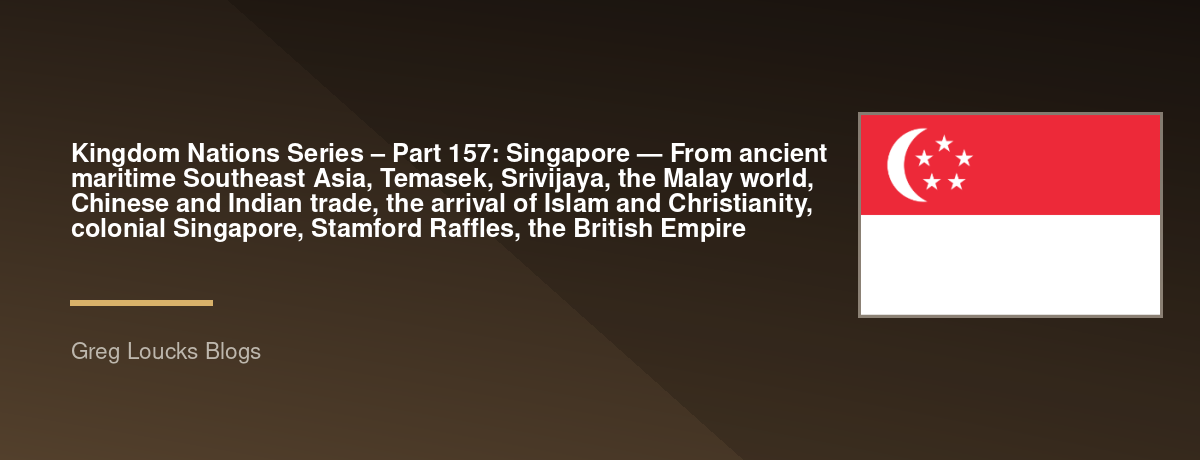
🌎 Kingdom Nations Series – Part 157: 🇸🇬 Singapore — From ancient maritime Southeast Asia, Temasek, Srivijaya, the Malay world, Chinese and Indian trade, the arrival of Islam and Christianity, colonial Singapore, Stamford Raffles, the British Empire

🌎 Kingdom Nations Series – Part 157 🇸🇬 Chapter 1 – Part 1 Singapore: The Lion City Ancient Maritime Southeast Asia, Temasek, Srivijaya, the Malay World, Chinese and Indian Trade, Islam and Christianity, Colonial Singapore, Stamford Raffles, the British Empire, World War II, Japanese Occupation, Lee Kuan Yew, Self-Government, Malaysia, Independence in 1965, the Transformation into a Global City-State, Marina Bay, the Singapore River, Multicultural Society, Languages, Education, Technology, Finance, Shipping, Aviation, the Port of Singapore, Gardens by the Bay, Environmental Stewardship, and Singapore's Kingdom Calling "The LORD shall preserve thy going out and thy coming in from this time forth, and even for evermore." — Psalm 121:8 Introduction Singapore is one of the world's most remarkable: City-states. Located at the southern tip of: The Malay Peninsula, Singapore sits at one of the most strategically important maritime crossroads on Earth. Its location connects: The Indian Ocean. The Strait of Malacca. The South China Sea. The Malay Archipelago. China. India. And: The wider world. Singapore's modern success is extraordinary. A small island with limited: Land. Natural resources. And: Freshwater became one of the world's major: Financial centers. Shipping centers. Air hubs. Technology centers. And: Commercial crossroads. But Singapore's history began long before the modern skyline. The island was connected to: The Malay world. Srivijaya. Javanese kingdoms. Chinese merchants. Indian traders. Arab merchants. And: Regional maritime networks. Its ancient name: Temasek is associated with: A historic trading settlement. Later traditions connected the island with: Sang Nila Utama and the name: Singapura. The word: Singapura comes from Sanskrit elements associated with: Lion. And: City. Thus Singapore became: The Lion City. Where Is Singapore? Singapore is located in: Southeast Asia. Malay Peninsula It sits at the southern tip of: The Malay Peninsula. Strait of Malacca Singapore lies near the: Strait of Malacca. Singapore Strait The: Singapore Strait connects Singapore's waters with: The wider maritime world. Malaysia Singapore borders: Malaysia to the north. Johor The Malaysian state of: Johor lies directly across the: Johor Strait. Indonesia Indonesia lies: South of Singapore. Riau Islands The: Riau Islands are located close to Singapore. Maritime Crossroads Singapore's location is one of: Its greatest assets. Ancient Temasek Before modern Singapore, the island was known as: Temasek. Temasek Temasek became: A regional trading settlement. Maritime Trade Ships traveled through: The waters around Singapore. Monsoon Winds Ancient sailors relied upon: Seasonal monsoon winds. India Indian merchants traveled: Eastward. China Chinese merchants traveled: Southward. Arabia Arab and Persian merchants participated in: Indian Ocean commerce. Southeast Asia Malay and Indonesian peoples connected: The islands of Southeast Asia. Srivijaya The maritime empire of: Srivijaya controlled important trade routes in: Southeast Asia. Srivijaya Its influence extended across: The Malay Archipelago. Buddhism Srivijaya became: An important Buddhist center. Maritime Empire Its power depended heavily upon: Trade. Ports. And: Sea routes. Majapahit Later: Majapahit became another powerful Southeast Asian kingdom. Javanese Influence Javanese political and cultural influence reached: The Singapore region. Malay World Singapore became part of: The wider Malay cultural world. Islam Islam gradually spread throughout: Maritime Southeast Asia. Muslim Merchants Muslim merchants helped establish: Islamic commercial networks. Malay Islam Islam became deeply embedded in: Malay civilization. Christianity Christianity arrived through: European merchants. Missionaries. And: Colonial networks. Portuguese The Portuguese conquered: Malacca in: 1511. Malacca Malacca was one of the most important: Trading ports in Southeast Asia. European Competition The Portuguese were followed by: The Dutch. Dutch The Dutch later dominated: Regional trade. British Britain eventually became: The dominant European power in Singapore. Stamford Raffles The modern British settlement is closely associated with: Sir Stamford Raffles. 1819 Raffles established a British trading settlement in: 1819. Singapore Singapore developed rapidly as: A free port. Free Port The free-port policy attracted: Merchants. Ships. Workers. And: Investors. Singapore River The: Singapore River became the center of: Early commercial activity. Harbor The harbor became: One of Singapore's greatest advantages. Trade Singapore attracted: Chinese merchants. Indian merchants. Arab merchants. Malay traders. European merchants. Chinese Community Chinese immigration became: A major component of Singapore's population. Indian Community Indian communities also became: An important part of the city. Arab Community Arab merchants contributed: To commerce and Islamic life. Malay Community The Malay community remained: Central to Singapore's identity. Kampong Glam Kampong Glam became an important: Malay and Muslim district. Sultan Mosque The: Sultan Mosque became one of Singapore's: Most important Islamic landmarks. Chinatown Chinatown developed as: A major Chinese cultural district. Little India Little India became: A major Indian cultural center. Cultural Diversity Singapore developed: A multicultural society. Colonial Singapore Singapore became part of: The British Empire. Straits Settlements Singapore eventually became one of the: Straits Settlements. Penang Penang was another: Major British settlement. Malacca Malacca also became: Part of the Straits Settlements. Port Singapore became: A major international port. Rubber The surrounding region became a major producer of: Rubber. Tin Tin mining also contributed: To regional commerce. Industrialization Singapore increasingly developed: Warehousing. Ship repair. Banking. Trading. World War I Singapore remained: A major British strategic location. World War II The Second World War transformed: Singapore's history. Japanese Invasion Japan invaded: British Malaya. Fall of Singapore Singapore fell to Japan in: 1942. Japanese Occupation The occupation lasted: Until 1945. Sook Ching The Japanese occupation included: Mass killings. And: Severe repression. War The occupation caused: Fear. Hunger. Death. And: Economic destruction. End of War Japan surrendered in: 1945. British Return Britain returned: To Singapore. Postwar Change But colonial rule could no longer: Continue unchanged. Self-Government Singapore gradually gained: Greater political autonomy. Political Movements Nationalist movements grew: After World War II. People's Action Party The: People's Action Party became a dominant political force. Lee Kuan Yew One of Singapore's most important leaders was: Lee Kuan Yew. Prime Minister Lee became: Singapore's first prime minister. 1959 Singapore achieved: Internal self-government in: 1959. Malaysia Singapore joined: The Federation of Malaysia in: 1963. Federation The merger lasted: Only a short time. Independence Singapore became independent in: 1965. 9 August 1965 Singapore became: A sovereign nation. Lee Kuan Yew Lee Kuan Yew became: The founding prime minister of independent Singapore. Nation Building The new country faced: Major challenges. Natural Resources Singapore possessed: Few natural resources. Water Freshwater was: A major strategic concern. Housing Housing shortages were: Severe. Unemployment Unemployment was: A major concern. Industrialization Singapore pursued: Rapid industrialization. Economic Development The government attracted: Foreign investment. Manufacturing Manufacturing expanded: Rapidly. Electronics Electronics became: A major industry. Port The port expanded: Dramatically. Shipping Singapore became: One of the world's busiest maritime hubs. Finance Banking and finance expanded: Rapidly. Aviation Singapore developed: A major international airport. Changi Singapore Changi Airport became: One of the world's most important aviation hubs. Changi Airport Changi connected: Singapore with: The world. Container Shipping Singapore became: A global container transshipment center. Port of Singapore The: Port of Singapore became: One of the world's major ports. Maritime Trade Singapore's economy became: Deeply connected to: Global trade. Global City Singapore transformed into: A global city-state. Marina Bay Marina Bay became: A symbol of modern Singapore. Marina Bay Sands Marina Bay Sands became: One of Singapore's most recognizable landmarks. Gardens by the Bay Gardens by the Bay became: A symbol of Singapore's environmental and technological ambition. Supertrees The: Supertree Grove combines: Architecture. Technology. And: Botanical design. Singapore River The Singapore River was: Heavily polluted during earlier decades. Cleanup The river was: Transformed through environmental cleanup. Water Singapore developed: Advanced water-management systems. NEWater Singapore developed: NEWater as part of its: Water-security strategy. Desalination Desalination became: Another water source. Water Security Singapore demonstrates: A small country can build: Strategic resilience. Education Education became: A national priority. Universities Singapore developed: World-class universities. National University of Singapore The: National University of Singapore became: A major research institution. Nanyang Technological University Nanyang Technological University became: Another major university. Science Singapore invested heavily in: Scientific research. Technology Technology became: Central to the economy. Biotechnology Singapore developed: A strong biotechnology sector. Artificial Intelligence Singapore has become: A major Asian technology hub. Digital Economy The digital economy became: Increasingly important. Finance Singapore became: A major financial center. Banking International banks established: Major operations. Investment Singapore became: A major investment hub. Law The legal system developed: A strong commercial reputation. Arbitration Singapore became: An important international arbitration center. Business Singapore developed: A highly business-oriented economy. Multicultural Society Singapore officially recognizes: Four major ethnic categories: Chinese. Malay. Indian. And: Other. Chinese Chinese Singaporeans form: The largest ethnic group. Malay Malays are: Singapore's indigenous population. Indian Indian Singaporeans form: A major community. Eurasian Eurasian communities also contribute: To Singapore's culture. Languages Singapore has: Four official languages. English English is the principal working language. Malay Malay is the national language. Mandarin Mandarin Chinese is an official language. Tamil Tamil is also an official language. National Language Malay's status as: The national language reflects Singapore's: Historical Malay identity. Education Singapore uses: English extensively in education. Bilingualism Students commonly learn: English. And: A mother-tongue language. Religion Singapore contains: Multiple religions. Buddhism Buddhism is: One of the largest religious traditions. Christianity Christianity is: A significant religion. Islam Islam is: Central to Malay Singaporean identity. Hinduism Hinduism is: Strongly represented among: Indian Singaporeans. Taoism Taoist traditions remain: Important. Religious Freedom Singapore provides: Legal protection for: Religious practice. Interfaith Relations Interfaith cooperation is: An important part of civic life. Harmony Singapore promotes: Religious harmony. Architecture Singapore's architecture combines: Colonial buildings. Modern skyscrapers. Chinese temples. Mosques. Hindu temples. Churches. Sri Mariamman Temple The: Sri Mariamman Temple is Singapore's: Oldest Hindu temple. Buddha Tooth Relic Temple The: Buddha Tooth Relic Temple is a major Buddhist landmark. Sultan Mosque The: Sultan Mosque represents: Singapore's Muslim heritage. St Andrew's Cathedral St Andrew's Cathedral represents: Singapore's Anglican heritage. Culture Singapore's culture is: Highly diverse. Food Food is: Central to Singaporean identity. Hawker Centers Singapore's: Hawker culture is internationally famous. UNESCO Singapore's hawker culture has been recognized as: UNESCO intangible cultural heritage. Hainanese Chicken Rice Chicken rice became: A famous Singaporean dish. Laksa Laksa reflects: Malay-Chinese cultural fusion. Chili Crab Chili crab became: A Singaporean culinary icon. Satay Satay reflects: Malay and regional influences. Food Culture Singapore's cuisine demonstrates: Cultural fusion. Chinatown Chinese traditions remain: Strong. Little India Indian traditions remain: Strong. Kampong Glam Malay and Islamic traditions remain: Strong. Peranakan The: Peranakan tradition combines: Chinese. Malay. And: Colonial influences. Straits Chinese Peranakan culture developed: Along the maritime Southeast Asian trading world. Music Singapore contains: Many musical traditions. Theatre The city has: A growing arts scene. Film Singapore has: A developing film industry. Literature Singapore produces: Writers in multiple languages. Sports Sports are: Important to national identity. Football Football remains: Popular. Swimming Singapore has produced: International swimmers. Joseph Schooling Joseph Schooling became: Singapore's first Olympic champion. Olympic Gold He won: Gold in swimming at: The 2016 Rio Olympics. Formula 1 Singapore hosts: The: Singapore Grand Prix. Night Race It became famous as: A major night race. Tourism Tourism is: A major economic sector. Marina Bay Marina Bay became: A major tourist destination. Sentosa Sentosa is a major: Leisure destination. Singapore Zoo The: Singapore Zoo became: An internationally recognized attraction. Night Safari The: Night Safari became: A unique wildlife attraction. Botanic Gardens The: Singapore Botanic Gardens became: A major botanical institution. UNESCO The Singapore Botanic Gardens became: A UNESCO World Heritage Site. Orchids Singapore is famous for: Orchid cultivation. Green City Singapore deliberately developed: A reputation as: A: Garden City. City in Nature The country later emphasized: City in Nature. Urban Forestry Trees and parks became: Integral to city planning. Biodiversity Singapore protects: Remaining natural ecosystems. Mangroves Mangroves remain: Important coastal habitats. Coral Reefs Singapore also contains: Coral reef ecosystems. Marine Conservation Marine conservation protects: Coastal biodiversity. Sustainability Singapore faces: Climate challenges. Sea-Level Rise Much of Singapore is: Low-lying. Coastal Protection Sea walls and other defenses are: Increasingly important. Climate Resilience Singapore is investing in: Climate adaptation. Energy Singapore has: Limited land for renewable energy. Solar Solar power is: Increasing. Green Buildings Green building standards are: Widely used. Public Transportation Singapore developed: An extensive public transport network. MRT The: Mass Rapid Transit system is: The backbone of urban transportation. Public Housing The: Housing and Development Board built: Large-scale public housing. HDB HDB housing became: A defining feature of Singapore. Home Ownership Singapore developed: A high rate of home ownership. Urban Planning Singapore became famous for: Long-term planning. Cleanliness The city became known for: Clean public spaces. Governance Singapore developed: Strong state institutions. Anti-Corruption The country became known for: Strong anti-corruption institutions. Efficiency Government administration became: Highly organized. Rule of Law Singapore emphasizes: Legal and institutional stability. Global Commerce Singapore became: A major international business hub. ASEAN Singapore was a founding member of: ASEAN. Southeast Asia It plays: An important regional role. Diplomacy Singapore's strategic position gives it: Diplomatic significance. Maritime Security The country is deeply interested in: Safe shipping lanes. Strait of Malacca The security of the strait is: Critical to global commerce. Global Supply Chains Singapore's port connects: Global supply chains. Aviation Changi connects: Asia. Europe. Africa. Australia. And: The Americas. Singapore's Kingdom Assignment Singapore's Kingdom assignment can be summarized as: City-state nation. Maritime nation. Malay-world nation. Asian crossroads. Port nation. Shipping nation. Financial nation. Technology nation. Education nation. Multicultural nation. Multilingual nation. Christian nation. Muslim nation. Buddhist nation. Hindu nation. Interfaith nation. Garden city. Water-security nation. Blue-economy nation. Innovation nation. Aviation hub. Global commerce hub. Diplomatic bridge. Island stewardship nation. Prayer for Singapore Pray: For the President. For the Prime Minister. For Parliament. For judges. For civil servants. For local leaders. For wisdom. For justice. For integrity. For national unity. For Singapore City. For every neighborhood. For families. For children. For young people. For women. For men. For elders. For workers. For entrepreneurs. For business leaders. For scientists. For engineers. For teachers. For students. For doctors. For nurses. For pastors. For priests. For imams. For monks. For temples. For mosques. For churches. For Hindu communities. For Buddhist communities. For Taoist communities. For Muslim communities. For Christian communities. For religious freedom. For interfaith cooperation. For Chinese Singaporeans. For Malay Singaporeans. For Indian Singaporeans. For Eurasian communities. For every ethnic community. For English. For Malay. For Mandarin. For Tamil. For Singapore's linguistic heritage. For education. For the National University of Singapore. For Nanyang Technological University. For researchers. For scientists. For artificial intelligence. For biotechnology. For technology. For entrepreneurs. For finance. For banking. For investment. For shipping. For maritime workers. For the Port of Singapore. For Changi Airport. For aviation workers. For global supply chains. For the Strait of Malacca. For maritime security. For regional peace. For ASEAN. For Southeast Asian cooperation. For Singapore's public housing communities. For HDB residents. For affordable housing. For urban planning. For transportation. For the MRT. For road safety. For the Singapore River. For Marina Bay. For Sentosa. For the Singapore Botanic Gardens. For Gardens by the Bay. For urban forests. For parks. For mangroves. For coral reefs. For marine biodiversity. For climate resilience. For coastal protection. For sea-level rise adaptation. For water security. For NEWater. For desalination. For reservoirs. For rainwater management. For solar energy. For green buildings. For sustainable development. For hawker culture. For Singaporean cuisine. For artists. For musicians. For writers. For filmmakers. For theater. For museums. For cultural preservation. For Chinatown. For Little India. For Kampong Glam. For Peranakan heritage. For Sultan Mosque. For Sri Mariamman Temple. For Buddha Tooth Relic Temple. For St Andrew's Cathedral. For historic neighborhoods. For Singapore's Christian communities. For Singapore's Muslim communities. For Singapore's Hindu communities. For Singapore's Buddhist communities. For Singapore's Taoist communities. For all people living in Singapore. For Singapore to become: A center of wisdom. A center of innovation. A center of peace. A center of education. A center of responsible commerce. A center of environmental stewardship. For the nations. Singapore Before the Throne Singapore has experienced: Ancient maritime trade. Temasek. Srivijaya. Majapahit. Malay civilization. Indian Ocean trade. Chinese trade. Indian trade. Islamic expansion. Portuguese influence. Dutch influence. British colonization. Free-port development. World War II. Japanese occupation. Self-government. Merger with Malaysia. Independence. Rapid industrialization. Globalization. Technological development. From Temasek to Singapore A historic trading settlement became: A modern city-state. From Malay World to Global City Singapore remained connected to: Southeast Asia while becoming: Globally integrated. From Port to Financial Center Trade created: Commercial wealth. From Colonial Settlement to Sovereign State Independence created: National responsibility. From Scarcity to Resilience Singapore turned: Limited resources into: Strategic innovation. From Dirty River to Clean River Environmental restoration demonstrated: Long-term planning. From Water Scarcity to NEWater Water insecurity produced: Technological innovation. From Jungle Island to Garden City Urban development incorporated: Nature. From Manufacturing to Technology Singapore moved: Up the economic value chain. From Local Port to Global Hub The port connected: The world. Kingdom Perspective Singapore teaches: Strategic stewardship can transform scarcity into strength. Geography Location can become: Opportunity. Water Scarcity can produce: Innovation. Education Knowledge can become: A national resource. Technology Technology can overcome: Physical limitations. Governance Institutions can create: Stability. Multiculturalism Diversity can become: Strength. Harmony Different religions can: Live alongside one another. Port Trade can connect: Nations. Environment Urban development does not necessarily require: The destruction of nature. Gardens Gardens can become: Part of national identity. Kingdom Calling Singapore's calling can be understood as: To demonstrate how wisdom, discipline, education, technology, multicultural cooperation, and environmental stewardship can transform a small strategic crossroads into a nation that serves the wider world. Singapore's Future Singapore can become a leader in: Artificial intelligence. Biotechnology. Finance. Education. Maritime technology. Aviation. Water management. Climate adaptation. Urban sustainability. Green architecture. International diplomacy. Marina Bay Marina Bay can remain: A symbol of innovation. Port The port can remain: A global maritime gateway. Changi Changi can remain: A global aviation gateway. Universities Universities can produce: Knowledge. Water NEWater can demonstrate: Resource innovation. Gardens Gardens can demonstrate: Urban ecology. Hawker Centers Hawker culture can preserve: Community. Multiculturalism Singapore can demonstrate: Cultural cooperation. ASEAN Singapore can contribute: To Southeast Asian peace. Strait of Malacca Singapore can contribute: To maritime security. Global Commerce Singapore can contribute: To stable global trade. Climate Singapore can contribute: To climate adaptation. Final Commission May Singapore become a nation of: Wisdom. Peace. Innovation. Stewardship. Education. Justice. Harmony. May Singapore flourish. May every neighborhood flourish. May families flourish. May children flourish. May young people flourish. May women flourish. May men flourish. May elders receive: Honor. May workers prosper. May entrepreneurs prosper. May scientists prosper. May engineers prosper. May teachers prosper. May students prosper. May doctors prosper. May nurses prosper. May artists prosper. May musicians prosper. May writers prosper. May filmmakers prosper. May churches flourish. May mosques flourish. May temples flourish. May religious communities live: In peace. May Christians serve: With love. May Muslims serve: With wisdom. May Buddhists pursue: Compassion. May Hindus pursue: Peace. May Taoist traditions preserve: Wisdom. May every religious community: Respect the dignity of others. May English remain: A bridge. May Malay remain: A national heritage. May Mandarin remain: A cultural bridge. May Tamil remain: A living heritage. May Singapore's languages flourish. May education flourish. May universities flourish. May research flourish. May artificial intelligence serve: Humanity. May biotechnology serve: Life. May technology serve: The public good. May finance serve: Productive enterprise. May business serve: Society. May the Port of Singapore remain: A global gateway. May shipping remain: Safe. May the Strait of Malacca remain: Secure. May Changi Airport remain: A global gateway. May aviation connect: People peacefully. May HDB communities flourish. May affordable housing remain: Accessible. May the MRT remain: Efficient. May transportation remain: Safe. May Singapore River remain: Clean. May Marina Bay flourish. May Gardens by the Bay flourish. May Singapore Botanic Gardens flourish. May urban forests flourish. May mangroves flourish. May coral reefs flourish. May marine ecosystems remain: Healthy. May coastal protection strengthen. May Singapore prepare wisely: For sea-level rise. May water remain: Secure. May NEWater continue: Serving the nation. May desalination become: More sustainable. May reservoirs remain: Protected. May solar energy expand. May green buildings expand. May sustainable development flourish. May hawker culture remain: Alive. May Singaporean cuisine remain: A source of cultural unity. May Chinatown flourish. May Little India flourish. May Kampong Glam flourish. May Peranakan heritage flourish. May historic buildings remain: Protected. May Singapore's multicultural heritage remain: Strong. May Singapore become: A leader in urban sustainability. May Singapore become: A leader in water security. May Singapore become: A leader in maritime innovation. May Singapore become: A leader in green technology. May Singapore become: A leader in education. May Singapore become: A leader in responsible artificial intelligence. May Singapore become: A leader in interfaith cooperation. May Singapore become: A leader in peaceful diplomacy. May Singapore contribute: To ASEAN. May Singapore contribute: To Southeast Asian peace. May Singapore contribute: To global maritime security. May Singapore contribute: To international trade. May Singapore contribute: To climate solutions. May Singapore contribute: To the flourishing of the nations. May its strategic location produce: Service. May its wealth produce: Generosity. May its technology produce: Human flourishing. May its diversity produce: Unity. May its education produce: Wisdom. May its institutions produce: Justice. May its gardens produce: Beauty. May its water systems produce: Resilience. May its port produce: Connection. May its people produce: Peace. And may the people of Singapore, together with every nation, tribe, people, and language, remember: "Wisdom is the principal thing; therefore get wisdom: and with all thy getting get understanding." (Proverbs 4:7) Amen. 🇸🇬 Kingdom Nations Series – Part 157 Singapore From ancient Temasek to modern Singapore. From maritime Southeast Asia to the Malay world. From Srivijaya to Majapahit. From Indian merchants to Chinese merchants. From Arab traders to Southeast Asian sailors. From Islam to the Malay world. From Christianity to the colonial era. From Malacca to the great maritime crossroads. From Portuguese rule to Dutch influence. From Stamford Raffles to British Singapore. From 1819 to the free port. From Singapore River to global commerce. From Chinatown to Little India. From Kampong Glam to Malay heritage. From Chinese to Malay. From Indian to Eurasian. From four languages to one multicultural nation. From British colonialism to self-government. From Lee Kuan Yew to nation building. From 1959 to self-government. From Malaysia to independence. From 1965 to sovereign Singapore. From scarcity to strategic resilience. From unemployment to industrialization. From manufacturing to technology. From port to global shipping hub. From finance to international banking. From Changi to global aviation. From Marina Bay to the modern skyline. From polluted waters to the Singapore River restoration. From water scarcity to NEWater. From jungle island to Garden City. From Gardens by the Bay to City in Nature. From hawker stalls to UNESCO heritage. From education to global universities. From science to biotechnology. From technology to artificial intelligence. From multiculturalism to national identity. From religious diversity to interfaith harmony. From the Strait of Malacca to global trade. From ASEAN to Southeast Asian diplomacy. From Singapore to Asia. From Singapore to the nations. From Singapore to the Kingdom. From the Lion City to the throne. End of Kingdom Nations Series – Part 157: 🇸🇬 Singapore Coming Next: 🌎 Kingdom Nations Series – Part 158: 🇸🇰 Slovakia — From ancient Celtic and Germanic peoples, Roman Danube frontier, Great Moravia, Saints Cyril and Methodius, the medieval Kingdom of Hungary, Bratislava, Spiš, Slovak national revival, Ľudovít Štúr, the Habsburg era, Czechoslovakia, World War II, the Slovak Republic, the Communist era, the Velvet Revolution, the peaceful dissolution of Czechoslovakia, modern Slovakia, the Carpathians, High Tatras, castles, caves, forests, Danube landscapes, Slovak Christianity, folk traditions, literature, industry, technology, and Slovakia's Kingdom calling.
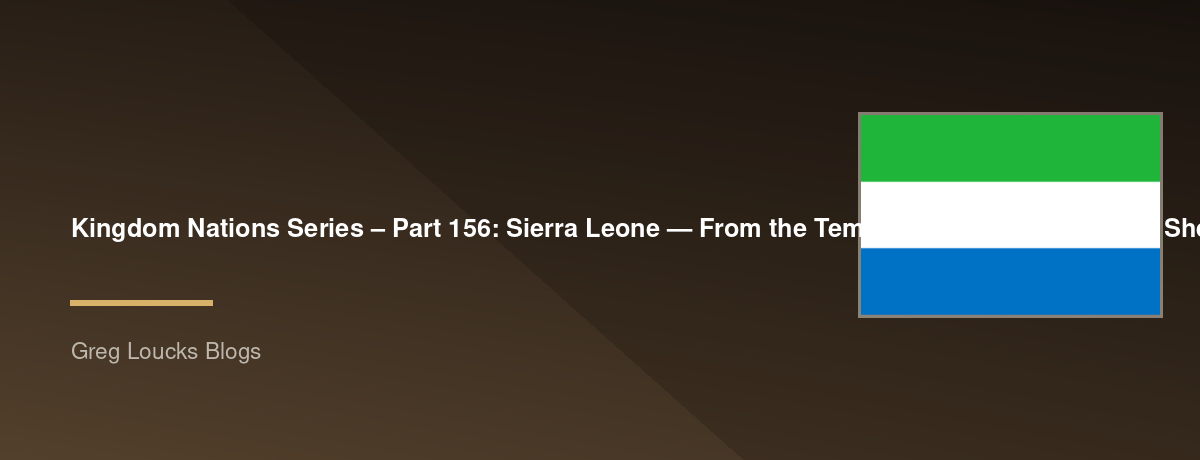
Read more 🌎 Kingdom Nations Series – Part 157: 🇸🇬 Singapore — From ancient maritime Southeast Asia, Temasek, Srivijaya, the Malay world, Chinese and Indian trade, the arrival of Islam and Christianity, colonial Singapore, Stamford Raffles, the British Empire

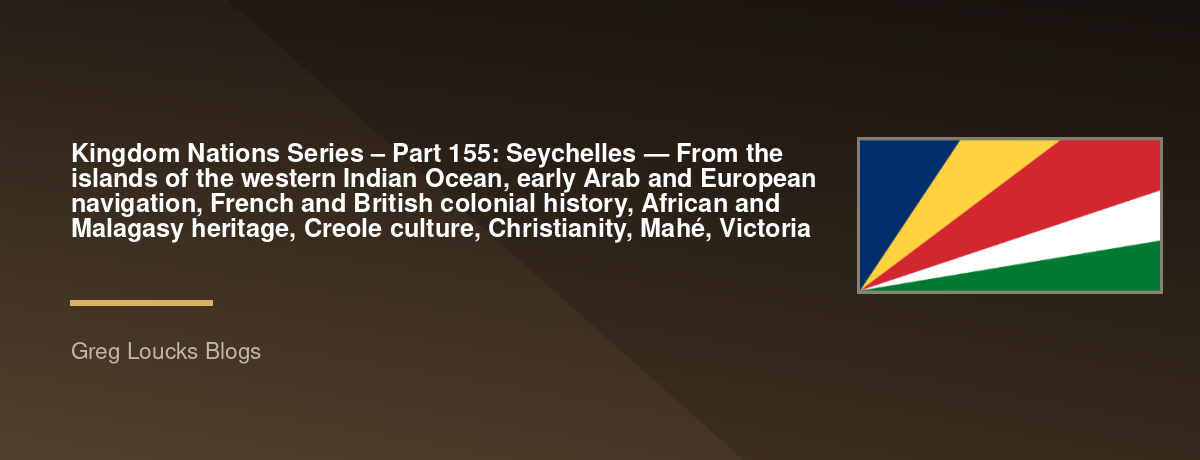
🌎 Kingdom Nations Series – Part 156: 🇸🇱 Sierra Leone — From the Temne, Mende, Limba, Loko, Sherbro and other peoples, ancient West African trade, the Bullom and coastal societies, Portuguese exploration, the slave trade, Freetown, the Province

🌎 Kingdom Nations Series – Part 156 🇸🇱 Chapter 1 – Part 1 Sierra Leone: The Land of Freedom The Temne, Mende, Limba, Loko, Sherbro and Other Peoples, Ancient West African Trade, Coastal Kingdoms, Portuguese Exploration, the Atlantic Slave Trade, Bunce Island, Freetown, the Province of Freedom, Black Loyalists, Jamaican Maroons, Nova Scotians, the Krio People, British Colonialism, Christianity, Islam, Bai Bureh, the Hut Tax War, Independence, Freetown, the Sierra Leone River, Diamonds, Agriculture, Civil War, Reconciliation, the Special Court, Tiwai Island, Rainforests, Chimpanzees, Music, Culture, and Sierra Leone's Kingdom Calling "He hath sent me to heal the brokenhearted, to preach deliverance to the captives." — Luke 4:18 Introduction Sierra Leone stands on: The Atlantic coast of West Africa. Its name means: Lion Mountains. The country occupies a region where: The Atlantic Ocean. The West African interior. The Upper Guinea forests. And: The Sahelian world meet. Sierra Leone's history is deeply connected with: West African kingdoms. Atlantic commerce. The slave trade. Christianity. Islam. Colonialism. African resistance. Independence. Civil war. Reconciliation. And: Conservation. Its people include: Temne. Mende. Limba. Loko. Sherbro. Kono. Kissi. Kuranko. And: Many other communities. But Sierra Leone is perhaps best known internationally for: Freetown. Freetown has an extraordinary history. It was founded as: A settlement for formerly enslaved Africans. Its very name represents: Freedom. Freetown Freetown is: The capital of Sierra Leone. Province of Freedom The settlement was established as: A: Province of Freedom. Formerly Enslaved Africans People who had experienced: Slavery. War. Displacement. And: Forced migration came to Freetown. Black Loyalists Some settlers were: Black Loyalists who had fought for the British during: The American Revolutionary War. Nova Scotians Other settlers came from: Nova Scotia. Jamaican Maroons The community was later joined by: Jamaican Maroons. Krio Over generations these communities developed: Krio society. Krio People The: Krio people became one of Sierra Leone's most distinctive communities. Krio Language Krio became: A major language of communication. Christianity Freetown became: A major center of Christian missionary activity. Fourah Bay College One of West Africa's most important educational institutions is: Fourah Bay College. Fourah Bay It was founded in: 1827. Education The institution became: A major center of African scholarship. Christianity Christian missionaries established: Schools. Churches. Hospitals. Islam Islam also has: Deep roots in Sierra Leone. Religious Coexistence Sierra Leone became known for: Muslim-Christian coexistence. Atlantic History Sierra Leone's history cannot be separated from: The Atlantic slave trade. Bunce Island Bunce Island became: A major slave-trading post. Slave Castle The island contains: Ruins of a former slave-trading fortress. Atlantic Slave Trade Enslaved Africans were transported from: West Africa to: The Americas. Plantations Many were taken to: Plantations. North America Some were transported to: British North America. Caribbean Others went to: The Caribbean. Human Suffering The slave trade produced: Violence. Family separation. Forced migration. Disease. Death. And: Generational trauma. Historical Memory Sierra Leone therefore carries: A powerful history of slavery. Freedom But the country also became: A symbol of emancipation. Freetown Its capital literally carries: The name: Freetown. Ancient Sierra Leone Before European colonialism, the region contained: Established African societies. Temne The: Temne became one of the largest peoples. Mende The: Mende became another major cultural group. Limba The: Limba have a long history in: Northern Sierra Leone. Loko The: Loko also have: Deep roots in the region. Sherbro The: Sherbro developed along: Coastal and island regions. Kono The: Kono became especially associated with: Eastern Sierra Leone. Kissi The: Kissi live across: Sierra Leone and neighboring countries. Kuranko The: Kuranko are associated particularly with: Northern and eastern regions. Coastal Trade Coastal societies traded: Salt. Fish. Ivory. Gold. Agricultural products. Inland Trade Trade routes connected: The coast with: The interior. Gold Gold was: A major regional commodity. Diamonds Centuries later: Diamonds would transform Sierra Leone's economy and politics. Portuguese Portuguese navigators reached: The Sierra Leone coast during: The fifteenth century. Pedro da Cintra Portuguese explorer: Pedro da Cintra is traditionally associated with naming: The Lion Mountains. Lion Mountains The name became: Sierra Leone. European Trade European traders established: Coastal trading relationships. Slave Trade The Atlantic slave trade expanded: Dramatically. Bunce Island Bunce Island became: One of the most important slave-trading sites in the region. British British merchants became: Major participants. Abolition The British abolition movement eventually transformed: Sierra Leone's history. Freetown Freetown was founded in: 1792. Granville Sharp The settlement was connected with: British abolitionists. Sierra Leone Company The: Sierra Leone Company helped establish: The settlement. Black Loyalists Black Loyalists from: Nova Scotia arrived in: Freetown. Africa For many settlers, returning to Africa represented: A new beginning. Freedom Freetown represented: Freedom. Christian Mission Freetown became: A major missionary center. Church Missionary Society The: Church Missionary Society became influential. Schools Missionaries established: Schools. Literacy Education promoted: Literacy. African Clergy African Christians eventually became: Teachers. Pastors. Scholars. Samuel Ajayi Crowther Samuel Ajayi Crowther was a major nineteenth-century African Christian leader. Crowther He was educated in: Freetown. Bishop Crowther eventually became: The first African Anglican bishop. Yoruba Connection His life also connected: Sierra Leone with: The wider West African Christian world. Fourah Bay College Freetown became: An intellectual center. African Scholarship Students from across: West Africa studied in Freetown. Christianity Christianity spread: Beyond the colony. Islam Islam continued: Across the interior. Religious Balance Sierra Leone developed: A predominantly Muslim population with: A substantial Christian population. Interfaith Relations Muslims and Christians have often: Lived alongside one another. Colonial Rule Britain eventually expanded: Colonial control. Protectorate In: 1896 Britain declared: A Protectorate over the interior. Freetown Colony Freetown remained: A separate colonial center. Protectorate The Protectorate contained: Most of the country's population. Indirect Rule British administration relied heavily on: Traditional rulers. Paramount Chiefs Chiefs became: Important colonial intermediaries. Hut Tax Britain introduced: A hut tax. Tax Resistance Resistance intensified: Throughout the Protectorate. Bai Bureh One of the most famous resistance leaders was: Bai Bureh. Temne Bai Bureh was: A Temne leader. Hut Tax War Resistance became known as: The: Hut Tax War. 1898 The uprising began in: 1898. Resistance The war demonstrated: African resistance to colonial rule. Bai Bureh Bai Bureh became: A national historical figure. Colonialism The conflict demonstrated: The tension between: Colonial taxation and: African political authority. Independence Sierra Leone achieved independence in: 1961. Milton Margai The first prime minister was: Sir Milton Margai. Independence The country became: A sovereign state. Republic Sierra Leone became: A republic in: 1971. Siaka Stevens Siaka Stevens became: A dominant political figure. Politics Political instability later affected: The country. Diamonds The discovery and exploitation of: Diamonds became increasingly important. Kono The: Kono District became famous for: Diamond mining. Diamond Wealth Diamonds generated: Large revenues. Diamond Curse But diamond wealth also contributed to: Corruption. Conflict. And: Smuggling. Civil War Sierra Leone entered: A devastating civil war. 1991 The civil war began in: 1991. Revolutionary United Front The: Revolutionary United Front launched: An armed rebellion. Civilian Suffering The war produced: Mass displacement. Killings. Mutilation. Child soldiers. Sexual violence. And: Destruction. Children Children were among: The war's greatest victims. Child Soldiers Many children were: Forced or coerced into armed groups. Blood Diamonds Sierra Leone became internationally associated with: Blood diamonds. Conflict Diamonds Diamonds were used: To finance warfare. International Attention The conflict became: An international humanitarian crisis. Freetown Freetown experienced: Severe violence. Intervention International and regional forces eventually helped: Stabilize the country. United Nations The: United Nations played a major role. UNAMSIL The: United Nations Mission in Sierra Leone helped: Implement the peace process. Peace The war officially ended in: 2002. Reconciliation Sierra Leone then faced: The enormous task of rebuilding. Truth and Reconciliation Commission The: Truth and Reconciliation Commission documented: War experiences. Special Court The: Special Court for Sierra Leone prosecuted: Major perpetrators. Justice The court became: An important international example. Charles Taylor Former Liberian president: Charles Taylor was convicted by: The Special Court for Sierra Leone. Accountability The trials demonstrated: Leaders could be held accountable. Healing But legal justice alone could not: Erase trauma. Rebuilding Sierra Leone invested in: Infrastructure. Education. Healthcare. Governance. Freetown Freetown rebuilt: After the war. Democracy Democratic institutions strengthened: Over time. Elections Competitive elections became: A major part of political life. Ebola Sierra Leone later suffered: A devastating Ebola epidemic. 2014 The outbreak became: A national emergency. Healthcare Workers Doctors and nurses faced: Extraordinary risks. Communities Communities experienced: Loss. Fear. And: Economic disruption. Recovery The country eventually: Contained the outbreak. Resilience Sierra Leone demonstrated: Remarkable resilience. Agriculture Agriculture remains: Central to the economy. Rice Rice is: A major staple crop. Cassava Cassava is: Widely cultivated. Cocoa Cocoa is: An important export. Coffee Coffee is also: Produced. Palm Oil Palm oil is: An important agricultural product. Fisheries Fishing supports: Coastal communities. Atlantic Ocean The Atlantic provides: Food. Trade. And: Economic opportunity. Marine Resources Marine ecosystems require: Protection. Rainforest Sierra Leone contains: Important remaining Upper Guinea forests. Gola Forest The: Gola Forest is one of the country's most important: Rainforest ecosystems. Gola Rainforest It provides habitat for: Rare species. Tiwai Island Tiwai Island is a major: Wildlife sanctuary. Tiwai It is especially famous for: Primates. Chimpanzees Sierra Leone contains: Important chimpanzee populations. Western Chimpanzee The: Western chimpanzee is critically endangered. Conservation Protecting chimpanzees requires: Forest protection. Pygmy Hippopotamus Sierra Leone also contains: The endangered: Pygmy hippopotamus. Forest Elephants Forest ecosystems support: Elephants. Biodiversity Sierra Leone contains: Exceptional biodiversity. Rainforest Forests protect: Water. Soil. Wildlife. Climate. Deforestation Deforestation threatens: Biodiversity. Agriculture Expansion of agriculture can: Destroy habitat. Conservation Sustainable agriculture can: Protect forests. Climate Change Climate change threatens: Coastal areas. Agriculture. Forests. Flooding Freetown is vulnerable to: Flooding and landslides. Landslides Heavy rainfall can cause: Deadly landslides. Urbanization Rapid urban growth creates: Infrastructure challenges. Freetown The capital faces: Housing. Transportation. Drainage. And: Environmental challenges. Culture Sierra Leonean culture combines: Many traditions. Krio Culture Krio culture is especially associated with: Freetown. Temne Culture Temne culture remains: Central to northern Sierra Leone. Mende Culture Mende culture remains: Central to southern and eastern Sierra Leone. Secret Societies Traditional institutions such as: Poro and: Sande have historically shaped: Community life. Sande Sande is associated with: Mende and neighboring societies. Poro Poro is a major: Male initiation institution. Traditional Knowledge These institutions preserved: Social structures. Education. Identity. Music Music is: Central to Sierra Leonean culture. Bubu Bubu is a traditional: Musical tradition. Gumbe Gumbe has deep: West African and Krio connections. Krio Music Krio culture developed: Distinctive musical traditions. Palm-Wine Music Palm-wine music became: An important West African tradition. Dance Dance remains: Central to celebrations. Football Football is: The country's most popular sport. Leone Stars The national team is: The: Leone Stars. Sports Football provides: National unity. Freetown Freetown remains: The cultural heart of the nation. Sierra Leone's Kingdom Assignment Sierra Leone's Kingdom assignment can be summarized as: West African nation. Atlantic nation. Forest nation. Krio nation. Temne nation. Mende nation. Limba nation. Sherbro nation. Islamic nation. Christian nation. Interfaith nation. Freedom nation. Freetown nation. Liberation nation. Education nation. Missionary nation. Fourah Bay nation. Bunce Island nation. Historical memory nation. Diamond nation. Agricultural nation. Rainforest nation. Conservation nation. Reconciliation nation. Resilience nation. Prayer for Sierra Leone Pray: For the President. For Parliament. For judges. For chiefs. For local leaders. For public servants. For wisdom. For justice. For integrity. For national unity. For Freetown. For Bo. For Kenema. For Makeni. For Koidu. For every district. For every village. For families. For children. For young people. For women. For men. For elders. For farmers. For fishermen. For miners. For entrepreneurs. For teachers. For students. For doctors. For nurses. For pastors. For priests. For imams. For churches. For mosques. For Muslim communities. For Christian communities. For peaceful Muslim-Christian relations. For religious freedom. For Temne communities. For Mende communities. For Limba communities. For Loko communities. For Sherbro communities. For Kono communities. For Kissi communities. For Kuranko communities. For Krio communities. For every ethnic community. For Krio language. For local languages. For cultural preservation. For traditional leaders. For historians. For archaeologists. For museums. For Bunce Island. For Freetown. For the history of slavery to be remembered honestly. For descendants of enslaved Africans. For reconciliation. For victims of the civil war. For survivors. For families affected by violence. For former child soldiers. For victims of sexual violence. For displaced families. For justice. For the Special Court's legacy. For the Truth and Reconciliation Commission's legacy. For democratic institutions. For peaceful elections. For good governance. For anti-corruption efforts. For education. For Fourah Bay College. For universities. For schools. For teachers. For students. For literacy. For healthcare. For doctors. For nurses. For hospitals. For public health. For lessons learned from Ebola. For agricultural development. For rice farmers. For cassava farmers. For cocoa farmers. For coffee farmers. For palm-oil producers. For food security. For fishermen. For sustainable fisheries. For the Atlantic Ocean. For coastal communities. For Freetown's environment. For flood prevention. For landslide prevention. For safe housing. For responsible urban development. For Gola Forest. For Tiwai Island. For chimpanzees. For pygmy hippos. For forest elephants. For endangered wildlife. For rainforests. For biodiversity. For sustainable forestry. For climate resilience. For environmental protection. For sustainable mining. For responsible diamond mining. For Kono. For mining communities. For miners. For Sierra Leone to never again allow: Natural resources to finance war. Children to become soldiers. Communities to be destroyed by corruption. For football. For Leone Stars. For musicians. For dancers. For artists. For writers. For traditional culture. For Poro and Sande traditions to be approached with wisdom and respect for human dignity. For Krio culture. For Mende culture. For Temne culture. For all Sierra Leonean traditions. For Sierra Leone to become: A center of reconciliation. A center of education. A center of rainforest conservation. A center of interfaith cooperation. A center of historical remembrance. For the nations. Sierra Leone Before the Throne Sierra Leone has experienced: Ancient African societies. Coastal trade. Islamic influence. European exploration. The Atlantic slave trade. Bunce Island. Freetown. Black Loyalists. Nova Scotians. Jamaican Maroons. Krio society. British colonialism. African resistance. Bai Bureh. Independence. Political instability. Diamond exploitation. Civil war. International intervention. Reconciliation. Ebola. Democratic rebuilding. From African Kingdoms to Atlantic Trade The region moved: From inland trade to: Atlantic commerce. From Slave Trade to Freetown A place associated with: Enslavement became: A city named for: Freedom. From Black Loyalists to Krios Formerly enslaved Africans developed: A new Creole society. From Fourah Bay to African Scholarship Freetown became: A center of education. From Christianity to Interfaith Society Christian and Muslim communities developed: Together. From Colonial Taxation to Resistance Bai Bureh became: A symbol of resistance. From Independence to Civil War Political instability eventually produced: Conflict. From Blood Diamonds to Accountability Sierra Leone became: A global symbol of the dangers of conflict resources. From War to Reconciliation The nation chose: A path toward peace. From Rainforest Loss to Conservation Sierra Leone is now working to: Protect its forests. From Trauma to Resilience The people have demonstrated: Extraordinary resilience. Kingdom Perspective Sierra Leone teaches: A nation's greatest strength can emerge from its deepest wounds. Freedom Freetown's name carries: A message. Slavery The country remembers: Human suffering. Reconciliation But reconciliation demonstrates: The possibility of healing. Education Fourah Bay demonstrates: Knowledge can transform societies. Faith Christian and Muslim communities demonstrate: Faith can coexist. Nature Gola and Tiwai demonstrate: Creation can be protected. Resources Diamonds demonstrate: Natural wealth without justice can become: A curse. Stewardship Resources require: Wisdom. Children Children must never become: Weapons of war. Justice Justice must protect: The vulnerable. Peace Peace requires: More than the absence of fighting. It requires: Opportunity. Justice. Education. Healthcare. And: Dignity. Kingdom Calling Sierra Leone's calling can be understood as: To transform a history marked by slavery, colonialism, exploitation, and war into a testimony of freedom, reconciliation, education, environmental stewardship, and human dignity. Sierra Leone's Future Sierra Leone can become a leader in: Rainforest conservation. Interfaith cooperation. Historical reconciliation. Sustainable agriculture. Responsible mining. Education. Healthcare. Democracy. Youth development. Freetown Freetown can remain: A city of freedom. Bunce Island Bunce Island can remain: A place of historical remembrance. Fourah Bay Fourah Bay can remain: A center of African scholarship. Kono Kono can become: A model for responsible resource development. Gola Gola can remain: A rainforest sanctuary. Tiwai Tiwai can remain: A wildlife sanctuary. Chimpanzees Sierra Leone can become: A global center for western chimpanzee conservation. Agriculture Farmers can produce: Food and prosperity. Fisheries Fisheries can provide: Food and employment. Diamonds Diamond wealth can serve: Communities rather than conflict. Youth Sierra Leone's young people can become: Its greatest strength. Education Education can transform: The next generation. Technology Technology can connect: Sierra Leone to the world. Diaspora The Sierra Leonean diaspora can contribute: Knowledge. Investment. Experience. Reconciliation Sierra Leone can demonstrate: Peace after war is possible. Final Commission May Sierra Leone become a nation of: Freedom. Justice. Peace. Wisdom. Education. Reconciliation. Stewardship. May Freetown flourish. May Bo flourish. May Kenema flourish. May Makeni flourish. May Koidu flourish. May every district flourish. May every village flourish. May families flourish. May children flourish. May young people flourish. May women flourish. May men flourish. May elders receive: Honor. May farmers prosper. May fishermen prosper. May miners prosper. May entrepreneurs prosper. May teachers prosper. May students prosper. May doctors prosper. May nurses prosper. May scientists prosper. May artists prosper. May musicians prosper. May athletes prosper. May churches flourish. May mosques flourish. May Christians and Muslims live: In peace. May religious leaders promote: Reconciliation. May Temne communities flourish. May Mende communities flourish. May Limba communities flourish. May Loko communities flourish. May Sherbro communities flourish. May Kono communities flourish. May Kissi communities flourish. May Kuranko communities flourish. May Krio communities flourish. May every Sierra Leonean community flourish. May Krio remain: Strong. May Temne remain: Strong. May Mende remain: Strong. May every indigenous language be: Protected. May cultural traditions remain: Alive. May music flourish. May dance flourish. May Bubu flourish. May Gumbe flourish. May palm-wine music flourish. May traditional arts flourish. May football flourish. May Leone Stars inspire: The nation. May Bunce Island remain: Protected. May the history of slavery be: Remembered truthfully. May the descendants of enslaved Africans receive: Honor. May survivors of war receive: Dignity. May victims of violence receive: Justice. May former child soldiers receive: Healing. May communities affected by war receive: Restoration. May corruption decrease. May justice strengthen. May democratic institutions flourish. May elections remain: Peaceful. May leaders serve: The people. May Fourah Bay College flourish. May universities flourish. May schools flourish. May teachers flourish. May literacy increase. May education become: Accessible. May healthcare improve. May hospitals strengthen. May doctors and nurses receive: Support. May Sierra Leone never again experience: The horrors of civil war. May diamonds never again finance: Conflict. May natural resources benefit: Communities. May Kono prosper. May mining become: Responsible. May agriculture flourish. May rice farmers prosper. May cassava farmers prosper. May cocoa farmers prosper. May coffee farmers prosper. May palm-oil producers prosper. May food security increase. May fisheries remain: Sustainable. May the Atlantic remain: Healthy. May coastal communities prosper. May Freetown become: More resilient. May flooding decrease. May landslides decrease. May safe housing increase. May urban planning improve. May Gola Forest remain: Protected. May Tiwai Island remain: Protected. May chimpanzees flourish. May pygmy hippos flourish. May forest elephants flourish. May rainforests flourish. May biodiversity increase. May sustainable forestry expand. May climate resilience strengthen. May Sierra Leone become: A leader in rainforest conservation. May Sierra Leone become: A leader in western chimpanzee protection. May Sierra Leone become: A leader in reconciliation. May Sierra Leone become: A leader in interfaith cooperation. May Sierra Leone become: A leader in responsible natural-resource development. May Sierra Leone become: A leader in African education. May Sierra Leone become: A symbol of freedom. May Sierra Leone's history of suffering produce: Compassion. May its history of slavery produce: A commitment to human dignity. May its history of war produce: A commitment to peace. May its history of exploitation produce: A commitment to stewardship. May its history of resilience produce: Hope. May Freetown's name continue to proclaim: Freedom. May Sierra Leone contribute: To the peace of West Africa. May Sierra Leone contribute: To the healing of Africa. May Sierra Leone contribute: To rainforest conservation. May Sierra Leone contribute: To global justice. May Sierra Leone contribute: To the flourishing of the nations. And may the people of Sierra Leone, together with every nation, tribe, people, and language, remember: "The LORD looseth the prisoners." (Psalm 146:7) Amen. 🇸🇱 Kingdom Nations Series – Part 156 Sierra Leone From ancient West African societies to Atlantic history. From Temne to Mende. From Limba to Loko. From Sherbro to Kono. From Kissi to Kuranko. From coastal trade to European exploration. From Portuguese sailors to the Lion Mountains. From African commerce to the Atlantic slave trade. From Bunce Island to historical memory. From slavery to abolition. From Black Loyalists to Freetown. From Nova Scotia to Africa. From Jamaican Maroons to Sierra Leone. From formerly enslaved Africans to the Krio people. From Freetown to the Province of Freedom. From Christianity to African scholarship. From Fourah Bay to West African education. From Islam to Muslim-Christian coexistence. From British colonialism to African resistance. From Bai Bureh to the Hut Tax War. From 1898 to the struggle against colonial rule. From independence in 1961 to sovereign nationhood. From diamonds to Kono. From natural wealth to the tragedy of conflict diamonds. From civil war to reconciliation. From 1991 to peace in 2002. From child soldiers to healing. From the Special Court to international justice. From the Truth and Reconciliation Commission to national memory. From Ebola to resilience. From agriculture to food security. From the Atlantic to fisheries. From Gola Forest to rainforest conservation. From Tiwai Island to wildlife protection. From chimpanzees to biodiversity. From Freetown to freedom. From Sierra Leone to West Africa. From Sierra Leone to the nations. From Sierra Leone to the Kingdom. From freedom to the throne. End of Kingdom Nations Series – Part 156: 🇸🇱 Sierra Leone Coming Next: 🌎 Kingdom Nations Series – Part 157: 🇸🇬 Singapore — From ancient maritime Southeast Asia, Temasek, Srivijaya, the Malay world, Chinese and Indian trade, the arrival of Islam and Christianity, colonial Singapore, Stamford Raffles, the British Empire, World War II and the Japanese occupation, Lee Kuan Yew, self-government, merger with Malaysia, independence in 1965, the transformation into a global city-state, Marina Bay, the Singapore River, multicultural society, English, Malay, Mandarin and Tamil, education, technology, finance, shipping, aviation, the Port of Singapore, Gardens by the Bay, environmental stewardship, and Singapore's Kingdom calling.    

Read more 🌎 Kingdom Nations Series – Part 156: 🇸🇱 Sierra Leone — From the Temne, Mende, Limba, Loko, Sherbro and other peoples, ancient West African trade, the Bullom and coastal societies, Portuguese exploration, the slave trade, Freetown, the Province

🌎 Kingdom Nations Series – Part 155: 🇸🇨 Seychelles — From the islands of the western Indian Ocean, early Arab and European navigation, French and British colonial history, African and Malagasy heritage, Creole culture, Christianity, Mahé, Victoria

🌎 Kingdom Nations Series – Part 155 🇸🇨 Chapter 1 – Part 1 Seychelles: The Islands of the Indian Ocean Mahé, Victoria, Praslin, La Digue, Early Arab Navigation, French and British Colonial History, African and Malagasy Heritage, Creole Culture, Christianity, Vallée de Mai, Aldabra, Giant Tortoises, Coral Reefs, Marine Conservation, Fishing, Tourism, Independence, Biodiversity, Island Stewardship, and Seychelles' Kingdom Calling "The sea is his, and he made it: and his hands formed the dry land." — Psalm 95:5 Introduction Seychelles is an extraordinary island nation scattered across: The western Indian Ocean. It lies northeast of: Madagascar. And east of: East Africa. The country consists of: 115 islands spread across a vast area of ocean. Its largest island is: Mahé. The capital is: Victoria. Other famous islands include: Praslin. La Digue. Silhouette. Curieuse. And: Aldabra. Seychelles is famous for: Tropical beaches. Granite mountains. Coral reefs. Giant tortoises. Rare birds. Marine ecosystems. And: Exceptional biodiversity. But Seychelles is more than: A tropical paradise. Its history reflects the meeting of: Africa. Madagascar. Arabian and Indian Ocean trade. France. Britain. And: Creole civilization. The islands were uninhabited when Europeans permanently settled them, but they were not unknown to the wider Indian Ocean world. Arab and other Indian Ocean sailors navigated: The surrounding seas. The islands eventually entered: French colonial history. Then: British imperial history. Plantations developed. Enslaved Africans were brought to the islands. Later, Indian and other communities also arrived. Over generations, these populations created: Seychellois Creole culture. Seychelles became independent in: 1976. Today it is: A sovereign republic. A major tourism destination. A marine conservation center. And: One of the world's most important island biodiversity environments. Where Is Seychelles? Seychelles is located in: The western Indian Ocean. Indian Ocean The country is surrounded by: The Indian Ocean. Madagascar Madagascar lies: Southwest of Seychelles. Africa The African mainland lies: West and southwest. Mauritius Mauritius lies: Farther south. Comoros The Comoros Islands lie: Southwest. Mahé The largest island is: Mahé. Victoria The capital: Victoria is located on Mahé. Victoria Victoria is: One of the world's smaller national capitals. Praslin Praslin is the second-largest major island. La Digue La Digue is famous for: Granite boulders. Beaches. Cycling. And: Traditional island landscapes. Silhouette Silhouette Island contains: Mountains. Forest. And: Protected ecosystems. Curieuse Curieuse Island is famous for: Giant tortoises. Aldabra Aldabra Atoll is one of Seychelles' greatest: Natural treasures. Aldabra It is: A massive coral atoll. UNESCO Aldabra is recognized as: A: UNESCO World Heritage Site. Granite Islands Many of the central Seychelles islands are: Granite islands. Coral Islands The outer islands include: Coral islands and atolls. Biodiversity This geological diversity created: Exceptional ecosystems. Ancient Indian Ocean World Seychelles sits within: The ancient Indian Ocean trading world. Navigation Sailors traveled between: East Africa. Arabia. India. Madagascar. And: Southeast Asia. Arab Sailors Arab navigators were among those who: Mapped and traveled the western Indian Ocean. Monsoon Winds Indian Ocean navigation depended heavily upon: Seasonal monsoon winds. Trade Ships moved: Goods. People. Ideas. Religions. Languages. Madagascar Madagascar was particularly important to: Indian Ocean navigation. Malagasy Heritage Seychelles' population eventually received: Malagasy cultural influence. Africa African heritage became: Central to Seychellois identity. French Exploration French explorers eventually entered: The Seychelles islands. French Settlement France established: Permanent settlement. 1750s French settlement began: In the eighteenth century. Mahé The island of Mahé became: The principal settlement. Seychelles The islands were named after: Jean Moreau de Séchelles a French official. Plantation Economy French settlers developed: Plantations. Coconut Coconut became: An important crop. Vanilla Vanilla became: An important plantation product. Cinnamon Cinnamon also became: Economically important. Cloves Cloves were: Cultivated. Slavery Plantations relied upon: Enslaved labor. Africa Enslaved Africans were transported: To the islands. Human Suffering Enslavement brought: Violence. Forced labor. Family separation. And: Loss of freedom. Abolition The abolition of slavery transformed: Seychellois society. Freed Communities Formerly enslaved people became: The foundation of the emerging Creole population. Indian Ocean Seychelles developed within: A multicultural maritime environment. Indians Indian communities became: Part of Seychellois society. Chinese Chinese migration also contributed: To the islands' culture and commerce. Creole Society African. Malagasy. European. Indian. And: Asian influences combined to create: Seychellois Creole culture. Creole Language Seychellois Creole became one of: The country's principal languages. English English became: Another official language. French French also remains: An official language. Three Official Languages Seychelles recognizes: Seychellois Creole. English. French. Christianity Christianity became: A major religious tradition. Catholicism Roman Catholicism remains: The dominant Christian tradition. Churches Historic churches are found: Across the islands. Anglicanism Anglican Christianity also became: Established during British rule. Religious Life Christianity became intertwined with: Creole culture. British Rule Britain took control of Seychelles: During the Napoleonic period. 1814 The: Treaty of Paris confirmed British control. British Seychelles Seychelles became: A British colony. Mahé Mahé remained: The political center. Victoria Victoria developed: As the colonial capital. British Influence British rule influenced: Law. Administration. Education. Language. Slavery Abolition Britain's abolition of slavery had: Major consequences. Apprenticeship Formerly enslaved people were sometimes placed under: Apprenticeship systems. Labor Plantation labor continued: Under changing arrangements. Seychelles Society A distinctive: Creole society continued to develop. Independence Seychelles became independent from: The United Kingdom in: 1976. Republic The country became: A sovereign republic. National Identity Independence strengthened: Seychellois identity. Victoria Victoria became: The national capital. Tourism Tourism became: One of the country's major industries. Beaches Seychelles became famous for: Exceptional beaches. Anse Source d'Argent Anse Source d'Argent on La Digue became: One of the world's most photographed beaches. Granite Boulders The beach is famous for: Huge granite formations. Praslin Praslin became: A major tourism destination. Vallée de Mai Praslin contains: Vallée de Mai. Vallée de Mai The forest is famous for: Coco de mer. Coco de Mer The: Coco de mer produces one of the world's: Largest seeds. Endemic Plant The palm is: Native to Seychelles. UNESCO Vallée de Mai is: A UNESCO World Heritage Site. Giant Tortoises Seychelles is famous for: Aldabra giant tortoises. Aldabra Giant Tortoise The: Aldabra giant tortoise is one of the world's largest: Tortoises. Aldabra Aldabra contains: One of the world's most important giant tortoise populations. Conservation Protecting the tortoises requires: Habitat protection. Giant Tortoises They have become: Symbols of Seychelles. Birds Seychelles contains: Many endemic bird species. Seychelles Black Parrot The: Seychelles black parrot is endemic to: Praslin. Seychelles Magpie-Robin The: Seychelles magpie-robin is another famous: Endemic species. Bird Conservation Some Seychelles birds were once: Critically threatened. Conservation Success Conservation programs have helped: Recover several species. Marine Life The surrounding waters contain: Coral reefs. Fish. Sea turtles. Sharks. Dolphins. Whales. Coral Reefs Coral reefs provide: Food. Tourism. Coastal protection. Habitat. Climate Change Coral reefs are threatened by: Ocean warming. Coral Bleaching Bleaching can: Damage reef ecosystems. Marine Conservation Seychelles has become: An international leader in marine protection. Marine Protected Areas Large areas of ocean have been designated: For conservation. Blue Economy Seychelles promotes: The: Blue economy. Blue Economy The concept connects: Economic development with: Ocean stewardship. Fishing Fishing remains: Important. Tuna Tuna fisheries are: Economically significant. Sustainable Fishing Long-term prosperity requires: Sustainable fisheries. Tourism Tourism is: One of Seychelles' most important industries. Eco-Tourism The islands are especially suited to: Eco-tourism. Diving Scuba diving attracts: International visitors. Snorkeling Coral reefs attract: Snorkelers. Sailing The islands support: Sailing tourism. Hiking Mountain trails provide: Forest experiences. Birdwatching Birdwatching attracts: Nature enthusiasts. Conservation Tourism Protected areas can generate: Economic value. Sustainability Tourism must avoid: Destroying the ecosystems that attract visitors. Climate Change Seychelles is highly vulnerable to: Climate change. Sea-Level Rise Rising sea levels threaten: Coastal infrastructure. Storms Tropical storms can damage: Islands and reefs. Ocean Warming Warming seas threaten: Coral reefs. Coastal Erosion Beaches face: Erosion. Conservation Environmental protection is therefore: National security. Freshwater Small islands face: Freshwater challenges. Rainfall Rain provides: Much of the islands' freshwater. Watersheds Forest protection helps: Protect water supplies. Forests Forests regulate: Water. Soil. Climate. Biodiversity. Mountain Ecosystems Mahé's mountains contain: Important forests. Morne Seychellois The: Morne Seychellois National Park protects much of Mahé's: Mountain environment. Morne Seychellois It includes: The highest mountain in Seychelles. Mount Seychellois The country's highest point is: Morne Seychellois. Elevation It rises to approximately: 905 meters. Island Stewardship Seychelles demonstrates: The importance of protecting small ecosystems. Culture Seychellois culture is: Creole. Music Music combines: African. European. Indian. And: Madagascar influences. Sega Sega is an important: Indian Ocean musical tradition. Moutya Moutya is a traditional Seychellois: Dance and music form. Moutya Its history is closely connected to: African heritage. UNESCO Moutya has been recognized by: UNESCO as intangible cultural heritage. Dance Traditional dance preserves: Historical memory. Cuisine Seychellois cuisine combines: African. French. Indian. Chinese. And: Island traditions. Fish Fish is: Central to the diet. Coconut Coconut appears: Frequently in cooking. Spices Spices reflect: Indian Ocean heritage. Rice Rice is: A major staple. Creole Cuisine Seychellois Creole cuisine demonstrates: Cultural fusion. Victoria Victoria contains: Markets. Churches. Colonial buildings. Museums. Sir Selwyn-Clarke Market The: Sir Selwyn-Clarke Market is one of Victoria's: Important landmarks. Clock Tower The: Victoria Clocktower is a famous: City symbol. Victoria The capital remains: The political and cultural center. Seychelles National Heritage The country's heritage includes: French. British. African. Malagasy. Indian. Chinese. And: Creole influences. Languages Language itself demonstrates: Cultural fusion. Creole Seychellois Creole is: Widely spoken. French French remains: Culturally influential. English English is important in: Government. Business. Education. Christianity Christianity remains: Central to national culture. Catholic Church The Catholic Church remains: Highly influential. Anglican Church Anglican communities remain: Part of the religious landscape. Religious Freedom Modern Seychelles provides: Constitutional protection for religious practice. Island Society Seychellois identity demonstrates: People from many origins can form: One nation. African Heritage African heritage remains: Foundational. Malagasy Heritage Madagascar contributed: Cultural traditions. French Heritage French colonial history contributed: Language. Law. Cuisine. British Heritage British rule contributed: Institutions. English. Law. Indian Heritage Indian communities contributed: Commerce. Cuisine. Religion. Culture. Chinese Heritage Chinese communities contributed: Commerce. Food. Business. Creole Identity These influences became: Seychellois. Independence Independence established: Modern sovereignty. Democracy Seychelles developed: A modern democratic political system. Republic The country is: A republic. Parliament The legislature is: The: National Assembly. President The President serves as: Head of state and government. Indian Ocean Diplomacy Seychelles participates in: Regional diplomacy. African Union Seychelles is: An African Union member. Small Island States Seychelles participates in: International small-island cooperation. Climate Diplomacy Because of its vulnerability, Seychelles has become: An important voice on: Climate change. Ocean Governance The country advocates: Ocean conservation. Marine Protection Seychelles demonstrates: Small countries can protect: Large areas of ocean. Debt-for-Nature Seychelles became associated with: Innovative conservation finance. Blue Bonds It has also been associated with: Blue-finance mechanisms. Conservation Finance Economic innovation can help: Protect nature. Sustainable Development The central challenge is: Balancing prosperity and conservation. Seychelles' Kingdom Assignment Seychelles' Kingdom assignment can be summarized as: Indian Ocean nation. African island nation. Creole nation. Christian heritage nation. French heritage nation. British heritage nation. African heritage nation. Malagasy heritage nation. Indian Ocean crossroads. Marine nation. Fishing nation. Tourism nation. Biodiversity nation. Conservation nation. Blue economy nation. Climate-vulnerable nation. Island stewardship nation. Eco-tourism nation. Cultural fusion nation. Small-island diplomatic voice. Prayer for Seychelles Pray: For the President. For the National Assembly. For government leaders. For judges. For public servants. For local leaders. For wisdom. For justice. For integrity. For national unity. For Victoria. For Mahé. For Praslin. For La Digue. For Silhouette. For Curieuse. For Aldabra. For every inhabited island. For every community. For families. For children. For young people. For women. For men. For elders. For fishermen. For farmers. For tourism workers. For entrepreneurs. For scientists. For conservationists. For teachers. For students. For doctors. For nurses. For pastors. For priests. For churches. For Christian communities. For Catholic communities. For Anglican communities. For religious freedom. For peaceful relations among communities. For Seychellois Creole. For French. For English. For language preservation. For Creole culture. For African heritage. For Malagasy heritage. For French heritage. For British heritage. For Indian heritage. For Chinese heritage. For artists. For musicians. For dancers. For Moutya. For Sega. For traditional culture. For museums. For historians. For cultural preservation. For Victoria. For historic buildings. For the Clock Tower. For the Sir Selwyn-Clarke Market. For tourism. For responsible tourism. For eco-tourism. For hotels. For local businesses. For fishermen. For sustainable fisheries. For tuna fisheries. For marine ecosystems. For coral reefs. For sea turtles. For whales. For dolphins. For sharks. For fish populations. For marine protected areas. For the blue economy. For ocean stewardship. For Aldabra. For Aldabra giant tortoises. For Vallée de Mai. For coco de mer. For Praslin. For the Seychelles black parrot. For the Seychelles magpie-robin. For endemic species. For Morne Seychellois National Park. For mountain forests. For watersheds. For freshwater security. For beaches. For coastal ecosystems. For mangroves. For coral restoration. For climate resilience. For protection from sea-level rise. For protection from coastal erosion. For ocean warming adaptation. For conservation finance. For blue bonds. For sustainable development. For Seychelles to become: A center of marine conservation. A center of island stewardship. A center of biodiversity research. A center of eco-tourism. A center of Creole culture. A center of peaceful diplomacy. For the nations. Seychelles Before the Throne Seychelles has experienced: Indian Ocean navigation. Arab and African maritime trade. French exploration. French settlement. Plantation agriculture. African enslavement. Malagasy migration. Indian migration. Chinese migration. British colonial rule. Abolition. Creole cultural development. Independence. Tourism. Marine conservation. Climate challenges. From Ocean Crossroads to French Colony The islands became: French settlements. From Plantations to Creole Society African. European. Malagasy. Indian. And: Chinese communities combined. From French Rule to British Rule The islands changed: Colonial administrators. From Slavery to Freedom Abolition transformed: Island society. From Colony to Republic Seychelles achieved: Independence. From Plantations to Tourism The economy shifted: Toward tourism. From Beaches to Conservation The islands learned: Their greatest asset is: Nature. From Coral Reefs to Blue Economy The ocean became: An economic and environmental priority. From Local Culture to Global Heritage Moutya and Creole traditions became: International heritage. Kingdom Perspective Seychelles teaches: Smallness can carry enormous responsibility. Islands Small islands possess: Fragile ecosystems. Ocean The ocean connects: The entire world. Stewardship Protecting one reef can protect: An entire food chain. Forests Protecting forests protects: Water. Tortoises Protecting tortoises protects: A unique evolutionary heritage. Birds Protecting endemic birds protects: Creation's diversity. Culture Protecting culture protects: Memory. Creole Identity Seychelles demonstrates: Different peoples can become: One nation. Christianity Christianity can contribute: Service. Hospitality Hospitality can become: A national strength. Tourism Tourism should become: Stewardship rather than exploitation. Kingdom Calling Seychelles' calling can be understood as: To demonstrate how an island nation can unite diverse peoples, protect extraordinary creation, and steward the ocean for future generations. Seychelles' Future Seychelles can become a leader in: Marine conservation. Blue finance. Eco-tourism. Biodiversity. Climate adaptation. Sustainable fisheries. Creole culture. Island diplomacy. Mahé Mahé can remain: The heart of national life. Victoria Victoria can remain: A cultural capital. Praslin Praslin can demonstrate: Forest conservation. La Digue La Digue can demonstrate: Sustainable island tourism. Aldabra Aldabra can remain: A global conservation treasure. Vallée de Mai Vallée de Mai can remain: A protected ancient forest. Coco de Mer The coco de mer can remain: A symbol of Seychelles. Giant Tortoises Aldabra tortoises can remain: A living testimony of island evolution. Marine Life The ocean can remain: Healthy. Coral Coral reefs can recover: Through restoration. Fishing Fisheries can become: Sustainable. Tourism Tourism can become: More environmentally responsible. Climate Climate resilience can protect: Island communities. Culture Creole culture can remain: Strong. Languages Creole, English, and French can remain: Living parts of national identity. Final Commission May Seychelles become a nation of: Peace. Wisdom. Beauty. Stewardship. Hospitality. Conservation. Creativity. May Victoria flourish. May Mahé flourish. May Praslin flourish. May La Digue flourish. May Silhouette flourish. May Curieuse flourish. May Aldabra flourish. May every island flourish. May families flourish. May children flourish. May young people flourish. May women flourish. May men flourish. May elders receive: Honor. May fishermen prosper. May farmers prosper. May tourism workers prosper. May entrepreneurs prosper. May scientists prosper. May conservationists prosper. May teachers prosper. May students prosper. May doctors prosper. May nurses prosper. May artists prosper. May musicians prosper. May dancers prosper. May churches flourish. May priests serve: With humility. May pastors serve: With wisdom. May Christians demonstrate: Love. May religious communities live: In peace. May Seychellois Creole remain: Strong. May French remain: Strong. May English remain: Strong. May Creole culture flourish. May African heritage flourish. May Malagasy heritage flourish. May French heritage flourish. May British heritage flourish. May Indian heritage flourish. May Chinese heritage flourish. May all these traditions contribute: To one peaceful Seychellois identity. May Moutya remain: Alive. May Sega remain: Alive. May traditional music flourish. May dance flourish. May artists flourish. May cultural institutions flourish. May Victoria's heritage remain: Protected. May the Clock Tower remain: Protected. May historic markets remain: Protected. May tourism become: Sustainable. May visitors respect: The islands. May local communities benefit: From tourism. May fisheries remain: Healthy. May tuna stocks remain: Sustainable. May fishermen prosper. May marine protected areas remain: Strong. May the blue economy develop: Wisely. May coral reefs flourish. May sea turtles flourish. May whales flourish. May dolphins flourish. May sharks flourish. May fish populations flourish. May marine ecosystems remain: Healthy. May Aldabra remain: Protected. May giant tortoises flourish. May Vallée de Mai remain: Protected. May coco de mer flourish. May the Seychelles black parrot flourish. May the Seychelles magpie-robin flourish. May every endemic species survive. May Morne Seychellois remain: Protected. May mountain forests flourish. May watersheds remain: Healthy. May freshwater supplies remain: Secure. May beaches remain: Clean. May coastal ecosystems remain: Healthy. May mangroves flourish. May coral restoration succeed. May climate adaptation strengthen. May sea-level rise be: Prepared for. May coastal erosion be: Reduced. May island communities become: More resilient. May conservation finance increase. May blue finance create: Long-term protection. May sustainable development prosper. May Seychelles become: A global leader in marine conservation. May Seychelles become: A global leader in island stewardship. May Seychelles become: A global leader in biodiversity. May Seychelles become: A global leader in eco-tourism. May Seychelles become: A global leader in Creole cultural preservation. May Seychelles become: A global voice for small island nations. May Seychelles contribute: To African environmental leadership. May Seychelles contribute: To Indian Ocean cooperation. May Seychelles contribute: To global climate solutions. May Seychelles contribute: To the flourishing of the nations. May its ocean produce: Life. May its forests produce: Water. May its islands produce: Beauty. May its culture produce: Joy. May its diversity produce: Unity. May its history produce: Wisdom. May its faith produce: Service. May its people produce: Peace. And may the people of Seychelles, together with every nation, tribe, people, and language, remember: "The earth is the LORD'S, and the fulness thereof; the world, and they that dwell therein." (Psalm 24:1) Amen. 🇸🇨 Kingdom Nations Series – Part 155 Seychelles From Indian Ocean navigation to island civilization. From Arab sailors to French explorers. From French settlement to British rule. From plantations to Creole society. From Africa to Madagascar. From Europe to Asia. From slavery to freedom. From Mahé to Victoria. From Praslin to La Digue. From granite islands to coral atolls. From Vallée de Mai to coco de mer. From Aldabra to giant tortoises. From endemic birds to tropical forests. From coral reefs to the blue economy. From fishing to marine conservation. From beaches to eco-tourism. From Moutya to Creole culture. From Sega to Indian Ocean music. From French to English. From English to Seychellois Creole. From Catholic heritage to modern religious life. From colonial society to independence. From 1976 to sovereign nationhood. From Victoria to the Indian Ocean. From small islands to global conservation. From climate vulnerability to resilience. From ocean stewardship to the future. From Seychelles to Africa. From Seychelles to the Indian Ocean. From Seychelles to the nations. From Seychelles to the Kingdom. From the islands to the throne. End of Kingdom Nations Series – Part 155: 🇸🇨 Seychelles Coming Next: 🌎 Kingdom Nations Series – Part 156: 🇸🇱 Sierra Leone — From the Temne, Mende, Limba, Loko, Sherbro and other peoples, ancient West African trade, the Bullom and coastal societies, Portuguese exploration, the slave trade, Freetown, the Province of Freedom, formerly enslaved Africans, Black Loyalists, Jamaican Maroons, Nova Scotians, the Creole Krios, British colonialism, Christianity, Islam, Bai Bureh, the Hut Tax War, independence, Freetown, the Sierra Leone River, diamonds, agriculture, civil war, reconciliation, the Special Court, Bunce Island, Tiwai Island, chimpanzees, rainforest conservation, music, culture, and Sierra Leone's Kingdom calling.

Read more 🌎 Kingdom Nations Series – Part 155: 🇸🇨 Seychelles — From the islands of the western Indian Ocean, early Arab and European navigation, French and British colonial history, African and Malagasy heritage, Creole culture, Christianity, Mahé, Victoria

🌎 Kingdom Nations Series – Part 154: 🇷🇸 Serbia — From ancient Balkan peoples and Roman Moesia, the medieval Serbian state, the Nemanjić dynasty, Stefan Nemanja, Saint Sava, Serbian Orthodoxy, Kosovo, the Ottoman centuries, the Serbian Revolution

🌎 Kingdom Nations Series – Part 154 🇷🇸 Chapter 1 – Part 1 Serbia: The Crossroads of the Balkans Ancient Balkan Peoples, Roman Moesia, the Medieval Serbian State, the Nemanjić Dynasty, Stefan Nemanja, Saint Sava, Serbian Orthodoxy, Kosovo, the Ottoman Centuries, the Serbian Revolution, Karađorđe and Miloš Obrenović, the Principality and Kingdom of Serbia, World War I, Yugoslavia, World War II, Socialist Yugoslavia, the Breakup of Yugoslavia, Modern Serbia, Belgrade, Novi Sad, the Danube and Sava, Monasteries, Cyrillic Heritage, Nikola Tesla, Mihajlo Pupin, Serbian Culture, Music, Sports, and Serbia's Kingdom Calling "Blessed are the peacemakers: for they shall be called the children of God." — Matthew 5:9 Introduction Serbia stands at the heart of: The Balkans. Its geography places it at a remarkable crossroads between: Central Europe. The Balkans. The Danube Basin. And: The lands of southeastern Europe. The country is shaped by two great rivers: The Danube and: The Sava. At their meeting stands: Belgrade. The capital has been one of Europe's great strategic cities for centuries. Empires have fought over it. Romans ruled it. Byzantines ruled it. Hungarians contested it. Ottomans conquered it. Habsburg armies fought for it. And modern Serbia made it: Its capital. Serbia's history is therefore a history of: Migration. Kingdoms. Empires. Faith. War. Liberation. Science. Culture. And: National revival. The medieval Serbian state reached its greatest territorial and cultural power under: Stefan Dušan. But the foundations were laid earlier by: Stefan Nemanja. And: Saint Sava. The Serbian Orthodox Church became one of the central institutions of: Serbian civilization. Monasteries became: Centers of prayer. Education. Art. Writing. And: Cultural preservation. The Serbian medieval tradition remains visible in: Studenica. Žiča. Sopoćani. Visoki Dečani. Gračanica. And: Other monasteries across the Balkans. Serbia's modern history was shaped by: The Ottoman Empire. The Serbian Revolution. The rise of the Serbian state. The Balkan Wars. World War I. The creation of Yugoslavia. World War II. Socialist Yugoslavia. The breakup of Yugoslavia. And: The emergence of modern Serbia. Serbia is also connected to some of the most famous scientists of the modern age. Among them: Nikola Tesla. And: Mihajlo Pupin. Its cultural contributions include: Literature. Music. Orthodox sacred art. Cyrillic writing. Film. Architecture. Cuisine. Football. Basketball. And: A powerful tradition of poetry and national memory. Where Is Serbia? Serbia is located in: Southeastern Europe. Balkans Serbia is one of the central countries of: The Balkan Peninsula. Danube The: Danube River flows through northern Serbia. Sava The: Sava River flows into the Danube at: Belgrade. Belgrade The capital is: Belgrade. Belgrade Belgrade stands where: The Sava meets the Danube. Fortress The: Belgrade Fortress overlooks the rivers. Novi Sad The second-largest city is: Novi Sad. Vojvodina Novi Sad lies in: Vojvodina. Vojvodina Vojvodina is a: Multicultural northern region. Pannonian Plain Much of northern Serbia lies within: The: Pannonian Plain. Šumadija Central Serbia includes: Šumadija. Mountains Southern and western Serbia contain: Mountain ranges. Kosovo The historical region of: Kosovo holds enormous importance in: Serbian history. Neighboring Countries Serbia borders: Hungary. Romania. Bulgaria. North Macedonia. Croatia. Bosnia and Herzegovina. Montenegro. And: Kosovo. Serbia's position regarding Kosovo remains: A major political issue. Ancient Balkans The territory of modern Serbia was inhabited: Long before the Serbian people arrived. Illyrians Various: Illyrian peoples lived across parts of: The western Balkans. Thracians Thracian peoples inhabited: Eastern Balkan regions. Dacians Dacian peoples lived: North of the Danube. Celtic Peoples The: Scordisci settled around: The Danube and Sava regions. Singidunum The ancient settlement of: Singidunum developed where: Belgrade stands today. Romans Rome conquered: Much of the Balkans. Moesia The region became part of: Roman provinces. Moesia Moesia covered areas along: The Danube. Roman Serbia Roman cities developed: Across the region. Sirmium The ancient city of: Sirmium was one of the most important Roman centers. Sirmium Modern: Sremska Mitrovica stands near the ancient city. Roman Emperors Several Roman emperors were born: In the Balkans. Constantine The emperor: Constantine the Great was born at: Naissus. Naissus Naissus corresponds to: Modern: Niš. Constantine Constantine became one of history's most important: Christian emperors. Christianity Christianity spread throughout: The Roman Balkans. Roman Christianity Church communities developed: Across the region. Byzantine Empire After Rome's transformation, the Balkans became deeply connected with: The: Byzantine Empire. Slavs During the early medieval period: Slavic peoples settled throughout: The Balkans. South Slavs The ancestors of modern Serbs were: South Slavic peoples. Serbian Identity Serbian identity developed through: Language. Tribal organization. Christianity. Political institutions. And: Shared history. Byzantine Influence Serbian lands remained influenced by: Constantinople. Christianity Christianization became: A defining transformation. Cyril and Methodius The missionary work of: Cyril and Methodius influenced the Slavic Christian world. Old Church Slavonic Slavic liturgical traditions developed around: Old Church Slavonic. Cyrillic Cyrillic eventually became: A major writing system of Serbian culture. Glagolitic The older: Glagolitic tradition also played a role in: Early Slavic Christianity. Serbian State Early Serbian political communities gradually developed: More organized states. Vlastimirović Dynasty The: Vlastimirović dynasty is associated with: The early Serbian state. Raška The region of: Raška became a central Serbian homeland. Medieval Serbia The Serbian state expanded: Over the centuries. Stefan Nemanja One of the foundational rulers was: Stefan Nemanja. Nemanja He established: A powerful Serbian state. Nemanjić Dynasty His dynasty became known as: The: Nemanjić dynasty. Nemanjići The dynasty transformed: Serbian political history. Studenica Stefan Nemanja founded: Studenica Monastery. Studenica Studenica became: A major spiritual and artistic center. Serbian Orthodox Church The Orthodox Church became: Central to Serbian identity. Saint Sava Stefan Nemanja's son was: Saint Sava. Rastko Before becoming Saint Sava, he was: Rastko Nemanjić. Monastic Life Rastko entered: Monastic life. Mount Athos He became associated with: Mount Athos. Hilandar Sava and his father were connected with: Hilandar Monastery. Serbian Church Saint Sava played a central role in establishing: An independent Serbian church hierarchy. 1219 The Serbian Church received: Autocephalous status. Archbishop Sava became: The first Serbian archbishop. Education Sava promoted: Education. Law He also helped establish: Legal traditions. Nomocanon The: Zakonopravilo became an important medieval Serbian legal text. Church The Church became: A national institution. Monasteries Monasteries became: Centers of learning. Frescoes Serbian monasteries became famous for: Fresco painting. Byzantine Art Their artistic tradition was strongly influenced by: Byzantine Christianity. Stefan the First-Crowned Stefan the First-Crowned became: Serbia's first crowned king. Kingdom Serbia became: A kingdom. Serbian Kingdom The medieval Serbian Kingdom expanded: Its political influence. King Milutin Stefan Milutin was one of the most important: Nemanjić rulers. Churches Milutin sponsored: Many churches and monasteries. Gračanica The: Gračanica Monastery is associated with: King Milutin. Dečani The: Visoki Dečani Monastery became one of: Serbia's greatest medieval monuments. Sopoćani The: Sopoćani Monastery contains: Famous medieval frescoes. UNESCO Several Serbian medieval monasteries are recognized as: World Heritage. Stefan Dušan The greatest medieval Serbian ruler was: Stefan Dušan. Emperor Dušan Dušan became: Emperor. Serbian Empire The Serbian state expanded dramatically. Byzantine Territories Serbia conquered: Large parts of the Balkans. Constantinople Dušan sought: Greater influence over the Byzantine world. Serbian Empire At its height, the Serbian Empire controlled: Large portions of southeastern Europe. Dušan's Code One of his most important achievements was: Dušan's Code. Law The code attempted to organize: Justice. Government. Church relations. Property. Social order. Medieval Civilization The Serbian Empire became: A major Balkan power. Kosovo The: Battle of Kosovo occurred in: 1389. Serbian History Kosovo became: A central symbol of Serbian historical memory. Prince Lazar The Serbian leader was: Prince Lazar. Ottoman Empire The opposing empire was: The: Ottoman Empire. Battle The battle weakened: Serbian independence. Martyr Tradition Prince Lazar became associated with: Sacrifice. Faith. And: National memory. Kosovo Tradition The Kosovo tradition became: A major part of Serbian literature and culture. Ottoman Conquest The Ottoman Empire gradually incorporated: Serbian territories. Despotate The: Serbian Despotate survived for a period. Despot Stefan Lazarević Stefan Lazarević became: A major Serbian ruler. Belgrade He made: Belgrade an important political center. Ottoman Rule Serbian lands remained under: Ottoman domination for centuries. Orthodox Church The Serbian Orthodox Church helped preserve: Religious identity. Monasteries Monasteries preserved: Books. Art. Language. Memory. Serbian Despotate The Despotate eventually fell in: 1459. Ottoman Serbia The Ottoman period profoundly shaped: Serbian society. Islam Islam expanded: Throughout the Ottoman Empire. Orthodox Christians Serbian Orthodox communities remained: A major population. Habsburg Empire Many Serbs migrated: Northward. Military Frontier Serbs served in: The Habsburg Military Frontier. Vojvodina Northern Serbian lands became: A major center of Serbian culture. Sremski Karlovci Sremski Karlovci became an important: Serbian Orthodox cultural center. Serbian Church The: Metropolitanate of Karlovci became important to: Serbian identity. Migration Large Serbian migrations changed: The ethnic landscape. Great Migration The: Great Serb Migrations are associated with: Patriarch Arsenije III. Habsburg Lands Serbs established: Communities north of the Danube and Sava. Serbian Culture Schools and churches helped preserve: Language. Religion. Identity. Serbian Revolution The nineteenth century brought: National liberation. Karađorđe The First Serbian Uprising was led by: Karađorđe Petrović. 1804 The uprising began in: 1804. Ottoman Rule The rebels challenged: Ottoman authority. Second Uprising A second uprising began under: Miloš Obrenović. Miloš Obrenović Miloš eventually became: Prince of Serbia. Autonomy Serbia gained: Increasing autonomy. Principality The: Principality of Serbia emerged. Independence Serbia gained internationally recognized: Independence in: 1878. Congress of Berlin The: Congress of Berlin recognized Serbia's independence. Kingdom of Serbia Serbia became: A kingdom in: 1882. Belgrade Belgrade became: The capital. Modernization The kingdom modernized: Education. Transportation. Industry. Government. Railways Railways connected: Serbia to Europe. University The: University of Belgrade became: A major educational institution. Literature Serbian literature flourished. Vuk Karadžić Vuk Stefanović Karadžić reformed: Serbian literary language. Cyrillic He promoted: A more phonetic Serbian writing system. Language His work helped establish: Modern Serbian literary language. Njegoš The neighboring Montenegrin literary tradition was shaped by: Petar II Petrović-Njegoš. Serbian Literature Serbian literature developed: Poetry. Epic traditions. Novels. Drama. Epic Poetry Kosovo became: A major theme. World War I Serbia became one of the first major targets of: World War I. Sarajevo The assassination of: Archduke Franz Ferdinand occurred in: Sarajevo. Gavrilo Princip The assassin was: Gavrilo Princip. Austria-Hungary Austria-Hungary declared war on: Serbia. 1914 The war began: For Serbia. Cer Serbian forces achieved an early victory at: The: Battle of Cer. Kolubara Serbia also won: The: Battle of Kolubara. Retreat Eventually Serbian forces were forced into: A catastrophic retreat. Albania Serbian soldiers and civilians retreated: Through Albania. Corfu The Serbian army reorganized on: Corfu. Salonika Serbian forces later fought on: The: Salonika Front. Liberation Serbia was eventually: Liberated. Casualties The war caused: Enormous Serbian losses. Yugoslavia After World War I, Serbia became central to: The creation of: The: Kingdom of Serbs, Croats and Slovenes. 1918 The new state was created in: 1918. Yugoslavia It was later renamed: Yugoslavia. Kingdom The interwar state was: A monarchy. Belgrade Belgrade became: The capital. Alexander I King: Alexander I attempted to centralize: The kingdom. Dictatorship In: 1929 Alexander established: A royal dictatorship. World War II Yugoslavia was invaded by: Axis forces. 1941 The invasion began in: 1941. Occupation Serbia experienced: Occupation. Resistance Two major resistance movements emerged: The: Chetniks and: Partisans. Josip Broz Tito The Partisans were led by: Josip Broz Tito. Communist Victory The Partisans eventually: Won control. Socialist Yugoslavia After the war, Yugoslavia became: A socialist federation. Tito Tito became: The country's dominant leader. Federal Republic Serbia became: One of Yugoslavia's constituent republics. Belgrade Belgrade remained: The federal capital. Non-Aligned Movement Yugoslavia became a leader of: The: Non-Aligned Movement. Cold War Yugoslavia remained: Outside the Soviet bloc. Self-Management The socialist system developed: Worker self-management. Industry Serbia became: An important industrial center. Culture Belgrade became: A major cultural city. Sports Serbian athletes became: Internationally recognized. Basketball Basketball became: One of Serbia's strongest sports. Novak Đoković Modern Serbia produced: Novak Đoković. Tennis Đoković became: One of tennis history's greatest champions. Football Football remains: Extremely popular. Red Star Red Star Belgrade became: A major European football club. Partizan Partizan Belgrade became another: Major Serbian sporting institution. Yugoslavia's Collapse After Tito's death: Yugoslavia entered: Political and economic crisis. Nationalism Nationalist politics intensified: Across the federation. 1990s The federation began: Breaking apart. Wars The breakup was accompanied by: Wars. Bosnia Bosnia and Herzegovina experienced: A devastating war. Croatia Croatia fought: For independence. Kosovo Kosovo became: A major source of conflict. NATO In: 1999 NATO conducted an air campaign against: The Federal Republic of Yugoslavia. Belgrade Belgrade was: Bombed. Civilian Impact The conflict caused: Deaths. Destruction. And: Displacement. Kosovo War The Kosovo conflict produced: Long-lasting political consequences. United Nations Kosovo came under: International administration. Modern Serbia The Federal Republic of Yugoslavia later became: Serbia and Montenegro. 2006 Montenegro declared: Independence. Serbia Serbia then became: An independent state. Modern Republic Modern Serbia is: A parliamentary republic. Belgrade Belgrade remains: The capital. Novi Sad Novi Sad remains: A major cultural center. Vojvodina Vojvodina remains: An autonomous province. Danube The Danube provides: Trade. Transportation. Tourism. Sava The Sava provides: Water. Transportation. And: A defining geographic feature. Drina The: Drina River forms part of Serbia's: Western boundary. Morava The: Morava River is central to: Serbian geography. Mountains Serbia contains: Forests. Mountains. Rivers. Valleys. Tara Tara National Park is famous for: Forests. Đerdap Đerdap National Park protects: The Danube Gorge. Iron Gate The: Iron Gate is one of Europe's great: River gorges. Biodiversity Serbia contains: Diverse ecosystems. Forests Forests cover: Large portions of the country. Agriculture Serbia has: Rich agricultural lands. Wheat Wheat is: An important crop. Corn Corn is: Widely cultivated. Fruit Serbia is famous for: Fruit production. Plums Plums are: Especially important. Rakija Fruit brandy known as: Rakija is part of: Serbian cultural tradition. Cuisine Serbian cuisine combines: Balkan. Central European. Ottoman. And: Slavic influences. Ćevapi Ćevapi is a popular: Grilled meat dish. Sarma Sarma is another: Traditional dish. Bread Bread is: Central to Serbian meals. Slava One of Serbia's most distinctive traditions is: Slava. Slava A family's patron-saint celebration is: Passed through: Generations. Orthodox Christianity Slava demonstrates: The connection between: Family. Faith. And: Tradition. Serbian Orthodox Church The: Serbian Orthodox Church remains: A major institution. Patriarchate The Serbian Orthodox Church is led by: The: Patriarch. Peć The historical: Patriarchate of Peć is deeply significant. Kosovo Monasteries Several Serbian monasteries in Kosovo are: Major cultural and religious monuments. Visoki Dečani Dečani contains: Exceptional medieval frescoes. Gračanica Gračanica remains: A major Serbian Orthodox monastery. Peć Peć has been: A historic center of Serbian Orthodoxy. Cultural Heritage These monasteries represent: Serbian medieval civilization. Cyrillic Heritage Serbia continues to use: Cyrillic as an official script. Latin Script Latin script is also: Widely used. Cyrillic Cyrillic connects modern Serbia with: The wider Slavic Christian tradition. Nikola Tesla One of the most famous Serbian-associated scientists was: Nikola Tesla. Tesla Tesla was born in: Smiljan in the Austrian Empire, to: A Serbian family. Electricity His work transformed: Electrical engineering. Alternating Current Tesla became famous for: Alternating-current systems. Motors He developed: Important electrical motors. Radio Tesla also contributed: To the development of radio technology. Mihajlo Pupin Another major Serbian-American scientist was: Mihajlo Pupin. Pupin Pupin contributed to: Telecommunications. Telephone His work improved: Long-distance telephone transmission. Science Serbian heritage therefore includes: Major scientific achievement. Education Modern Serbia contains: Universities. Research institutes. Technical schools. University of Belgrade The University of Belgrade remains: A major academic institution. Novi Sad Novi Sad is also: A university city. Exit Festival Novi Sad is known internationally for: EXIT Festival. Music Serbia has: A vibrant music scene. Film Belgrade hosts: Film festivals. Literature Serbian writers have produced: Major works of literature. Ivo Andrić Ivo Andrić was born in Bosnia but became: A major Yugoslav and Serbian literary figure. Nobel Prize Andrić received: The Nobel Prize in Literature. Epic Tradition Serbian epic poetry preserves: Historical memory. Folklore Traditional costumes. Dance. Music. And: Stories remain important. Kolo The: Kolo is a traditional circle dance. Serbian Culture Culture combines: Orthodox Christianity. Slavic traditions. Balkan influences. Ottoman heritage. Central European influences. And: Modern global culture. Serbia's Kingdom Assignment Serbia's Kingdom assignment can be summarized as: Balkan nation. Danube nation. South Slavic nation. Orthodox Christian nation. Cyrillic nation. Medieval kingdom. Nemanjić nation. Monastic nation. Kosovo-memory nation. Liberation nation. Revolution nation. Scientific nation. Literary nation. Musical nation. Sports nation. Agricultural nation. River nation. European crossroads. Balkan bridge. Cultural preservation nation. Historical memory nation. Peacemaking nation. Prayer for Serbia Pray: For the President. For the Prime Minister. For the National Assembly. For judges. For public servants. For local governments. For wisdom. For justice. For integrity. For national unity. For Belgrade. For Novi Sad. For Niš. For Kragujevac. For every city. For every village. For Serbian families. For children. For young people. For women. For men. For elders. For farmers. For workers. For entrepreneurs. For scientists. For engineers. For teachers. For students. For doctors. For nurses. For artists. For musicians. For writers. For athletes. For churches. For priests. For bishops. For the Serbian Orthodox Church. For Christian communities. For religious freedom. For peaceful relations between religious communities. For Serbian monasteries. For Studenica. For Žiča. For Sopoćani. For Visoki Dečani. For Gračanica. For the Patriarchate of Peć. For the preservation of medieval frescoes. For Orthodox Christian heritage. For Serbian Cyrillic. For Serbian literature. For Vuk Karadžić's linguistic legacy. For poets. For historians. For archaeologists. For universities. For the University of Belgrade. For the University of Novi Sad. For scientific research. For Nikola Tesla's legacy. For Mihajlo Pupin's legacy. For Serbian scientists. For inventors. For technology. For innovation. For musicians. For traditional music. For Kolo. For film. For theater. For EXIT Festival. For football. For basketball. For tennis. For Novak Đoković. For Red Star. For Partizan. For athletes. For agriculture. For wheat farmers. For corn farmers. For fruit growers. For plum growers. For food producers. For the Danube. For the Sava. For the Drina. For the Morava. For forests. For mountains. For Tara National Park. For Đerdap National Park. For the Iron Gate. For wildlife. For environmental protection. For clean rivers. For sustainable agriculture. For rural communities. For Serbian heritage. For Vojvodina. For all ethnic communities in Serbia. For peace with neighboring countries. For Croatia. For Bosnia and Herzegovina. For Montenegro. For North Macedonia. For Bulgaria. For Romania. For Hungary. For Kosovo. For reconciliation. For historical truth. For healing from war. For families affected by conflict. For refugees and displaced people. For regional cooperation. For European cooperation. For Serbia to become: A center of peace. A center of scholarship. A center of science. A center of culture. A center of Christian heritage. A center of reconciliation. For the nations. Serbia Before the Throne Serbia has experienced: Ancient Balkan civilizations. Roman rule. Christianization. Slavic migration. Early Serbian states. The Nemanjić dynasty. The Serbian Kingdom. The Serbian Empire. Kosovo. Ottoman conquest. Habsburg migration. The Serbian Revolution. The Principality. The Kingdom. World War I. Yugoslavia. World War II. Socialist Yugoslavia. The breakup of Yugoslavia. The wars of the 1990s. And: Modern Serbia. From Roman Moesia to Medieval Serbia The territory transformed: From Roman provinces to: Slavic kingdoms. From Stefan Nemanja to Saint Sava Political power developed alongside: Christian institutions. From Studenica to Peć Monasteries became: Centers of Serbian identity. From Kingdom to Empire Stefan Dušan expanded: Serbian power. From Kosovo to Ottoman Rule Serbia entered: Centuries of Ottoman domination. From Monasteries to National Revival Faith and culture helped preserve: National memory. From Karađorđe to Miloš Revolution transformed: Serbian political life. From Principality to Kingdom Serbia regained: Full independence. From Kingdom to Yugoslavia Serbia became: Central to a new South Slavic state. From World War I to Socialist Yugoslavia The twentieth century transformed: The political order. From Yugoslavia to Modern Serbia The breakup created: A new Serbian republic. From Tesla to Technology Serbia's scientific heritage became: A global contribution. From Cyrillic to the Digital Age Ancient writing traditions entered: Modern technology. From Monasteries to Universities Knowledge continues through: Faith. Education. And: Science. Kingdom Perspective Serbia teaches: Memory matters. Memory A people without memory: Loses part of its identity. Faith Faith can preserve: Hope. Monasteries Monasteries preserve: Art. Language. Prayer. History. Science Science can transform: The world. Tesla Tesla demonstrates: How an individual from a small nation can influence humanity. Culture Culture preserves: A people's voice. Reconciliation History must not become: A prison. Peace Historical memory should produce: Wisdom. Justice Justice requires: Truth. Mercy Mercy requires: The willingness to forgive. Kingdom Calling Serbia's calling can be understood as: To preserve its rich Christian, Slavic, scientific, and cultural heritage while becoming a bridge of peace and reconciliation across the Balkans. Serbia's Future Serbia can become a leader in: Science. Technology. Agriculture. Culture. Christian heritage preservation. Environmental stewardship. Regional reconciliation. Danube cooperation. Education. Belgrade Belgrade can remain: A European crossroads. Novi Sad Novi Sad can remain: A cultural bridge. Danube The Danube can connect: Serbia with Europe. Sava The Sava can connect: Communities. Monasteries Medieval monasteries can continue: Teaching future generations. Universities Universities can produce: Knowledge. Science Scientific institutions can produce: Innovation. Technology Technology can create: Opportunity. Agriculture Serbia's farmland can provide: Food. Environment Its forests and rivers can provide: Life. Culture Its artists can provide: Beauty. Sports Its athletes can provide: Inspiration. Reconciliation Serbia can help demonstrate: That historical enemies can pursue: Peace. Balkans The Balkans need: Peace. Europe Europe needs: Cooperation. Serbia Serbia can serve: As a bridge. Final Commission May Serbia become a nation of: Peace. Justice. Wisdom. Knowledge. Faith. Creativity. Stewardship. May Belgrade flourish. May Novi Sad flourish. May Niš flourish. May Kragujevac flourish. May Vojvodina flourish. May Šumadija flourish. May every Serbian community flourish. May families flourish. May children flourish. May young people flourish. May women flourish. May men flourish. May elders receive: Honor. May farmers prosper. May workers prosper. May entrepreneurs prosper. May scientists prosper. May engineers prosper. May teachers prosper. May students prosper. May doctors prosper. May nurses prosper. May artists prosper. May writers prosper. May musicians prosper. May athletes prosper. May the Serbian Orthodox Church flourish. May churches serve: With humility. May monasteries remain: Protected. May Studenica remain: Protected. May Žiča remain: Protected. May Sopoćani remain: Protected. May Dečani remain: Protected. May Gračanica remain: Protected. May Peć remain: Protected. May medieval frescoes remain: Protected. May Serbian Cyrillic remain: Strong. May Serbian literature flourish. May Serbian poetry flourish. May Serbian history be: Studied honestly. May Vuk Karadžić's linguistic legacy remain: Remembered. May universities flourish. May Belgrade University flourish. May Novi Sad University flourish. May science flourish. May Nikola Tesla's legacy inspire: Future generations. May Mihajlo Pupin's legacy inspire: Future generations. May Serbian technology flourish. May innovation flourish. May young scientists receive: Opportunity. May agriculture flourish. May wheat fields flourish. May corn fields flourish. May orchards flourish. May plum growers prosper. May rural communities flourish. May the Danube remain: Clean. May the Sava remain: Clean. May the Drina remain: Clean. May the Morava remain: Clean. May Tara remain: Protected. May Đerdap remain: Protected. May the Iron Gate remain: Protected. May forests flourish. May wildlife flourish. May sustainable agriculture increase. May Serbian cultural traditions remain: Alive. May Kolo remain: Alive. May traditional music remain: Alive. May Serbian film flourish. May Serbian theater flourish. May Serbian literature flourish. May Serbian sports flourish. May basketball flourish. May football flourish. May tennis flourish. May Serbia's athletes inspire: Young people. May historical wounds be: Healed. May families affected by war receive: Comfort. May displaced people receive: Dignity. May reconciliation grow. May Serbia and Croatia pursue: Peace. May Serbia and Bosnia and Herzegovina pursue: Peace. May Serbia and Montenegro pursue: Peace. May Serbia and North Macedonia pursue: Peace. May Serbia and Bulgaria pursue: Peace. May Serbia and Romania pursue: Peace. May Serbia and Hungary pursue: Peace. May Serbia and Kosovo pursue: Peace. May all Balkan peoples pursue: Reconciliation. May the Balkans become: A region of peace. May historical memory become: A source of wisdom. May suffering produce: Compassion. May faith produce: Humility. May science produce: Service. May wealth produce: Generosity. May political power produce: Responsibility. May culture produce: Beauty. May Serbia become: A bridge between East and West. May Serbia become: A bridge between Central Europe and the Balkans. May Serbia become: A bridge between generations. May Serbia become: A voice for peace. May Serbia become: A guardian of heritage. May Serbia become: A center of scholarship. May Serbia become: A center of scientific innovation. May Serbia become: A center of Christian cultural preservation. May Serbia contribute: To the peace of Europe. May Serbia contribute: To the peace of the Balkans. May Serbia contribute: To the flourishing of the nations. And may the people of Serbia, together with every nation, tribe, people, and language, one day stand before the throne and proclaim: "Mercy and truth are met together; righteousness and peace have kissed each other." (Psalm 85:10) Amen. 🇷🇸 Kingdom Nations Series – Part 154 Serbia From ancient Balkan peoples to Roman Moesia. From Singidunum to Belgrade. From Sirmium to the Roman Balkans. From Constantine to Christian civilization. From Slavic migration to the Serbian people. From Raška to the Serbian state. From Stefan Nemanja to the Nemanjić dynasty. From Studenica to Serbian Orthodoxy. From Rastko to Saint Sava. From Hilandar to the Serbian Church. From Žiča to Peć. From Milutin to Gračanica. From Sopoćani to Dečani. From Stefan Dušan to the Serbian Empire. From Dušan's Code to medieval law. From Kosovo to national memory. From Prince Lazar to the Kosovo tradition. From the Serbian Despotate to Ottoman conquest. From Ottoman centuries to Orthodox preservation. From Habsburg migrations to Vojvodina. From Karlovci to Serbian cultural revival. From Karađorđe to the Serbian Revolution. From Miloš Obrenović to autonomy. From Principality to Kingdom. From independence in 1878 to European statehood. From Belgrade to modern Serbia. From Vuk Karadžić to Serbian language reform. From Cyrillic to modern Serbian identity. From Sarajevo to World War I. From Cer to Kolubara. From Albania to Corfu. From Salonika to liberation. From Serbia to Yugoslavia. From monarchy to socialism. From Tito to Non-Alignment. From Belgrade to the Cold War. From Yugoslavia to its breakup. From the wars of the 1990s to modern Serbia. From Tesla to electricity. From Pupin to telecommunications. From monasteries to universities. From Danube to Sava. From Tara to Đerdap. From agriculture to technology. From Kolo to modern culture. From basketball to tennis. From history to reconciliation. From Serbia to the Balkans. From Serbia to Europe. From Serbia to the nations. From Serbia to the Kingdom. From Belgrade to the throne. End of Kingdom Nations Series – Part 154: 🇷🇸 Serbia Coming Next: 🌎 Kingdom Nations Series – Part 155: 🇸🇨 Seychelles — From the islands of the western Indian Ocean, early Arab and European navigation, French and British colonial history, African and Malagasy heritage, Creole culture, Christianity, Mahé, Victoria, Praslin and La Digue, coral reefs, giant tortoises, Vallée de Mai, Aldabra, marine conservation, tourism, fishing, biodiversity, island stewardship, independence, and Seychelles' Kingdom calling.    

Read more 🌎 Kingdom Nations Series – Part 154: 🇷🇸 Serbia — From ancient Balkan peoples and Roman Moesia, the medieval Serbian state, the Nemanjić dynasty, Stefan Nemanja, Saint Sava, Serbian Orthodoxy, Kosovo, the Ottoman centuries, the Serbian Revolution

🌎 Kingdom Nations Series – Part 153: 🇸🇳 Senegal — From ancient West African kingdoms and the Ghana and Mali worlds, the Wolof, Serer, Fulani, Tukulor and Mandinka peoples, the Jolof Empire, Islamic scholarship, Portuguese and French exploration

🌎 Kingdom Nations Series – Part 153 🇸🇳 Chapter 1 – Part 1 Senegal: The Gateway of West Africa Ancient West African Kingdoms, Wolof, Serer, Fulani, Tukulor and Mandinka Peoples, the Jolof Empire, Islamic Scholarship, Portuguese and French Exploration, the Atlantic Slave Trade, Gorée Island, French Colonialism, the Four Communes, Léopold Sédar Senghor, Independence, Dakar, Saint-Louis, the Senegal River, Sufi Islam, Christianity, Traditional Culture, Wrestling, Music, Agriculture, Fishing, the Sahel, Conservation, and Senegal's Kingdom Calling "How good and how pleasant it is for brethren to dwell together in unity!" — Psalm 133:1 Introduction Senegal stands at the western edge of: Africa. It faces: The Atlantic Ocean. And geographically connects: The Sahel. West Africa. The Sahara. And: The Atlantic world. Its position made Senegal one of the great crossroads of: West African history. Trade. Islamic scholarship. European exploration. Colonialism. The Atlantic slave trade. And: Modern African independence. The country is home to a remarkable diversity of peoples, languages, cultures, and traditions. Among the major peoples are: Wolof. Serer. Fulani. Tukulor. Mandinka. Jola. Soninke. And: Other communities. Senegal's history includes powerful states and kingdoms such as: Takrur. Jolof. Sine. Saloum. Waalo. And: Futa Toro. Islam became deeply rooted in the region through: Trade. Scholars. Sufi brotherhoods. And: Religious teachers. But Senegal's history also contains some of the darkest chapters of the Atlantic world. The island of: Gorée became associated with the history of the Atlantic slave trade. French colonialism later transformed: Dakar. Saint-Louis. Commerce. Education. Politics. And: Language. Senegal eventually became independent in: 1960. Its first president was: Léopold Sédar Senghor. Senghor was not only a statesman. He was also: A poet. A philosopher. And: One of the leading voices of the: Négritude movement. Modern Senegal therefore combines: African heritage. Islamic scholarship. French influence. Christian minority communities. Traditional culture. Democratic institutions. And: A powerful artistic identity. Where Is Senegal? Senegal is located in: West Africa. Atlantic Ocean The western boundary is: The Atlantic Ocean. Mauritania Mauritania lies: North of Senegal. Mali Mali lies: East. Guinea Guinea lies: Southeast. Guinea-Bissau Guinea-Bissau lies: Southwest. Gambia The: Gambia is almost completely surrounded by Senegal. The Gambia The Gambia follows much of: The Gambia River. Dakar The capital is: Dakar. Dakar Dakar sits on: The Atlantic coast. Dakar It is Senegal's: Political. Economic. Cultural. And: Major transportation center. Saint-Louis Saint-Louis lies near: The mouth of the Senegal River. Saint-Louis It was an important: Colonial capital. Senegal River The: Senegal River forms much of the country's northern border with: Mauritania. Casamance Southern Senegal contains: Casamance. Casamance Casamance is known for: Tropical vegetation. Rice cultivation. Forests. And: Distinctive cultural traditions. Sahel Northern and central Senegal lie within: The: Sahel. Sahel The Sahel is: A transition zone between: The Sahara and: More humid tropical regions. Sahara The Sahara begins: Farther north. Savanna Much of Senegal contains: Savanna landscapes. Mangroves Southern Senegal contains: Extensive mangrove ecosystems. Senegal River Delta The: Senegal River Delta contains: Wetlands. Djoudj The: Djoudj National Bird Sanctuary is internationally important for: Migratory birds. Niokolo-Koba The: Niokolo-Koba National Park protects: Savanna ecosystems. UNESCO Niokolo-Koba is recognized as: A: UNESCO World Heritage Site. Biodiversity Senegal contains: Birds. Mammals. Reptiles. Fish. Mangroves. Grasslands. Wildlife Conservation protects: Wild species. Ancient West Africa Senegal's history stretches back: Thousands of years. Archaeology Archaeological evidence demonstrates: Long-term human settlement. Megalithic Senegambia The region contains: Ancient stone circles. Stone Circles The: Senegambian stone circles are among West Africa's: Important archaeological monuments. UNESCO The stone circles are: A UNESCO World Heritage Site. Ancient Communities Early societies developed: Agriculture. Fishing. Metalworking. Trade. Ironworking Iron technology transformed: West African societies. Trade Trade routes connected: The Senegal region with: The wider Sahel. Gold West African gold became: A major international commodity. Salt Salt was also: Extremely valuable. Trans-Saharan Trade Caravans crossed: The Sahara. Camels Camels enabled: Long-distance desert trade. Islamic World Trade connected Senegal with: North Africa. Islam Islam entered West Africa: Gradually. Takrur The kingdom of: Takrur was an early center of: Islamic influence. Senegal River Takrur developed along: The Senegal River. Almoravids Islamic influence expanded through: North African connections. Muslim Scholars Scholars traveled: Across West Africa. Arabic Arabic became: A language of scholarship. Qur'anic Schools Islamic education spread through: Qur'anic schools. Manuscripts Scholars preserved: Islamic manuscripts. Jolof The: Jolof Empire became one of the most important states of: Senegambia. Wolof The empire was closely associated with: Wolof political culture. Jolof Empire The empire developed: Political institutions. Trade networks. Royal authority. Waalo The kingdom of: Waalo developed in the Senegal River region. Sine The: Kingdom of Sine was associated with: Serer society. Saloum The: Kingdom of Saloum was another important: Serer kingdom. Futa Toro The: Futa Toro region became an important center of: Islamic scholarship. Fulani Fulani communities played: A major role in regional history. Tukulor The: Tukulor also became: Major political and religious actors. El Hadj Umar Tall One of the region's most influential nineteenth-century leaders was: El Hadj Umar Tall. Tijaniyya He was associated with: The: Tijaniyya Sufi order. Islamic Reform His movement combined: Religious scholarship. Political authority. Military expansion. Sufi Islam Sufism became: Deeply rooted in Senegal. Mouridism The: Mouride Brotherhood became one of Senegal's most influential: Islamic movements. Ahmadou Bamba The founder was: Sheikh Ahmadou Bamba. Touba The city of: Touba became the spiritual center of: Mouridism. Touba The: Great Mosque of Touba is one of the most important religious landmarks in: West Africa. Tijaniyya The Tijaniyya tradition also remains: Extremely influential. Religious Brotherhoods Senegal's Sufi brotherhoods influence: Religion. Economics. Politics. Community life. Islamic Scholarship Senegal became: A major center of Islamic learning. Arabic Manuscripts Libraries preserve: Centuries of scholarship. European Arrival European maritime powers reached: The Senegal coast. Portuguese Portuguese sailors were among the first: European traders. Atlantic Trade European merchants sought: Gold. Ivory. Gum. And: Enslaved people. Slave Trade The Atlantic slave trade transformed: Senegal. Gorée Island Gorée Island became associated with: The history of Atlantic slavery. House of Slaves The: House of Slaves is one of Gorée's most famous: Historical sites. Historical Debate The exact scale and role of Gorée in the slave trade has been: Debated by historians. Memory But Gorée remains: A powerful site of remembrance. Atlantic Slave Trade Enslaved Africans were transported: Across the Atlantic. Americas They were taken to: The Americas. Human Suffering The slave trade caused: Mass suffering. Family separation. Violence. Displacement. And: Loss of freedom. African Resistance African people resisted: Enslavement. Cultural Survival Yet African communities preserved: Language. Music. Religion. Food. Family. Identity. Christianity Christianity also arrived through: European missionaries. Catholicism Catholic missions became: Established. Protestantism Protestant communities later developed. Christian Communities Senegal today contains: A Muslim majority and: A Christian minority. Religious Coexistence Senegal has developed a strong tradition of: Muslim-Christian coexistence. Serer The Serer people maintain: Distinctive cultural traditions. Traditional Religion Some traditional Serer religious concepts survived: Alongside Islam and Christianity. Sufi Islam Islam became: The dominant religion. Tolerance Interfaith family relationships are: Not unusual. Senegalese Identity Religion is important. But Senegalese identity also includes: Ethnicity. Language. Family. Community. Nation. French Colonialism France established: Colonial control. Saint-Louis Saint-Louis became: An important French colonial center. Dakar Dakar later became: The principal colonial capital. French West Africa Senegal became central to: French West Africa. AOF The federation was known as: Afrique Occidentale Française. Four Communes Certain Senegalese cities received: Special political status. Four Communes The famous: Four Communes were: Saint-Louis. Gorée. Dakar. Rufisque. Citizenship Residents of the Four Communes developed: Special legal rights. Education French colonial education created: A Western-educated African elite. Blaise Diagne Blaise Diagne became a major Senegalese political figure. French Parliament He became: The first African elected to the French Chamber of Deputies. Senegalese Politics Senegal became one of France's: Most politically developed African colonies. Léopold Sédar Senghor The most famous intellectual of modern Senegal was: Léopold Sédar Senghor. Poet Senghor was: A poet. Philosopher He was also: A thinker. Politician And: A statesman. Négritude Senghor became a leading figure in: Négritude. Négritude The movement celebrated: African identity. Black culture. African history. African creativity. Aimé Césaire Senghor developed Négritude alongside: Aimé Césaire and: Other intellectuals. Literature Senghor demonstrated: African literature could speak to: The world. Independence Senegal became independent in: 1960. Senghor Senghor became: The first president. Republic Senegal became: A republic. Dakar Dakar became: The national capital. Democracy Senegal developed: A long tradition of electoral politics. Political Stability Compared with many countries in the region, Senegal became known for: Relative political stability. West Africa Senegal became: An important diplomatic power. ECOWAS Senegal is a member of: ECOWAS. African Union It is also part of: The: African Union. Francophonie Senegal remains: An important French-speaking African nation. Wolof Wolof is one of the most widely spoken: Languages. French French remains: The official language. Pulaar Pulaar is widely spoken among: Fulani and related communities. Serer Serer remains an important: National language. Jola Jola is widely spoken in: Casamance. Mandinka Mandinka is another important: West African language. Linguistic Diversity Senegal contains: Many languages. Oral Tradition Storytelling remains: Important. Griots Traditional: Griots preserve: Genealogy. History. Music. Poetry. Music Senegal has produced: Internationally influential music. Youssou N'Dour One of Senegal's most famous musicians is: Youssou N'Dour. Mbalax The musical style: Mbalax became internationally associated with: Senegal. Drums Drumming remains: Central to West African music. Dance Dance remains: An important cultural expression. Wrestling Senegalese wrestling is known as: Laamb. Laamb Traditional wrestling is: A major national sport. Wrestling Matches combine: Sport. Music. Dance. Culture. Football Football is also: Extremely popular. Teranga One of Senegal's most famous cultural concepts is: Teranga. Teranga Teranga means: Hospitality. Generosity. Welcome. Community. Hospitality Senegalese hospitality is: A major cultural value. Food Senegalese cuisine is: Influential throughout West Africa. Thieboudienne The national dish is: Thieboudienne. Fish It combines: Fish. Rice. Vegetables. Yassa Yassa is another famous: Senegalese dish. Peanut Peanuts became: An important crop. Groundnuts Groundnut agriculture became: Central to Senegal's economy. Agriculture Agriculture remains: Important. Millet Millet is: A major food crop. Rice Rice is particularly important in: Casamance. And: The Senegal River Valley. Fishing Fishing remains: A major livelihood. Atlantic Ocean The ocean supports: Fishing. Trade. Tourism. Fish Stocks Overfishing threatens: Marine ecosystems. Sustainable Fisheries Responsible fisheries management is: Essential. Casamance Casamance is: One of Senegal's most culturally distinctive regions. Ziguinchor The major city is: Ziguinchor. Casamance Conflict Casamance experienced: A long-running separatist conflict. Peace Peace processes have: Reduced violence. Reconciliation Long-term peace requires: Development. Justice. Dialogue. Gambia The Gambia divides Senegal's: Northern and southern regions. Senegambia Historically, Senegal and Gambia formed: A connected cultural region. River The Gambia River flows: Through the region. Senegal River The Senegal River supported: Ancient civilizations. Agriculture River irrigation supports: Agriculture. Sahel The Sahel faces: Desertification. Climate Change Climate change threatens: Agriculture. Water. Fisheries. Coastal communities. Drought Drought can damage: Pastoral communities. Flooding Heavy rainfall can cause: Flooding. Coastal Erosion Rising seas threaten: Coastal areas. Mangroves Mangroves provide: Coastal protection. Fish habitat. Carbon storage. Conservation Protecting mangroves is: Critical. Djoudj Djoudj protects: Wetland habitat. Migratory Birds Millions of birds pass through: Senegal's wetlands. Niokolo-Koba Niokolo-Koba protects: Savanna wildlife. Lions The park contains: West African wildlife. Elephants Elephants historically inhabited: The region. Chimpanzees Forest areas contain: Chimpanzees. Conservation Wildlife protection requires: Strong institutions. Senegal's Kingdom Assignment Senegal's Kingdom assignment can be summarized as: West African nation. Atlantic nation. Sahel nation. Wolof nation. Serer nation. Fulani nation. Tukulor nation. Mandinka nation. Jola nation. Islamic nation. Christian minority nation. Sufi nation. Scholarship nation. Griot nation. Literary nation. Musical nation. Wrestling nation. Fishing nation. Agricultural nation. Teranga nation. Democratic nation. Francophone nation. Atlantic bridge. Sahel bridge. West African diplomatic center. Cultural crossroads. Prayer for Senegal Pray: For the President. For the Prime Minister. For Parliament. For judges. For public servants. For local leaders. For wisdom. For justice. For integrity. For national unity. For Dakar. For Saint-Louis. For Gorée. For Rufisque. For Ziguinchor. For Touba. For every region. For every village. For Senegalese families. For children. For young people. For women. For men. For elders. For farmers. For fishermen. For pastoralists. For entrepreneurs. For artists. For musicians. For writers. For poets. For griots. For wrestlers. For teachers. For students. For doctors. For nurses. For pastors. For priests. For missionaries. For churches. For Christian communities. For Muslim communities. For Sufi brotherhoods. For Islamic scholars. For religious leaders. For peaceful Muslim-Christian relations. For religious freedom. For Wolof culture. For Serer culture. For Fulani culture. For Tukulor culture. For Mandinka culture. For Jola culture. For Soninke culture. For all Senegalese peoples. For Wolof. For French. For Pulaar. For Serer. For Jola. For Mandinka. For linguistic preservation. For oral traditions. For griots. For Senegalese literature. For Négritude's intellectual legacy. For Léopold Sédar Senghor's literary legacy. For Youssou N'Dour. For Senegalese musicians. For Mbalax. For traditional music. For traditional dance. For Laamb wrestling. For football. For artists. For cultural institutions. For Gorée Island. For honest remembrance of slavery. For descendants of enslaved Africans. For historical research. For museums. For archives. For historians. For archaeology. For the Senegambian stone circles. For ancient heritage. For Islamic scholarship. For Arabic manuscripts. For Touba. For the Great Mosque. For Islamic schools. For Christian schools. For universities. For education. For healthcare. For agriculture. For groundnut farmers. For millet farmers. For rice farmers. For Casamance farmers. For Senegal River Valley farmers. For food security. For fishermen. For sustainable fisheries. For the Atlantic Ocean. For coastal communities. For mangroves. For the Senegal River. For the Gambia River. For wetlands. For Djoudj National Bird Sanctuary. For Niokolo-Koba National Park. For wildlife. For migratory birds. For forests. For savannas. For the Sahel. For drought resilience. For flood protection. For climate adaptation. For coastal protection. For mangrove restoration. For sustainable agriculture. For sustainable fisheries. For Casamance. For peace in Casamance. For reconciliation. For Ziguinchor. For regional development. For relations with The Gambia. For Mauritania. For Mali. For Guinea. For Guinea-Bissau. For regional peace. For ECOWAS. For the African Union. For West African cooperation. For Senegal to become: A center of peace. A center of scholarship. A center of African culture. A center of hospitality. A center of reconciliation. A center of environmental stewardship. For the nations. Senegal Before the Throne Senegal has experienced: Ancient settlement. Megalithic traditions. Trans-Saharan trade. Takrur. Jolof. Waalo. Sine. Saloum. Futa Toro. Islamic scholarship. Sufi brotherhoods. European exploration. Atlantic slavery. French colonialism. The Four Communes. African political leadership. Négritude. Independence. Democracy. From Ancient Stone Circles to Modern Senegal The land preserves: Thousands of years of history. From Caravan Routes to Modern Highways Trade connected: Senegal to: The Sahara. From Gold and Salt to Global Commerce The region became: An international trading zone. From Jolof to Modern Senegal West African political traditions shaped: National identity. From Islam to Sufi Brotherhoods Islam became: Deeply rooted in Senegalese society. From Gorée to Historical Memory The Atlantic slave trade left: A permanent wound. From Colonialism to Independence Senegal became: A sovereign African state. From Senghor to Négritude African identity became: A global intellectual movement. From Dakar to the World Dakar became: A major African cultural center. From Teranga to Hospitality Senegal became known for: Welcome. From Griots to Global Music Senegalese culture became: Internationally influential. From Casamance Conflict to Peace Reconciliation remains: A national responsibility. From Sahel Drought to Resilience Climate adaptation is: Essential. Kingdom Perspective Senegal teaches: Hospitality can become a national identity. Teranga Teranga says: The stranger should be welcomed. Christianity Christian hospitality echoes: Love of neighbor. Islam Islamic traditions also emphasize: Generosity. Community Both traditions can support: Service. Reconciliation Senegal's history demonstrates: Different communities can live together. Religious Coexistence Muslims and Christians have: Shared communities. Family Family remains: Central. Culture Culture preserves: Identity. Scholarship Scholarship preserves: Memory. Literature Literature preserves: Voice. Music Music preserves: Emotion. Griots Griots preserve: History. Kingdom Calling Senegal's calling can be understood as: To serve as a bridge between Africa's ancient heritage, Islamic scholarship, Christian communities, Atlantic history, modern democracy, and the future of West Africa. Senegal's Future Senegal can become a leader in: West African democracy. Islamic scholarship. Interfaith coexistence. African literature. Music. Cultural preservation. Sustainable fisheries. Sahel resilience. Renewable energy. Agriculture. Regional diplomacy. Dakar Dakar can remain: A cultural capital. Touba Touba can remain: A center of Islamic scholarship. Saint-Louis Saint-Louis can preserve: Colonial and African heritage. Gorée Gorée can preserve: Historical memory. Casamance Casamance can become: A model of peace and development. Sahel Senegal can contribute: Leadership in Sahel resilience. Atlantic Senegal can lead: Marine conservation. Fisheries Sustainable fisheries can protect: Food security. Mangroves Mangrove restoration can protect: Communities. Agriculture Sustainable agriculture can protect: Farmers. Culture Cultural industries can create: Economic opportunity. Youth Senegal's young population can become: A major national strength. Education Education can transform: Opportunity. Technology Technology can connect: Senegal to global markets. Diaspora The Senegalese diaspora can contribute: Knowledge. Investment. Culture. Final Commission May Senegal become a nation of: Peace. Justice. Wisdom. Hospitality. Scholarship. Creativity. Stewardship. May Dakar flourish. May Saint-Louis flourish. May Touba flourish. May Gorée flourish. May Rufisque flourish. May Ziguinchor flourish. May Casamance flourish. May every Senegalese village flourish. May families flourish. May children flourish. May young people flourish. May women flourish. May men flourish. May elders receive: Honor. May farmers prosper. May fishermen prosper. May pastoralists prosper. May entrepreneurs prosper. May artists prosper. May musicians prosper. May writers prosper. May poets prosper. May griots prosper. May wrestlers prosper. May teachers prosper. May students prosper. May doctors prosper. May nurses prosper. May churches flourish. May Christian communities flourish. May Muslim communities flourish. May Sufi brotherhoods serve: With wisdom. May Islamic scholars pursue: Truth. May Christian leaders pursue: Truth. May Muslims and Christians live: In peace. May religious leaders promote: Reconciliation. May Senegalese languages remain: Strong. May Wolof flourish. May Serer flourish. May Pulaar flourish. May Jola flourish. May Mandinka flourish. May Soninke flourish. May French serve: As a bridge. May oral traditions remain: Alive. May griots preserve: History. May literature flourish. May poetry flourish. May the legacy of Senghor continue: To inspire. May Senegalese music flourish. May Mbalax flourish. May traditional music flourish. May dance flourish. May Laamb remain: A source of culture and community. May football flourish. May cultural institutions flourish. May Gorée preserve: Historical truth. May the memory of slavery remain: Honest. May the descendants of enslaved Africans receive: Honor. May historical research flourish. May archaeology flourish. May the Senegambian stone circles remain: Protected. May Islamic manuscripts remain: Protected. May Touba flourish. May education flourish. May universities flourish. May agriculture flourish. May groundnut farmers prosper. May millet farmers prosper. May rice farmers prosper. May Casamance farmers prosper. May Senegal River Valley farmers prosper. May food security increase. May fishermen prosper. May fisheries remain: Sustainable. May the Atlantic remain: Healthy. May mangroves flourish. May wetlands remain: Protected. May Djoudj remain: Protected. May Niokolo-Koba remain: Protected. May wildlife flourish. May migratory birds flourish. May forests remain: Healthy. May savannas remain: Healthy. May the Senegal River remain: Healthy. May the Gambia River remain: Healthy. May drought resilience increase. May flood resilience increase. May coastal erosion decrease. May climate adaptation strengthen. May Senegal become: A leader in Sahel climate resilience. May Senegal become: A leader in sustainable fisheries. May Senegal become: A leader in African cultural preservation. May Senegal become: A leader in interfaith coexistence. May Senegal become: A leader in West African diplomacy. May Senegal become: A leader in sustainable agriculture. May Senegal become: A leader in African literature and the arts. May peace remain: Strong. May Casamance remain: At peace. May reconciliation continue. May The Gambia and Senegal cooperate: For mutual prosperity. May Mauritania and Senegal cooperate: For peace. May Mali and Senegal cooperate: For regional stability. May Guinea and Senegal cooperate: For development. May Guinea-Bissau and Senegal cooperate: For peace. May ECOWAS strengthen: Regional cooperation. May the African Union strengthen: African unity. May Senegal contribute: To the peace of West Africa. May Senegal contribute: To the healing of Africa. May Senegal contribute: To the preservation of African memory. May Senegal contribute: To the flourishing of the nations. May its history produce: Wisdom. May its suffering produce: Compassion. May its hospitality produce: Community. May its scholarship produce: Knowledge. May its music produce: Joy. May its faith produce: Service. May its land produce: Abundance. May its ocean produce: Life. May its people produce: Peace. And may the people of Senegal, together with every nation, tribe, people, and language, one day stand before the throne and proclaim: "For the earth shall be full of the knowledge of the LORD, as the waters cover the sea." (Isaiah 11:9) Amen. 🇸🇳 Kingdom Nations Series – Part 153 Senegal From ancient West African settlement to modern Senegal. From megalithic stone circles to ancient kingdoms. From Takrur to Jolof. From Waalo to Sine and Saloum. From Futa Toro to Islamic scholarship. From Wolof to Serer. From Fulani to Tukulor. From Mandinka to Jola. From caravan routes to Atlantic commerce. From gold and salt to global trade. From Islam to Sufi brotherhoods. From Touba to Islamic scholarship. From Christianity to interfaith coexistence. From Portuguese exploration to French colonialism. From Saint-Louis to Dakar. From Gorée to the memory of slavery. From the Four Communes to African political leadership. From Blaise Diagne to African representation. From Senghor to Négritude. From poetry to politics. From independence in 1960 to modern democracy. From Dakar to West Africa. From Teranga to hospitality. From griots to oral history. From Youssou N'Dour to global music. From Mbalax to African culture. From Laamb to national sport. From thieboudienne to Senegalese cuisine. From groundnuts to agriculture. From the Senegal River to the Sahel. From Casamance to peace and reconciliation. From mangroves to marine conservation. From Djoudj to migratory birds. From Niokolo-Koba to wildlife conservation. From the Atlantic to the nations. From Senegal to West Africa. From Senegal to the Kingdom. From Dakar to the throne. End of Kingdom Nations Series – Part 153: 🇸🇳 Senegal Coming Next: 🌎 Kingdom Nations Series – Part 154: 🇷🇸 Serbia — From ancient Balkan peoples and Roman Moesia, the medieval Serbian state, the Nemanjić dynasty, Stefan Nemanja, Saint Sava, Serbian Orthodoxy, Kosovo, the Ottoman centuries, the Serbian Revolution, Karađorđe and Miloš Obrenović, the Principality and Kingdom of Serbia, World War I, Yugoslavia, World War II, socialist Yugoslavia, the breakup of Yugoslavia, modern Serbia, Belgrade, Novi Sad, the Danube and Sava, monasteries, Cyrillic heritage, Nikola Tesla, Mihajlo Pupin, Serbian culture, music, sports, and Serbia's Kingdom calling.

Read more 🌎 Kingdom Nations Series – Part 153: 🇸🇳 Senegal — From ancient West African kingdoms and the Ghana and Mali worlds, the Wolof, Serer, Fulani, Tukulor and Mandinka peoples, the Jolof Empire, Islamic scholarship, Portuguese and French exploration

🌎 Kingdom Nations Series – Part 152: 🇸🇦 Saudi Arabia — From ancient Arabian civilizations and caravan routes, the Nabataeans and incense trade, pre-Islamic Arabia, the rise of Islam and Mecca and Medina, the Quraysh, the Prophet Muhammad, the early

🌎 Kingdom Nations Series – Part 152 🇸🇦 Chapter 1 – Part 1 Saudi Arabia: The Heart of Arabia Ancient Arabian Civilizations, Caravan Kingdoms, Nabataean Heritage, the Incense Trade, Pre-Islamic Arabia, Mecca and Medina, the Rise of Islam, the Quraysh, the Prophet Muhammad, the Caliphates, the House of Saud, Wahhabism, the Ottoman Era, the Unification of Saudi Arabia, Riyadh, the Red Sea and Arabian Gulf, Oil, Aramco, Vision 2030, Hajj and Umrah, Desert and Oasis Life, Christianity and the Biblical History of Arabia, Regional Influence, and Saudi Arabia's Kingdom Calling "For the earth is the LORD'S, and the fulness thereof; the world, and they that dwell therein." — Psalm 24:1 Introduction Saudi Arabia occupies most of: The Arabian Peninsula. It is one of the most historically significant lands in: The Middle East. Its territory stretches between: The Red Sea and: The Arabian Gulf. Its landscape includes: Deserts. Mountains. Oases. Coastal plains. Volcanic fields. Ancient caravan routes. And: Sacred cities. Saudi Arabia is home to: Mecca and: Medina. For Muslims around the world, these are the two most sacred cities of: Islam. Millions of Muslims travel to Saudi Arabia every year for: Hajj and: Umrah. The history of Arabia, however, stretches far beyond the rise of Islam. The peninsula was home to: Ancient kingdoms. Traders. Nomadic peoples. Oasis communities. Incense routes. Caravan cities. Jewish communities. Christian communities. And: Arab tribes. The region was connected to: Africa. Mesopotamia. The Levant. Persia. India. And: The wider Mediterranean world. Ancient Arabia therefore cannot be understood as: An isolated desert. It was: A crossroads. The Arabian Peninsula Saudi Arabia occupies approximately: Most of the Arabian Peninsula. Red Sea The country's western boundary is: The Red Sea. Arabian Gulf Its eastern side borders: The Arabian Gulf. Yemen Yemen lies: South of Saudi Arabia. Oman Oman lies: Southeast. United Arab Emirates The UAE lies: East. Qatar Qatar lies: On the Arabian Gulf. Bahrain Bahrain lies: Off the eastern coast. Kuwait Kuwait lies: Northeast. Jordan Jordan lies: Northwest. Iraq Iraq lies: North. Riyadh The capital is: Riyadh. Riyadh Riyadh developed around: Oasis settlements. Najd Riyadh is located in: Najd. Najd Najd is the: Central plateau of Arabia. Hejaz The western region is: Hejaz. Mecca Mecca lies in: The Hejaz. Medina Medina also lies in: The Hejaz. Asir The southwest contains: Asir. Eastern Province The eastern part of the country contains: Major oil fields. Rub' al Khali The: Rub' al Khali is: The Empty Quarter. Empty Quarter It is one of the largest: Continuous sand deserts in the world. Desert Desert has shaped: Arabian civilization. Oases Oases provided: Water. Food. Settlement. Trade. Date Palms Date palms became: Essential to oasis agriculture. Camels Camels transformed: Desert transportation. Caravan Caravans connected: Arabian settlements. Incense Trade Arabia became famous for: Frankincense. Myrrh. Spices. Frankincense Frankincense was transported through: Ancient caravan routes. Myrrh Myrrh was also: Highly valuable. Incense Route Trade connected: Southern Arabia with: The Mediterranean. Ancient Arabia The Arabian Peninsula contained: Multiple civilizations. Saba The kingdom of: Saba flourished in southern Arabia. Sheba Saba is commonly associated with: Biblical Sheba. Queen of Sheba The: Queen of Sheba appears in: 1 Kings 10. Solomon Sheba's queen visited: King Solomon. Gold She brought: Gold. Spices She also brought: Spices. Precious Stones And: Precious stones. Biblical Arabia Arabia appears repeatedly in: Biblical history. Dedan The ancient oasis of: Dedan was an important: Trade center. AlUla Modern: AlUla contains major archaeological remains. Lihyan The: Lihyanite kingdom developed in: Northwestern Arabia. Hegra The ancient city of: Hegra is also known as: Madain Salih. Nabataeans The: Nabataeans controlled important trade routes. Petra Their famous capital was: Petra in modern Jordan. Hegra Hegra was one of their: Major Arabian centers. UNESCO Hegra is recognized as: A: UNESCO World Heritage Site. Archaeology Ancient Arabia contains: Inscriptions. Tombs. Temples. Fortifications. Trade settlements. Writing Ancient Arabian peoples used: Multiple scripts. Languages Ancient Arabia contained: Several Semitic languages. South Arabian Languages Southern Arabia developed: Distinct languages. Arabic Classical Arabic later became: One of the world's major literary languages. Pre-Islamic Arabia Before Islam, Arabia contained: Many tribes. Tribes Tribal relationships were: Central to society. Clan Family and clan identity determined: Protection. Alliance. Honor. Poetry Poetry was: Highly valued. Oral Tradition Poets preserved: Genealogy. History. Honor. Stories. Trade Arabian merchants traveled: Across vast distances. Mecca Mecca was: A major religious and commercial center. Quraysh The: Quraysh were the dominant tribe of Mecca. Kaaba The: Kaaba stood at the center of Mecca. Pilgrimage Pilgrimage to the Kaaba existed: Before Islam. Muhammad The Prophet: Muhammad was born in: Mecca. 570 Traditional dating places his birth around: 570 AD. Quraysh Muhammad belonged to: The Quraysh. Revelation According to Islamic tradition, Muhammad received his first revelation around: 610 AD. Islam The new faith became: Islam. Quran The: Quran became Islam's central scripture. Mecca Muhammad preached: Monotheism. Opposition The Meccan establishment opposed: His message. Migration In: 622 AD Muhammad and his followers migrated to: Medina. Hijra This migration is known as: Hijra. Islamic Calendar The Islamic calendar begins from: The Hijra. Medina Medina became: The center of the early Muslim community. Ummah The Muslim community became: The: Ummah. Return to Mecca Muhammad eventually returned to: Mecca. Kaaba The Kaaba became: The central sanctuary of Islam. Arabia Much of Arabia eventually came under: Islamic political influence. Death Muhammad died in: 632 AD. Medina He was buried in: Medina. Early Caliphate After Muhammad's death, leadership passed to: The: Rashidun Caliphs. Abu Bakr The first caliph was: Abu Bakr. Umar Then: Umar ibn al-Khattab. Uthman Then: Uthman ibn Affan. Ali Then: Ali ibn Abi Talib. Islamic Expansion Islam spread rapidly beyond: Arabia. Damascus The: Umayyad Caliphate established its capital in: Damascus. Baghdad The: Abbasid Caliphate later established its capital in: Baghdad. Arabia Arabia remained: Spiritually central. Mecca Mecca remained: A major pilgrimage center. Medina Medina remained: A major center of Islamic scholarship. Islamic Civilization Arabia became connected to: A vast civilization. Science Islamic civilization produced: Scientists. Mathematics Mathematicians developed: Important mathematical traditions. Astronomy Astronomers studied: The heavens. Medicine Physicians developed: Medical knowledge. Philosophy Scholars translated: Greek and other philosophical works. Libraries Libraries became: Centers of scholarship. Arabic Language Arabic became: A major international language. Christianity in Arabia Christianity existed in Arabia: Before and during the rise of Islam. Arabian Christians Christian communities existed in: Parts of the peninsula. Najran Najran became an important: Christian center. Ethiopian Connection Arabian Christianity had connections with: Ethiopia. Byzantium Arabian Christian communities also interacted with: The Byzantine world. Eastern Arabia Christian communities existed: Along parts of the Gulf. Church of the East The: Church of the East had a presence in: Arabian regions. Biblical Arabia Arabia appears in: The Old Testament. Hagar Hagar was associated with: Abraham. Ishmael Ishmael became an important biblical figure. Ishmael Genesis describes Ishmael as: The son of Abraham and Hagar. Wilderness Ishmael's descendants were associated with: Arabian peoples. Paul The Apostle Paul wrote: "I went into Arabia." (Galatians 1:17) Arabia Paul's reference demonstrates: Arabia was known within the earliest Christian world. Sinai The region around: Sinai was connected with: Biblical Arabia. Midian The biblical land of: Midian is associated with: Northwestern Arabia and neighboring regions. Moses Moses lived in: Midian for a period of his life. Jethro Moses's father-in-law: Jethro was associated with: Midian. Mount Sinai The precise location of biblical Sinai remains: Historically debated. Biblical Geography Arabia's biblical geography should therefore be approached: Carefully. Nabataeans The Nabataeans built: A sophisticated trading civilization. Petra Petra became: A major Nabataean capital. Hegra Hegra became: An important Arabian center. Roman Empire Rome eventually annexed: The Nabataean kingdom. 106 AD Nabataea was incorporated into: The Roman Empire around: 106 AD. Desert Trade Trade routes remained: Important. Caravan Cities Oases became: Centers of commerce. Islam The rise of Islam transformed: Arabia. Arabic Arabic became: A global language. Mecca Mecca became: The center of Islamic pilgrimage. Medina Medina became: A major spiritual center. Hajj The: Hajj became one of Islam's: Five Pillars. Umrah The: Umrah is an additional pilgrimage. Pilgrimage Millions of Muslims visit: Saudi Arabia. Kaaba The Kaaba remains: Islam's most important sanctuary. Modern Mecca Mecca has become: A massive pilgrimage city. Medina Medina receives: Millions of visitors. Saudi State Modern Saudi Arabia emerged: Much later. House of Saud The: House of Saud became central to: Saudi political history. Diriyah The first Saudi state was centered around: Diriyah. Muhammad ibn Saud Muhammad ibn Saud formed an alliance with: Muhammad ibn Abd al-Wahhab. 1744 The alliance traditionally dates to: 1744. Religious Reform Ibn Abd al-Wahhab promoted: A strict reform movement. Wahhabism The movement became widely known as: Wahhabism. Tawhid Its central emphasis was: The absolute oneness of God. Religious Reform The movement opposed: Practices it considered: Religious innovations. First Saudi State The alliance created: The First Saudi State. Ottoman Empire The Ottoman Empire eventually: Defeated the first Saudi state. Ibrahim Pasha Ottoman-Egyptian forces destroyed: Diriyah. Second Saudi State The House of Saud later established: A second Saudi state. Riyadh Riyadh became: Increasingly important. Collapse The second Saudi state eventually collapsed. Ibn Saud Abdulaziz Ibn Saud later reunited: Much of Arabia. 1902 Ibn Saud captured: Riyadh in: 1902. Unification His campaigns eventually created: Modern Saudi Arabia. 1932 The: Kingdom of Saudi Arabia was proclaimed in: 1932. Abdulaziz Ibn Saud became: The founding king. Saudi Arabia The modern kingdom united: Najd. Hejaz. Asir. and: Other regions. Mecca Mecca became: Part of the unified kingdom. Medina Medina also became: Part of Saudi Arabia. Riyadh Riyadh became: The capital. Oil The discovery of: Oil transformed Saudi Arabia. 1938 Commercial oil production began: In: 1938. Aramco The: Arabian American Oil Company became: A major oil enterprise. Saudi Aramco It eventually became: Saudi Aramco. Oil Wealth Oil transformed: Infrastructure. Education. Healthcare. Transportation. Urbanization. Government revenue. Roads Modern roads connected: The kingdom. Airports Airports connected: Saudi cities to: The world. Universities Higher education expanded: Rapidly. Hospitals Healthcare expanded: Dramatically. Riyadh Riyadh transformed from: An oasis town into: A major modern metropolis. Jeddah Jeddah became: A major Red Sea commercial center. Dammam Dammam became important to: The oil economy. Dhahran Dhahran became closely associated with: Oil production. Eastern Province The Eastern Province became: The center of Saudi oil production. Petroleum Oil became: A strategic global resource. Energy Saudi Arabia became: One of the world's most important energy producers. OPEC Saudi Arabia became a founding member of: OPEC. Global Influence Oil gave Saudi Arabia: Major geopolitical influence. Islamic World The kingdom also became influential because it controls: Mecca. and: Medina. Hajj The Saudi government manages: The modern pilgrimage infrastructure. Pilgrimage Infrastructure Millions of pilgrims require: Transportation. Housing. Water. Food. Healthcare. Security. Mina Mina is an important: Hajj site. Arafat Mount Arafat is central to: The Hajj. Muzdalifah Muzdalifah is another: Hajj location. Grand Mosque The: Masjid al-Haram surrounds: The Kaaba. Prophet's Mosque The: Prophet's Mosque is located in: Medina. Islamic Heritage Saudi Arabia contains: Some of Islam's most important historical sites. Modernization Saudi Arabia has undergone: Rapid modernization. Urbanization Cities expanded: Rapidly. Education Universities expanded. Women Women's participation in: Education. Employment. And: Public life has increased. Vision 2030 Saudi Arabia launched: Vision 2030. Economic Diversification Vision 2030 seeks to: Reduce dependence on oil. Tourism The kingdom is expanding: Tourism. Red Sea Saudi Arabia is developing: Red Sea tourism. AlUla AlUla has become: A major heritage and tourism destination. Hegra Hegra is being promoted as: A major archaeological attraction. Neom NEOM is one of the kingdom's most ambitious: Development projects. The Line The Line is a proposed: Linear urban development. Renewable Energy Saudi Arabia is investing in: Renewable energy. Solar The kingdom has enormous: Solar potential. Hydrogen Saudi Arabia is investing in: Hydrogen technologies. Mining Mining is becoming: A diversification sector. Technology Technology and: Artificial intelligence are increasingly important. Entertainment The kingdom has expanded: Entertainment. Sports Saudi Arabia has invested heavily in: International sports. Football Football is: Extremely popular. Formula 1 Saudi Arabia hosts: Formula 1. Boxing The kingdom has also hosted: Major boxing events. Golf Saudi Arabia has invested in: Golf. Tourism Vision 2030 seeks: A broader visitor economy. Heritage Saudi Arabia is increasingly promoting: Archaeological heritage. Nabataean Heritage Hegra demonstrates: The ancient depth of Arabian civilization. Diriyah Historic Diriyah represents: Saudi political heritage. AlUla AlUla represents: Ancient Arabian heritage. Jeddah Historic Jeddah represents: Red Sea commerce. UNESCO Saudi Arabia has: Multiple UNESCO World Heritage Sites. Desert The desert remains: Central to Saudi identity. Bedouin Bedouin traditions preserve: Desert culture. Hospitality Arab hospitality emphasizes: Generosity. Coffee Arabic coffee is: A major hospitality tradition. Dates Dates are: Central to Arabian cuisine. Camel Camels remain: Important cultural symbols. Falconry Falconry is: A traditional Arabian practice. Poetry Arabic poetry remains: Important. Arabic Calligraphy Calligraphy represents: Arab artistic heritage. Islam Islam remains: Central to Saudi national identity. Sunni Islam Most Saudis are: Sunni Muslims. Shia Communities Saudi Arabia also contains: Shia Muslim communities. Religious Diversity The kingdom has: A complex religious landscape. Religious Policy Religious practice is governed by: Saudi law and institutions. Christianity Christianity is historically connected to: Arabia. Modern Christians Foreign Christian workers and residents have: Lived in Saudi Arabia. Public Worship Public non-Muslim worship is: Highly restricted. Biblical Perspective The Bible's references to Arabia remind us: The peninsula has always been part of: The biblical world. Ishmael Ishmael's descendants became associated with: Arab peoples. Midian Midian connects: Biblical history with: Arabian geography. Sheba Sheba connects: Arabia with: Israel's biblical history. Paul Paul's journey into Arabia connects: The early Church with: The Arabian world. Kingdom Perspective Saudi Arabia's modern political kingdom is: Not the same thing as: The biblical Kingdom of God. Earthly Kingdom Saudi Arabia is: A sovereign state. God's Kingdom God's Kingdom is: His reign. Justice God's Kingdom requires: Justice. Mercy It requires: Mercy. Truth It requires: Truth. Human Dignity It requires: Human dignity. Stewardship It requires: Stewardship. Peace It requires: Peace. Saudi Arabia's Kingdom Assignment Saudi Arabia's Kingdom assignment can be summarized as: Arabian nation. Middle Eastern nation. Islamic heartland. Desert nation. Red Sea nation. Arabian Gulf nation. Oil nation. Energy nation. Pilgrimage nation. Mecca nation. Medina nation. Arabic-language nation. Ancient civilization nation. Nabataean heritage nation. Caravan nation. Oasis nation. Bedouin heritage nation. Economic transformation nation. Vision 2030 nation. Regional power. Gulf power. Islamic-world center. Heritage nation. Tourism nation. Desert stewardship nation. Diplomatic nation. Strategic bridge between continents. Prayer for Saudi Arabia Pray: For the King. For the Crown Prince. For the royal family. For government leaders. For the Consultative Council. For judges. For public servants. For wisdom. For justice. For integrity. For peace. For national stability. For Riyadh. For Mecca. For Medina. For Jeddah. For AlUla. For Diriyah. For the Eastern Province. For Asir. For Najd. For Hejaz. For every city. For every village. For Saudi families. For children. For young people. For women. For men. For elders. For workers. For entrepreneurs. For farmers. For fishermen. For engineers. For scientists. For teachers. For students. For doctors. For nurses. For artists. For writers. For historians. For archaeologists. For pilgrims. For Hajj workers. For Umrah workers. For Muslims coming from every nation. For the safety of pilgrims. For healthcare workers serving pilgrims. For transportation workers. For hospitality workers. For the preservation of ancient heritage. For Hegra. For AlUla. For Diriyah. For historic Jeddah. For archaeological sites. For ancient inscriptions. For museums. For libraries. For Arabic scholarship. For Arabic literature. For poetry. For calligraphy. For education. For universities. For scientific research. For technological development. For artificial intelligence. For renewable energy. For solar energy. For hydrogen. For mining. For economic diversification. For Vision 2030. For entrepreneurs. For small businesses. For ethical investment. For transparent business. For Saudi Aramco. For the energy industry. For oil workers. For the transition toward a diversified economy. For Red Sea ecosystems. For the Arabian Gulf. For coral reefs. For sea turtles. For fisheries. For marine conservation. For desert ecosystems. For oases. For date farmers. For sustainable agriculture. For water conservation. For groundwater protection. For climate resilience. For protection from extreme heat. For desertification prevention. For sustainable cities. For responsible tourism. For AlUla. For NEOM. For the Red Sea development. For preservation of cultural heritage. For Arabian traditions. For Bedouin heritage. For hospitality. For Arabic language. For peaceful relations with neighboring nations. For Yemen. For Oman. For the United Arab Emirates. For Qatar. For Bahrain. For Kuwait. For Iraq. For Jordan. For Egypt. For regional peace. For the Gulf. For the Red Sea. For international diplomacy. For humanitarian work. For refugees. For people affected by regional conflict. For religious communities. For Muslims. For Christians. For all people living and working in the kingdom. For religious freedom and peaceful coexistence. For truth. For justice. For mercy. For human dignity. For reconciliation. For Saudi Arabia to become: A center of peace. A center of wisdom. A center of responsible stewardship. A center of historical preservation. A center of scientific advancement. A center of ethical economic development. For the nations. Saudi Arabia Before the Throne Arabia has experienced: Ancient kingdoms. Saba. Dedan. Lihyan. Nabataea. Roman influence. Arab tribes. Caravan trade. Judaism. Christianity. Pre-Islamic Arabian religion. The rise of Islam. The Rashidun Caliphate. The Umayyad Caliphate. The Abbasid Caliphate. Ottoman influence. The House of Saud. The First Saudi State. The Second Saudi State. The modern Saudi Kingdom. Oil. Global energy leadership. Vision 2030. From Caravan to Kingdom Arabia moved: From caravan routes to: Modern nation-state. From Oasis to Metropolis Riyadh transformed: From oasis settlement to: Global city. From Camel Caravan to Air Travel Pilgrims once traveled: By camel. Today they arrive: By aircraft. From Incense to Oil Ancient Arabia traded: Frankincense. Modern Arabia became famous for: Petroleum. From Hegra to AlUla Ancient heritage is becoming: A modern cultural destination. From Tribal Arabia to Nation-State Saudi Arabia unified: Multiple regions. From Desert to Technology The kingdom is investing in: Artificial intelligence. From Oil to Diversification Vision 2030 seeks: A broader economy. Kingdom Perspective Saudi Arabia demonstrates: The importance of crossroads. Geography Arabia sits between: Three continents. Africa Across the: Red Sea. Asia Through: The Arabian Peninsula. Europe Through: Mediterranean trade routes. Crossroads Saudi Arabia therefore has: Strategic significance. Mecca Mecca represents: Spiritual centrality. Medina Medina represents: Historical centrality. Riyadh Riyadh represents: Political centrality. Jeddah Jeddah represents: Maritime and commercial centrality. AlUla AlUla represents: Archaeological centrality. Eastern Province The Eastern Province represents: Energy centrality. Red Sea The Red Sea represents: Maritime opportunity. Arabian Gulf The Gulf represents: Economic opportunity. Desert The desert represents: Heritage. Oasis The oasis represents: Life. Water Water is: One of Arabia's greatest treasures. Stewardship Water must be: Protected. Climate The kingdom faces: Extreme heat. Sustainability Future development must: Respect environmental limits. Solar Energy The desert provides: Enormous solar potential. Renewable Future Saudi Arabia can become: A major renewable-energy producer. Hydrogen Hydrogen could become: An important export. Technology Technology can help: Reduce resource waste. Water Desalination Desalination provides: Fresh water. Energy But desalination requires: Large amounts of energy. Sustainability The challenge is: Balancing growth with stewardship. Human Development Economic wealth should produce: Human flourishing. Education Education should create: Knowledge. Science Science should create: Solutions. Technology Technology should serve: People. Wealth Wealth should produce: Opportunity. Justice Economic development must also include: Justice. Kingdom Calling Saudi Arabia's calling can be understood as: To steward the resources, history, influence, and strategic position entrusted to it for the flourishing of its people and the wider region. Pilgrimage The kingdom has: An extraordinary responsibility toward millions of pilgrims. Hospitality Hospitality is: A national responsibility. Safety Pilgrim safety requires: Excellence. Infrastructure Pilgrimage requires: World-class infrastructure. Human Dignity Every pilgrim should receive: Dignity. Ancient Heritage Archaeological heritage should be: Protected. Biblical Heritage The biblical history of Arabia should be: Studied carefully. Islamic Heritage Islamic heritage should be: Preserved. Christian History Christian communities historically connected with Arabia should be: Remembered. Religious History The religious history of Arabia is: Complex. Historical Truth History should be: Studied honestly. Future Saudi Arabia's future is: Strategically important. Regional Peace The kingdom can contribute: Diplomatic influence. Gulf Stability It can contribute: Regional stability. Red Sea Security It can contribute: Maritime security. Economic Cooperation It can contribute: Regional prosperity. Humanitarian Aid It can contribute: Humanitarian assistance. Climate Leadership It can contribute: Climate solutions. Energy Transition It can contribute: Renewable-energy development. Final Commission May Saudi Arabia become a nation of: Wisdom. Justice. Peace. Stewardship. Hospitality. Knowledge. Innovation. May Riyadh flourish. May Mecca flourish. May Medina flourish. May Jeddah flourish. May AlUla flourish. May Diriyah flourish. May every city flourish. May every village flourish. May Saudi families flourish. May children flourish. May young people flourish. May women flourish. May men flourish. May elders receive: Honor. May workers prosper. May farmers prosper. May fishermen prosper. May entrepreneurs prosper. May scientists prosper. May engineers prosper. May teachers prosper. May students prosper. May doctors prosper. May nurses prosper. May artists prosper. May historians prosper. May archaeologists prosper. May scholars prosper. May pilgrims be: Protected. May Hajj be: Safe. May Umrah be: Safe. May every pilgrim receive: Dignity. May the sacred sites remain: Protected. May Mecca remain: A place of peace. May Medina remain: A place of peace. May historic Islamic sites be: Preserved. May ancient Arabian heritage be: Protected. May Hegra remain: Protected. May AlUla flourish. May Diriyah flourish. May historic Jeddah flourish. May archaeological research flourish. May Arabic scholarship flourish. May Arabic literature flourish. May poetry flourish. May calligraphy flourish. May education flourish. May universities flourish. May scientific research flourish. May technology serve: Humanity. May artificial intelligence serve: Human flourishing. May Vision 2030 produce: Sustainable prosperity. May economic diversification succeed. May Saudi Aramco operate: With integrity. May the energy sector remain: Responsible. May renewable energy expand. May solar power expand. May hydrogen research expand. May mining develop: Responsibly. May water resources be: Protected. May desalination become: More sustainable. May oases remain: Healthy. May date palms flourish. May agriculture become: More sustainable. May deserts remain: Protected. May biodiversity flourish. May the Red Sea remain: Healthy. May the Arabian Gulf remain: Healthy. May coral reefs survive. May sea turtles flourish. May fisheries remain: Sustainable. May coastal communities prosper. May climate resilience strengthen. May extreme heat adaptation improve. May desertification decrease. May sustainable cities flourish. May tourism protect: Nature and culture. May AlUla demonstrate: Responsible heritage tourism. May the Red Sea demonstrate: Responsible coastal tourism. May NEOM develop: With wisdom and stewardship. May modernization never destroy: The nation's heritage. May economic growth never destroy: Human dignity. May prosperity produce: Generosity. May power produce: Responsibility. May influence produce: Peace. May leadership produce: Service. May Saudi Arabia contribute: To regional reconciliation. May Saudi Arabia contribute: To Gulf stability. May Saudi Arabia contribute: To Red Sea security. May Saudi Arabia contribute: To humanitarian relief. May Saudi Arabia contribute: To climate solutions. May Saudi Arabia contribute: To global energy stability. May Saudi Arabia contribute: To scientific advancement. May Saudi Arabia contribute: To human flourishing. May relations with neighboring nations become: Peaceful. May Yemen know: Peace. May Oman know: Peace. May the UAE know: Peace. May Qatar know: Peace. May Bahrain know: Peace. May Kuwait know: Peace. May Iraq know: Peace. May Jordan know: Peace. May Egypt know: Peace. May the wider Middle East know: Peace. May the Arab world know: Peace. May the nations know: Peace. May historical wounds be: Healed. May truth be: Honored. May justice be: Established. May mercy be: Extended. May human dignity be: Protected. May religious communities live: In peace. May Muslims worship: In peace. May Christians live: In peace. May all people receive: Human dignity. May Saudi Arabia's history produce: Wisdom. May its desert produce: Endurance. May its oases produce: Life. May its heritage produce: Knowledge. May its wealth produce: Generosity. May its influence produce: Peace. May its future produce: Stewardship. And may the people of Saudi Arabia, together with every nation, tribe, people, and language, one day recognize the sovereignty of the Creator over every earthly kingdom: "The kingdom is the LORD'S: and he is the governor among the nations." (Psalm 22:28) Amen. 🇸🇦 Kingdom Nations Series – Part 152 Saudi Arabia From ancient Arabia to modern Saudi Arabia. From Saba and Sheba to the biblical world. From Dedan to AlUla. From Lihyan to Hegra. From Nabataeans to Madain Salih. From incense caravans to global energy markets. From frankincense and myrrh to petroleum. From desert routes to modern highways. From camel caravans to international aviation. From tribal Arabia to the modern kingdom. From Mecca to Islam. From Medina to the Ummah. From Muhammad to the rise of Islamic civilization. From the Rashidun to the Umayyads. From Damascus to Baghdad. From Arabia to the wider Islamic world. From Christianity in Arabia to the complex religious history of the peninsula. From Midian to the biblical story. From Ishmael to Arabian tradition. From Sheba to Solomon. From Paul's Arabia to the early Christian world. From the House of Saud to the First Saudi State. From Diriyah to Riyadh. From the Ottoman era to Saudi unification. From Abdulaziz Ibn Saud to the Kingdom of Saudi Arabia. From 1932 to modern sovereignty. From oil to Saudi Aramco. From petroleum wealth to Vision 2030. From Riyadh to global diplomacy. From Jeddah to the Red Sea. From the Eastern Province to global energy. From Mecca to Hajj. From Medina to Umrah. From AlUla to ancient heritage. From Hegra to archaeology. From the Empty Quarter to desert stewardship. From oases to water security. From oil to renewable energy. From solar power to hydrogen. From economic wealth to human responsibility. From the Arabian Peninsula to the nations. From Saudi Arabia to the Kingdom. From the desert to the throne. End of Kingdom Nations Series – Part 152: 🇸🇦 Saudi Arabia Coming Next: 🌎 Kingdom Nations Series – Part 153: 🇸🇳 Senegal — From ancient West African kingdoms and the Ghana and Mali worlds, the Wolof, Serer, Fulani, Tukulor and Mandinka peoples, the Jolof Empire, Islamic scholarship, Portuguese and French exploration, the Atlantic slave trade, Gorée Island, French colonialism, the Four Communes, Léopold Sédar Senghor, independence, Dakar, Saint-Louis, the Senegal River, Sufi Islam, Christianity, traditional culture, wrestling, music, agriculture, fishing, the Sahel, conservation, and Senegal's Kingdom calling.

Read more 🌎 Kingdom Nations Series – Part 152: 🇸🇦 Saudi Arabia — From ancient Arabian civilizations and caravan routes, the Nabataeans and incense trade, pre-Islamic Arabia, the rise of Islam and Mecca and Medina, the Quraysh, the Prophet Muhammad, the early

🌎 Kingdom Nations Series – Part 151: 🇸🇹 São Tomé and Príncipe — From the discovery and settlement of the volcanic islands, Portuguese colonization, African communities, plantation slavery, cocoa and coffee, the islands' role in the Atlantic world

🌎 Kingdom Nations Series – Part 151 🇸🇹 Chapter 1 – Part 1 São Tomé and Príncipe: The Islands of the Gulf of Guinea Portuguese Exploration and Settlement, African Heritage, Plantation Slavery, Cocoa and Coffee, Christianity, Independence, São Tomé, Santo António, Príncipe, Pico de São Tomé, Pico de Príncipe, Tropical Rainforest, UNESCO Heritage, Biodiversity, Sea Turtles, Fishing, Tourism, Gulf of Guinea Culture, and São Tomé and Príncipe's Kingdom Calling "The earth is the LORD'S, and the fulness thereof; the world, and they that dwell therein." — Psalm 24:1 Introduction São Tomé and Príncipe is a small island nation located in the: Gulf of Guinea. The country consists primarily of two major islands: São Tomé and: Príncipe. There are also several smaller islands and islets. The islands are: Volcanic. Tropical. Mountainous. And: Extremely biodiverse. São Tomé and Príncipe sits off the western coast of: Central Africa. Its location makes it part of both: The Atlantic world. and: The African world. The history of the islands is deeply connected with: Portuguese exploration. Colonial settlement. African migration. Plantation agriculture. Enslavement. Cocoa. Coffee. Christianity. Independence. And: Modern conservation. The islands became important plantation territories because of their: Tropical climate. Volcanic soils. And: Strategic Atlantic location. São Tomé eventually became one of the world's major producers of: Cocoa. The history of that agricultural economy, however, is inseparable from: Forced labor. Colonial exploitation. And: The struggle for human dignity. Today São Tomé and Príncipe is an independent: Portuguese-speaking African nation. It is also one of the world's most biologically important: Island ecosystems. Where Is São Tomé and Príncipe? São Tomé and Príncipe is located in: Central Africa. Gulf of Guinea The country lies in: The Gulf of Guinea. Atlantic Ocean The islands are part of: The Atlantic Ocean. Continental Africa They lie off the coast of: Central Africa. Gabon Gabon lies: East of the islands. Equatorial Guinea Equatorial Guinea is also: Nearby. Cameroon Cameroon lies: Northeast of the islands. São Tomé The larger island is: São Tomé. Príncipe The smaller major island is: Príncipe. São Tomé City The capital is: São Tomé. São Tomé The capital is located on: The northeastern coast of São Tomé island. Santo António The principal town of Príncipe is: Santo António. Príncipe Príncipe is: Smaller. More sparsely populated. And: Highly biodiverse. Volcanic Islands Both islands are: Volcanic. Cameroon Volcanic Line The islands form part of the broader: Cameroon Volcanic Line. Pico de São Tomé The highest point is: Pico de São Tomé. Pico de São Tomé It rises to approximately: 2,024 meters. Pico de Príncipe Príncipe's highest mountain is: Pico de Príncipe. Mountains The islands contain: Steep volcanic mountains. Rainforest Their interiors contain: Tropical rainforest. Biodiversity São Tomé and Príncipe is internationally recognized for: Exceptional biodiversity. Endemic Species Many species occur: Nowhere else in the world. Island Evolution Isolation allowed: Unique species to evolve. Birds The islands contain: Numerous endemic birds. São Tomé Giant Sunbird The: São Tomé giant sunbird is one of the country's distinctive: Endemic species. São Tomé Ibis The: São Tomé ibis is another important endemic bird. Príncipe Kingfisher Príncipe contains: Distinctive endemic birdlife. Conservation Protecting these species is: A national responsibility. Ocean The surrounding Atlantic waters contain: Marine ecosystems. Sea Turtles Sea turtles use: São Tomé and Príncipe's beaches. Beaches The islands contain: Tropical beaches. Mangroves Mangrove ecosystems support: Marine life. Fishing Fishing is important to: Coastal communities. Indigenous Settlement Unlike many Pacific or Caribbean islands, São Tomé and Príncipe was: Uninhabited when the Portuguese arrived. Portuguese Exploration Portuguese navigators reached the islands in: The fifteenth century. Discovery São Tomé was reached by Portuguese explorers in: 1470. Príncipe Príncipe was reached around: 1471. Portuguese Colonization The islands became: Portuguese territories. Settlement Portugal established: Permanent settlements. São Tomé São Tomé became: The main colonial center. Plantation Economy The Portuguese developed: Plantations. Sugar The first major plantation crop was: Sugar. Sugar Plantations Sugar became: Extremely important. Slavery Plantations depended upon: Enslaved labor. Africa Enslaved people were brought from: The African mainland. Atlantic Slave Trade São Tomé became connected to: The Atlantic slave-trading system. Human Suffering Enslaved people experienced: Forced labor. Violence. Family separation. And: Dehumanization. African Communities African people eventually became: The overwhelming majority of the island population. Creole Culture A distinct: Afro-São Toméan culture developed. Forros Freed or locally established populations became associated with: Forro identity. Angolares Another important community is: Angolares. Angolars Angolares traditions are associated particularly with: Fishing communities. Cape Verdeans Later Portuguese colonial labor systems also brought: Cape Verdean workers. Contract Labor Workers were recruited from: Other Portuguese territories. Colonial Labor The plantation economy therefore created: A complex multicultural society. Christianity Roman Catholicism became: The dominant colonial religion. Churches Churches became: Important institutions. Portuguese Language Portuguese became: The official language. Creole Languages Local Portuguese-based Creole languages also developed. Forro Forro is one of the country's important: Creole languages. Lung'ie On Príncipe, the language: Lung'ie preserves: Island cultural identity. Angolar Angolar is another local: Creole language. Language The linguistic diversity reflects: The islands' history. Cocoa Cocoa transformed: São Tomé and Príncipe. Cocoa Plantations By the nineteenth century, cocoa had become: A dominant plantation crop. Cocoa Production The islands became known internationally for: High-quality cocoa. Roças Plantations became organized around: Roças. Roças A roça was: A large agricultural plantation estate. Plantation Complex Roças included: Workers' housing. Processing facilities. Administrative buildings. Agricultural fields. Colonial Landscape The roças transformed: The island landscape. Forced Labor Plantation production depended heavily upon: Coercive labor systems. Abuses Labor conditions became: Severe. International Criticism The plantation system attracted: International condemnation. Human Rights The history of cocoa production demonstrates: The connection between commodities and human suffering. Cocoa Modern cocoa production should therefore be connected with: Ethical agriculture. Coffee Coffee also became: An important crop. Coconut Coconut products were also: Important. Bananas Bananas are: Cultivated. Breadfruit Breadfruit contributes to: Local food traditions. Agriculture Agriculture remains: Important to the economy. Independence São Tomé and Príncipe became independent on: July 12, 1975. Independence The country became: A sovereign African state. African Independence Its independence occurred during: The major wave of Portuguese decolonization. Portuguese Revolution The: Carnation Revolution of 1974 accelerated: The end of Portuguese colonial rule. National Identity Independence created: A modern São Toméan identity. Democracy The country developed: A republican political system. Republic São Tomé and Príncipe is: A republic. President The head of state is: The President. Prime Minister The head of government is: The Prime Minister. Parliament The national legislature is: The: National Assembly. Political Development The country has experienced: Political change. São Tomé The capital remains: The center of national government. Santo António Santo António remains: The principal settlement of Príncipe. Príncipe Príncipe has: A distinctive cultural identity. UNESCO Príncipe has been recognized as: A: UNESCO Biosphere Reserve. Biosphere The designation reflects: The island's extraordinary biodiversity. Protected Areas Conservation protects: Forests. Birds. Marine habitats. Obô Natural Park The: Obô Natural Park protects large areas of: Rainforest. Rainforest The forest contains: Unique species. Endemic Birds São Tomé and Príncipe is famous for: Endemic bird species. Conservation The islands are sometimes described as: A biodiversity hotspot. Evolution Island isolation created: Unique evolutionary pathways. Natural Laboratory The islands can function as: A natural laboratory. Scientists Researchers study: Evolution. Ecology. Climate. Biodiversity. Marine Ecosystems The surrounding ocean contains: Coral communities. Fish. Sea turtles. Sea Turtles Several species of sea turtles use: Island beaches. Nesting Beaches Protecting nesting beaches is: Essential. Fishing Fishing supports: Local communities. Sustainable Fisheries Marine resources require: Responsible management. Tourism Tourism has potential to become: A major economic sector. Eco-Tourism São Tomé and Príncipe is especially suited for: Eco-tourism. Rainforest Tourism Visitors can explore: Mountain forests. Birdwatching The islands attract: Birdwatchers. Hiking Mountain trails offer: Hiking opportunities. Beaches Coastal tourism includes: Swimming. Snorkeling. Diving. Whale and Dolphin Watching The surrounding Atlantic waters support: Marine wildlife tourism. Historical Tourism Roças provide: Historic tourism opportunities. Colonial Heritage The plantation estates can tell: The history of the islands. Historical Memory Heritage tourism should remember: The people who worked under coercion. Cocoa Heritage Cocoa remains: Part of the national identity. Coffee Specialty coffee has: Growing potential. Sustainable Agriculture Agriculture can combine: Economic opportunity. And: Environmental protection. Climate Change São Tomé and Príncipe is vulnerable to: Climate change. Sea-Level Rise Coastal communities face: Rising seas. Storms Heavy rainfall and storms can cause: Flooding. Erosion Coastal erosion threatens: Beaches. Infrastructure. Agriculture Climate change can affect: Cocoa. Coffee. Food crops. Forests Forests can help: Protect watersheds. Mangroves Mangroves can help: Protect coasts. Conservation Environmental protection is therefore: Economic protection. Kingdom Stewardship Creation is: A responsibility. African Heritage São Tomé and Príncipe is: An African nation. Atlantic Heritage But it is also: An Atlantic nation. Portuguese Heritage Portuguese culture remains: Strong. Creole Heritage Creole cultures preserve: Local identity. African Diaspora The islands form part of: The wider African diaspora. Gulf of Guinea São Tomé and Príncipe is connected culturally and economically with: The Gulf of Guinea. Central Africa Its history is connected with: Central African societies. Portuguese-Speaking Africa The country belongs to: The Lusophone African world. CPLP São Tomé and Príncipe is a member of: The: Community of Portuguese Language Countries. Lusophone World The country is connected with: Portugal. Brazil. Angola. Mozambique. Cape Verde. Guinea-Bissau. East Timor. and: Other Portuguese-speaking communities. African Cooperation Regional cooperation is important for: Development. Gulf of Guinea The Gulf of Guinea is important for: Trade. Fishing. Energy. Security. Maritime Security The islands have a strategic position within: Atlantic shipping routes. Christianity Christianity remains: A major part of national culture. Catholicism Roman Catholicism remains: The dominant Christian tradition. Protestantism Protestant communities also exist. Churches Churches provide: Community. Education. Prayer. Service. Faith Christianity can contribute to: National reconciliation. Colonialism But the Christian story must acknowledge: Its complicated relationship with colonialism. Slavery The history of slavery demands: Truth. Repentance Historical truth should produce: Repentance. Justice Justice requires: Human dignity. Reconciliation Reconciliation requires: Remembering the past. Human Dignity Every person bears: The image of God. São Toméan Culture Modern culture combines: African. Portuguese. Creole. and: Island traditions. Music Music is: Important. Dance Dance preserves: Cultural memory. Tchiloli The: Tchiloli is one of São Tomé's most distinctive: Traditional theatrical forms. Tchiloli It combines: Performance. Music. Dance. History. Auto de Floripes Auto de Floripes is another important: Cultural performance. Folklore Traditional performances preserve: Collective memory. Food São Toméan cuisine combines: African. Portuguese. And: Island influences. Fish Fish is: A major food. Plantains Plantains are: Widely consumed. Breadfruit Breadfruit is: Important. Cassava Cassava remains: A staple. Cocoa Cocoa is: One of the nation's most famous agricultural products. Coffee Coffee is: Increasingly associated with specialty agriculture. Chocolate Cocoa offers opportunities for: Value-added production. Local Industry Producing finished chocolate locally could: Increase economic value. Sustainable Cocoa Ethical cocoa can help: Farmers. Tourism and Agriculture Agriculture and tourism can support: Each other. Heritage Tourism Roças can become: Centers of education. Conservation Tourism Protected forests can support: Eco-tourism. Culture Tourism Traditional performances can support: Cultural tourism. Community Tourism Local communities should: Benefit directly. Kingdom Economy Economic development should pursue: Human flourishing. Education Education is essential to: National development. Schools Schools serve: Island communities. Higher Education The country has developed: Higher education institutions. Healthcare Healthcare remains: An important development priority. Island Challenges Small island states face: Limited resources. Infrastructure Infrastructure can be: Expensive. Energy Energy systems require: Resilience. Transportation Island geography creates: Transportation challenges. Maritime Connections The ocean is essential to: National connectivity. Aviation Air transport connects: São Tomé with: Regional and international destinations. Digital Connectivity Digital infrastructure can create: New economic opportunities. Technology Technology can connect: Island communities to: The world. Diaspora São Toméan communities live: Outside the islands. Migration Migration has created: Global family networks. Remittances The diaspora can support: Families. Cultural Exchange The diaspora carries: São Toméan culture abroad. São Tomé and Príncipe's Kingdom Assignment The nation's Kingdom assignment can be summarized as: African nation. Gulf of Guinea nation. Atlantic nation. Island nation. Volcanic nation. Portuguese-speaking nation. Creole nation. Christian heritage nation. Cocoa nation. Coffee nation. Plantation-history nation. Biodiversity nation. Rainforest nation. Marine nation. Fishing nation. Eco-tourism nation. Cultural heritage nation. African-diaspora nation. Conservation nation. Climate-resilience nation. Lusophone bridge. Atlantic bridge. Central African island nation. Prayer for São Tomé and Príncipe Pray: For the President. For the Prime Minister. For the National Assembly. For judges. For public servants. For local leaders. For wisdom. For justice. For integrity. For national unity. For São Tomé. For Príncipe. For Santo António. For every village. For families. For children. For young people. For women. For men. For elders. For farmers. For fishermen. For cocoa growers. For coffee growers. For entrepreneurs. For tourism workers. For teachers. For students. For doctors. For nurses. For pastors. For priests. For missionaries. For churches. For Christian schools. For Christian ministries. For biblical teaching. For spiritual renewal. For Christian unity. For religious freedom. For Catholic communities. For Protestant communities. For São Toméan culture. For Forro culture. For Angolar communities. For Príncipe's cultural heritage. For Lung'ie. For Angolar. For Forro. For Portuguese. For language preservation. For traditional music. For Tchiloli. For Auto de Floripes. For dancers. For musicians. For artists. For storytellers. For historians. For cultural preservation. For the memory of enslaved people. For descendants of enslaved Africans. For healing from colonial exploitation. For historical truth. For reconciliation. For justice. For human dignity. For plantation communities. For roças. For ethical cocoa production. For cocoa farmers. For coffee farmers. For sustainable agriculture. For food security. For local businesses. For entrepreneurship. For education. For healthcare. For infrastructure. For energy security. For transportation. For digital connectivity. For the Gulf of Guinea. For maritime security. For fishermen. For sustainable fisheries. For sea turtles. For marine ecosystems. For coral habitats. For mangroves. For beaches. For tropical forests. For Obô Natural Park. For Príncipe Biosphere Reserve. For endemic birds. For the São Tomé giant sunbird. For the São Tomé ibis. For Príncipe's wildlife. For Pico de São Tomé. For Pico de Príncipe. For biodiversity. For conservation workers. For scientists. For researchers. For eco-tourism. For sustainable tourism. For historical tourism. For roça heritage. For climate resilience. For coastal communities. For sea-level rise adaptation. For protection from flooding. For erosion control. For forests. For watersheds. For mangrove restoration. For São Toméan communities abroad. For the diaspora. For families separated by migration. For remittances. For African cooperation. For Portuguese-speaking African nations. For Angola. For Equatorial Guinea. For Gabon. For Cameroon. For Cape Verde. For Guinea-Bissau. For Mozambique. For Portugal. For Brazil. For the Lusophone world. For the Community of Portuguese Language Countries. For Gulf of Guinea cooperation. For African unity. For regional peace. For climate cooperation. For São Tomé and Príncipe to become: A center of biodiversity conservation. A center of ethical cocoa. A center of eco-tourism. A center of Atlantic culture. A center of Christian service. A center of reconciliation. For the nations. São Tomé and Príncipe Before the Throne The islands have experienced: Portuguese exploration. Colonial settlement. Sugar plantations. African enslavement. Cocoa plantations. Forced labor. African resistance. Creole culture. Portuguese Christianity. Independence. Democracy. Biodiversity conservation. Modern development. From Volcanic Islands to Portuguese Colonies The islands became: Portuguese territories. From Sugar to Cocoa The plantation economy shifted: From sugar to: Cocoa. From Africa to the Islands African peoples became: The foundation of the population. From Slavery to Freedom The islands moved through: Abolition. Contract labor. Independence. From Plantation Estates to Heritage The roças remain: Historical witnesses. From Colonialism to Independence São Tomé and Príncipe became: A sovereign African state. From Cocoa to Conservation The islands now face: The challenge of protecting nature. From Plantation Economy to Eco-Tourism The future can combine: Culture. Nature. Agriculture. Tourism. From Atlantic Colony to African Nation São Tomé and Príncipe demonstrates: The complexity of African island identity. Kingdom Perspective The islands teach: Beauty and history can coexist. Beauty The forests are: Beautiful. History But the plantations also preserve: Painful memories. Cocoa Cocoa can represent: Both exploitation and opportunity. Tourism Tourism can represent: Both economic development and cultural responsibility. Conservation Nature can become: A source of healing. Christianity Faith can become: A source of reconciliation. Justice Justice requires: Remembering those who suffered. Reconciliation Reconciliation requires: Truth. Human Dignity The Gospel teaches: Every person has dignity. Stewardship Creation requires: Protection. São Tomé and Príncipe's Future The nation can become a leader in: Biodiversity conservation. Ethical cocoa. Specialty coffee. Eco-tourism. Marine protection. Cultural preservation. Climate resilience. Atlantic cooperation. Lusophone cooperation. Christian ministry. Biodiversity The islands possess: A natural treasure. Forests Forests can support: Water. Wildlife. Tourism. Ocean The ocean can support: Fishing. Tourism. Conservation. Cocoa Cocoa can support: Farmers. Chocolate Value-added production can increase: Local economic opportunity. Coffee Specialty coffee can create: New markets. Heritage Roças can become: Centers of education. Culture Tchiloli and other traditions can remain: Living culture. Language Creole languages can remain: Strong. Education Education can prepare: The next generation. Technology Technology can connect: The islands to global markets. Diaspora The diaspora can become: A global network. Climate Climate resilience can protect: Communities. Conservation Environmental stewardship can protect: Future generations. Final Commission May São Tomé and Príncipe become a nation of: Peace. Justice. Wisdom. Stewardship. Creativity. Reconciliation. May São Tomé flourish. May Príncipe flourish. May Santo António flourish. May every community flourish. May families flourish. May children flourish. May young people flourish. May women flourish. May men flourish. May elders receive: Honor. May farmers prosper. May cocoa growers prosper. May coffee growers prosper. May fishermen prosper. May entrepreneurs prosper. May tourism workers prosper. May teachers flourish. May students flourish. May doctors flourish. May nurses flourish. May churches flourish. May pastors lead: With wisdom. May priests serve: With humility. May missionaries serve: With love. May Christians demonstrate: The character of Christ. May Forro culture remain: Strong. May Angolar culture remain: Strong. May Príncipe's heritage remain: Strong. May Lung'ie survive: For future generations. May Portuguese remain: A bridge. May traditional music flourish. May Tchiloli remain: Alive. May Auto de Floripes remain: Alive. May artists flourish. May musicians flourish. May storytellers flourish. May historians preserve: Truth. May the history of slavery be: Remembered. May the history of forced labor be: Taught honestly. May descendants of enslaved Africans receive: Honor. May colonial history be: Remembered truthfully. May reconciliation grow. May justice remain: Strong. May human dignity remain: Central. May cocoa production become: Ethical. May farmers receive: Fair opportunity. May coffee production become: Sustainable. May agriculture remain: Productive. May food security increase. May the roças be preserved: As places of historical education. May plantation heritage tell: The whole story. May Obô Natural Park remain: Protected. May Príncipe's Biosphere Reserve remain: Protected. May Pico de São Tomé remain: Protected. May Pico de Príncipe remain: Protected. May endemic birds flourish. May the São Tomé giant sunbird flourish. May the São Tomé ibis flourish. May Príncipe's unique species survive. May sea turtles flourish. May marine ecosystems remain: Healthy. May fisheries remain: Sustainable. May mangroves remain: Protected. May beaches remain: Clean. May forests remain: Healthy. May watersheds remain: Protected. May the Gulf of Guinea remain: Healthy. May maritime security increase. May coastal communities remain: Protected. May climate resilience strengthen. May sea-level rise adaptation improve. May flood protection improve. May erosion decrease. May sustainable tourism flourish. May eco-tourism benefit: Local communities. May visitors respect: The islands. May tourism protect: Nature and culture. May São Tomé and Príncipe become: A global leader in island conservation. May it become: A leader in ethical cocoa. May it become: A leader in eco-tourism. May it become: A leader in Atlantic biodiversity research. May it become: A leader in marine stewardship. May it become: A bridge between Africa and the Portuguese-speaking world. May its relationship with: Portugal remain peaceful and mutually beneficial. May Portuguese-speaking nations cooperate: For development. May Gulf of Guinea nations cooperate: For security. May African nations cooperate: For prosperity. May the Lusophone world cooperate: For cultural preservation. May São Tomé and Príncipe become: A voice for small island nations. May its history produce: Wisdom. May its suffering produce: Compassion. May its culture produce: Creativity. May its forests produce: Stewardship. May its ocean produce: Life. May its faith produce: Love. May its independence produce: Responsibility. May its people produce: Peace. And may the people of São Tomé and Príncipe, together with every nation, tribe, people, and language, one day stand before the throne and proclaim: "O give thanks unto the LORD; for he is good: for his mercy endureth for ever." (Psalm 136:1) Amen. 🇸🇹 Kingdom Nations Series – Part 151 São Tomé and Príncipe From volcanic islands to Portuguese exploration. From Portuguese settlement to African society. From sugar plantations to cocoa. From cocoa to forced labor. From forced labor to emancipation. From African communities to Creole culture. From São Tomé to Príncipe. From São Tomé City to Santo António. From Portuguese Christianity to African Christianity. From Forro to Angolar. From Lung'ie to Portuguese. From roças to heritage. From cocoa to ethical agriculture. From coffee to new opportunity. From Pico de São Tomé to Pico de Príncipe. From tropical rainforest to endemic species. From Obô Natural Park to Príncipe's Biosphere Reserve. From sea turtles to coral ecosystems. From fishing to the blue economy. From Atlantic waters to the Gulf of Guinea. From colonial territory to independent African nation. From 1975 to sovereignty. From plantation history to national memory. From cultural survival to modern identity. From Tchiloli to living heritage. From traditional culture to global tourism. From biodiversity to conservation. From climate vulnerability to resilience. From São Tomé and Príncipe to Lusophone Africa. From Central Africa to the Atlantic world. From the islands to the nations. From São Tomé and Príncipe to the Kingdom. From the islands to the throne. End of Kingdom Nations Series – Part 151: 🇸🇹 São Tomé and Príncipe Coming Next: 🌎 Kingdom Nations Series – Part 152: 🇸🇦 Saudi Arabia — From ancient Arabian civilizations and caravan routes, the Nabataeans and incense trade, pre-Islamic Arabia, the rise of Islam and Mecca and Medina, the Quraysh, the Prophet Muhammad, the early caliphates, the House of Saud, Wahhabism, the Ottoman era, the unification of the Kingdom of Saudi Arabia, Riyadh, the Arabian Peninsula, the Red Sea and Persian Gulf, oil, Aramco, Vision 2030, Hajj and Umrah, the modern Saudi state, Christianity and the biblical history of Arabia, regional influence, deserts, oases, and Saudi Arabia's Kingdom calling.    

Read more 🌎 Kingdom Nations Series – Part 151: 🇸🇹 São Tomé and Príncipe — From the discovery and settlement of the volcanic islands, Portuguese colonization, African communities, plantation slavery, cocoa and coffee, the islands' role in the Atlantic world

🌎 Kingdom Nations Series – Part 150: 🇸🇲 San Marino — From the traditional founding of the republic by Saint Marinus in the early fourth century, the medieval commune, survival between Italian powers, the world's oldest surviving sovereign state

🌎 Kingdom Nations Series – Part 150 🇸🇲 Chapter 1 – Part 1 San Marino: The Ancient Republic on the Mountain Saint Marinus, the Founding Tradition, the World's Oldest Surviving Republic, Monte Titano, the Three Towers, Borgo Maggiore, Serravalle, Catholic Christianity, Giuseppe Garibaldi, Italian Unification, World War II, Neutrality, Modern San Marino, Tourism, Culture, and San Marino's Kingdom Calling "The LORD shall preserve thy going out and thy coming in from this time forth, and even for evermore." — Psalm 121:8 Introduction San Marino is one of the world's most remarkable countries. It is: Tiny. Ancient. Independent. And: Surrounded completely by Italy. The Republic of San Marino occupies a small mountainous territory on the: Italian Peninsula. Its capital is: San Marino. Its most famous landmark is: Monte Titano. Three medieval towers stand upon the mountain: Guaita. Cesta. and: Montale. Together they have become the defining symbols of: San Marino. The country's traditional founding story reaches back to: Saint Marinus. According to tradition, Marinus was a Christian stonemason from the island of: Rab in the Adriatic. He came to the area around: Rimini and eventually established a Christian community on: Monte Titano. Tradition places the founding of San Marino in: 301 AD. Whether every detail of the traditional account can be historically verified is a separate question. But the tradition itself became foundational to: San Marino's identity. For more than a millennium, the community developed institutions of: Local government. Self-rule. Christian faith. Communal responsibility. And: Political independence. San Marino therefore became an extraordinary historical survivor. While kingdoms, empires, republics, and city-states rose and disappeared around it: San Marino endured. Where Is San Marino? San Marino is located in: Southern Europe. Italian Peninsula The republic lies on: The Italian Peninsula. Enclave San Marino is: Completely surrounded by Italy. Italy Its only neighboring country is: Italy. Adriatic Sea The Adriatic coast lies: East of San Marino. Rimini The Italian city of: Rimini is nearby. Monte Titano The country's dominant geographical feature is: Monte Titano. Monte Titano The mountain rises to approximately: 739 meters. Three Towers The summit contains: Guaita. Cesta. Montale. Guaita Guaita is the oldest and most famous of the: Three Towers. Cesta Cesta stands on another summit of: Monte Titano. Montale Montale is the smallest of the: Three Towers. UNESCO The historic center of San Marino and Mount Titano are recognized as: A: UNESCO World Heritage Site. Historic Center The capital's historic center preserves: Medieval streets. Stone buildings. Churches. Government buildings. Fortifications. Capital The capital is: City of San Marino. Borgo Maggiore Borgo Maggiore is one of the republic's major: Municipalities. Serravalle Serravalle is the largest municipality by population. Castello San Marino's municipalities are traditionally known as: Castelli. Nine Castelli The republic is divided into: Nine castelli. Small Country San Marino is one of the: Smallest sovereign states in Europe. Microstate It is classified as: A European microstate. Ancient Republic But its historical significance is: Far larger than its territory. Saint Marinus The nation's traditional founder is: Saint Marinus. Marinus Tradition says Marinus was: A Christian stonemason. Dalmatia He is traditionally associated with: Dalmatia. Rab Tradition places his birthplace on: Rab in the Adriatic. Rimini Marinus came to the region around: Rimini. Christian Community He established a: Christian community. Monte Titano He eventually established himself on: Monte Titano. 301 AD Traditional founding date: 301 AD. Foundation Tradition The traditional story is central to: San Marino's national identity. Saint Marinus His name became: San Marino. Republic San Marino developed into: A self-governing community. Christian Republic Its identity became closely associated with: Christianity. Catholic Christianity Roman Catholicism remains: The dominant religion. Basilica The: Basilica of San Marino stands in the capital. Basilica di San Marino The basilica is dedicated to: Saint Marinus. Saint Marinus The saint became: The republic's patron. Faith Christianity influenced: San Marino's culture. Community Religious and civic life historically developed: Together. Medieval San Marino During the Middle Ages, San Marino developed: Fortifications. Government institutions. Territorial independence. Fortifications Monte Titano provided: A natural defensive position. Towers The Three Towers protected: The mountain community. Guaita Guaita served as: A fortress. Cesta Cesta also served: A defensive purpose. Montale Montale formed part of: The defensive system. Medieval Europe San Marino survived among: Competing Italian powers. City-States Medieval Italy contained: Many independent cities and territories. Papal States San Marino existed near: The Papal States. Dukedoms It also existed near: Italian duchies. Republics Other Italian republics included: Venice. Genoa. Independence San Marino's survival depended upon: Diplomacy. Geography. Local institutions. And: Careful neutrality. Sovereignty The republic gradually developed: A durable tradition of sovereignty. Government San Marino is: A parliamentary republic. Captains Regent One of the country's most unusual institutions is: The: Captains Regent. Two Heads of State San Marino has: Two Captains Regent serving simultaneously. Term Their term lasts: Six months. Ancient Institution The system dates back: To the medieval period. Checks and Balance Having two heads of state reflects: A long tradition of shared authority. Parliament The legislature is: The: Grand and General Council. Council The council is: The national legislative body. Democracy Modern San Marino is: A democratic republic. Constitution Its constitutional system developed through: Centuries of statutes and institutions. Statutes San Marino's legal tradition is: Extremely old. Political Survival The republic survived by: Adapting. Italian Unification The nineteenth century brought: The unification of Italy. Giuseppe Garibaldi San Marino is associated with: Giuseppe Garibaldi. Garibaldi Garibaldi, one of the central figures of Italian unification, sought refuge in: San Marino during:   Garibaldi San Marino granted: Protection. Garibaldi's Army Garibaldi and his followers were: In a difficult position. Republic San Marino's neutrality and independence helped: Protect the community. Italian Unification When Italy unified, San Marino: Remained independent. Sovereignty This was one of the great achievements of: San Marino's diplomacy. Italy San Marino developed a close relationship with: Italy. Treaty The republic entered into: Treaties with: Italy. Cooperation The two states maintain: Close economic and political relations. World War I San Marino maintained: Its independent identity. World War II San Marino attempted to remain: Neutral. Refugees During World War II, San Marino became a refuge for: People fleeing the conflict. Thousands Large numbers of displaced people sought: Safety. Neutrality Neutrality became: A humanitarian responsibility. Bombing San Marino itself was mistakenly bombed by: British forces in:   World War II The event demonstrated: The dangers facing small neutral states. Postwar After the war, San Marino rebuilt: Its economy. Modern Republic San Marino became increasingly connected with: Italy. Europe The republic developed: Strong European relationships. Council of Europe San Marino is a member of: The: Council of Europe. United Nations San Marino joined: The: United Nations. International Diplomacy The country participates in: International organizations. Microstate Diplomacy Small states can have: Diplomatic influence. Tourism Tourism is a major: Economic activity. Medieval City Visitors come to experience: The medieval capital. Monte Titano Monte Titano provides: Panoramic views. Three Towers The Three Towers are: Major tourist attractions. Guaita Visitors can explore: Guaita. Cesta Visitors can also visit: Cesta. Montale Montale remains: A historic tower. Fortress The mountain's fortifications create: A dramatic skyline. Historic Streets The capital's narrow streets contain: Shops. Restaurants. Museums. Churches. Tourism San Marino attracts visitors from: Around the world. Italian Connection Many visitors arrive from: Italy. Cultural Tourism The republic's main attraction is: Its history. Museums San Marino contains: Museums. State Museum The: State Museum preserves: Historical artifacts. Philately San Marino is famous for: Stamps. Stamps Its postage stamps are: Highly collected. Coins San Marino also issues: Euro coins. Euro Although San Marino is not a member of the European Union, it uses: The euro. Economy San Marino's economy is based on: Tourism. Services. Manufacturing. Finance. Retail. Manufacturing The country has: Industrial activity. Ceramics Traditional and modern: Craft production is part of the economy. Banking Financial services have historically played: An important role. Economic Regulation Modern financial systems require: Transparency. Cross-Border Economy San Marino's economy is deeply connected with: Italy. Agriculture Agriculture is: Limited. Wine San Marino produces: Wine. Olive Oil Olive cultivation also occurs. Food San Marino shares many culinary traditions with: Northern and central Italy. Pasta Pasta is: Common. Bread Bread remains: Important. Cheese Cheese forms part of: Local cuisine. Torta Tre Monti One famous confection is: Torta Tre Monti. Three Mountains Its name references: The Three Towers. Culture San Marino's culture is closely connected to: Italian culture. Language The official language is: Italian. Sammarinese A local dialect known as: Sammarinese is also part of: Local heritage. Identity San Marino demonstrates that: Political independence does not require cultural isolation. Italian Culture San Marino remains: Culturally Italian. National Identity Yet it remains: Politically independent. Religion Catholic Christianity remains: Central to national heritage. Churches Historic churches preserve: Religious architecture. Basilica The Basilica of San Marino remains: A national symbol. Saint Marinus The founder's story remains: Central to national identity. Faith and Government San Marino's history demonstrates: The relationship between faith and civic institutions. Kingdom Perspective The Kingdom of God is: Not identical with any earthly republic. Republic San Marino is: A republic. Kingdom The biblical Kingdom is: The reign of God. Faith The Christian calling is: To serve God. Justice That includes: Justice. Mercy It includes: Mercy. Truth It includes: Truth. Stewardship It includes: Stewardship. Peace It includes: Peace. Small Nation San Marino's survival teaches: Smallness does not mean insignificance. Sovereignty Its history demonstrates: The importance of institutions. Diplomacy Its survival also demonstrates: The power of diplomacy. Neutrality Neutrality can provide: Protection. But it also requires: Responsibility. Humanitarianism During wartime, small nations can provide: Refuge. Refugees San Marino's wartime history reminds: Nations have moral responsibilities. Freedom Political independence is: A responsibility. Republic Government exists: To serve people. Leaders Leaders require: Wisdom. Captains Regent The Captains Regent represent: Shared leadership. Service Leadership should be: Service. San Marino's Kingdom Assignment San Marino's Kingdom assignment can be summarized as: European nation. Italian Peninsula nation. Microstate. Ancient republic. Christian heritage nation. Catholic nation. Diplomatic nation. Neutrality nation. Fortress nation. Mountain nation. Cultural heritage nation. Tourism nation. European bridge. Historic republic. Refuge nation. Peace nation. Stewardship nation. Sovereignty nation. Diplomatic witness. Prayer for San Marino Pray: For the Captains Regent. For the Grand and General Council. For the government. For judges. For public servants. For local leaders. For wisdom. For justice. For integrity. For national unity. For City of San Marino. For Borgo Maggiore. For Serravalle. For all nine castelli. For families. For children. For young people. For elderly citizens. For workers. For entrepreneurs. For business owners. For teachers. For students. For doctors. For nurses. For artists. For historians. For museum workers. For tourism workers. For churches. For priests. For Christian communities. For spiritual renewal. For biblical teaching. For Christian unity. For religious freedom. For the Basilica of San Marino. For the preservation of Saint Marinus's legacy. For Catholic communities. For Sammarinese cultural traditions. For the Italian language. For the Sammarinese dialect. For historic architecture. For Monte Titano. For Guaita. For Cesta. For Montale. For the protection of the historic center. For UNESCO heritage preservation. For museums. For libraries. For archives. For historians. For artists. For craftsmen. For traditional industries. For agriculture. For vineyards. For olive growers. For food producers. For tourism. For responsible tourism. For financial integrity. For transparent government. For ethical business. For international diplomacy. For the Council of Europe. For the United Nations. For relations with Italy. For European peace. For humanitarian efforts. For refugees. For people fleeing war. For San Marino to remain: A nation of peace. A nation of wisdom. A nation of justice. A nation of hospitality. A nation of historical preservation. For the nations. San Marino Before the Throne San Marino has experienced: Saint Marinus. Christian settlement. Medieval self-government. Fortification. Italian city-state politics. Papal influence. The rise and fall of neighboring powers. Italian unification. Garibaldi. World War I. World War II. Refugees. Neutrality. Modern European diplomacy. From Saint Marinus to the Republic The traditional founder established: A Christian community. From Community to Republic The community developed: Self-government. From Mountain to Fortress Monte Titano became: A defensive stronghold. From Fortress to Nation The mountain community became: A sovereign state. From Medieval Europe to Modern Europe San Marino adapted: Without surrendering its identity. From Garibaldi to Italian Unification The republic survived: The creation of modern Italy. From Neutrality to Humanitarianism During World War II, San Marino offered: Refuge. From Ancient Institutions to Modern Democracy The republic continues: Its ancient political traditions. From Towers to Tourism The Three Towers became: Symbols of national identity. From Saint Marinus to Modern San Marino The founding tradition remains: A national foundation. Kingdom Perspective San Marino's story teaches: Endurance matters. Endurance Empires can disappear. Republic Governments can change. Culture But communities can: Survive. Faith Faith can preserve: Identity. Institutions Institutions can preserve: Freedom. Diplomacy Diplomacy can protect: Sovereignty. Memory History can preserve: Wisdom. San Marino's Future San Marino can continue serving as: A center of European heritage. A center of historical preservation. A center of microstate diplomacy. A center of tourism. A center of Christian heritage. A center of peace. Heritage The country can preserve: Its medieval identity. Diplomacy San Marino can continue: Peaceful diplomacy. Humanitarianism It can remember: Its wartime refugee history. Stewardship It can protect: Monte Titano. Tourism It can develop: Sustainable tourism. Culture It can preserve: Sammarinese identity. Europe It can contribute: A small-state perspective. Kingdom Calling San Marino's calling can be summarized as: To demonstrate that endurance, peace, community, and principled self-government can preserve a people through centuries of political change. Final Commission May San Marino remain: A nation of peace. A nation of wisdom. A nation of justice. A nation of hospitality. A nation of historical memory. A nation of responsible government. May the Captains Regent lead: With wisdom. May Parliament govern: With integrity. May judges uphold: Justice. May public servants serve: The people. May families flourish. May children flourish. May young people find: Purpose. May elders receive: Honor. May businesses prosper: Ethically. May workers receive: Fair treatment. May teachers educate: With wisdom. May students learn: With diligence. May doctors heal: With compassion. May nurses serve: With mercy. May artists create: With excellence. May historians preserve: Truth. May museums preserve: Memory. May churches preserve: Faith. May priests serve: With humility. May Christians demonstrate: The love of Christ. May the legacy of Saint Marinus remain: A testimony of endurance. May the Basilica remain: A place of prayer. May Monte Titano remain: Protected. May Guaita remain: Preserved. May Cesta remain: Preserved. May Montale remain: Preserved. May the historic center remain: Protected. May UNESCO heritage remain: Safeguarded. May tourism remain: Sustainable. May visitors respect: The nation's heritage. May the economy remain: Strong. May financial institutions remain: Transparent. May businesses operate: With integrity. May relations with Italy remain: Peaceful. May European cooperation remain: Strong. May San Marino continue: To practice peaceful diplomacy. May its neutrality remain: Responsible. May its humanitarian tradition remain: Strong. May refugees fleeing war find: Compassion. May small nations around the world find: A voice. May San Marino demonstrate: That sovereignty can coexist with cooperation. May San Marino demonstrate: That ancient institutions can coexist with democracy. May San Marino demonstrate: That cultural identity can coexist with international friendship. May San Marino demonstrate: That a small territory can carry a great history. May its history produce: Wisdom. May its Christian heritage produce: Compassion. May its independence produce: Responsibility. May its diplomacy produce: Peace. May its mountains produce: Perspective. May its towers produce: Remembrance. May its people produce: Goodness. And may the people of San Marino, together with every nation, tribe, people, and language, one day stand before the throne and proclaim: "Blessed be the peacemakers: for they shall be called the children of God." (Matthew 5:9) Amen. 🇸🇲 Kingdom Nations Series – Part 150 San Marino From Saint Marinus to the republic. From Dalmatia to Monte Titano. From Christian settlement to self-government. From a mountain community to a sovereign state. From medieval fortifications to the Three Towers. From Guaita to Cesta. From Cesta to Montale. From fortress to heritage. From medieval Italy to the modern Italian Peninsula. From neighboring empires to independent sovereignty. From Catholic Christianity to civic tradition. From Saint Marinus to the Basilica. From the medieval republic to modern democracy. From Captains Regent to shared leadership. From the Grand and General Council to parliamentary government. From Giuseppe Garibaldi to Italian unification. From Italian unification to continued independence. From neutrality to humanitarian refuge. From World War II to national survival. From Monte Titano to UNESCO heritage. From medieval streets to modern tourism. From stamps and coins to national identity. From Italian culture to Sammarinese identity. From San Marino to Europe. From Europe to international diplomacy. From ancient institutions to modern government. From a tiny republic to a global historical witness. From San Marino to the nations. From San Marino to the Kingdom. From San Marino to the throne. End of Kingdom Nations Series – Part 150: 🇸🇲 San Marino Coming Next: 🌎 Kingdom Nations Series – Part 151: 🇸🇹 São Tomé and Príncipe — From the discovery and settlement of the volcanic islands, Portuguese colonization, African communities, plantation slavery, cocoa and coffee, the islands' role in the Atlantic world, Christianity, independence, São Tomé, Santo António, Príncipe, Pico de São Tomé, Pico de Príncipe, tropical rainforest, UNESCO heritage, biodiversity, sea turtles, fishing, tourism, Gulf of Guinea culture, and São Tomé and Príncipe's Kingdom calling.

Read more 🌎 Kingdom Nations Series – Part 150: 🇸🇲 San Marino — From the traditional founding of the republic by Saint Marinus in the early fourth century, the medieval commune, survival between Italian powers, the world's oldest surviving sovereign state

🌎 Kingdom Nations Series – Part 149: 🇼🇸 Samoa — From the ancient Polynesian settlement of the Samoan Islands, the origins of Fa'a Samoa, Samoan chiefly titles and villages, Christianity, European exploration, German and New Zealand administration, the

🌎 Kingdom Nations Series – Part 149 🇼🇸 Chapter 1 – Part 1 Samoa: The Heart of Polynesia Ancient Polynesian Settlement, Fa'a Samoa, Samoan Chiefly Titles, Village Life, Christianity, European Exploration, German and New Zealand Administration, the Mau Movement, Independence, Apia, Upolu, Savai'i, Volcanic Landscapes, Ocean Culture, Traditional Tattooing, Rugby, Samoan Christianity, Diaspora, Climate Resilience, and Samoa's Kingdom Calling "How good and how pleasant it is for brethren to dwell together in unity!" — Psalm 133:1 Introduction Samoa is one of the great cultural centers of: Polynesia. Located in the central South Pacific, Samoa consists of: Upolu. Savai'i. and several smaller islands. The country is known for: Volcanic mountains. Tropical forests. Coral reefs. Villages. The Pacific Ocean. Traditional chiefly systems. Christianity. Family. Hospitality. And: Fa'a Samoa. The phrase: Fa'a Samoa means: "The Samoan way." It describes a social and cultural system centered on: Family. Community. Respect. Service. Land. Chiefly authority. Genealogy. And: Collective responsibility. Samoa's history reaches deep into: Ancient Polynesian navigation. The settlement of the Pacific. Oral tradition. Inter-island relationships. And: Traditional village life. European contact brought: Missionaries. Traders. Colonial competition. Germany. New Zealand. And: New political institutions. But Samoa's people retained: Their language. Their villages. Their chiefly titles. Their ceremonies. Their land relationships. And: Their cultural identity. Samoa also became one of the earliest Pacific nations to achieve: Modern independence. Samoa became independent in: 1962. Its story is therefore one of: Ancient navigation. Cultural survival. Christian transformation. Colonial resistance. National independence. And: Pacific resilience. Where Is Samoa? Samoa is located in: Polynesia. Pacific Ocean The islands sit in: The South Pacific Ocean. Polynesia Samoa is part of: The: Polynesian cultural region. Neighboring Islands Samoa lies near: American Samoa. Tonga. Fiji. Tokelau. Wallis and Futuna. Upolu Upolu is Samoa's most populated island. Savai'i Savai'i is the largest island. Apia The capital is: Apia. Apia Apia is located on: Upolu. Apia It is the country's: Political. Commercial. Administrative. and: Cultural center. Savai'i Savai'i contains: Large areas of volcanic landscape. Volcanic Islands Samoa's islands were created primarily through: Volcanic activity. Mount Silisili The highest point in Samoa is: Mount Silisili. Mount Silisili It rises to approximately: 1,858 meters. Volcanoes Samoa contains: Ancient volcanic landscapes. Lava Fields Some areas preserve: Historic lava flows. Tropical Forests The islands contain: Tropical rainforest. Coral Reefs Coastal waters contain: Coral ecosystems. Ocean The ocean is central to: Samoan life. Fishing Fishing provides: Food. Income. Tradition. Navigation Samoans inherited: Ancient Polynesian navigation traditions. Polynesian Voyaging Ancient Polynesians navigated enormous distances across: The Pacific. Stars Navigators used: Stars. Ocean Swells They also read: Ocean swells. Winds Traditional navigators understood: Wind patterns. Birds Bird behavior could help reveal: The presence of land. Canoes Large ocean-going canoes connected: Pacific islands. Polynesian Settlement Samoa was settled by: Austronesian-speaking peoples. Lapita The broader Polynesian settlement story is connected to: The: Lapita cultural tradition. Polynesian Expansion Over centuries, Polynesian peoples spread across: The Pacific. Samoa Samoa became one of the important: Polynesian cultural centers. Tonga Samoa maintained historical connections with: Tonga. Fiji Samoa also maintained connections with: Fiji. Polynesian Triangle Samoa belongs to the broader: Polynesian world. Genealogy Genealogy is central to: Samoan identity. Oral Tradition Samoan history was preserved through: Oral traditions. Stories Stories preserved: Genealogy. Land rights. Chiefly histories. Wars. Migration. Matai The traditional title-holder system is centered around: Matai. Matai Matai are: Family chiefs. Titles Matai titles are inherited and/or bestowed through: Family processes. Aiga The extended family is known as: Aiga. Aiga The aiga forms: The foundation of Samoan society. Family Family includes: Parents. Children. Extended relatives. Ancestors. And: Community relationships. Land Land is closely connected with: Family identity. Communal Land Much Samoan land remains: Communally held. Village The village is a fundamental: Social unit. Village Council Village affairs are influenced by: Matai councils. Respect Respect is central to: Fa'a Samoa. Service Service to family and community is: Highly valued. Reciprocity Samoan social life emphasizes: Giving. Receiving. Returning. Hospitality Hospitality is: A major Samoan value. Fa'a Samoa The: Samoan way connects: Family. Faith. Land. Chiefly authority. Culture. And: Community. European Contact European explorers eventually reached: Samoa. Jacob Roggeveen Dutch explorer: Jacob Roggeveen encountered the Samoan islands in:   European Exploration European contact increased during: The eighteenth and nineteenth centuries. Traders Traders arrived seeking: Resources. Whalers Whalers also visited: The Pacific. Missionaries Christian missionaries eventually transformed: Samoan society. John Williams Missionary: John Williams played an important role in bringing: Christianity to Samoa. London Missionary Society The: London Missionary Society sent missionaries into: The Pacific. Christianity Christianity spread rapidly. Traditional Religion Samoan traditional religious beliefs were: Gradually transformed. Conversion Many Samoans embraced: Christianity. Village Christianity Christianity became integrated into: Village life. Churches Churches became: Central village institutions. Sabbath Sunday became: A major day of Christian worship and community life. Samoan Christianity Samoan Christianity developed alongside: Fa'a Samoa. Prayer Prayer became: Central to family and village life. Scripture The Bible became: A major cultural text. Translation Samoan became one of the Pacific languages with: A long Christian literary tradition. Christianity and Culture Samoan Christianity became: Distinctly Polynesian. Colonial Competition European powers competed for: Influence in Samoa. Germany Germany established: Colonial control over: Western Samoa. German Samoa Western Samoa became: A German colony. Apia Apia became: An important colonial port. United States The United States established control over: Eastern Samoa. American Samoa Eastern Samoa became: American Samoa. New Zealand New Zealand later administered: Western Samoa. World War I During: World War I, New Zealand occupied: German Samoa. Mandate Samoa subsequently came under: New Zealand administration. Mau Movement Samoans increasingly demanded: Self-government. Mau The: Mau movement became the major independence movement. "Samoa for Samoans" The movement emphasized: Samoan self-determination. Resistance The Mau used: Nonviolent resistance. Black Saturday In: 1929 New Zealand police opened fire on: Mau demonstrators. Tupua Tamasese Lealofi III One of the most important leaders was: Tupua Tamasese Lealofi III. Death He was killed during: The 1929 violence. Martyr He became a symbol of: Samoan independence. Independence Samoa eventually became: Independent. 1962 Independence occurred on: January 1, 1962. First Independent Polynesian State Samoa became: The first Pacific island country to achieve independence from a colonial power in the modern era. Independence The nation initially became known as: Western Samoa. Name Change In: 1997 the official name became: Samoa. Government Samoa is: A parliamentary democracy. O le Ao o le Malo The head of state is known as: O le Ao o le Malo. Constitutional System Samoa combines: Modern government with: Traditional chiefly institutions. Matai Matai remain important to: Political and social life. Parliament The national legislature is: The: Legislative Assembly. Village Government Traditional village governance remains: Powerful. Cultural Authority Matai councils influence: Community affairs. Traditional and Modern Samoa demonstrates that: Traditional governance and modern government can coexist. Samoan Language The official languages include: Samoan and: English. Samoan Samoan is one of the major: Polynesian languages. Language Language is central to: Cultural identity. Oral Culture Oral traditions remain: Important. Poetry Traditional poetry preserves: History. Oratory Formal speech is: Highly developed. Fa'a Samoa Public speaking reflects: Respect. Genealogy. Status. History. Ceremonies Ceremonial exchange is: Important. 'Ie toga The: 'Ie toga is a finely woven: Traditional textile. Fine Mats Fine mats are: Highly valued cultural treasures. Ceremonial Gifts They are exchanged during: Important ceremonies. Weddings Fine mats can be presented during: Weddings. Funerals They are also important during: Funerals. Titles They can be involved in: Matai title ceremonies. Tattooing Samoan tattooing is: Extremely important. Pe'a The traditional male tattoo is: Pe'a. Malu The traditional female tattoo is: Malu. Tattooing Traditional tattooing represents: Identity. Service. Courage. Cultural belonging. Tatau The Samoan tattoo tradition is often called: Tatau. Ceremony Traditional tattooing involves: Community. Endurance. Ritual. Cultural Survival Tattooing survived: Colonial influence. Dance Dance remains: A major cultural expression. Siva Siva is an important Samoan: Dance tradition. Music Music combines: Traditional. Christian. And: Modern influences. Choirs Church choirs are: Important. Hymns Christian hymns became: Part of Samoan culture. Rugby Rugby is one of Samoa's most popular: Sports. Rugby Union Samoa has produced: International rugby players. Manu Samoa The national rugby team is known as: Manu Samoa. Rugby Rugby has become: A major expression of national identity. Pacific Diaspora Samoans have migrated to: New Zealand. Australia. The United States. American Samoa. New Zealand New Zealand contains: A large Samoan community. Australia Australia also contains: A substantial Samoan diaspora. United States Samoans have significant communities in: The United States. Diaspora The diaspora maintains: Language. Family. Church. Culture. Remittances Money sent home supports: Families. Global Samoa Samoan identity now exists: Across continents. Rugby Diaspora Samoan athletes have achieved: Global recognition. Culture The diaspora helps spread: Samoan culture. Agriculture Agriculture remains: Central to Samoa's economy. Coconut Coconut is: Important. Copra Copra has historically been: An important export. Cocoa Cocoa is: Cultivated. Taro Taro remains: A major food crop. Breadfruit Breadfruit is: Important to Samoan cuisine. Bananas Bananas are also: Cultivated. Fishing Fishing supports: Food security. Ocean The ocean provides: Fish. Transportation. Tourism. Cultural identity. Tourism Tourism has become: Increasingly important. Beaches Samoa is famous for: Tropical beaches. Waterfalls The islands contain: Beautiful waterfalls. To Sua Ocean Trench The: To Sua Ocean Trench is one of Samoa's most famous: Natural attractions. Volcanic Landscape Samoa's volcanic geology created: Dramatic scenery. Alofaaga Blowholes The: Alofaaga Blowholes demonstrate the power of: Ocean and volcanic rock. Lava Fields Savai'i contains: Historic lava landscapes. Forests Samoan forests support: Biodiversity. Flying Foxes Fruit bats are: Important forest animals. Marine Life Samoan waters contain: Coral reefs. Fish. Sea turtles. Dolphins. Conservation Marine ecosystems require: Protection. Climate Change Samoa is highly vulnerable to: Climate change. Sea-Level Rise Rising seas threaten: Coastal communities. Cyclones Pacific cyclones can cause: Major destruction. Tsunami Samoa has experienced: Major tsunami events. Disaster Resilience Communities require: Preparedness. Coastal Protection Mangroves and reefs can help: Protect shorelines. Traditional Knowledge Traditional ecological knowledge can contribute: To resilience. Kingdom Stewardship Samoa's environment requires: Wise stewardship. Christianity Christianity remains: Central to Samoan society. Churches Churches are: Visible throughout Samoa. Congregations Families often participate together in: Church life. Prayer Prayer is deeply integrated into: Daily life. Scripture The Bible remains: Highly respected. Faith Christian faith has become: Part of Samoan identity. Kingdom Perspective But the Kingdom of God is larger than: Any national culture. Church The Church is called to: Serve. Service Samoan culture already emphasizes: Service. Family Fa'a Samoa emphasizes: Responsibility to family. Kingdom Christian discipleship calls believers toward: Love of neighbor. Hospitality Samoan hospitality reflects: A powerful cultural value. Humility Humility is: Highly valued. Respect Respect for elders is: Important. Elders Elders carry: Knowledge. Chiefs Matai carry: Responsibility. Servant Leadership Leadership should produce: Service. Land Samoan land is: Connected to identity. Stewardship Land should be: Protected. Ocean The ocean should be: Protected. Forests Forests should be: Protected. Climate Climate resilience should be: Strengthened. Samoa's Kingdom Assignment Samoa's Kingdom assignment can be summarized as: Polynesian nation. Pacific nation. Island nation. Ocean nation. Volcanic nation. Christian nation. Family nation. Village nation. Matai nation. Fa'a Samoa nation. Cultural preservation nation. Maritime nation. Agricultural nation. Rugby nation. Diaspora nation. Climate-resilience nation. Conservation nation. Hospitality nation. Pacific bridge. Polynesian cultural center. Peacemaking nation. Prayer for Samoa Pray: For the head of state. For the Prime Minister. For Parliament. For matai. For village councils. For public servants. For wisdom. For justice. For integrity. For national unity. For Apia. For Upolu. For Savai'i. For every village. For Samoan families. For children. For young people. For women. For men. For elders. For matai. For teachers. For students. For farmers. For fishermen. For sailors. For entrepreneurs. For artists. For musicians. For dancers. For tattoo artists. For traditional craftsmen. For pastors. For priests. For missionaries. For churches. For Christian schools. For Christian ministries. For biblical teaching. For spiritual renewal. For Christian unity. For religious freedom. For Samoan language. For cultural preservation. For Fa'a Samoa. For aiga. For village communities. For traditional chiefly institutions. For the preservation of genealogy. For traditional oratory. For fine-mat weaving. For tatau. For pe'a. For malu. For traditional dance. For music. For Samoan literature. For education. For universities. For healthcare. For doctors. For nurses. For community health. For agriculture. For taro farmers. For coconut growers. For cocoa growers. For banana growers. For food security. For sustainable agriculture. For fishermen. For sustainable fisheries. For the ocean. For coral reefs. For sea turtles. For dolphins. For marine ecosystems. For rainforests. For flying foxes. For native wildlife. For Mount Silisili. For volcanic landscapes. For Savai'i's lava fields. For To Sua Ocean Trench. For the Alofaaga Blowholes. For beaches. For waterfalls. For coastal communities. For climate resilience. For protection from cyclones. For tsunami preparedness. For sea-level rise. For disaster response. For environmental conservation. For sustainable tourism. For tourism workers. For local businesses. For the Samoan diaspora. For Samoans in New Zealand. For Samoans in Australia. For Samoans in the United States. For Samoans in American Samoa. For families separated by migration. For remittance-dependent families. For Samoan athletes. For Manu Samoa. For rugby. For Pacific cooperation. For Polynesian peoples. For Tonga. For Fiji. For American Samoa. For Tokelau. For New Zealand. For Australia. For Pacific Island nations. For climate justice. For regional peace. For cultural preservation. For Samoa to become: A center of Polynesian culture. A center of Christian service. A center of Pacific stewardship. A center of reconciliation. A center of hospitality. For the nations. Samoa Before the Throne Samoa has experienced: Ancient Polynesian settlement. Lapita cultural expansion. Ocean navigation. Village development. Matai institutions. Aiga. Fa'a Samoa. Traditional religion. Christian missionary arrival. Colonial competition. German administration. New Zealand administration. The Mau movement. Black Saturday. Independence. Modern democracy. Pacific development. From Ocean Voyagers to Villages Samoan ancestors crossed: Enormous stretches of ocean. From Navigation to Settlement They established: Permanent communities. From Genealogy to Land Families developed: Deep relationships with land. From Chiefs to Villages Matai institutions developed: Community leadership. From Traditional Religion to Christianity Christianity transformed: Spiritual life. From Colonialism to Independence Samoa became: An independent nation. From Mau to Freedom The Mau movement demonstrated: The power of peaceful resistance. From Western Samoa to Samoa The country adopted: Its modern name. From Village to Diaspora Samoan communities now exist: Across the world. From Island to Global Culture Samoan: Music. Dance. Language. Tattooing. Rugby. Christianity. And: Family traditions are now globally recognized. Kingdom Perspective Samoa's greatest treasure is not: Tourism. Culture It is: Its people. Family Its: Aiga. Land Its: Connection to land. Ocean Its: Relationship with the sea. Faith Its: Christian heritage. Service Its: Commitment to family and community. Fa'a Samoa Its: Cultural identity. Kingdom Calling Samoa's calling may be: To demonstrate how culture, family, faith, and community can remain strong in a rapidly changing world. Family Aiga teaches: Responsibility. Community Village life teaches: Interdependence. Service Matai leadership teaches: Responsibility. Hospitality Samoan culture teaches: Generosity. Christianity Faith teaches: Love. Stewardship The islands teach: Dependence upon creation. Diaspora Migration teaches: Connection across borders. Pacific The ocean teaches: Interdependence. Climate Climate change teaches: Responsibility. Samoa's Future Samoa can become a leader in: Pacific climate resilience. Marine conservation. Cultural preservation. Sustainable tourism. Traditional knowledge. Christian ministry. Pacific diplomacy. Climate Samoa can advocate for: Small island nations. Ocean Samoa can lead in: Marine stewardship. Culture Samoa can preserve: Polynesian heritage. Language Samoan can remain: Strong across generations. Diaspora The diaspora can become: A global cultural network. Christianity Samoan churches can become: Centers of service. Youth Young Samoans can carry: Culture into the future. Education Education can connect: Tradition. and: Modern knowledge. Technology Technology can preserve: Language. Genealogy. Culture. Tourism Tourism can support: Communities. Without destroying: Culture. Sustainable Tourism Visitors can be welcomed: Without turning Samoa into: A cultural museum. Authenticity Samoan culture should remain: Living. Land Traditional land relationships should be: Respected. Ocean Marine ecosystems should be: Protected. Forests Forests should remain: Healthy. Final Commission May Samoa become a nation of: Wisdom. Peace. Faith. Family. Service. Stewardship. May Apia flourish. May Upolu flourish. May Savai'i flourish. May every Samoan village flourish. May aiga flourish. May families flourish. May children grow up: With purpose. May young people remain: Connected to their heritage. May elders be: Honored. May matai lead: With wisdom. May chiefs serve: With humility. May villages remain: Strong. May Fa'a Samoa remain: Living. May Samoan language remain: Strong. May genealogy be: Preserved. May traditional oratory remain: Strong. May 'ie toga weaving remain: Strong. May tatau remain: Protected. May pe'a and malu remain: Honored. May traditional dance remain: Alive. May music flourish. May Samoan artists flourish. May Samoan writers flourish. May Samoan teachers flourish. May students flourish. May universities flourish. May healthcare improve. May doctors serve: With compassion. May nurses serve: With compassion. May churches flourish. May pastors lead: With wisdom. May priests serve: With humility. May missionaries serve: With love. May Christianity produce: Service. May faith produce: Justice. May faith produce: Mercy. May faith produce: Reconciliation. May agriculture flourish. May taro farmers prosper. May coconut growers prosper. May cocoa growers prosper. May banana growers prosper. May food security increase. May fishermen prosper. May fisheries remain: Sustainable. May the Pacific Ocean remain: Healthy. May coral reefs flourish. May sea turtles flourish. May dolphins flourish. May native wildlife flourish. May rainforests remain: Protected. May flying foxes survive. May Mount Silisili remain: Protected. May Savai'i's volcanic landscapes remain: Protected. May To Sua remain: Protected. May waterfalls remain: Clean. May beaches remain: Beautiful. May coastal communities remain: Safe. May Samoa become: More resilient to cyclones. May Samoa become: More resilient to tsunamis. May Samoa become: More resilient to sea-level rise. May climate adaptation strengthen. May disaster preparedness strengthen. May Pacific climate cooperation strengthen. May tourism remain: Sustainable. May tourism benefit: Local communities. May culture never become: A commodity without dignity. May visitors respect: Samoan traditions. May the Samoan diaspora remain: Connected. May Samoans in New Zealand remain: Connected. May Samoans in Australia remain: Connected. May Samoans in America remain: Connected. May American Samoa and Samoa maintain: Strong family ties. May migration strengthen: Families rather than divide them. May remittances support: Communities. May Manu Samoa flourish. May Samoan athletes flourish. May rugby remain: A source of pride. May Pacific nations cooperate: For peace. May Polynesian peoples preserve: Their heritage. May Samoa become: A voice for Pacific peoples. May Samoa become: A voice for climate justice. May Samoa become: A guardian of Polynesian culture. May Samoa become: A center of Christian service. May Samoa become: A model of community. May Samoa demonstrate: That tradition and modernity can coexist. May Samoa demonstrate: That family remains powerful. May Samoa demonstrate: That hospitality can be a national strength. May Samoa demonstrate: That cultural identity can survive globalization. May Samoa demonstrate: That small islands can speak to the world. May Samoa demonstrate: That the ocean is not a barrier: But a connection. May Samoa's history produce: Wisdom. May its culture produce: Beauty. May its faith produce: Love. May its families produce: Strength. May its land produce: Abundance. May its ocean produce: Life. May its people produce: Peace. And may the people of Samoa, together with every nation, tribe, people, and language, one day stand before the throne and proclaim: "Let the heavens be glad, and let the earth rejoice: and let men say among the nations, The LORD reigneth." (1 Chronicles 16:31) Amen. 🇼🇸 Kingdom Nations Series – Part 149 Samoa From ancient Polynesian voyagers to island settlement. From Lapita traditions to Samoa. From stars and ocean swells to Pacific navigation. From canoes to villages. From genealogy to land. From aiga to community. From matai to village leadership. From Fa'a Samoa to national identity. From Indigenous traditions to Christianity. From John Williams to the spread of the Gospel. From missionaries to Samoan churches. From German Samoa to New Zealand administration. From colonial rule to the Mau movement. From Black Saturday to national remembrance. From Tupua Tamasese Lealofi III to independence. From 1962 to sovereignty. From Western Samoa to Samoa. From Upolu to Savai'i. From Apia to the villages. From Mount Silisili to volcanic landscapes. From forests to waterfalls. From To Sua to the Pacific Ocean. From 'ie toga to tatau. From pe'a to malu. From siva to song. From church choirs to Christian worship. From taro to coconut. From agriculture to tourism. From Samoa to the Pacific diaspora. From New Zealand to Australia. From America to the islands. From Manu Samoa to global rugby. From Polynesian heritage to global culture. From climate vulnerability to resilience. From ocean culture to marine stewardship. From Samoa to the Pacific nations. From Samoa to the nations. From Samoa to the Kingdom. From Samoa to the throne. End of Kingdom Nations Series – Part 149: 🇼🇸 Samoa Coming Next: 🌎 Kingdom Nations Series – Part 150: 🇸🇲 San Marino — From the traditional founding of the republic by Saint Marinus in the early fourth century, the medieval commune, survival between Italian powers, the world's oldest surviving sovereign state and constitutional republic, Monte Titano, the Three Towers, Borgo Maggiore, Serravalle, Catholic Christianity, Giuseppe Garibaldi, World War II, neutrality, modern San Marino, tourism, finance, culture, and San Marino's Kingdom calling.

Read more 🌎 Kingdom Nations Series – Part 149: 🇼🇸 Samoa — From the ancient Polynesian settlement of the Samoan Islands, the origins of Fa'a Samoa, Samoan chiefly titles and villages, Christianity, European exploration, German and New Zealand administration, the

🌎 Kingdom Nations Series – Part 148: 🇻🇨 Saint Vincent and the Grenadines — From Indigenous Kalinago and Garifuna heritage, European colonization, the Black Caribs, British rule, slavery and emancipation, the Garifuna story, the Grenadine islands, Kings

🌎 Kingdom Nations Series – Part 148 🇻🇨 Chapter 1 – Part 1 Saint Vincent and the Grenadines: The Islands of the Garifuna Indigenous Kalinago and Garifuna Heritage, European Colonization, the Black Caribs, British Rule, Slavery and Emancipation, the Grenadine Islands, Kingstown, La Soufrière, Bequia, Mustique, Canouan, Union Island, Caribbean Christianity, Agriculture, Bananas, Sailing, Tourism, Volcanic Landscapes, Marine Conservation, Hurricane Resilience, and Saint Vincent and the Grenadines' Kingdom Calling "He that dwelleth in the secret place of the most High shall abide under the shadow of the Almighty." — Psalm 91:1 Introduction Saint Vincent and the Grenadines is an island nation scattered across the: Eastern Caribbean. It consists of: Saint Vincent and: A chain of smaller islands and cays known as: The Grenadines. The nation is famous for: Turquoise waters. Volcanic mountains. Rainforests. Coral reefs. Sailing. Fishing. Small island communities. And: A remarkable Indigenous and African-Caribbean heritage. But Saint Vincent's history is deeper than: Beaches. Sailing. And: Tourism. The island of Saint Vincent became one of the strongest centers of Indigenous resistance in the Caribbean. The: Kalinago people resisted European colonization for generations. African people who escaped slavery joined the Indigenous population, creating the community historically known as: Black Caribs. Their descendants became known as: Garifuna. The Garifuna story eventually spread far beyond Saint Vincent to: Dominica. Honduras. Guatemala. Nicaragua. Belize. And: The United States. Saint Vincent therefore became one of the great historical centers of: Indigenous resistance. African survival. Caribbean identity. And: Cultural resilience. The nation later passed through: British colonial rule. Plantation agriculture. Slavery. Emancipation. Self-government. And: Independence. Saint Vincent and the Grenadines became independent in: 1979. Today the country remains a: Constitutional monarchy. Its head of state is: King Charles III. Where Is Saint Vincent and the Grenadines? Saint Vincent and the Grenadines is located in: The Lesser Antilles. Eastern Caribbean The nation lies within: The eastern Caribbean. Windward Islands Saint Vincent is part of: The: Windward Islands. Saint Lucia Saint Lucia lies: North of Saint Vincent. Grenada Grenada lies: South of Saint Vincent. Barbados Barbados lies: East of the island chain. Caribbean Sea The islands are surrounded by: The Caribbean Sea. Kingstown The capital is: Kingstown. Kingstown Kingstown is located on: Saint Vincent. Saint Vincent Saint Vincent is the: Largest island in the country. Grenadines The Grenadines extend: Southward. Bequia Bequia is one of the most important: Grenadine islands. Mustique Mustique is internationally famous for: Tourism. Canouan Canouan is another major: Grenadine island. Union Island Union Island lies toward the: Southern end of the Grenadines. Mayreau Mayreau is one of the smaller: Inhabited islands. Tobago Cays The: Tobago Cays are famous for: Marine ecosystems. Marine Park The Tobago Cays are protected through: A marine conservation area. La Soufrière Saint Vincent is dominated by: La Soufrière. Volcano La Soufrière is an: Active volcano. 2021 Eruption La Soufrière erupted in: 2021. Volcanic Hazard The eruption demonstrated: The vulnerability of island communities. Volcanoes Volcanic activity has shaped: Saint Vincent's landscape. Mountains The island contains: Steep mountains. Rainforest The interior contains: Tropical rainforest. Vermont Nature Trail The: Vermont Nature Trail passes through: Rainforest habitat. Biodiversity Saint Vincent contains: Rich biodiversity. Saint Vincent Parrot The: Saint Vincent parrot is the national bird. Endemic Species The parrot is: Native to Saint Vincent. Conservation Protecting endemic species is: A national responsibility. Indigenous Peoples Long before European colonization, Saint Vincent was inhabited by: Indigenous Caribbean peoples. Arawak Earlier Indigenous populations included: Arawak-speaking peoples. Kalinago The: Kalinago became particularly important in: Saint Vincent. Indigenous Resistance Saint Vincent became one of the Caribbean's major centers of: Indigenous resistance. European Colonization European powers sought: Control of the island. French French settlers established: Communities. British British forces eventually established: Colonial control. Kalinago Resistance The Kalinago resisted: European settlement. African Arrivals Africans arrived through: The slave trade. Shipwrecks Some historical traditions describe escaped Africans reaching Saint Vincent through: Shipwrecks. African-Kalinago Community African and Indigenous populations became: Interconnected. Black Caribs The resulting population became known historically as: Black Caribs. Garifuna The descendants became widely known as: Garifuna. Garifuna Heritage Garifuna culture combines: Indigenous Caribbean. African. and: European influences. Language Garifuna language contains: A distinctive blend of: Arawakan. Cariban. African. and: European influences. Music Garifuna music became famous for: Drumming. Singing. Dance. Resistance The Garifuna tradition is deeply connected with: Resistance. Chief Joseph Chatoyer One of the greatest Indigenous resistance leaders was: Chief Joseph Chatoyer. Chatoyer Chatoyer led resistance against: British expansion. First Carib War The: First Carib War occurred in: 1772–1773. Second Carib War The: Second Carib War occurred from: 1795–1797. War The conflict became: Extremely destructive. Chatoyer's Death Chatoyer was killed in:   National Hero Chatoyer is honored as: A national hero. National Heroes Day Saint Vincent and the Grenadines observes: National Heroes Day in his honor. Resistance His story represents: Indigenous resistance. British Victory British forces eventually defeated: The Black Carib resistance. Deportation Many Garifuna were forcibly deported from: Saint Vincent. Roatán Large numbers were transported to: Roatán off the coast of: Honduras. Central America Garifuna communities subsequently spread throughout: Central America. Garifuna Diaspora Garifuna communities today exist in: Belize. Guatemala. Honduras. Nicaragua. United States. Cultural Survival The Garifuna survived: Displacement. Colonialism. And: Cultural pressure. UNESCO Garifuna language, music and dance have been recognized internationally as: Important intangible cultural heritage. African Heritage African heritage remains: Central to Vincentian culture. Plantation Economy European colonial rule introduced: Plantation agriculture. Sugar Sugar became an important: Plantation crop. Cotton Cotton was also: Important. Arrowroot Saint Vincent later became especially known for: Arrowroot. Arrowroot Arrowroot became an important: Agricultural product. Agriculture Agriculture remains important to: Rural communities. Bananas Bananas became one of the island's: Major export crops. Banana Industry The banana industry connected Saint Vincent with: European markets. Small Farmers Many farms were: Small-scale. Emancipation Slavery was abolished in: 1834 throughout the British Empire. Full Emancipation Full freedom followed: In:   Post-Emancipation Formerly enslaved people built: Independent communities. African-Caribbean Society The island developed a strong: Afro-Caribbean identity. British Rule Saint Vincent remained part of: The British colonial system. Christianity Christianity became: Deeply established. Anglicanism The: Anglican Church developed important: Institutions. Catholicism Catholic communities also developed: Across the islands. Methodism Methodist churches became: Important. Baptist Churches Baptist communities also became: Significant. Pentecostalism Pentecostal Christianity became: Increasingly influential. Evangelical Christianity Evangelical churches became: Part of modern Vincentian religious life. Churches Churches have historically provided: Education. Community. Welfare. Spiritual life. Caribbean Christianity Caribbean Christianity combines: Scripture. Prayer. Music. Community. And: African-Caribbean cultural traditions. Independence Saint Vincent and the Grenadines became independent on: October 27, 1979. Constitutional Monarchy The country remained: A constitutional monarchy. Commonwealth Saint Vincent and the Grenadines remains part of: The Commonwealth. King The head of state is: King Charles III. Governor-General The King is represented by: A governor-general. Democracy The country operates as: A parliamentary democracy. Caribbean Community Saint Vincent and the Grenadines is a member of: CARICOM. OECS It is also a member of: The: Organisation of Eastern Caribbean States. Eastern Caribbean Regional cooperation is essential to: Small island states. Tourism Tourism is an increasingly important: Economic sector. Sailing Saint Vincent and the Grenadines is internationally famous for: Sailing. Grenadines The Grenadines contain: Some of the Caribbean's most famous sailing waters. Bequia Bequia has a strong: Maritime tradition. Boatbuilding Traditional boatbuilding remains: Part of Bequia's heritage. Whaling Heritage Bequia has a historical: Whaling tradition. Conservation Modern conservation efforts seek to balance: Cultural heritage. and: Marine protection. Mustique Mustique became famous for: Luxury tourism. Canouan Canouan has developed: Resort tourism. Union Island Union Island serves as: A regional center. Tobago Cays The Tobago Cays are famous for: Clear waters. Coral reefs. Sea turtles. Sea Turtles Sea turtles are among the: Marine treasures of the Grenadines. Coral Reefs Coral reefs support: Fish. Tourism. Coastal protection. Marine Conservation Protecting marine ecosystems is: Essential. Fisheries Fishing remains important to: Island communities. Sustainable Fishing Fish stocks require: Responsible management. Blue Economy The ocean provides opportunities for: Tourism. Fishing. Transportation. Conservation. Climate Change Saint Vincent and the Grenadines is vulnerable to: Climate change. Hurricanes Caribbean storms can cause: Severe damage. Hurricane Beryl In: 2024 Hurricane Beryl caused severe damage in: The southern Grenadines. Union Island Union Island was among the areas: Seriously affected. Canouan Canouan also experienced: Major impacts. Mayreau Mayreau suffered: Storm damage. Recovery Recovery requires: Infrastructure. Housing. Economic support. Resilience Small island communities demonstrate: Remarkable resilience. Volcanoes La Soufrière also represents: A major natural hazard. 2021 The eruption forced: Large-scale evacuation. Disaster Preparedness Island nations require: Strong emergency systems. Climate Resilience Saint Vincent must invest in: Resilient infrastructure. Agriculture Agriculture faces: Climate challenges. Bananas Banana production can be damaged by: Storms. Food Security Local agriculture strengthens: National resilience. Rainforest The rainforest provides: Freshwater. Watersheds Mountain forests protect: Water supplies. Conservation Forests must be: Protected. Saint Vincent Parrot The national bird is: A conservation symbol. Wildlife Saint Vincent contains: Endemic species. Marine Life The surrounding seas contain: Rich biodiversity. National Parks Protected areas preserve: Natural heritage. Kingstown Kingstown is: The political center. Port Kingstown's harbor supports: Commerce. Market Traditional markets support: Local agriculture. Vincentian Culture Saint Vincent and the Grenadines has: A strong Caribbean identity. Music Music is central to: Vincentian culture. Calypso Calypso remains: Important. Soca Soca is: Widely popular. Reggae Reggae has influenced: Vincentian music. Drumming African-derived rhythms remain: Important. Garifuna Music Garifuna traditions preserve: Drumming. Dance. Song. Dance Dance remains: A major cultural expression. Carnival Saint Vincent celebrates: Vincy Mas. Vincy Mas Carnival brings together: Music. Dance. Costumes. Competition. Community. Heritage Carnival preserves: Cultural identity. Food Vincentian cuisine combines: African. Caribbean. European. and: Indigenous influences. Breadfruit Breadfruit is: An important Caribbean food. Roasted Breadfruit Roasted breadfruit is a: Popular traditional food. Saltfish Saltfish is commonly paired with: Breadfruit. Callaloo Callaloo reflects: Caribbean culinary traditions. Seafood Seafood remains: Important. Root Crops Cassava. Sweet potatoes. Yams. and: Other crops are cultivated. Agriculture Agriculture provides: Food. Income. Rural livelihoods. Education Education is important to: National development. Schools Primary and secondary education serves: Island communities. University The: University of the West Indies supports higher education throughout: The Caribbean. Medical Education Saint Vincent has also become connected to: International medical education. Healthcare Healthcare includes: Hospitals. Clinics. Community health. Community Small islands depend heavily on: Community networks. Family Family remains: Central to social life. Church Churches remain: Important community institutions. Faith Christianity continues to shape: Vincentian identity. Kingdom Justice The Christian faith must defend: Human dignity. Slavery The history of slavery requires: Honest remembrance. Indigenous Resistance The history of Chatoyer requires: Recognition. Garifuna Garifuna heritage must be: Protected. African Heritage African heritage must be: Honored. Colonial History Colonial history must be: Taught truthfully. Reconciliation Historical memory should produce: Wisdom. Saint Vincent's Kingdom Assignment Saint Vincent and the Grenadines' Kingdom assignment can be summarized as: Caribbean nation. Island nation. Volcanic nation. Maritime nation. Kalinago heritage nation. Garifuna heritage nation. African-Caribbean nation. Christian nation. Sailing nation. Fishing nation. Agricultural nation. Banana nation. Tourism nation. Conservation nation. Marine nation. Cultural nation. Diaspora nation. Resilience nation. Climate-vulnerable nation. Regional bridge. Caribbean peacemaker. Prayer for Saint Vincent and the Grenadines Pray: For the King. For the Governor-General. For the Prime Minister. For Parliament. For judges. For local leaders. For public servants. For wisdom. For justice. For integrity. For national unity. For Saint Vincent. For the Grenadines. For Kingstown. For Bequia. For Mustique. For Canouan. For Union Island. For Mayreau. For the Tobago Cays. For every village. For families. For children. For young people. For women. For men. For the elderly. For farmers. For fishermen. For sailors. For boatbuilders. For entrepreneurs. For tourism workers. For teachers. For students. For doctors. For nurses. For pastors. For priests. For missionaries. For churches. For Christian schools. For spiritual renewal. For biblical teaching. For Christian unity. For religious freedom. For the Anglican Church. For Catholic communities. For Methodists. For Baptists. For Pentecostals. For Evangelicals. For all Christian communities. For Kalinago heritage. For Garifuna heritage. For African-Caribbean communities. For descendants of enslaved Africans. For the memory of Chief Joseph Chatoyer. For National Heroes Day. For preservation of Indigenous history. For preservation of Garifuna culture. For Garifuna language. For traditional music. For traditional dance. For drumming traditions. For artists. For musicians. For storytellers. For cultural festivals. For Vincy Mas. For agriculture. For banana farmers. For arrowroot farmers. For small farmers. For food security. For rural communities. For fishermen. For sustainable fishing. For boatbuilders. For maritime communities. For sailing. For tourism. For responsible tourism. For local businesses. For Mount La Soufrière. For volcano monitoring. For volcanic safety. For rainforest protection. For the Saint Vincent parrot. For endemic wildlife. For coral reefs. For sea turtles. For marine ecosystems. For the Tobago Cays. For protected areas. For conservation workers. For park rangers. For clean water. For healthy forests. For climate resilience. For hurricane preparedness. For communities affected by Hurricane Beryl. For Union Island. For Canouan. For Mayreau. For the southern Grenadines. For recovery from storms. For resilient infrastructure. For housing. For healthcare. For education. For economic opportunity. For regional cooperation. For CARICOM. For the OECS. For Saint Lucia. For Grenada. For Barbados. For neighboring Caribbean nations. For Caribbean unity. For climate cooperation. For marine conservation. For regional peace. For the nations. Saint Vincent and the Grenadines Before the Throne The islands have experienced: Indigenous Caribbean civilization. Kalinago settlement. European colonization. French influence. British rule. African migration. Black Carib communities. Garifuna heritage. Resistance. The Carib Wars. Chief Joseph Chatoyer. Deportation. Sugar. Cotton. Arrowroot. Slavery. Emancipation. Christian missionary activity. British colonial government. Independence. Agriculture. Bananas. Tourism. Sailing. Marine conservation. From Indigenous Resistance to National Memory Saint Vincent became: A center of resistance. From Africa to Garifuna African and Indigenous communities created: A unique people. From Chatoyer to National Hero Resistance became: National memory. From Deportation to Diaspora The Garifuna story spread: Across Central America. From Slavery to Emancipation Freedom transformed: Society. From Plantation Agriculture to Small Farms Agriculture became: More diverse. From Colonial Rule to Independence Saint Vincent and the Grenadines became: A sovereign nation. From Agriculture to Tourism The economy diversified into: Services. From Sailing to Global Tourism The Grenadines became: An international sailing destination. From Volcanic Threat to Resilience La Soufrière demonstrated: The importance of preparedness. From Hurricane Beryl to Recovery The Grenadines demonstrated: Community resilience. From Garifuna Heritage to Global Culture Vincentian history became: Part of the wider African-Caribbean story. Kingdom Perspective Saint Vincent and the Grenadines teaches: Small nations can preserve enormous histories. Indigenous Resistance The Kalinago resistance demonstrates: The importance of defending dignity. Garifuna The Garifuna demonstrate: Cultural survival. Slavery The plantation era demonstrates: The consequences of dehumanization. Emancipation Freedom demonstrates: The power of human dignity. Christianity Faith can become: A source of service. But Faith Must Be Lived Christianity must not become: Empty identity. Gospel The Gospel calls: People to love. Justice It calls: People to justice. Mercy It calls: People to mercy. Reconciliation It calls: People to reconciliation. Stewardship It calls: People to protect creation. Saint Vincent's Future Saint Vincent and the Grenadines can become a leader in: Marine conservation. Sustainable tourism. Climate resilience. Caribbean culture. Garifuna heritage. Indigenous history. Sustainable agriculture. Regional cooperation. Christian ministry. Blue Economy The surrounding ocean can support: Fishing. Tourism. Transportation. Conservation. Green Economy Forests can provide: Water. Biodiversity. Climate protection. Cultural Economy Music. Dance. Art. Heritage. Tourism. can support: Local communities. Diaspora Vincentians abroad can contribute: Knowledge. Investment. Culture. Caribbean Cooperation Regional cooperation can strengthen: Small island resilience. Climate Justice Saint Vincent can speak strongly about: The vulnerability of small island nations. Disaster Resilience Volcanic eruptions and hurricanes demonstrate: The importance of preparation. Conservation The nation's natural heritage is: A treasure. Final Commission May Saint Vincent and the Grenadines become a nation of: Peace. Justice. Resilience. Wisdom. Stewardship. Unity. May Kingstown flourish. May Bequia flourish. May Mustique flourish. May Canouan flourish. May Union Island flourish. May Mayreau flourish. May the Tobago Cays flourish. May every village flourish. May families flourish. May children grow up: In peace. May young people find: Purpose. May women flourish. May men flourish. May elderly people receive: Honor. May farmers prosper. May fishermen prosper. May sailors prosper. May boatbuilders prosper. May entrepreneurs prosper. May tourism workers prosper. May local businesses prosper. May agriculture flourish. May banana farmers prosper. May arrowroot farmers prosper. May food security increase. May rural communities flourish. May churches flourish. May pastors lead: With wisdom. May priests serve: With humility. May missionaries serve: With courage. May Christians demonstrate: The love of Christ. May Kalinago history be: Remembered. May Garifuna heritage be: Protected. May Garifuna language remain: Strong. May African-Caribbean heritage be: Honored. May the memory of Chief Joseph Chatoyer remain: Strong. May Indigenous resistance be: Remembered. May the history of slavery be: Taught truthfully. May colonial history be: Remembered honestly. May descendants of enslaved Africans receive: Honor. May reconciliation grow. May justice remain: Strong. May democracy remain: Healthy. May leaders remain: Accountable. May corruption decrease. May La Soufrière be: Carefully monitored. May communities near the volcano remain: Prepared. May the rainforest remain: Protected. May the Saint Vincent parrot flourish. May endemic wildlife survive. May coral reefs flourish. May sea turtles flourish. May fish populations remain: Healthy. May the Tobago Cays remain: Protected. May marine conservation flourish. May beaches remain: Clean. May the Caribbean Sea remain: Healthy. May fishermen receive: Sustainable livelihoods. May tourism remain: Responsible. May local communities benefit: From tourism. May sailing remain: A source of culture and livelihood. May boatbuilding traditions survive. May the maritime heritage of Bequia remain: Strong. May Hurricane Beryl's survivors receive: Support. May Union Island recover. May Canouan recover. May Mayreau recover. May all affected communities rebuild: Stronger. May climate resilience increase. May hurricane preparedness improve. May infrastructure become: Resilient. May homes become: Safer. May Saint Vincent and the Grenadines become: A leader in Caribbean conservation. May Saint Vincent and the Grenadines become: A leader in climate resilience. May Saint Vincent and the Grenadines become: A leader in marine stewardship. May Saint Vincent and the Grenadines become: A leader in preserving Garifuna heritage. May Saint Vincent and the Grenadines become: A leader in Indigenous historical remembrance. May Saint Vincent and the Grenadines become: A leader in sustainable island tourism. May Saint Vincent and the Grenadines become: A leader in Caribbean cooperation. May its history produce: Wisdom. May its suffering produce: Compassion. May its resistance produce: Courage. May its culture produce: Creativity. May its faith produce: Love. May its natural beauty produce: Stewardship. May its independence produce: Responsibility. May its islands remain: A place of hospitality. May its people remain: Resilient. May its communities remain: United. May the Garifuna diaspora remain: Connected. May Vincentians abroad remain: Connected to their homeland. May the Caribbean remain: A region of peace. May CARICOM flourish. May the OECS flourish. May Caribbean nations cooperate: For climate resilience. May Caribbean nations cooperate: For economic opportunity. May Caribbean nations cooperate: For marine conservation. May Caribbean nations cooperate: For peace. And may the people of Saint Vincent and the Grenadines, together with every nation, tribe, people, and language, one day stand before the throne and proclaim: "For he shall have dominion also from sea to sea, and from the river unto the ends of the earth." (Psalm 72:8) Amen. 🇻🇨 Kingdom Nations Series – Part 148 Saint Vincent and the Grenadines From Arawak peoples to the Kalinago. From Indigenous settlement to European colonization. From French influence to British rule. From African arrival to the Black Caribs. From the Black Caribs to the Garifuna. From Garifuna heritage to a global diaspora. From Indigenous resistance to Chief Joseph Chatoyer. From the Carib Wars to national memory. From resistance to deportation. From Saint Vincent to Roatán. From Roatán to Central America. From slavery to emancipation. From plantations to agriculture. From arrowroot to bananas. From bananas to tourism. From Kingstown to the Grenadines. From Bequia to Mustique. From Canouan to Union Island. From Mayreau to the Tobago Cays. From sailing to marine conservation. From La Soufrière to volcanic resilience. From Hurricane Beryl to recovery. From forests to freshwater. From coral reefs to sea turtles. From African-Caribbean heritage to Vincentian culture. From Christianity to Caribbean faith. From Vincy Mas to national celebration. From colonial rule to independence. From independence to sovereignty. From two hundred years of colonial history to national identity. From Saint Vincent to CARICOM. From Saint Vincent to the Eastern Caribbean. From the Grenadines to the Caribbean Sea. From the Caribbean to the nations. From Saint Vincent and the Grenadines to the Kingdom. From the islands to the throne. End of Kingdom Nations Series – Part 148: 🇻🇨 Saint Vincent and the Grenadines Coming Next: 🌎 Kingdom Nations Series – Part 149: 🇼🇸 Samoa — From the ancient Polynesian settlement of the Samoan Islands, the origins of Fa'a Samoa, Samoan chiefly titles and villages, Christianity, European exploration, German and New Zealand administration, the Mau movement, independence, Apia, Upolu, Savai'i, volcanic landscapes, ocean culture, traditional tattooing, rugby, Samoan Christianity, diaspora, climate resilience, and Samoa's Kingdom calling.  

Read more 🌎 Kingdom Nations Series – Part 148: 🇻🇨 Saint Vincent and the Grenadines — From Indigenous Kalinago and Garifuna heritage, European colonization, the Black Caribs, British rule, slavery and emancipation, the Garifuna story, the Grenadine islands, Kings

🌎 Kingdom Nations Series – Part 147: 🇱🇨 Saint Lucia — From Indigenous Kalinago and Arawak peoples, French and British colonial rivalry, slavery and emancipation, the plantation economy, independence, Castries, Soufrière, the Pitons, Mount Gimie

🌎 Kingdom Nations Series – Part 147 🇱🇨 Chapter 1 – Part 1 Saint Lucia: The Helen of the West Indies Indigenous Peoples, Arawak and Kalinago Heritage, French and British Rivalry, Slavery and Emancipation, the Plantation Economy, Independence, Castries, Soufrière, the Pitons, Mount Gimie, Caribbean Christianity, Creole Culture, Derek Walcott, Arthur Lewis, Tourism, Agriculture, Volcanic Landscapes, Marine Ecosystems, Hurricane Resilience, and Saint Lucia's Kingdom Calling "The LORD is good to all: and his tender mercies are over all his works." — Psalm 145:9 Introduction Saint Lucia is a volcanic island in the: Eastern Caribbean. It is one of the most geographically dramatic islands of the Lesser Antilles. Its landscape includes: The Pitons. Rainforests. Volcanic peaks. Waterfalls. Hot springs. Coral reefs. Beaches. And: The Caribbean Sea. Saint Lucia is sometimes called: "The Helen of the West Indies." The name reflects the island's long history of competition between: France. and: Britain. Saint Lucia changed hands between the two powers repeatedly during the colonial period. The island's history therefore contains layers of: Indigenous Caribbean civilization. European colonization. African slavery. Plantation agriculture. Emancipation. British rule. French cultural influence. Creole identity. Christianity. Independence. And: Modern Caribbean nationhood. Saint Lucia has also produced two extraordinary Nobel laureates: Sir Arthur Lewis, an economist. and: Derek Walcott, a poet and playwright. Their achievements gave this small island an influence far beyond its geographic size. Where Is Saint Lucia? Saint Lucia is located in: The Lesser Antilles. Caribbean Sea The island lies within: The eastern Caribbean. Windward Islands Saint Lucia is generally considered part of: The: Windward Islands. Neighbors Saint Lucia lies: North of Saint Vincent and the Grenadines. and: South of Martinique. Martinique To the north lies: Martinique. Saint Vincent To the south lies: Saint Vincent and the Grenadines. Castries The capital is: Castries. Castries Castries is the island's: Political. Commercial. Administrative. and: Major port center. Soufrière Soufrière is one of Saint Lucia's most famous: Historic and tourist towns. The Pitons The: Pitons are Saint Lucia's most recognizable: Natural landmarks. Gros Piton Gros Piton rises dramatically from the: Southern coast. Petit Piton Petit Piton stands beside: Gros Piton. UNESCO The Pitons Management Area is recognized as a: UNESCO World Heritage Site. Mount Gimie The highest mountain on Saint Lucia is: Mount Gimie. Mount Gimie It rises to approximately: 950 meters. Volcanic Island Saint Lucia was formed through: Volcanic activity. Soufrière Volcano The Soufrière region contains: Geothermal activity. Sulphur Springs Saint Lucia's: Sulphur Springs are famous for: Hot springs. Mud baths. Volcanic landscapes. Volcano The island contains: An active volcanic system. Rainforest Saint Lucia's mountains support: Tropical rainforest. Biodiversity The island contains: Rich plant and animal life. Parrot The: Saint Lucia parrot is the country's national bird. Saint Lucia Parrot It is: Endemic to Saint Lucia. Conservation Protecting the island's endemic species is: A national responsibility. Marine Environment Saint Lucia's surrounding waters contain: Coral reefs. Fish. Sea turtles. Marine ecosystems. Beaches Tourism is strongly connected to: Saint Lucia's coastline. Indigenous Peoples Long before Europeans arrived, Saint Lucia was inhabited by: Indigenous Caribbean peoples. Arawak Earlier inhabitants included: Arawak-speaking peoples. Kalinago Later: Kalinago communities became prominent in the Lesser Antilles. Indigenous Caribbean The Caribbean was already: A populated world. Agriculture Indigenous communities cultivated: Cassava. Sweet potatoes. Maize. Other crops. Fishing Fishing was: Essential. Canoes Canoes allowed travel between: Caribbean islands. Inter-Island Culture The Lesser Antilles were connected through: Trade. Migration. Conflict. Marriage. and: Cultural exchange. European Arrival European exploration transformed: Saint Lucia. Christopher Columbus Columbus's voyages helped bring: The Caribbean into European imperial competition. Colonization European powers sought: Ports. Land. Resources. Strategic positions. French and British Rivalry Saint Lucia became one of the great contested islands between: France. and: Britain. Helen of the West Indies The island's repeated changes of control inspired the nickname: "Helen of the West Indies." French Influence French settlers established: Plantations. Communities. Catholic institutions. British Influence Britain eventually established: Long-term political control. Colonial Rivalry The island changed hands: Repeatedly. Seven Times Saint Lucia is traditionally described as having changed between French and British control: Seven times. Treaty The British eventually secured permanent control in: 1814. Plantation Economy European colonization transformed Saint Lucia's economy into: A plantation system. Sugar Sugar became: A major plantation crop. Sugar Cane Large plantations cultivated: Sugarcane. Enslaved Africans Plantations depended upon: Enslaved African labor. Transatlantic Slave Trade People were forcibly transported from: Africa to: The Caribbean. Human Suffering Slavery involved: Forced labor. Violence. Family separation. Sexual exploitation. Dehumanization. and: Loss of freedom. African Heritage Yet African communities preserved: Music. Food. Faith. Language. Family. Community. Traditions. Saint Lucian Culture Modern Saint Lucian culture is deeply shaped by: African heritage. Resistance Enslaved people resisted through: Escape. Rebellion. Community. Cultural survival. Maroons Escaped enslaved people formed: Maroons. Freedom Resistance became part of: Saint Lucian history. Emancipation Slavery was abolished throughout the British Empire in: 1834. Apprenticeship Full freedom followed: An apprenticeship period. 1838 Full emancipation took effect in: 1838. Post-Emancipation Formerly enslaved people sought: Land. Economic independence. Family stability. Freedom. Plantation Legacy The plantation economy continued to shape: Saint Lucia. Labor Plantation labor systems changed: After emancipation. Colonial Society Saint Lucian society developed through: African. European. Caribbean. and: Mixed cultural influences. Creole Saint Lucia developed a strong: Creole culture. Kwéyòl Saint Lucian French Creole is known as: Kwéyòl. French Creole Kwéyòl reflects: French vocabulary. African linguistic influence. Caribbean development. English English is the official: National language. Multilingual Heritage Saint Lucia therefore contains: English. Kwéyòl. and: Other linguistic influences. Christianity Christianity became deeply established: During the colonial period. Catholicism Roman Catholicism became: Highly influential. Anglicanism Anglican Christianity also developed: Strong roots. Protestantism Other Protestant denominations established: Churches and schools. Missionaries Missionaries contributed to: Education. Healthcare. Literacy. Church The Church became: A central community institution. Education Christian schools helped develop: Literacy. Christianity and Colonialism But Christian history must also acknowledge: The Church's complicated relationship with colonial society. Slavery Christian institutions did not always adequately challenge: Slavery. Gospel The Gospel demands: Human dignity. Repentance The Church must learn from: Its failures. Reconciliation Christianity can also become: A source of reconciliation. Independence Saint Lucia became independent on: February 22, 1979. Independence Saint Lucia became: A sovereign state. Commonwealth Saint Lucia remained part of: The Commonwealth. Constitutional Monarchy Saint Lucia is a: Constitutional monarchy. King The head of state is: King Charles III. Governor-General The monarch is represented by: A governor-general. Democracy The country operates under: Parliamentary democracy. Castries Castries remains: The national capital. Parliament The national legislature is: Parliament. Political Development Independence created: A new national political identity. Caribbean Community Saint Lucia is part of: CARICOM. OECS It is also a member of: The: Organisation of Eastern Caribbean States. Eastern Caribbean Saint Lucia participates in: Regional cooperation. Caribbean Unity Small Caribbean states gain strength through: Regional integration. Tourism Tourism is one of Saint Lucia's: Most important economic sectors. Pitons The Pitons are a major: Tourism attraction. Soufrière Soufrière is famous for: Volcanic landscapes. Sulphur Springs Visitors travel to: The geothermal region. Hot Springs Saint Lucia's volcanic activity creates: Hot springs. Rainforest Tourism Visitors explore: Mountain forests. Hiking Hiking trails connect: Communities. Forests. Mountains. Beaches Coastal tourism remains: Important. Diving Marine tourism includes: Scuba diving. Snorkeling Coral reefs support: Snorkeling. Sailing Saint Lucia is part of: The Caribbean sailing network. Yachting Yachting contributes to: Tourism. Cruise Ships Castries receives: Cruise ships. Tourism Economy Tourism creates employment in: Hotels. Restaurants. Transportation. Guiding. Entertainment. Retail. Sustainable Tourism Tourism must protect: The environment. Forests Mountain forests provide: Water. Habitat. Climate regulation. Watersheds Healthy forests protect: Freshwater resources. Marine Ecosystems Healthy reefs protect: Coastal communities. Coral Reefs Coral ecosystems face: Climate stress. Sea Turtles Sea turtles require: Protected nesting beaches. Fisheries Fish stocks require: Sustainable management. Agriculture Agriculture remains: Important. Bananas Bananas became an important: Export crop. Banana Industry The industry connected Saint Lucia with: European markets. Cocoa Cocoa is also cultivated. Coconut Coconut products contribute to: Agriculture. Tropical Fruit Farmers produce: Mangoes. Papayas. Avocados. and: Other tropical crops. Food Security Local agriculture contributes to: National resilience. Small Farmers Small farmers remain: Important. Climate Change Saint Lucia is vulnerable to: Climate change. Hurricanes Caribbean hurricanes can cause: Severe destruction. Storms Storms threaten: Homes. Roads. Agriculture. Tourism. Coastal Risk Sea-level rise increases: Coastal vulnerability. Coral Bleaching Warming oceans can cause: Coral bleaching. Resilience Saint Lucia must invest in: Climate resilience. Kingdom Stewardship Creation is: A responsibility. Rainforest Protecting forests protects: Water. Mountains Protecting mountains protects: Ecosystems. Ocean Protecting the ocean protects: Food and livelihoods. Volcanic Heritage Volcanic landscapes are: Part of Saint Lucia's identity. The Pitons The Pitons have become: A national symbol. Saint Lucia Parrot The national bird represents: Endemic biodiversity. Conservation Conservation can become: A source of national pride. Derek Walcott One of Saint Lucia's greatest cultural figures was: Derek Walcott. Poet Walcott was: A poet. Playwright. Artist. Nobel Prize Walcott received the: Nobel Prize in Literature in: 1992. Caribbean Literature His work brought: Caribbean experience to: Global literature. Colonial Legacy Walcott explored: Identity. Colonialism. Language. History. The Caribbean. Poetry His work demonstrates: The power of literature. Omeros One of Walcott's major works is: Omeros. Homer The work engages with: Classical literature. Caribbean Walcott transformed: Caribbean geography into: Literary mythology. Arthur Lewis Another Saint Lucian giant was: Sir Arthur Lewis. Economist Lewis became: A world-renowned economist. Nobel Prize He received the: Nobel Prize in Economic Sciences in: 1979. Development Economics Lewis made major contributions to: Development economics. Dual Sector Model His work examined: Economic development. Labor. Industrialization. Agriculture. Caribbean Achievement Lewis demonstrated that: A small Caribbean island could produce: World-class intellectual leadership. Nobel Legacy Saint Lucia is extraordinary because it produced: Two Nobel laureates. Walcott Literature. Lewis Economics. Culture and Development Together they represent: Imagination. and: Economic thought. Saint Lucia A small island can have: Global influence. Music Music is central to: Saint Lucian culture. Carnival Saint Lucia celebrates: Carnival. Jazz The: Saint Lucia Jazz & Arts Festival became internationally known. Music Music brings together: African. European. Caribbean. and: Modern influences. Folk Culture Traditional culture remains: Important. Dance Dance preserves: Community history. Storytelling Oral tradition remains: Important. Food Saint Lucian cuisine combines: African. French. British. and: Caribbean influences. Green Fig and Saltfish Green fig and saltfish is widely regarded as: Saint Lucia's national dish. Breadfruit Breadfruit is: An important Caribbean food. Fish Fish remains important because: Saint Lucia is an island nation. Creole Food Kwéyòl culture is reflected in: Cuisine. Music. Language. Festivals. Architecture Saint Lucia contains: Colonial buildings. Caribbean homes. Modern development. Castries Castries reflects: Colonial and modern history. Soufrière Soufrière preserves: Historic Caribbean character. Heritage Historic architecture should be: Protected. Indigenous Heritage Saint Lucia's Indigenous history also deserves: Recognition. African Heritage African heritage must remain: Central to national memory. European Heritage European influence is: Part of the historical record. Creole Heritage Creole culture demonstrates: Cultural creativity. Caribbean Identity Saint Lucia's identity is: Distinctly Caribbean. National Unity Different historical influences can become: One national story. Kingdom Perspective Saint Lucia demonstrates: The power of cultural synthesis. From Arawak and Kalinago The island inherited: Indigenous traditions. From Africa It inherited: Music. Food. Spiritual traditions. Community structures. From Europe It inherited: Languages. Institutions. Architecture. Christian traditions. From the Caribbean It developed: A unique identity. Kingdom Calling Saint Lucia's Kingdom calling can be summarized as: Caribbean nation. Island nation. Volcanic nation. Maritime nation. Creole nation. African-heritage nation. Christian nation. Literary nation. Economic-thought nation. Nobel nation. Tourism nation. Conservation nation. Cultural nation. Heritage nation. Climate-resilience nation. Caribbean bridge. Regional peacemaker. Creative nation. Stewardship nation. Prayer for Saint Lucia Pray: For the King. For the Governor-General. For the Prime Minister. For Parliament. For judges. For public servants. For local leaders. For wisdom. For justice. For integrity. For transparency. For national unity. For Castries. For Soufrière. For every village. For Saint Lucian families. For children. For young people. For women. For men. For the elderly. For workers. For farmers. For fishermen. For entrepreneurs. For artists. For musicians. For writers. For teachers. For students. For scientists. For economists. For doctors. For nurses. For pastors. For priests. For missionaries. For churches. For Christian schools. For spiritual renewal. For biblical teaching. For Christian unity. For religious freedom. For the Catholic Church. For Anglican churches. For Protestant churches. For Evangelical churches. For Pentecostal churches. For all Christian communities. For Indigenous heritage. For Kalinago history. For Arawak heritage. For African-descended Saint Lucians. For healing from the legacy of slavery. For descendants of plantation communities. For historical truth. For museums. For historians. For teachers. For cultural preservation. For Kwéyòl. For English speakers. For Saint Lucian literature. For poets. For playwrights. For artists. For Derek Walcott's literary legacy. For Arthur Lewis's intellectual legacy. For universities. For economists. For development researchers. For education. For healthcare. For tourism workers. For hotel workers. For restaurant workers. For tour guides. For taxi drivers. For small businesses. For entrepreneurs. For farmers. For banana growers. For cocoa growers. For fishermen. For food security. For agriculture. For sustainable farming. For Mount Gimie. For the Pitons. For Gros Piton. For Petit Piton. For Soufrière. For the rainforests. For the Saint Lucia parrot. For endemic wildlife. For coral reefs. For sea turtles. For marine ecosystems. For fisheries. For clean water. For clean beaches. For sustainable tourism. For responsible development. For hurricane preparedness. For climate resilience. For coastal communities. For the Caribbean Sea. For CARICOM. For the OECS. For Martinique. For Saint Vincent and the Grenadines. For neighboring Caribbean nations. For regional peace. For Caribbean unity. For economic cooperation. For climate cooperation. For environmental protection. For Saint Lucia to become: A center of creativity. A center of wisdom. A center of reconciliation. A center of conservation. A center of Caribbean scholarship. A center of hospitality. For the nations. Saint Lucia Before the Throne Saint Lucia has experienced: Arawak settlement. Kalinago settlement. European exploration. French colonization. British colonization. Repeated imperial rivalry. Sugar plantations. African slavery. Resistance. Emancipation. Christian missionary activity. Creole cultural development. British rule. Independence. Tourism. Modern Caribbean development. From Indigenous Island to Colonial Battleground Saint Lucia became: A strategic prize. From France to Britain The island repeatedly changed: Imperial hands. From Sugar to Freedom Plantations transformed: The economy. From Slavery to Emancipation Freedom transformed: Society. From Colonial Rule to Independence Saint Lucia became: A sovereign nation. From Plantations to Tourism The economy transitioned toward: Services. From Volcanic Mountains to Global Tourism The Pitons became: An international symbol. From Saint Lucia to Nobel Recognition Walcott and Lewis demonstrated: The intellectual power of the Caribbean. From Creole Culture to Global Culture Saint Lucia's culture became: Internationally recognized. Kingdom Perspective Saint Lucia demonstrates that: Smallness does not determine significance. Literature Walcott demonstrated: A small island can speak to the world. Economics Lewis demonstrated: A small island can shape global economic thought. Conservation The Pitons demonstrate: Natural beauty can become stewardship. Culture Kwéyòl demonstrates: Language can preserve memory. Christianity The Church can become: A force for service. Justice But Christianity must remember: Its failures during colonial history. Slavery The history of slavery demands: Truth. Repentance Truth should produce: Repentance. Reconciliation Repentance can produce: Reconciliation. Human Dignity Every human being is created: In God's image. Creation Every ecosystem also requires: Stewardship. Saint Lucia's Future Saint Lucia can become a leader in: Sustainable tourism. Climate resilience. Marine conservation. Caribbean education. Literature. Arts. Economic development. Regional cooperation. Christian ministry. Blue Economy The ocean can provide: Livelihoods. Food. Tourism. Green Economy Forests can provide: Water. Biodiversity. Climate protection. Creative Economy Literature and arts can provide: Global influence. Education Education can produce: The next generation of: Walcotts. Lewises. Scientists. Teachers. Artists. Entrepreneurs. Caribbean Leadership Saint Lucia can contribute: Wisdom to: The wider Caribbean. Regional Peace Saint Lucia can strengthen: Caribbean cooperation. Climate Justice Small island nations can speak with: Moral authority about: Climate change. Stewardship The islands depend upon: Healthy creation. Final Commission May Saint Lucia become a nation of: Wisdom. Justice. Creativity. Peace. Stewardship. May Castries flourish. May Soufrière flourish. May every village flourish. May families flourish. May children flourish. May young people flourish. May women flourish. May men flourish. May elderly people receive: Honor. May farmers prosper. May fishermen prosper. May entrepreneurs prosper. May artists prosper. May writers prosper. May musicians prosper. May teachers prosper. May students prosper. May doctors prosper. May nurses prosper. May churches flourish. May Christian ministries flourish. May pastors lead: With humility. May priests serve: With integrity. May missionaries serve: With courage. May Christians demonstrate: The love of Christ. May Kwéyòl remain: Strong. May Saint Lucian culture remain: Vibrant. May African heritage be: Honored. May Indigenous history be: Remembered. May the history of slavery be: Taught truthfully. May descendants of enslaved people receive: Honor. May colonial history be: Remembered honestly. May reconciliation grow. May justice remain: Strong. May democracy remain: Healthy. May leaders remain: Accountable. May corruption decrease. May government serve: The people. May Mount Gimie remain: Protected. May Gros Piton remain: Protected. May Petit Piton remain: Protected. May the rainforests remain: Healthy. May the Saint Lucia parrot flourish. May endemic species survive. May coral reefs recover. May sea turtles flourish. May fisheries remain: Healthy. May beaches remain: Clean. May the Caribbean Sea remain: Healthy. May Sulphur Springs remain: Protected. May volcanic landscapes remain: Protected. May tourism benefit: Local communities. May tourism remain: Sustainable. May agriculture remain: Productive. May farmers receive: Fair opportunity. May food security increase. May climate resilience strengthen. May hurricane preparedness improve. May coastal communities remain: Protected. May Saint Lucia become: A leader in Caribbean climate resilience. May Saint Lucia become: A leader in marine conservation. May Saint Lucia become: A leader in sustainable tourism. May Saint Lucia become: A leader in Caribbean education. May Saint Lucia continue: The intellectual legacy of Arthur Lewis. May Saint Lucia continue: The literary legacy of Derek Walcott. May poets rise. May economists rise. May scientists rise. May teachers rise. May entrepreneurs rise. May artists rise. May the Caribbean voice be: Heard. May the Caribbean story be: Remembered. May Saint Lucia become: A bridge between cultures. A bridge between languages. A bridge between generations. A bridge between Africa and the Caribbean. A bridge between Europe and the Caribbean. A bridge between the islands. A bridge between scholarship and service. A bridge between beauty and stewardship. May the island's history produce: Wisdom. May its suffering produce: Compassion. May its culture produce: Creativity. May its faith produce: Love. May its natural beauty produce: Stewardship. May its independence produce: Responsibility. And may the people of Saint Lucia, together with every nation, tribe, people, and language, one day stand before the throne and proclaim: "Let every thing that hath breath praise the LORD. Praise ye the LORD." (Psalm 150:6) Amen. 🇱🇨 Kingdom Nations Series – Part 147 Saint Lucia From Arawak peoples to the Kalinago. From Indigenous Caribbean civilization to European colonization. From French settlement to British rule. From the rivalry of empires to the Helen of the West Indies. From sugar plantations to emancipation. From slavery to freedom. From African heritage to Creole culture. From French influence to Kwéyòl. From Christianity to Caribbean faith. From colonial rule to independence. From Castries to Soufrière. From Mount Gimie to the Pitons. From volcanic mountains to tropical rainforest. From coral reefs to sea turtles. From bananas to tourism. From plantations to modern Caribbean development. From Derek Walcott to the Nobel Prize in Literature. From Arthur Lewis to the Nobel Prize in Economic Sciences. From Saint Lucia to global scholarship. From Sugar Mas to Caribbean culture. From music to literature. From the Caribbean Sea to maritime life. From climate vulnerability to resilience. From conservation to stewardship. From Saint Lucia to CARICOM. From Saint Lucia to the Eastern Caribbean. From Saint Lucia to the nations. From Saint Lucia to the Kingdom. From Saint Lucia to the throne. End of Kingdom Nations Series – Part 147: 🇱🇨 Saint Lucia Coming Next: 🌎 Kingdom Nations Series – Part 148: 🇻🇨 Saint Vincent and the Grenadines — From Indigenous Kalinago and Garifuna heritage, European colonization, the Black Caribs, British rule, slavery and emancipation, the Garifuna story, the Grenadine islands, Kingstown, La Soufrière, Bequia, Mustique, Canouan, Union Island, Caribbean Christianity, agriculture, bananas, sailing, tourism, volcanic landscapes, marine conservation, hurricane resilience, and Saint Vincent and the Grenadines' Kingdom calling.

Read more 🌎 Kingdom Nations Series – Part 147: 🇱🇨 Saint Lucia — From Indigenous Kalinago and Arawak peoples, French and British colonial rivalry, slavery and emancipation, the plantation economy, independence, Castries, Soufrière, the Pitons, Mount Gimie

🌎 Kingdom Nations Series – Part 146: 🇰🇳 Saint Kitts and Nevis — From the Indigenous Kalinago and Taíno peoples, European colonization, sugar plantations, slavery, the British colonial period, independence in 1983, Basseterre, Nevis, Alexander Hamilton

🌎 Kingdom Nations Series – Part 146 🇰🇳 Chapter 1 – Part 1 Saint Kitts and Nevis: The Mother Colony of the Caribbean Indigenous Peoples, European Colonization, Sugar Plantations, Slavery, the British Colonial Era, Independence, Basseterre, Nevis, Alexander Hamilton's Family Heritage, Mount Liamuiga, Volcanic Landscapes, Caribbean Christianity, Tourism, Agriculture, Maritime Culture, and Saint Kitts and Nevis's Kingdom Calling "The earth is the LORD'S, and the fulness thereof; the world, and they that dwell therein." — Psalm 24:1 Introduction Saint Kitts and Nevis is one of the smallest sovereign states in the Western Hemisphere. It consists of: Two islands. Saint Kitts. and: Nevis. Together they form: The Federation of Saint Kitts and Nevis. The nation sits in: The eastern Caribbean. Its landscape is dominated by: Volcanic mountains. Tropical forests. Sugarcane fields. Coastal villages. Beaches. and: The Caribbean Sea. But beneath the beauty is a complicated history. The islands experienced: Indigenous settlement. European colonization. English and French competition. Sugar plantations. African slavery. Emancipation. British colonial rule. Political development. And: Independence. Saint Kitts became one of the earliest English colonies in the Caribbean. For that reason, it became deeply connected with: The development of the British Caribbean. The plantation economy. Atlantic commerce. And: The transatlantic slave trade. The islands' modern identity therefore contains: African heritage. European heritage. Caribbean culture. Christianity. British institutions. Volcanic geography. Maritime traditions. And: A strong sense of national identity. Where Are Saint Kitts and Nevis? Saint Kitts and Nevis is located in: The Caribbean Sea. Lesser Antilles The islands are part of: The: Lesser Antilles. Leeward Islands They belong geographically to: The: Leeward Islands. Saint Kitts The larger island is: Saint Kitts. Nevis The smaller island is: Nevis. Basseterre The capital is: Basseterre. Basseterre Basseterre is located on: Saint Kitts. Charlestown The principal settlement on Nevis is: Charlestown. Nevis Nevis is dominated by: Nevis Peak. Saint Kitts Saint Kitts is dominated by: Mount Liamuiga. Mount Liamuiga Mount Liamuiga rises to approximately: 1,156 meters. Volcano Mount Liamuiga is: A dormant volcanic mountain. Nevis Peak Nevis Peak is also: Volcanic. Volcanic Islands Both islands were formed through: Volcanic activity. Tropical Climate The islands have: A tropical climate. Rainfall The mountainous interiors receive: More rainfall than the coastal lowlands. Forests The mountains support: Tropical forests. Coral Reefs The surrounding waters contain: Marine ecosystems. Beaches Tourism is strongly connected with: Beaches. Caribbean Sea The sea has always shaped: The islands' history. Indigenous Peoples Long before European colonization, the islands were inhabited by: Indigenous Caribbean peoples. Kalinago The: Kalinago were among the Indigenous peoples associated with: The Lesser Antilles. Taíno Earlier Indigenous settlement also involved: Taíno-related peoples. Indigenous Caribbean The pre-European Caribbean was not: Empty. Villages Indigenous communities developed: Settlements. Fishing Fishing was: Important. Agriculture Indigenous peoples cultivated: Crops. Cassava Cassava was an important: Caribbean staple. Maritime Culture Canoes connected: Caribbean islands. Inter-Island Networks The Caribbean was connected through: Trade. Travel. Marriage. Conflict. and: Cultural exchange. European Arrival European exploration transformed: The Caribbean. Christopher Columbus Christopher Columbus encountered the islands during: His voyages across the Caribbean. European Colonization European powers soon competed for: Caribbean territory. English Settlement English colonization of Saint Kitts began in: 1623. French Settlement French settlers also established themselves on: Saint Kitts. Dual Colonialism For periods, Saint Kitts was divided between: English. and: French control. Caribbean Competition The islands became part of the struggle among: England. France. Spain. and: Other European powers. Sugar The transformation of Saint Kitts and Nevis accelerated with: Sugar. Sugar Cane Sugarcane became the foundation of: The plantation economy. Plantations Large plantations transformed: The landscape. African Slavery Plantations depended heavily upon: Enslaved Africans. Transatlantic Slave Trade People were forcibly transported from: Africa to: The Caribbean. Human Suffering The plantation system involved: Enslavement. Violence. Forced labor. Family separation. and: Extreme inequality. African Heritage Despite oppression, enslaved Africans preserved: Language. Music. Food. Religion. Family traditions. Community. Caribbean Culture Modern Kittitian and Nevisian culture is deeply influenced by: African heritage. Resistance Enslaved people resisted through: Rebellion. Escape. Cultural preservation. Everyday acts of resistance. Freedom The struggle for freedom became part of: Caribbean history. Emancipation Slavery was abolished in the British Empire in: 1834. Apprenticeship Formerly enslaved people were subjected to: An apprenticeship system before full emancipation. 1838 Full emancipation took effect in: 1838. Post-Emancipation Formerly enslaved people sought: Land. Economic independence. Family stability. Freedom. Plantation Economy The sugar economy continued: After emancipation. Labor Plantations increasingly relied upon: Contract labor. Indentured Workers Workers from other parts of the world were brought to: The Caribbean. Indian Heritage Indian Caribbean communities became part of: The broader Caribbean story. British Empire Saint Kitts and Nevis remained part of: The British colonial system. Christianity Christianity became deeply established: During the colonial era. Anglicanism The: Anglican Church became an important institution. Methodist Methodist communities also developed: Strong roots. Moravian The: Moravian Church became historically important in: Nevis. Baptist Baptist communities became: Important across the islands. Christianity Caribbean Christianity became a major source of: Community. Education. Identity. Mission Schools Churches established: Schools. Education Education became a pathway toward: Social advancement. Nevis Nevis developed a distinctive: Plantation culture. Charlestown Charlestown became a center of: Commerce. Alexander Hamilton One of Nevis's most famous historical connections is: Alexander Hamilton. Birthplace Alexander Hamilton was born on: Nevis. Caribbean Origins Hamilton's early life in the Caribbean shaped: His worldview. United States Hamilton later became one of the: Founding Fathers of the United States. Federal Government He became a major architect of: The early American financial system. Treasury Hamilton served as: The first U.S. Secretary of the Treasury. Caribbean Connection His Nevisian origins remain an important part of: The island's heritage. Hamilton Museum Charlestown contains sites connected with: Hamilton's childhood. National Heritage Hamilton represents: One connection between the Caribbean and American history. British Institutions Colonial institutions shaped: Government. Law. Education. Language. English English is the official language. Creole Caribbean speech patterns also reflect: African and Caribbean influences. Independence Saint Kitts and Nevis became independent on: September 19, 1983. Federation The country became: A sovereign federation. Constitutional Monarchy Saint Kitts and Nevis is a: Constitutional monarchy. Commonwealth The country remains a member of: The: Commonwealth. King The head of state is: King Charles III. Governor-General The monarch is represented locally by: A governor-general. Democracy The country operates as: A parliamentary democracy. National Identity Independence strengthened: Kittitian and Nevisian identity. Saint Kitts Saint Kitts is the larger: Island. Nevis Nevis maintains a distinct: Island identity. Nevis Island Administration Nevis possesses: Constitutionally recognized local autonomy. Federation The federation therefore combines: National government with: Nevisian self-government. Basseterre Basseterre is the country's: Capital. Port Basseterre has historically been: A maritime center. Port Zante Modern Basseterre includes: Cruise tourism infrastructure. Tourism Tourism has become one of the country's: Major industries. Cruise Ships Cruise tourism brings: International visitors. Hotels Resorts support: Tourism employment. Beaches Coastal tourism is a major: Economic activity. Eco-Tourism The islands also have opportunities for: Nature tourism. Hiking Mountain trails provide access to: Volcanic landscapes. Rainforest The interior forests support: Wildlife. Monkeys Green vervet monkeys are found on: Saint Kitts. Marine Life The surrounding waters contain: Tropical fish. Sea turtles. Coral ecosystems. Sea Turtles Sea turtles depend upon: Healthy coastal habitats. Conservation Marine conservation is important to: The nation's future. Sugar Sugar was once the: Economic foundation. Sugarcane Fields once covered: Large portions of the islands. Sugar Industry The industry declined dramatically during: The twentieth century. Sugar Factory The: St. Kitts Sugar Factory became a major symbol of: The plantation era. Railway The: St. Kitts Scenic Railway uses part of the historic railway system. Sugar Railway The railway originally transported: Sugarcane. Modern Tourism Today it serves: Tourists. Agricultural Heritage The landscape still contains: Old plantation estates. Great Houses Plantation estates preserve: Colonial architecture. Heritage These sites provide opportunities to: Remember history. History and Memory Historic plantations should not be romanticized without remembering: Enslaved labor. Memory Heritage tourism should tell: The whole story. African Heritage African-descended communities transformed: Caribbean society. Music Music is central to: Kittitian and Nevisian culture. Carnival Sugar Mas is Saint Kitts and Nevis's major: Carnival celebration. Carnival Carnival combines: Music. Dance. Costumes. History. Community. Nevis Culturama Nevis hosts: Culturama. Culturama The festival celebrates: Nevisian culture. Festivals Festivals preserve: National identity. Food Cuisine combines: African. European. Caribbean. and: Regional influences. Goat Water Goat water is one of Saint Kitts and Nevis's best-known: Traditional dishes. Seafood Seafood is important because: The islands are maritime societies. Saltfish Saltfish is part of: Caribbean culinary heritage. Tropical Fruit Local agriculture produces: Mangoes. Bananas. Papayas. and: Other tropical fruits. Rum Rum production is part of: The broader Caribbean heritage. Maritime Culture The sea continues to influence: Identity. Fishing Fishing remains important to: Coastal communities. Boats Small boats connect: Communities. Sailing The Caribbean remains: A major sailing region. Volcanoes Saint Kitts and Nevis are fundamentally: Volcanic islands. Mount Liamuiga Mount Liamuiga dominates: Saint Kitts. Nevis Peak Nevis Peak dominates: Nevis. Volcanoes Volcanic geology created: Fertile soils. Mountains The mountains also create: Rainfall. Rainforest Mountain forests protect: Water resources. Watersheds Healthy forests help maintain: Freshwater supplies. Climate Change Small island nations are vulnerable to: Climate change. Hurricanes The Caribbean faces: Hurricane risk. Coastal Erosion Rising seas can increase: Coastal vulnerability. Coral Reefs Warming oceans threaten: Coral reefs. Tourism Tourism itself depends upon: Healthy ecosystems. Kingdom Stewardship Economic development must protect: Creation. Forests Mountains should remain: Forested. Beaches Beaches should remain: Protected. Marine Life Marine ecosystems require: Protection. Fisheries Fishing must remain: Sustainable. Coral Coral reefs require: Careful management. Water Freshwater resources require: Responsible stewardship. Saint Kitts and Nevis's Economy The economy is based primarily on: Tourism. Services. Manufacturing. Agriculture. Tourism Tourism is: Extremely important. Citizenship by Investment Saint Kitts and Nevis became known internationally for: Its citizenship-by-investment program. Investment The program has attracted: Foreign capital. Development Investment has supported: Real estate. Tourism. Infrastructure. Governance Such programs require: Strong transparency. Financial Integrity The nation must protect: Its reputation. Education Education is important to: National development. Schools Primary and secondary schools serve: Island communities. Higher Education The: Ross University School of Veterinary Medicine is located on: Saint Kitts. Veterinary Medicine The university attracts: International students. Medical Education The islands have become connected to: International education networks. Healthcare Healthcare services include: Hospitals. Clinics. Community health. Small State Small island states face challenges involving: Limited resources. Imported Goods The islands depend on: Imports. Energy Energy costs can be: High. Food Security Agriculture remains important for: Resilience. Climate Resilience Disaster preparation is essential. Hurricanes Strong hurricane preparedness can: Save lives. Kingdom Resilience Small nations demonstrate: The importance of community. Community Neighbors depend upon: One another. Family Family remains: Important. Church Churches remain: Community centers. Christianity Christianity remains deeply embedded in: National life. Caribbean Christianity Caribbean Christianity has often combined: Biblical faith. African heritage. Community life. Music. Prayer. Worship Church worship often emphasizes: Singing. Prayer. Scripture. Community. Gospel The Gospel should produce: Love. Freedom Christianity must never be used to: Justify oppression. Slavery The history of slavery demonstrates: The consequences of dehumanization. Kingdom Justice Every human being possesses: Dignity. Human Dignity Enslaved Africans were: Not property in the sight of God. Repentance The Church must remember: Its failures. Reconciliation History can become a path toward: Reconciliation. African Heritage The African heritage of Saint Kitts and Nevis is: Central to national identity. European Heritage European influence is also: Deeply embedded. Caribbean Identity But the islands have developed their own: Distinct Caribbean identity. National Motto Saint Kitts and Nevis's national identity emphasizes: Unity. Federation Two islands became: One nation. Saint Kitts Saint Kitts. Nevis Nevis. One Federation Together: Saint Kitts and Nevis. Regional Community The country is part of: The Caribbean Community. CARICOM Saint Kitts and Nevis is a member of: CARICOM. OECS It also belongs to: The: Organisation of Eastern Caribbean States. Eastern Caribbean The islands cooperate with: Neighboring Caribbean states. Regional Integration Small Caribbean nations benefit from: Cooperation. Shared Challenges The islands face common challenges involving: Climate. Tourism. Trade. Security. Migration. Caribbean Unity Regional cooperation strengthens: Resilience. Kingdom Assignment Saint Kitts and Nevis's Kingdom assignment can be summarized as: Caribbean nation. Island nation. Volcanic nation. Maritime nation. African-heritage nation. Christian nation. Commonwealth nation. Federation nation. Tourism nation. Cultural preservation nation. Heritage nation. Environmental stewardship nation. Small-state nation. Caribbean bridge. African-diaspora nation. Reconciliation nation. Hospitality nation. Maritime gateway. Prayer for Saint Kitts and Nevis Pray: For the King. For the Governor-General. For the Prime Minister. For Parliament. For Nevisian leaders. For local governments. For judges. For public servants. For wisdom. For justice. For integrity. For honest government. For national unity. For Saint Kitts. For Nevis. For Basseterre. For Charlestown. For families. For children. For young people. For women. For men. For the elderly. For workers. For farmers. For fishermen. For entrepreneurs. For teachers. For students. For doctors. For nurses. For pastors. For priests. For missionaries. For churches. For Christian schools. For Christian ministries. For spiritual renewal. For biblical teaching. For religious freedom. For unity among churches. For African-descended communities. For Indigenous heritage. For the preservation of cultural memory. For the descendants of enslaved people. For healing from the legacy of slavery. For honest teaching of colonial history. For historical preservation. For museums. For heritage sites. For plantation sites to tell the full story. For descendants of plantation communities. For tourism workers. For hotel workers. For restaurant workers. For taxi drivers. For tour guides. For cruise workers. For small businesses. For responsible investment. For financial transparency. For economic opportunity. For agriculture. For farmers. For food security. For coffee and specialty agriculture where applicable. For sugar heritage. For the St. Kitts Scenic Railway. For cultural festivals. For Sugar Mas. For Culturama. For musicians. For dancers. For artists. For craftspeople. For traditional storytellers. For Kittitian culture. For Nevisian culture. For Caribbean culture. For Mount Liamuiga. For Nevis Peak. For tropical forests. For coral reefs. For sea turtles. For marine life. For fisheries. For sustainable fishing. For beaches. For coastal communities. For freshwater. For watersheds. For climate resilience. For hurricane preparedness. For protection from storms. For disaster recovery. For environmental conservation. For sustainable tourism. For responsible development. For education. For Ross University students. For international students. For healthcare. For hospitals. For community health. For the Caribbean region. For CARICOM. For the OECS. For neighboring islands. For regional peace. For economic cooperation. For climate cooperation. For Caribbean unity. For the nations. Saint Kitts and Nevis Before the Throne The islands have experienced: Indigenous Caribbean civilization. Kalinago culture. Taíno influence. European exploration. English settlement. French settlement. Colonial rivalry. Sugar. Plantations. African slavery. Resistance. Emancipation. British colonial rule. Christian missionary expansion. Independence. Federation. Tourism. Modern development. From Indigenous Islands to Colonies The islands moved from: Indigenous sovereignty to: European colonial rule. From Plantations to Freedom The plantation economy depended upon: Enslaved labor. From Slavery to Emancipation The nineteenth century brought: Freedom. From Colony to Federation The twentieth century produced: Self-government. From Federation to Independence In: 1983 Saint Kitts and Nevis became: Independent. From Sugar to Tourism The economy moved from: Sugar toward: Tourism and services. From Plantation Rails to Scenic Railway Infrastructure built for: Sugar became part of: Heritage tourism. From Colonial History to National Memory The past remains: Part of the present. Alexander Hamilton Nevis's connection with: Alexander Hamilton also links the islands to: The history of the United States. Caribbean Influence The Caribbean shaped: Global history. Atlantic World Saint Kitts and Nevis was connected to: Africa. Europe. The Americas. Kingdom Perspective Small islands can have: Global significance. Maritime Culture The sea connected: Peoples. Trade Trade connected: Continents. Slavery The same Atlantic system also produced: Human suffering. Memory History must therefore be remembered: Honestly. Reconciliation Remembering can produce: Healing. Christianity The Christian faith can become a source of: Reconciliation. But Faith Must Be Lived Christianity cannot simply be: Cultural identity. Gospel The Gospel calls people to: Love God. Love neighbor. Protect the vulnerable. Seek justice. Practice mercy. Caribbean Church The Church in Saint Kitts and Nevis has an opportunity to: Serve the nation. Youth Young people need: Purpose. Education Education creates: Opportunity. Entrepreneurship Entrepreneurship creates: Jobs. Tourism Tourism creates: Economic opportunity. Stewardship But tourism must protect: The islands themselves. Volcanoes Mount Liamuiga reminds: Creation is powerful. Nevis Peak Nevis Peak reminds: Small islands can contain: Great beauty. Sea The Caribbean reminds: Nations are connected. Climate The changing climate reminds: Human beings must: Steward creation. Future Saint Kitts and Nevis can become: A model of sustainable island development. Sustainable Tourism Tourism can protect: Nature. Culture. Communities. Blue Economy The surrounding ocean can support: Sustainable fisheries. Marine tourism. Renewable energy. Conservation. Green Economy The islands can develop: Renewable energy. Efficient infrastructure. Sustainable agriculture. Cultural Economy Culture can support: Artists. Musicians. Craftspeople. Historians. Heritage Heritage can become: Education. Memory Memory can become: Wisdom. Kingdom Future Saint Kitts and Nevis can demonstrate: How a small nation can become: A blessing. Final Commission May Saint Kitts and Nevis become a nation of: Peace. Justice. Unity. Wisdom. Hospitality. Stewardship. May Basseterre flourish. May Charlestown flourish. May Saint Kitts flourish. May Nevis flourish. May families flourish. May children grow up: In peace. May young people find: Purpose. May women flourish. May men flourish. May elderly people receive: Honor. May workers receive: Fair treatment. May farmers prosper. May fishermen prosper. May small businesses prosper. May entrepreneurs prosper. May tourism create: Good livelihoods. May economic development produce: Human flourishing. May investment produce: Long-term benefit. May government remain: Transparent. May leaders remain: Accountable. May justice remain: Strong. May democracy remain: Healthy. May the federation remain: United. May Saint Kitts and Nevis preserve: Its national identity. May Nevis retain: Its distinctive heritage. May Saint Kitts preserve: Its history. May the descendants of enslaved Africans: Receive honor. May the history of slavery be: Remembered. May colonial history be: Taught honestly. May plantation sites tell: The complete story. May museums preserve: Truth. May churches acknowledge: Where Christians failed. May believers demonstrate: Repentance. May forgiveness produce: Healing. May reconciliation produce: Unity. May the Church become: A refuge for the vulnerable. May pastors preach: Truth. May priests serve: With humility. May missionaries serve: With love. May Christian communities work: Together. May children receive: Excellent education. May schools flourish. May teachers flourish. May students flourish. May healthcare flourish. May doctors flourish. May nurses flourish. May hospitals flourish. May Mount Liamuiga remain: Protected. May Nevis Peak remain: Protected. May forests remain: Healthy. May watersheds remain: Protected. May coral reefs flourish. May sea turtles flourish. May fish populations remain: Healthy. May beaches remain: Clean. May marine ecosystems remain: Protected. May hurricanes cause: Less destruction. May disaster preparation improve. May climate resilience increase. May sustainable tourism flourish. May local communities benefit from: Tourism. May Caribbean culture remain: Strong. May Sugar Mas continue: To celebrate heritage. May Culturama continue: To preserve Nevisian culture. May music flourish. May dance flourish. May art flourish. May traditional crafts flourish. May Caribbean cuisine flourish. May maritime traditions flourish. May fishermen continue: To provide for their communities. May the sea remain: A source of life. May the islands remain: A place of hospitality. May Saint Kitts and Nevis strengthen: Its Caribbean neighbors. May CARICOM flourish. May the OECS flourish. May Caribbean nations cooperate: For peace. May Caribbean nations cooperate: For climate resilience. May Caribbean nations cooperate: For economic development. May Caribbean nations cooperate: For environmental protection. May Saint Kitts and Nevis become: A model small island state. May its small size never limit: Its vision. May its history never become: A burden. May its history become: Wisdom. May its suffering become: Compassion. May its culture become: A blessing. May its natural beauty become: A responsibility. May its independence become: A stewardship. May its federation become: A testimony of unity. May its churches become: Houses of prayer. May its people become: Peacemakers. And may the people of Saint Kitts and Nevis, together with every nation, tribe, people, and language, one day stand before the throne and proclaim: "O magnify the LORD with me, and let us exalt his name together." (Psalm 34:3) Amen. 🇰🇳 Kingdom Nations Series – Part 146 Saint Kitts and Nevis From Indigenous Caribbean peoples to European colonization. From the Kalinago to the Atlantic world. From English and French rivalry to British rule. From volcanic mountains to sugar plantations. From sugar to slavery. From slavery to emancipation. From African heritage to modern Caribbean identity. From colonial Christianity to Caribbean Christianity. From plantation estates to national heritage. From Nevis to Alexander Hamilton. From Basseterre to national independence. From Saint Kitts and Nevis to the Caribbean Community. From sugar railways to the Scenic Railway. From plantations to tourism. From colonial history to national memory. From Mount Liamuiga to Nevis Peak. From forests to coral reefs. From beaches to the blue economy. From hurricanes to climate resilience. From two islands to one federation. From colony to constitutional monarchy. From independence to sovereignty. From Caribbean heritage to global connection. From Saint Kitts to Nevis. From Nevis to Saint Kitts. From the federation to the Caribbean. From the Caribbean to the nations. From the islands to the Kingdom. From the islands to the throne. End of Kingdom Nations Series – Part 146: 🇰🇳 Saint Kitts and Nevis Coming Next: 🌎 Kingdom Nations Series – Part 147: 🇱🇨 Saint Lucia — From Indigenous Kalinago and Arawak peoples, French and British colonial rivalry, slavery and emancipation, the plantation economy, independence, Castries, Soufrière, the Pitons, Mount Gimie, Caribbean Christianity, Creole culture, Nobel laureates Derek Walcott and Arthur Lewis, tourism, agriculture, volcanic landscapes, marine ecosystems, Hurricane resilience, and Saint Lucia's Kingdom calling.

Read more 🌎 Kingdom Nations Series – Part 146: 🇰🇳 Saint Kitts and Nevis — From the Indigenous Kalinago and Taíno peoples, European colonization, sugar plantations, slavery, the British colonial period, independence in 1983, Basseterre, Nevis, Alexander Hamilton

🌎 Kingdom Nations Series – Part 145: 🇷🇼 Rwanda — From ancient Great Lakes peoples and the Kingdom of Rwanda through the Tutsi, Hutu, and Twa communities, the colonial era under Germany and Belgium, independence, the 1994 genocide against the Tutsi

🌎 Kingdom Nations Series – Part 145 🇷🇼 Chapter 1 – Part 1 Rwanda: The Land of a Thousand Hills Ancient Great Lakes Peoples, the Kingdom of Rwanda, the Tutsi, Hutu and Twa Communities, Colonial Rule, Independence, the 1994 Genocide Against the Tutsi, National Reconciliation, Kigali, Mountain Gorillas, the Great Lakes Region, Christianity, Traditional Culture, Agriculture, Conservation, Development, and Rwanda's Kingdom Calling "Blessed are the peacemakers: for they shall be called the children of God." — Matthew 5:9 Introduction Rwanda is a small country with a profound history. It is known around the world as: The Land of a Thousand Hills. Its landscape is dominated by: Green hills. Mountain valleys. Terraced farmland. Volcanic peaks. Forests. Lakes. And: The extraordinary biodiversity of the Albertine Rift. But Rwanda's deepest story is not simply geographical. It is a story of: Kingdom. Culture. Colonialism. Identity. Faith. Violence. Genocide. Survival. Reconciliation. And: Rebuilding. For centuries, Rwandan society developed around: A centralized kingdom. Agriculture. Cattle. Clan relationships. Royal institutions. Oral traditions. And: Complex social identities. The twentieth century brought enormous disruption. German colonial rule was followed by: Belgian administration. Christian missionary expansion. Changes to political structures. Changes to social identities. Independence. Political upheaval. And eventually: The catastrophic genocide against the Tutsi in: 1994. Approximately: 800,000 people were killed during roughly: 100 days. The genocide destroyed: Families. Communities. Trust. Lives. And: The moral fabric of the nation. Yet Rwanda did not disappear. It began the extraordinarily difficult work of: Rebuilding. Where Is Rwanda? Rwanda is located in: East-Central Africa. Great Lakes Region Rwanda belongs to the: African Great Lakes region. Neighbors Rwanda borders: Uganda to the north. Tanzania to the east. Burundi to the south. Democratic Republic of the Congo to the west. Landlocked Rwanda is: Landlocked. Great Lakes Although Rwanda does not have a coastline, it is closely connected to: The Great Lakes system. Lake Kivu The western border includes: Lake Kivu. Lake Kivu Lake Kivu is one of: Africa's great lakes. Congo Basin Lake Kivu connects Rwanda's western environment with: The Congo Basin. Albertine Rift Rwanda lies within the: Albertine Rift. Albertine Rift The Albertine Rift is one of Africa's most biologically: Diverse regions. Mountains Rwanda is famous for: Mountains. Volcanoes The northwest contains: The: Virunga Mountains. Volcanoes National Park The: Volcanoes National Park protects a major: Mountain ecosystem. Kigali The capital is: Kigali. Kigali Kigali is Rwanda's: Political. Economic. Cultural. and: Administrative center. Hills Rwanda's landscape is dominated by: Rolling hills. Land of a Thousand Hills The country's nickname: "Land of a Thousand Hills" reflects its extraordinary terrain. Climate Rwanda has a generally: Moderate tropical highland climate. Elevation High elevations produce: Cooler temperatures than much of tropical Africa. Rainfall Rwanda receives substantial: Seasonal rainfall. Agriculture Agriculture is central to: Rwandan life. Crops Farmers grow: Bananas. Beans. Cassava. Sweet potatoes. Maize. Coffee. Tea. Coffee Coffee is one of Rwanda's important: Export crops. Tea Tea is another major: Agricultural export. Hillside Farming The mountainous landscape creates: Challenges for agriculture. Soil Good volcanic soils in some regions support: Productive farming. Population Rwanda is one of Africa's: Most densely populated countries. Rural Rwanda Much of the population has historically lived in: Rural communities. Ancient Rwanda Rwanda's history extends far beyond: Colonialism. Great Lakes Peoples The region was inhabited by: Multiple African peoples. Twa The: Twa are an Indigenous Great Lakes population. Hutu The: Hutu became the largest demographic community in Rwanda. Tutsi The: Tutsi historically formed an important cattle-owning and political elite in much of Rwanda. Identity The historical relationship between: Hutu. Tutsi. and: Twa is complex. Important Distinction Modern racial interpretations of these identities can be: Misleading. Shared Culture Hutu and Tutsi communities historically shared: Language. Religion. Territory. Culture. Food. Marriage networks. and: Political institutions. Kinyarwanda Rwanda's principal national language is: Kinyarwanda. Shared Language Kinyarwanda has historically connected: Different communities. Clan Clan identity could be: More significant than simplistic modern racial categories suggest. Cattle Cattle were central to: Rwandan economic life. Cattle Cattle represented: Wealth. Status. Marriage relationships. Social influence. Agriculture Farming supported: The majority of the population. Kingdom of Rwanda Rwanda developed a: Centralized kingdom. Mwami The king was known as: Mwami. Royal Court The royal court became the center of: Political authority. Expansion The Kingdom of Rwanda expanded through: Political consolidation. Military campaigns. Alliance. and: Client relationships. Royal Authority The king exercised authority through: Chiefs. Subchiefs. Local leaders. Cattle Cattle relationships helped structure: Political alliances. Ubuhake A system known as: Ubuhake involved relationships between patrons and clients. Social Complexity Rwandan society was not simply: Hutu versus Tutsi. Historical Layers It included: Clan. Region. Occupation. Cattle ownership. Political status. Family. and: Royal allegiance. Oral Tradition Much of Rwanda's early history was preserved through: Oral tradition. Genealogy Royal genealogies preserved: Historical memory. Poetry Court poetry preserved: Royal history. Praise Poetry Royal poets known as: Abiru and other court specialists played roles in preserving: Royal traditions. Intore The: Intore were associated with: Royal performance. Dance. Military tradition. Traditional Dance Rwandan dance remains: A powerful cultural expression. Colonialism The colonial era transformed Rwanda: Deeply. Germany Germany claimed Rwanda as part of: German East Africa. German Rule German administration was: Relatively limited. Belgian Rule After World War I: Belgium administered Rwanda. Belgian Mandate Rwanda became part of: Ruanda-Urundi. Indirect Rule Belgian authorities governed largely through: Existing institutions. Identity Cards Colonial administration increasingly classified people as: Hutu. Tutsi. Twa. Racialization Colonial policies hardened identities that had previously been: More fluid. Social Hierarchy Belgian authorities often favored: Tutsi elites. Education Missionaries established: Schools. Catholic Missions Roman Catholic missionaries became: Extremely influential. Christianity Christianity expanded rapidly. Baptism Large numbers of Rwandans eventually became: Christians. Catholic Church Catholicism became deeply embedded in: Rwandan society. Protestantism Protestant missions also expanded. Christianity and Politics The relationship between: Church. Colonial administration. and: Political authority became complicated. Independence Rwanda became independent on: July 1, 1962. Republic The monarchy was replaced by: A republic. Revolution The late colonial period saw: Political violence. 1959 The: Rwandan Revolution began in:   Monarchy The monarchy was eventually: Abolished. First Republic The post-independence government was dominated largely by: Hutu political leadership. Violence Political violence displaced: Large numbers of people. Refugees Many Tutsi fled: Rwanda. Regional Refugees Refugee communities developed in: Uganda. Burundi. Tanzania. Zaire. and: Other countries. Second Republic Juvénal Habyarimana came to power in:   Habyarimana His government established: A centralized authoritarian state. Civil War In: 1990 the: Rwandan Patriotic Front invaded Rwanda from: Uganda. RPF The: Rwandan Patriotic Front was composed largely of: Tutsi refugees and their descendants. War Civil war continued: Until:   Arusha Accords Peace negotiations produced: The: Arusha Accords. Peace Process The agreements attempted to establish: Power-sharing. Tension Political tensions remained: Extremely high. April 1994 On: April 6, 1994 the plane carrying President: Juvénal Habyarimana was shot down. Assassination The assassination became the immediate trigger for: Mass violence. Genocide Extremist forces began: Systematic killing. Genocide Against the Tutsi The: 1994 Genocide Against the Tutsi was organized and carried out primarily against: Tutsi civilians. Moderate Hutu Moderate Hutu who opposed the genocide were also: Killed. Twa Twa people were also: Victims. 100 Days The genocide lasted approximately: 100 days. Death Approximately: 800,000 people were killed. Human Catastrophe The genocide became: One of the twentieth century's worst crimes. Neighbors Families were: Destroyed. Children Children were: Orphaned. Women Women experienced: Mass violence and sexual violence. Churches Some massacres occurred in: Churches. Faith The role of Christian institutions during the genocide remains: A deeply painful and contested part of Rwanda's history. Christian Responsibility The genocide demonstrates the danger of: Religious identity without moral transformation. Genocide Faith cannot simply be: A label. Gospel The Gospel demands: Repentance. RPF The RPF eventually defeated: The genocidal government forces. Paul Kagame Paul Kagame became a central figure in: Post-genocide Rwanda. Reconstruction The new government faced: An almost unimaginable task. Refugees Millions had: Fled. Orphans Huge numbers of children had: Lost parents. Infrastructure Infrastructure was: Destroyed. Economy The economy was: Devastated. Justice The country needed: Justice. Reconciliation But it also needed: Reconciliation. Gacaca Rwanda revived and adapted: Gacaca community-based courts. Gacaca These courts processed: Enormous numbers of genocide-related cases. Community Justice Gacaca sought to combine: Justice. Truth. Confession. Community participation. Limitations The system also faced: Criticism. Trauma No legal system could completely heal: The trauma of genocide. Memorials Rwanda established: Genocide memorials. Kigali Genocide Memorial The: Kigali Genocide Memorial is a major place of: Remembrance. Memory Remembering the genocide is essential to: Preventing its repetition. Reconciliation Rwanda has invested heavily in: National reconciliation. Unity The government emphasizes: National unity. Identity Official policy seeks to reduce: Ethnic political division. Citizenship The state emphasizes: A shared Rwandan identity. Rebuilding Rwanda became one of Africa's most notable examples of: Post-conflict reconstruction. Kigali Kigali has developed: Rapidly. Cleanliness Kigali is internationally known for: Urban cleanliness. Infrastructure Roads and public infrastructure have: Expanded. Technology Rwanda has invested in: Digital technology. Innovation The country seeks to become: A regional technology hub. Development Rwanda has pursued: Economic development. Tourism Tourism became increasingly important. Gorilla Tourism One of Rwanda's most famous attractions is: Mountain gorilla trekking. Mountain Gorillas The: mountain gorilla is one of the world's most endangered: Great apes. Volcanoes National Park The park protects: Gorilla habitat. Dian Fossey Dian Fossey became famous for her work studying: Mountain gorillas. Karisoke Fossey established the: Karisoke Research Center. Conservation Her work helped draw global attention to: Gorilla conservation. Gorilla Families Visitors can observe: Habituated gorilla groups. Tourism Gorilla tourism generates: Important revenue. Conservation Funding Tourism can support: Conservation. Community Benefits Local communities can benefit through: Employment. Infrastructure. Tourism revenue. Conservation Challenge Tourism must be managed carefully to prevent: Ecological damage. Golden Monkeys Volcanoes National Park also protects: Golden monkeys. Nyungwe Nyungwe National Park contains: Ancient montane rainforest. Chimpanzees Nyungwe is home to: Chimpanzees. Colobus The forest supports: Large primate populations. Canopy Nyungwe contains: Exceptional forest biodiversity. Akagera Akagera National Park protects: Savanna ecosystems. Wildlife Akagera contains: Elephants. Lions. Hippos. Giraffes. Zebras. Antelope. Wetlands Akagera also contains: Lakes. Wetlands. Rewilding Wildlife restoration has become: A major conservation success story. Lions Lions were reintroduced to: Akagera. Rhinos Rhinoceroses were also: Reintroduced. Conservation Rwanda demonstrates how: Wildlife restoration can become part of: National development. Agriculture Agriculture remains fundamental to: Rwanda's economy. Small Farms Many Rwandan farmers operate: Small holdings. Terracing Hillside terracing helps: Prevent soil erosion. Soil Conservation Land management is essential because: Population density is high. Tea Rwandan tea is: An important export. Coffee Rwandan coffee is known for: High-quality specialty production. Livestock Cattle remain culturally: Important. Dairy Dairy production contributes to: Rural livelihoods. Poverty Reduction Rwanda has made: Significant development gains. Health The country expanded: Healthcare access. Community Health Workers Community health workers play: A major role. Public Health Rwanda became known for: Strong public-health administration. Technology Digital systems support: Health. Government. Finance. Education. Mobile Technology Mobile payments have expanded: Financial access. Education Rwanda has invested heavily in: Education. Children Primary education has expanded: Significantly. Girls Girls' education has become: A major priority. Women Rwanda has achieved: High levels of women's political representation. Parliament Women have held: A large share of parliamentary seats. Leadership Women's participation has become: A notable feature of modern Rwanda. Kingdom Justice Women's participation demonstrates: The importance of including the whole population in national development. Traditional Culture Rwanda has preserved: Traditional arts. Imigongo Imigongo is a traditional Rwandan art form. Cow Dung Art Imigongo traditionally uses: Cow dung mixed with pigments. Basketry Rwandan baskets are famous for: Intricate designs. Agaseke The: Agaseke basket is a major cultural symbol. Dance Traditional dance remains: Important. Intore The: Intore dance tradition is associated with: Royal heritage. Music Music remains central to: Rwandan cultural life. Kinyarwanda Kinyarwanda is a major unifying: National language. French French has historical importance from: The colonial period. English English has become increasingly important in: Education. Business. Government. Swahili Swahili is also used in: Regional commerce. Christianity Christianity remains: Dominant in Rwanda. Catholicism Catholicism has a major: Historical presence. Protestantism Protestant and evangelical churches are: Numerous. Pentecostalism Pentecostal Christianity has: Grown significantly. Religious Complexity Rwanda's Christian identity must be understood alongside: Its genocide history. Church and Genocide Some church institutions and clergy: Failed to protect victims. Courage Others: Protected people. Martyrs Some Christians died: Protecting others. Repentance Rwanda's Christian communities continue to face the need for: Truth. Repentance. Reconciliation. Gospel The Gospel cannot be separated from: Justice. Reconciliation Reconciliation requires: Truth. Truth Truth requires: Remembering what happened. Forgiveness Forgiveness cannot mean: Pretending nothing happened. Justice Justice and reconciliation must: Work together. Rwanda's Model Rwanda's post-genocide experience offers lessons about: Reconstruction. But Rwanda Is Not Simple Modern Rwanda has also been criticized regarding: Political freedoms. Opposition politics. Media restrictions. Human rights. Governance Rwanda's development achievements coexist with: Political constraints. Leadership Strong leadership can: Build institutions. Power But concentrated power can also: Limit political pluralism. Kingdom Discernment Development should not require: Silencing legitimate voices. Justice Peace must include: Justice. Freedom Stability must include: Human dignity. Truth Unity must not become: Historical amnesia. Reconciliation True reconciliation requires: Memory. Truth. Justice. Forgiveness. Rwanda's Great Lakes Role Rwanda is deeply connected to: The Great Lakes region. Democratic Republic of the Congo The relationship with: The Democratic Republic of the Congo has been especially: Complex. Eastern Congo Conflict in eastern Congo has affected: Rwanda. Refugees Regional conflict has produced: Mass displacement. Great Lakes Peace Rwanda's future is tied to: Regional peace. Burundi Rwanda shares deep historical and cultural connections with: Burundi. Uganda Rwanda also has close connections with: Uganda. Tanzania Tanzania is an important: Regional neighbor. Regional Cooperation Peace requires: Cross-border cooperation. Lake Kivu Lake Kivu is shared with: The Democratic Republic of the Congo. Water Shared water resources require: Cooperation. Conservation Ecosystems do not respect: Political boundaries. Kingdom Stewardship Rwanda can become a leader in: Regional environmental cooperation. Rwanda's Kingdom Assignment Rwanda's Kingdom assignment can be summarized as: Great Lakes nation. Hill nation. Kingdom nation. Agricultural nation. Christian nation. Reconciliation nation. Conservation nation. Gorilla nation. Biodiversity nation. Development nation. Innovation nation. Women's leadership nation. Cultural preservation nation. Regional bridge. Great Lakes peacemaker. Healing nation. Memory nation. Hope nation. Prayer for Rwanda Pray: For the people of Rwanda. For the President. For government leaders. For Parliament. For judges. For local leaders. For wisdom in government. For justice. For truth. For peace. For freedom. For national unity. For reconciliation. For survivors of the 1994 genocide. For families who lost loved ones. For widows. For widowers. For orphans. For children born after the genocide. For those carrying trauma. For healing from post-traumatic suffering. For communities still carrying grief. For former perpetrators seeking genuine repentance. For families of victims. For families of perpetrators. For truthful remembrance. For genocide memorials. For the Kigali Genocide Memorial. For historians. For teachers. For students. For journalists. For survivors giving testimony. For justice. For reconciliation. For forgiveness. For churches. For pastors. For priests. For missionaries. For Catholic Christians. For Protestant Christians. For Evangelicals. For Pentecostals. For all Christian communities. For Christian leaders to speak truthfully about the genocide. For courage to confront evil. For repentance where the Church failed. For protection of those who seek justice. For religious freedom. For interfaith peace. For the Tutsi community. For the Hutu community. For the Twa community. For all Rwandans. For unity that does not erase history. For Kinyarwanda. For cultural preservation. For traditional arts. For traditional music. For dance. For basket makers. For artists. For farmers. For coffee growers. For tea growers. For livestock farmers. For rural communities. For women. For girls. For mothers. For children. For education. For teachers. For universities. For scientists. For entrepreneurs. For technology workers. For healthcare workers. For community health workers. For hospitals. For public-health programs. For Kigali. For rural districts. For Lake Kivu. For the Virunga Mountains. For Volcanoes National Park. For Nyungwe National Park. For Akagera National Park. For mountain gorillas. For golden monkeys. For chimpanzees. For elephants. For lions. For rhinos. For hippos. For giraffes. For forests. For wetlands. For rivers. For clean water. For sustainable agriculture. For soil conservation. For biodiversity. For conservation workers. For park rangers. For responsible tourism. For local communities benefiting from tourism. For the Great Lakes region. For Uganda. For Burundi. For Tanzania. For the Democratic Republic of the Congo. For peace in eastern Congo. For refugees. For displaced families. For humanitarian workers. For regional cooperation. For cross-border peace. For shared environmental stewardship. For Rwanda to become a source of: Peace. Wisdom. Reconciliation. Justice. Hope. For the nations. Rwanda Before the Throne Rwanda has experienced: Ancient Great Lakes societies. The Twa. The Hutu. The Tutsi. The Kingdom of Rwanda. The Mwami. Cattle culture. Agriculture. Royal traditions. German colonial rule. Belgian colonial rule. Christian missionary expansion. Independence. Political revolution. Refugee movements. Civil war. The 1994 genocide against the Tutsi. Mass displacement. RPF victory. Reconstruction. Gacaca. Reconciliation. Modern development. Conservation. Tourism. Technology. From Kingdom to Republic Rwanda's ancient monarchy became: A republic. From Colony to Independence Colonial rule ended: In 1962. From Revolution to Civil War Political instability eventually produced: War. From War to Genocide The darkest chapter came: In 1994. From Genocide to Rebuilding Rwanda then undertook: One of history's most difficult reconstruction efforts. From Destruction to Development Kigali became: A modern African capital. From Fear to Reconciliation Rwanda attempted to transform: Trauma into: National unity. From Forest to Conservation Mountain gorillas became: A symbol of conservation. From Hills to Hope Rwanda's hills remain: A symbol of resilience. Kingdom Perspective Rwanda's story raises profound questions. What Happens After Catastrophe? How does a nation rebuild: After genocide? Justice How does it pursue: Justice? Forgiveness How does it pursue: Forgiveness? Memory How does it preserve: Memory? Unity How does it rebuild: Unity? Rwanda There are no: Easy answers. Truth But one principle remains: Truth matters. Repentance Repentance matters. Justice Justice matters. Mercy Mercy matters. Reconciliation Reconciliation matters. Christianity Christianity must demonstrate: All five. Faith Without Justice Faith without justice becomes: Empty religion. Justice Without Mercy Justice without mercy can become: Vengeance. Mercy Without Truth Mercy without truth can become: Denial. Reconciliation True reconciliation requires: Truth. Justice. Mercy. Repentance. Forgiveness. Rwanda's Opportunity Rwanda can become a global teacher in: Post-genocide reconciliation. But Also Humility It must recognize: The work is never finished. Peace Peace must be: Maintained. Freedom Freedom must be: Protected. Human Rights Human rights must be: Respected. Development Development must serve: People. Conservation Conservation must serve: Creation. Gorillas The mountain gorilla demonstrates: The value of protecting vulnerable life. Hills The hills demonstrate: The power of persistence. Agriculture The farms demonstrate: The dignity of work. Kigali The city demonstrates: The possibility of rebuilding. Memory The memorials demonstrate: The necessity of remembering. Kingdom Calling Rwanda's deepest Kingdom calling may be: Reconciliation. Reconciliation To demonstrate that: Enemies can become neighbors. Healing That: Trauma can be confronted. Truth That: History can be remembered. Mercy That: Forgiveness is possible. Justice That: Justice matters. Hope That: A nation can rebuild. Final Commission May Rwanda become a nation of: Peace. Justice. Truth. Mercy. Wisdom. Reconciliation. May Kigali flourish. May Rwanda's hills flourish. May rural communities flourish. May farmers prosper. May coffee growers prosper. May tea growers prosper. May children receive: Education. May girls receive: Opportunity. May women lead: With wisdom. May families be: Strengthened. May survivors receive: Healing. May victims be: Remembered. May the dead be: Honored. May historical truth be: Protected. May the genocide never be: Forgotten. May hatred never again: Take root. May ethnic violence never again: Consume the nation. May Tutsi families live: In safety. May Hutu families live: In safety. May Twa families live: In safety. May every Rwandan be treated with: Dignity. May unity never become: Silence. May reconciliation never become: Historical denial. May justice never become: Vengeance. May forgiveness never become: Excusing evil. May truth never be: Suppressed. May churches become: Houses of reconciliation. May pastors teach: Truth. May priests teach: Truth. May Christian leaders confess: Where the Church failed. May believers protect: The vulnerable. May Christians become: Peacemakers. May the Gospel produce: Justice. May the Gospel produce: Mercy. May the Gospel produce: Repentance. May the Gospel produce: Love. May Rwanda's young people inherit: Hope. May Rwanda's children inherit: Peace. May Rwanda's elderly inherit: Honor. May widows receive: Support. May orphans receive: Family. May survivors receive: Compassion. May former perpetrators who genuinely repent find: A path toward accountability and restoration. May Rwanda's justice system remain: Fair. May political institutions remain: Accountable. May citizens have: A voice. May journalists pursue: Truth. May opposition voices be: Protected. May freedom of conscience be: Respected. May human rights be: Protected. May development continue: Without sacrificing dignity. May technology serve: People. May healthcare reach: Every community. May education reach: Every child. May women continue: To lead. May agriculture become: More sustainable. May soil remain: Healthy. May hills remain: Green. May forests remain: Protected. May Lake Kivu remain: Clean. May the Virunga Mountains remain: Protected. May mountain gorillas flourish. May golden monkeys flourish. May chimpanzees flourish. May elephants flourish. May lions flourish. May rhinos flourish. May Akagera flourish. May Nyungwe flourish. May Volcanoes National Park flourish. May conservation workers remain: Protected. May park rangers remain: Safe. May tourism benefit: Local communities. May conservation benefit: Future generations. May Rwanda become: A leader in African conservation. May Rwanda become: A leader in reconciliation. May Rwanda become: A leader in sustainable development. May Rwanda become: A leader in Great Lakes peace. May Rwanda become: A bridge between peoples. May Rwanda become: A voice for healing. May Rwanda become: A place where the memory of genocide produces: Wisdom rather than hatred. May Rwanda become: A place where justice produces: Restoration. May Rwanda become: A place where forgiveness produces: Freedom. May Rwanda become: A place where Christianity produces: Peacemakers. May Rwanda become: A place where development produces: Human flourishing. May Rwanda become: A place where the hills testify: Life can grow again. And may the people of Rwanda, together with every nation, tribe, people, and language, one day stand before the throne and proclaim: "He healeth the broken in heart, and bindeth up their wounds." (Psalm 147:3) Amen. 🇷🇼 Kingdom Nations Series – Part 145 Rwanda From ancient Great Lakes peoples to the Kingdom of Rwanda. From the Twa, Hutu, and Tutsi communities to a shared national identity. From the Mwami to the republic. From German rule to Belgian rule. From colonial identity classifications to independence. From revolution to political upheaval. From refugee communities to civil war. From the RPF invasion to the 1994 genocide against the Tutsi. From approximately 100 days of unimaginable violence to survival. From destruction to reconstruction. From genocide to remembrance. From Gacaca to reconciliation. From Kigali's ruins to Kigali's renewal. From fear to hope. From hills to farms. From farms to coffee. From tea to global markets. From Volcanoes National Park to mountain gorillas. From Nyungwe to ancient rainforest. From Akagera to restored wildlife. From conservation to tourism. From tradition to technology. From Christianity to a deeper call for repentance and reconciliation. From the Great Lakes to regional peace. From Rwanda to Burundi. From Rwanda to Uganda. From Rwanda to Tanzania. From Rwanda to the Democratic Republic of the Congo. From Rwanda to Africa. From Rwanda to the nations. From Rwanda to the Kingdom. From Rwanda to the throne. End of Kingdom Nations Series – Part 145: 🇷🇼 Rwanda Coming Next: 🌎 Kingdom Nations Series – Part 146: 🇰🇳 Saint Kitts and Nevis — From the Indigenous Kalinago and Taíno peoples, European colonization, sugar plantations, slavery, the British colonial period, independence in 1983, Basseterre, Nevis, Alexander Hamilton's family heritage, Mount Liamuiga, volcanic landscapes, Caribbean Christianity, tourism, agriculture, maritime culture, and the nation's Kingdom calling.

Read more 🌎 Kingdom Nations Series – Part 145: 🇷🇼 Rwanda — From ancient Great Lakes peoples and the Kingdom of Rwanda through the Tutsi, Hutu, and Twa communities, the colonial era under Germany and Belgium, independence, the 1994 genocide against the Tutsi

🌎 Kingdom Nations Series – Part 144: 🇷🇺 Russia — From ancient East Slavic peoples, Kievan Rus', Novgorod, Vladimir-Suzdal, the Mongol period, the rise of Moscow, Ivan III, Ivan the Terrible, the Romanovs, Peter the Great, Catherine the Great

🌎 Kingdom Nations Series – Part 144 🇷🇺 Chapter 1 – Part 1 Russia: The Great Northern Land Ancient East Slavs, Kievan Rus', Novgorod, Vladimir-Suzdal, the Mongol Period, the Rise of Moscow, Ivan III, Ivan the Terrible, the Romanovs, Peter the Great, Catherine the Great, the Russian Empire, Siberia, Alaska, the Napoleonic Wars, Emancipation, the Russian Revolution, Lenin, Stalin, World War II, the Soviet Union, the Cold War, the Collapse of the USSR, Modern Russia, Russian Orthodoxy, Siberia, the Arctic, the Volga, Lake Baikal, Russian Literature, Science, Space Exploration, and Russia's Kingdom Calling "The earth is the LORD'S, and the fulness thereof; the world, and they that dwell therein." — Psalm 24:1 Introduction Russia is the largest country on Earth. Its territory stretches across: Eastern Europe. Northern Asia. The Arctic. The Pacific. Its geographic scale is almost impossible to comprehend. Russia contains: Vast forests. Endless steppes. Huge rivers. Deep lakes. Arctic tundra. Volcanic mountains. Pacific coastlines. Ancient cities. Modern megacities. And: Some of the most extraordinary wilderness remaining on Earth. Russia's history is equally immense. Its story reaches from: Ancient East Slavic peoples. To: Kievan Rus'. From: Novgorod. To: Vladimir-Suzdal. From: Mongol domination. To: The rise of Moscow. From: Ivan III. To: Ivan IV. From: The Romanovs. To: Peter the Great. From: Catherine the Great. To: The Russian Empire. From: Siberia. To: Alaska. From: Napoleon. To: The emancipation of the serfs. From: The Russian Revolution. To: Lenin. From: Stalin. To: World War II. From: The Soviet Union. To: The Cold War. From: The collapse of communism. To: The Russian Federation. Russia is also a civilization of: Literature. Music. Art. Mathematics. Science. Engineering. Space exploration. Orthodox Christianity. And: Deep philosophical reflection. But Russia's history also contains: War. Imperial expansion. Autocracy. Serfdom. Revolution. Political repression. Forced collectivization. Famine. The Gulag. Mass executions. World wars. And: Tremendous human suffering. Understanding Russia requires remembering: Both the beauty and the darkness. Where Is Russia? Russia stretches across: Europe and Asia. Eurasia Russia is fundamentally: A Eurasian country. Europe Western Russia lies in: Eastern Europe. Asia Most of Russia's territory lies in: Northern Asia. Siberia The enormous region east of the Ural Mountains is: Siberia. Urals The: Ural Mountains traditionally divide: Europe. and: Asia. Arctic Ocean Russia possesses an enormous: Arctic coastline. Pacific Ocean Russia also reaches: The Pacific Ocean. Atlantic Connection Although Russia does not directly border the Atlantic Ocean, its European waterways connect to: The wider European maritime system. Bering Strait Russia lies across the: Bering Strait from: Alaska. United States Russia and the United States are separated by: The Bering Strait. Japan Russia lies north of: Japan. China Russia shares a long border with: China. Mongolia Russia also borders: Mongolia. Kazakhstan Russia shares an enormous border with: Kazakhstan. Finland To the northwest lies: Finland. Norway Russia also borders: Norway. Baltic Region Russia has connections to: The Baltic Sea. Kaliningrad Russia possesses the: Kaliningrad Oblast between: Poland. and: Lithuania. Moscow The capital is: Moscow. Moscow Moscow is the political and economic center of: Russia. Kremlin The: Moscow Kremlin has been a center of Russian political power for: Centuries. Red Square Red Square is one of Russia's most famous: Public spaces. Saint Petersburg Saint Petersburg was founded by: Peter the Great. Saint Petersburg The city became the capital of: The Russian Empire. Neva River Saint Petersburg stands along: The: Neva River. Volga The: Volga River is Europe's longest: River. Volga The Volga flows into: The Caspian Sea. Lake Baikal Lake Baikal is one of Earth's most remarkable: Freshwater lakes. Baikal Baikal is: Extremely deep. Baikal It contains approximately: One-fifth of the world's unfrozen surface freshwater. Siberia Siberia contains: Huge forests. Taiga The: Siberian taiga is one of the world's largest: Forest ecosystems. Arctic Northern Russia contains: Vast Arctic wilderness. Kamchatka The: Kamchatka Peninsula contains volcanoes. Volcanoes Kamchatka is one of Earth's great: Volcanic regions. Far East Russia's Far East reaches: The Pacific. Vladivostok Vladivostok is a major: Pacific port. Ancient Peoples Long before Russian states existed, the territory was inhabited by: Many peoples. Scythians The Eurasian steppe was home to: Scythian and related nomadic peoples. Sarmatians The: Sarmatians also inhabited parts of the steppe. Turkic Peoples Later centuries saw the rise of: Turkic peoples. Finno-Ugric Peoples Northern and western regions contained: Finno-Ugric peoples. Slavs East Slavic peoples gradually became dominant across: Much of western Russia. East Slavs The East Slavs became the ancestors of: Russians. Ukrainians. Belarusians. Kievan Rus' One of the foundational political formations was: Kievan Rus'. Kyiv The major center became: Kyiv. Dnieper The: Dnieper River connected northern and southern regions. Trade Route The famous trade route: "from the Varangians to the Greeks" connected: The Baltic. and: Byzantium. Varangians Scandinavian warriors and traders known as: Varangians played a major role in the formation of early Rus'. Rurik Tradition associates the early ruling dynasty with: Rurik. Rurik Dynasty The: Rurikid dynasty ruled Rus' for centuries. Oleg Oleg of Novgorod is traditionally associated with the consolidation of: Kievan Rus'. Kyiv Kyiv became: The political center. Vladimir the Great One of the most important rulers was: Vladimir the Great. 988 In: 988 Vladimir adopted: Christianity from the Byzantine tradition. Baptism of Rus' The conversion of Rus' became one of the defining events in: Eastern European history. Orthodox Christianity The Christian tradition that developed in Rus' was: Eastern Orthodox Christianity. Byzantine Influence Byzantine Christianity brought: Liturgy. Iconography. Architecture. Theology. Literature. Cyrillic The Slavic Christian world used: Cyrillic writing. Cyril and Methodius The missionary tradition associated with: Cyril and Methodius was foundational to Slavic Christianity. Church Christianity became central to: Rus' civilization. Kiev Kyiv became an important: Christian center. Novgorod Novgorod became another major: Political and commercial center. Novgorod Republic Novgorod developed a distinctive: Political tradition. Assembly The: veche was a form of popular assembly. Trade Novgorod participated in: European trade networks. Hanseatic League Novgorod had connections with: The Hanseatic trading world. Vladimir-Suzdal Another important center developed around: Vladimir and Suzdal. Vladimir Vladimir became an important: Political center. Mongols Then came one of the greatest catastrophes in medieval Rus'. Mongol Invasion In the thirteenth century: Mongol armies invaded. Batu Khan Batu Khan led major Mongol campaigns into: Rus'. 1237 The invasion intensified in: 1237. Kyiv Kyiv was devastated in: 1240. Golden Horde Much of Rus' came under the influence of: The: Golden Horde. Mongol Rule Russian princes paid: Tribute. Orthodox Church The Orthodox Church retained: Significant institutional continuity. Alexander Nevsky One of the most famous medieval Russian figures was: Alexander Nevsky. Novgorod Alexander became prince of: Novgorod. Teutonic Knights He defeated forces associated with: The Teutonic Order. Battle on the Ice The: Battle of the Ice occurred in:   Moscow Meanwhile, a smaller settlement began rising: Moscow. Moscow Moscow's location helped it become: Strategically important. Princes of Moscow The princes of Moscow gradually accumulated: Power. Ivan I Ivan I helped strengthen: Moscow's position. Metropolitan The head of the Orthodox Church in Rus' eventually moved his seat to: Moscow. Moscow and Orthodoxy Moscow increasingly presented itself as: A center of Orthodox Christianity. Dmitry Donskoy Dmitry Donskoy became famous for: Resistance to the Golden Horde. Kulikovo The: Battle of Kulikovo occurred in:   Moscow The victory strengthened: Moscow's prestige. Ivan III The decisive rise of Moscow occurred under: Ivan III. Ivan the Great Ivan III is often called: Ivan the Great. 1480 In: 1480 Moscow rejected Mongol tribute after the: Great Stand on the Ugra River. Independence Moscow increasingly emerged as: An independent great power. Grand Duchy of Moscow Moscow became the center of: The Grand Duchy of Moscow. Sophia Palaiologina Ivan III married: Sophia Palaiologina of the Byzantine imperial family. Byzantine Legacy This marriage strengthened Moscow's claim to: Byzantine succession. Third Rome Moscow developed the idea that it was: The: Third Rome. First Rome Rome. Second Rome Constantinople. Third Rome Moscow. Orthodox Civilization The idea reinforced: Moscow's Orthodox identity. Double-Headed Eagle The Byzantine: Double-headed eagle became associated with: Russian state symbolism. Tsardom Under: Ivan IV Russia became: A tsardom. Ivan the Terrible Ivan IV is commonly known as: Ivan the Terrible. 1547 Ivan was crowned: Tsar. Tsar The title implied: Imperial authority. Expansion Ivan expanded Russian territory: Eastward. Kazan Russia conquered: Kazan in:   Astrakhan Russia conquered: Astrakhan in:   Volga These victories gave Russia control over: Much of the Volga. Siberia Russian expansion began moving: Across Siberia. Yermak Yermak Timofeyevich became associated with: Russian expansion into Siberia. Cossacks Cossacks played a major role in: Frontier expansion. Siberian Frontier Russia gradually expanded: Across enormous distances. Pacific Eventually Russia reached: The Pacific Ocean. Alaska Russian expansion eventually crossed: The Bering Strait. Russian America Russia established: Settlements in Alaska. Alaska Russia controlled Alaska until: 1867. United States Russia sold Alaska to: The United States. 1867 The Alaska Purchase occurred in: 1867. Russian Empire Russia became: A vast continental empire. Time of Troubles After the death of: Ivan IV's dynasty, Russia entered: The: Time of Troubles. Famine Famine contributed to: Political instability. Polish-Lithuanian Intervention Foreign armies entered: Russia. 1613 A new dynasty emerged: The: Romanovs. Romanov Dynasty The Romanovs ruled Russia until:   Michael Romanov Michael I became the first Romanov tsar. Consolidation Russia gradually recovered: Political stability. Peter the Great One of Russia's greatest transforming rulers was: Peter the Great. Modernization Peter sought to modernize: Russia. Westernization He adopted many: Western European technologies and institutions. Navy Peter created a modern: Russian navy. Baltic Sea Russia sought access to: The Baltic Sea. Great Northern War Russia fought: Sweden. Victory Russia emerged as: A major European power. Saint Petersburg Peter founded: Saint Petersburg in:   New Capital Saint Petersburg became: Russia's capital. Window to Europe The city was designed as: Russia's window to Europe. Russian Empire In: 1721 Russia formally became: An empire. Imperial Power Russia became one of: Europe's great powers. Catherine the Great Another transformative ruler was: Catherine II. Catherine the Great She ruled from: 1762 to 1796. Enlightenment Catherine corresponded with: European intellectuals. Expansion Under Catherine: Russia expanded. Crimea Russia annexed: Crimea in:   Black Sea Russia gained greater access to: The Black Sea. Poland Russia participated in the: Partitions of Poland. Empire Russian territory expanded: Westward. Southward. Eastward. Siberia Siberia became increasingly integrated into: The Russian Empire. Alaska Russian colonization reached: North America. Pacific Russia became: A Pacific power. Serfdom The Russian Empire depended heavily on: Peasant agriculture. Serfs Millions of peasants lived under: Serfdom. Serfdom Serfs had limited: Freedom of movement. Social Hierarchy Russian society was highly: Stratified. Nobility The: Nobility held enormous privileges. Orthodox Church The Orthodox Church was closely connected with: The imperial state. Religion Orthodoxy became central to: Russian national identity. Napoleonic Wars Russia became deeply involved in: The wars against Napoleon. Napoleon Napoleon Bonaparte invaded Russia in: 1812. Moscow Napoleon's army reached: Moscow. Burning Moscow Much of Moscow was: Burned. Retreat Napoleon's army was devastated during: The retreat. Winter The harsh Russian winter became: Legendary. Historical Complexity The disaster was caused by: Many factors. Not winter alone. Russia in Europe Russia emerged from the Napoleonic Wars as: A major European power. Congress of Vienna Russia participated prominently in: The post-Napoleonic settlement. Nicholas I Nicholas I ruled during a period of: Conservative autocracy. Decembrists In: 1825 the: Decembrist Revolt challenged the monarchy. Reform Calls for: Constitutional reform. Crimean War Russia fought the: Crimean War from: 1853 to 1856. Defeat Russia's defeat exposed: Military and technological weaknesses. Alexander II Alexander II became emperor. Emancipation In: 1861 Alexander II emancipated: The serfs. Emancipation Reform Serfdom was formally abolished. Reform Era Alexander II introduced: Judicial reforms. Military reforms. Educational reforms. Local government reforms. Assassination Alexander II was assassinated in: 1881. Industrialization Russia increasingly industrialized during: The late nineteenth century. Railways Railways transformed: Russia. Trans-Siberian Railway Construction began on: The: Trans-Siberian Railway in:   Trans-Siberian Railway It eventually connected: European Russia with: The Pacific. Siberia The railway transformed: Siberian settlement. Russian Far East Vladivostok became: A major terminus. Nicholas II The final Romanov emperor was: Nicholas II. 1905 Russia experienced revolution in: 1905. Bloody Sunday The: Bloody Sunday massacre intensified: Public opposition. Duma The: Duma was established as a parliament. World War I Russia entered: World War I. 1917 The crisis became: Revolution. February Revolution The: February Revolution overthrew: Nicholas II. Abdication Nicholas II: Abdicated. Provisional Government A provisional government took: Power. Bolsheviks The: Bolsheviks under: Vladimir Lenin seized power in: October 1917. October Revolution The: October Revolution transformed Russia. Civil War Russia descended into: Civil War. Red Army The Bolsheviks organized: The Red Army. White Forces Opposition forces became: The Whites. Civil War The war produced: Mass death. Famine. Displacement. Terror. Romanov Family Nicholas II and his family were: Executed in:   Soviet Union In: 1922 the: Union of Soviet Socialist Republics was established. USSR The: USSR became one of the twentieth century's: Great powers. Lenin Lenin led the Soviet state until: His death in:   Stalin Joseph Stalin eventually became: The dominant Soviet leader. Collectivization Stalin forced: Agricultural collectivization. Dekulakization Millions of peasants were: Dispossessed. Famine Collectivization contributed to: Catastrophic famines. Holodomor The famine in: Ukraine is remembered as the: Holodomor. Soviet Repression The Stalin era included: Mass arrests. Executions. Deportations. Forced labor. Great Purge The: Great Purge eliminated: Political opponents. Military officers. Intellectuals. Ordinary citizens. Gulag The: Gulag system imprisoned millions in: Forced-labor camps. Terror Fear became: A central feature of Soviet life. Industrialization Stalin also drove: Rapid industrialization. Five-Year Plans The: Five-Year Plans transformed: Soviet industry. World War II The Soviet Union entered: World War II after Germany invaded in: 1941. Operation Barbarossa Nazi Germany launched: Operation Barbarossa against the USSR. Eastern Front The Eastern Front became: The largest and deadliest theater of the war. Siege of Leningrad The: Siege of Leningrad lasted nearly: 900 days. Stalingrad The: Battle of Stalingrad became a decisive: Turning point. Red Army The Red Army eventually: Pushed westward. Berlin Soviet forces captured: Berlin. Victory The Soviet Union played a decisive role in: Defeating Nazi Germany. Human Cost The Soviet Union suffered: Enormous casualties. Memory World War II remains central to: Russian historical memory. Cold War After World War II: The Cold War began. United States The Soviet Union became the principal rival of: The United States. NATO Western Europe formed: NATO. Warsaw Pact The Soviet bloc formed: The: Warsaw Pact. Eastern Europe Soviet influence expanded across: Eastern Europe. Berlin Berlin became: A symbol of the Cold War. Nuclear Weapons The Soviet Union developed: Nuclear weapons. Arms Race The United States and USSR entered: A nuclear arms race. Space Race The Cold War extended into: Space. Sputnik In: 1957 the USSR launched: Sputnik 1. First Satellite Sputnik became: The first artificial satellite. Yuri Gagarin In: 1961 Yuri Gagarin became the first human in: Space. Space Exploration Russia inherited: A remarkable space legacy. Moon The Soviet space program achieved: Major lunar missions. Space Stations The USSR developed: Space station technology. Mir The: Mir space station became a symbol of: Long-duration spaceflight. Science The Soviet Union produced major achievements in: Physics. Mathematics. Engineering. Chemistry. Space science. Literature Russian literature became one of: The world's great traditions. Pushkin Alexander Pushkin is often regarded as: The founder of modern Russian literature. Dostoevsky Fyodor Dostoevsky explored: Faith. Freedom. Sin. Suffering. Human psychology. Tolstoy Leo Tolstoy wrote: War and Peace. and: Anna Karenina. Chekhov Anton Chekhov became one of the world's great: Playwrights. Bulgakov Mikhail Bulgakov wrote: The Master and Margarita. Solzhenitsyn Aleksandr Solzhenitsyn documented: Soviet repression. Literature Russian literature repeatedly asks: What is a human being? Faith It asks: What is truth? Suffering It asks: What does suffering mean? Redemption It asks: Can humanity be redeemed? Music Russia produced: Tchaikovsky. Rachmaninoff. Stravinsky. Mussorgsky. Rimsky-Korsakov. Tchaikovsky Pyotr Ilyich Tchaikovsky became one of the world's most famous: Composers. Ballet Russian ballet became: Internationally influential. Bolshoi The: Bolshoi Theatre became synonymous with: Russian ballet. Russian Orthodoxy Orthodox Christianity has deep roots in: Russian civilization. Kievan Rus' The Christianization of Rus' in: 988 is foundational. Moscow Patriarchate The: Russian Orthodox Church became a major institution. Cathedrals Russian cities are filled with: Orthodox churches. Icons Icon painting became a: Major Russian art form. Andrei Rublev Andrei Rublev became one of the greatest: Icon painters. Trinity Rublev's: Trinity is one of the most famous works of: Orthodox iconography. Monasticism Russian monasticism produced: Spiritual traditions. Sergius of Radonezh Sergius of Radonezh became one of Russia's most revered: Saints. Monasteries Monasteries became centers of: Prayer. Education. Culture. Communism The Soviet regime attempted to: Suppress religion. Churches Closed Thousands of churches were: Closed or destroyed. Clergy Many clergy members were: Persecuted. Martyrs Millions of believers suffered: For their faith. Religious Revival After the Soviet collapse: Orthodox Christianity experienced: A major revival. Modern Russia Modern Russia is: A federal republic. Moscow Moscow remains: The capital. Russian Federation The: Russian Federation emerged in:   Soviet Collapse The USSR dissolved in: 1991. Boris Yeltsin Boris Yeltsin became the first president of: The Russian Federation. 1990s Russia experienced: Economic turmoil. Political instability. Privatization. Social disruption. Vladimir Putin Vladimir Putin became Russia's dominant political leader beginning around: The turn of the millennium. Modern Russia Russia remains: A major global power. Nuclear Arsenal Russia possesses: A large nuclear arsenal. United Nations Russia holds a: Permanent seat on the: UN Security Council. Military Russia remains one of: The world's major military powers. Geography Its geography gives it: Enormous strategic depth. Energy Russia possesses: Oil. Natural gas. Coal. Hydroelectric resources. Arctic Russia has enormous interests in: The Arctic. Northern Sea Route The: Northern Sea Route runs along Russia's Arctic coast. Arctic Resources The Arctic contains: Energy. Minerals. Fisheries. Strategic routes. Climate Change Arctic warming is transforming: Russia's northern environment. Permafrost Permafrost is: Melting. Infrastructure This creates major challenges for: Buildings. Roads. Pipelines. Siberia Siberia contains: Vast natural resources. Minerals Russia possesses: Nickel. Iron. Gold. Diamonds. Rare minerals. Diamonds Yakutia is famous for: Diamond production. Norilsk Norilsk is a major: Mining center. Yakutia Sakha Republic also known as: Yakutia, is enormous. Indigenous Peoples Russia contains many: Indigenous peoples. Nenets The: Nenets have traditional connections to: Arctic reindeer herding. Evenki The: Evenki have traditional livelihoods connected with: Hunting. Herding. and: The Siberian environment. Chukchi The: Chukchi live in Russia's Far East. Buryats The: Buryats live around: Lake Baikal. Indigenous Heritage Indigenous cultures deserve: Protection. Lake Baikal Baikal contains unique: Freshwater species. Baikal Seal The: Baikal seal is found only in: Lake Baikal. Conservation Baikal requires: Strong environmental protection. Forests Russia contains an enormous portion of: The world's boreal forests. Taiga The taiga is critical to: Global ecological systems. Carbon Forests store: Carbon. Fire Wildfires increasingly threaten: Siberian forests. Stewardship Russia has enormous responsibility for: Global environmental stewardship. Kingdom Stewardship Vast territory means: Vast responsibility. Russia's Kingdom Assignment Russia's Kingdom assignment can be summarized as: Eurasian nation. Arctic nation. Pacific nation. European nation. Siberian nation. Danubian? No. Russia is: Volga nation. Baikal nation. Forest nation. Space nation. Scientific nation. Literary nation. Musical nation. Orthodox Christian nation. Cultural bridge. Arctic steward. Eurasian bridge. Scientific civilization. Spacefaring nation. Mission field. Reconciliation nation. Prayer for Russia Pray: For the Russian people. For the country's leaders. For government officials. For local communities. For justice. For truth. For peace. For protection of civilians. For families. For children. For women. For the elderly. For young people. For workers. For farmers. For scientists. For teachers. For students. For artists. For writers. For musicians. For engineers. For astronauts. For researchers. For Indigenous peoples. For Siberian communities. For Arctic communities. For Moscow. For Saint Petersburg. For Novgorod. For Kazan. For Vladivostok. For Siberia. For Yakutia. For Kamchatka. For the Far East. For the Arctic. For the Volga. For Lake Baikal. For the Black Sea. For the forests. For the tundra. For the taiga. For wildlife. For brown bears. For Amur tigers. For snow leopards. For Baikal seals. For Siberian cranes. For sturgeon. For whales. For Arctic ecosystems. For clean rivers. For healthy forests. For protection of permafrost ecosystems. For responsible resource development. For sustainable energy. For environmental protection. For Indigenous rights. For preservation of Indigenous languages. For preservation of Indigenous cultures. For Russian literature. For Russian music. For Russian art. For Russian science. For Russian universities. For mathematics. For engineering. For space exploration. For peaceful scientific cooperation. For the Russian Orthodox Church. For Orthodox Christians. For Protestant Christians. For Evangelicals. For Baptists. For Pentecostals. For Catholics. For Christian minorities. For pastors. For priests. For missionaries. For Bible translators. For Christian schools. For religious freedom. For protection of churches. For protection of religious minorities. For healing from Soviet persecution. For families affected by war. For veterans. For refugees. For displaced people. For prisoners. For political prisoners. For those suffering oppression. For truthful journalism. For courageous journalists. For honest scholarship. For historical truth. For remembrance of Soviet victims. For remembrance of Gulag victims. For remembrance of famine victims. For remembrance of Holocaust victims. For reconciliation among peoples. For peaceful relations with neighboring nations. For Ukraine. For Belarus. For Kazakhstan. For Georgia. For Armenia. For Azerbaijan. For the Baltic peoples. For Finland. For Poland. For Norway. For Japan. For China. For Mongolia. For the United States. For the Arctic nations. For peace in Europe. For peace in Eurasia. For an end to war. For protection of civilians. For humanitarian workers. For diplomacy. For reconciliation. For Russia to use its resources responsibly. For Russia to use its scientific capabilities for peaceful purposes. For Russia to protect its environment. For Russia to respect human dignity. For Russia to become a blessing rather than a source of fear. For Russian-speaking peoples around the world. For the Russian diaspora. For the nations. Russia Before the Throne Russia has experienced: Scythians. Sarmatians. East Slavs. Kievan Rus'. Novgorod. Vladimir-Suzdal. The Christianization of Rus'. Mongol invasion. The Golden Horde. Alexander Nevsky. Moscow. Dmitry Donskoy. Ivan III. Ivan IV. The conquest of Kazan. The expansion into Siberia. The Pacific. Alaska. The Time of Troubles. The Romanovs. Peter the Great. Saint Petersburg. Catherine the Great. The Russian Empire. Serfdom. Napoleon. The emancipation of the serfs. Industrialization. The Russian Revolution. Lenin. The Soviet Union. Stalin. Collectivization. The Gulag. World War II. The Cold War. Sputnik. Gagarin. The Soviet Union. The collapse of 1991. The Russian Federation. From Rus' to Russia The Russian story begins: With a wider East Slavic civilization. From Kyiv to Moscow Political power gradually shifted: Northward and eastward. From Horde to Tsardom Moscow transformed: Tributary dependence into: Imperial power. From Moscow to Saint Petersburg Peter the Great turned: Russia toward Europe. From Empire to Revolution The imperial system eventually: Collapsed. From Revolution to Soviet Union The Bolsheviks created: A revolutionary state. From Lenin to Stalin The Soviet Union became: A centralized dictatorship. From Stalin to Victory The Soviet Union survived: The Nazi invasion. From Victory to Cold War The USSR became: A global superpower. From Sputnik to Gagarin The Soviet Union became: A spacefaring civilization. From Communism to Federation The Soviet Union collapsed: In 1991. From USSR to Russia The Russian Federation inherited: Much of the Soviet geopolitical and institutional legacy. Russian Orthodoxy The Christian story of Russia begins: With the baptism of Rus'. Vladimir Vladimir's conversion connected: Rus' with: Byzantine Christianity. Kyiv The Christian faith was established: Through the wider Rus' world. Moscow Moscow later became: A major Orthodox center. Monasteries Monasteries preserved: Prayer. Scripture. Icons. Learning. Soviet Persecution The twentieth century brought: Severe persecution. Martyrs Many believers suffered: For Christ. Revival The post-Soviet period brought: Religious revival. Kingdom Discernment But Christian faith must never be confused with: National power. Church The Church is called to: Truth. Empire Empire seeks: Power. Kingdom The Kingdom seeks: Righteousness. Russia's History Russia's history demonstrates: The danger of confusing: National destiny with: Divine destiny. Nationalism National pride can become: Idolatry. Patriotism Healthy love of one's homeland should produce: Service. Kingdom The Kingdom of God transcends: National borders. Science Russia's scientific heritage is: Extraordinary. Mathematics Russian mathematicians have contributed: Foundational discoveries. Physics Russian physicists transformed: Modern science. Space Russia's space program demonstrated: Human ingenuity. Peaceful Science Scientific power should serve: Humanity. Space Space should become: A field of cooperation. Arctic The Arctic should be: Protected. Siberia Siberia's forests are: Globally significant. Baikal Lake Baikal is: A treasure of creation. Volga The Volga connects: People. Cultures. Cities. Pacific The Pacific connects Russia to: Asia. and: The wider world. Russia's Future Russia possesses enormous: Human potential. Young People Young Russians can contribute: Science. Art. Technology. Entrepreneurship. Literature Russian literature can continue: Asking profound questions. Music Russian music can continue: Creating beauty. Science Russian science can continue: Discovering. Space Russian engineers can continue: Exploring. Environment Russia can become a leader in: Conservation. Arctic Stewardship Russia can protect: The Arctic. Siberian Stewardship Russia can protect: The taiga. Baikal Stewardship Russia can protect: Lake Baikal. Indigenous Stewardship Russia can respect: Indigenous peoples. Peace Russia's greatest future contribution could be: Peace. Reconciliation The greatest power is not: Military strength. True Strength True strength is: The ability to protect life. Final Commission May Russia become a nation of: Wisdom. Justice. Peace. Truth. Stewardship. May Moscow flourish. May Saint Petersburg flourish. May Novgorod flourish. May Kazan flourish. May Vladivostok flourish. May Siberia flourish. May Yakutia flourish. May Kamchatka flourish. May the Russian Far East flourish. May the Arctic remain: Protected. May the taiga remain: Standing. May the tundra remain: Healthy. May Lake Baikal remain: Pure. May the Volga remain: Clean. May the Pacific coast remain: Healthy. May Amur tigers survive. May snow leopards survive. May Baikal seals flourish. May brown bears remain: Protected. May whales remain: Protected. May fish populations remain: Healthy. May forests be: Wisely managed. May Indigenous peoples be: Respected. May Indigenous languages be: Preserved. May traditional cultures be: Protected. May scientists discover: For the good of humanity. May engineers build: For the good of humanity. May astronauts explore: For peaceful purposes. May universities flourish. May students learn: Truth. May writers create: Beauty. May musicians create: Beauty. May artists create: Beauty. May Russian literature continue: To challenge the human conscience. May Russian churches become: Houses of prayer. May Orthodox Christians serve: With humility. May Protestant Christians serve: With courage. May Evangelical Christians serve: With love. May Catholic Christians serve: With faithfulness. May every Christian community seek: Christ above politics. May churches remember: The martyrs. May the Gulag victims be: Remembered. May famine victims be: Remembered. May Holocaust victims be: Remembered. May historical truth be: Protected. May propaganda be: Rejected. May lies be: Exposed. May journalists work: Without fear. May prisoners be: Treated with dignity. May political prisoners receive: Justice. May families separated by war be: Reunited. May refugees find: Safety. May displaced people find: Home. May Russia's neighbors find: Peace. May Ukraine find: Peace. May Belarus find: Peace. May Georgia find: Peace. May Armenia find: Peace. May Azerbaijan find: Peace. May Kazakhstan find: Peace. May the Baltic peoples find: Security. May Finland find: Peace. May Norway find: Peace. May Japan find: Peace. May China find: Peace. May Mongolia find: Peace. May the United States find: Peace. May Europe find: Peace. May Eurasia find: Peace. May the Arctic become: A region of cooperation. May the Pacific become: A region of peace. May Russia use its: Resources with: Wisdom. May Russia use its: Scientific knowledge for: Human flourishing. May Russia use its: Global influence for: Peace. May Russia use its: Military strength only to protect: Life and legitimate security. May Russia reject: Aggression. May Russia reject: Imperialism. May Russia reject: Political oppression. May Russia reject: Ethnic hatred. May Russia reject: Antisemitism. May Russia reject: Racism. May Russia reject: Religious persecution. May Russia embrace: Justice. May Russia embrace: Truth. May Russia embrace: Freedom. May Russia embrace: Human dignity. May Russia become: A steward of the Arctic. A protector of Siberia. A guardian of Lake Baikal. A contributor to science. A contributor to space exploration. A producer of great art. A keeper of great literature. A place of Christian revival. A place of reconciliation. A bridge between civilizations. A bridge between Europe and Asia. A bridge between the Arctic and Pacific. A bridge between peoples. And may the Russian people, together with every nation, tribe, people, and language, one day stand before the throne and proclaim: "For the LORD is good; his mercy is everlasting; and his truth endureth to all generations." (Psalm 100:5) Amen. 🇷🇺 Kingdom Nations Series – Part 144 Russia From ancient peoples to the East Slavs. From Kievan Rus' to Novgorod. From Vladimir-Suzdal to Moscow. From Byzantine Christianity to Russian Orthodoxy. From Alexander Nevsky to Dmitry Donskoy. From the Golden Horde to the rise of Moscow. From Ivan III to the Third Rome. From Ivan IV to the Russian Tsardom. From Kazan to Siberia. From Siberia to the Pacific. From Alaska to Russian America. From the Time of Troubles to the Romanovs. From Peter the Great to Saint Petersburg. From Catherine the Great to imperial expansion. From the Volga to the Black Sea. From the Baltic to the Pacific. From the Russian Empire to emancipation. From serfdom to industrialization. From Napoleon to the defense of Moscow. From Nicholas II to revolution. From Lenin to the Soviet Union. From Stalin to industrialization and terror. From the Gulag to victory in World War II. From victory to the Cold War. From Sputnik to Gagarin. From Soviet science to space exploration. From communism to the collapse of 1991. From the USSR to the Russian Federation. From the Kremlin to the Arctic. From Siberia to Lake Baikal. From the Volga to the Pacific. From Pushkin to Dostoevsky. From Tolstoy to Solzhenitsyn. From Tchaikovsky to Rachmaninoff. From Rublev to Russian iconography. From Orthodoxy to religious revival. From the taiga to global environmental responsibility. From Russia to Eurasia. From Russia to the Arctic. From Russia to the nations. From Russia to the Kingdom. From Russia to the throne. End of Kingdom Nations Series – Part 144: 🇷🇺 Russia Coming Next: 🌎 Kingdom Nations Series – Part 145: 🇷🇼 Rwanda — From ancient Great Lakes peoples and the Kingdom of Rwanda through the Tutsi, Hutu, and Twa communities, the colonial era under Germany and Belgium, independence, the 1994 genocide against the Tutsi, national reconciliation, Paul Kagame, modern Rwanda, Kigali, mountain gorillas, the Great Lakes region, Christianity, traditional culture, agriculture, conservation, development, and Rwanda's Kingdom calling.

Read more 🌎 Kingdom Nations Series – Part 144: 🇷🇺 Russia — From ancient East Slavic peoples, Kievan Rus', Novgorod, Vladimir-Suzdal, the Mongol period, the rise of Moscow, Ivan III, Ivan the Terrible, the Romanovs, Peter the Great, Catherine the Great

🌎 Kingdom Nations Series – Part 143: 🇷🇴 Romania — From ancient Dacians and Roman Dacia through the formation of Wallachia and Moldavia, Transylvania, Vlad III, Stephen the Great, Michael the Brave, the union of the principalities, the Kingdom

🌎 Kingdom Nations Series – Part 143 🇷🇴 Chapter 1 – Part 1 Romania: The Land Between Empires Ancient Dacians, Roman Dacia, the Formation of Wallachia and Moldavia, Transylvania, Vlad III, Stephen the Great, Michael the Brave, the Union of the Principalities, the Kingdom of Romania, Carol I, World War I, Greater Romania, World War II, Communist Rule, Nicolae Ceaușescu, the 1989 Revolution, Modern Romania, Romanian Orthodoxy, the Carpathians, the Danube Delta, Romanian Culture, Latin Heritage, and Romania's Kingdom Calling "Blessed is the nation whose God is the LORD; and the people whom he hath chosen for his own inheritance." — Psalm 33:12 Introduction Romania stands at a remarkable crossroads. It is: Latin. Balkan. Carpathian. Danubian. Black Sea. Eastern European. And: Orthodox Christian. Romania's history has been shaped by the meeting of: Rome. The Balkans. The Byzantine world. The Slavic world. Hungary. The Ottoman Empire. Russia. Central Europe. And: The modern European Union. Its story reaches from: The ancient Dacians. To: Roman Dacia. From: Medieval Wallachia and Moldavia. To: Transylvania. From: Vlad III. To: Stephen the Great. From: Michael the Brave. To: The union of the principalities. From: Carol I. To: The Kingdom of Romania. From: World War I. To: Greater Romania. From: World War II. To: Communist dictatorship. From: Nicolae Ceaușescu. To: The Revolution of 1989. And from: Communism. To: Modern European democracy. Romania's geography is equally remarkable. It contains: The Carpathian Mountains. The Transylvanian Basin. The Danube River. The Black Sea. The Danube Delta. Ancient forests. Rolling agricultural plains. And: One of Europe's richest concentrations of biodiversity. Where Is Romania? Romania is located in: Southeastern Europe. Europe Romania lies between: Central Europe. Eastern Europe. and: The Balkans. Black Sea Romania has a coastline along: The Black Sea. Danube The: Danube River forms part of Romania's southern boundary before reaching: The Black Sea. Danube Delta The Danube eventually forms: The: Danube Delta. Neighbors Romania borders: Ukraine to the north and northeast. Moldova to the east. Bulgaria to the south. Serbia to the southwest. Hungary to the west. Carpathian Mountains The: Carpathian Mountains form the geographical backbone of: Romania. Transylvania Inside the arc of the Carpathians lies: Transylvania. Transylvania Transylvania literally means: "land beyond the forest." Wallachia South of the Carpathians lies: Wallachia. Moldavia East of the Carpathians lies: Moldavia. Three Historic Regions Romania's historical identity is strongly associated with: Transylvania. Wallachia. Moldavia. Bucharest The capital is: Bucharest. Bucharest Bucharest is Romania's: Political. Economic. Cultural. and: Administrative center. Cluj-Napoca Cluj-Napoca is one of Romania's major: University and technology centers. Iași Iași has been one of Moldavia's most important: Cultural centers. Timișoara Timișoara became famous for its role in: The 1989 Revolution. Constanța Constanța is Romania's major: Black Sea port. Brașov Brașov is a major: Transylvanian city. Sibiu Sibiu is famous for its: Historic architecture. Ancient Dacia Long before Romania existed, the region was inhabited by: Dacians. Dacians The Dacians were part of the broader: Thracian world. Dacian Kingdom Dacian rulers eventually built a: Powerful regional kingdom. Burebista One of the most important Dacian rulers was: Burebista. Decebalus The most famous Dacian king was: Decebalus. Roman Empire Dacia eventually came into conflict with: Rome. Trajan The Roman emperor: Trajan launched major campaigns against: Dacia. Dacian Wars The decisive Roman-Dacian wars occurred in: 101–102 and: 105–106 AD. Roman Conquest Rome conquered: Dacia. Roman Dacia The province became: Roman Dacia. Sarmizegetusa The Dacian capital: Sarmizegetusa Regia was a major center of: Dacian power. Ulpia Traiana Sarmizegetusa The Romans established: Ulpia Traiana Sarmizegetusa as a major Roman city. Romanization Latin language and Roman culture became influential in: The region. Romanian Language Romanian developed from: Latin. Romance Language Romanian is therefore a: Romance language. Latin Heritage Romanian is unusual because it developed as a Romance language within: Eastern Europe. Slavic Influence Romanian also absorbed substantial: Slavic. Greek. Turkish. Hungarian. and: Other influences. Roman Withdrawal Roman forces withdrew from Dacia during: The late Roman period. Migration Period The region subsequently experienced migrations by: Goths. Huns. Avars. Slavs. and: Other peoples. Slavs Slavic peoples became particularly influential across: Southeastern Europe. Byzantine World The region remained connected to: The Byzantine world. Christianity Christianity gradually became: Established. Orthodox Christianity Over time, the region became strongly connected with: Eastern Christianity. Medieval Romania During the Middle Ages, distinct political entities developed. Wallachia Wallachia emerged south of the Carpathians. Moldavia Moldavia developed east of the Carpathians. Transylvania Transylvania developed under: Hungarian. and later: Habsburg influence. Hungarian Kingdom Transylvania became closely connected with: The Kingdom of Hungary. Saxons German-speaking settlers known as: Transylvanian Saxons established communities in: Transylvania. Szeklers The: Székelys also formed an important community. Multiethnic Transylvania Transylvania became home to: Romanians. Hungarians. Saxons. Jews. Roma. and: Other peoples. Orthodox Romanians Many Romanians in Transylvania remained: Eastern Christian. Catholicism Hungarian and German communities included: Catholics. Protestantism The Reformation later produced: Protestant communities. Vlad III One of Romania's most famous historical figures was: Vlad III. Vlad the Impaler He is commonly known as: Vlad the Impaler. Vlad Dracula He became associated with: Dracula. Historical Dracula The historical Vlad was: A fifteenth-century ruler of Wallachia. Ottoman Empire Wallachia existed under pressure from: The Ottoman Empire. Vlad's Resistance Vlad fought against: Ottoman expansion. Impalement Vlad became infamous for: Impalement. Historical Complexity His reputation combines: Military resistance. Brutality. Political propaganda. and: Later mythology. Dracula Myth The fictional Dracula created by: Bram Stoker was inspired partly by: Vlad's name and reputation. Fiction The literary Dracula is not: The historical Vlad. Stephen the Great Moldavia's greatest medieval ruler was: Stephen the Great. Stephen III Stephen ruled Moldavia for: Nearly half a century. Ottoman Wars He repeatedly fought: Ottoman forces. Battle of Vaslui In: 1475 Stephen defeated a major Ottoman army. Christian Europe Stephen was celebrated in parts of Europe as: A defender against Ottoman expansion. Monasteries Stephen founded and supported: Many monasteries. Painted Monasteries Moldavia became famous for: Painted monasteries. Bucovina The region of: Bucovina contains remarkable medieval monasteries. Voroneț The: Voroneț Monastery is especially famous. Romanian Orthodoxy Monasteries became centers of: Prayer. Education. Art. Culture. Michael the Brave Another major figure was: Michael the Brave. Three Principalities In: 1600 Michael briefly united: Wallachia. Moldavia. and: Transylvania. Symbolic Union Although his union was short-lived, Michael later became a symbol of: Romanian national unity. Romanian Nationalism Nineteenth-century Romanian nationalism drew heavily on: The memory of Michael. Phanariots During part of the eighteenth century, Ottoman authorities appointed: Phanariot Greek rulers in Wallachia and Moldavia. National Awakening Romanian intellectuals increasingly emphasized: Language. History. Latin heritage. National identity. 1848 Revolutionary movements spread across: Europe. Romanian Revolution Romanian revolutionaries demanded: Political reform. National rights. Modernization. Alexandru Ioan Cuza In: 1859 Alexandru Ioan Cuza was elected ruler of both: Moldavia. and: Wallachia. Union This created the foundation of: Modern Romania. United Principalities The united state was initially known as: The: United Principalities. Bucharest Bucharest became the: Political center. Carol I Cuza was eventually replaced by: Carol I. Carol I Carol I became one of Romania's most important: Modernizing monarchs. Independence Romania declared independence from: The Ottoman Empire during the: Russo-Turkish War. 1877 Romania declared independence in: 1877. Berlin Romania's independence was internationally recognized through the: Congress of Berlin in:   Kingdom of Romania Romania became a: Kingdom in: 1881. Carol I Carol I became: King of Romania. Modernization Carol I encouraged: Railways. Industry. Education. Military development. Bucharest Bucharest developed into: A modern European capital. Peleș Castle Peleș Castle became one of Romania's most famous: Royal residences. Romanian Railways Railway expansion connected: Romanian regions. Economy Romania developed: Agriculture. Oil. Industry. Trade. Oil Romania became an important early producer of: Petroleum. Ploiești Ploiești became a major: Oil center. World War I Romania entered: World War I in: 1916. Transylvania Romania sought to unite with: Transylvania. Greater Romania After World War I, Romania gained: Large new territories. 1918 The year: 1918 became central to Romanian national history. Union Transylvania united with: Romania. Bessarabia Bessarabia also joined Romania for a period. Bukovina Bukovina became part of: Romania. Greater Romania The enlarged state became known as: Greater Romania. Multiethnic State Greater Romania contained: Romanians. Hungarians. Germans. Jews. Ukrainians. Bulgarians. Roma. and: Others. Jewish Romania Romania contained a large: Jewish population. Cultural Diversity Greater Romania was: Highly diverse. Interwar Period Romania experienced: Political instability. Economic development. Cultural flourishing. Bucharest Bucharest became known as: "Little Paris." Romanian Culture The interwar period produced: Architecture. Literature. Music. Philosophy. Constantin Brâncuși Romanian-born sculptor: Constantin Brâncuși became one of the pioneers of: Modern sculpture. George Enescu George Enescu became one of Romania's greatest: Composers. World War II Romania entered: World War II. King Michael I King Michael I became an important figure during: The war. Antonescu Ion Antonescu led Romania's wartime government. Axis Romania initially aligned with: The Axis powers. Eastern Front Romanian forces participated in: The war against the Soviet Union. Holocaust Romanian authorities and forces participated in: The persecution and murder of Jews. Historical Truth This history must be remembered: Honestly. Romanian Jews Hundreds of thousands of Romanian Jews were: Killed during the Holocaust. Roma Roma people were also subjected to: Persecution and deportation. King Michael In: 1944 King Michael supported a coup against: Antonescu. Romania Switches Sides Romania joined: The Allies. Soviet Army Soviet forces entered: Romania. Communist Rule After the war, Romania came under: Soviet influence. Monarchy Ends The monarchy was abolished in: 1947. People's Republic Romania became a: Communist state. Gheorghe Gheorghiu-Dej The early communist period was led by: Gheorghe Gheorghiu-Dej. Nicolae Ceaușescu In: 1965 Nicolae Ceaușescu became leader. Ceaușescu Ceaușescu developed an increasingly: Personalist dictatorship. National Communism Romania pursued a distinctive form of: National communism. Foreign Policy Ceaușescu sometimes pursued: More independent foreign relations than other Soviet-bloc leaders. 1968 He famously condemned the: Soviet invasion of Czechoslovakia. Dictatorship Domestically, however, his government became: Increasingly repressive. Securitate The: Securitate secret police monitored: Citizens. Surveillance Romanian society experienced: Extensive surveillance. Censorship Freedom of expression was: Restricted. Debt Ceaușescu attempted to repay: Romania's foreign debt. Austerity The policy produced: Severe austerity. Electricity Electricity was: Restricted. Food Food became: Scarce. Heating Heating was: Restricted. Everyday Life Ordinary Romanians experienced: Hardship. Personality Cult Ceaușescu developed a: Personality cult. Elena Ceaușescu His wife: Elena Ceaușescu also held significant political power. Bucharest Ceaușescu launched massive: Urban redevelopment projects. Palace of Parliament The: Palace of the Parliament became the enormous symbol of: His regime. Destruction Historic neighborhoods were demolished to make room for: Government projects. 1989 Communism collapsed across: Eastern Europe. Timișoara The Romanian Revolution began in: Timișoara. December 1989 Protests spread rapidly. Bucharest The uprising reached: Bucharest. Ceaușescu Speech A televised speech dramatically exposed: The collapse of his authority. Escape Ceaușescu and Elena attempted to: Flee. Capture They were captured. Trial They were given a: Rapid military trial. Execution They were executed on: December 25, 1989. Revolution Romania became: A post-communist state. Democracy Romania began rebuilding: Democratic institutions. Transition The transition to a market economy was: Difficult. European Union Romania joined the: European Union in: 2007. NATO Romania joined: NATO in: 2004. Modern Romania Romania is now: A democratic republic. Bucharest Bucharest has become: A major Eastern European city. Technology Romania has developed a significant: Technology sector. IT Romanian programmers have become known for: Software development. Universities Romania has numerous: Universities. Education Education remains important to: Romanian society. Agriculture Romania possesses: Large agricultural areas. Carpathian Agriculture Mountain communities maintain: Traditional agricultural practices. Danube The Danube remains: Economically important. Black Sea Romania's Black Sea coast supports: Trade. Tourism. Shipping. Constanța Constanța is one of the: Black Sea's major ports. Danube-Black Sea Canal The: Danube–Black Sea Canal connects the river system with: The Black Sea. Energy Romania possesses: Oil. Natural gas. Hydroelectric resources. Nuclear Energy Romania operates: Nuclear power facilities. Renewables Wind and solar energy have also: Expanded. Carpathians Romania contains one of Europe's largest: Carpathian ecosystems. Forests Romania retains extensive: Old-growth forests. Brown Bears Romania contains one of Europe's largest: Brown bear populations. Wolves Wolves remain: Widely distributed. Lynx The: Eurasian lynx also survives in Romanian forests. Biodiversity The Carpathians provide habitat for: Large mammals. Birds. Insects. Plants. Danube Delta The: Danube Delta is one of Europe's greatest: Wetland ecosystems. Wetlands The delta contains: Lakes. Channels. Marshes. Reeds. Islands. Birds The delta supports: Hundreds of bird species. Pelicans Pelicans are especially: Famous. Fish The delta supports: Large fish populations. Sturgeon The Danube has historically been important for: Sturgeon. Black Sea The river ultimately flows into: The Black Sea. UNESCO The Danube Delta is internationally recognized for: Its ecological significance. Carpathian Stewardship Romania has a major responsibility to: Protect its forests. Illegal Logging Illegal and unsustainable logging has been: A major environmental concern. Conservation Strong conservation can protect: Romania's biodiversity. Bear Conservation Bear management requires balancing: Wildlife protection. and: Human safety. Rural Romania Traditional villages remain important. Wooden Churches Romania is famous for: Historic wooden churches. Maramureș Maramureș contains some of Romania's best-known: Traditional wooden churches. Painted Monasteries Moldavia contains: Famous painted monasteries. Bucovina Bucovina's monasteries are famous for: Exterior frescoes. Orthodox Christianity Romania is predominantly: Eastern Orthodox Christian. Romanian Orthodox Church The: Romanian Orthodox Church is the country's largest: Religious institution. Patriarchate The Romanian Orthodox Church has its: Patriarchal center in Bucharest. Christian Heritage Orthodox Christianity has shaped: Romanian art. Music. Architecture. Tradition. Byzantine Heritage Romanian Orthodoxy connects Romania with: The Byzantine Christian tradition. Monasticism Monasteries remain important centers of: Prayer. Prayer Romanian monasteries preserve: Ancient Christian traditions. Icons Iconography is an important: Orthodox art form. Liturgy Orthodox worship remains central to: Many Romanian communities. Religious Freedom Modern Romania guarantees: Freedom of religion. Evangelical Christianity Romania also contains: Baptist. Pentecostal. Evangelical. and: Other Christian communities. Protestantism Protestant communities have historical roots particularly in: Transylvania. Catholicism Romania also contains: Roman Catholic. and: Greek Catholic communities. Greek Catholic Church The: Romanian Greek Catholic Church has an important historical role. Transylvania Transylvania is especially important to: Romanian Christian diversity. Jewish Heritage Romania also possesses: A significant Jewish heritage. Jewish Communities Jewish communities contributed to: Romanian urban life. Commerce. Culture. Scholarship. Synagogues Historic synagogues remain in: Several Romanian cities. Holocaust Memory Romania has increasingly confronted: Its Holocaust history. Historical Responsibility Remembering victims is essential to: National maturity. Roma Romania has one of Europe's largest: Roma populations. Roma Communities Roma communities have faced: Discrimination. Poverty. Social exclusion. Kingdom Justice Human dignity must extend to: Every ethnic group. Romanian Diaspora Millions of Romanians live: Outside Romania. Migration Large Romanian communities exist in: Italy. Spain. Germany. United Kingdom. France. Other countries. Diaspora The Romanian diaspora is an important part of: Modern Romanian identity. Remittances Money sent home by Romanians abroad supports: Families. Communities. Return Migration Some Romanians have returned to: Build businesses. Culture Romanian culture combines: Latin. Balkan. Slavic. Ottoman. Central European. and: Eastern Christian influences. Romanian Language Romanian remains: A Romance language. Latin Its Latin heritage distinguishes it from: Most neighboring languages. Romanian Literature Romania has produced: Major writers. Mihai Eminescu Mihai Eminescu is one of Romania's greatest: Poets. Ion Creangă Ion Creangă became famous for: Romanian storytelling. George Enescu Enescu represents: Romanian musical genius. Constantin Brâncuși Brâncuși transformed: Modern sculpture. Nadia Comăneci Nadia Comăneci became one of the world's greatest: Gymnasts. Perfect 10 At the: 1976 Olympics she received the first perfect: 10.0 in Olympic gymnastics scoring. Sport Romania has produced: World-class athletes. Football Football is among Romania's most popular: Sports. Gheorghe Hagi Gheorghe Hagi became one of Romania's greatest: Footballers. Romanian Cuisine Romanian food combines: Balkan. Central European. and: Eastern European traditions. Sarmale Sarmale is one of Romania's best-known: Traditional foods. Mămăligă Mămăligă is a traditional: Cornmeal dish. Ciorbă Romanian: ciorbă includes a wide variety of: Sour soups. Cozonac Cozonac is a traditional: Sweet bread. Hospitality Romanian culture places importance on: Hospitality. Village Life Traditional village culture remains: An important part of Romanian identity. Wooden Architecture Maramureș is famous for: Wooden gates. Wooden churches. Traditional houses. Folk Clothing Traditional Romanian clothing remains: A cultural symbol. Folk Music Romanian folk music preserves: Regional traditions. Kingdom Culture Culture can become: A vehicle for memory. National Identity Romanian identity is built from: Many historical layers. Rome Romania remembers: Its Roman heritage. Dacia It remembers: Its Dacian heritage. Orthodoxy It remembers: Its Christian heritage. Transylvania It remembers: Its Central European heritage. Moldavia It remembers: Its medieval heritage. Wallachia It remembers: Its political heritage. Europe Modern Romania participates in: European institutions. NATO Romania contributes to: European security. European Union Romania participates in: European economic and political cooperation. Black Sea Security Romania has an important role in: Black Sea security. Ukraine Romania shares a border with: Ukraine. Moldova Romania has especially close: Cultural and linguistic ties with: Moldova. Romanian Language Romanian is the official language of: Romania. and: Moldova. Moldovan Identity The relationship between Romanian and Moldovan identity is: Historically complex. Kingdom Peace Romania can become: A bridge between Eastern and Western Europe. Romania's Kingdom Assignment Romania's Kingdom assignment can be summarized as: Carpathian nation. Danubian nation. Black Sea nation. Latin nation. Orthodox Christian nation. European bridge. Balkan bridge. Eastern European bridge. Cultural preservation nation. Biodiversity nation. Forest stewardship nation. Danube stewardship nation. Christian heritage nation. Diaspora nation. Reconciliation nation. Freedom nation. Human dignity nation. Prayer for Romania Pray: For the President. For the Prime Minister. For Parliament. For judges. For local governments. For democratic institutions. For political wisdom. For national unity. For justice. For honest government. For freedom from corruption. For families. For children. For young people. For women. For the elderly. For workers. For farmers. For entrepreneurs. For scientists. For teachers. For students. For artists. For musicians. For writers. For the Romanian diaspora. For Romanian communities abroad. For Romanians in Italy. For Romanians in Spain. For Romanians in Germany. For Romanians in the United Kingdom. For Romanians in France. For families separated by migration. For return migration. For economic opportunity. For rural communities. For urban communities. For Bucharest. For Cluj-Napoca. For Iași. For Timișoara. For Brașov. For Sibiu. For Constanța. For the Carpathians. For Transylvania. For Wallachia. For Moldavia. For the Black Sea. For the Danube. For the Danube Delta. For the forests. For brown bears. For wolves. For lynx. For European bison where conservation efforts support their recovery. For birds. For pelicans. For sturgeon. For wetlands. For clean rivers. For sustainable forestry. For an end to illegal logging. For conservation. For environmental protection. For agriculture. For farmers. For food security. For sustainable energy. For responsible development. For technology. For Romanian universities. For Romanian researchers. For innovation. For healthcare. For hospitals. For doctors. For nurses. For teachers. For the Romanian Orthodox Church. For Orthodox Christians. For Greek Catholics. For Roman Catholics. For Baptists. For Pentecostals. For Evangelicals. For Protestants. For pastors. For priests. For missionaries. For Christian schools. For Christian ministries. For spiritual awakening. For Christian unity. For Bible translation. For religious freedom. For Jewish communities. For Jewish heritage. For Holocaust remembrance. For Roma communities. For an end to discrimination. For reconciliation between ethnic communities. For Romanians and Hungarians. For Romanians and Roma. For Romanians and Jews. For Romanian-Ukrainian relations. For Romanian-Moldovan relations. For Romanian-Hungarian relations. For Romanian-Serbian relations. For Romanian-Bulgarian relations. For peaceful Black Sea cooperation. For regional security. For Ukraine. For Moldova. For peace in Eastern Europe. For protection of civilians. For refugees. For displaced families. For Romania to become a blessing to: Eastern Europe. Central Europe. The Balkans. The Black Sea. Moldova. Ukraine. The nations. Romania Before the Throne Romania has experienced: Dacian kingdoms. Roman conquest. Roman Dacia. Latinization. Migration. Slavic influence. Christianization. Wallachia. Moldavia. Transylvania. Vlad III. Stephen the Great. Michael the Brave. Ottoman pressure. The union of the principalities. Cuza. Carol I. Independence. The Kingdom of Romania. World War I. Greater Romania. World War II. The Holocaust. Communism. Ceaușescu. The Securitate. The 1989 Revolution. Democracy. NATO. The European Union. From Dacia to Romania The Romanian story begins: Before Romania existed. From Rome to Romanian Latin became: A foundational language. From Medieval Principalities to Nation Wallachia and Moldavia became: Foundations of modern Romania. From Transylvania to Greater Romania Transylvania became central to: Romanian national identity. From Vlad to Legend Vlad III became: A historical figure transformed into: A global fictional legend. From Stephen to Resistance Stephen the Great became: A symbol of Christian resistance. From Michael to Unity Michael the Brave became: A symbol of Romanian national unity. From Cuza to Union The nineteenth century transformed: Separate principalities into: A modern state. From Carol I to Kingdom Romania became: An independent kingdom. From World War I to Greater Romania Romania expanded dramatically after: World War I. From War to Communism World War II brought: Occupation. Loss. Dictatorship. From Ceaușescu to Freedom The 1989 Revolution ended: Communist rule. From Revolution to Europe Romania became: A member of the European community. Orthodox Christianity Romanian Christianity carries: A deep Eastern Christian heritage. Kingdom Discernment Yet the Kingdom of God is larger than: Romanian Orthodoxy. Church The Church is called to: Serve. Nationalism National identity must never become: Idolatry. Faith Christian faith should produce: Love of neighbor. Memory Romania must remember: Its suffering. Holocaust The Holocaust must remain: Part of national memory. Communism Communist repression must also remain: Part of historical memory. Revolution The sacrifices of: 1989 must be remembered. Freedom Freedom is: A responsibility. Carpathian Stewardship Romania possesses: A tremendous natural inheritance. Forests Its forests are: A European treasure. Danube The Danube is: A shared European river. Delta The Danube Delta is: A global ecological treasure. Black Sea The Black Sea is: A shared regional ecosystem. Kingdom Stewardship Creation requires: Protection. Biodiversity Romania can become a leader in: Biodiversity conservation. Bears The brown bear population requires: Wise management. Wolves Wolves deserve: Ecological protection. Forests Forests require: Responsible management. Rural Communities Conservation must also protect: Human livelihoods. Kingdom Balance Stewardship means: Protecting both creation and: People. Romania's Future Romania can become a leader in: Technology. Agriculture. Energy. Conservation. Education. Culture. Christian mission. Regional peace. Technology Romanian technology talent can contribute to: Europe. Agriculture Romanian farmland can contribute to: Food security. Energy Romania can contribute to: European energy security. Black Sea Romania can contribute to: Regional stability. Moldova Romania can support: Moldovan development. Ukraine Romania can support: Humanitarian assistance. Europe Romania can serve as: A bridge. Faith Romanian Christians can become: Missionaries. Diaspora Romanian communities abroad can become: Networks of Christian service. Final Commission May Romania become a nation of: Truth. Justice. Wisdom. Peace. Stewardship. May Bucharest flourish. May Cluj-Napoca flourish. May Iași flourish. May Timișoara flourish. May Brașov flourish. May Sibiu flourish. May Constanța flourish. May Transylvania flourish. May Wallachia flourish. May Moldavia flourish. May the Carpathians remain: Protected. May the forests remain: Standing. May brown bears survive. May wolves flourish. May lynx survive. May birds flourish. May pelicans flourish. May sturgeon survive. May the Danube remain: Clean. May the Danube Delta remain: Wild. May wetlands flourish. May the Black Sea remain: Healthy. May fishermen prosper. May farmers prosper. May rural communities flourish. May technology flourish. May universities flourish. May scientists discover. May teachers inspire. May doctors heal. May nurses serve. May artists create. May writers write. May musicians preserve: Romanian culture. May Romanian language remain: Strong. May Romanian communities abroad remain: Connected. May families separated by migration be: Strengthened. May young people find: Hope. May children grow up: In peace. May the elderly receive: Honor. May workers receive: Dignity. May Roma communities experience: Justice. May Jewish communities experience: Security. May ethnic minorities receive: Equal dignity. May Romanians and Hungarians live: In peace. May Romanian Christians live: In unity. May Orthodox Christians serve: Faithfully. May Catholics serve: Faithfully. May Protestants serve: Faithfully. May Evangelicals serve: Faithfully. May Pentecostals serve: Faithfully. May pastors lead: With humility. May priests serve: With integrity. May missionaries go: With courage. May Christians reject: Antisemitism. May Christians reject: Racism. May Christians reject: Ethnic hatred. May Christians reject: Political idolatry. May historical truth be: Protected. May the Holocaust be: Remembered. May communist victims be: Remembered. May the 1989 Revolution be: Remembered. May memory produce: Wisdom. May suffering produce: Compassion. May freedom produce: Responsibility. May Romania remain: Democratic. May corruption decrease. May justice become: Strong. May institutions become: Trustworthy. May Romania become: A defender of human dignity. May Romania become: A bridge between East and West. May Romania become: A bridge between Latin and Eastern Europe. May Romania become: A bridge between the Danube and Black Sea. May Romania become: A bridge between Europe and Moldova. May Romania become: A friend to Ukraine. May Romania become: A protector of creation. May Romania become: A missionary nation. May Romanian churches become: Houses of prayer. May Romanian Christians carry: The Gospel to the nations. May Romanian culture become: A blessing. May Romanian science become: A service. May Romanian forests become: A testimony. May the Danube Delta become: A testimony of stewardship. May Romania use: Its history to teach: Wisdom. May Romania use: Its freedom to serve: Others. May Romania use: Its resources to strengthen: Families. May Romania use: Its influence to promote: Peace. And may the Romanian people, together with every nation, tribe, people, and language, one day stand before the throne and proclaim: "For of him, and through him, and to him, are all things: to whom be glory for ever. Amen." (Romans 11:36) Amen. 🇷🇴 Kingdom Nations Series – Part 143 Romania From the Dacians to Rome. From Roman Dacia to the Romanian language. From medieval Wallachia to Moldavia. From Transylvania to the Carpathians. From Vlad III to Dracula. From Stephen the Great to Moldavian resistance. From Michael the Brave to Romanian unity. From Cuza to the union of the principalities. From Carol I to the Kingdom of Romania. From independence to Greater Romania. From World War I to 1918. From World War II to occupation. From the Holocaust to remembrance. From monarchy to communism. From Ceaușescu to dictatorship. From Timișoara to the Revolution of 1989. From communism to democracy. From Romania to NATO. From Romania to the European Union. From the Carpathians to the Danube. From the Danube to the Black Sea. From the Danube Delta to biodiversity. From Orthodoxy to Christian heritage. From Transylvania to multicultural history. From Romanian villages to modern cities. From Romania to Moldova. From Romania to Eastern Europe. From Romania to the Black Sea. From Romania to the nations. From Romania to the Kingdom. From Romania to the throne. End of Kingdom Nations Series – Part 143: 🇷🇴 Romania Coming Next: 🌎 Kingdom Nations Series – Part 144: 🇷🇺 Russia — From ancient East Slavic peoples, Kievan Rus', Novgorod, Vladimir-Suzdal, the Mongol period, the rise of Moscow, Ivan III, Ivan the Terrible, the Romanovs, Peter the Great, Catherine the Great, the Russian Empire, Siberia, Alaska, the Napoleonic Wars, the emancipation of the serfs, the Russian Revolution, Lenin, Stalin, World War II, the Soviet Union, the Cold War, the collapse of the USSR, modern Russia, Russian Orthodoxy, Siberia, the Arctic, the Volga, Lake Baikal, Russian literature, science, space exploration, and Russia's Kingdom calling.

Read more 🌎 Kingdom Nations Series – Part 143: 🇷🇴 Romania — From ancient Dacians and Roman Dacia through the formation of Wallachia and Moldavia, Transylvania, Vlad III, Stephen the Great, Michael the Brave, the union of the principalities, the Kingdom

Everything

One feed with all of it - requests, prayers and news, as they are posted.

Or choose a section

Follow the blogs

Every blog is filed under one of four sections. Take the lot, or just the ones you want.

What would you like to be sent?

One confirmation email, then only the posts.

Feed readers: RSS Atom JSON

Subscribe to the blogs

Choose which blogs you want. Every post in a section you pick reaches you by email.

What would you like to hear about?

Comments and reactions 0

No comments yet. Yours would be the first.

Add emoji to your comment (optional, as many as you like)